Revenue Operations System of Record: CRM, Workflow, and Data Architecture
The revenue operations system of record is the governed architecture for revenue truth.
For many companies, the CRM is the core. But not every revenue fact belongs only in the CRM. Billing may own subscription data. Customer success may own health data. Marketing automation may own campaign membership. BI may own consolidated reporting.
RevOps defines how those systems work together.
Forrester's RevOps technology alignment research is useful because the system-of-record question is not only a tooling question. It is an operating model question. Forrester's RevOps operating model research makes the same point from a governance angle: systems only work when ownership, process, and decision rights are clear.
Key operating facts
- The revenue operations system of record is the governed architecture for where work happens, where truth lives, and how reporting combines systems.
- CRM is usually the core for accounts, contacts, opportunities, ownership, and pipeline, but billing, CS, marketing automation, and BI may own other truths.
- The system-of-record model should define read/write rules, integration ownership, conflict handling, and reporting caveats.
- RevOps should document which system is used for workflow, which system is used for truth, and which layer is used for executive reporting.
Architecture layers
| Layer | Role |
|---|---|
| CRM | Core account, contact, opportunity, ownership, pipeline |
| Workflow | Routing, tasks, handoffs, approvals |
| Marketing automation | Campaign and engagement data |
| CS system | Health, onboarding, renewal, adoption |
| Billing | Subscription, invoice, contract data |
| BI | Cross-system reporting and analysis |
The system-of-record model should be documented in Source of Truth for Revenue Data.
Workflow vs truth
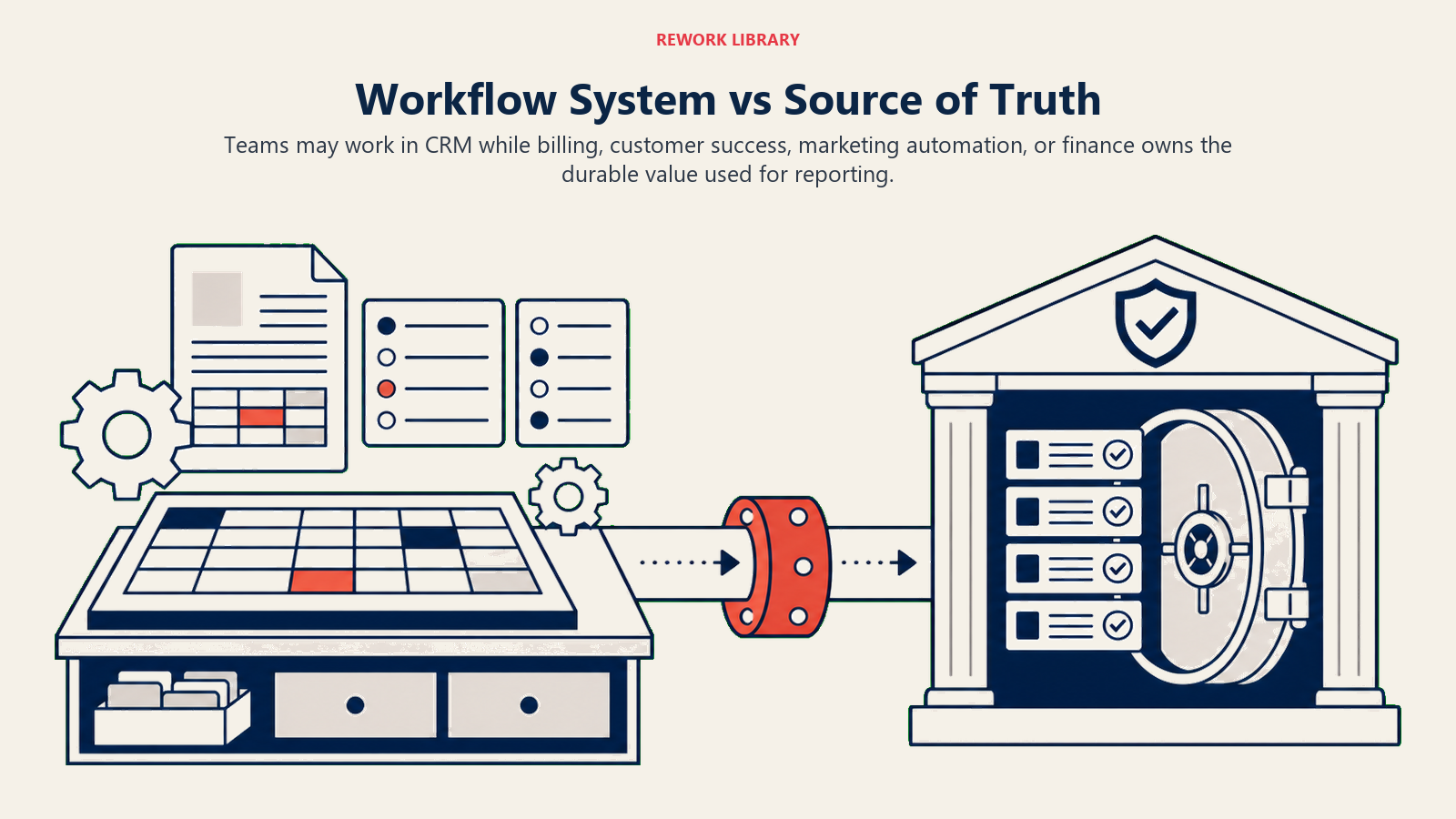
Separate the place people work from the place the official value lives.
Turn this article into takeaways for your work.


Each assistant summarizes the article only for you and suggests best practices for your work.
| Question | Example answer |
|---|---|
| Where does sales manage the deal? | CRM |
| Where does finance trust subscription value? | Billing or finance system |
| Where does CS manage renewal risk? | CS platform or CRM |
| Where does marketing own campaign membership? | Marketing automation |
| Where do executives view combined revenue metrics? | Governed BI or board package |
This split avoids forcing one system to do every job. The CRM may be the workflow system for sales, but finance may still own the final revenue value. CS may manage health in a CS platform, while BI combines that health with renewal data for leadership.
System of record vs source of truth
The terms are related but not identical.
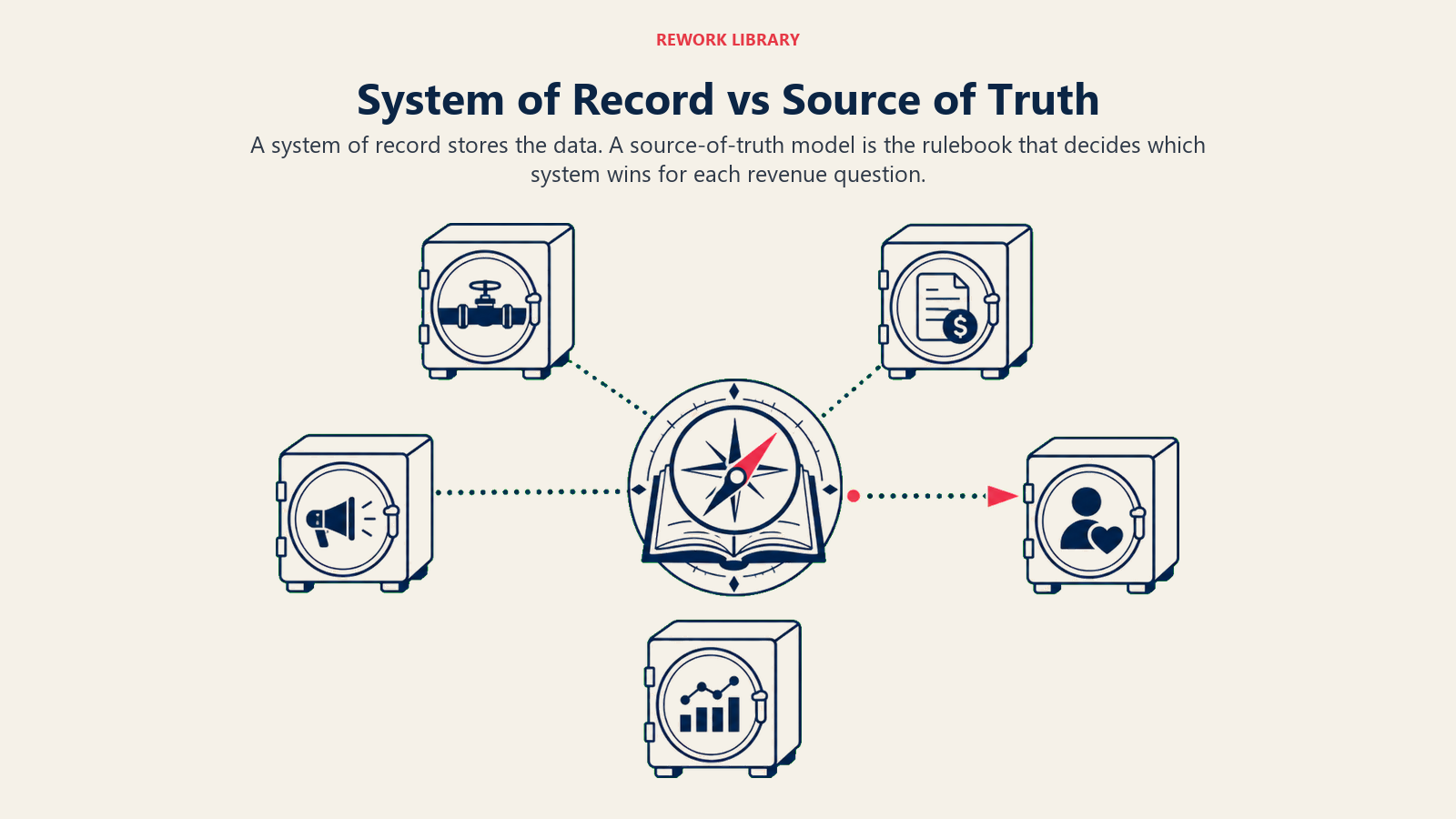
A system of record is the application or database that owns a specific type of data. A source-of-truth model explains which system wins for each business question.
For example:
| Question | Source of truth | System of record |
|---|---|---|
| Who owns this opportunity? | CRM opportunity owner | CRM |
| What is the current subscription amount? | Billing record | Billing system |
| What campaign created the lead? | Governed source field | Marketing automation or CRM |
| Is this customer at risk? | Health status model | CS platform or CRM |
| What revenue number goes to the board? | Finance-approved report | BI or finance reporting layer |
The source-of-truth model is the rulebook. The system of record is where the data lives.
Why one tool is not enough
Many teams want one tool to be the answer for everything. That usually fails.
The CRM is strong for accounts, contacts, opportunities, owners, activities, and pipeline, as long as duplicate record management keeps those objects from fragmenting. It may not be the best place for invoices, subscription schedules, usage telemetry, support tickets, product events, or financial close data.
RevOps should avoid forcing every fact into the CRM. Instead, it should define:
- Which system owns the fact
- Which fields sync into CRM for workflow
- Which fields sync into BI for reporting
- Which system can edit the value
- Which system is read-only
- How conflicts are resolved
This protects both usability and trust.
Architecture decision rules
Use these rules:
| Decision | Rule |
|---|---|
| Ownership | The team closest to the durable fact usually owns the system |
| Workflow | The system where action happens needs enough context |
| Reporting | BI can combine data, but definitions must be governed |
| Finance | Financial metrics need finance-approved rules |
| Customer context | CS data should connect to renewal and expansion reporting |
| Source data | Marketing and RevOps must agree on capture and edit rules |
The goal is not purity. The goal is reliable work.
CRM as operating core
For most B2B teams, the CRM is the operating core.
It usually owns:
- Account and contact records
- Opportunity records
- Owners and territories
- Pipeline stages
- Forecast categories
- Activities and tasks
- Lead routing and sales handoffs
- Closed-won handoff context
That does not mean CRM owns every revenue truth. It means CRM is where many teams coordinate action.
Workflow layer
Workflow is where many systems-of-record models break.
A field may be owned by billing, but sales may need to see it before renewal. A health signal may be owned by CS, but finance may need it for planning. A campaign field may be owned by marketing automation, but sales needs it for source context.
RevOps should define which facts are copied or surfaced into workflow systems and which remain in their original system.
BI and reporting layer
BI is often the best place for combined reporting, but BI should not become an unmanaged source of truth.
RevOps and finance should define:
- Which metrics are calculated in BI
- Which fields are imported from each system
- Which transformations are approved
- Which dashboards are executive source of truth
- Which caveats appear in reports
If BI logic differs from CRM dashboards without documentation, trust will fall.
Integration governance
Integrations can create data conflict.
Govern:
- Write direction
- Sync frequency
- Field mapping
- Conflict rules
- Error handling
- Owner of failed syncs
- Change approval
For example, if marketing automation and CRM can both edit lead source, the company needs a rule for which value wins. If billing and CRM both store contract amount, finance needs to define the planning value.
Rework context
A CRM and workflow platform like Rework can support RevOps when lifecycle stages, routing, tasks, ownership, and customer context are governed in one operating surface. The architecture still depends on clear process and data rules.
Rework should be treated as the work surface for customer and revenue motion when teams use it that way. But RevOps still needs to define which data comes from billing, marketing, CS, finance, or BI when those systems own the durable fact.
Common mistakes
Calling CRM the source of truth for everything. This creates bad fit for finance, billing, and product usage data.
Letting BI redefine metrics silently. Reports become disconnected from workflow systems.
No conflict rules. Two systems write different values and teams choose whichever supports their argument.
No integration owner. Sync errors become invisible until reporting breaks.
No data dictionary. People cannot find current definitions.
Implementation plan
Start with critical revenue questions:
- Where does account ownership live?
- Where does opportunity stage live?
- Where does forecast category live?
- Where does subscription amount live?
- Where does customer health live?
- Where does lead source live?
- Where does board reporting live?
Map each question to a system, owner, edit rule, and report.
Readiness checklist
Before publishing the model:
- Critical data elements are mapped.
- Edit rights are clear.
- Conflict rules are written.
- BI transformations are documented.
- Finance has approved financial definitions.
- RevOps owns change governance.
- Teams know where to inspect truth.
The system of record is working when teams stop exporting data to decide which system they believe.
Example architecture
A practical mid-market architecture might look like this:
| Workflow | Operating system | Durable record |
|---|---|---|
| Lead capture | Marketing automation and CRM | Lead or contact source data |
| Lead routing | CRM or workflow platform | Owner, SLA, status |
| Sales pipeline | CRM | Opportunity, stage, forecast |
| Contract and billing | Billing or finance system | Subscription, invoice, contract |
| Customer health | CS system or CRM | Health status, risk, adoption |
| Executive reporting | BI | Governed combined metrics |
The architecture works when each system has a job and the handoffs are governed.
Operating controls
RevOps should maintain controls around the architecture:
- Field ownership
- Integration ownership
- Write permissions
- Change approval
- Sync monitoring
- Error handling
- Report ownership
- Data dictionary updates
These controls prevent slow decay. Most system-of-record problems do not come from one large failure. They come from small unmanaged changes: a field added here, a workflow changed there, a sync error ignored for weeks.
System-of-record catalog
Create a catalog:
| Item | Description |
|---|---|
| System | Tool name |
| Business owner | Function accountable for business use |
| Technical owner | Person or team maintaining configuration |
| Data owned | Key objects and fields |
| Writes to | Downstream systems |
| Reads from | Upstream systems |
| Critical reports | Reports depending on this system |
| Risks | Known gaps or caveats |
This catalog helps new RevOps, systems, and finance leaders understand the architecture quickly.
Failure scenarios
Common scenarios:
CRM and billing disagree on ARR. Finance should define which number is used for planning and how CRM receives updated commercial context.
Marketing automation overwrites source. RevOps should lock original source or create strict update rules.
CS health lives outside revenue reporting. Renewal risk and expansion planning miss customer reality.
BI transforms metrics without documentation. Executive reporting becomes hard to reconcile with operational dashboards.
Integration errors are not monitored. Teams discover data gaps during board reporting.
Governance meeting
Run a monthly systems governance review for changes that affect revenue data:
- New fields
- New workflows
- Integration changes
- Dashboard definition changes
- Tool additions
- Write-permission changes
- Data-quality issues
This is not a tool request meeting. It is an architecture protection meeting.
Launch sequence
To build the model:
- Inventory systems.
- Map critical revenue questions.
- Assign source-of-record ownership.
- Identify write conflicts.
- Document integrations.
- Add data dictionary entries.
- Align finance and RevOps on reporting rules.
- Publish the model.
- Review monthly.
Launch sequence rule
The system-of-record model should make work easier, not slower. Teams should know where to enter data, where to inspect truth, and where to escalate conflicts. If the model only lives in architecture diagrams, it will not change behavior.
Ownership matrix
The system-of-record model should include an ownership matrix:
| Area | Business owner | Technical owner | RevOps role |
|---|---|---|---|
| CRM objects | Sales or RevOps | CRM admin or systems | Governance and workflow design |
| Marketing data | Marketing Ops | Marketing systems | Source and lifecycle alignment |
| Billing data | Finance | Finance systems | Revenue reporting alignment |
| CS health | Customer success | CS Ops or systems | Renewal and expansion visibility |
| BI reporting | Finance or data | Data team | Metric governance and caveats |
This matrix avoids a common problem: everyone uses the system, but no one owns its quality.
What belongs in CRM
CRM should hold the data needed for revenue workflow:
- Account owner
- Opportunity owner
- Lifecycle stage
- Pipeline stage
- Forecast category
- Next step
- Close date
- Deal risk
- Closed-won handoff fields
- Renewal owner or renewal visibility
It should not necessarily hold every product usage event, invoice line, support ticket, or financial close adjustment. Those may belong elsewhere and sync only summarized context into CRM.
What belongs outside CRM
Some data should stay in specialist systems:
- Billing schedules
- Invoice status
- Product usage logs
- Support case history
- Contract documents
- Finance close data
- Detailed campaign engagement
The CRM may need a summary, link, or status, but not the entire data set.
Data movement rules
For every integration, document:
- Source object
- Target object
- Field mapping
- Sync direction
- Sync frequency
- Error owner
- Conflict rule
- Business impact if sync fails
This prevents integration ownership from becoming tribal knowledge.
Data movement rules operating examples
If CS health changes to high risk, CRM may need a renewal risk flag so sales and finance can see it. CS remains the owner of the health model, but CRM needs the workflow signal.
If billing updates subscription amount, finance remains the owner of the commercial truth. CRM may need the updated ARR for account planning, but not as the final financial system.
If marketing captures original source, RevOps should protect that value from casual edits because attribution and budget decisions depend on it.
Data movement checklist
Before rollout:
- System catalog exists.
- Critical fields have owners.
- Write directions are clear.
- Conflict rules are documented.
- Sync errors have owners.
- BI formulas are visible.
- CRM users know what to enter.
- Finance knows which numbers are official.
The system-of-record model is mature when teams use the right system because it is easier, not because RevOps keeps reminding them.
Practical warning
Do not redesign architecture only from a diagram. Inspect how work actually happens. Where do reps update deals? Where does CS record risk? Where does finance trust contract values? Where does leadership inspect performance?
The architecture should follow durable ownership and real workflow. If a model looks clean but forces teams into awkward workarounds, it will fail.
Risk checklist
Before calling the architecture done, confirm that every critical revenue question has an answer:
- Where is the value entered?
- Who can edit it?
- Which system wins?
- Where does it appear in workflow?
- Where does it appear in reporting?
- Who fixes it when it breaks?
If any of those answers are unclear, the system-of-record model is not complete enough for scale.
The model should also be tested during onboarding. A new revenue leader should be able to understand which systems own pipeline, billing, customer health, source data, and executive reporting without asking five different teams. If onboarding still depends on tribal knowledge, the architecture needs clearer documentation.
Architecture decision packet
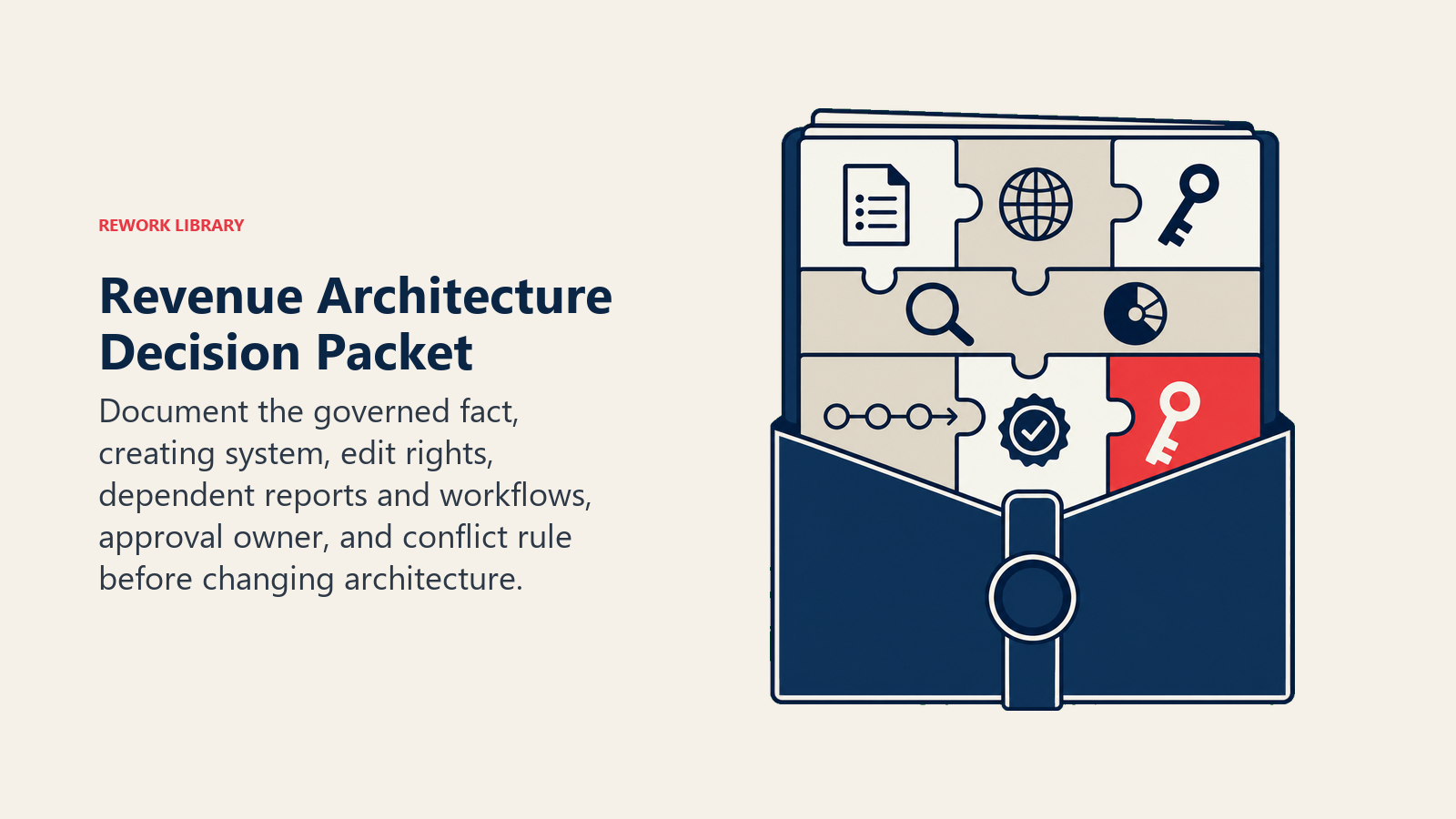
Before changing a revenue system of record, prepare a short packet:
| Question | Why it matters |
|---|---|
| Which business fact is being governed? | Prevents tool debates from replacing data ownership |
| Which system creates the fact first? | Identifies the system of creation |
| Which system is allowed to edit it? | Prevents conflicting updates |
| Which reports depend on it? | Shows downstream risk |
| Which workflows use it? | Shows operational impact |
| Who approves changes? | Creates clear decision rights |
| How will conflicts be resolved? | Prevents shadow logic |
The packet should be reviewed before adding integrations, changing CRM fields, or moving revenue data into a new platform. A system-of-record decision is not only a technical choice. It changes how teams trust, edit, and act on revenue data.
Frequently Asked Questions about Revenue Operations System of Record
Is CRM the system of record for revenue?
Often for pipeline and opportunity data, yes. But billing, CS, marketing automation, and BI may own other parts of revenue truth.
Who owns the system-of-record model?
RevOps should own it with finance, IT, marketing, sales, and CS input.
Learn more

Senior Operations & Growth Strategist
On this page
- Architecture layers
- Workflow vs truth
- System of record vs source of truth
- Why one tool is not enough
- Architecture decision rules
- CRM as operating core
- Workflow layer
- BI and reporting layer
- Integration governance
- Rework context
- Common mistakes
- Implementation plan
- Readiness checklist
- Example architecture
- Operating controls
- System-of-record catalog
- Failure scenarios
- Governance meeting
- Launch sequence
- Launch sequence rule
- Ownership matrix
- What belongs in CRM
- What belongs outside CRM
- Data movement rules
- Data movement rules operating examples
- Data movement checklist
- Practical warning
- Risk checklist
- Architecture decision packet
- Learn more