RevOps RACI: Ownership Matrix for Revenue Operations
RevOps breaks when everyone agrees the work matters but no one agrees who owns the decision.
Who approves a new lifecycle stage? Who owns the source field? Who decides whether a lead routing rule changes? Who resolves a dispute between marketing attribution and finance reporting?
A RevOps RACI answers those questions before they become political.
If you need the base model, see RACI Matrix and RACI vs RASCI vs DACI.
PMI describes RACI as a way to clarify responsibility and accountability so work does not fall between teams. In RevOps, that clarity matters because the work crosses marketing, sales, customer success, finance, data, and systems.
Forrester's RevOps responsibilities model is a useful reminder that RevOps is broad by nature. A RACI keeps that breadth from becoming ambiguity.
Key operating facts
- A RevOps RACI should map recurring decisions, not only project tasks. The hard questions are usually about definitions, data ownership, systems changes, forecast rules, handoffs, and executive reporting.
- Each decision needs one accountable owner. Shared input is healthy. Shared accountability often creates delay and political escalation.
- RevOps should not be made accountable for outcomes without authority. If RevOps owns data quality, it must be able to approve, reject, or escalate field and workflow changes.
- A RACI works best when it is paired with the hiring mandate. The first RevOps hire needs decision rights that match the ownership matrix.
What RACI means in RevOps
| Role | Meaning |
|---|---|
| Responsible | Does the work |
| Accountable | Owns the final decision or outcome |
| Consulted | Provides input before the decision |
| Informed | Needs to know after the decision |
RevOps often has to be accountable for the system even when another team is responsible for local execution.
The distinction matters. Sales managers may be responsible for coaching reps to enter next steps. RevOps may be accountable for the stage definition, required fields, dashboard rules, and inspection cadence that make those next steps useful. Finance may be consulted because the same opportunity data feeds planning.
That is why RevOps RACI design needs more care than a normal project RACI. The output is not just one project delivery. It is a standing operating model. Where decision rights land also depends on whether you run centralized vs embedded RevOps.
Core RevOps RACI
| Decision or process | Responsible | Accountable | Consulted | Informed |
|---|---|---|---|---|
| Revenue lifecycle definitions | RevOps | CRO | Marketing, sales, CS, finance | GTM teams |
| Lead source governance | Marketing Ops | RevOps | Finance, sales | Marketing and sales |
| Lead routing rules | RevOps or Sales Ops | RevOps | Sales managers, marketing | SDRs and AEs |
| MQL definition | Marketing Ops and RevOps | CMO and CRO | Sales, SDR leader | Marketing and sales |
| SQL acceptance criteria | Sales Ops and RevOps | VP Sales | Marketing, SDR leader | Sales and marketing |
| Opportunity stage criteria | Sales Ops | VP Sales | RevOps, finance | Sales team |
| Forecast category rules | RevOps | CRO | Sales, finance | Executive team |
| Closed-won handoff fields | RevOps and CS Ops | COO or CRO | Sales, CS | Sales and CS |
| Executive dashboard definitions | RevOps analytics | RevOps | Finance, GTM leaders | Executive team |
| CRM field changes | Systems owner | RevOps | Affected functions | Field users |
This table is a starting point. Adjust it to your company structure.

Turn this article into takeaways for your work.


Each assistant summarizes the article only for you and suggests best practices for your work.
How to build a RevOps RACI
Start with decisions, not departments.
A weak RACI begins with a list of teams and asks, "What does each team own?" That usually mirrors existing politics. A stronger RACI begins with the recurring decisions that create friction:
- What counts as a qualified lead?
- When can a deal enter stage 3?
- Who can create a new required field?
- Which report is the source of truth for pipeline?
- Who approves routing changes?
- Who decides forecast categories?
- What data must pass from sales to CS?
- Who owns churn reason taxonomy?
After listing decisions, assign roles.
For each decision, choose one accountable owner. Then identify who does the work, who must provide input, and who needs to be informed. If there are two accountable owners, stop and resolve it. Shared input is fine. Shared accountability usually means no one can make the final call.
Build the decision inventory first
The most useful RevOps RACI starts with a decision inventory.
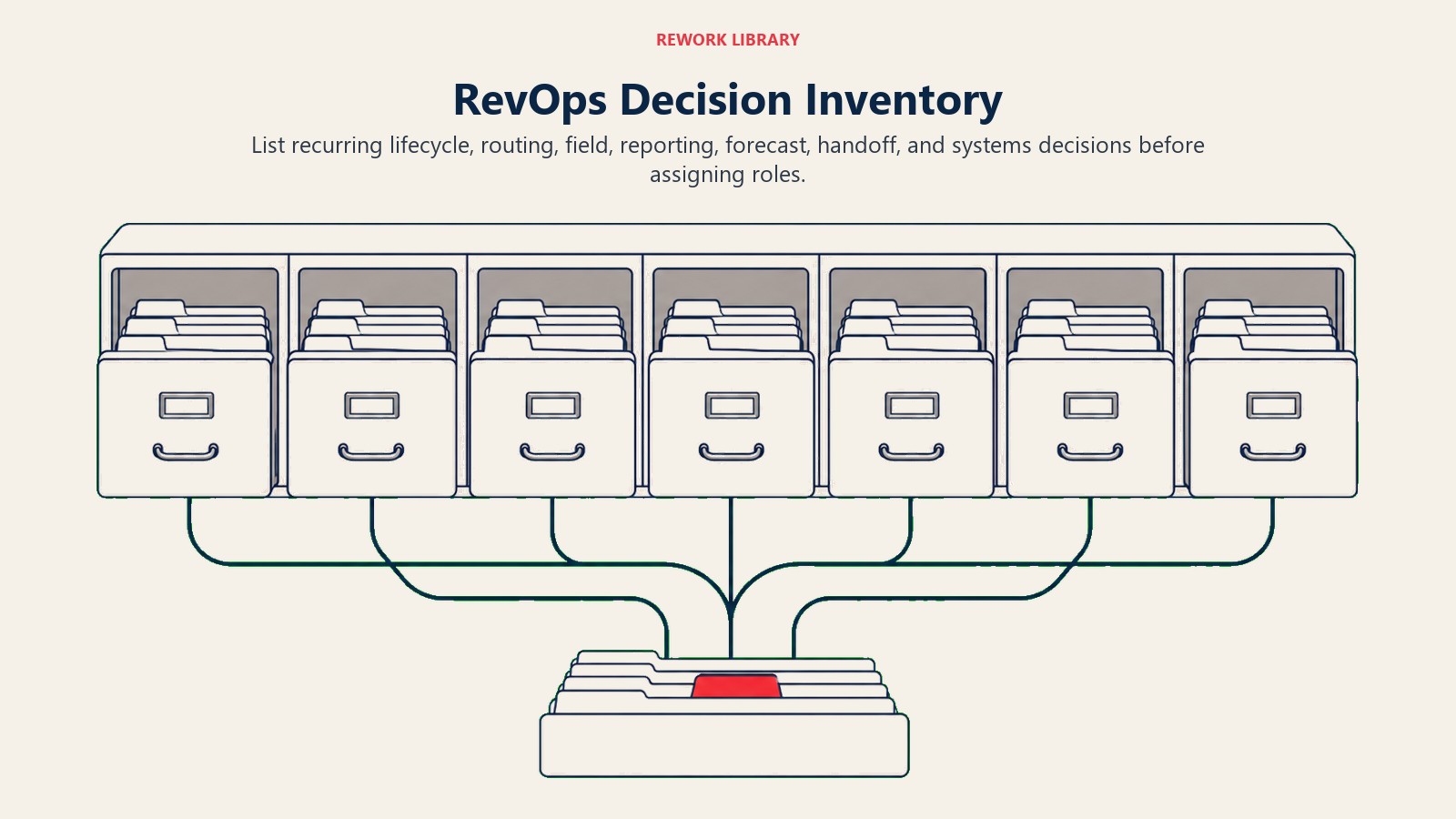
List the recurring decisions that create confusion:
| Decision area | Example decision | Why it needs RACI |
|---|---|---|
| Lifecycle | What makes a lead become MQL or SQL? | Affects marketing, sales, reporting, and finance |
| Routing | Which owner receives a lead when account ownership and territory conflict? | Affects response time and rep fairness |
| Data fields | When should a CRM field become required? | Affects user burden and reporting quality |
| Forecast | What evidence is required for commit? | Affects leadership confidence and planning |
| Handoff | What must be complete before CS accepts a closed-won deal? | Affects onboarding and customer trust |
| Dashboards | Which metric definition reaches executives? | Affects board reporting and management decisions |
| Automation | Who approves a workflow that changes owner or status? | Affects system behavior and user trust |
The inventory should be based on real friction, not theoretical completeness. Pull examples from the last quarter: disputed reports, failed handoffs, messy field requests, forecast disagreements, routing exceptions, and dashboard rebuilds. Those are the decisions the RACI should clarify first.
Once the inventory exists, group decisions by risk. Low-risk decisions can move quickly with RevOps and a systems owner. High-risk decisions need finance, functional leadership, or executive approval.
| Risk level | Example | Decision model |
|---|---|---|
| Low | Rename a report view or clean field help text | RevOps decides, users informed |
| Medium | Add a workflow alert or optional field | RevOps accountable, affected teams consulted |
| High | Change forecast category definition or required handoff fields | Executive or functional owner accountable, RevOps governs process |
| Critical | Change revenue metric used in board reporting | Finance and revenue leadership approve, RevOps documents and implements |
This risk view keeps the RACI from slowing down every small change. It also prevents high-impact changes from happening through casual requests.
RACI by revenue lifecycle
A helpful RevOps RACI maps ownership across the lifecycle:
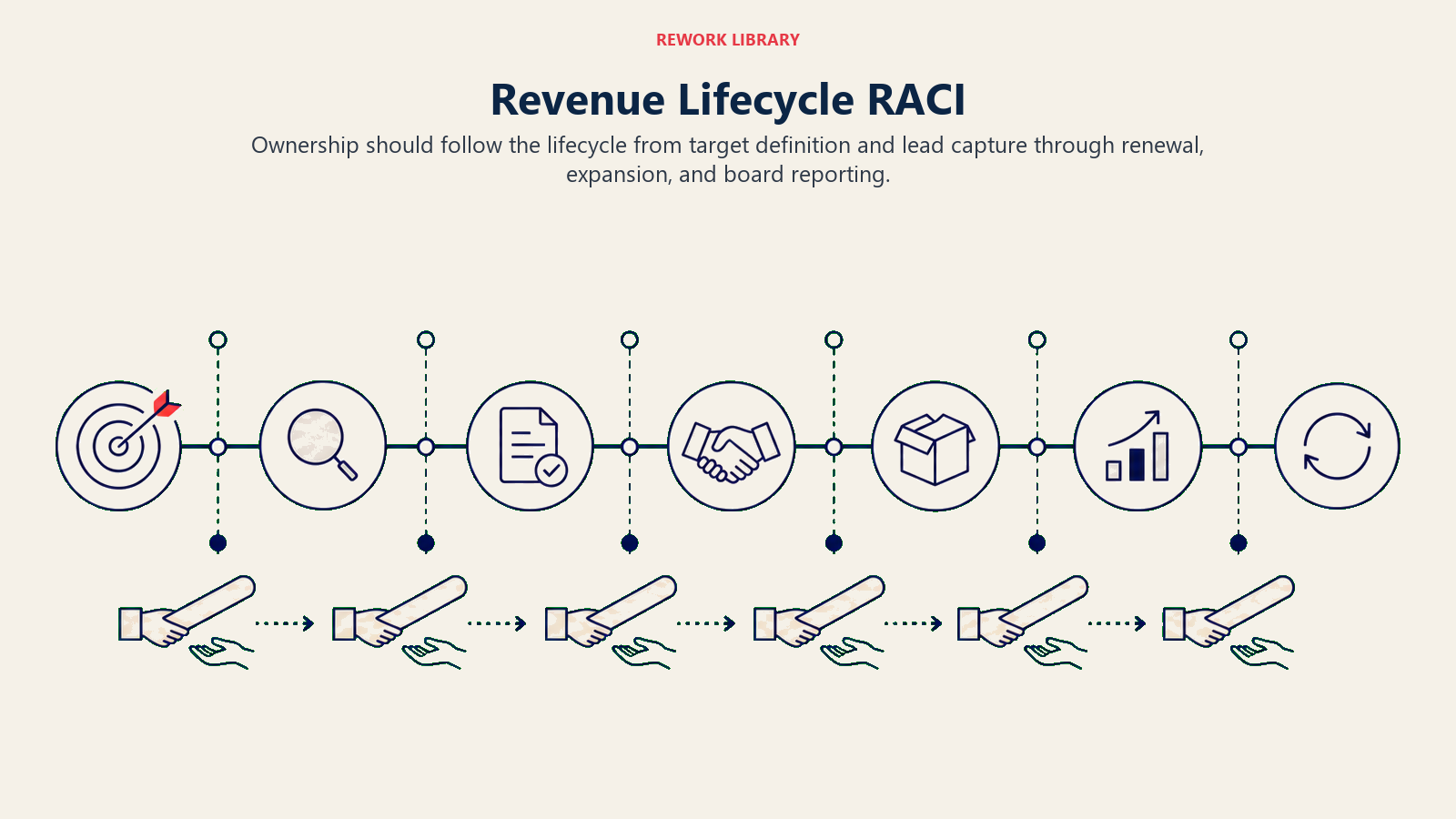
| Lifecycle area | Accountable owner | RevOps role |
|---|---|---|
| Target account definition | Marketing or GTM leader | Consulted on data model and segmentation |
| Lead capture | Marketing Ops | Consulted on source and attribution fields |
| Lead qualification | CMO and CRO | Responsible for shared definition governance |
| Lead routing | RevOps | Accountable for routing logic and SLA reporting |
| Opportunity creation | Sales leadership | Consulted on required criteria and field design |
| Opportunity stages | VP Sales | Consulted or responsible for process governance |
| Forecast process | CRO | Responsible for cadence, data quality, and rules |
| Closed-won handoff | RevOps or COO | Accountable for workflow and completeness |
| Renewal forecast | CS leader or CRO | Consulted on data model and reporting |
| Expansion pipeline | Sales or CS leadership | Responsible for trigger rules and reporting |
This view helps leaders see why RevOps cannot be only a sales support function. The same operating system spans the full journey.
RACI for CRM and reporting changes
CRM changes are where vague ownership becomes expensive.
Use a separate RACI for systems changes:
| Change type | Responsible | Accountable | Consulted | Informed |
|---|---|---|---|---|
| New field | Systems owner | RevOps | Requesting team, finance if metric-related | Affected users |
| Required field | RevOps | RevOps and functional leader | Sales managers, CS managers, systems | Field users |
| Workflow automation | Systems owner | RevOps | Affected functions, IT/security | Managers and users |
| Dashboard metric | RevOps analytics | RevOps | Finance, GTM leaders | Executive team |
| Integration | Systems or IT | Systems leader | RevOps, data, affected function | Users and leaders |
| Object model change | Systems and RevOps | RevOps plus executive sponsor | Finance, data, affected leaders | GTM teams |
This prevents the most common mistake: letting any function change shared data structures for a local need.
Rules for resolving conflicts
Even a good RACI will not remove every conflict.
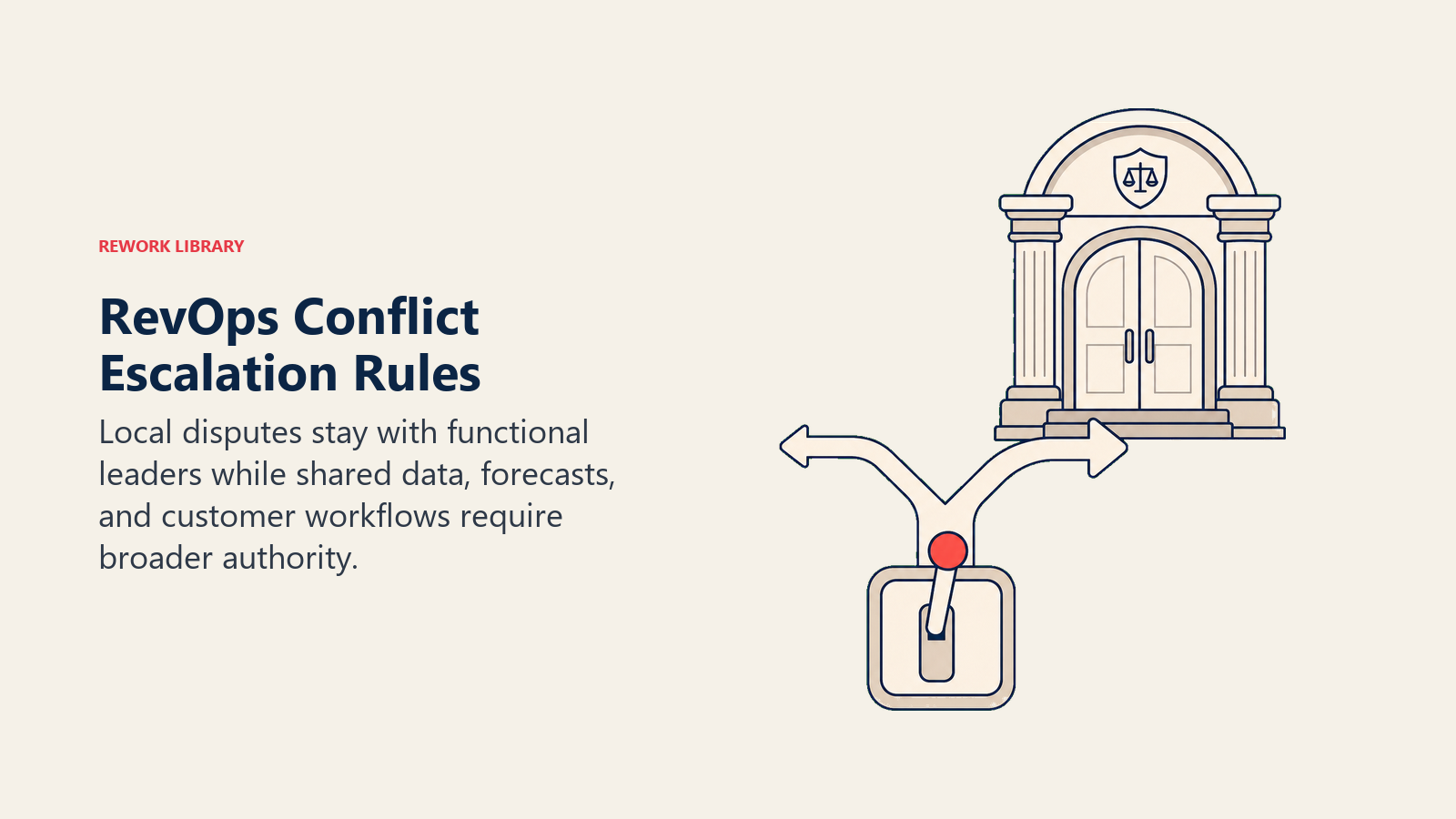
Add escalation rules:
- If the dispute affects only one function, the functional leader decides.
- If the dispute affects shared data, RevOps decides or recommends.
- If the dispute affects forecast, planning, or board reporting, RevOps and finance must align before launch.
- If the dispute affects customer experience across teams, the CRO or COO decides.
- If the dispute affects company-level tradeoffs, the executive sponsor decides.
Escalation rules matter because RevOps often sits between strong leaders with valid needs. The RACI should make the decision path visible before the conflict gets personal.
Rules for using the RACI
One accountable owner. Multiple consulted people are fine. Multiple accountable owners create deadlock.
Functional leaders still own performance. RevOps can own the system, but the sales leader still owns sales performance and the CS leader still owns retention execution.
Decision rights must match responsibility. Do not make RevOps accountable for data quality if it cannot enforce field governance.
Review after org changes. A RACI gets stale when teams, systems, or GTM motions change.
Common RACI mistakes
Too many accountable owners. This is the most common failure. If two leaders are accountable, neither has a clean mandate.
RevOps responsible but not empowered. Do not make RevOps accountable for data quality if it cannot reject low-value fields, change stage criteria, or enforce handoff rules.
Finance informed too late. If a metric appears in board reporting, finance should usually be consulted before definitions change.
Embedded ops teams follow different rules. Marketing Ops, Sales Ops, and CS Ops can stay close to their functions, but shared definitions need one governance model.
The RACI is not used in intake. If requests still arrive as "can you build this?", RevOps will become a ticket queue. Intake should ask which decision the request affects and who is accountable.
Review cadence
Review the RevOps RACI quarterly, and sooner after major changes.
Triggers include:
- New CRO, CMO, CS leader, CFO, or COO
- New GTM motion
- New CRM or major systems change
- Acquisition or business unit split
- Move from new-business focus to expansion focus
- Repeated disputes about the same ownership area
A RACI is not a static document. It is a working agreement. If leaders stop using it, ownership will drift back into informal power and repeated debate.
Meeting model
The RACI should be used in recurring operating meetings, not stored in a folder.
Use it in:
- RevOps roadmap review
- Systems change review
- Forecast governance review
- Funnel definition review
- Lead quality review
- Closed-won handoff review
- Dashboard definition review
Each meeting should answer the same ownership questions:
- Which decision are we making?
- Who is accountable?
- Who must be consulted before the decision?
- Who needs to be informed after the decision?
- What data or evidence is required?
- What changes in the system after the decision?
This makes the RACI practical. Leaders do not need to memorize a document. They need a habit of using ownership language when the revenue system changes.
Example: lead routing change
Suppose sales wants enterprise leads routed directly to senior AEs, while marketing wants them routed first to SDRs for qualification.
Without a RACI, this becomes a debate about preference.
With a RACI:
- RevOps is responsible for mapping routing logic and SLA impact.
- The CRO is accountable for the revenue workflow decision.
- Marketing, SDR leadership, sales managers, and finance are consulted.
- SDRs, AEs, and marketing campaign owners are informed after the change.
RevOps can then test the operating impact: response time, acceptance rate, conversion rate, owner capacity, and reporting changes. The RACI does not decide the strategy, but it makes the decision path clean.
Example: new required field
Required fields are a common source of friction.
Sales may resist because fields slow rep workflow. Marketing may want more segmentation data. CS may need handoff context. Finance may need cleaner reporting.
A RACI helps separate field value from field ownership:
- The requesting team is responsible for explaining the decision the field supports.
- RevOps is accountable for field governance.
- Systems is responsible for configuration.
- Affected managers are consulted.
- Users are informed with clear rollout notes.
RevOps should approve the field only if it supports a real decision or workflow. If the field only supports occasional curiosity, it should stay optional or move to a different capture point.
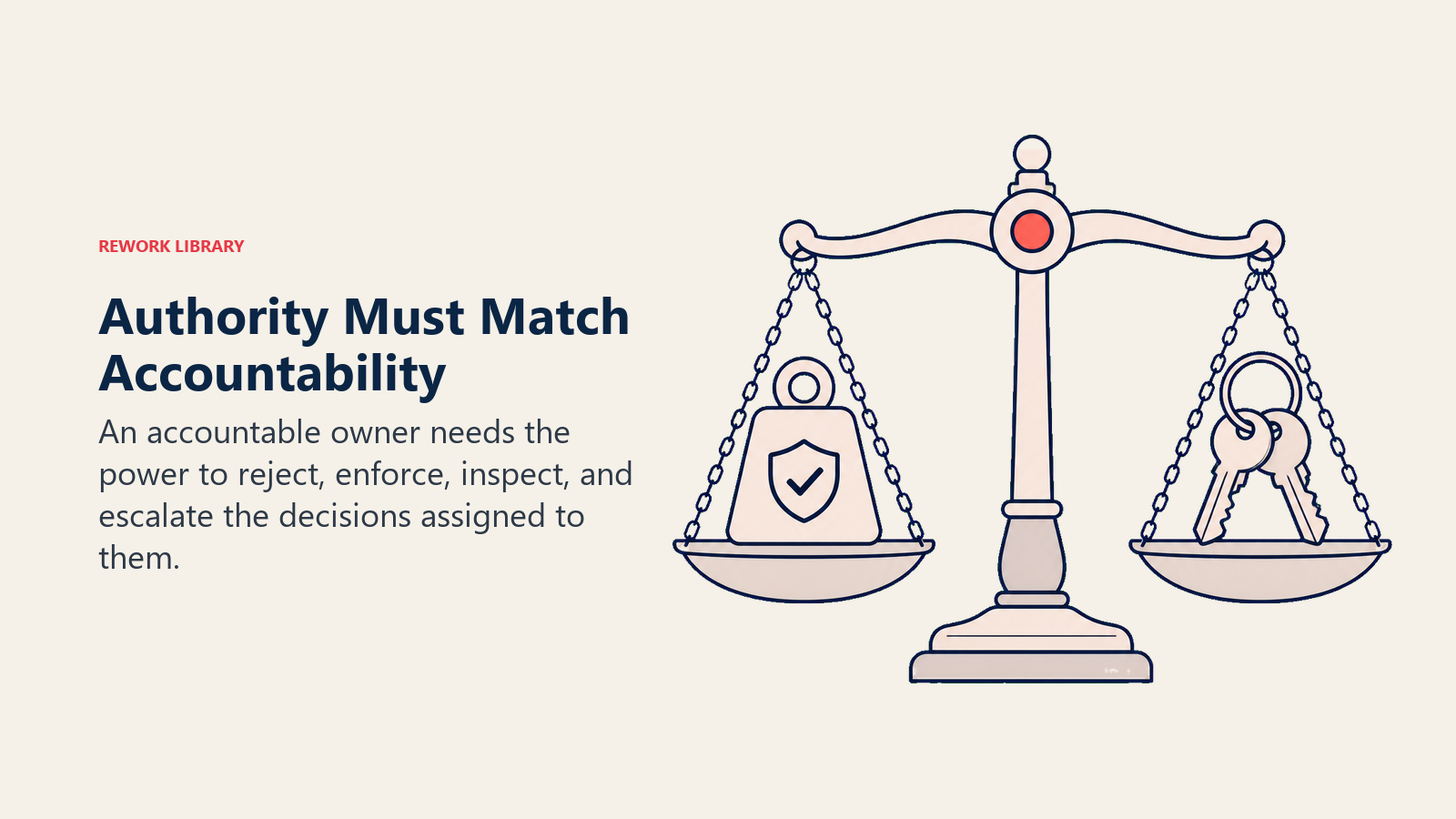
Authority must match accountability
A RACI can look clean on paper and still fail if authority is missing.
Common mismatches:
| RACI assignment | Missing authority |
|---|---|
| RevOps accountable for CRM data quality | RevOps cannot reject field requests |
| Sales accountable for stage accuracy | Managers do not inspect stage evidence |
| Finance consulted on board metrics | Finance sees definitions after dashboards are built |
| CS responsible for churn reasons | CS has no approved taxonomy or review rhythm |
| Marketing responsible for source quality | Source rules are overwritten during opportunity conversion |
Fix the authority gap before publishing the matrix. If RevOps is accountable for governance, leaders must accept that RevOps can pause low-value requests, require definitions, and escalate conflicts. If functional leaders own behavior, they must inspect it in their teams. If finance is consulted on planning metrics, finance needs a seat before the metric goes live, not after.
The RACI should also state what happens when the accountable owner does not decide. For example, if a lifecycle dispute blocks reporting for more than two weeks, the CRO or COO may need to make the final call. Without escalation, the RACI names ownership but does not resolve stalled decisions.
How RACI connects to the charter
The RevOps Charter defines the mandate. The RACI defines who acts inside that mandate.
Use the charter to answer, "Is this RevOps scope?"
Use the RACI to answer, "Who decides, who does the work, who gives input, and who gets notified?"
Together, they create operating discipline. Separately, they are weaker. A charter without a RACI is too broad. A RACI without a charter may clarify tasks but miss the purpose of the function.
Lightweight version for small teams
Small companies do not need a giant ownership matrix.
Start with five decisions:
- Lifecycle definitions
- Lead routing
- Opportunity stage rules
- Forecast categories
- Closed-won handoff requirements
For each, name one accountable owner and one RevOps role. That is enough to reduce confusion without slowing the company down.
As the company adds segments, motions, systems, and ops specialists, expand the RACI. The model should grow with complexity.
RACI readiness checklist
Before publishing the matrix, test it against recent conflicts.
Pick three real examples from the last quarter:
- A disputed lead definition
- A forecast rule change
- A dashboard metric disagreement
- A required field request
- A closed-won handoff failure
- A routing escalation
For each example, ask whether the RACI makes the decision path obvious. If leaders still cannot tell who is accountable, the matrix is not ready.
Also test whether the accountable owner has the authority to act. A RACI that assigns accountability without authority will create frustration. If RevOps is accountable for field governance, it must be able to approve, reject, or escalate field changes. If sales is accountable for stage accuracy, managers need an inspection cadence and consequences for poor hygiene.
The final test is usability. The RACI should fit on a few pages and be easy to scan. If the matrix is so detailed that no one uses it, start smaller and focus on the decisions that create the most revenue friction.
Once the matrix is live, reference it in every meaningful systems or process change. That repeated use is what turns ownership from a document into operating behavior and reduces repeated debate.
How to keep the RACI lightweight
The RACI should be detailed enough to resolve conflict, but not so detailed that no one opens it.
Use three levels:
| Level | What it covers | Review rhythm |
|---|---|---|
| Executive decisions | Forecast definitions, board metrics, lifecycle model, major system changes | Quarterly or when strategy changes |
| Operating decisions | Routing, handoffs, field governance, dashboard definitions, SLA rules | Monthly or through intake |
| Admin decisions | Report cleanup, field help text, view changes, minor workflow tuning | As needed |
This layered model helps small companies avoid over-process while giving larger teams enough control. A minor report cleanup should not require a steering committee. A change to forecast category definitions should not happen inside a ticket.
The best sign that the RACI is working is not that people cite it constantly. It is that fewer decisions stall because everyone already knows the path.
RACI intake questions
Use the RACI at the moment a request enters RevOps.
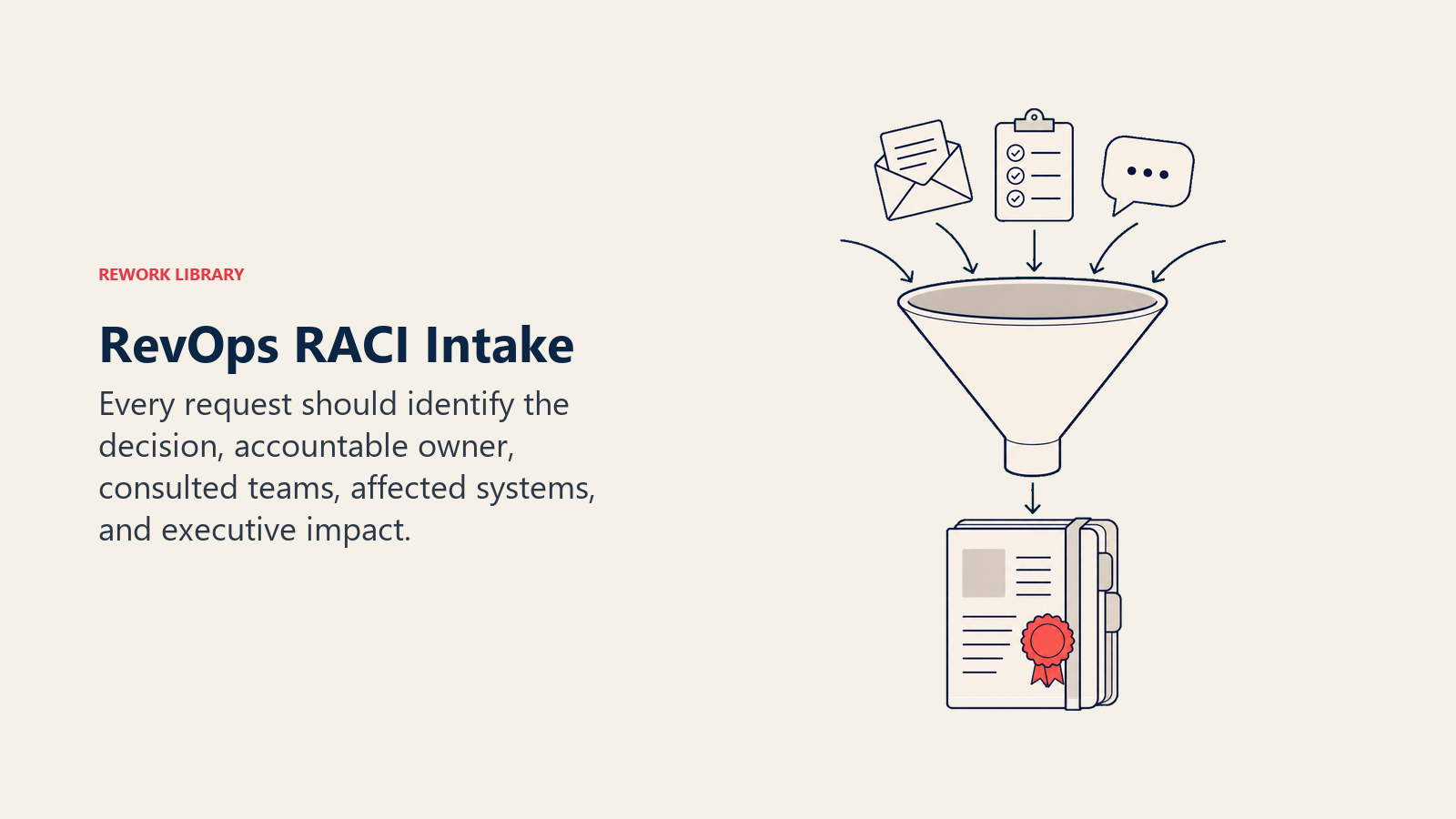
Instead of asking only "what do you need built?", intake should ask:
- Which business decision does this request affect?
- Which field, workflow, dashboard, or handoff changes?
- Who is accountable for the business outcome?
- Who needs to be consulted before implementation?
- Which teams need to be informed after launch?
- Does finance need to review the definition?
- Does the change affect executive reporting or forecast?
- What happens if the request is rejected or delayed?
These questions slow down weak requests before they become system work. A team asking for a new dashboard may not have a metric definition. A leader asking for a required field may not know who owns the value. A manager asking for a routing exception may not have considered capacity or reporting impact.
The intake process should not be heavy. It can be a short form or a checklist inside the RevOps backlog. The important part is that every meaningful request is tied to an accountable owner and a decision path.
This also protects RevOps capacity. Without intake discipline, the team spends time building local fixes that create shared complexity. With RACI-based intake, RevOps can explain why some requests move quickly, some need consultation, and some should not be built.
Signs the RACI is working
Look for behavior changes:
- Field requests arrive with owner, definition, and business reason.
- Dashboard disputes are resolved through agreed source-of-truth rules.
- Forecast rule changes include sales, finance, and RevOps before launch.
- Handoff failures lead to ownership changes, not only reminders.
- Teams know who decides before the meeting starts.
- RevOps spends less time mediating repeated debates.
The RACI is successful when decisions become faster and clearer. It should reduce meeting time, lower rework, and make escalation less personal.
RACI decision packet
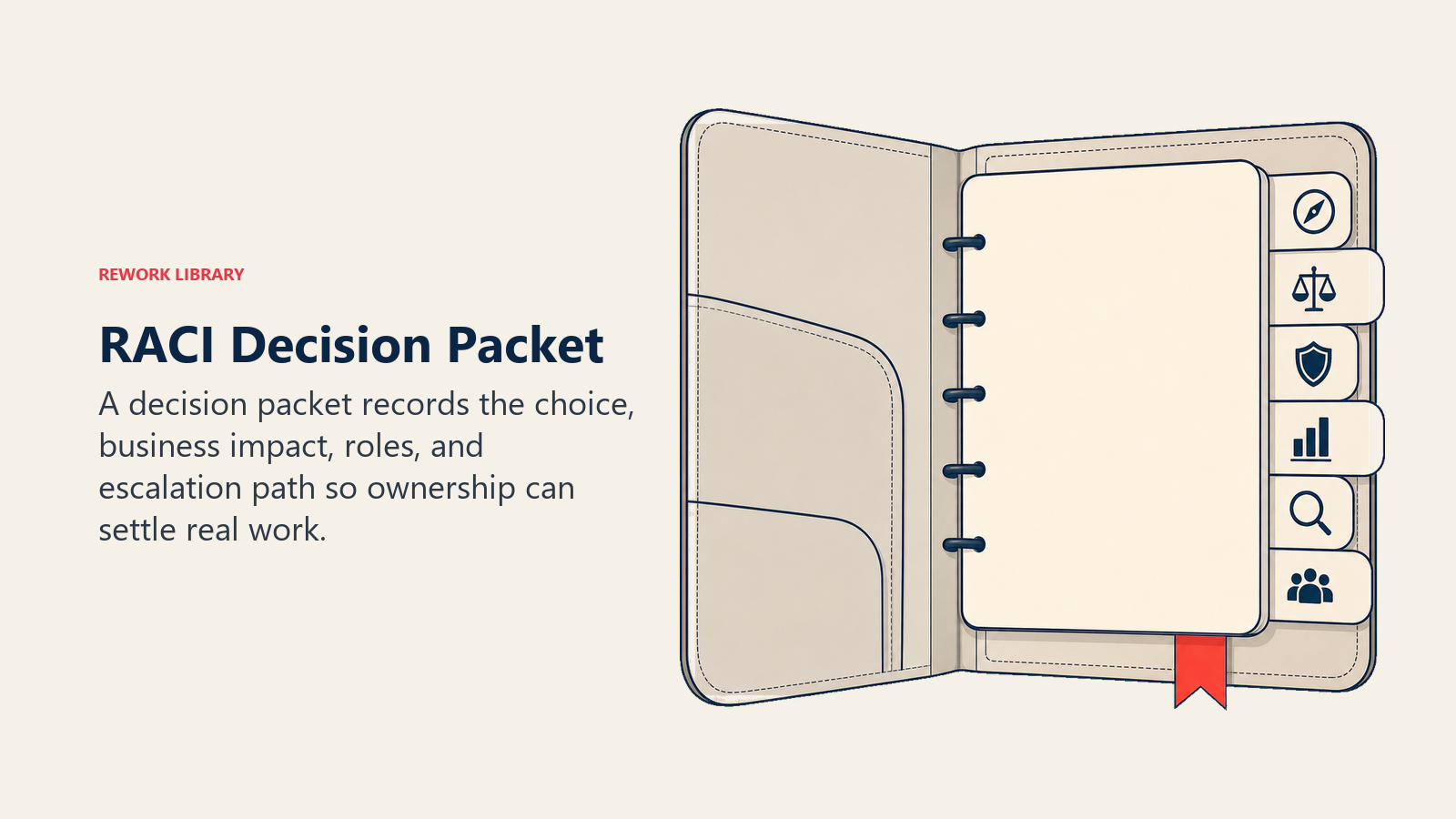
Use a decision packet when ownership is disputed.
| Item | What to capture |
|---|---|
| Decision | What needs to be decided |
| Business impact | Why the decision matters |
| Responsible | Who does the work |
| Accountable | Who owns the outcome |
| Consulted | Who must give input |
| Informed | Who needs visibility |
| Escalation | Who resolves conflict |
This prevents RACI from becoming a static document. It becomes useful when leaders use it to settle real operating decisions.
Frequently Asked Questions about RevOps RACI
Does RevOps need a RACI?
Yes, once multiple teams depend on the same revenue system. Without a RACI, handoffs and data ownership become informal.
Who should be accountable for forecast accuracy?
Sales leadership usually owns the forecast outcome. RevOps owns forecast process, definitions, data quality, and inspection cadence. Finance is a key consulted partner.
Is RACI enough for decision-making?
Sometimes. For high-stakes decisions, DACI may be better because it explicitly defines the decision driver and approver.
Learn more

Senior Operations & Growth Strategist
On this page
- What RACI means in RevOps
- Core RevOps RACI
- How to build a RevOps RACI
- Build the decision inventory first
- RACI by revenue lifecycle
- RACI for CRM and reporting changes
- Rules for resolving conflicts
- Rules for using the RACI
- Common RACI mistakes
- Review cadence
- Meeting model
- Example: lead routing change
- Example: new required field
- Authority must match accountability
- How RACI connects to the charter
- Lightweight version for small teams
- RACI readiness checklist
- How to keep the RACI lightweight
- RACI intake questions
- Signs the RACI is working
- RACI decision packet
- Learn more