Centralized vs Embedded RevOps: Which Operating Model Fits Your Company?
Centralized RevOps and embedded RevOps solve different problems.
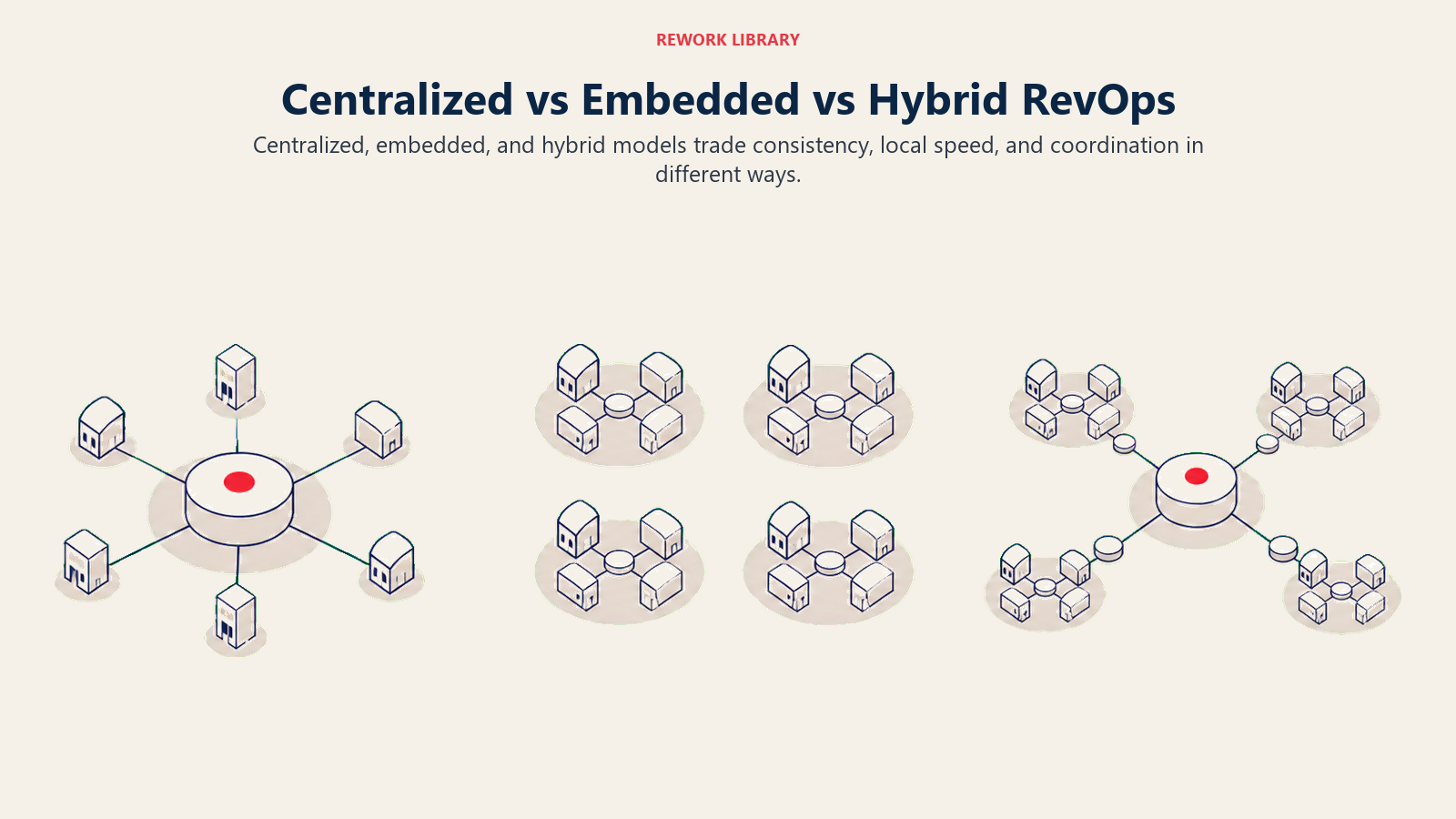
Centralized RevOps protects standards. Embedded RevOps protects context. Hybrid RevOps tries to preserve both.
The wrong choice creates either slow governance or fragmented execution.
For broader structure, start with RevOps Team Structure.
Forrester's RevOps organizational design research frames RevOps design as a cross-functional choice, not only a reporting-line decision. Forrester's RevOps technology alignment research also shows why operating model and tooling cannot be separated.
The org model determines how standards are set, how close operators sit to the work, and how quickly the company can change without breaking shared data.
Key operating facts
- Centralized RevOps protects shared standards, source of truth, and cross-functional governance.
- Embedded RevOps protects speed, local context, and functional adoption.
- Hybrid RevOps works when decision rights are explicit: central governance for shared definitions and systems, embedded support for local workflows.
- The best model depends on current operating risk. If definitions and dashboards are fragmented, centralize more. If central RevOps is too slow and teams create workarounds, embed more context.
The three models
| Model | How it works | Best for | Main risk |
|---|---|---|---|
| Centralized | One RevOps team serves all revenue functions | Standardization and source of truth | Bottleneck and distance from teams |
| Embedded | Ops specialists sit inside functions | Speed and functional context | Fragmented definitions and tool sprawl |
| Hybrid | Central governance plus functional partners | Scaling companies with complexity | Unclear decision rights |
Most companies move through more than one model. A founder-led team may start with one generalist. A growth-stage company may centralize to fix source-of-truth problems. A larger company may embed specialists near functions while keeping central governance.
Turn this article into takeaways for your work.


Each assistant summarizes the article only for you and suggests best practices for your work.
The mistake is treating the model as an identity. It should be a response to the company's current operating risk.
Diagnose the operating risk first
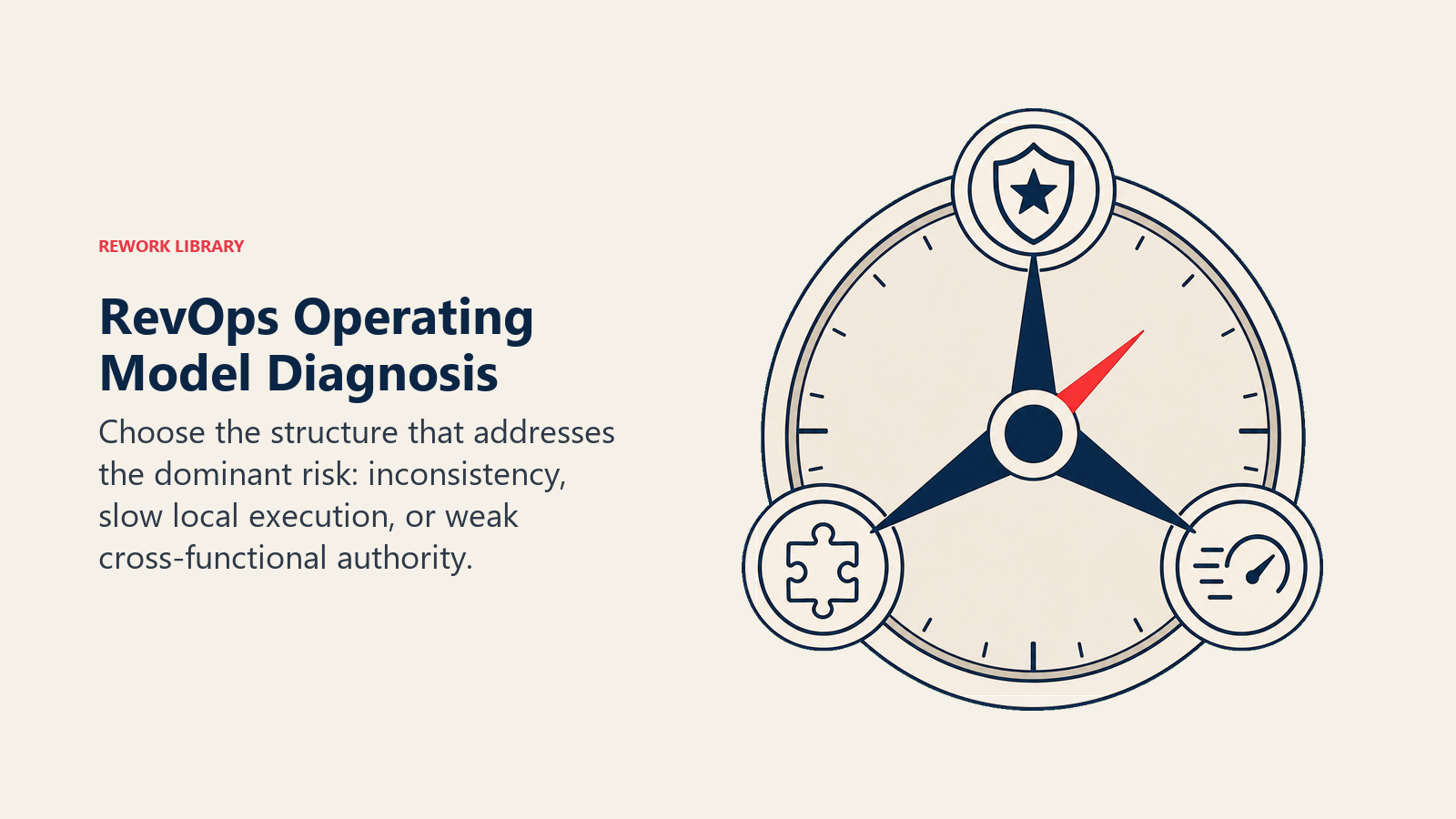
Start with the problem the model needs to solve.
| Operating risk | Model bias |
|---|---|
| Multiple dashboards disagree | More centralized governance |
| Functions create local workflows that break shared reporting | More centralized standards |
| RevOps backlog is slow and disconnected from daily work | More embedded support |
| Functional leaders bypass RevOps because context is missing | More embedded context |
| Company has multiple segments, motions, or regions | Hybrid with strong decision rights |
| Finance does not trust revenue reporting | Central governance with finance partnership |
| Managers need faster workflow support | Embedded or named functional partners |
This diagnosis prevents org design from becoming ideological. Centralized is not more mature by default. Embedded is not more agile by default. Either can work or fail depending on the problem.
The wrong model usually shows up as behavior. In a too-centralized model, teams create side spreadsheets and private workflows. In a too-embedded model, executives see conflicting definitions and duplicate tools. In a weak hybrid model, everyone says "shared ownership" but no one knows who decides.
Centralized RevOps
Centralized RevOps works well when the company needs one revenue operating system.
It is strongest when:
- Dashboards disagree.
- Tools are multiplying.
- Data quality is inconsistent.
- Marketing, sales, and CS need shared governance.
- Finance needs one trusted revenue view.
The risk is responsiveness. If every request goes through a central queue, teams may work around RevOps. That creates shadow systems.
Centralized model in practice
A centralized model usually has one RevOps leader and shared specialists:
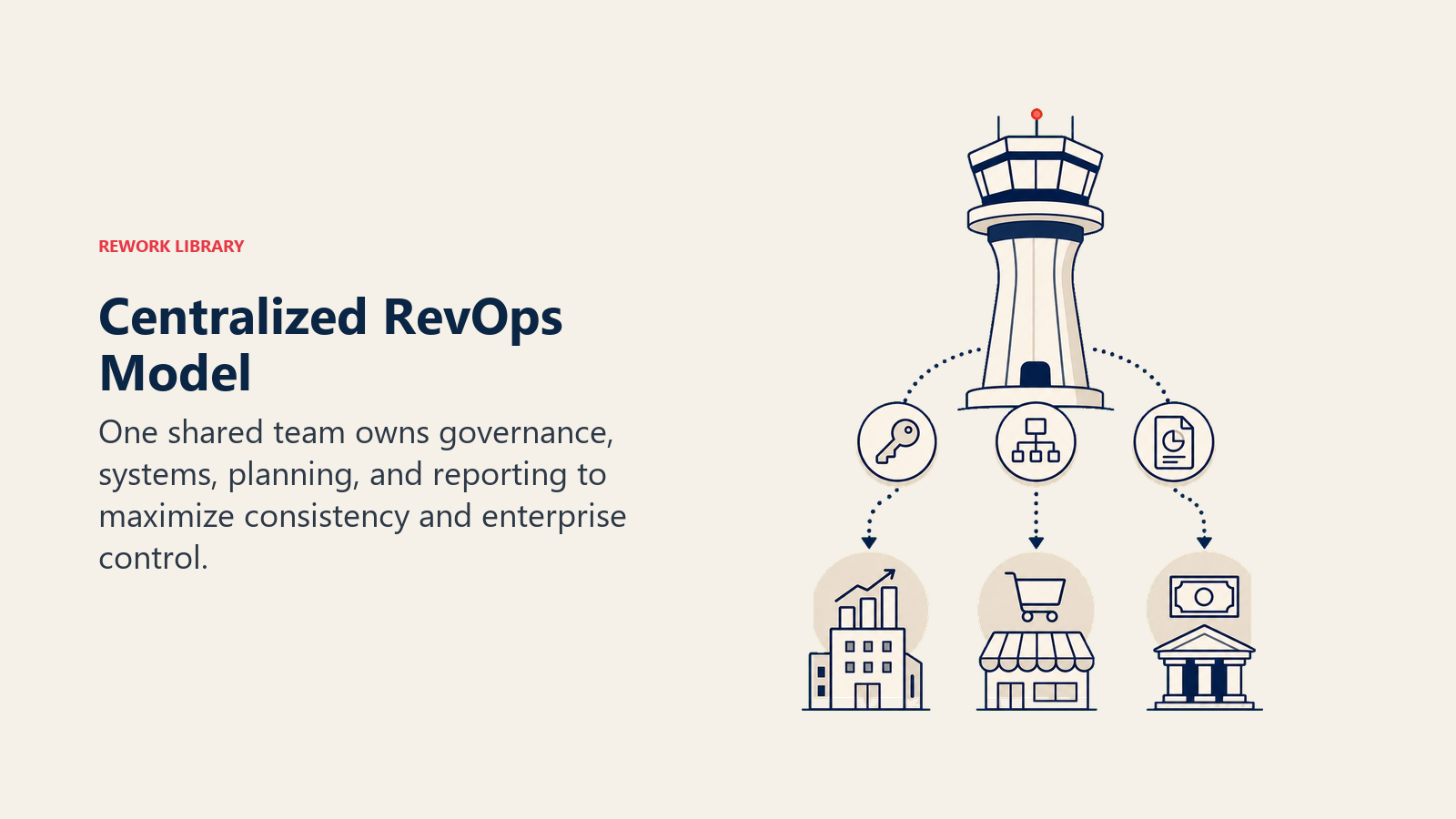
- CRM and systems
- Analytics and dashboards
- Process and governance
- Forecast operations
- Lifecycle and handoff design
Requests flow into a central roadmap. RevOps prioritizes based on company-level impact, not only functional urgency.
This model is strong when leaders need one source of truth. It helps prevent each team from creating its own fields, dashboards, workflows, and definitions.
But centralized RevOps can become too far from daily work. If sales managers feel RevOps does not understand rep workflow, they will build side spreadsheets. If marketing feels campaign context is lost, it will create separate reporting. If CS feels renewal process is ignored, it will manage risk in its own tools.
Centralized RevOps needs structured listening:
- Functional office hours
- Regular field feedback from managers
- Quarterly roadmap review with GTM leaders
- Clear intake rules
- Published service levels for common requests
Without that, centralization becomes control without context.
Embedded RevOps
Embedded operations works well when teams need speed and context.
A marketing ops partner understands campaigns deeply. A sales ops partner understands territories, quota, and rep workflow. A CS ops partner understands onboarding and renewal patterns.
The risk is fragmentation. Each function may optimize locally and damage the shared revenue system.
Embedded RevOps needs central standards for lifecycle definitions, fields, dashboards, and system changes.
Embedded model in practice
An embedded model places operators inside functions:
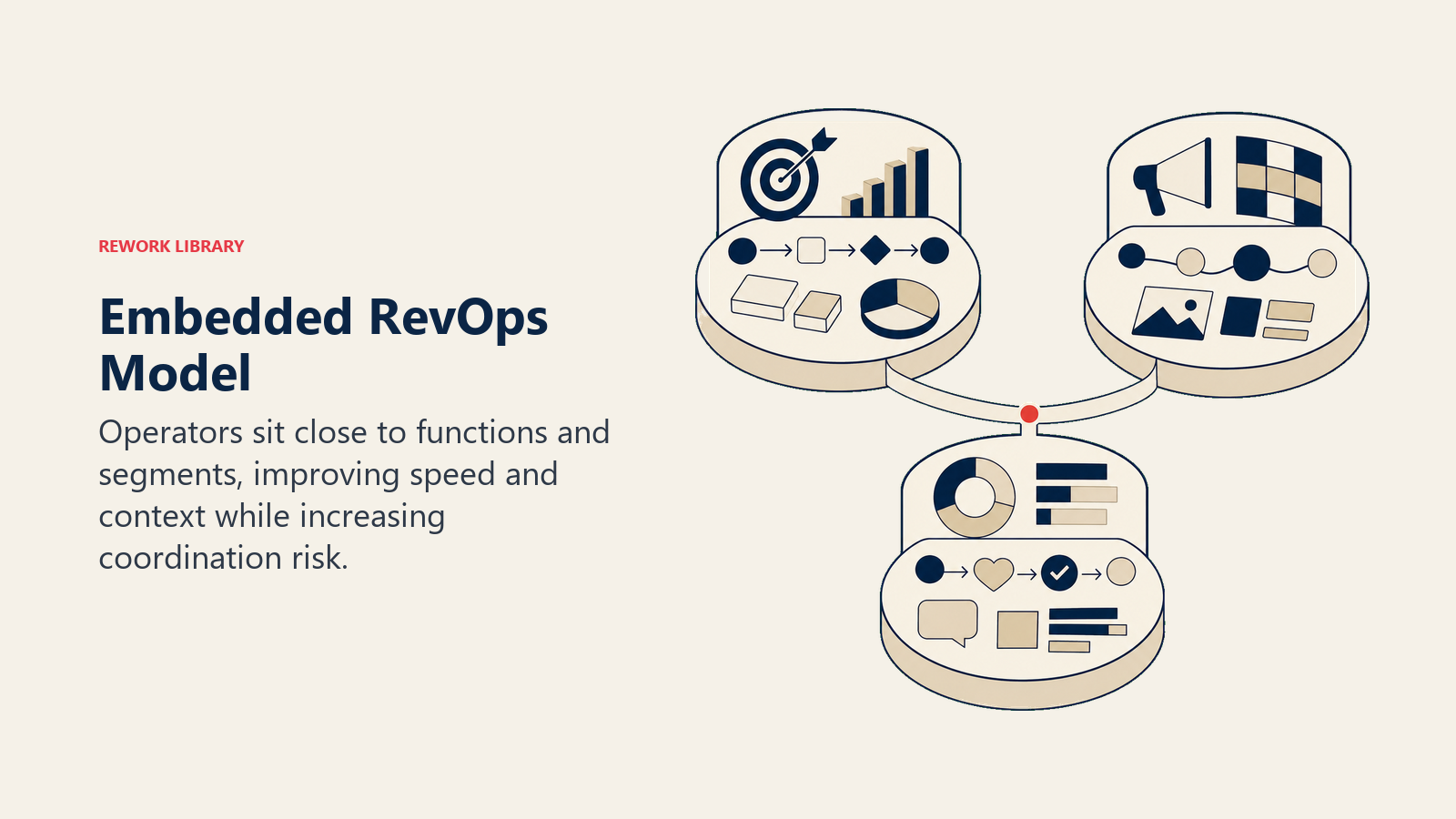
- Marketing Ops inside marketing
- Sales Ops inside sales
- CS Ops inside customer success
- Revenue analytics close to leadership or finance
The benefit is speed. Operators understand local details. A sales ops partner can see how reps actually work. A marketing ops partner can adjust campaign workflows quickly. A CS ops partner can tune health signals based on renewal conversations.
The risk is local optimization.
Marketing may define source fields for campaign reporting while finance needs bookings consistency. Sales may add fields for manager inspection while reps resist data entry. CS may build health categories that do not connect to forecast or expansion pipeline.
Embedded teams need a shared RevOps governance layer:
- Common lifecycle definitions
- Shared data dictionary
- Source-of-truth reporting rules
- Systems change process
- Cross-functional RACI
- Executive escalation path
Without that layer, embedded RevOps is not really RevOps. It is separate functional ops with a modern label.
Hybrid RevOps
Hybrid is usually the best model for mid-market companies.
Central RevOps owns:
- Revenue lifecycle
- Data dictionary
- Source of truth
- Systems governance
- Executive dashboards
- Operating cadence
Functional partners own:
- Marketing ops execution
- Sales ops execution
- CS ops execution
- Local workflow detail
- Functional reporting needs
The model only works if decision rights are written down in a RevOps RACI.
Hybrid model in practice
Hybrid RevOps is often the strongest model once the company has enough complexity to need both standards and context.
Central RevOps owns the operating architecture:
- Lifecycle model
- Data dictionary
- Governance cadence
- Executive dashboards
- Forecast process
- Systems change control
- Cross-functional roadmap
Embedded partners own local execution:
- Campaign operations
- Territory and quota support
- Sales workflow detail
- CS onboarding and renewal workflow
- Functional reporting needs
- Local adoption feedback
The model works when everyone knows which decisions are local and which decisions are shared.
For example, marketing can decide campaign naming conventions for internal use, but RevOps should govern the source fields that feed revenue reporting. Sales can manage rep workflow, but RevOps should govern stage definitions and forecast category rules. CS can manage health playbooks, but RevOps should govern which renewal and expansion signals enter revenue reporting.
How to choose
Choose centralized if trust and standardization are the main problems.
Choose embedded if speed and functional nuance are the main problems.
Choose hybrid if you need standardization without making every local request wait behind a central queue.
How to diagnose your current model
Ask these questions:
- Do teams use the same lifecycle definitions?
- Does finance trust the same dashboards as sales leadership?
- Can local ops teams change CRM fields without cross-functional review?
- Do managers know where to request systems changes?
- Are embedded operators measured only by functional speed?
- Does central RevOps understand daily workflow?
- Are tool decisions reviewed for downstream impact?
If standards are weak, move more authority to central RevOps.
If execution is slow and teams are creating workarounds, move more context closer to functions.
If both are true, the company likely needs a hybrid model with clearer decision rights.
Model by stage
| Stage | Better model | Why |
|---|---|---|
| Founder-led sales | No formal RevOps or one ops generalist | Too early for heavy governance |
| 3 to 10 sellers | Light central ownership | Basic CRM hygiene and pipeline visibility |
| Marketing plus sales engine | Central or hybrid | Handoffs and lifecycle definitions matter |
| Sales plus CS renewal motion | Hybrid | Acquisition and retention need one operating model |
| Multiple segments or regions | Hybrid with strong central standards | Local context and shared reporting both matter |
| Enterprise scale | Central architecture plus embedded specialists | Complexity needs both governance and proximity |
The model should change as the company changes. A structure that worked at 50 employees may fail at 200.
Decision-rights comparison
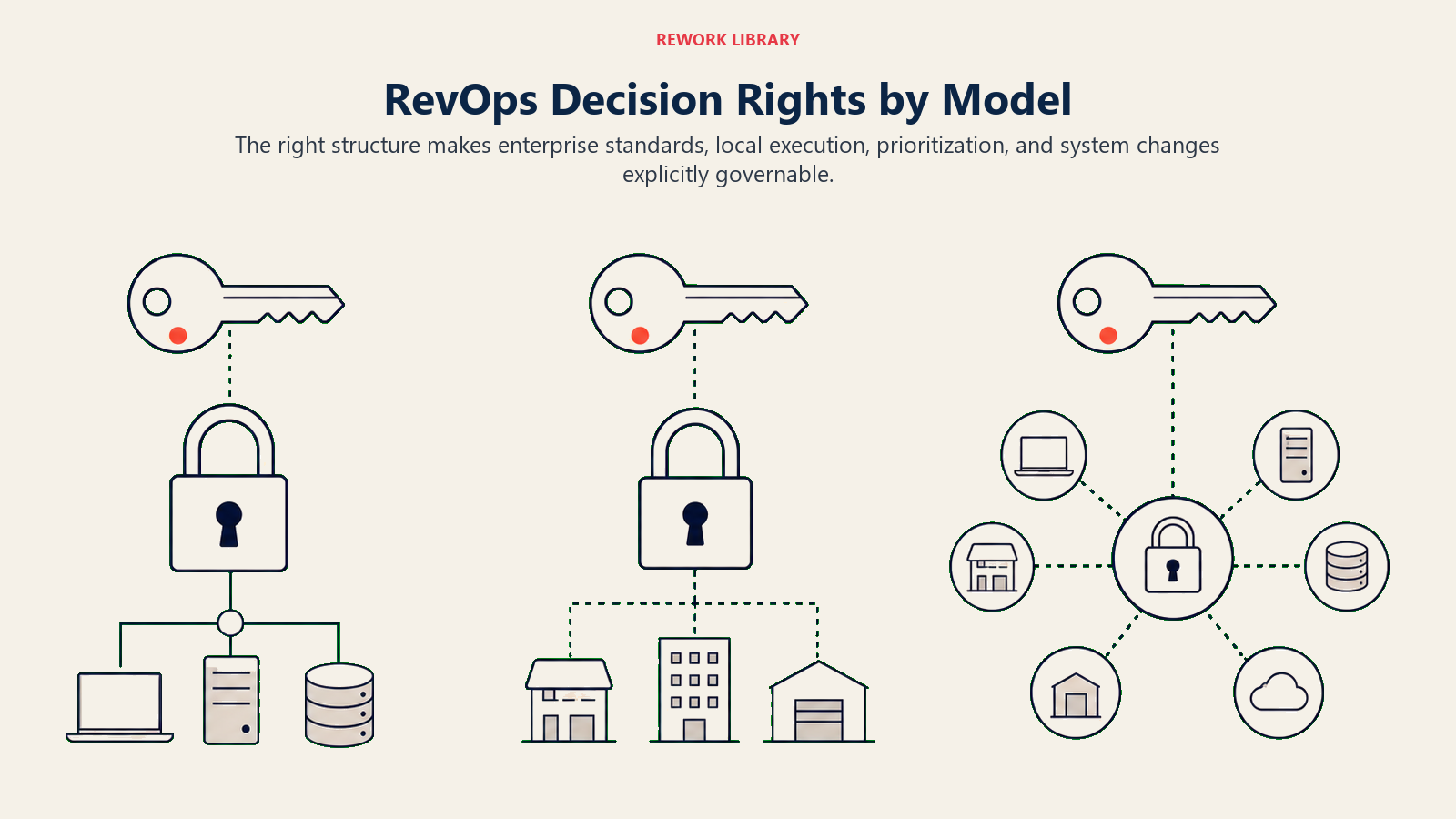
The real difference between models is decision rights.
| Decision | Centralized | Embedded | Hybrid |
|---|---|---|---|
| Lifecycle definitions | Central RevOps | Often fragmented | Central RevOps |
| Campaign workflow | Central review | Marketing Ops | Marketing Ops within standards |
| Sales stage rules | Central RevOps and sales | Sales Ops | Shared governance |
| CS health model | Central review | CS Ops | CS Ops within shared data model |
| Executive dashboards | Central RevOps | Risk of multiple versions | Central RevOps |
| CRM field changes | Central approval | Local requests may move fast | Central approval with local input |
| Tool selection | Central governance | Functional selection risk | Shared review |
This table is the heart of the choice. Reporting line matters less than who can change shared operating assets.
Anti-patterns
Centralized RevOps as ticket queue. The team becomes overloaded and distant. Functional teams build workarounds.
Embedded RevOps without standards. Each function moves fast, but the company loses a shared revenue view.
Hybrid RevOps without RACI. Everyone says the model is hybrid, but no one knows who decides.
Reporting line mistaken for operating model. RevOps can report to the CRO, COO, or finance and still operate centrally, embedded, or hybrid.
No finance involvement. Reporting and planning definitions drift away from operating dashboards.
The right model should reduce friction, not simply redraw the org chart.
Transition plan
If you need to change models, do it in stages:
- Audit where definitions, dashboards, fields, and workflows disagree.
- Decide which assets must be centrally governed.
- Identify which teams need embedded support.
- Write the RevOps charter and RACI.
- Move intake and roadmap review into a shared cadence.
- Update scorecards so operators are measured on both local service and shared system health.
Do not reorganize first and define ownership later. That creates months of confusion.
Scorecard by model
Measure the model by the problem it is supposed to solve.
For centralized RevOps, track:
- Dashboard trust
- Duplicate reporting reduction
- Data-quality improvement
- Systems change cycle time
- Forecast process consistency
- Cross-functional roadmap completion
For embedded RevOps, track:
- Functional request turnaround
- Adoption of local workflows
- Manager satisfaction
- Local process improvement
- Compliance with central definitions
- Number of workarounds created outside the system
For hybrid RevOps, track both:
- Shared definition compliance
- Functional speed
- Central roadmap delivery
- Local adoption
- Escalation volume
- Cross-functional dispute resolution time
If a centralized team is trusted but too slow, the model needs more embedded support. If embedded teams are fast but definitions are drifting, the model needs stronger central governance. If hybrid teams are confused, the issue is usually decision rights.
Reporting line vs operating model
Do not confuse reporting line with operating model.
RevOps can report to:
- CRO
- COO
- CFO
- CEO
- Chief Customer Officer
Any of those can work if the mandate is clear.
The operating model answers a different question: how does RevOps serve the business day to day?
A team can report to the CRO and still operate centrally across marketing, sales, CS, and finance. A team can report to the COO and still embed specialists inside functions. A team can report to finance and still own operating governance beyond reporting.
The danger is when the reporting line quietly narrows the mandate. If RevOps reports to sales and every decision favors sales speed over shared data quality, marketing, CS, and finance will stop trusting the function. If RevOps reports to finance and focuses only on reporting control, sales and marketing may see it as a compliance team.
The executive sponsor should protect neutrality. RevOps needs enough distance to govern shared systems and enough proximity to understand the work.
Practical recommendation
For many B2B SaaS and services companies between 50 and 500 employees, a lightweight hybrid model is the best starting point.
That usually means:
- One central RevOps owner
- Clear lifecycle and data governance
- Close partnership with marketing, sales, CS, and finance
- Named functional contacts instead of full embedded teams at first
- A monthly systems and reporting governance cadence
- A quarterly RevOps roadmap
As volume grows, the company can add embedded partners. Marketing may get a dedicated ops partner. Sales may get territory, comp, or enablement operations. CS may get CS Ops for health, renewal, and expansion workflows. But all of them should still follow one revenue operating model.
This keeps the company from overbuilding too early while preventing the fragmentation that appears when every team solves its own problems in isolation.
Readiness checklist
Before changing the model, check whether leaders agree on:
- Which revenue definitions are shared
- Which requests can be handled locally
- Which changes require central review
- Which dashboards are source of truth
- Which functional teams need closer support
- Which executive sponsor resolves tradeoffs
If those questions are unanswered, changing boxes on the org chart will not fix the operating problem.
Transition risks
Changing RevOps models creates risk if the company moves people before it moves decision rights.
Common transition risks:
| Transition | Risk |
|---|---|
| Embedded to centralized | Functional teams feel they lost service and create workarounds |
| Centralized to embedded | Shared definitions weaken and local tools multiply |
| Centralized to hybrid | Decision rights stay unclear and central team remains a bottleneck |
| Embedded to hybrid | Embedded operators keep old local habits without central standards |
Manage the transition with three artifacts: charter, RACI, and roadmap. The charter explains the mandate. The RACI explains who decides. The roadmap shows which shared problems the model will solve first.
Do not judge the new model only by short-term request speed. A move toward centralization may slow local requests at first while improving trust in shared reporting. A move toward embedded support may increase local speed while requiring stronger governance to prevent fragmentation. The operating metrics should match the reason for the change.
Model selection workshop
Run a short workshop before changing the model.
Agenda:
- List the top recurring RevOps conflicts from the last quarter.
- Mark each conflict as a standards problem, context problem, capacity problem, or decision-rights problem.
- Identify which assets must be centrally governed.
- Identify which workflows need closer functional support.
- Decide which decisions can be local and which need central approval.
- Update the charter, RACI, roadmap, and intake process.
This workshop keeps org design grounded in evidence. If the top issues are conflicting dashboards, duplicate fields, and finance distrust, the answer is not more embedded autonomy. If the top issues are slow support, poor manager adoption, and central RevOps missing workflow context, the answer is not more central control.
The model should solve the actual friction, not the friction leaders assume exists.
Model change trigger
Do not change the RevOps model only because another company uses a different structure.
Change the model when the operating evidence is clear:
| Signal | Possible change |
|---|---|
| Central RevOps is a bottleneck for local workflow work | Add embedded functional partners |
| Embedded ops teams create conflicting definitions | Centralize governance |
| Dashboards disagree across teams | Move metric definitions under RevOps |
| Functional teams bypass systems rules | Strengthen charter and change control |
| RevOps lacks day-to-day context | Add business partner coverage |
| Every request escalates to leadership | Clarify decision rights and intake |
The model should change to solve a specific operating failure. If the failure is unclear, fix the charter and intake first.
Frequently Asked Questions about Centralized vs Embedded RevOps
Is centralized RevOps better?
Not always. It is better for governance and source-of-truth problems. It can be worse for speed if the team becomes a bottleneck.
Is embedded RevOps really RevOps?
It can be, if embedded operators follow shared RevOps governance. Without shared governance, it is usually separate functional ops.
What model should a 100-person B2B company use?
Usually a lightweight hybrid: one RevOps owner with close functional support from marketing, sales, and CS.
Learn more

Senior Operations & Growth Strategist
On this page
- The three models
- Diagnose the operating risk first
- Centralized RevOps
- Centralized model in practice
- Embedded RevOps
- Embedded model in practice
- Hybrid RevOps
- Hybrid model in practice
- How to choose
- How to diagnose your current model
- Model by stage
- Decision-rights comparison
- Anti-patterns
- Transition plan
- Scorecard by model
- Reporting line vs operating model
- Practical recommendation
- Readiness checklist
- Transition risks
- Model selection workshop
- Model change trigger
- Learn more