Forecast Governance: How RevOps Improves Forecast Quality
Forecast accuracy is not only a sales judgment problem.
It is a system problem. Stage definitions, close dates, commit criteria, stale opportunities, manager inspection, CRM hygiene, and finance assumptions all affect whether a forecast can be trusted.
Forecast governance defines how the company creates, inspects, and improves that forecast.
Gartner has reported that fewer than half of sales leaders and sellers had high confidence in forecast accuracy. McKinsey's sales productivity research also points to the need for focused operating discipline rather than broad activity tracking.
Forecast governance is how RevOps turns that discipline into a repeatable operating system.
Key operating facts
- Forecast governance makes the forecast inspectable: categories, evidence rules, close-date hygiene, manager calibration, data caveats, and post-period review.
- Sales owns the commercial call. RevOps owns the process, definitions, packet, and data quality. Finance owns planning interpretation and should see caveats early.
- Commit should mean evidence, not confidence. Best case should mean possible with defined gaps, not wishful upside.
- Forecast quality improves through a learning loop: inspect before the call, decide during the call, calibrate after close, then update rules.
What RevOps governs
| Area | Governance rule |
|---|---|
| Forecast categories | Define commit, best case, pipeline, omitted |
| Commit criteria | Require evidence, not optimism |
| Close dates | Audit stale and repeatedly pushed dates |
| Stage criteria | Tie stages to buyer evidence |
| Inspection cadence | Separate cleanup from forecast judgment |
| Accuracy tracking | Compare forecast to actual over time |
Use Forecast Accuracy and Forecasting Fundamentals for deeper pipeline methodology.
Forecast categories
Forecast categories need clear definitions.
| Category | Meaning |
|---|---|
| Commit | Expected to close in period based on defined evidence |
| Best case | Possible to close, but evidence or timing is incomplete |
| Pipeline | Open opportunity not yet forecastable enough for best case |
| Omitted | Not expected to close in period or not relevant to forecast |
The exact names can differ. What matters is that every manager uses the categories the same way.
Evidence rules
Forecast governance should define evidence for movement.
For a deal to move into commit, the company may require:
- Clear business problem
- Economic buyer or approval path
- Mutual close plan
- Commercial terms understood
- Procurement or legal path known
- Close date tied to buyer process
- No hidden blocker
- Manager-reviewed next step
This connects to Commit Criteria.
Close-date governance
Close dates are one of the most important forecast fields.
RevOps should track:
- Close-date pushes
- Close-date age
- Deals closing this period with no recent activity
- Late-stage deals with old next steps
- Commit deals with repeated date movement
Repeated close-date movement is a forecast risk signal. It may show weak qualification, poor manager inspection, or buyer process uncertainty.
Forecast data packet
Before the forecast call, RevOps should prepare:
- Current forecast by category
- Change since last call
- Commit added, removed, or slipped
- Close-date movement
- Stage aging
- Large deal risks
- Missing data
- Prior forecast accuracy trend
The call should not start with data cleanup. It should start with judgment on known changes.
Ownership model
Sales owns the forecast number. RevOps owns process and data quality. Finance owns planning implications. The CRO owns final judgment.
This ownership split prevents forecast calls from becoming political. If sales owns everything, finance may rebuild the number. If finance owns the process, sales may see it as policing. If RevOps owns the commercial call, accountability gets blurred.
Forecast accuracy review
After each period, review forecast accuracy:
- Commit accuracy
- Best-case conversion
- Slippage
- Closed-lost from commit
- Upside not forecasted
- Manager or segment variance
The goal is learning. A missed forecast should produce an operating change, not only a post-mortem.
Common mistakes
Commit means confidence. It should mean evidence.
Forecast calls clean CRM. Cleanup should happen before the call.
Finance is excluded. Planning assumptions drift.
No accuracy review. The same forecast mistakes repeat.
Stage and category conflict. Late stage does not automatically mean commit.
Readiness checklist
Before rollout:
- Categories are defined.
- Commit criteria are written.
- Close-date rules are clear.
- Forecast packet exists.
- Sales, RevOps, and finance roles are clear.
- Accuracy review is scheduled.
- Data caveats appear in reports.
Forecast governance is working when the forecast call becomes shorter, clearer, and more evidence-based.
Ownership model detail
Sales owns the forecast number. RevOps owns forecast process and data quality. Finance owns planning implications. The CRO owns the final operating call.
When those roles blur, forecast calls become political.
The best governance gives each role a clear seat: sales judgment, RevOps evidence, finance planning, and executive decision.
Forecast governance cadence
Forecast governance needs more than the weekly call.
Use a cadence:
| Cadence | Purpose |
|---|---|
| Weekly | Review current forecast, changes, and risk |
| Monthly | Review forecast accuracy, slippage, and category behavior |
| Quarterly | Review forecast definitions, planning assumptions, and stage rules |
Weekly calls manage the number. Monthly reviews improve the system. Quarterly reviews update the operating model.
Data-quality gates
Forecast reports should flag:
- Missing close date
- Close date in the past
- Close date changed multiple times
- No next step
- Old activity on late-stage deal
- Missing forecast category
- Commit without required evidence
- High-value deal with unresolved risk
These flags help managers inspect before the call.
Forecast governance examples
Example: commit accuracy is low.
RevOps should inspect commit criteria, close-date movement, manager behavior, and lost commit reasons. The fix may be stricter commit rules, not a new forecast tool.
Example: finance discounts the sales forecast every quarter.
That signals trust gap. RevOps should compare sales call, finance scenario, and actuals. Then identify whether the gap comes from stage quality, close dates, manager judgment, or planning assumptions.
Example: best case never closes.
The category may be too optimistic. Redefine best case or create stricter evidence rules.
Forecast operating artifacts
Maintain:
- Forecast category definitions
- Commit criteria
- Forecast packet template
- Accuracy report
- Slippage report
- Decision log
- Data-quality caveat list
Artifacts make the process repeatable.
Forecast and finance
Finance should not be a spectator.
Finance needs:
- Forecast rollup
- Risk by segment
- Slippage trend
- Scenario assumptions
- Data caveats
- Changes from prior call
RevOps should make sure finance sees operating evidence early enough to adjust planning.
Post-period review
After the month or quarter closes, run a review:
- What did we call?
- What closed?
- What slipped?
- What was lost?
- What was upside?
- Which category was least reliable?
- Which manager or segment varied most?
- Which process rule should change?
This is where forecast governance improves.
Launch plan
To launch forecast governance:
- Define categories.
- Define commit criteria.
- Clean critical forecast fields.
- Build the forecast packet.
- Train managers.
- Run forecast calls with action log.
- Review accuracy after close.
- Adjust rules based on evidence.
Launch rule
Forecast governance is healthy when forecast misses create learning. If every miss is explained as "deal slipped" without changing criteria, inspection, or data quality, the system is not improving.
Forecast governance scorecard
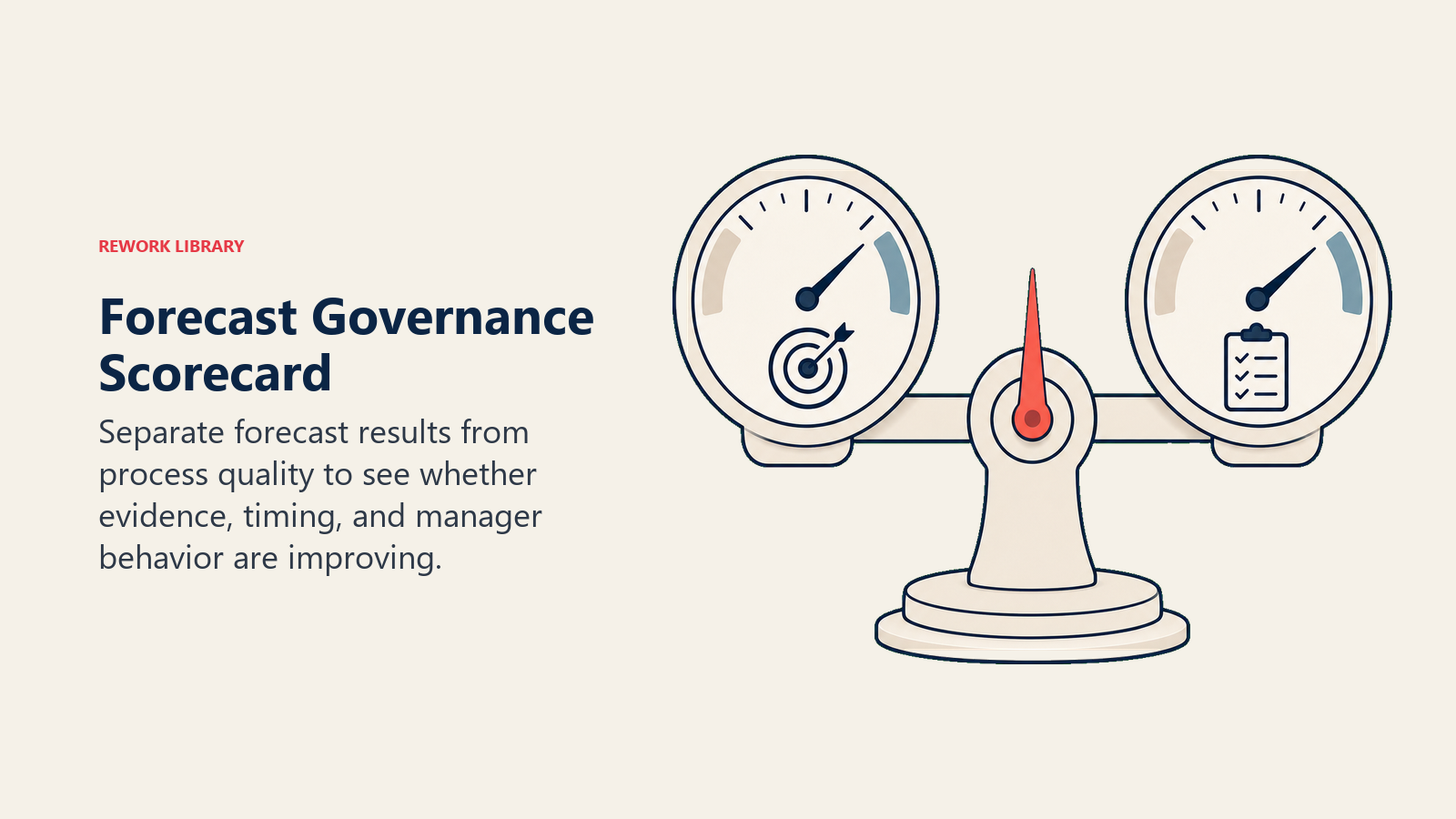
A governance program needs a scorecard that separates forecast output from process quality.
Turn this article into takeaways for your work.


Each assistant summarizes the article only for you and suggests best practices for your work.
| Metric | What it shows |
|---|---|
| Commit accuracy | Whether commit means what the company says it means |
| Best-case conversion | Whether upside is realistic or inflated |
| Slippage rate | Whether close dates are reliable |
| Date-push count | Whether timing is based on buyer process |
| Forecast change after call | Whether managers are updating late |
| Data caveat count | Whether the report is trusted enough for planning |
| Lost-from-commit reasons | Which evidence rules are weak |
The scorecard should not become another dashboard that leaders glance at once. It should be reviewed in the monthly post-period operating meeting. When commit accuracy improves, the team should know which behavior changed. When slippage rises, the team should know whether the issue is stage quality, buyer timing, legal delay, procurement delay, or manager inspection.
This makes forecast governance a learning loop instead of a reporting ritual.
Forecast category change rules
Forecast categories should not move without a reason.
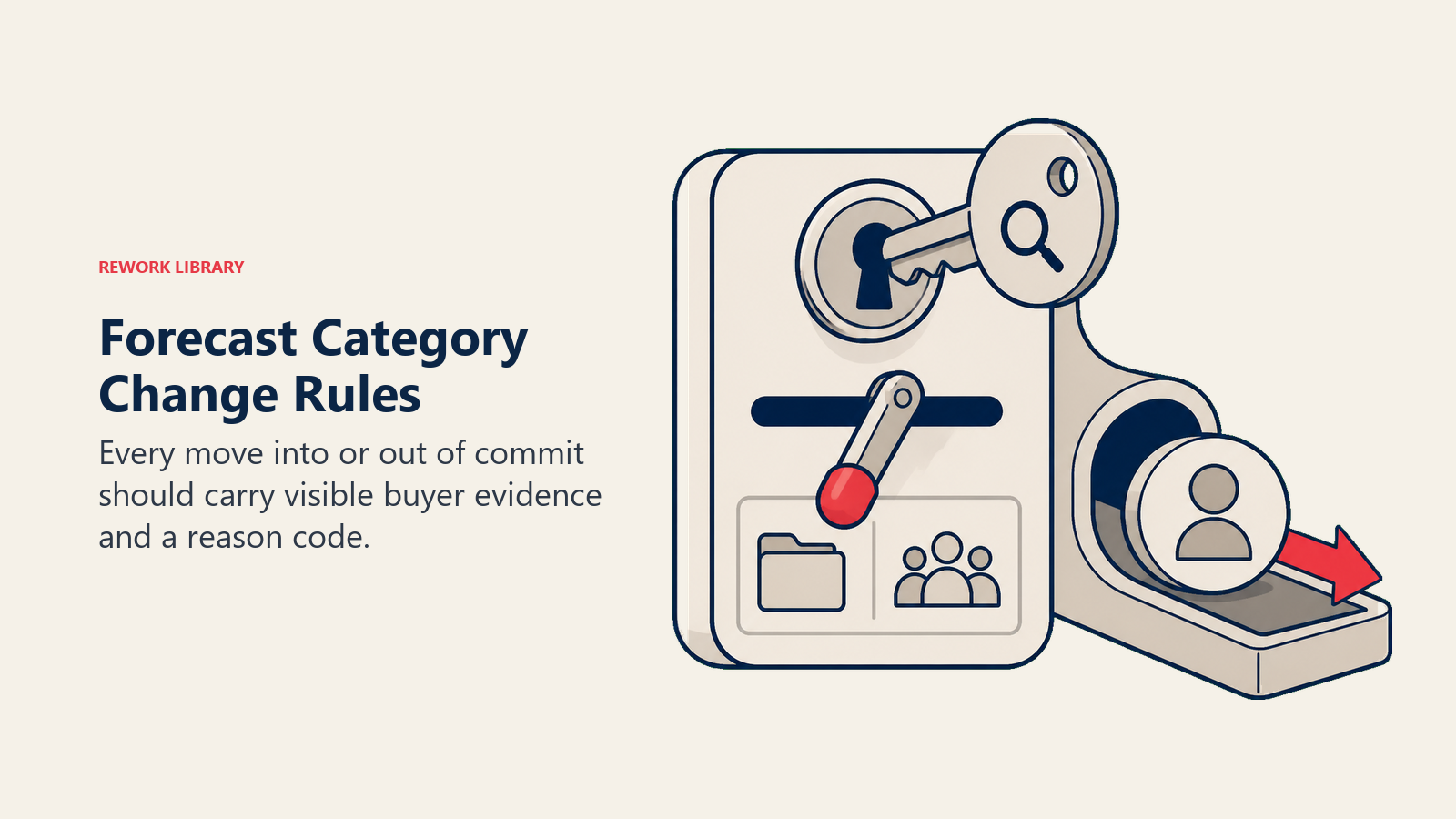
When a deal moves into commit, the manager should be able to point to the evidence that changed. When a deal moves out of commit, the reason should be visible enough for future review. When best case grows late in the period, RevOps should ask whether the movement represents real upside or an attempt to fill a gap.
Useful change reasons include:
- Buyer action confirmed
- Economic buyer engaged
- Procurement started
- Legal risk identified
- Commercial scope changed
- Decision timeline changed
- Budget risk appeared
- Champion lost influence
- Competitor risk increased
- Close plan became unclear
The reason list should be short enough for managers to use and specific enough for post-period analysis. Avoid vague reasons such as "timing" or "customer delay" when a more precise cause is known.
Manager calibration
Forecast governance often fails because managers use different standards.
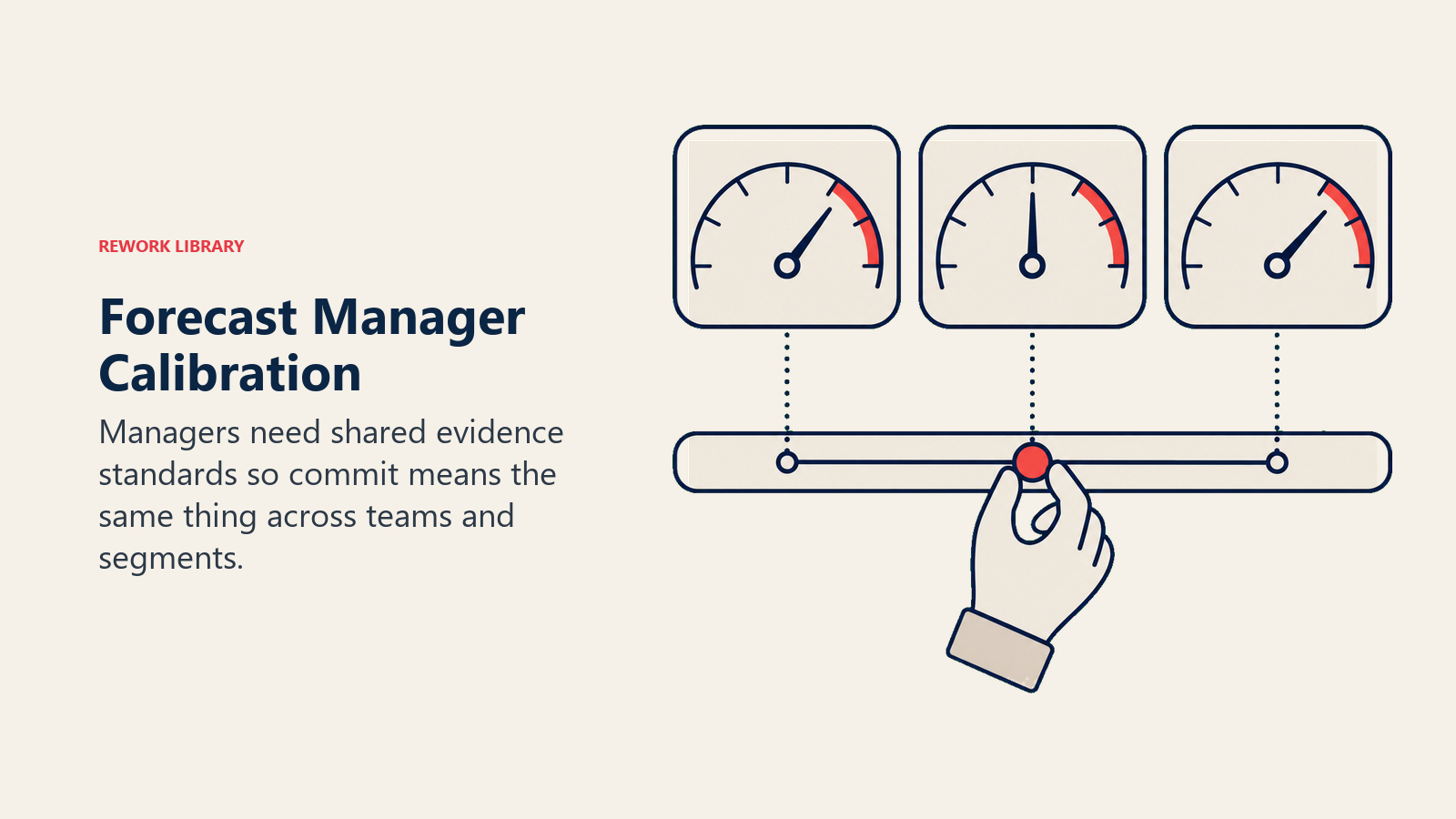
One manager may call a deal commit only when procurement is active. Another may call it commit when the rep has a strong champion. A third may avoid commit until paperwork is ready. Each manager may be acting in good faith, but the rollup becomes inconsistent.
RevOps can support calibration by running deal review sessions with example opportunities. Sales leaders should ask managers how they would categorize each deal and why. Differences should become rule changes, not private interpretation.
Calibration topics:
- What counts as economic buyer engagement?
- When does legal review become enough evidence?
- How much implementation risk can remain in commit?
- What close-date movement forces category review?
- When should expansion deals use a different standard?
- Which renewal risks should affect forecast category?
Calibration is especially important after hiring new managers, changing segments, adding a new product, or entering a new market.
Forecast governance and compensation
Forecast rules can affect behavior, so they should be aligned with sales compensation and manager expectations.
If managers are punished for visible risk, they may hide risk until late. If leaders reward aggressive commit without reviewing misses, managers may inflate forecast categories. If finance discounts the sales forecast every period, sales may stop treating the forecast process as meaningful.
RevOps does not own compensation design, but it should flag behavior created by the forecast process. A forecast process that asks for honesty and then penalizes honesty will decay quickly.
The operating question is simple: does the process reward accurate inspection, or does it reward optimistic storytelling?
Segment-specific governance
One forecast model rarely fits every revenue motion.
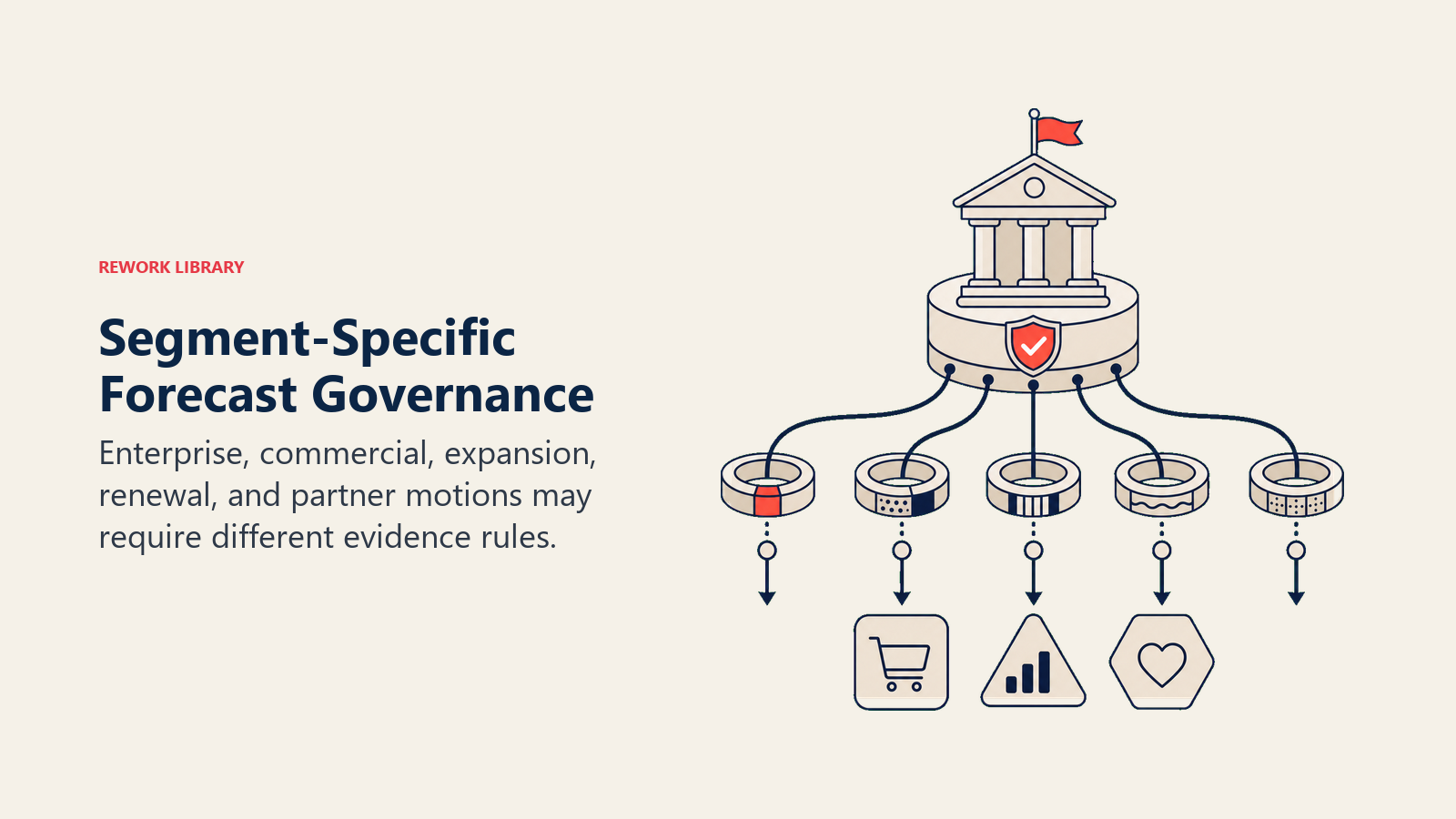
Enterprise new business, commercial new business, expansion, renewals, partner deals, and services revenue may need different evidence rules. A small self-serve expansion may not need a mutual close plan. A seven-figure enterprise deal should not be commit without buyer process evidence. A renewal may depend on usage, executive sponsor, contract date, and customer health more than classic opportunity stage.
RevOps should document where standards differ:
| Motion | Governance focus |
|---|---|
| Enterprise new business | Buyer committee, legal path, procurement path, executive sponsor |
| Commercial new business | Decision process, business problem, close date, commercial fit |
| Expansion | Adoption, value proof, stakeholder map, contract scope |
| Renewal | Health, usage, sponsor, risk, renewal date |
| Partner | Source ownership, partner action, customer access, timeline |
This prevents two bad outcomes: overbuilding governance for simple deals and underbuilding governance for complex deals.
Forecast governance operating questions
In weekly and monthly reviews, leaders should ask a consistent set of questions:
- Which part of the forecast changed?
- Which changes are supported by buyer evidence?
- Which changes are manager judgment?
- Which risks require executive help?
- Which data issues reduce confidence?
- Which category produced the most surprise last period?
- Which segment has the largest gap between forecast and actual?
- Which rule needs to change before the next cycle?
The point is not to make the forecast process heavy. The point is to make it inspectable. A lightweight process that answers these questions is better than a large process that produces dashboards nobody trusts.
Implementation path
For teams starting from weak forecast discipline, implement governance in stages.
First, define categories and commit criteria. Second, clean the fields used in the forecast packet. Third, separate pipeline inspection from the forecast call. Fourth, review accuracy after the period closes. Fifth, tune the rules by segment and motion.
Do not start by adding more forecast meetings. Start by making the existing call more useful.
The first signs of progress are practical: fewer basic data questions during the call, clearer reasons for movement, fewer surprise slips, and less finance rework after sales submits the forecast.
Forecast miss diagnosis
When the forecast misses, classify the miss before changing rules.
| Miss pattern | Likely cause | First governance response |
|---|---|---|
| Commit deals slip late | Weak evidence or close-date discipline | Tighten commit criteria and inspection timing |
| Best case rarely closes | Category too loose or poorly calibrated | Redefine best case evidence |
| Upside closes unforecasted | Signals are missed too early | Improve manager inspection and movement review |
| Finance discounts accurately | Sales forecast has known optimism | Compare sales call, finance scenario, and actuals |
| One segment varies widely | Segment rules differ from overall motion | Create segment-specific evidence rules |
| Data caveats repeat | Source fields or stage hygiene are weak | Fix data governance before adding forecast process |
This diagnosis keeps leaders from applying the same fix to every miss. A miss caused by buyer timing needs different action than a miss caused by manager optimism or stale data. RevOps should bring this classification into the post-period review and turn it into rule changes, packet changes, or manager calibration.
Forecast decision packet
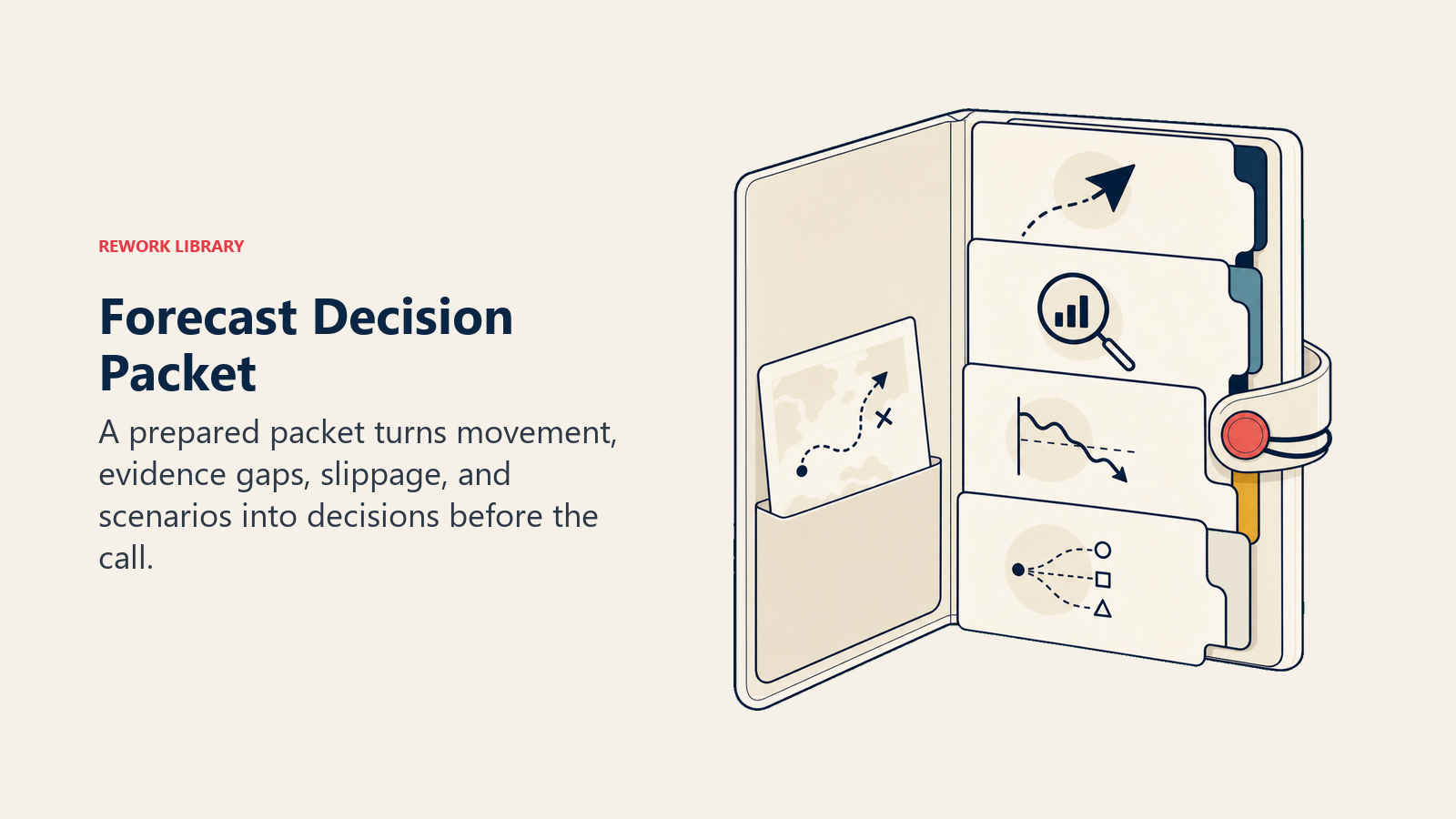
A forecast call should not start with raw opportunity lists. RevOps should prepare a packet that helps leaders make decisions quickly.
| Packet section | What it should show | Decision it supports |
|---|---|---|
| Forecast movement | What changed since last call by category and segment | Where leadership attention is needed |
| Commit evidence | Commit amount, count, evidence gaps, and manager notes | Whether commit is credible |
| Slippage risk | Deals with close-date movement, stage aging, or weak next step | Which deals need action or downgrade |
| Coverage context | Current and next-period coverage by stage and segment | Whether the plan has enough pipeline |
| Data caveats | Missing fields, stale records, duplicate risk, or category inconsistency | Whether numbers can be trusted |
| Finance view | Plan, scenario, and variance against sales call | Whether forecast changes affect planning |
| Decision log | Actions from last call and owner status | Whether governance is changing behavior |
This packet changes the meeting. Instead of asking every manager to explain every deal, leaders can focus on category movement, risk, evidence, and action.
Forecast call decision rules
Set rules before the call:
- Deals with missing commit evidence cannot be clean commit.
- Deals with repeated close-date pushes require manager explanation.
- Large deals with post-sale risk need CS or implementation input.
- Forecast category changes after a cutoff require a reason.
- Data cleanup belongs before the call, not during it.
- Every forecast exception needs an owner and review date.
These rules do not remove judgment. They make judgment visible enough for sales, RevOps, and finance to work from the same standard.
Frequently Asked Questions about Forecast Governance
What is forecast governance?
Forecast governance is the set of rules, definitions, inspection rhythms, and ownership practices that make a sales forecast reliable.
Who owns forecast accuracy?
Sales owns the outcome. RevOps owns the process and data quality. Finance owns the planning impact.
Learn more

Senior Operations & Growth Strategist
On this page
- What RevOps governs
- Forecast categories
- Evidence rules
- Close-date governance
- Forecast data packet
- Ownership model
- Forecast accuracy review
- Common mistakes
- Readiness checklist
- Ownership model detail
- Forecast governance cadence
- Data-quality gates
- Forecast governance examples
- Forecast operating artifacts
- Forecast and finance
- Post-period review
- Launch plan
- Launch rule
- Forecast governance scorecard
- Forecast category change rules
- Manager calibration
- Forecast governance and compensation
- Segment-specific governance
- Forecast governance operating questions
- Implementation path
- Forecast miss diagnosis
- Forecast decision packet
- Forecast call decision rules
- Learn more