What Is Revenue Operations? The Operating System for Predictable Growth
The first sign that a company needs Revenue Operations is usually not a missing dashboard.
It sounds more like this: marketing says lead volume is up, sales says lead quality is down, customer success says new customers are arriving with promises the product cannot support, and finance says the forecast has stopped matching reality.
Every team is working hard. Every team has a reasonable version of the truth. The problem is that the revenue system has no single operating owner.
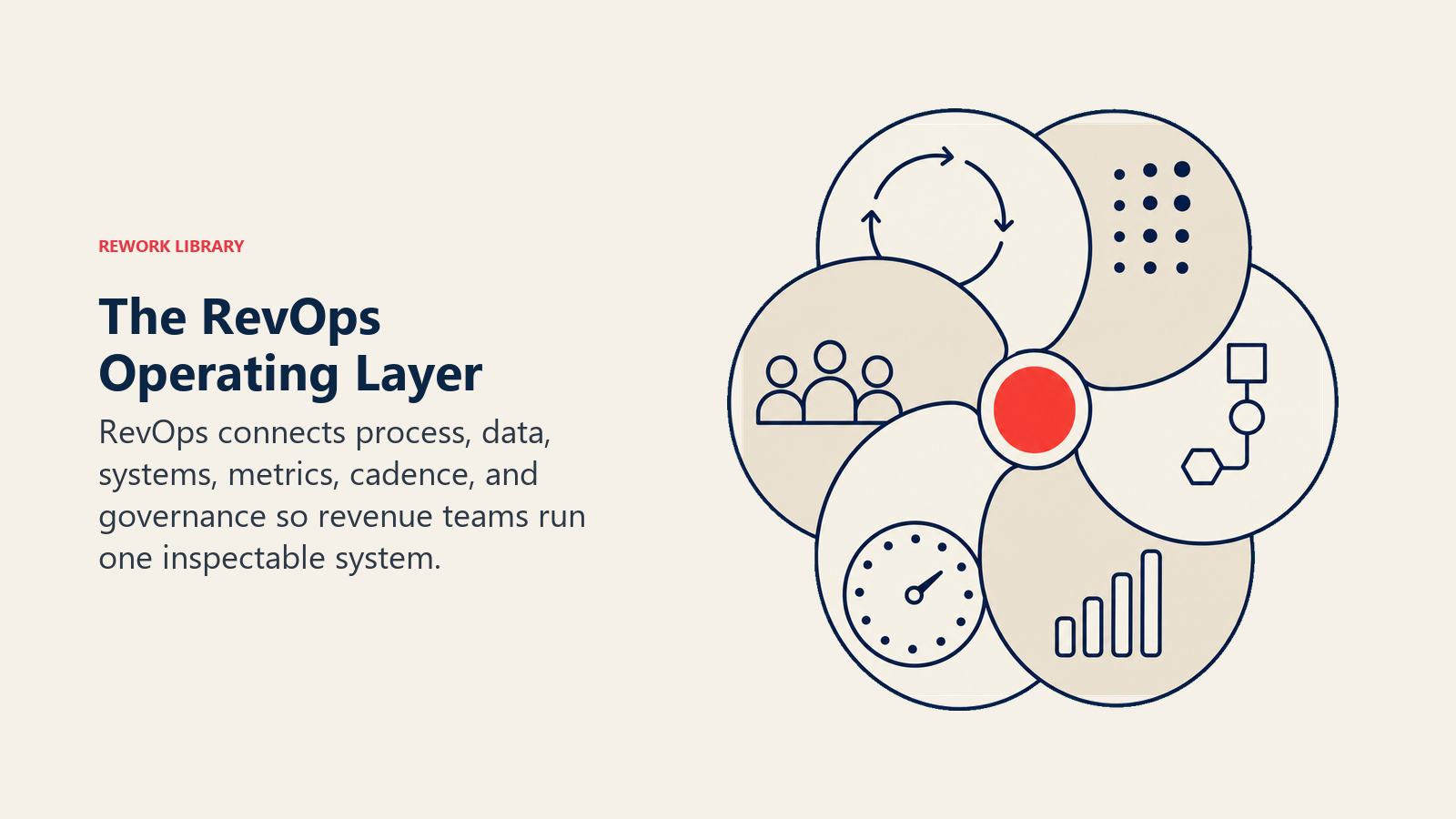
Revenue Operations, usually shortened to RevOps, is the function that designs, governs, measures, and improves the full revenue operating system from first touch to renewal. It connects marketing, sales, customer success, finance, data, and systems so the company can run one measurable revenue motion instead of several disconnected motions.
Gartner describes Revenue Operations as an end-to-end model that unifies customer engagement across functions and integrates people, process, and technology across the business. That is the right starting point. RevOps is not a reporting team. It is not a CRM admin team. It is not a new title for Sales Ops. It is the operating layer that makes revenue easier to run, inspect, forecast, and improve.
Revenue Operations definition
Revenue Operations is the cross-functional discipline responsible for the processes, data, systems, metrics, and operating cadence that support revenue growth across the full customer lifecycle.
In practical terms, RevOps owns the connective tissue:
- How a lead enters the system
- How the lead is qualified, routed, and accepted
- How an opportunity is created and inspected
- How a forecast is built and trusted
- How closed-won deals move into onboarding
- How renewal and expansion signals flow back into planning
- How leadership sees one version of revenue performance
That scope is what makes RevOps different from a function-specific operations team. Sales Ops improves sales execution. Marketing Ops improves campaign execution. CS Ops improves retention execution. RevOps improves the revenue system those teams share. The line is fuzzier with GTM Operations vs Revenue Operations, where the two roles often overlap.
For a company with one founder, one salesperson, and a simple funnel, that distinction may not matter yet. The founder can hold the system in their head. Once marketing, sales, customer success, and finance all depend on the same customer data, handoffs, forecast inputs, and dashboards, the system needs an operating owner.
Why RevOps exists
RevOps exists because revenue work crosses team boundaries, while most companies are organized in team-specific silos.
Marketing owns demand generation, but not the sales conversion work that proves whether the demand is useful. Sales owns pipeline, but not the campaign data or lifecycle definitions that created that pipeline. Customer success owns retention, but inherits customer expectations set during sales. Finance owns the plan, but depends on forecast inputs from a CRM that may be incomplete, stale, or inconsistent.
The result is predictable friction.
A lead is called qualified in the marketing automation platform, but sales does not agree. A deal is in commit, but the close date has moved three times. A customer churns because implementation never received the original use case. A board report shows one pipeline number while the sales forecast shows another.
None of those failures belongs cleanly to one team. They live between teams. That is why they persist.
Harvard Business Review has written about the cost of marketing and sales misalignment, estimating that the gap costs businesses more than $1 trillion each year. RevOps is one answer to that gap: give the shared revenue system an owner with authority to standardize definitions, enforce handoffs, and maintain the data layer.
Key facts about RevOps
Key Facts: Revenue Operations
- Gartner defines RevOps as an end-to-end model that unifies customer engagement across functions and integrates people, process, and technology.
- Forrester frames revenue operations around alignment across marketing, sales, partner, and customer success operational responsibilities.
- HBR estimates sales and marketing misalignment costs businesses more than $1 trillion annually.
- Salesforce's 2026 State of Sales reports that average sellers spend 40% of their time selling, measured across 4,050 sellers in 22 countries, against the 28% its December 2022 edition measured on a larger, differently composed sample. Either way selling is a minority of the week, which is one reason RevOps teams focus heavily on process friction, CRM hygiene, and workflow quality.
The numbers matter, but the operating implication matters more. Companies move toward RevOps because revenue complexity outgrows informal coordination.
The RevOps operating layer
A useful way to understand RevOps is to break it into six operating layers.
| Layer | What RevOps governs | Example question |
|---|---|---|
| Process | Lifecycle stages, handoffs, SLAs, exception paths | What happens when an MQL is not accepted within SLA? |
| Data | Required fields, source of truth, definitions, quality rules | Which system owns lifecycle status? |
| Systems | CRM, marketing automation, CS tooling, billing, BI | Which tools can write to revenue fields? |
| Metrics | Funnel conversion, velocity, forecast quality, retention | Which numbers are used in the operating review? |
| Cadence | Weekly, monthly, and quarterly revenue reviews | Which meeting makes which decision? |
| Governance | Decision rights, change control, accountability | Who approves a new lead source field? |
When RevOps is weak, those layers are scattered. Marketing owns one definition. Sales owns another. Finance builds a spreadsheet to reconcile both. Customer success keeps renewal risk in a separate tool.
Turn this article into takeaways for your work.


Each assistant summarizes the article only for you and suggests best practices for your work.
When RevOps is strong, those layers become a shared operating system. The lead management process connects cleanly to lead routing automation. The sales pipeline is built from clear stages. Forecasting fundamentals depend on data that people trust. Marketing and sales alignment becomes a system, not a recurring negotiation.
What RevOps owns
RevOps should own the operating assets that multiple revenue teams depend on.
Definitions. Lifecycle stages, MQL, SQL, opportunity, closed-won, churn, expansion, sourced pipeline, influenced pipeline, and forecast categories need one shared definition. Without that, every report becomes a debate.
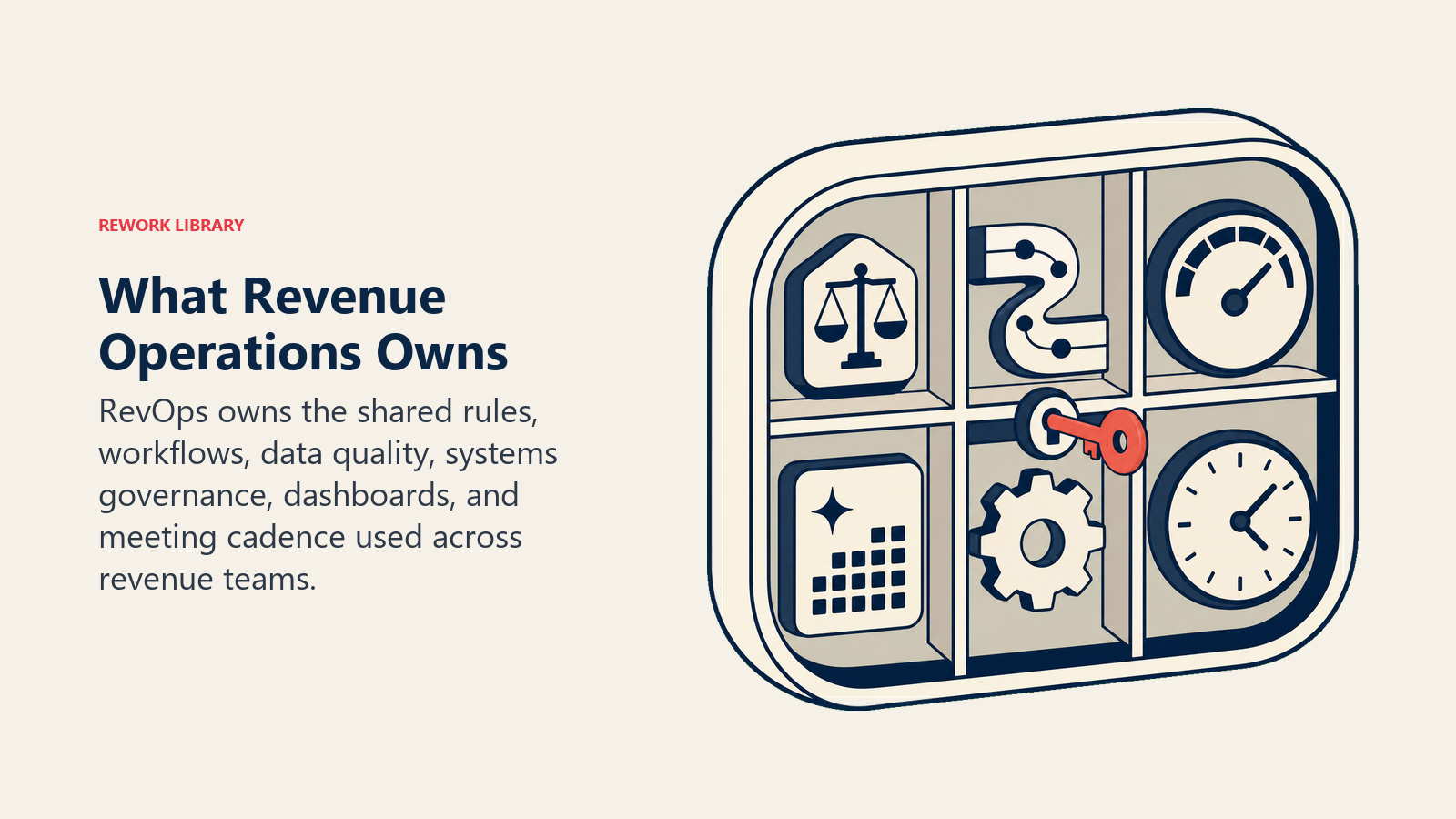
Workflows. RevOps designs the workflows that move records, tasks, and accountability between teams. This includes lead routing, assignment SLAs, opportunity stage movement, closed-won handoff, renewal alerts, and escalation paths.
Dashboards. RevOps should own the shared reporting layer. That does not mean every team loses its functional dashboard. It means leadership runs revenue decisions from a trusted shared view.
Data quality. Field completeness, duplicates, stale records, enrichment, and integration health are not admin cleanup tasks. They are revenue infrastructure.
Systems governance. RevOps determines how revenue systems connect and which teams can change fields, automations, scoring rules, and reporting logic.
Operating cadence. Weekly pipeline review, monthly funnel review, quarterly planning, forecast inspection, and retention review should each have a clear purpose, data packet, owner, and decision output.
What RevOps does not own
RevOps fails when it tries to become the strategy owner for every commercial decision.
RevOps does not replace marketing leadership. The CMO or marketing lead still owns positioning, channels, campaigns, and demand strategy.
RevOps does not replace sales leadership. The VP Sales still owns quota execution, coaching, hiring, territory strategy, and deal management.
RevOps does not replace customer success leadership. CS still owns onboarding quality, adoption, renewal conversations, and expansion strategy.
RevOps does not replace finance. Finance still owns the company plan, revenue recognition, budget, and financial reporting.
RevOps makes those functions easier to run by making the shared system reliable. It operationalizes strategy. It does not invent strategy in isolation.
When a company needs RevOps
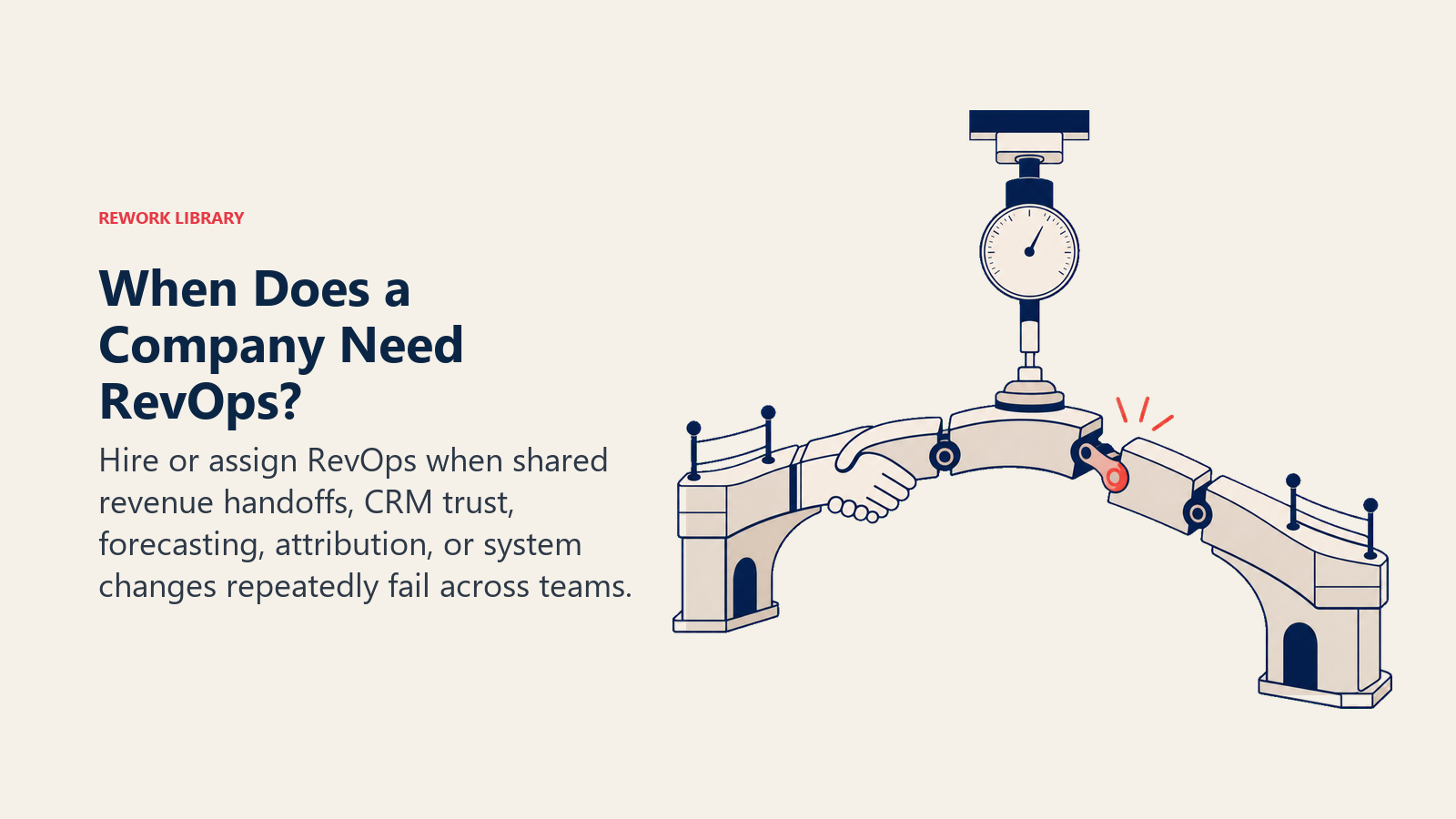
The need for RevOps appears when coordination cost starts reducing growth quality.
You probably need a RevOps owner when several of these are true:
- Marketing and sales disagree about lead quality every month.
- Sales leaders do not trust CRM pipeline data.
- Finance maintains a separate forecast because the CRM forecast is unreliable.
- Customer success says too many customers arrive with incomplete handoff notes.
- Campaign attribution is debated more than acted on.
- Lead routing rules are outdated or unclear.
- Managers spend forecast calls cleaning data instead of making decisions.
- Tooling decisions in one function break reporting in another.
- The company is adding headcount but revenue process quality is getting worse.
These problems do not always require a full RevOps team. Sometimes the first step is assigning one clear owner to the shared revenue process. But ignoring the problem usually makes every future hire less productive.
Five stages of RevOps maturity
Most companies do not move from no RevOps to a mature operating system in one quarter. The function usually evolves through five stages.
| Stage | What it looks like | Main risk |
|---|---|---|
| 1. Reactive reporting | A person pulls reports when leaders ask | Reports explain the past but do not improve the system |
| 2. Sales Ops support | Ops supports pipeline, CRM, quota, and sales tooling | Marketing and CS remain outside the operating model |
| 3. Funnel governance | Shared lifecycle stages, routing, handoffs, and dashboards emerge | Governance depends on one strong operator |
| 4. Revenue operating system | Marketing, sales, CS, finance, and systems run on common definitions | Change management becomes the bottleneck |
| 5. Predictive RevOps | AI-assisted scoring, forecasting, risk detection, and workflow automation | Automation scales bad data if governance is weak |
The mistake is skipping stages. A company with poor stage definitions should not start with predictive forecasting. A company without handoff SLAs should not automate routing before the acceptance rule is clear.
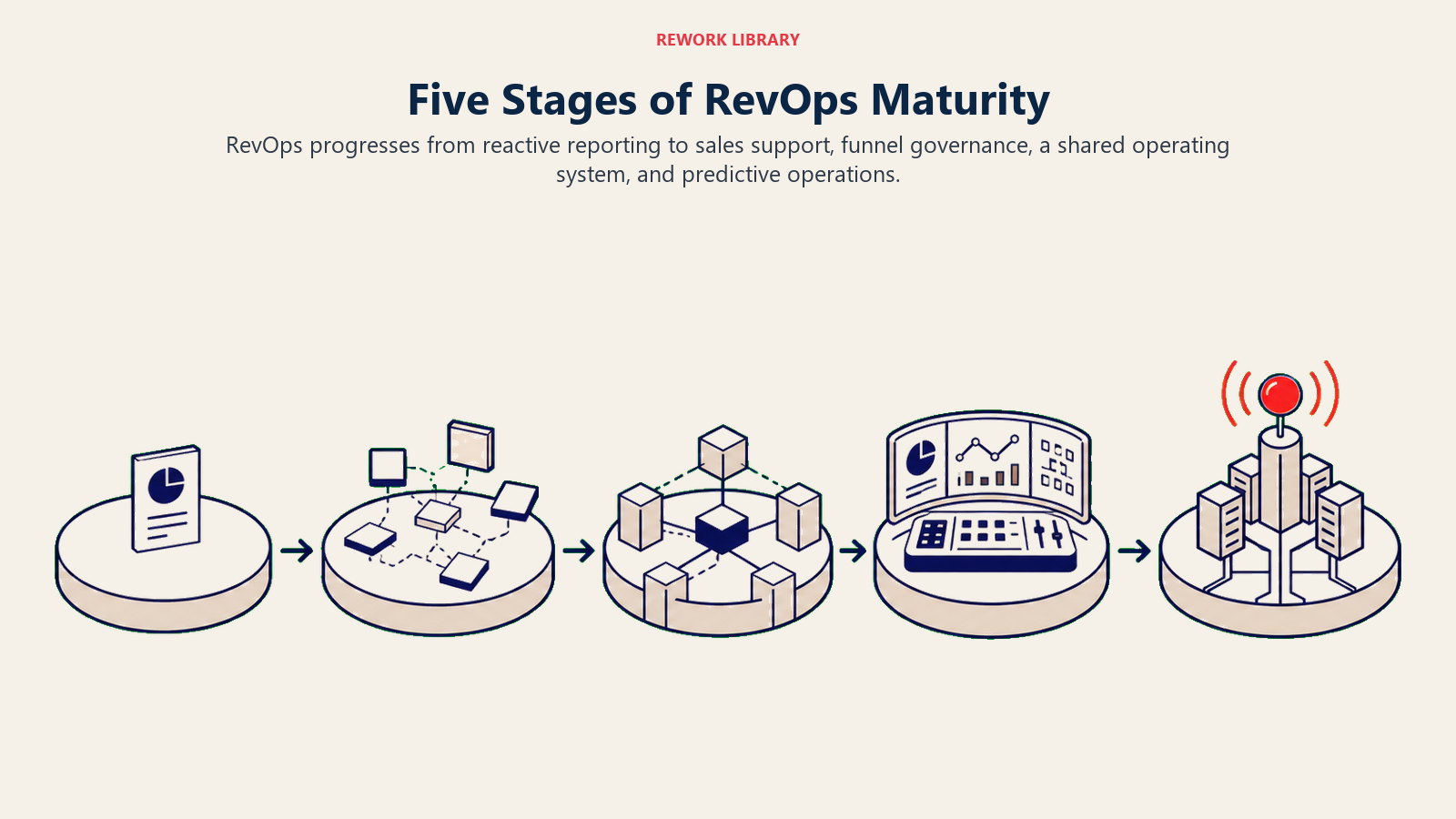
Use the RevOps maturity model to diagnose where the company sits before deciding what to build next.
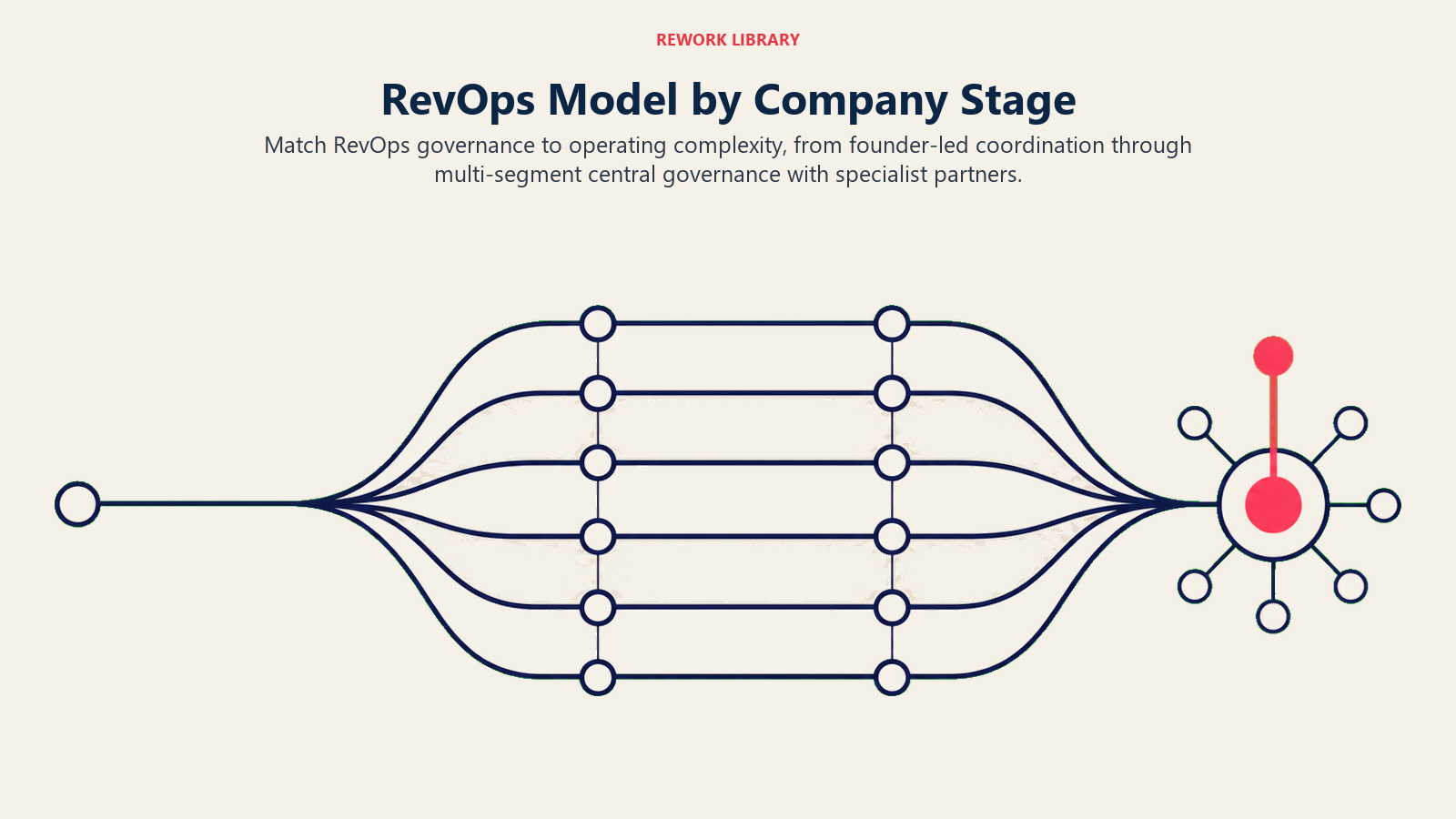
RevOps operating model by company stage
RevOps should look different as the company grows. A 30-person company does not need the same operating model as a 500-person company with multiple products, regions, and renewal motions.
| Company stage | Practical RevOps model | Main operating risk | What to avoid |
|---|---|---|---|
| Founder-led revenue | Founder or one operator owns CRM hygiene and simple handoffs | Process sits in people's heads | Creating heavy governance before the motion is learned |
| First repeatable sales team | Sales Ops or ops generalist owns lead routing, pipeline stages, and basic reporting | Sales execution becomes inconsistent | Letting every manager define stages differently |
| Marketing plus sales engine | One RevOps owner governs lifecycle, source, routing, and conversion | Marketing and sales argue from different data | Treating lead quality as a meeting topic instead of a governed process |
| Sales plus customer success | RevOps extends the model through onboarding, renewal, and expansion | Closed-won becomes a handoff gap | Ending the revenue model at closed-won |
| Multi-segment company | Central RevOps with specialist partners for systems, analytics, sales ops, marketing ops, and CS ops | Local optimization breaks shared reporting | Copying one motion's rules across every segment |
This stage view keeps RevOps practical. The goal is not to make the function look mature on an org chart. The goal is to match operating discipline to the amount of coordination the revenue system now requires.
How to start RevOps without overbuilding
The first RevOps pass should make the system easier to inspect. It should not create a heavy approval process for every small change.
Start with four moves.
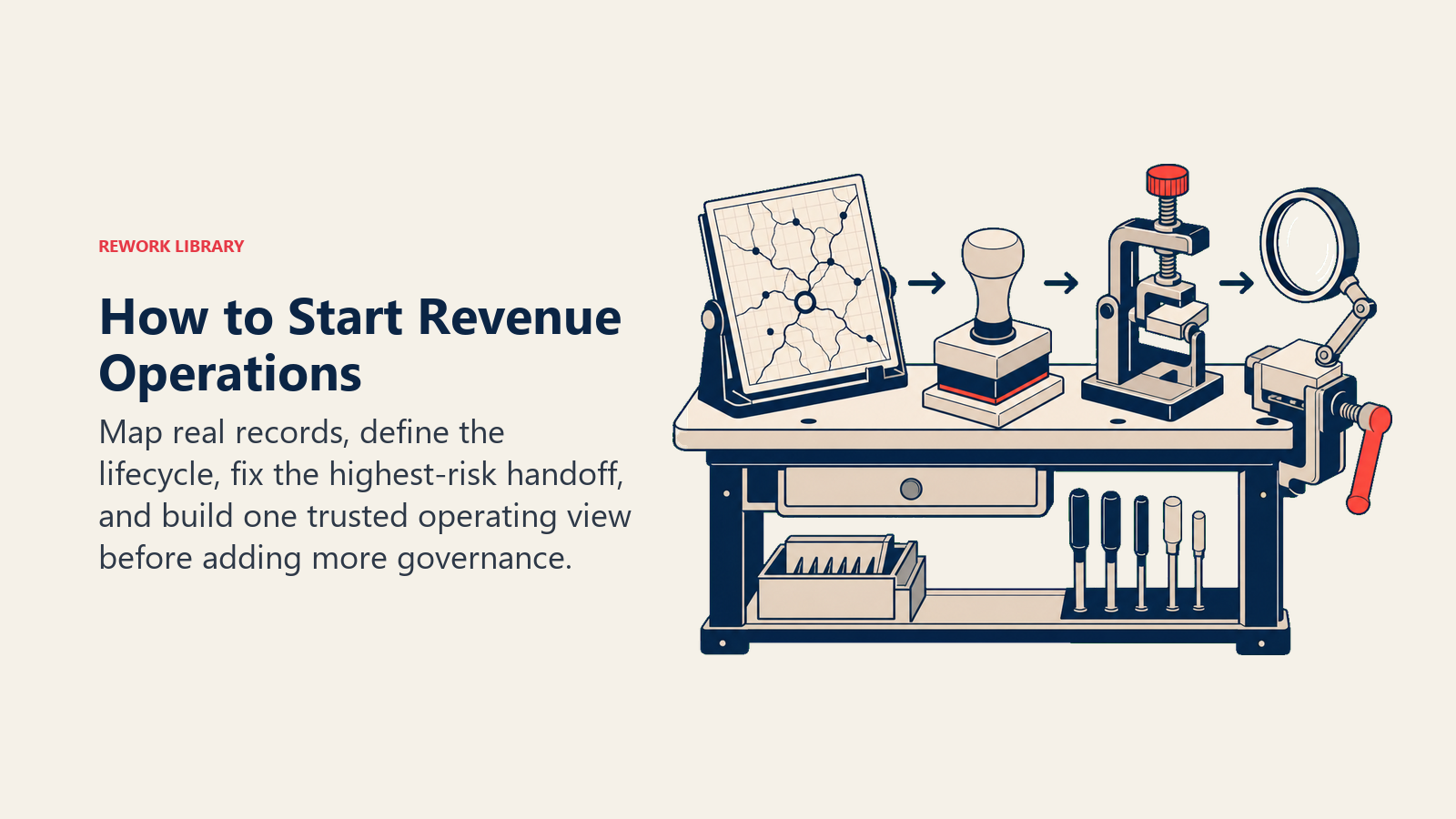
Map the lifecycle from real records. Pull recent leads, opportunities, closed-won deals, churned customers, and expansion opportunities. For each record, ask: who owns it now, what stage is it in, what evidence supports that stage, and what action should happen next? Real records expose confusion faster than a workshop diagram.
Write the shared definitions. Define lead, MQL, SQL, opportunity, commit, closed-won, onboarded, renewal risk, churn, and expansion. Keep each definition short. If a manager cannot use it during inspection, it is not clear enough.
Pick the highest-risk handoff. Most companies should start with lead assignment, MQL to SQL, opportunity creation, or closed-won to onboarding. Fix one handoff deeply before rewriting every workflow.
Create one trusted operating view. Build a small dashboard that leaders actually use: stage conversion, SLA misses, pipeline coverage, forecast quality, handoff completeness, and required-field completeness. A trusted 10-metric view beats a 40-chart dashboard no one acts on.
This is where the First 90 Days in RevOps playbook becomes useful. RevOps earns trust by turning visible pain into operating change, not by publishing a giant roadmap.
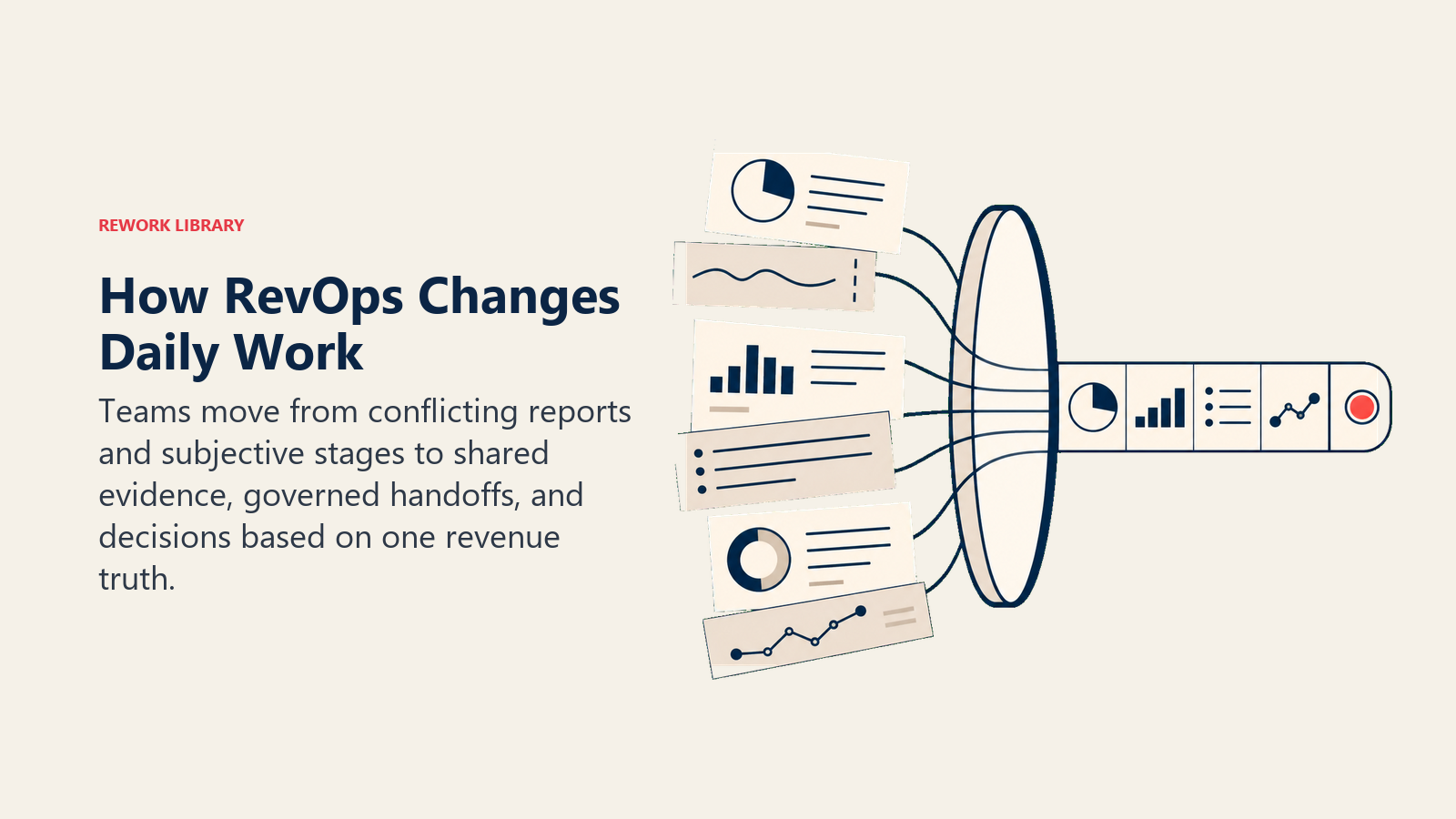
What RevOps changes in daily work
Good RevOps is visible in small operating behaviors.
| Before RevOps | After RevOps is working |
|---|---|
| Leaders debate which report is right | Leaders inspect the same source of truth |
| Reps decide stage movement by feel | Stage movement requires evidence |
| Marketing celebrates volume while sales disputes quality | Source quality is reviewed by conversion and acceptance |
| CS asks sales for context after close | Handoff data is required before onboarding |
| Finance applies a private discount to the forecast | Forecast confidence is tied to shared criteria |
| System changes happen through side requests | Field, workflow, and dashboard changes follow governance |
The value is not abstract alignment. The value is fewer avoidable debates, faster diagnosis, cleaner handoffs, and better planning confidence.
A good first-quarter RevOps outcome
A realistic first quarter should produce a few high-trust assets, not a total rebuild.
By the end of the first quarter, a new RevOps owner should be able to show:
- One lifecycle map from lead through renewal.
- A short list of agreed definitions.
- A handoff table with owners, SLAs, required fields, and exception paths.
- A source-of-truth map for the main revenue metrics.
- A prioritized RevOps roadmap tied to revenue risk.
- A cleaner operating review where leaders spend less time reconciling data.
If the first quarter only produces new reports, the mandate is too narrow. Reports are useful, but the real test is whether the company has changed how revenue work moves between teams.
How RevOps connects the Rework revenue libraries
RevOps is useful because it connects work that is usually documented in separate playbooks.
Lead management defines how demand enters the system. Pipeline management defines how potential revenue is inspected. Deal closing defines how commitments become customers. Post-sale management defines how customers renew, expand, or churn. Marketing-sales alignment and sales-CS alignment define the handoffs between those phases.
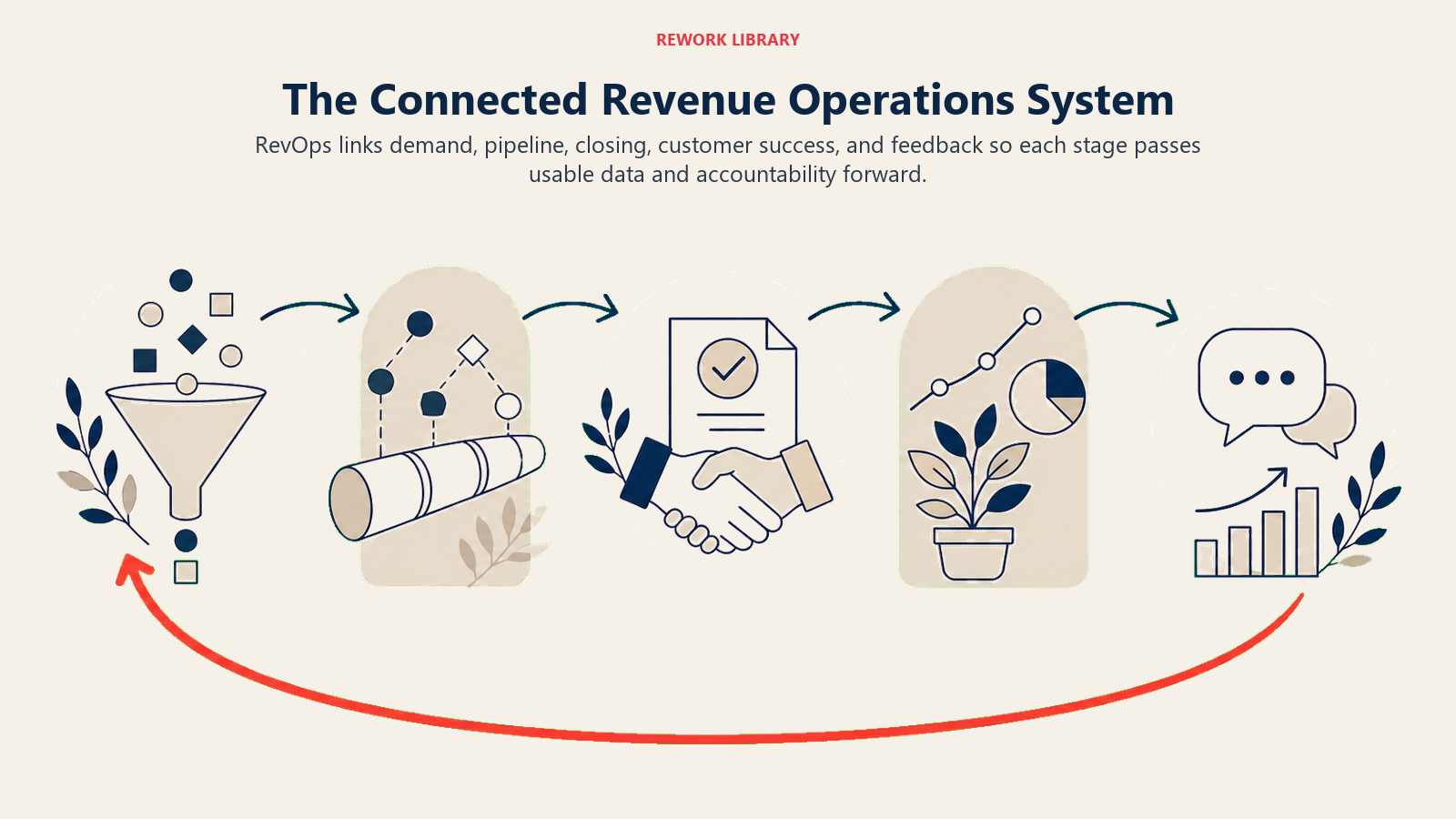
RevOps makes those libraries one system.
A lead source should flow into funnel conversion reporting. A qualification rule should affect routing and sales capacity. A sales promise should appear in customer onboarding. A churn reason should inform ICP and campaign targeting. A forecast miss should trigger process review, not only a manager explanation.
That is why the SaaS RevOps framework is strongest when it covers acquisition, conversion, retention, and expansion together. RevOps is not the team that owns one stage. It is the team that makes sure every stage can pass usable data and accountability to the next.
A practical RevOps diagnostic
Ask these questions in your next operating review:
- Can marketing, sales, CS, and finance explain the same lifecycle stages in the same words?
- Does every handoff have an owner, SLA, and exception path?
- Is the CRM trusted enough to run the forecast without a shadow spreadsheet?
- Can leaders see conversion by source, segment, and stage without manual cleanup?
- Do closed-won deals arrive in onboarding with the information CS needs?
- Are forecast calls about risk and action, or about fixing stale data?
- Does someone own revenue system changes across tools?
- Are dashboards tied to decisions, or are they only reporting artifacts?
- Are churn and expansion signals feeding back into ICP and qualification rules?
- Is RevOps spending most of its time improving the system, or reacting to tickets?
If the answers are mostly unclear, the company does not only need better reports. It needs stronger revenue operations.
Where a platform like Rework fits
RevOps needs a system where records, workflows, ownership, and activity data can be governed consistently. A CRM or workflow platform like Rework can support that foundation by making lead routing, lifecycle status, task ownership, and handoff records visible in one place. The tool does not create RevOps by itself. The operating rules come first. The platform enforces them once they are clear.
Frequently Asked Questions about What Is Revenue Operations? The Operating System for Predictable Growth
What is Revenue Operations in simple terms?
Revenue Operations is the function that makes the full revenue process work across marketing, sales, customer success, finance, and systems. It owns shared definitions, workflows, data quality, dashboards, and operating cadence.
Is RevOps the same as Sales Ops?
No. Sales Ops improves sales execution. RevOps improves the full revenue system. Sales Ops may sit inside RevOps as a specialist lane, but RevOps has a broader cross-functional mandate.
Who should RevOps report to?
RevOps usually works best under a cross-functional leader such as the CRO, COO, or CEO. If it reports only to sales or only to marketing, other teams may distrust its decisions and dashboards.
When should a company hire RevOps?
Hire or assign a RevOps owner when revenue handoffs, CRM trust, forecast quality, attribution, or post-sale handoffs start breaking across teams. That often happens before leaders feel ready for a full RevOps department.
What is the first RevOps project?
Start with lifecycle definitions and handoffs. If the company cannot define lead, MQL, SQL, opportunity, closed-won, onboarding, renewal, and churn consistently, every dashboard and automation will inherit that confusion.
Learn more

Principal Solution Architect
On this page
- Revenue Operations definition
- Why RevOps exists
- Key facts about RevOps
- The RevOps operating layer
- What RevOps owns
- What RevOps does not own
- When a company needs RevOps
- Five stages of RevOps maturity
- RevOps operating model by company stage
- How to start RevOps without overbuilding
- What RevOps changes in daily work
- A good first-quarter RevOps outcome
- How RevOps connects the Rework revenue libraries
- A practical RevOps diagnostic
- Where a platform like Rework fits
- Learn more