Lead to Revenue Attribution: How RevOps Connects Source to Closed-Won
Lead-to-revenue attribution connects where demand came from to what revenue it produced.
That sounds simple until the first budget meeting. Marketing reports sourced pipeline. Sales questions lead quality. Finance asks which revenue definition is being used. Customer success points out that one source creates customers who churn quickly. A campaign looks strong on form fills but weak on sales acceptance. A partner source looks small by volume but strong by expansion.
Attribution becomes political when teams use different definitions.
RevOps should keep attribution focused on decisions, not credit. The goal is to improve budget, targeting, qualification, routing, conversion, retention, and customer-fit strategy. If the attribution model only decides which team gets praise, it will not stay trusted for long.
Harvard Business Review's sales and marketing alignment research is relevant because attribution becomes political when teams do not share definitions. McKinsey's B2B growth research also reinforces the need for integrated commercial systems that connect engagement, conversion, and measurable impact.
Key operating facts
- Attribution should answer decision questions, not settle credit arguments.
- Source data, lead conversion rules, contact roles, and opportunity linkage matter more than model complexity.
- First-touch, influence, source-to-opportunity, and source-to-revenue views answer different questions.
- Finance should review attribution when it affects budget, board reporting, or planning.
- Retention and expansion feedback prevent teams from over-investing in low-quality revenue sources.
What lead-to-revenue attribution really means
Lead-to-revenue attribution follows demand from first known source through revenue outcome.
It connects:
- Original source
- Latest source
- Campaign or offer
- Lead creation
- MQL or qualification point
- Sales acceptance
- Opportunity creation
- Contact and account association
- Closed-won revenue
- Product, segment, or region
- Retention, churn, and expansion where useful
The phrase "lead to revenue" matters because attribution should not stop at form fills. A source that creates many leads but few accepted opportunities may need a targeting fix. A source that creates fewer leads but strong win rates may deserve more investment. A source that closes well but churns quickly may be a customer-fit problem.
Attribution should show those tradeoffs.
Start with the decision question
Before choosing a model, define the question.

Turn this article into takeaways for your work.


Each assistant summarizes the article only for you and suggests best practices for your work.
Different questions need different views.
| Question | Useful view | Decision it supports |
|---|---|---|
| Which source creates initial demand? | First-touch attribution | Demand creation budget |
| Which campaigns help move deals? | Influence attribution | Content and campaign support |
| Which source creates accepted pipeline? | Source-to-opportunity conversion | Targeting and qualification |
| Which channel creates revenue? | Source-to-closed-won reporting | Budget and capacity planning |
| Which source creates good customers? | Source-to-retention and expansion | Customer-fit and lifecycle strategy |
| Which campaigns support existing deals? | Opportunity influence | Deal acceleration programs |
No single model answers every question. RevOps should make the question clear before the dashboard is built.
What RevOps must govern
Attribution needs governance across the full revenue data chain.
| Layer | Governance need |
|---|---|
| Source capture | Consistent source, medium, campaign, and offer fields |
| Lead conversion | Clear MQL, SQL, and opportunity rules |
| Account matching | Leads and contacts tied to the right account |
| Opportunity linkage | Contact roles and campaign influence connected to pipeline |
| Revenue outcome | Closed-won amount, product, segment, and revenue definition |
| Retention feedback | Churn and expansion connected back to source where useful |
| Reporting caveats | Data-quality warnings visible in dashboards |
Attribution fails when source data is messy or opportunity association is weak. Start with source-of-truth revenue data before debating model precision.
Data requirements
Attribution depends on clean data.
Core fields:
- Original source
- Latest source
- Campaign
- Landing page or form
- Lead creation date
- MQL date
- SQL or sales-accepted date
- Opportunity created date
- Opportunity contact roles
- Account match
- Closed-won amount
- Product or segment
- Renewal and expansion outcomes
The hardest part is often association. If leads, contacts, accounts, and opportunities are not connected correctly, attribution reports will be wrong no matter which model is chosen.
This is where attribution depends on CRM data hygiene. Clean fields are not enough if the records themselves are fragmented.
Define source fields clearly
Most attribution fights begin with source definitions.
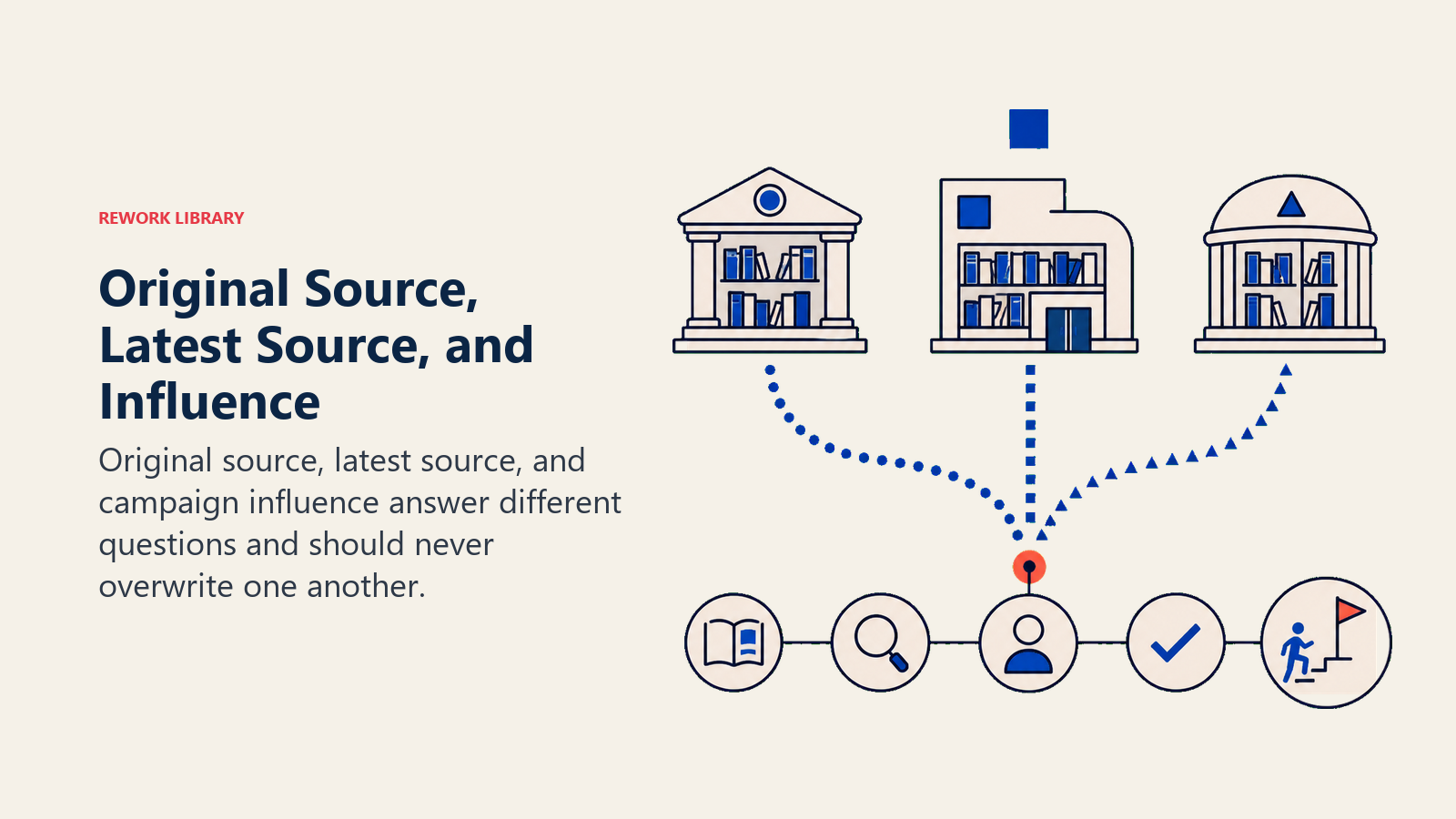
RevOps should define at least three concepts:
| Field | Meaning | Rule |
|---|---|---|
| Original source | Where the person or account first entered known demand | Usually locked after creation |
| Latest source | Most recent meaningful acquisition or re-engagement source | Can update under defined rules |
| Campaign influence | Campaign touches that supported a journey or opportunity | Stored separately from source |
These fields should not overwrite each other.
If a partner introduces an account, and the buyer later attends a webinar, the original source and campaign influence may both matter. If an outbound account later fills out a demo form, RevOps needs a rule for whether the opportunity is outbound-sourced, inbound-influenced, or both.
The answer depends on the decision the report supports.
Build source categories leaders can use
Source categories should be broad enough to compare, but specific enough to act.
A practical executive model:
- Paid search
- Paid social
- Organic search
- Direct
- Referral
- Partner
- Event
- Webinar
- Outbound
- Customer referral
- Community
- Existing customer expansion
Avoid dozens of tiny categories in executive reporting. Keep detailed campaign data underneath, but roll up to categories leaders can use.
The wrong source category model creates fake precision. Leaders do not need 47 source values in a budget meeting. They need enough detail to make a real investment decision.
First-touch vs influence
First-touch attribution is useful for understanding where demand starts. It is simple and stable, but it can over-credit early sources.

Influence attribution is useful for understanding which campaigns and interactions supported movement. It is richer, but it can become noisy and political if every touch receives credit.
RevOps should avoid model debates that are disconnected from decisions.
If the decision is budget allocation for demand creation, first-touch or qualified-source reporting may be enough. If the decision is content or campaign support for active opportunities, influence reporting may be useful. If the decision is customer quality, retention and expansion by source matter more.
Person, account, and opportunity attribution
B2B attribution gets messy because demand does not always belong to one person.

A person submits a form. Another person joins a webinar. A third person becomes the champion. The account already has outbound activity. The opportunity may be created months after the first touch. If RevOps does not define attribution level, teams will interpret the same journey differently.
| Attribution level | What it answers | Risk |
|---|---|---|
| Person-level | Which contact source created the first known person? | Misses account context |
| Account-level | Which source first engaged the account? | Can over-credit early low-intent touches |
| Opportunity-level | Which source is tied to pipeline creation? | Needs contact roles and account matching |
| Campaign influence | Which campaigns touched people tied to the opportunity? | Can become noisy without rules |
For many B2B teams, the safest operating model is to report multiple views instead of forcing one universal answer.
Use person-level source to understand demand capture. Use opportunity-level source to understand pipeline creation. Use influence to understand campaign support. Use retention by source to understand customer quality.
Define opportunity source logic
Opportunity source is often the hardest field.

It can be based on:
- Original source of the primary contact
- Latest source before opportunity creation
- Campaign that directly triggered the opportunity
- Account source
- Sales-created source
- Partner or referral source
- Manual source selected by manager
Each approach has tradeoffs.
| Logic | Works when | Breaks when |
|---|---|---|
| Primary contact original source | Contact roles are reliable | Buying committee has multiple sources |
| Latest source before opportunity | Recent demand matters most | Late touches over-credit nurture |
| Campaign-created opportunity | Campaign directly triggers demand | Sales creates opportunity manually |
| Account source | Account-based motion is primary | Multiple contacts enter separately |
| Manager-selected source | Sales context matters | Manual edits become political |
RevOps should write the rule plainly. If nobody can explain how opportunity source is assigned, leaders should not use it for budget decisions.
Use conversion context
Revenue by source is useful, but it is incomplete without conversion context.
A source can produce high revenue because it produces many leads. Another can produce high win rates from low volume. Another can produce strong pipeline but slow sales cycles. Those are different operating stories.
A useful attribution view should show:
- Lead volume
- MQL rate
- Sales acceptance rate
- Opportunity rate
- Win rate
- Average deal size
- Sales cycle
- Closed-won revenue
- Retention where available
This connects attribution to full-funnel conversion rates. Attribution becomes more useful when it shows where the funnel changes, not only where revenue lands.
Use time windows carefully
Attribution changes when the time window changes.
Common time windows:
- Lead created in period
- Opportunity created in period
- Opportunity closed in period
- Campaign touch before opportunity creation
- Campaign touch during active opportunity
- Revenue recognized in period
These windows answer different questions.
If marketing reports leads created this quarter and finance reports revenue closed this quarter, the numbers will not reconcile. Both may be correct, but they are not answering the same question.
RevOps should label every attribution report with the time logic used.
Attribute expansion separately
Expansion attribution should not be forced into the same model as new business.
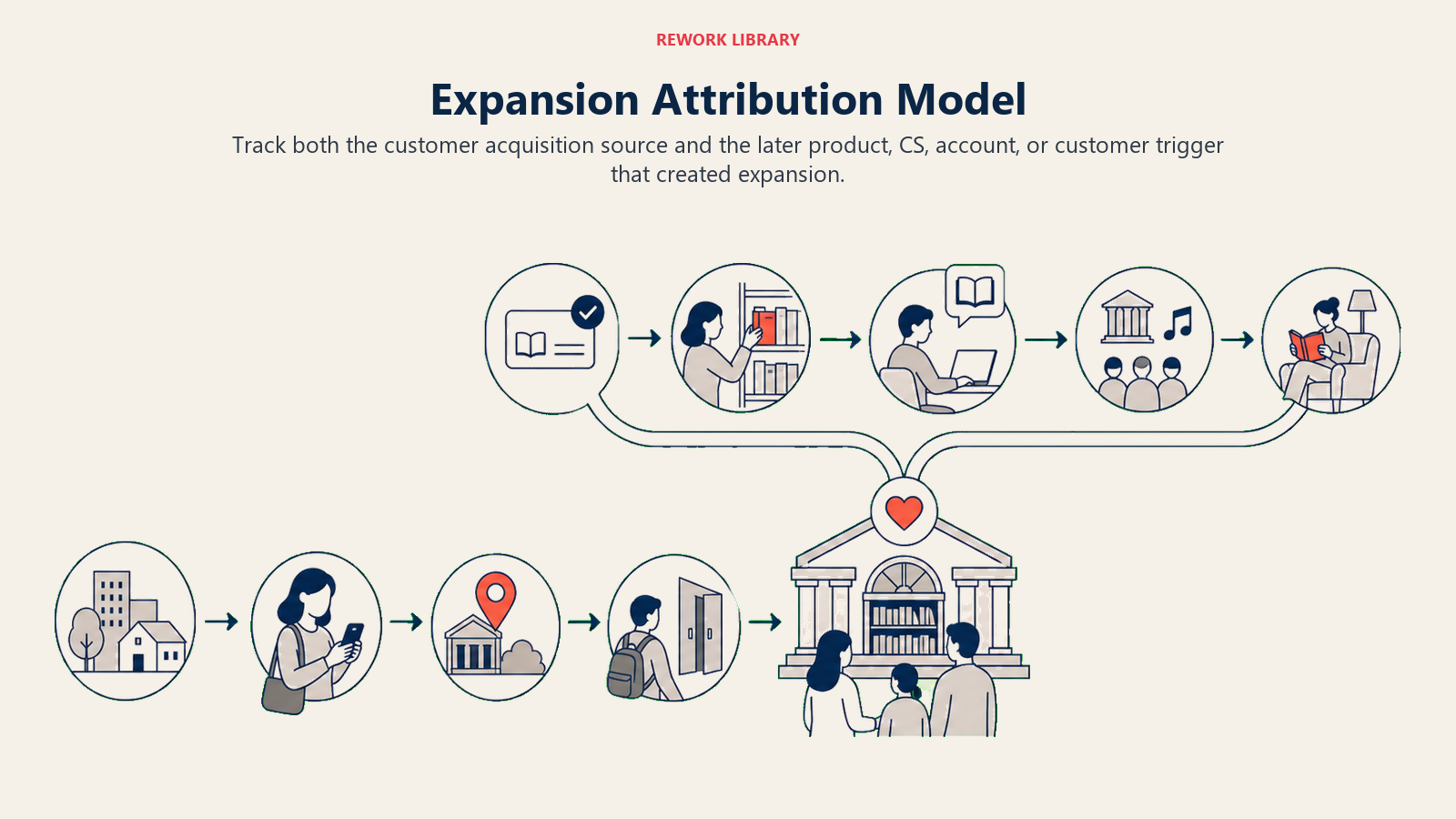
Expansion may come from:
- Customer success identifying need
- Product usage signal
- Account manager outreach
- Customer marketing
- Executive sponsor relationship
- Partner involvement
- Inbound request from an existing customer
If expansion revenue is attributed only to original acquisition source, teams may miss the work that created expansion. If expansion is attributed only to the latest touch, teams may miss the source that brought in the right customer.
A practical approach is to show both:
- Acquisition source for the customer
- Expansion motion or trigger for the expansion event
This keeps customer quality and expansion motion visible at the same time.
Give each function the right view
Attribution should not be one dashboard for everyone.
| Audience | Primary question | Best view |
|---|---|---|
| CEO | Where should we invest for efficient growth? | Source to pipeline, revenue, retention |
| CFO | Which revenue number is reliable for planning? | Finance-aligned revenue attribution |
| CMO | Which channels create qualified pipeline? | Source to MQL, SQL, opportunity, revenue |
| CRO | Which sources sales can convert? | Acceptance, win rate, cycle length by source |
| RevOps | Where does data or process break? | Unknown source, contact role, duplicate, edit-rate warnings |
| Customer success | Which sources create durable customers? | Retention, expansion, onboarding risk by source |
When one dashboard tries to answer every question, it becomes crowded. Better to create a shared model with role-specific views.
Create attribution caveats
Caveats are not excuses. They are trust controls.
Use caveats like:
- "Original source is reliable for leads created after March 1."
- "Opportunity source excludes partner-sourced deals until partner mapping is complete."
- "Influence reporting includes campaign touches within 90 days before opportunity creation."
- "Retention by source excludes customers closed before the billing system migration."
- "Manual source edits above 5 percent require monthly review."
Caveats help leaders use the report at the right confidence level.
The absence of caveats does not make data stronger. It only hides uncertainty.
Source-to-opportunity model
For many RevOps teams, source-to-opportunity is the most practical starting point.
Track:
- Leads by source
- MQL rate by source
- SQL acceptance by source
- Opportunity creation by source
- Pipeline value by source
- Stage aging by source
- Closed-won rate by source
This shows whether a source creates demand that sales can work, not only form fills.
Example: paid social may produce high lead volume but low sales acceptance. Partner referrals may produce low volume but high opportunity creation. Organic search may create steady pipeline with longer sales cycles. Those differences should change budget, nurture, routing, or qualification decisions.
Source-to-revenue model
Source-to-revenue connects opportunity source to closed-won revenue.
RevOps should define:
- Which source field is used
- Whether source is person, account, or opportunity based
- How multi-contact opportunities are handled
- How partner, outbound, paid, organic, events, and referrals are classified
- How manual edits are controlled
- How historical changes are documented
- Which revenue definition is used
Finance should review the model when it affects budget or board reporting.
Retention and expansion feedback
Attribution should not stop at closed-won.
Some sources produce customers who churn quickly. Some sources produce slower pipeline but stronger expansion. Some sources look expensive at acquisition but strong over the customer lifecycle.
RevOps should connect attribution to:
- Gross retention
- Net revenue retention
- Expansion rate
- Churn reasons
- Implementation complexity
- Customer segment
- Support load
- Time to value
This prevents teams from over-investing in sources that create low-quality revenue.
Attribution and finance
Finance should be involved when attribution affects budget, planning, or board reporting.
Finance will care about:
- Revenue definition
- Time period
- Bookings vs ARR vs recognized revenue
- New business vs expansion
- Segment cuts
- Exclusions
- Manual adjustments
- Currency and territory treatment
RevOps should document these choices. Otherwise marketing may report one sourced revenue number while finance reports another.
This is also where attribution connects to board-ready reporting. If leaders see attribution in an executive packet, the revenue definition and caveats must be clear.
Offline and partner sources
Attribution often breaks on offline and partner activity.
Examples:
- Events
- Referrals
- Partners
- Outbound
- Direct traffic
- Executive introductions
- Community
- Field marketing
RevOps should define capture rules. If a partner introduces an account that later fills out a form, how is source recorded? If an outbound account later attends a webinar, is that sourced or influenced? If an executive introduction creates a deal, where does it live?
These questions are not philosophical. They decide whether budget and channel performance are understood.
Duplicate and merge rules
Duplicate records damage attribution.
RevOps should define:
- How duplicates are detected
- Which source field survives merge
- How campaign history is preserved
- How account matching works
- Who can override source data
- What audit trail is kept
If merges overwrite original source, attribution history becomes unstable. If duplicates are not merged, one buyer journey may appear as multiple records.
Manual source edits
Manual source edits are sometimes necessary, but they need control.
Good controls:
- Limit who can edit original source
- Require reason for edit
- Preserve old value in history
- Track edit date and editor
- Review edits monthly
- Separate source correction from campaign influence
Manual edits without audit destroy trust. If teams believe source can be changed to make a report look better, the attribution model becomes political.
Campaign hierarchy
Campaign hierarchy matters because leaders need rollups.
A useful hierarchy can connect:
- Channel
- Source
- Campaign
- Offer
- Region
- Segment
- Event or program
- Fiscal period
Without hierarchy, reports become either too detailed or too vague. One dashboard shows hundreds of campaign names. Another shows only broad channels. Neither helps leaders understand which programs should grow, shrink, or change.
RevOps should keep the hierarchy simple enough to use and structured enough to answer budget questions.
Dashboard design
A useful attribution dashboard should include:
- Source volume
- Conversion by stage
- Pipeline by source
- Win rate by source
- Revenue by source
- Sales cycle by source
- Average deal size by source
- Retention or expansion by source where available
- Data-quality warnings
The dashboard should make tradeoffs visible. Volume without conversion is not enough. Revenue without sales cycle can mislead planning. Closed-won without retention can hide poor customer fit.
This is why attribution dashboards belong near the broader revenue operations dashboard, not in a disconnected marketing-only report.
Show data-quality warnings
Do not hide caveats.
Every attribution dashboard should show:
- Unknown source rate
- Percent of opportunities without contact role
- Percent of manually edited sources
- Duplicate rate
- Campaign missing rate
- Source overwritten after conversion
- Time period covered by trusted data
This prevents false confidence. A dashboard with 35 percent unknown source should not be used for precise budget decisions.
Transparent caveats make the report more useful, not less.
Attribution review cadence
Review attribution monthly or quarterly depending on volume.
The review should cover:
- Data completeness
- Unknown source rate
- Manual source edits
- Campaign hierarchy issues
- Conversion by source
- Pipeline and revenue by source
- Retention or expansion by source where available
- Decisions made from the data
If no decisions are made, the report may be too decorative.
Practical examples
If paid search creates many leads but low sales acceptance, the issue may be targeting, offer quality, or qualification threshold.
If events create fewer leads but stronger opportunities, the budget decision may favor quality over volume.
If outbound creates high-value pipeline but slow cycles, sales capacity and forecast timing matter.
If referrals create strong retention, RevOps should feed that into customer advocacy or partner strategy.
Attribution becomes useful when it explains tradeoffs, not when it crowns one team as the winner.
Attribution and routing
Attribution should influence routing and qualification when patterns are clear.
If one source produces high acceptance and strong win rate, it may deserve faster routing. If another source produces many low-fit leads, it may need different nurture or stricter qualification. If a channel produces customers with high churn, RevOps should review fit and messaging.
That is the practical value of attribution: changing the operating system, not only reporting credit.
Common attribution mistakes
Choosing a model before cleaning data. The model will not save bad source capture.
Using attribution to settle credit disputes. Attribution should improve decisions, not reward politics.
Ignoring sales acceptance. A source with many leads but low acceptance may need targeting work.
Ignoring retention. Closed-won revenue is not the full quality signal.
Allowing manual source edits without audit. This makes the model hard to trust.
Reporting sourced revenue without conversion context. Revenue alone does not show how efficiently the source works.
Hiding assumptions. Dashboards should show model, time period, revenue definition, and caveats.
Readiness checklist
Before rollout:
- Source fields are defined.
- Campaign hierarchy is documented.
- Lead-to-account matching is reliable enough.
- Opportunity contact roles are used consistently.
- Manual edits are controlled.
- Finance understands revenue definitions.
- Marketing and sales agree on the question the model answers.
- Data-quality caveats are visible.
Attribution is working when it changes decisions: budget, targeting, qualification, content, routing, or customer-fit strategy.
Implementation plan
Start with a narrow attribution model.
Version one should answer: which sources create qualified pipeline and closed-won revenue?
Steps:
- Define source categories.
- Lock original source after creation where possible.
- Clean unknown and duplicate source values.
- Ensure leads or contacts connect to accounts and opportunities.
- Define opportunity source logic.
- Build source-to-opportunity and source-to-revenue views.
- Add data-quality warnings.
- Review with marketing, sales, finance, and RevOps.
Only after that model is trusted should the company add more complex influence logic.
What good looks like
Good attribution reduces noise in revenue decisions.
Marketing and sales agree on source definitions. Finance understands which revenue number is being used. Leaders can see where volume, conversion, revenue, and retention diverge. Data-quality caveats are visible. Teams argue about strategy, not whose spreadsheet is right.
The best attribution model is not the most mathematically elaborate one. It is the one leaders trust enough to use and simple enough that teams can understand its limits.
When attribution is clear, budget debates become more grounded. Teams can decide what to invest in, what to fix, and what to stop doing.
Attribution maturity model
| Stage | Behavior | RevOps move |
|---|---|---|
| Source reporting | Leads and opportunities are grouped by basic source | Define source categories and clean unknowns |
| Funnel attribution | Source is connected to MQL, SQL, and opportunity creation | Add conversion and sales acceptance views |
| Revenue attribution | Source is connected to closed-won revenue | Align finance definitions and opportunity logic |
| Quality attribution | Source is connected to retention and expansion | Add customer quality feedback |
| Operating attribution | Attribution changes budget, routing, targeting, and qualification | Review decisions in cadence |
Most teams should not jump straight to complex multi-touch models. They should earn complexity by proving that simpler models are trusted and used.
Attribution decision packet
Attribution should be tied to the business decision it supports.
Document:
- Decision being made.
- Attribution model used.
- Included sources.
- Excluded sources.
- Time window.
- Opportunity or revenue definition.
- Known caveats.
- Finance approval status.
- Review cadence.
This prevents attribution from becoming a methodology fight. The right model depends on whether the company is making campaign, budget, routing, partner, or board-reporting decisions.
Frequently Asked Questions about Lead to Revenue Attribution
Who owns attribution?
Marketing may operate campaign tracking, but RevOps should govern the source-to-revenue model because it affects sales, finance, reporting, and operating decisions.
Is first-touch or multi-touch better?
It depends on the decision. Use the model that answers the operating question, and keep definitions consistent. First-touch can be better for demand creation. Influence can be better for campaign support. Revenue and retention views are better for customer quality.
Should attribution include retention?
Yes, once the data is reliable enough. Closed-won revenue does not tell the whole quality story. Retention and expansion show whether a source creates customers worth acquiring.
What makes attribution trustworthy?
Clear source definitions, protected original source, reliable lead-to-account matching, opportunity association, finance-aligned revenue definitions, and visible data-quality caveats.
Learn more

Senior Operations & Growth Strategist
On this page
- What lead-to-revenue attribution really means
- Start with the decision question
- What RevOps must govern
- Data requirements
- Define source fields clearly
- Build source categories leaders can use
- First-touch vs influence
- Person, account, and opportunity attribution
- Define opportunity source logic
- Use conversion context
- Use time windows carefully
- Attribute expansion separately
- Give each function the right view
- Create attribution caveats
- Source-to-opportunity model
- Source-to-revenue model
- Retention and expansion feedback
- Attribution and finance
- Offline and partner sources
- Duplicate and merge rules
- Manual source edits
- Campaign hierarchy
- Dashboard design
- Show data-quality warnings
- Attribution review cadence
- Practical examples
- Attribution and routing
- Common attribution mistakes
- Readiness checklist
- Implementation plan
- What good looks like
- Attribution maturity model
- Attribution decision packet
- Learn more