Forecast Call Operating Model: How to Run a Useful Revenue Forecast Meeting
A forecast call should produce a better revenue call.
It should not be the place where managers discover missing close dates, unclear stages, and stale opportunities. Those issues belong in pipeline inspection before the meeting.
Gartner's forecast confidence research is relevant because forecast calls often expose trust gaps in the revenue system. Forrester's RevOps operating model research also reinforces why meetings need defined ownership and process, not only dashboards.
Key operating facts
- A forecast call should not be a CRM cleanup meeting. Hygiene, stale close dates, missing next steps, and weak stage evidence belong in pipeline inspection before the call.
- The call should produce a forecast judgment, risk list, decision log, and action owners. If it produces only discussion, the operating model is incomplete.
- RevOps owns the packet, definitions, caveats, and action log. Sales leadership owns the commercial judgment. Finance interprets planning impact.
- Deal risk signals from deal health scoring can help prioritize discussion, but the forecast call still needs human judgment and clear evidence.
- Forecast output should feed executive and board-ready revenue reporting, which means caveats must be written, not remembered.
Meeting structure
| Segment | Purpose |
|---|---|
| Forecast rollup | Compare current call to target and prior call |
| Change analysis | Explain movement since last review |
| Risk review | Inspect high-impact risks and slips |
| Commit review | Validate commit evidence |
| Action ownership | Assign next steps and executive help |
Use Forecast Governance and Commit Criteria as inputs.
What should happen before the call
Before the call:
- Managers clean stale close dates.
- Reps update next steps.
- RevOps prepares change analysis.
- Finance reviews plan variance.
- Large deal risks are flagged.
- Commit changes are highlighted.
This keeps the call focused on judgment.
Forecast call packet
The packet should include:
| Section | Question |
|---|---|
| Rollup | Where are we against target? |
| Movement | What changed since last call? |
| Commit | Which commit deals were added, removed, or slipped? |
| Risk | Which deals can change the number? |
| Data quality | Which caveats affect confidence? |
| Actions | What decisions or help are needed? |
Send the packet before the call.
What the call should decide
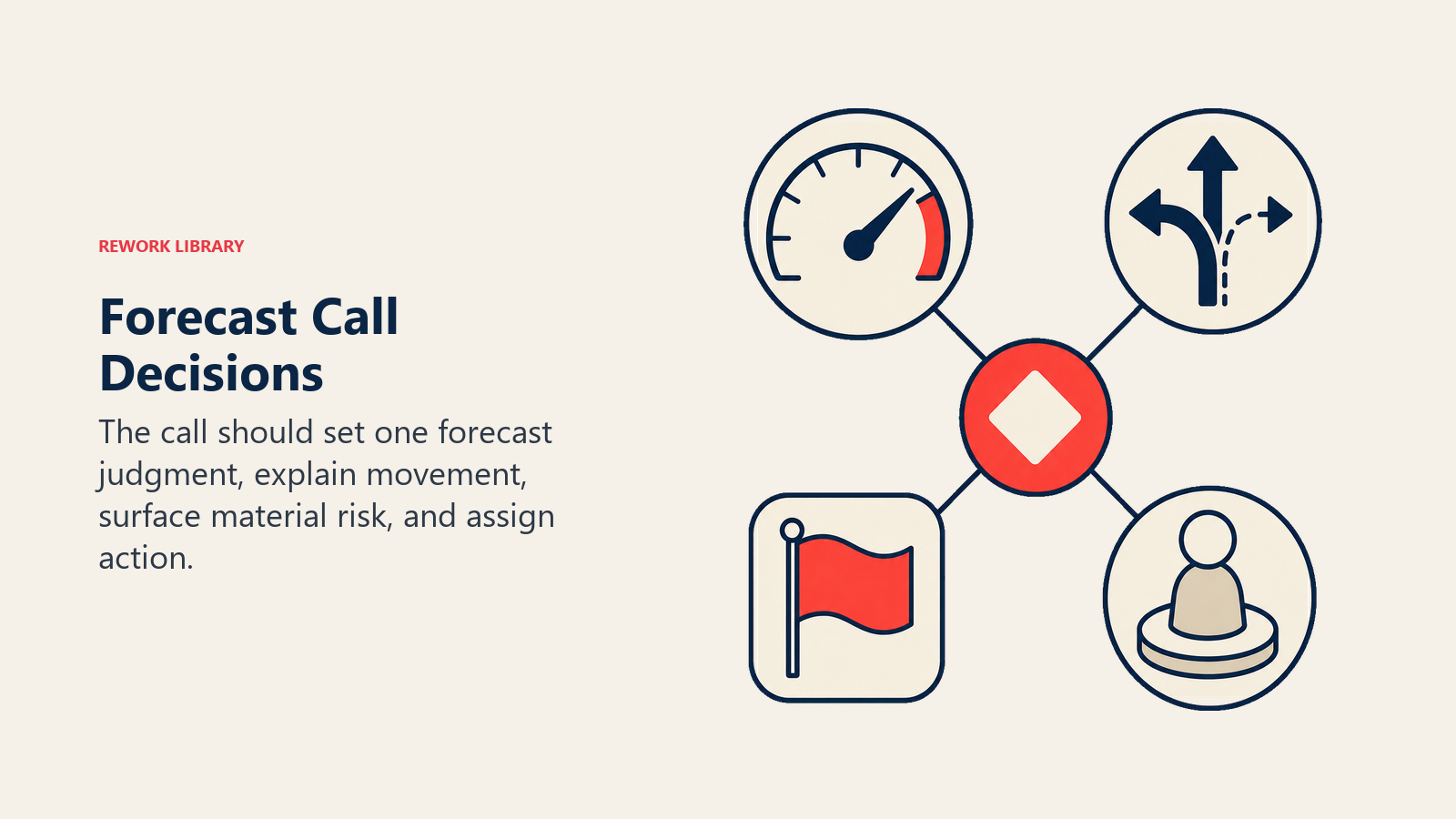
The forecast call should answer a small number of decision questions.
Turn this article into takeaways for your work.


Each assistant summarizes the article only for you and suggests best practices for your work.
| Decision question | Why it matters |
|---|---|
| What is the current leader call? | Creates one shared forecast judgment |
| What changed since the prior call? | Shows movement rather than static totals |
| Which risks can move the number materially? | Focuses attention on high-impact issues |
| Which deals need executive help? | Turns risk into action |
| Which caveats affect confidence? | Prevents false precision |
| What changed for finance planning? | Connects sales judgment to company planning |
| What must happen before the next call? | Creates accountability |
If a topic does not help answer one of these questions, it probably belongs somewhere else. Basic CRM cleanup belongs in inspection. Lead quality belongs in funnel review. Territory capacity belongs in planning. Pricing policy belongs in governance. Keeping those topics out is what lets the forecast call stay useful.
The call should also separate three numbers:
| Number | Meaning |
|---|---|
| System rollup | What the CRM says based on categories and amounts |
| Manager call | What managers believe after inspection |
| Leader call | What sales leadership is willing to stand behind |
Those numbers may differ. The value of the call is explaining why. A gap between system rollup and leader call may show data quality issues, category discipline problems, or informed risk judgment. RevOps should make the gap visible and document the reason.
Meeting roles
| Role | Responsibility |
|---|---|
| CRO or sales leader | Owns forecast judgment |
| Sales managers | Explain changes, risk, and actions |
| RevOps | Owns packet, definitions, data caveats, action log |
| Finance | Interprets planning impact |
| Executives | Help remove blockers when needed |
Attendance should stay focused. Forecast calls with too many people become performance theater.
What not to discuss
Do not spend the forecast call on:
- Basic field cleanup
- Every deal in pipeline
- Activity reporting
- CRM training
- Marketing source debate
- Strategy topics unrelated to current forecast
Move those topics to pipeline inspection, funnel review, systems governance, or planning cadence.
Decision log
Every call should capture:
- Forecast number
- Change from prior call
- Key risks
- Deals needing executive help
- Owners
- Deadlines
- Follow-up status
The decision log creates memory. Without it, the same risk can be discussed every week without movement.
Common failure modes
Call starts with "is the CRM updated?" Pipeline inspection failed.
Managers defend every deal. Criteria are unclear.
Finance does not trust the rollup. Data or definition governance is weak.
No action log. Risks repeat.
Every deal is reviewed. The meeting lacks prioritization.
Readiness checklist
Before launching the operating model:
- Forecast categories are defined.
- Commit criteria exist.
- Pipeline hygiene happens before the call.
- Packet is sent before the call.
- Roles are clear.
- Action log exists.
- Accuracy review happens after period close.
A useful forecast call should create a better forecast, not merely a cleaner spreadsheet.
Forecast call agenda
A practical agenda:
- Current rollup vs target
- Change since last call
- Commit movement
- High-impact risk
- Slippage review
- Finance planning impact
- Decisions and owners
Do not review every opportunity. Review the deals and movements that can change the number.
Pre-call checklist
Before the call:
- Managers review stale close dates.
- Reps update next steps.
- RevOps flags missing data.
- Finance notes plan variance.
- Sales leaders identify deals needing help.
- Prior action log is updated.
This keeps the meeting focused.
Risk review
Risk review should focus on evidence:
- What changed?
- What customer action is next?
- What could block the deal?
- Has procurement or legal started?
- Is the economic buyer engaged?
- Is close date tied to buyer process?
- Does CS or delivery see post-sale risk?
The goal is to make risk visible early.
Movement analysis
Every forecast call should explain movement:
- New commit added
- Commit removed
- Deals slipped
- Deals pulled forward
- Amount changed
- Category changed
- Close date changed
Movement matters more than static totals because it shows forecast behavior.
Forecast confidence model
Forecast calls need a practical way to talk about confidence.
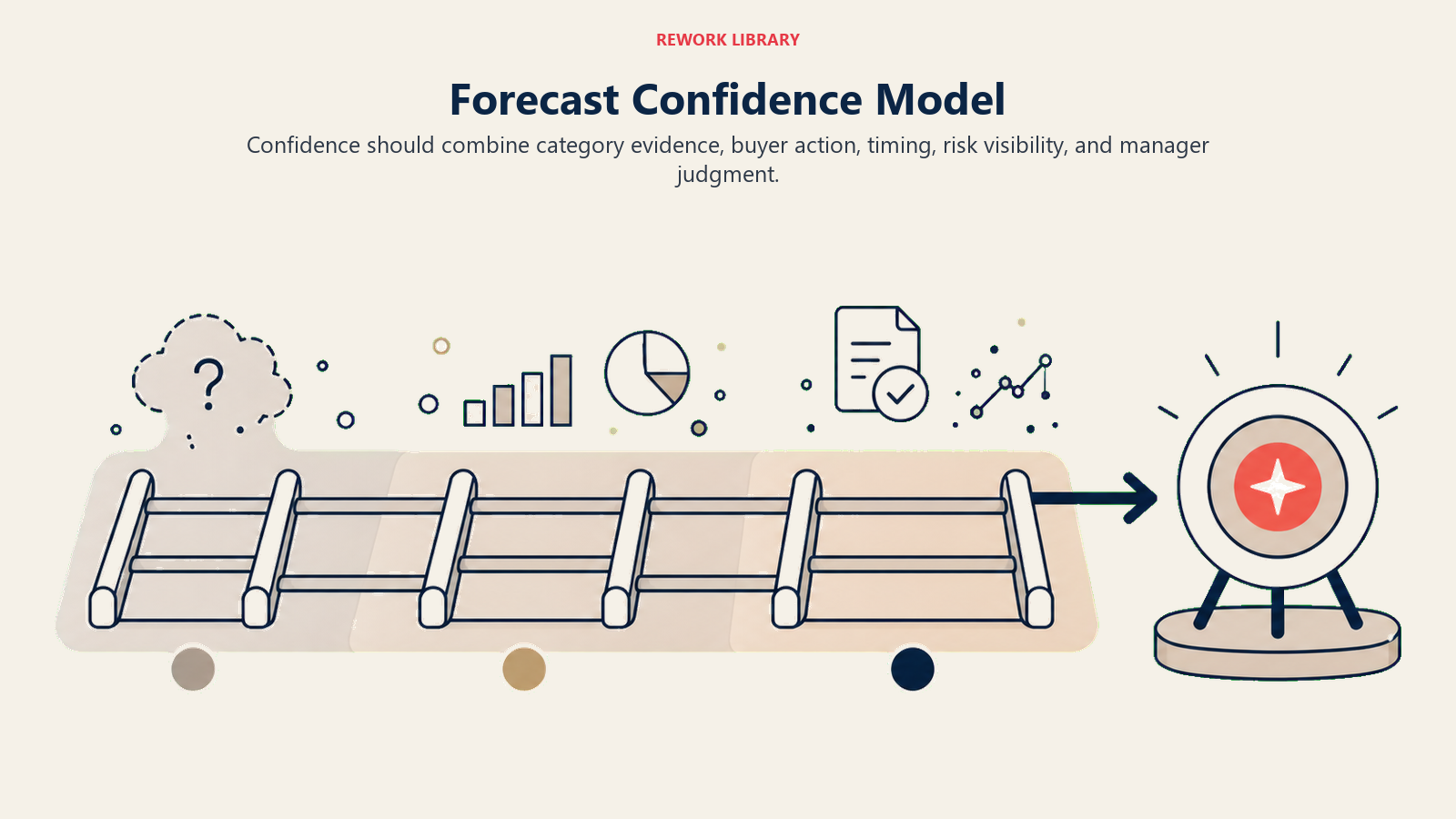
Use a simple confidence model:
| Confidence level | What it means | Evidence |
|---|---|---|
| High | Forecast category is supported and risk is known | Current next step, buyer action, manager inspection, clean data |
| Medium | Forecast is plausible but key evidence is incomplete | Some timing or risk caveat remains |
| Low | Forecast relies heavily on optimism or incomplete data | Missing buyer action, stale next step, weak stage evidence |
Confidence should not replace forecast category. It explains how much trust leaders should place in the category. A commit deal can have medium confidence if procurement timing is unclear. A best-case deal can have high confidence if the path is clear but timing is outside the current commit standard.
RevOps can include confidence in the packet as a caveat field or summary note. Keep it simple. A complex confidence score will create debate unless the data is very mature. A plain-language high, medium, low model is often enough to improve the conversation.
The confidence model should be calibrated after period close. If high-confidence commit deals slip often, the evidence standard is too weak. If low-confidence deals close frequently, the team may be too conservative or may be missing useful signals.
Action ownership
Actions should be specific:
- Executive sponsor to join customer call
- Manager to validate procurement path
- Rep to update mutual plan
- RevOps to correct data issue
- Finance to update scenario assumption
Generic actions like "follow up" are weak.
Forecast call scorecard
Track:
- Meeting length
- Percent of time spent on judgment vs cleanup
- Actions closed
- Forecast movement explained
- Commit accuracy
- Slippage rate
- Data-quality issues found during call
If cleanup consumes the call, move cleanup upstream.
Common scenarios
If a deal slips every week, it should not stay in commit without review.
If finance repeatedly asks for a separate forecast, trust is broken.
If managers disagree on category meaning, governance is weak.
If the same risk appears every week without an owner, the action log is failing.
What the scenario teaches
The forecast call should be a decision meeting. It should decide what the company believes, what could change that belief, and who owns the next action.
Meeting design by company stage
The forecast call should match the complexity of the business.
An early-stage company may need a simple weekly meeting with the founder, sales leader, finance lead, and RevOps owner. The call may focus on a small number of deals that can change cash planning. A larger company may need segment-level forecast calls that roll into an executive forecast review. The core logic is the same, but the operating model needs more layers.
| Company stage | Forecast call design |
|---|---|
| Early-stage | Few deals, direct executive review, high cash sensitivity |
| Scaling | Segment rollups, manager ownership, RevOps packet |
| Multi-region | Regional calls, standard definitions, executive rollup |
| Multi-product | Product mix, renewal and expansion visibility, finance scenarios |
The danger is adding meeting layers without improving decision quality. Every layer should either improve data quality, improve judgment, or speed action.
Forecast call inputs
The call should rely on a defined set of inputs:
- Forecast by category
- Change from prior call
- Commit movement
- Best-case movement
- Pipeline coverage by period
- Slippage list
- Large deal risk list
- Data-quality caveats
- Prior action log
- Finance plan variance
If an input is missing, the call should still happen, but the caveat should be stated. Hidden data caveats create false confidence.
Forecast call outputs
Each call should produce outputs that are clear enough to review next week.
| Output | Example |
|---|---|
| Forecast number | Current commit, best case, and leader call |
| Change explanation | Commit down because two deals slipped after procurement delay |
| Risk list | Three deals can move the quarter by more than 10 percent |
| Decisions | Executive sponsor will join two calls |
| Actions | Manager validates procurement path by Friday |
| Data caveats | Five commit deals missing current next step |
Without outputs, a forecast call becomes a discussion. With outputs, it becomes an operating mechanism.
Time-boxing the call
Forecast calls often expand because leaders review too many deals.
A better approach is to time-box the meeting:
- 5 minutes for rollup and target gap
- 10 minutes for movement since last call
- 20 minutes for high-impact risks and commit changes
- 10 minutes for finance and planning implications
- 5 minutes for decisions and owners
The exact time can change, but the principle should hold: spend most of the meeting on movements that change the number and actions that reduce risk.
If the team needs an hour to clean fields, the problem is not meeting length. The problem is pre-call discipline.
Handling disagreement
Forecast calls should allow disagreement, but disagreement needs a path to decision.
Common disagreements include:
- Sales believes the deal will close; finance sees weak timing evidence.
- A manager wants a deal in commit; RevOps flags missing criteria.
- A rep says procurement is done; legal status is unclear.
- A leader wants upside included; the category definition does not support it.
The operating model should define how these disagreements are handled. The CRO can make the final commercial call, but the data caveat should remain visible. That prevents political agreement from hiding forecast risk.
Forecast call and pipeline inspection
Pipeline inspection should happen before forecast judgment.
Inspection asks whether records are current, stages are accurate, next steps exist, and close dates make sense. Forecast judgment asks what the company believes will happen. Combining those jobs creates slow meetings and weak decisions.
Use Pipeline Inspection Cadence for the hygiene layer. Use the forecast call for movement, risk, and commitments.
Forecast call quality signals
RevOps should periodically evaluate the call itself.
Strong signals:
- Leaders spend little time on basic cleanup.
- Forecast changes are explained clearly.
- Finance sees caveats early.
- Actions close before the next call.
- Commit changes are tied to evidence.
- Accuracy improves over several periods.
Weak signals:
- The same stale deals appear every week.
- Leaders debate definitions during the call.
- Managers explain missing fields live.
- Finance rebuilds the forecast after the meeting.
- Actions are vague or ownerless.
The goal is not a perfect meeting. The goal is a meeting that makes the forecast more trustworthy every week.
Example operating flow
A simple weekly operating flow:
- Monday morning: reps update opportunities and next steps.
- Monday afternoon: managers inspect stage, close date, and forecast category.
- Tuesday morning: RevOps sends packet with movement and caveats.
- Tuesday call: leaders review changes, risk, and actions.
- Wednesday: owners update action log.
- Friday: RevOps checks action status and major changes.
This flow separates update work, inspection work, and decision work. It also gives finance time to see plan impact before the executive review.
What RevOps should avoid
RevOps should avoid becoming the forecast police.
The job is not to win arguments with managers. The job is to make definitions visible, caveats explicit, and actions traceable. Sales leadership still owns the commercial call. Finance still owns planning interpretation. RevOps owns the system that makes both possible.
If RevOps only points out dirty data, the team may see the process as administrative. If RevOps connects data issues to forecast risk, the process becomes useful.
Post-call review
After the call, send a short recap:
- Final forecast call
- Changes from prior call
- Top risks
- Decisions made
- Action owners
- Data caveats
- Next review date
Keep the recap short. The value is memory and accountability, not meeting minutes.
Escalation rules
The forecast call should define when a risk needs escalation.
Escalation triggers can include:
- A commit deal above a materiality threshold has no clear buyer action.
- Procurement or legal timing threatens the close date.
- Executive access is missing on a strategic account.
- A large deal moved category after the packet was sent.
- A data caveat affects the leadership call.
- A manager and finance disagree on planning impact.
Escalation should not mean panic. It means the issue needs a named owner and a decision path.
Escalation rules operating examples
Example: a $400K commit deal has a close date this month, but procurement has not started. The call should not spend ten minutes debating optimism. It should decide whether the deal remains commit, who owns procurement validation, and when the category will be reviewed again.
Example: best case increased by $900K in the final week of the quarter. RevOps should show which deals moved, what evidence changed, and whether the increase is real upside or gap-filling behavior.
Example: finance discounts one segment every month. The call should expose whether the issue is stage quality, category definitions, manager calibration, or weak historical conversion.
These examples are why the call needs structure. The meeting should convert risk into decisions.
Minimum viable version
If the team is early, start with a small version:
- One forecast packet
- One category definition page
- One action log
- One weekly call
- One post-period accuracy review
That is enough to improve discipline. The operating model can become more detailed after leaders trust the basic rhythm.
Rules
- Send data before the call.
- Clean CRM before the call.
- Focus on changes and risks.
- Record decisions and owners.
- Track forecast accuracy over time.
Post-period calibration
The forecast call operating model is incomplete without calibration after the period closes.
Review:
- Final actuals vs leader call
- Commit accuracy
- Best-case conversion
- Deals that slipped
- Deals that pulled forward
- Forecast category changes in the final weeks
- Data caveats that affected confidence
- Actions that helped or failed
The point is not to blame the manager who missed. The point is to improve the next forecast call. If slips came from procurement timing, the team may need better evidence rules. If upside closed unexpectedly, the team may be missing signals earlier in the period. If finance discounted a segment accurately, the team should inspect why sales category confidence was too high.
Post-period calibration should produce changes to definitions, packet design, inspection views, or manager coaching. If it only produces a retrospective discussion, the same forecast pattern will repeat.
Keep a simple calibration log:
| Finding | Operating change |
|---|---|
| Commit deals slipped because legal had not started | Add legal status to commit evidence for enterprise deals |
| Best-case conversion was higher than expected in one segment | Review whether category rules are too conservative |
| Forecast improved after manager inspection | Move inspection earlier in the weekly cadence |
| Finance caveat was accurate | Add caveat to packet instead of side-channel discussion |
This closes the loop between forecast calls, pipeline inspection, and executive reporting.
Preparation quality bar
The fastest way to improve a forecast call is to raise the bar for preparation.
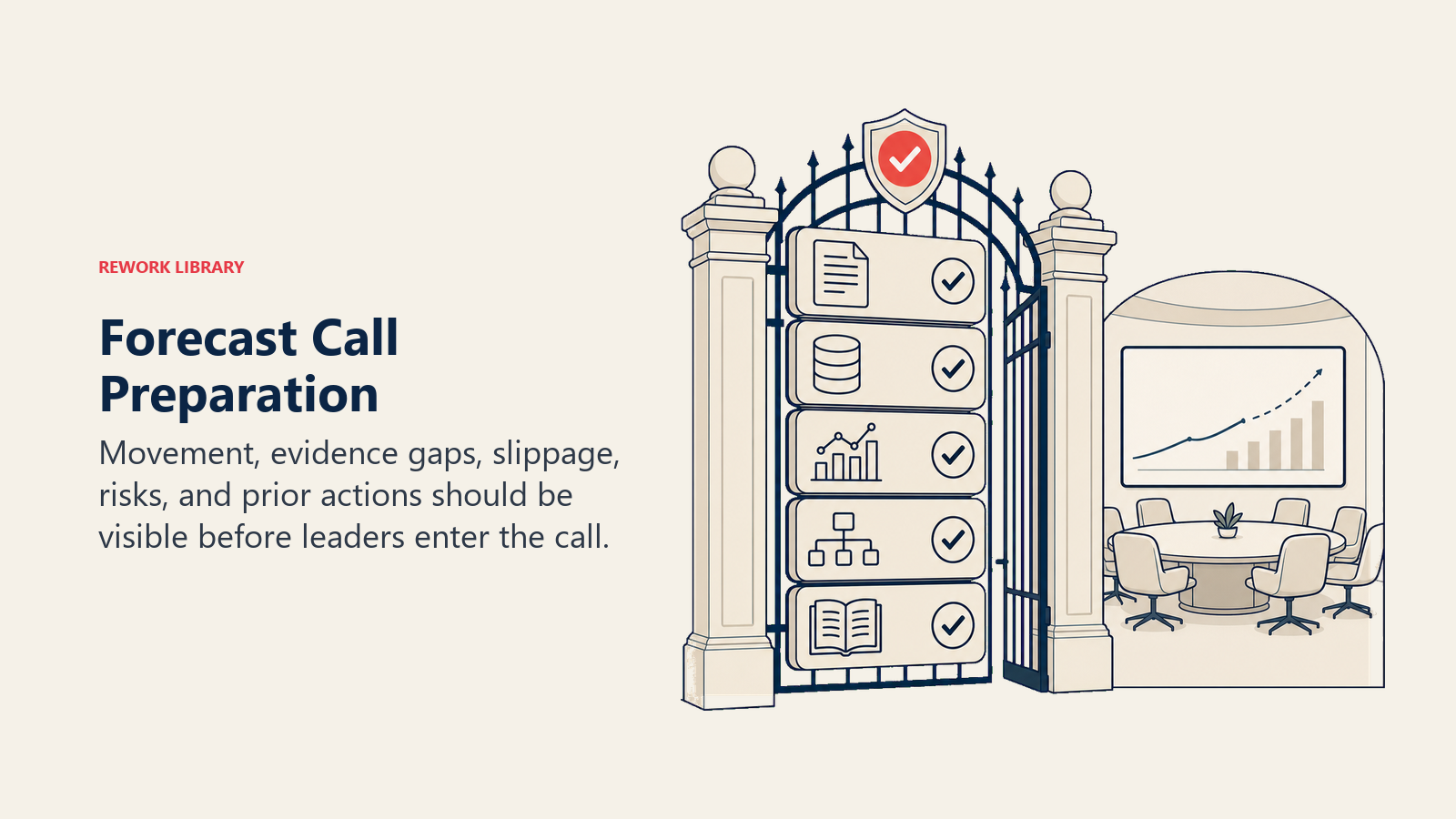
Before the call starts, leaders should be able to see:
| Prep item | Why it matters |
|---|---|
| Movement since prior call | Prevents static rollup discussion |
| Commit added and removed | Shows whether managers are changing judgment responsibly |
| Deals slipped or pulled forward | Explains timing movement |
| Large risks | Focuses the call on material issues |
| Data caveats | Separates data trust from commercial judgment |
| Prior action status | Stops repeated discussion without progress |
| Finance variance note | Connects forecast to planning |
If these inputs are not ready, the call will drift into live data gathering. That is slow and unfair to the people in the meeting. Managers end up explaining records they should have inspected earlier. Finance hears caveats too late. RevOps becomes the note taker for problems that should have been prepared.
Set a cutoff time for updates. For example, managers update opportunities by Monday noon, RevOps sends the packet Tuesday morning, and the forecast call happens Tuesday afternoon. Late changes can still be discussed, but they should be marked as late movement so leaders can see volatility.
The preparation bar should be visible. When the call goes poorly, inspect whether the issue was weak data, weak manager preparation, unclear criteria, or a real market change. Do not treat all misses as the same problem.
That distinction keeps the forecast process fair. A miss caused by sudden customer delay needs different action than a miss caused by stale category rules or manager optimism. The operating model should help leaders tell those cases apart quickly.
Forecast call decision packet
Before the call, RevOps should prepare:
| Section | Purpose |
|---|---|
| Movement since last call | Shows what changed |
| Commit evidence gaps | Shows where confidence is weak |
| Slippage list | Focuses managers on timing risk |
| Data caveats | Separates cleanup from judgment |
| Finance variance | Connects sales call to plan |
| Decision log | Tracks whether actions happen |
This lets the call focus on risk, movement, and management decisions instead of walking every opportunity line by line.
Frequently Asked Questions about Forecast Call Operating Model
Who should attend forecast calls?
Sales leadership, RevOps, finance, and managers responsible for the forecast. Keep attendance focused.
What should RevOps do in the call?
Own the data packet, highlight risk signals, and track decisions. Sales leadership owns the forecast judgment.
Learn more

Senior Operations & Growth Strategist
On this page
- Meeting structure
- What should happen before the call
- Forecast call packet
- What the call should decide
- Meeting roles
- What not to discuss
- Decision log
- Common failure modes
- Readiness checklist
- Forecast call agenda
- Pre-call checklist
- Risk review
- Movement analysis
- Forecast confidence model
- Action ownership
- Forecast call scorecard
- Common scenarios
- What the scenario teaches
- Meeting design by company stage
- Forecast call inputs
- Forecast call outputs
- Time-boxing the call
- Handling disagreement
- Forecast call and pipeline inspection
- Forecast call quality signals
- Example operating flow
- What RevOps should avoid
- Post-call review
- Escalation rules
- Escalation rules operating examples
- Minimum viable version
- Rules
- Post-period calibration
- Preparation quality bar
- Forecast call decision packet
- Learn more