CRM Data Hygiene With an AI Copilot
Turn this article into takeaways for your work.


Each assistant summarizes the article only for you and suggests best practices for your work.
Garbage in, garbage out.
You've heard it enough times that it feels like a platitude. But in AI-assisted sales operations, it's the governing equation. Your lead scoring model is trained on CRM data. Your account tier assignments pull from CRM firmographics. Your pipeline forecast is calculated from deal stage data. Your intent signal routing fires based on account records in CRM.
Every AI function in your sales stack is downstream of CRM data quality. When that data is messy, your AI outputs are confidently wrong. And confidently wrong is worse than admittedly uncertain because reps act on it. Gartner estimates that poor data quality costs organizations an average of $15 million annually, with CRM data quality issues representing one of the highest-impact sources of that cost for commercial teams.
CRM hygiene isn't glamorous work. RevOps leaders know this. Most have launched a data cleanup project, run it for a quarter, declared victory, and watched data quality degrade again within 6 months. The quarterly cleanup model doesn't work because data doesn't go bad quarterly. It degrades continuously, at a rate driven by your deal volume, your rep discipline, and the pace of change in your accounts.
The Workflow Copilot pattern applied to CRM hygiene is a different model: continuous, automated detection and correction, with a governance layer that keeps humans in the decision chain for anything above a confidence threshold. This article covers how it works, the four problem types it handles, and why it's the infrastructure investment that makes everything else in your AI stack more reliable.
What CRM data hygiene means operationally
Key Facts: The Cost of Bad CRM Data
- Poor CRM data quality costs the average B2B company $12.9 to $15 million per year through wasted marketing spend, lost sales opportunities, and operational inefficiencies. (Gartner / ZoomInfo, 2025)
- Sales reps waste 27% of their time dealing with bad data, costing an estimated $32,000 per rep annually in lost productivity. (Validity, 2025)
- B2B contact data decays at approximately 2.1% per month, meaning 22-30% of CRM contact records become inaccurate within a year without active hygiene. (Salesgenie, 2025)
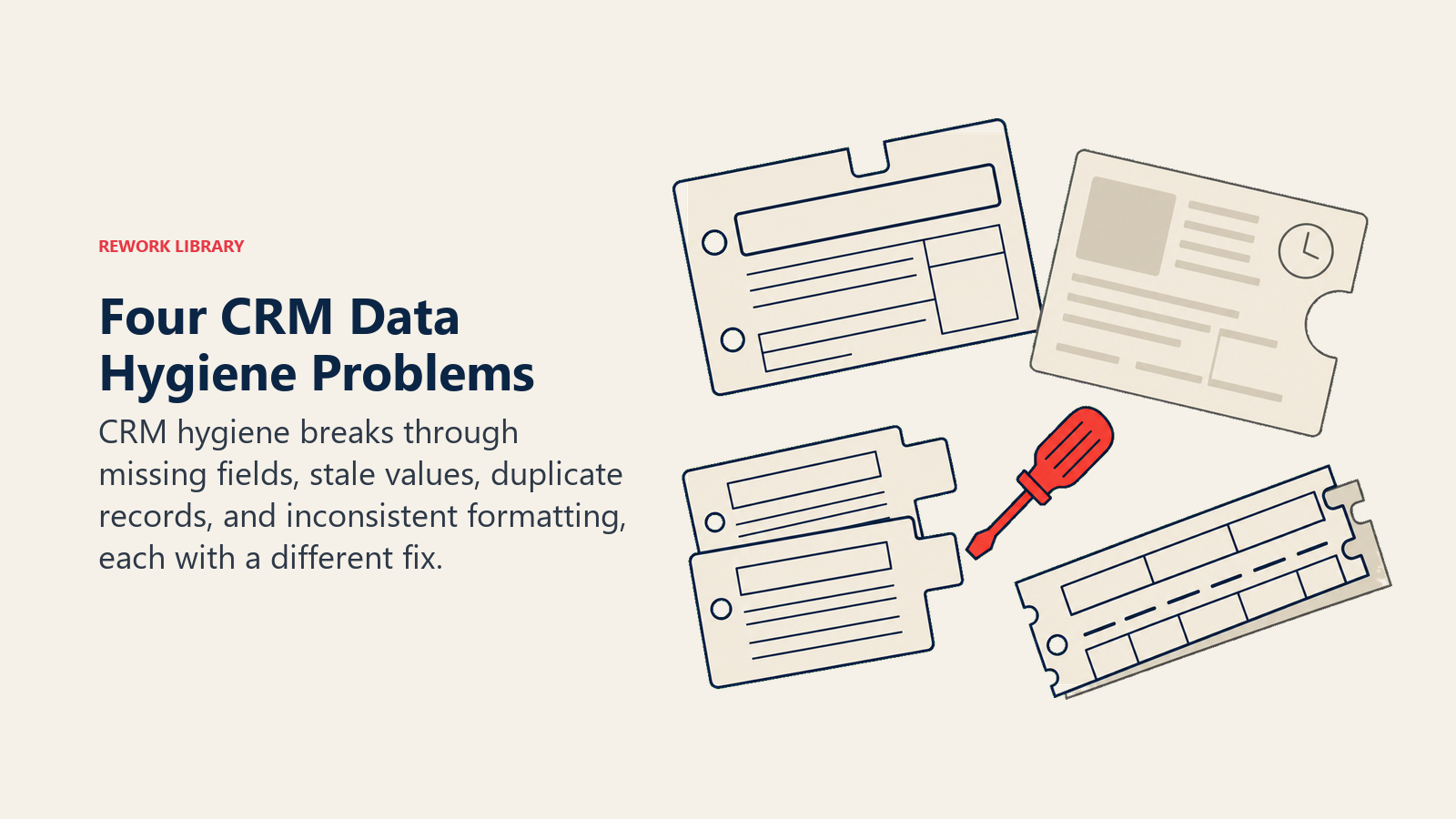
"Data hygiene" is a catch-all term. For RevOps purposes, it covers four distinct problem types:
Duplicates. The same company exists as two records ("Acme Corp" and "Acme Corporation Inc"). The same contact is in the system three times from three different import events. Duplicates split activity history, fragment relationship context, and produce inflated contact counts that mess up your territory assignments.
Field completeness. Required fields are empty. No industry vertical. No employee count. No last funding round. No primary contact on the account. These gaps break scoring models that use those fields as inputs and produce blank cells in reports that should be decision surfaces.
Stale records. No activity logged in 180 days, but the deal is still open in your pipeline. The contact's company got acquired 8 months ago but the account record hasn't been updated. The primary champion left the company but is still listed as the main contact. Stale records generate false pipeline confidence and produce missed outreach to live opportunities.
Enrichment drift. Data was accurate when entered and has since become wrong through external change. Companies move. Contacts change jobs. Phone numbers go dead. Funding rounds happen. Headcounts change. The CRM doesn't know; it just stores what was entered. Over time, the gap between CRM records and ground truth expands.
All four problem types degrade AI output quality in specific ways. Duplicates confuse scoring models with split signal data. Missing fields reduce model accuracy and produce unscored records. Stale records inflate pipeline numbers and distort forecasting. Enrichment drift produces outreach to wrong contacts and wrong qualification criteria.
How the Workflow Copilot handles hygiene
The Workflow Copilot pattern in the ACE Framework describes a continuous assist loop: Ingest the current context, Analyze to identify what needs attention, Generate a suggestion, Execute with human approval (or automated action for high-confidence cases), then repeat.
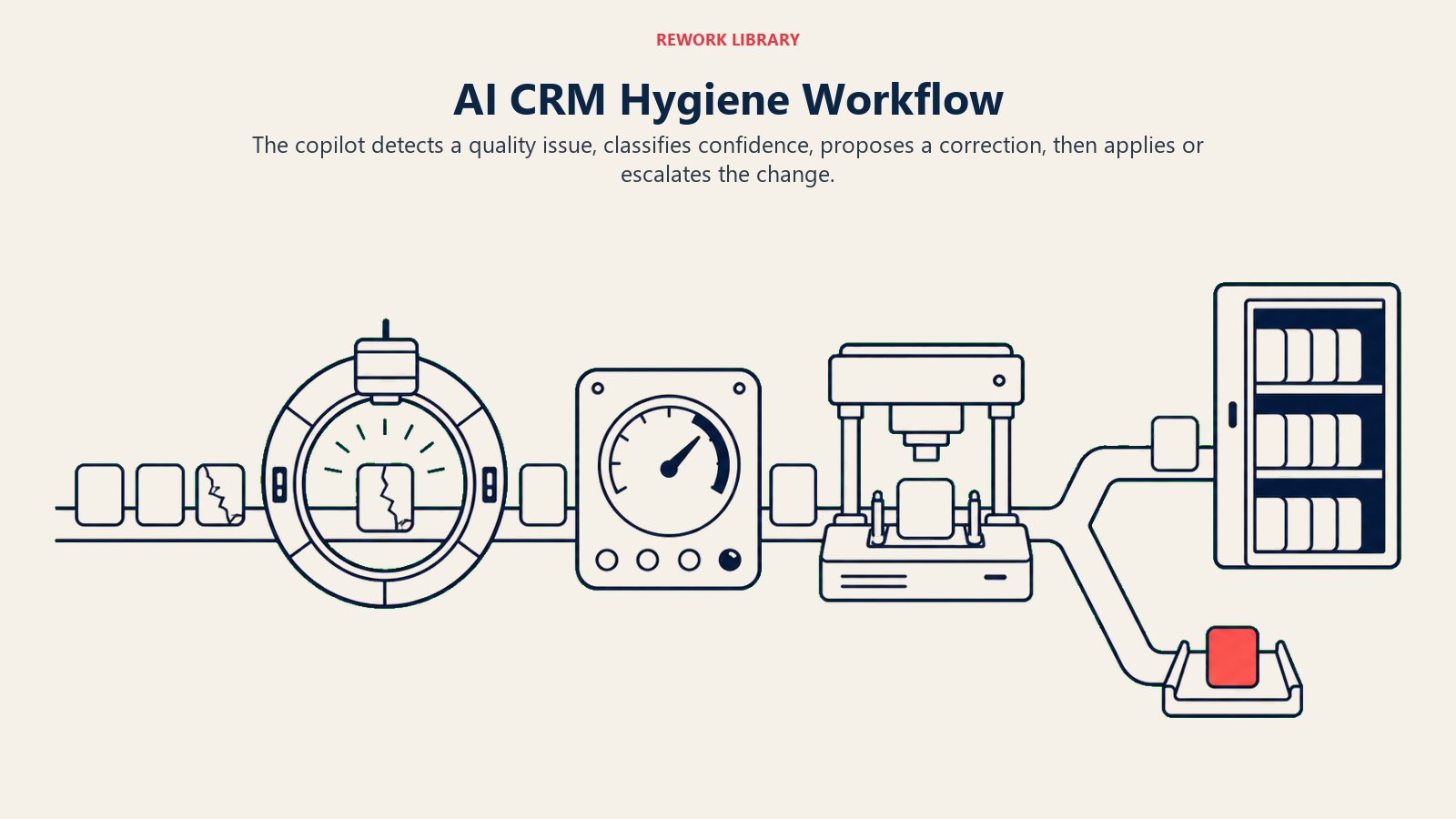
Applied to CRM hygiene:
Ingest reads the current CRM state. All records, all activity logs, all field values. This happens on a continuous basis (new records trigger immediate checks) and on a scheduled batch basis (full database scan weekly).
Analyze identifies data issues across the four problem types:
- Duplicate detection: matching on company name, domain, phone number, and address similarity
- Completeness checking: scoring each record against required field definitions
- Freshness assessment: flagging records with no logged activity past configurable thresholds
- Enrichment drift detection: comparing CRM data against external data sources (company databases, LinkedIn, domain lookup)
Generate produces a suggested fix for each identified issue:
- For duplicates: a merge recommendation specifying which record to keep as primary and which fields to take from each record
- For missing fields: auto-filled values from enrichment sources, with confidence scores
- For stale records: suggested status change (mark inactive, requalify, archive) with context
- For drift: updated field values from enrichment, clearly sourced
Execute routes the suggested fix through one of two paths, depending on confidence:
- High confidence (above threshold): auto-execute the fix and log the action
- Below threshold: queue for rep or RevOps review with the suggested fix presented
The governance layer is what separates this from chaos. Automated execution on everything produces a different kind of data quality problem: corrections applied at scale without review can propagate errors just as efficiently as they fix them. For the broader governance principles that apply across all AI systems, AI sales ops governance and audit trails covers the framework in detail.
B2B contact data decays at 2.1% per month, and 30% of all CRM records become obsolete annually. A quarterly cleanup campaign means the average organization is operating on 5-7% degraded data for most of the year.
The Confidence-Threshold Auto-Fix Rule
The Confidence-Threshold Auto-Fix Rule is the governance principle that determines which CRM hygiene corrections execute automatically and which require human review. It has three tiers: above 90% confidence on a known enrichment source triggers auto-fix with an audit log entry; between 50-90% confidence generates a suggestion queued for RevOps or rep approval; below 50% confidence produces a flag only, no suggested correction. The rule prevents two failure modes: under-automation (a backlog nobody processes) and over-automation (confident errors propagated at scale). The threshold percentages should be calibrated quarterly based on sampled audit review of auto-corrections.
Auto-fix vs. rep-review thresholds
The governance model is the most important design decision in an AI CRM hygiene system.
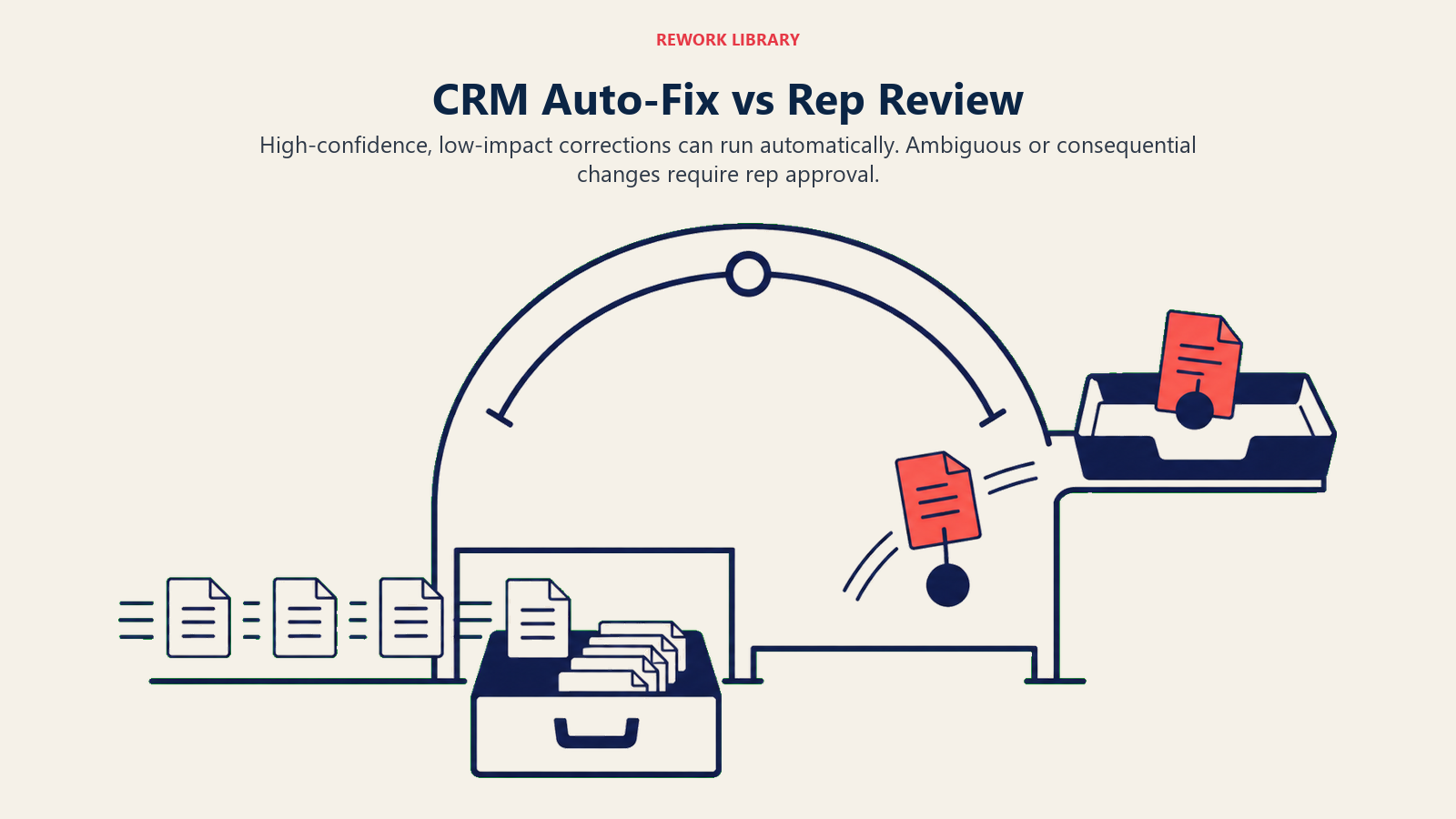
What gets auto-fixed:
- Exact-match duplicate records (same email address, same domain, confirmed same company) with no conflicting field data: merge automatically, log the merge
- Missing fields where enrichment source confidence is high (greater than 90%): fill automatically
- Records with zero activity and zero deal history older than 365 days: auto-archive with a 30-day recovery window
What gets queued for review:
- Fuzzy-match duplicates (same company name, different domains): present a merge suggestion, require human confirmation
- Missing fields where enrichment confidence is moderate (50% to 90%): suggest the fill with source citation, require confirmation
- Stale active deals (no activity in 90 days, deal status still open): alert the deal owner, don't auto-close
- Enrichment drift on key fields like company name or primary contact: flag for rep review, don't overwrite silently
What gets flagged only:
- Potential enrichment drift with low confidence: surface as "this may be outdated" without suggesting a specific correction
- Records that appear to have mismatched data across fields without a clear fix
The threshold calibration requires tuning based on your data environment. Start conservative (more review, less automation) and move toward automation as you build confidence in the model's accuracy for your specific data patterns.
A useful way to think about it: if the AI makes a mistake at this confidence level, how bad is the consequence? For exact-match duplicates, the cost of a wrong merge is recoverable. For overwriting a key contact's information with wrong enrichment data, the consequence is a rep calling the wrong person about a live deal. Different risk profiles require different thresholds.
The four hygiene problem types in depth
Use this section map to orient the workflow before moving into the detailed steps.
Duplicates
Duplicate records are the most common CRM data problem and the most computationally interesting to detect. Exact matches on email or domain are easy. The hard cases are:
- "Acme Corp" and "Acme Corporation" (same company, different name strings)
- Two contact records for "John Smith" with the same phone number but different companies listed (job change, not a different person)
- A company that was acquired and now exists as both an account in its own right and as a subsidiary under the acquirer
AI deduplication uses multiple matching signals: string similarity on company name, domain matching, address matching, phone matching, and network graph analysis (contacts linked to the same company through different paths). Combining signals produces a confidence score for each potential merge.
The key operational decision: should merges be automatic, or should every merge require human review? For high-volume organizations running 50,000+ records, requiring human review on every merge creates a backlog nobody will process. Define your automation threshold and audit a sample of auto-merges monthly to check accuracy.
Field completeness
Required field definitions vary by organization. But a minimum standard for AI-assisted sales operations includes: company industry vertical, company headcount range, last funding date and round, primary contact with verified email, and sales-qualified lead status.
AI fills missing fields from enrichment sources: Clearbit, ZoomInfo, LinkedIn, Crunchbase, and company website data. The quality varies by field type. Company headcount and funding are generally reliable. Industry classification can drift (some enrichment providers use different taxonomy systems). Individual contact data degrades quickly as people change jobs.
Track completeness rates as a standing RevOps metric. Target 90%+ completeness on required fields for active accounts. MIT Sloan's research on data quality finds that organizations treating data quality as a continuous process rather than a periodic project see three to four times better outcomes from their data-driven initiatives. When completeness drops below threshold, investigate whether the issue is in the data entry workflow (reps skipping fields) or in enrichment coverage (your enrichment provider doesn't have data for small companies in your target vertical).
Stale records
Stale records in the pipeline are the most dangerous hygiene problem because they produce false revenue confidence. A pipeline report showing $2.4M in open deals is misleading if $800K of that is in deals that haven't had any activity in 6 months.
AI stale record detection uses activity timestamp data: last email, last call, last meeting, last CRM note. Records that cross configurable thresholds (90 days for early-stage deals, 180 days for late-stage) get flagged.
The appropriate action depends on the record type. For open deals: alert the deal owner to either log activity or mark the deal inactive. Don't auto-close active deals. For contacts with no activity: check if they're still employed at the company before deciding what to do. For accounts with no activity: differentiate between accounts in no active sequence (fine) and accounts that should be in a nurture sequence but aren't.
Enrichment drift
This is the quietest problem and one of the most damaging. The data was right when it was entered. External reality changed. The CRM didn't update.
Contact job changes are the most common: the champion you've been cultivating left the company 3 months ago and your rep is still emailing the old address. Company acquisitions: the account you're pursuing was bought and is now a subsidiary with a different procurement process. Funding events: the company just raised a Series B, which changes their buying power and probably their timeline for technology decisions.
AI drift detection compares CRM records against external signals: LinkedIn changes (contact title or company changes), news events (acquisition announcements, funding rounds), company website changes. When a mismatch is detected, it surfaces as a flag rather than an automatic correction, because context matters. "This contact's LinkedIn now shows a different company" is a signal, not a definitive correction.
Continuous hygiene vs. quarterly cleanup
Most organizations approach CRM hygiene as a project: quarterly cleanup campaigns, usually triggered by a forecasting review where numbers look wrong or an audit where data quality appears degraded.
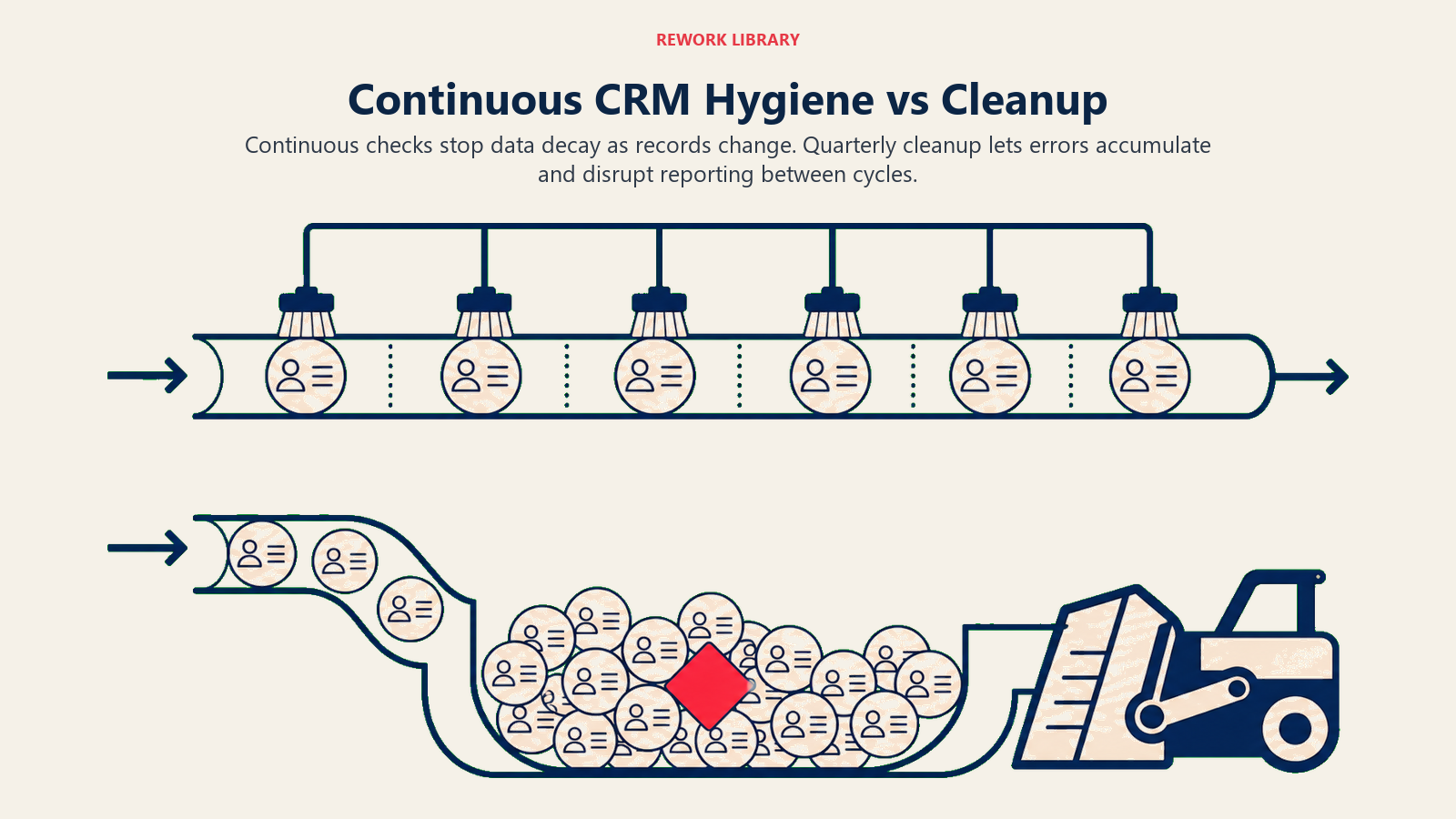
The problem with quarterly campaigns is the data degradation curve. For an organization with active deal flow, here's a rough estimate of how quickly each problem type accumulates:
- New duplicates: 5 to 15 per week from import events, manual entry, and system integrations
- Field completeness gaps: every new record created without a complete intake process
- Stale records: every deal that stalls, every contact that goes cold
- Enrichment drift: 2 to 3% of active contact records become inaccurate per month from job changes alone
By the time a quarterly cleanup campaign runs, months of degradation have accumulated. The cleanup is a bigger project each time. And it doesn't prevent degradation; it just restores to baseline before the next cycle of decay.
Continuous AI hygiene changes the economics. Rather than batch-correcting months of accumulated problems, the AI runs continuously and catches issues close to when they occur. The maintenance workload per issue is lower. The data quality floor is higher. And the AI-assisted downstream functions, scoring, routing, forecasting, all operate on cleaner data throughout the quarter, not just in the two weeks after a cleanup project.
Upstream dependency: why clean data isn't just a hygiene concern
Every AI function in your sales stack is downstream of CRM data quality. This dependency chain makes data hygiene a strategic investment, not just an operational one.
AI Lead Scoring Beyond Rules-Based Models depends on CRM field completeness for scoring inputs. Missing industry or headcount data produces unscored or poorly-scored records.
From Call to CRM Update Automatically produces cleaner CRM data as outputs, but depends on account and contact records being correctly structured to know where to write updates.
Next Best Action for Each Open Deal uses deal stage data, last activity dates, and contact completeness to generate recommendations. Stale deal data and missing contact information directly degrade recommendation quality.
The compounding effect: CRM hygiene problems don't produce isolated errors. They propagate. A duplicate account record means scoring signals are split across two records, reducing apparent intent for both. A stale deal inflates the pipeline forecast, which leads to over-optimistic resource planning. An outdated contact means outreach goes to the wrong person, which generates no response, which the AI scoring model interprets as low engagement, which reduces the account's priority score.
Clean data improves every AI output downstream. It's not about having tidy records. It's about the quality of every AI-generated decision your organization makes from those records.
Implementation tools
Rework CRM includes AI-assisted data hygiene as part of its sales operations layer. Duplicate detection, field completion from enrichment sources, and staleness flagging are built into the account and contact management workflow. The governance model (auto-fix vs. review queue) is configurable by field type and confidence threshold.
Salesforce duplicate management provides native duplicate rules and matching rules, with automated detection and merging. Third-party tools (Cloudingo, DemandTools) extend this with more sophisticated matching logic and batch operations. AI enrichment is typically added via integration with Clearbit or ZoomInfo.
HubSpot data quality tools include duplicate management for contacts and companies, with a dedicated review queue. Field-level data health reporting shows completeness rates across the database. HubSpot's native enrichment (via its data enrichment feature) fills basic company fields automatically for identified records.
Clay is a more composable option for teams that want to build custom enrichment workflows. Connect multiple data sources (Clearbit, Apollo, LinkedIn, domain data), define enrichment waterfalls (try source A, fall back to source B), and push clean data back to your CRM. Requires more setup than native CRM tools but offers more flexibility for non-standard use cases.
The Analyze capability covers the detection and classification logic that underlies hygiene analysis. The data readiness prerequisite article explains why clean CRM data is the gating requirement for every AI system in your stack. Gartner's 12 actions to improve data quality is a practical companion resource for RevOps leaders building a formal data quality program alongside their AI hygiene tooling.
The infrastructure argument
CRM hygiene is the least glamorous line item in a RevOps budget. It doesn't directly generate revenue, doesn't add a new capability, and doesn't produce a metric that shows up in a board report.
But it's the infrastructure that makes everything else accurate. Lead scoring accuracy, routing precision, pipeline forecast reliability, rep next-action quality: all of it is contingent on data quality.
The AI-assisted continuous hygiene model changes the resource equation. Instead of one large cleanup project per quarter that consumes 40 to 80 hours of RevOps time, you have an always-on system that catches and corrects issues at source. The total human time required is lower. The data quality is consistently higher.
And when you add a new AI capability to your sales stack, you're not starting from a data problem. You're building on clean data. That's the compounding return on the infrastructure investment.
Data hygiene is not a product you buy once. It's a process you run continuously. AI makes it possible to run that process without proportional headcount growth. That's the argument for it. And it's the reason every other AI tool in your stack works better when you get this one right.
Rework Analysis: In RevOps deployments, the most important early calibration decision is the auto-fix threshold for duplicate merges. Setting it too low (auto-merging fuzzy matches below 85% confidence) creates a different data quality problem: legitimate companies with similar names merged incorrectly, producing activity history contamination that's harder to untangle than the original duplicates. Start at 95% confidence for auto-merge, verify 50 random auto-merges in the first month, then adjust the threshold based on error rate. Most teams can move to 90% after the first calibration cycle.
Organizations with continuous AI data hygiene programs maintain 90%+ field completeness on required CRM fields. Organizations relying on quarterly manual cleanup average 65-75% completeness, with accuracy lowest in the six weeks before each cleanup cycle. (MIT Sloan data quality research)
Frequently Asked Questions
How much does poor CRM data quality actually cost?
Poor data quality costs the average B2B company $12.9 to $15 million per year through wasted marketing spend, lost sales opportunities, and operational inefficiencies, according to Gartner estimates. At the individual rep level, sales reps waste 27% of their time dealing with bad data, costing roughly $32,000 per rep annually. The organizational cost compounds because every AI function downstream of CRM (lead scoring, pipeline forecasting, next-best-action) is producing confidently wrong outputs from dirty inputs.
How quickly does CRM data decay?
B2B contact data decays at approximately 2.1% per month, translating to 22-30% of all contact records becoming inaccurate within a year without active hygiene. Job changes are the primary driver: contacts change employers, titles, and email addresses continuously. Company-level data (firmographics, funding stage, tech stack) changes more slowly but is equally impactful when it does change, because it affects scoring model inputs and qualification criteria.
What is the Confidence-Threshold Auto-Fix Rule?
The Confidence-Threshold Auto-Fix Rule is a three-tier governance model for AI CRM corrections: above 90% confidence on a known enrichment source triggers auto-correction with an audit log; between 50-90% confidence queues a suggestion for human review; below 50% produces a flag only. The rule prevents under-automation (backlog nobody processes) and over-automation (confident errors at scale). The thresholds should be calibrated quarterly by sampling audit reviews of auto-corrections. Most teams start at 95% for the auto-fix tier and move to 90% after the first calibration cycle.
What four types of CRM data problems does AI hygiene address?
AI CRM hygiene addresses duplicates (same company or contact in multiple records), field completeness gaps (required fields empty), stale records (open deals or contacts with no activity for 90-180+ days), and enrichment drift (data that was accurate when entered but has since become wrong through external change). Each problem type degrades different downstream AI functions: duplicates split scoring signals, missing fields reduce model accuracy, stale records inflate pipeline forecasts, and drift produces outreach to wrong contacts.
Why is quarterly CRM cleanup insufficient?
Quarterly cleanup treats data quality as a project rather than a process. For an organization with active deal flow, new duplicates accumulate at 5-15 per week, field completeness gaps appear with every new record, stale deals accumulate constantly, and 2.1% of contacts drift per month. By the time a quarterly campaign runs, months of degradation have accumulated. Continuous AI hygiene catches issues close to when they occur, reducing both the backlog and the consequences of errors that persist for 90 days before correction.
How does CRM data quality affect AI lead scoring?
AI lead scoring models train on and run against CRM data. Missing fields (no industry vertical, no headcount) produce unscored or inaccurately scored records. Duplicate records split intent signals across two accounts, making each appear less engaged than they actually are. Stale deal data distorts training sets by including inactive deals as if they're live prospects. Organizations with 90%+ CRM completeness rates see meaningfully higher lead scoring accuracy than organizations with 65-75% completeness, because the model has more complete signal data to work from.
What to read next
- Workflow Copilot: AI as Peer-Level Assistant: the ACE pattern behind continuous AI assistance in sales workflows
- AI Lead Scoring Beyond Rules-Based Models: how CRM data quality directly affects scoring model accuracy
- Next Best Action for Each Open Deal: the downstream AI function most dependent on clean deal data
- AI Sales Ops Governance and Audit Trails: governance frameworks for automated data operations

Co-Founder, Rework.com
On this page
- What CRM data hygiene means operationally
- How the Workflow Copilot handles hygiene
- The Confidence-Threshold Auto-Fix Rule
- Auto-fix vs. rep-review thresholds
- The four hygiene problem types in depth
- Duplicates
- Field completeness
- Stale records
- Enrichment drift
- Continuous hygiene vs. quarterly cleanup
- Upstream dependency: why clean data isn't just a hygiene concern
- Implementation tools
- The infrastructure argument
- What to read next