Funnel Governance: How RevOps Keeps the Revenue Lifecycle Clean
Funnel governance is the discipline of defining, operating, and improving the revenue lifecycle.
Without governance, funnel stages become labels people interpret differently. Marketing calls a lead qualified because it meets a score. Sales rejects it because the account does not match the ICP. Customer success sees a closed-won customer with no implementation context. Finance sees a forecast built from stages that mean different things by rep.
RevOps prevents that by governing the funnel as one system.
Harvard Business Review's work on sales and marketing alignment shows why shared definitions matter: teams can believe they are aligned while operating from different assumptions. McKinsey's B2B growth research also points to the need for integrated commercial systems when buyer journeys and growth motions become more complex.
Funnel governance is how RevOps turns those ideas into operating rules.
Key operating facts
- Funnel governance defines lifecycle stages, entry criteria, exit criteria, owners, required data, SLAs, and exception paths.
- It should cover the full revenue lifecycle, not only lead and opportunity stages.
- Governance works only when stage movement is auditable and managers inspect against evidence.
- RevOps should review funnel governance when GTM motion, systems, segments, or customer lifecycle changes.
What funnel governance covers
| Area | Governance question |
|---|---|
| Stage definitions | What does each stage mean? |
| Entry criteria | What must be true before a record enters? |
| Exit criteria | What evidence moves it forward? |
| Ownership | Which team owns the stage? |
| Required data | What fields are mandatory? |
| SLA | How quickly must action happen? |
| Exception path | What happens when the process breaks? |
Start with Revenue Funnel Stages, then add Stage Exit Criteria.
What good governance changes
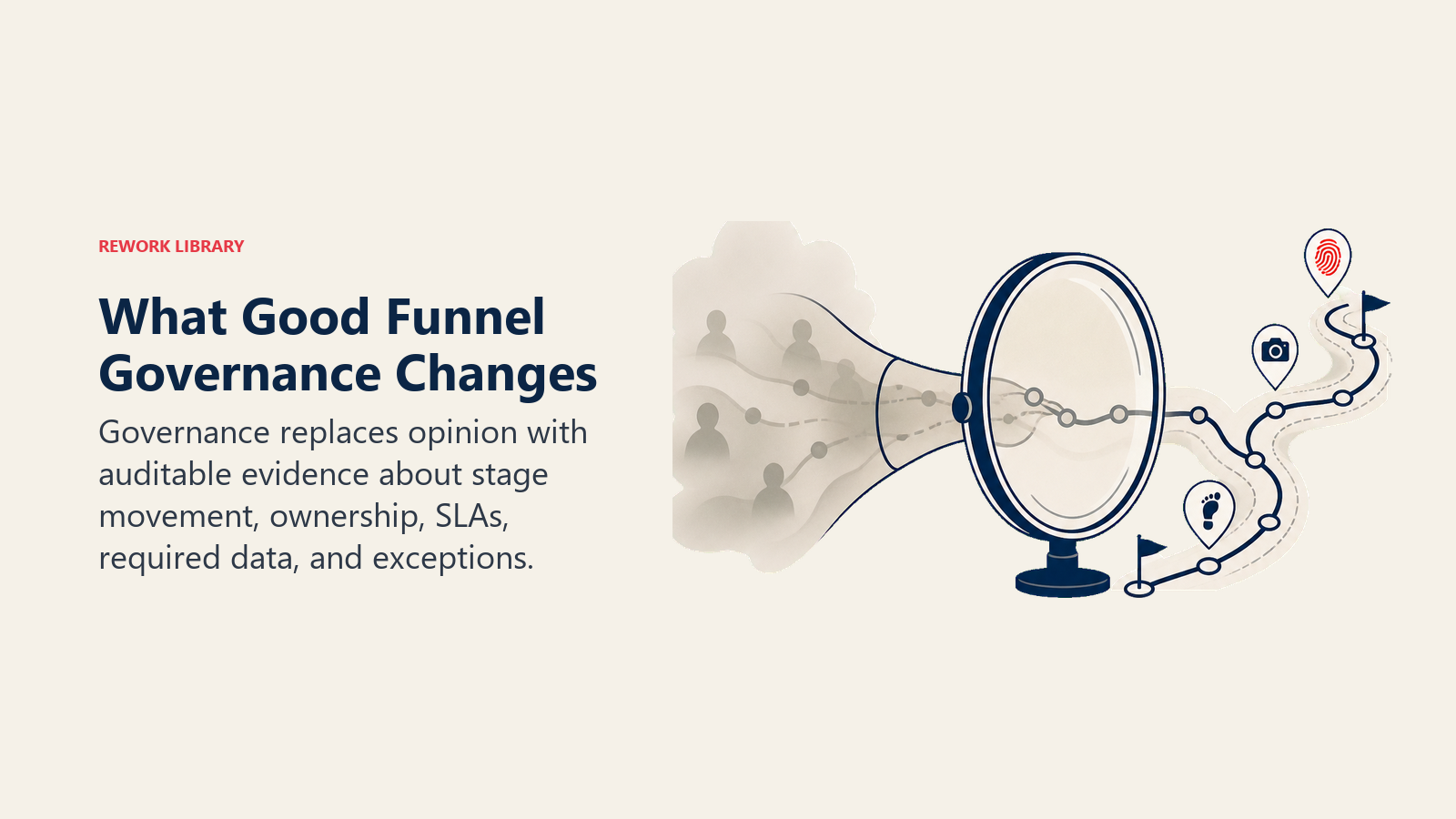
Good funnel governance changes the conversation from opinion to evidence.
Turn this article into takeaways for your work.


Each assistant summarizes the article only for you and suggests best practices for your work.
Without governance, leaders ask:
- Why did sales reject those leads?
- Why did this opportunity move to late stage?
- Why is the forecast so different from finance's view?
- Why did CS receive a customer without success criteria?
- Why do two dashboards show different conversion rates?
With governance, the company can inspect the process:
- Which entry criteria were met?
- Which exit criteria were missing?
- Which owner missed the SLA?
- Which required data was incomplete?
- Which exception path was used?
- Which definition changed?
That shift matters because revenue operations is not only about visibility. It is about control. A company cannot improve a funnel it cannot define.
The governance layer
RevOps should govern the funnel at three levels.
| Level | What it governs | Example |
|---|---|---|
| Definition | What each stage means | MQL requires ICP fit plus qualifying behavior |
| Movement | How records enter and exit | SQL requires sales acceptance or rejection reason |
| Inspection | How quality is monitored | Weekly report on SLA misses and stale stages |
Definition without movement rules creates vague labels. Movement rules without inspection create process theater. Inspection without definitions turns meetings into arguments.
A strong funnel has all three.
Entry and exit criteria
Every stage should have entry and exit criteria.
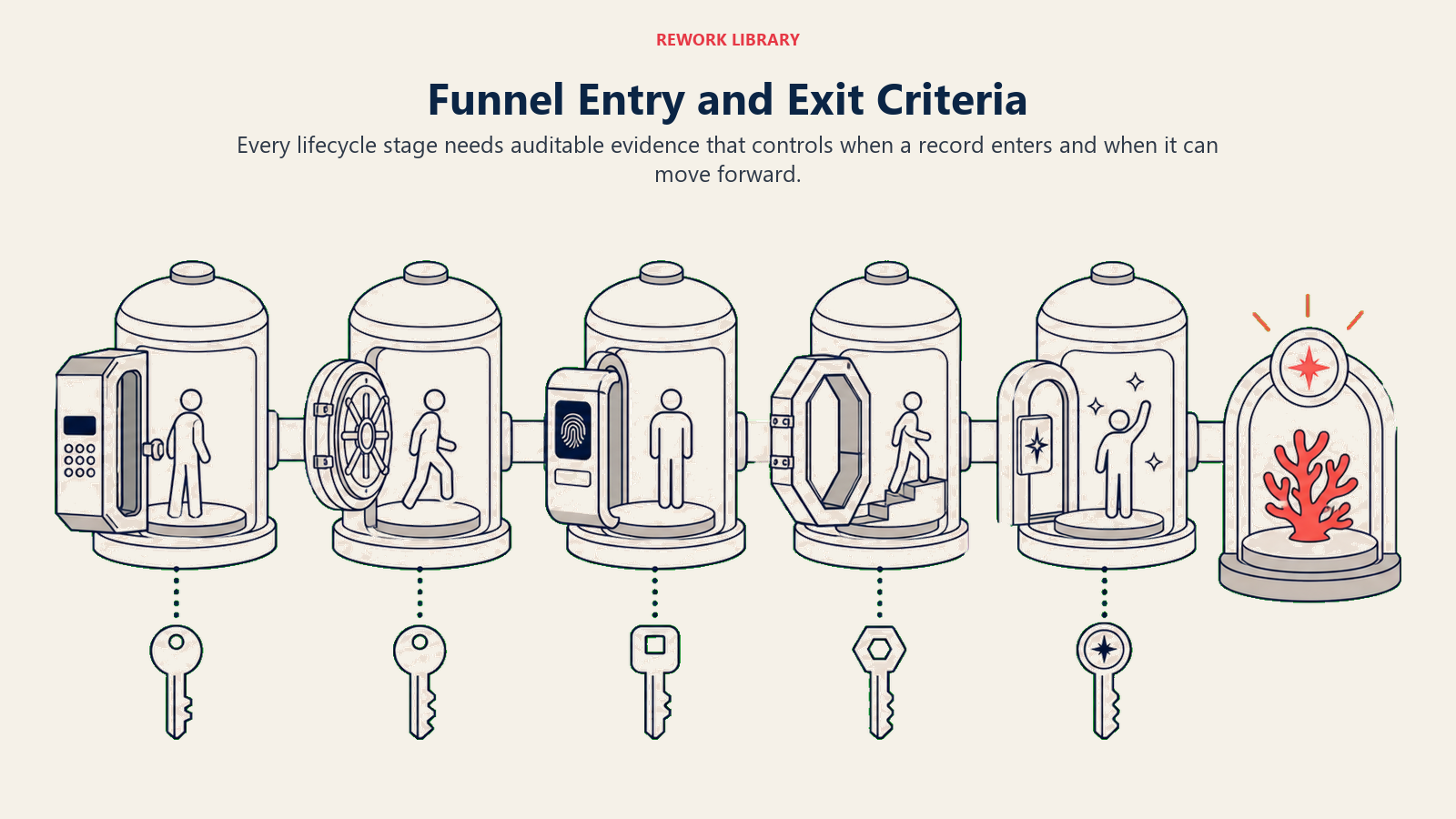
Entry criteria define when a record is allowed to enter a stage. Exit criteria define what evidence moves it forward.
For example:
| Stage | Entry criteria | Exit criteria |
|---|---|---|
| MQL | ICP fit plus engagement threshold | Routed to owner and accepted or rejected |
| SQL | Sales accepts lead for active follow-up | Qualification confirms need, fit, and next action |
| Opportunity | Qualified deal with business value and buyer process | Stage advances based on evidence, not optimism |
| Closed-won | Contract signed and commercial terms complete | Handoff data complete for onboarding |
| Renewal risk | Customer signal meets risk threshold | Risk resolved, renewal forecast changed, or escalation opened |
The criteria should be specific enough to audit. "Interested" is not an exit criterion. "Completed discovery with confirmed business problem, stakeholder, next step, and expected value" is closer.
Ownership rules
Funnel governance also needs ownership.
Each stage should have:
- A functional owner
- A RevOps governance owner
- A data owner
- A decision owner for exceptions
For example, sales may own opportunity execution, but RevOps governs stage criteria and finance may be consulted on forecast categories. Customer success may own renewal conversations, but RevOps governs renewal forecast fields and expansion trigger routing.
This is where RevOps RACI becomes practical. The RACI should tell leaders who owns each stage, who can change definitions, and who resolves disputes.
SLA and exception design
Most funnels break at handoffs. Governance should include SLA and exception paths.
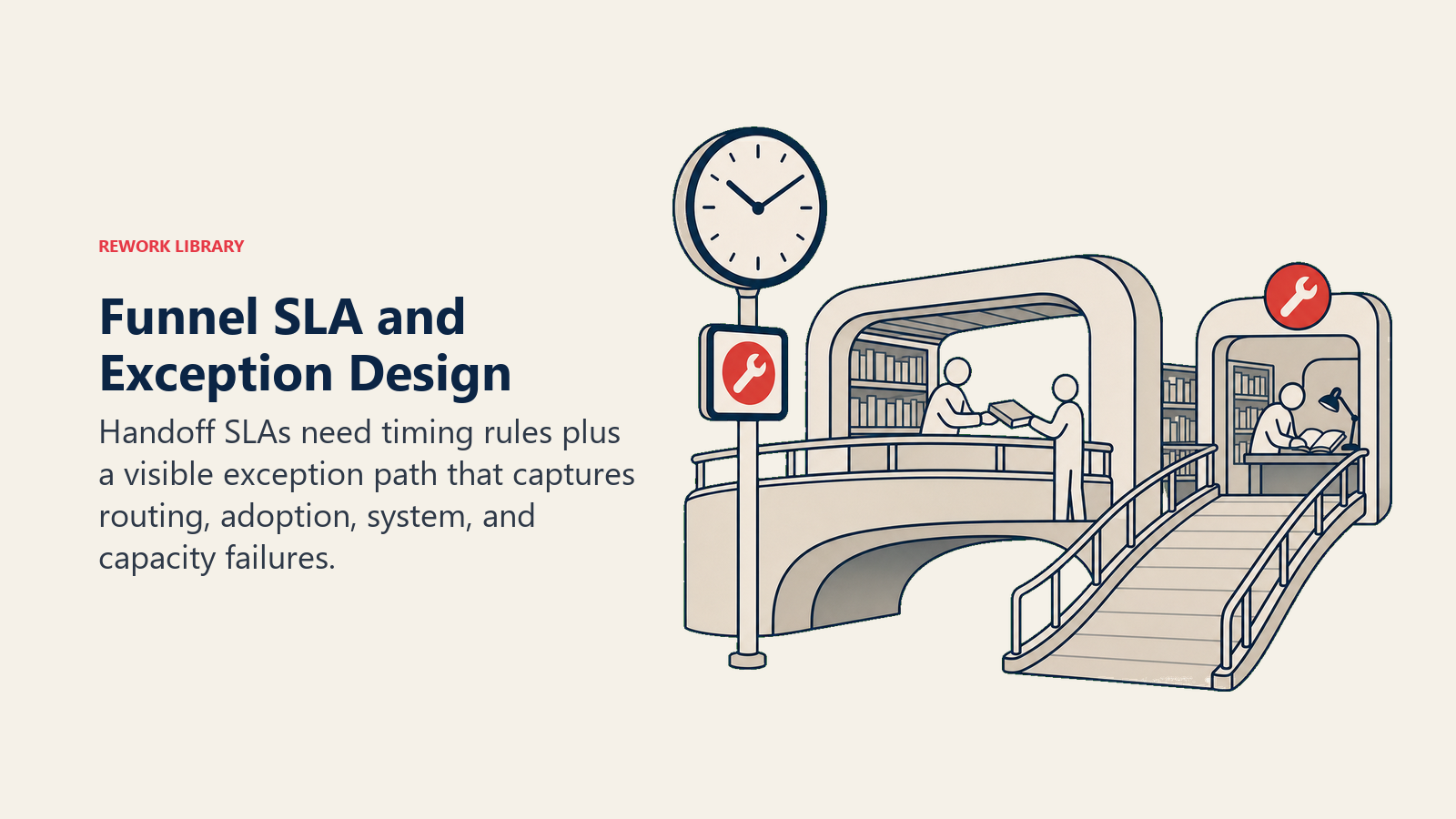
Common SLA examples:
- New inbound demo requests must be routed within minutes.
- MQLs must be accepted or rejected within one business day.
- SQL rejection must include a reason.
- Opportunities with no next step after a defined period are flagged.
- Closed-won deals cannot enter onboarding until handoff fields are complete.
- Renewal risk must be reviewed before a customer reaches a high-risk window.
But SLA alone is not enough. The process needs an exception path.
If a lead is routed to the wrong owner, who fixes it? If a rep rejects qualified leads without reason, who reviews it? If closed-won data is incomplete, can CS push back? If a renewal risk is missed, does it appear in the revenue review?
Good governance treats exceptions as process data. A high exception rate means the funnel design is wrong, adoption is weak, or the system is not supporting the work.
Required data
Required data should be tied to decisions.
Do not make a field required only because someone wants a report. Make it required when it changes routing, qualification, forecast, handoff, compliance, customer delivery, or planning.
For a full-funnel model, important fields often include:
- Lead source
- Campaign or channel
- ICP segment
- Owner
- Lifecycle stage
- Qualification reason
- Rejection reason
- Opportunity amount
- Close date
- Stage entry date
- Forecast category
- Use case
- Success criteria
- Renewal date
- Churn reason
- Expansion signal
RevOps should maintain these in a Revenue Data Dictionary. If the data dictionary and funnel stages drift apart, reporting trust will fall.
Governance cadence
Funnel governance needs a cadence.
| Cadence | Review |
|---|---|
| Weekly | SLA misses, routing issues, stale opportunities, urgent handoff breaks |
| Monthly | Stage conversion, rejection reasons, source-to-opportunity quality, handoff completeness |
| Quarterly | Stage definitions, field governance, lifecycle changes, dashboard definitions |
| Annually | Full funnel architecture, GTM motion fit, source-of-truth model |
The cadence should not be a long meeting where every metric is read aloud. It should focus on where the process is leaking.
For example, if MQL-to-SQL conversion falls, inspect source quality, scoring rules, routing, SLA, acceptance criteria, and rejection reasons. Do not jump straight to "marketing needs more leads" or "sales needs better follow-up."
Funnel governance scorecard
Track the health of the funnel with a small scorecard:
- Stage conversion by source and segment
- SLA compliance
- Rejection reason completeness
- Stage aging
- Stale opportunity rate
- Forecast category accuracy
- Closed-won handoff completeness
- Renewal risk visibility
- Expansion trigger acceptance
- Manual reporting time
The scorecard should show whether the funnel is inspectable. It does not need to replace executive dashboards. It is an operating tool for finding leaks.
Common failure modes
Stages are copied from the CRM template. The company inherits labels that do not match its motion.
Definitions are written but not enforced. Managers still allow records to move based on judgment alone.
Required fields pile up. Reps and CSMs enter low-quality data because the system asks for too much.
Marketing and sales optimize separate funnels. Marketing reports MQL volume, sales reports pipeline, and no one governs the handoff.
CS is excluded. The funnel ends at closed-won, so churn and expansion learning never improves acquisition.
Finance is informed too late. Metric definitions change after they are already used in planning.
First 90 days
If funnel governance is weak, start small.
Days 1 to 30: map current stages, owners, required fields, and dashboards. Identify where definitions conflict.
Days 31 to 60: define entry and exit criteria for the most important stages: MQL, SQL, opportunity, closed-won, renewal risk, and expansion.
Days 61 to 90: launch a governance cadence, clean the highest-impact fields, and publish the first scorecard.
Do not try to fix every field and workflow at once. Start with the stages that create the most revenue debate.
Governance artifacts
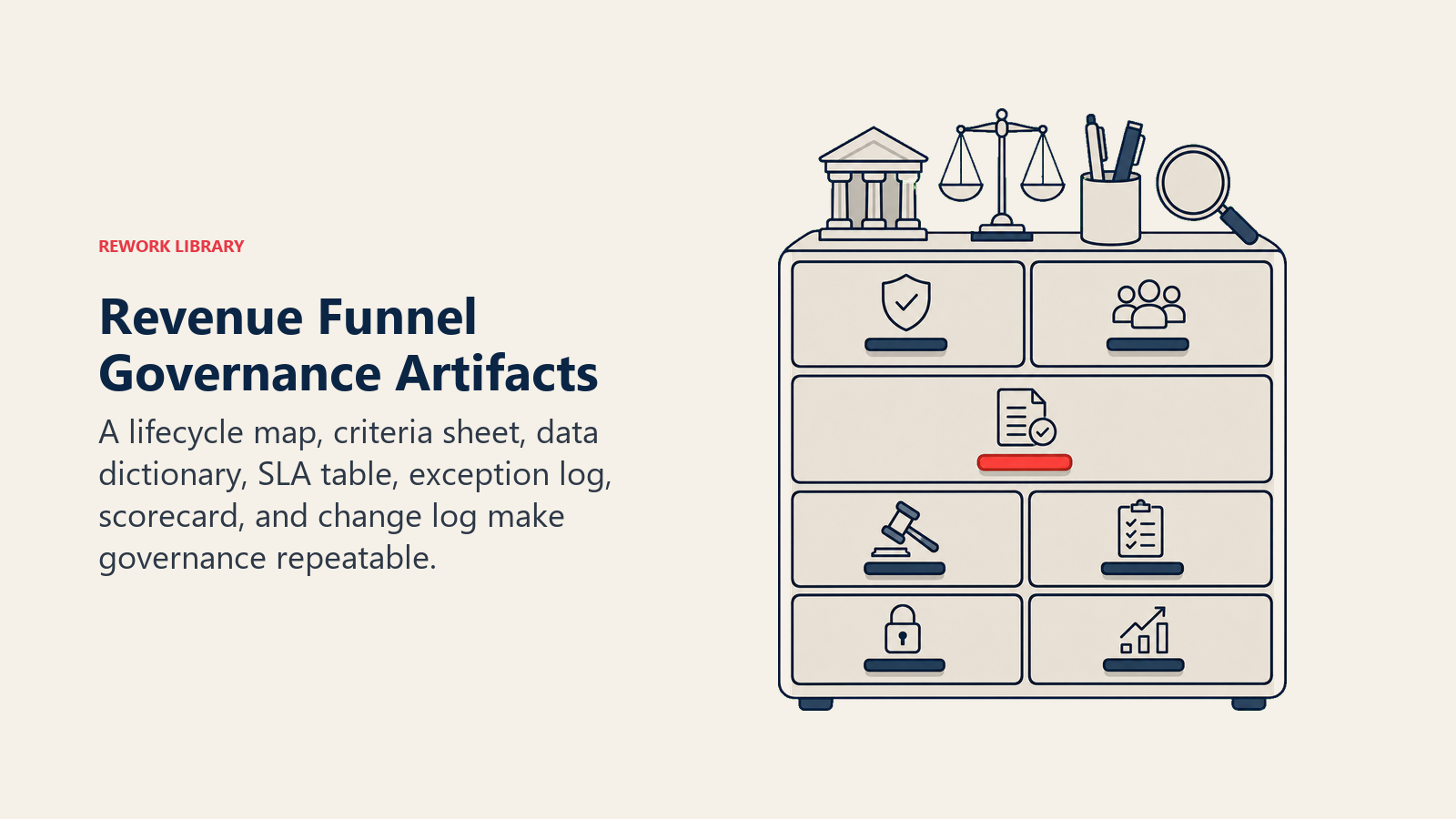
RevOps should maintain a small set of artifacts that make governance repeatable:
| Artifact | Purpose |
|---|---|
| Lifecycle map | Shows stages from lead through expansion |
| Stage criteria sheet | Defines entry and exit evidence |
| Data dictionary | Defines fields, owners, formulas, and source systems |
| SLA table | Defines handoff timing and escalation |
| Exception log | Captures process breaks and owner follow-up |
| Funnel scorecard | Tracks conversion, aging, SLA, and data quality |
| Change log | Records definition, field, and workflow changes |
These artifacts do not need to be long. They need to be current and used.
For example, when sales asks to change an opportunity stage, RevOps should update the stage criteria sheet, data dictionary, dashboards, and change log. When marketing changes qualification rules, RevOps should update the lifecycle map, SLA table, and scorecard interpretation. Governance fails when changes happen in one place but not the others.
Record-level funnel audit
The cleanest way to test funnel governance is to audit real records.
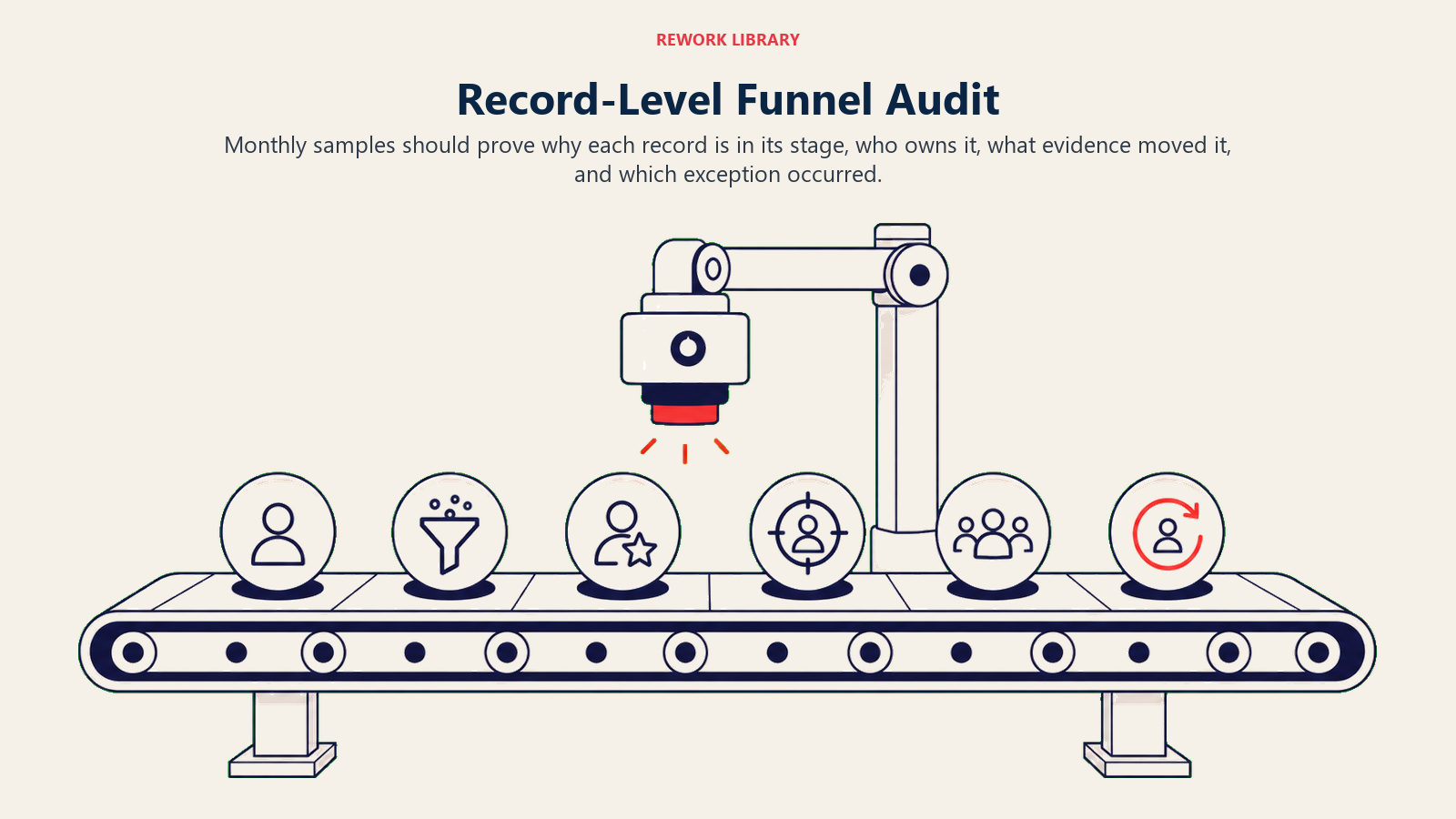
Pick a small sample every month:
- Ten new leads
- Ten MQLs
- Ten SQLs
- Ten open opportunities
- Five closed-won customers
- Five renewal-risk customers
For each record, ask:
| Audit question | What weak answers reveal |
|---|---|
| Why is this record in its current stage? | Stage criteria are unclear or not enforced |
| Who owns the next action? | Ownership is not visible |
| What evidence moved the record forward? | Stage movement is based on opinion |
| Which required data is missing? | Fields are not tied to workflow control |
| Which SLA applied? | Handoff timing is not governed |
| What exception occurred? | Process breaks are not being captured |
| Which dashboard uses this record? | Reporting trust depends on hidden cleanup |
This audit keeps governance grounded. A polished lifecycle map can still fail if real records are stale, misrouted, missing evidence, or sitting with the wrong owner.
Governance rules by lifecycle stage
Different stages need different controls.
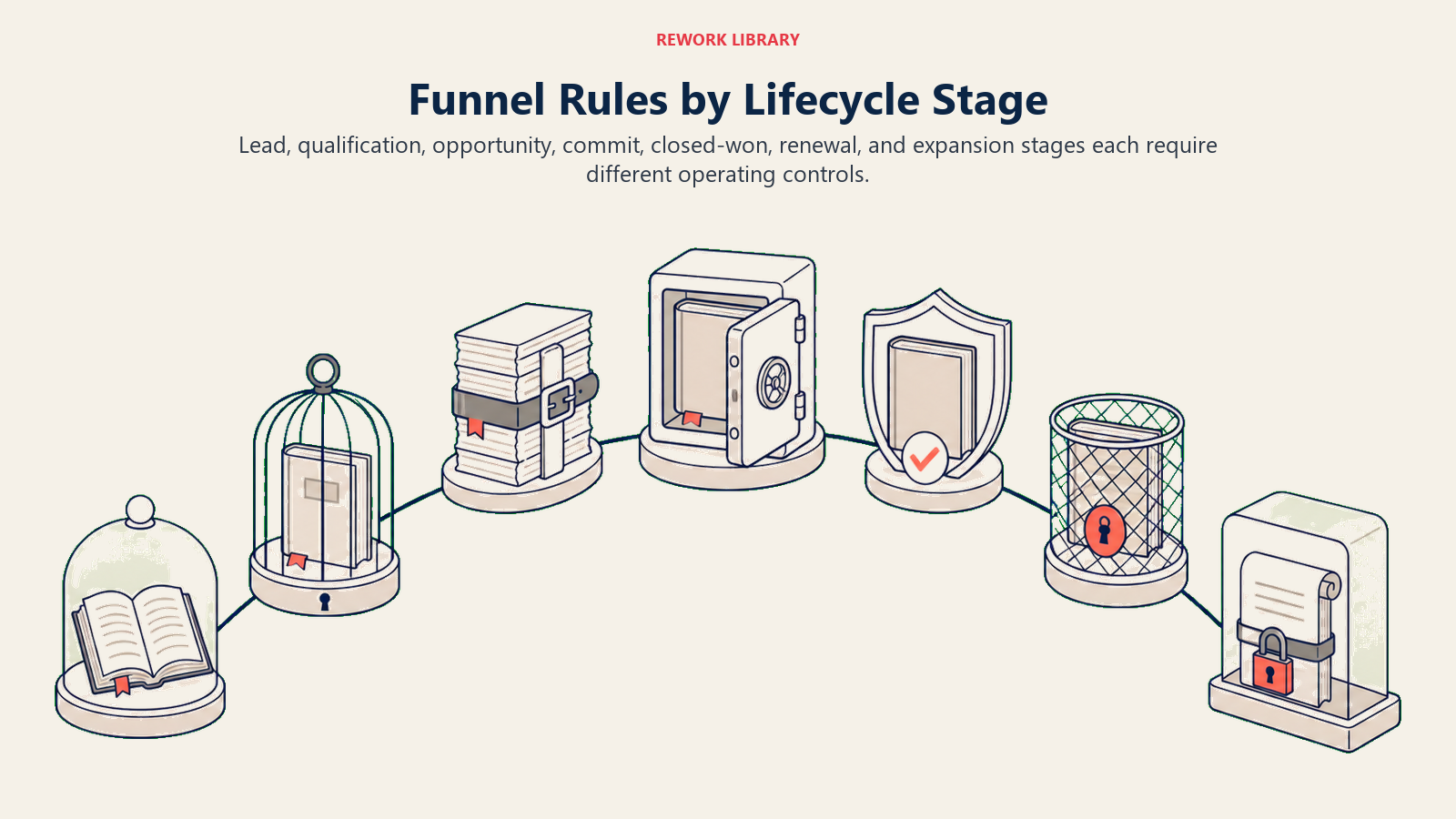
| Stage | Governance rule | Why it matters |
|---|---|---|
| Lead | Source, consent, ICP fit, and owner must be captured | Prevents poor routing and weak attribution |
| MQL | Qualification reason must be visible | Prevents marketing-only scoring from becoming revenue truth |
| SQL | Sales acceptance or rejection must be recorded | Creates feedback for source quality and scoring |
| Opportunity | Business problem, value, next step, and owner must be clear | Prevents inflated pipeline |
| Commit | Buyer evidence must support timing and confidence | Protects forecast quality |
| Closed-won | Handoff fields must be complete before onboarding | Reduces post-sale rework |
| Renewal risk | Risk reason, owner, and next action must be logged | Makes retention risk inspectable |
| Expansion | Trigger, use case, and owner must be defined | Prevents expansion signals from being lost |
The table should be adapted by motion. A transactional motion may need lighter opportunity controls. An enterprise motion may need stricter buying committee, legal, and implementation evidence.
How to review exceptions
Exception review is where governance becomes useful.
Do not only count exceptions. Categorize them:
- Definition issue
- Routing issue
- SLA issue
- Data quality issue
- System issue
- Training issue
- Capacity issue
- Manager inspection issue
Then assign the fix to the right owner. A routing issue may belong to RevOps. A capacity issue may belong to sales leadership. A training issue may belong to enablement. A system issue may belong to the CRM owner.
This prevents RevOps from becoming the dumping ground for every funnel problem. The function owns governance, but functional leaders still own execution in their lanes.
Leadership questions
In a monthly funnel governance review, leaders should ask:
- Which stage is creating the most leakage?
- Which handoff has the most exceptions?
- Which source creates pipeline that sales accepts?
- Which segment has weak conversion?
- Which required fields are low quality?
- Which definitions caused disputes?
- Which changes were made to the funnel this month?
If the meeting cannot answer these questions, the funnel is not yet governed. It is only reported.
Why RevOps should own it
No single function owns the whole funnel. Marketing owns demand creation. Sales owns pipeline execution. Customer success owns retention and expansion. Finance owns the plan. RevOps owns the operating rules that connect them.
This is why funnel governance belongs inside the Revenue Operations Framework.
RevOps should own the governance layer because it is the only function designed to look across the whole system. Marketing should not unilaterally define what sales must accept. Sales should not unilaterally define what marketing should count as qualified. CS should not have to repair missing closed-won context after the fact. Finance should not have to rebuild the numbers outside the system.
RevOps gives the funnel one operating owner while leaving performance ownership with the right functions.
Signs governance is weak
- MQL and SQL definitions are debated every month.
- Opportunity stages are used inconsistently.
- Forecast calls involve basic CRM cleanup.
- Closed-won handoffs depend on rep memory.
- Reports change depending on who pulled them.
Other signs include:
- Stage conversion looks fine at the top level but breaks by segment.
- Rejection reasons are blank or too vague.
- Required fields are completed with junk values.
- Handoff data is captured but not used.
- Managers allow stage exceptions without review.
- Finance maintains a separate funnel model.
These are not reporting issues. They are governance issues.
Review template
Use this lightweight template for a monthly funnel governance review:
| Question | Owner | Output |
|---|---|---|
| Where did conversion drop? | RevOps analytics | Segment, source, or stage issue |
| Where did SLA fail? | RevOps and managers | Owner action or routing fix |
| Which stage has the most aging? | Sales or CS leader | Manager inspection action |
| Which data fields are low quality? | RevOps | Field cleanup or requirement change |
| Which handoff created rework? | Functional owners | Process correction |
| Which definition changed? | RevOps | Change log and dashboard update |
The review should produce a short action list. If the meeting ends only with "watch this next month," governance is too passive.
Review template governance test
The final test is whether a new manager can understand the funnel without asking five people for tribal knowledge.
They should be able to see what each stage means, who owns it, what evidence moves records forward, what data is required, how exceptions work, and which dashboard is the source of truth. If that is not visible, RevOps still has governance work to do.
Frequently Asked Questions about Funnel Governance
What is funnel governance?
Funnel governance is the set of definitions, rules, owners, and controls that keep the full revenue lifecycle consistent.
Is funnel governance the same as funnel reporting?
No. Reporting shows what happened. Governance defines how records move so reports can be trusted.
Learn more

Senior Operations & Growth Strategist
On this page
- What funnel governance covers
- What good governance changes
- The governance layer
- Entry and exit criteria
- Ownership rules
- SLA and exception design
- Required data
- Governance cadence
- Funnel governance scorecard
- Common failure modes
- First 90 days
- Governance artifacts
- Record-level funnel audit
- Governance rules by lifecycle stage
- How to review exceptions
- Leadership questions
- Why RevOps should own it
- Signs governance is weak
- Review template
- Review template governance test
- Learn more