RevOps and Customer Success: Connecting Retention, Expansion, and Revenue Data
Revenue does not stop at closed-won.
In a recurring revenue business, the sale creates a customer lifecycle that still needs operating discipline: onboarding, adoption, renewal, expansion, and churn prevention. If RevOps only covers marketing and sales, the company has an acquisition operating system, not a revenue operating system.
Customer success brings the post-sale reality. RevOps connects that reality back into revenue data, forecasting, planning, and qualification.
Forrester's 2025 customer success platforms landscape describes customer success platforms as systems for retention, growth, customer outcomes, and engagement at scale. Gainsight's Customer Success Index also connects higher NRR with investment in customer success and CS operations.
That is why RevOps and CS cannot operate as separate worlds. Acquisition quality affects retention. Customer outcomes affect expansion. Churn reasons should affect qualification. Renewal risk should affect forecast and planning.
Key operating facts
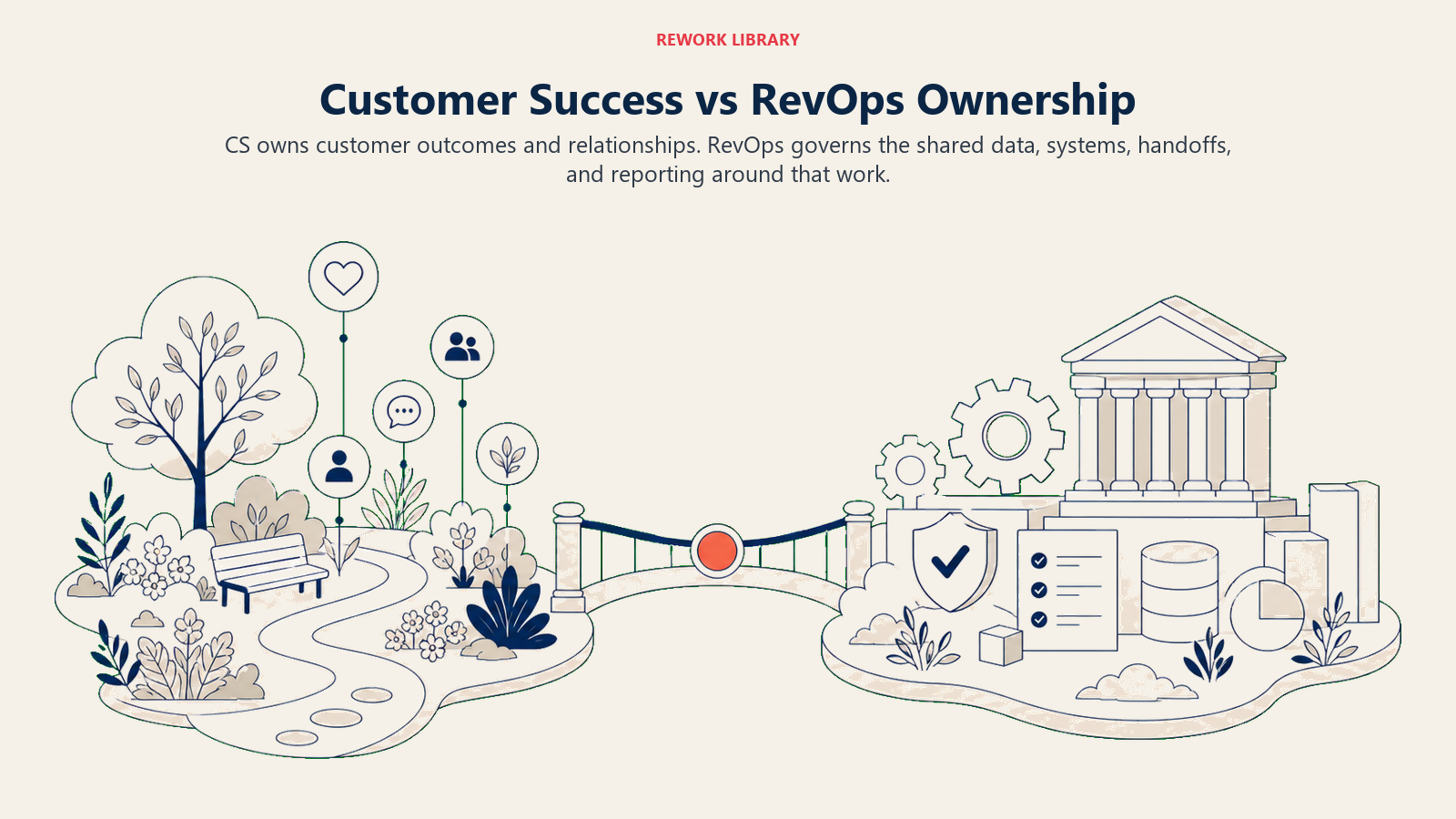
- RevOps should not manage customer relationships. CS owns the relationship, renewal conversations, adoption plans, and customer outcomes. RevOps owns the shared process and data model that make those outcomes visible.
- The most important RevOps-CS handoff is closed-won to onboarding because it carries the promise made during sales into the customer relationship.
- Retention data belongs in revenue planning. Renewal risk, expansion signals, churn reasons, customer health, and onboarding quality should affect forecast, ICP, qualification, and board reporting.
- A useful RevOps-CS model does not start with a complex health score. It starts with clean handoff data, renewal dates, risk categories, expansion triggers, and a review cadence people actually use.
What CS owns vs what RevOps owns
| Area | Customer Success owns | RevOps owns |
|---|---|---|
| Onboarding execution | Customer relationship and delivery | Handoff requirements and workflow |
| Customer health | Interpretation and action | Data model and reporting consistency |
| Renewal management | Customer conversations | Renewal forecast process and visibility |
| Expansion | Account strategy with sales | Expansion pipeline rules and trigger routing |
| Churn analysis | Customer context | Feedback loop into ICP and qualification |
The partnership works when CS owns customer outcomes and RevOps owns the system that makes those outcomes visible.
Turn this article into takeaways for your work.


Each assistant summarizes the article only for you and suggests best practices for your work.
That boundary should be explicit. If RevOps starts judging CSM relationship quality from a dashboard, CS will treat the model as inspection. If CS owns every definition privately, leadership cannot compare customer risk with pipeline, forecast, and plan. The partnership works when CS provides context and action, while RevOps standardizes the objects, fields, timestamps, and reporting rules that make the context usable outside the CS team.
The most useful question is not "who owns post-sale revenue?" The useful question is: which part of the post-sale motion needs a system owner, and which part needs a relationship owner?
| Operating question | Relationship owner | System owner |
|---|---|---|
| Did the customer receive the promise made in sales? | CSM | RevOps governs handoff completeness |
| Is the renewal at risk? | CSM manager | RevOps governs risk category and visibility |
| Is there an expansion signal? | CSM and AE | RevOps governs trigger logic and routing |
| Why did the customer churn? | CS leader | RevOps governs reason taxonomy and reporting |
| Should this segment remain in ICP? | GTM leadership | RevOps connects CS evidence to acquisition data |
This split keeps RevOps from becoming a post-sale command center while still making CS learning part of the revenue system.
Why post-sale belongs in RevOps
Some companies treat RevOps as marketing plus sales operations. That is too narrow for recurring revenue.
If RevOps stops at closed-won, leaders lose visibility into the largest part of the revenue system: whether customers receive value, renew, expand, contract, or churn.
Post-sale data affects:
- ICP quality
- Qualification rules
- Sales discovery
- Forecast and planning
- Expansion motion
- Renewal risk
- Product feedback
- Pricing and packaging
For example, if customers from one segment churn after six months, that should not stay inside a CS dashboard. RevOps should help connect that pattern back to lead scoring, discovery questions, sales qualification, implementation readiness, and board reporting.
The point is not to make RevOps the owner of customer relationships. CS owns customer relationships. RevOps owns the data and process loop that prevents customer learning from staying trapped after the sale.
Closed-won handoff
The most visible RevOps-CS interface is the closed-won handoff.
CS needs to know:
- Use case
- Success criteria
- Stakeholders
- Decision process
- Promises made
- Risks surfaced
- Implementation notes
- Contract scope
If that information lives in rep memory or Slack, onboarding quality will vary by rep discipline. RevOps should make critical handoff fields required before a deal can move cleanly into onboarding.
See Sales-CS Alignment and Closed-Won to Onboarded Handoff Process.
Handoff operating model
A closed-won handoff should be a workflow, not a favor.
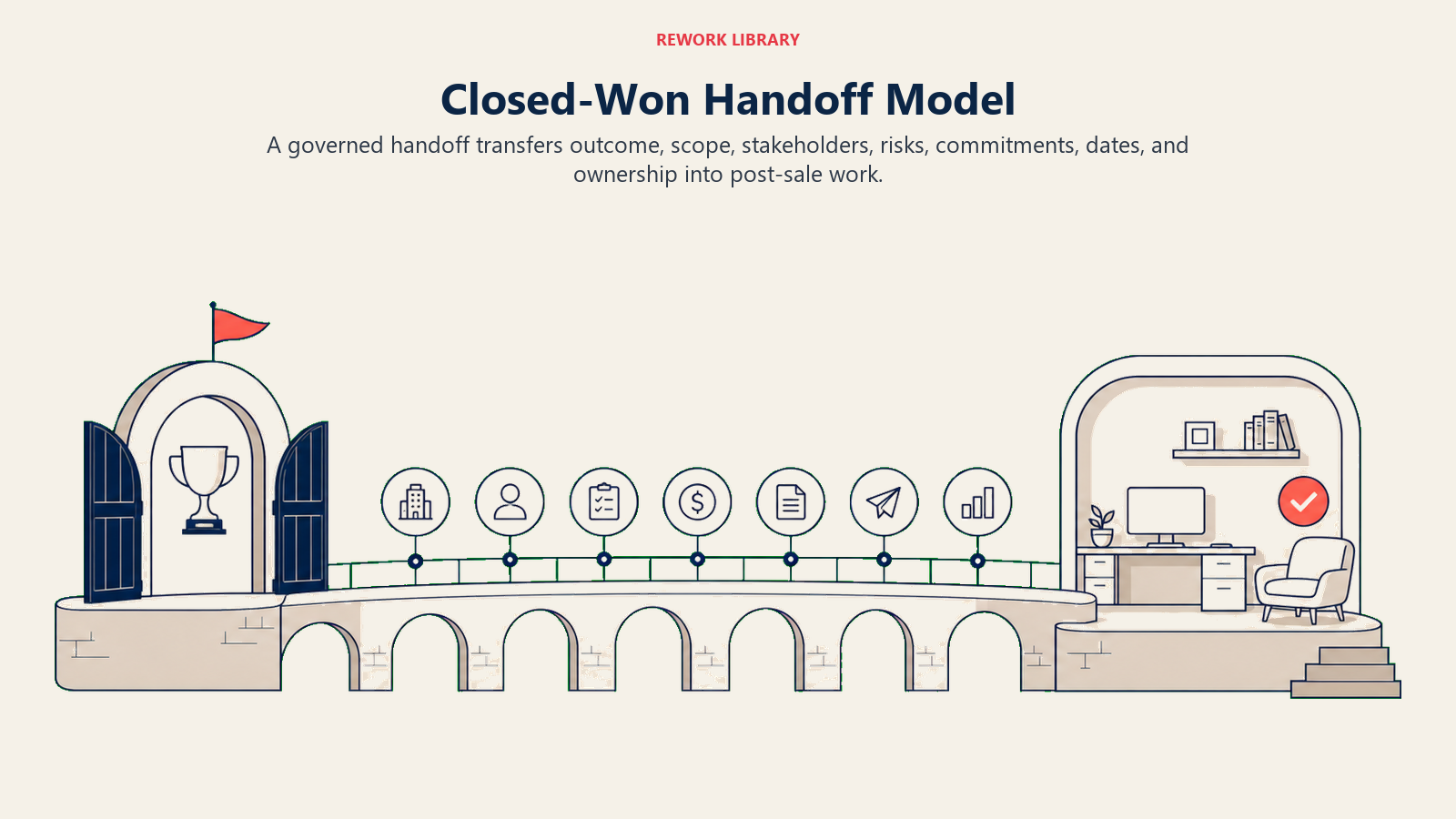
RevOps should define:
| Handoff element | Owner | RevOps role |
|---|---|---|
| Required deal context | Sales and CS | Define fields and completeness rules |
| Handoff meeting criteria | Sales manager and CSM manager | Set trigger and agenda |
| Implementation risk | Sales and CS | Standardize risk taxonomy |
| Success criteria | Sales and CS | Store in source-of-truth fields |
| Promises made | Sales | Make capture required before onboarding |
| Contract scope | Sales and finance | Connect contract data to CS workflow |
| Renewal date | CS and finance | Ensure visibility in revenue reporting |
The handoff should answer one question: can CS start the customer relationship with enough context to deliver the outcome sold?
If not, the opportunity should not simply disappear into onboarding. The missing data should become visible to sales managers, CS leaders, and RevOps.
The handoff should also separate required facts from helpful context. Required facts are the minimum needed to start onboarding safely. Helpful context is useful but should not block every deal.
| Handoff information | Required before onboarding? | Why |
|---|---|---|
| Contract scope | Yes | CS needs to know what was sold |
| Success criteria | Yes | Onboarding needs a target outcome |
| Primary stakeholders | Yes | CS needs the relationship map |
| Promises made | Yes | Prevents delivery surprises |
| Implementation risk | Yes when present | Helps CS plan escalation early |
| Competitive context | Optional | Useful for strategy, rarely a blocker |
| Full sales notes | Optional | Helpful if readable and relevant |
This distinction matters because overloading the handoff creates compliance without usefulness. Reps fill fields because the system forces them to, not because the information changes CS action. RevOps should require the data that protects the customer and the company, then make the rest easy to add but not mandatory.
Customer health data
Customer health scores often fail because they are treated as a magic number.
A useful health model should separate inputs:
- Product usage
- Adoption milestones
- Executive engagement
- Support burden
- Business outcome progress
- Contract risk
- Payment or procurement risk
- Sentiment from CSM notes
- Expansion signals
RevOps should help define which inputs are objective, which are judgment-based, and which are reliable enough for planning.
Not every health signal belongs in the forecast. A CSM concern may be important but subjective. A usage drop across an entire account may be a stronger early warning. A renewal date with no executive sponsor may require escalation. RevOps helps create the taxonomy so leaders do not overreact to noise or miss real risk.
The post-sale data model
The RevOps-CS partnership needs a shared data model that connects account reality to revenue decisions.
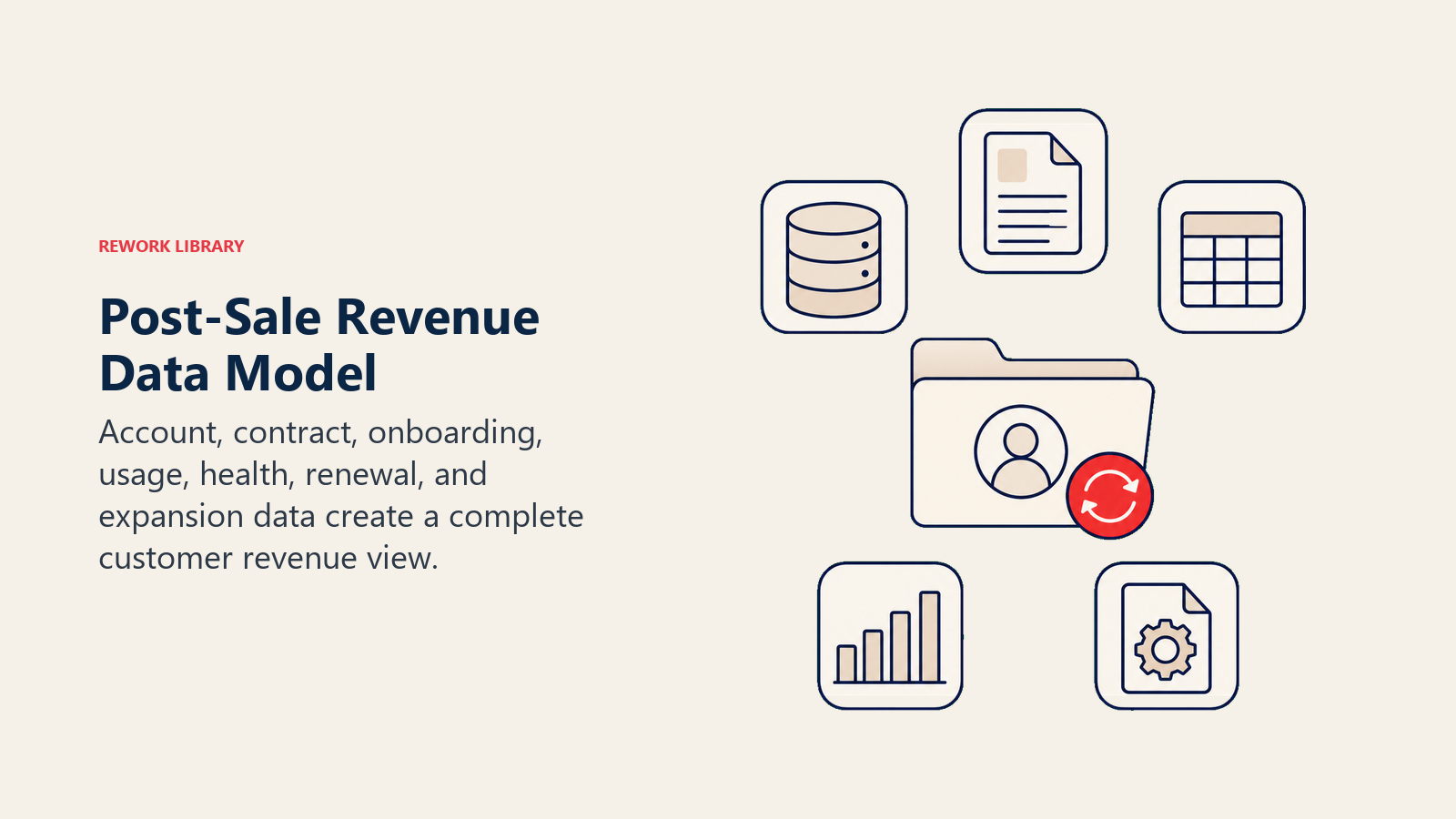
At minimum, define these fields:
| Field | Why it matters | Primary owner |
|---|---|---|
| Onboarding stage | Shows whether value delivery started on time | CS Ops or CS |
| Success criteria | Connects sold outcome to delivered outcome | Sales and CS |
| Renewal date | Anchors retention planning | CS and finance |
| Renewal forecast category | Gives leadership an early view of risk | CS with RevOps |
| Health inputs | Explains why an account is healthy or at risk | CS |
| Expansion trigger | Turns customer behavior into commercial action | CS and sales |
| Churn reason | Feeds acquisition, product, and onboarding improvement | CS with RevOps |
| Handoff completeness | Shows whether sales-to-CS context is reliable | RevOps |
The data model should be small enough that CSMs can maintain it. A team does not need 40 required customer fields to forecast renewals. It needs the handful of fields that change action: when renewal happens, whether the account is at risk, why it is at risk, what expansion signal exists, and whether CS has enough context to act.
RevOps should also define which post-sale fields are allowed to update pipeline or planning views. For example, a renewal forecast category may feed finance planning. A qualitative CSM note may not. A usage drop may trigger an escalation report. A vague sentiment label may stay inside the CS workspace until it is supported by evidence.
Retention and expansion visibility
CS data should feed revenue planning.
RevOps should help standardize:
- Renewal dates
- Renewal forecast categories
- Health score inputs
- Expansion triggers
- Churn reasons
- Risk escalation
- Product usage fields
Without this, leadership sees new pipeline but misses revenue risk already sitting in the customer base.
For metric design, connect this work to Net Revenue Retention and Forecasting NRR Jointly.
Renewal forecast model
Renewal forecasting should not be a last-minute CS update.
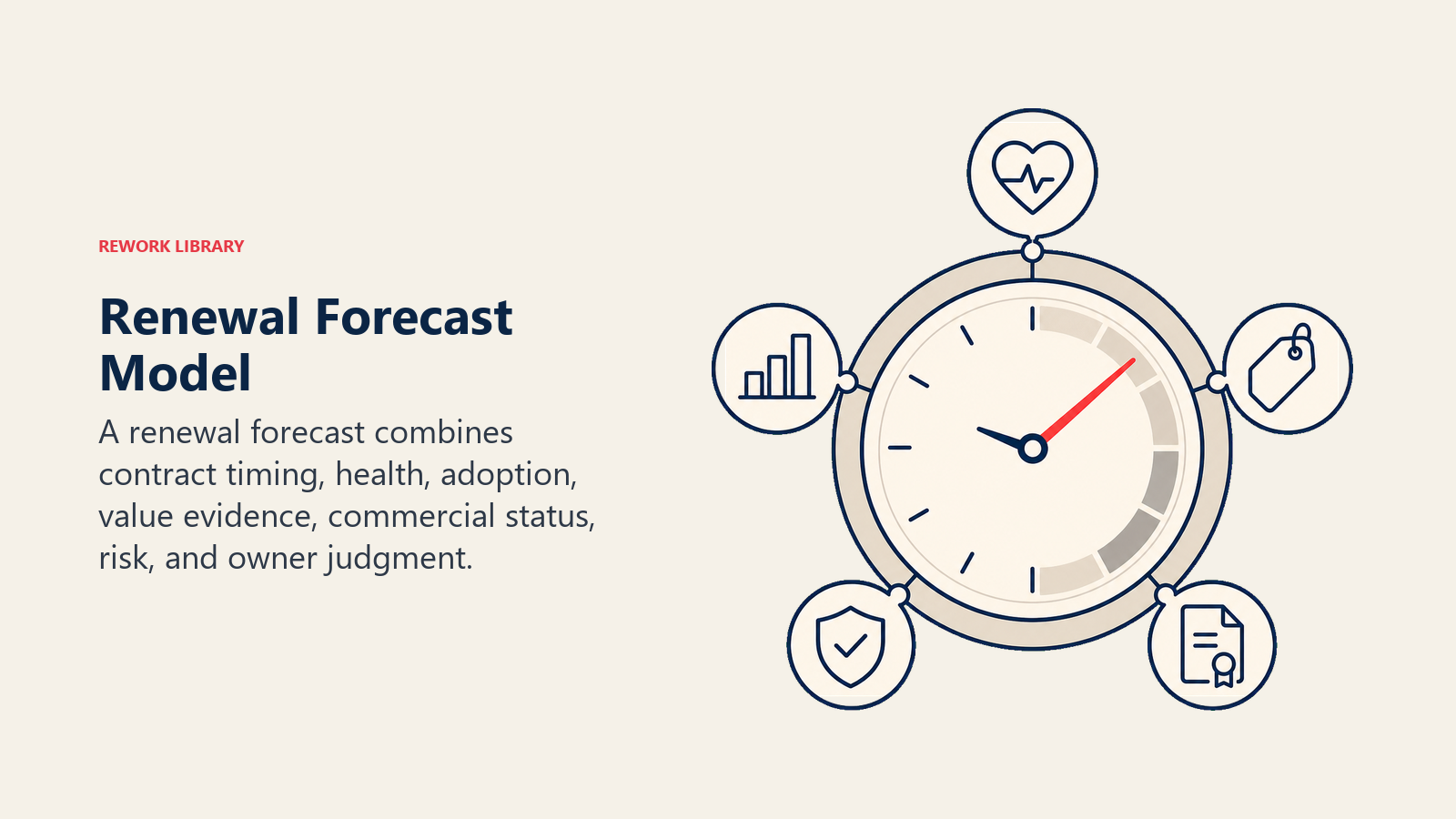
RevOps and CS should agree on renewal forecast categories:
| Category | Meaning | Evidence |
|---|---|---|
| Strong renewal | Customer is using the product, value is clear, sponsor is engaged | Usage, QBR notes, stakeholder map |
| Likely renewal | No major risk, but value proof may be incomplete | Adoption notes, support trend |
| At risk | Churn or contraction signal exists | Low usage, sponsor loss, unresolved issue |
| Expansion likely | Growth signal exists | New use case, additional team, usage growth |
| Unknown | Not enough evidence | Missing data or no recent engagement |
RevOps should make these categories visible in revenue reporting. Finance and leadership need to know whether the customer base is stable, not only whether new pipeline exists.
Expansion triggers
Expansion should not rely only on CSM memory or AE timing.
RevOps can help define triggers:
- Usage exceeds plan
- New team requests access
- Customer opens multiple support requests about advanced use cases
- Champion moves into a larger role
- Business unit expansion appears in notes
- Contract utilization reaches a threshold
- New integration or workflow is activated
Each trigger should have a routing rule. Some belong to CS. Some belong to sales. Some need joint action.
This is where Customer to Expansion Process becomes important. Expansion is not just a sales play. It is a post-sale operating motion.
Feedback into acquisition
CS knows which customers become successful after the sale.
RevOps should route that learning back into:
- ICP definition
- Lead scoring
- Qualification rules
- Sales discovery
- Pricing and packaging signals
- Campaign targeting
If churn reasons never affect qualification, the company keeps acquiring bad-fit customers efficiently.
Segment retention should feed ICP
The RevOps-CS connection becomes especially valuable when retention is viewed by segment, not only in aggregate.
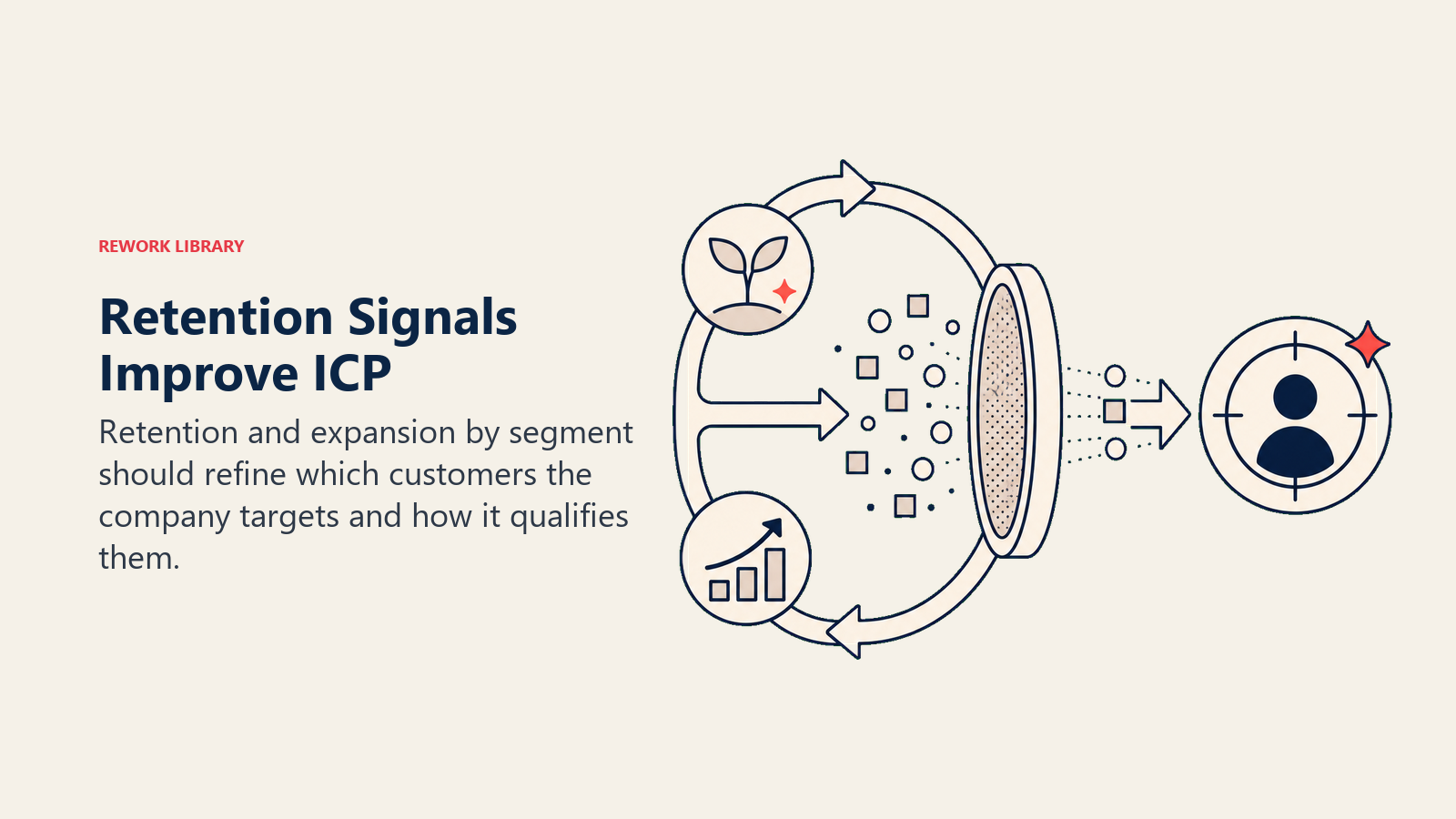
Aggregate NRR can hide the truth. A company may have healthy overall expansion because a few large customers grow, while a smaller segment churns repeatedly after poor onboarding. Or the company may celebrate strong logo retention while missing contraction inside accounts that no longer see value.
RevOps should help CS and GTM leaders review retention through useful cuts:
| Segment view | Question it answers |
|---|---|
| Company size | Are small, mid-market, and enterprise accounts succeeding differently? |
| Use case | Which promised outcomes renew and which ones churn? |
| Acquisition source | Do some channels create customers with weak retention? |
| Sales motion | Do partner, inbound, outbound, and expansion deals retain differently? |
| Onboarding path | Does implementation quality explain renewal risk? |
| Product package | Are some packages linked to low adoption or contraction? |
| Region or market | Does support coverage or localization affect success? |
This work should not turn into a hunt for a single perfect segment. It should reveal which acquisition patterns deserve more investment and which ones need tighter qualification. If a segment closes quickly but churns within two quarters, the revenue system is rewarding the wrong motion. If a slower segment renews and expands consistently, the company may need to revisit scoring, routing, or sales capacity.
CS usually sees this before the dashboard does. RevOps makes the pattern visible enough for marketing, sales, finance, and leadership to change behavior.
Churn feedback loop
Churn analysis should produce operating changes, not just a slide.
RevOps should help classify churn reasons into categories that can be acted on:
| Churn reason | Revenue system response |
|---|---|
| Bad fit | Update ICP, scoring, and disqualification rules |
| Missing feature | Route to product and adjust sales promises |
| Poor onboarding | Fix closed-won handoff and implementation readiness |
| No executive sponsor | Improve discovery and stakeholder capture |
| Price sensitivity | Review packaging and qualification |
| Low usage | Improve adoption triggers and health scoring |
| Competitive loss | Feed competitive notes into sales enablement |
The key is closed-loop learning. If CS learns why customers fail but RevOps does not bring that learning back into acquisition, the company repeats the same mistakes at higher volume.
Shared cadence
RevOps and CS should meet on a predictable rhythm:
- Weekly or biweekly renewal risk review
- Monthly handoff quality review
- Monthly churn reason review
- Monthly expansion trigger review
- Quarterly lifecycle definition review
The cadence should include sales and finance when the topic affects forecast or planning.
For example, renewal risk should flow into finance planning. Expansion triggers should flow into pipeline reporting. Churn reasons should flow into marketing and sales qualification. RevOps makes sure those loops happen.
Practical scorecard
Measure the partnership with operating metrics:
- Handoff completeness
- Time from closed-won to onboarding kickoff
- Percent of accounts with success criteria captured
- Percent of renewals with forecast category
- Renewal risk aging
- Expansion trigger acceptance rate
- Churn reason completeness
- NRR and GRR trend
- Data quality for renewal and expansion fields
The scorecard should not make CS feel inspected by RevOps. It should show whether the post-sale revenue system is healthy enough for leaders to manage.
How to run the monthly RevOps-CS review
A monthly review should be short, evidence-based, and focused on decisions. It should not become a tour of every customer.
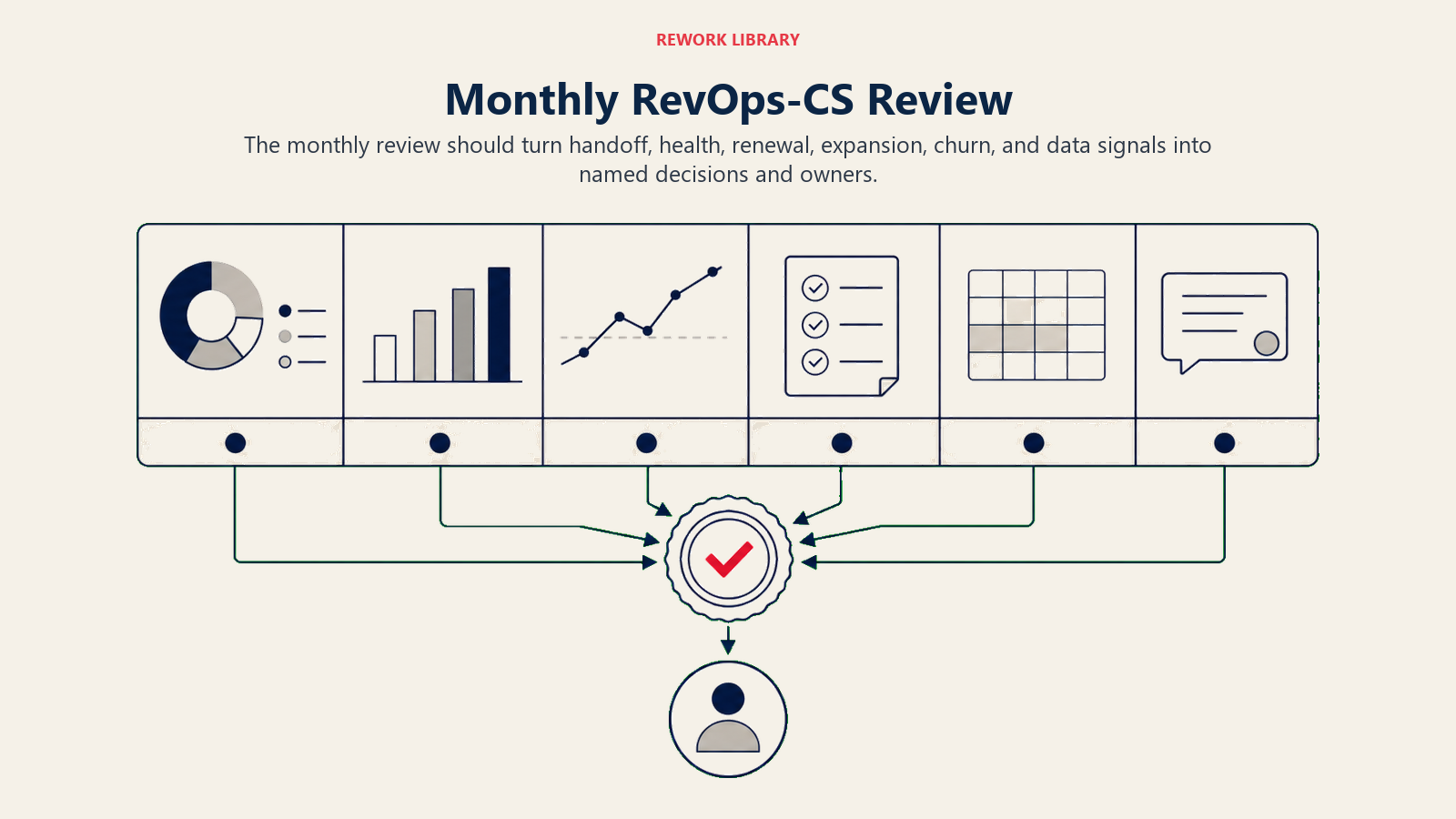
Use a standing agenda:
| Agenda item | Question | Decision output |
|---|---|---|
| Handoff quality | Are closed-won records complete enough for onboarding? | Field, stage, or coaching change |
| Renewal risk | Which accounts changed category and why? | Escalation or forecast update |
| Expansion signals | Which signals converted to action? | Trigger change or owner follow-up |
| Churn reasons | What patterns should change acquisition or onboarding? | ICP, qualification, product, or handoff action |
| Data gaps | Which missing fields blocked planning? | Dictionary, CRM, or process update |
The review should end with a small number of operating changes. If churn from bad-fit customers keeps appearing, RevOps should bring that evidence to qualification and ICP discussions. If expansion signals are missed, RevOps should inspect the trigger and routing model. If renewal categories are stale, CS leadership may need a tighter inspection rhythm.
This is how post-sale learning becomes a revenue-system input instead of a customer-success anecdote.
Operating artifacts
RevOps and CS should maintain a small set of shared artifacts.
| Artifact | Purpose | Owner |
|---|---|---|
| Closed-won handoff checklist | Makes sold context usable for onboarding | RevOps and CS Ops |
| Renewal forecast taxonomy | Makes renewal risk visible before the quarter ends | CS and RevOps |
| Expansion trigger map | Defines how expansion signals become action | RevOps with CS and sales |
| Churn reason taxonomy | Turns churn into acquisition and product feedback | CS Ops and RevOps |
| Health score definition | Keeps customer risk reporting consistent | CS with RevOps |
| Customer lifecycle map | Shows the post-sale journey and key handoffs | CS and RevOps |
These artifacts do not need to be complex. They need to be used.
For example, a churn reason taxonomy is only useful if it changes future behavior. If "bad fit" is a common reason, RevOps should review ICP and qualification rules. If "poor onboarding" is common, RevOps should inspect closed-won data, implementation readiness, and kickoff timing. If "no executive sponsor" is common, sales discovery and CS engagement plans both need adjustment.
First 90 days of RevOps-CS alignment
If the partnership is weak, start with the first 90 days.
Days 1 to 30: inspect the handoff. Review recent closed-won deals and onboarding records. Look for missing success criteria, promised outcomes, risk notes, stakeholder maps, contract scope, and implementation context. Interview CSMs and sales managers about what they wish had been captured.
Days 31 to 60: define the shared data model. Agree on renewal date, renewal forecast category, churn reason, expansion trigger, health input, onboarding stage, and handoff completeness. Decide which fields are required, optional, or manager-reviewed.
Days 61 to 90: build cadence and reporting. Launch a simple renewal risk review, handoff quality report, and churn feedback loop. Do not start with a giant dashboard. Start with the operating questions leaders already need answered.
By the end of 90 days, CS should feel that RevOps is making the post-sale system easier to run, not adding administrative work.
What to avoid
Avoid these mistakes:
Making every CS note structured. Some judgment belongs in notes. Only structure the data that affects decisions.
Building a health score no one trusts. If the score hides its inputs, managers will ignore it.
Treating expansion as only sales-owned. CS often sees expansion signals first. Sales may own the commercial motion, but RevOps should define routing.
Letting churn reasons stay vague. "Budget" or "no value" is often too broad to change behavior.
Reviewing renewals too late. A renewal forecast that starts 30 days before renewal is mostly damage control.
Ignoring finance. Renewal and expansion signals affect planning. Finance should understand the data model.
The strongest RevOps-CS partnerships are practical. They do not try to turn customer success into a reporting function. They give CS better handoffs, clearer renewal visibility, cleaner expansion routing, and a stronger way to send market learning back into the front of the funnel.
Readiness checklist
Use this checklist before calling the RevOps-CS model healthy:
- Every closed-won deal has success criteria captured.
- CS can see promises made before onboarding begins.
- Renewal dates and forecast categories are visible in the revenue system.
- Expansion triggers have named owners and routing rules.
- Churn reasons are specific enough to change acquisition behavior.
- Finance can see renewal and expansion risk before planning meetings.
- Sales leaders see recurring post-sale issues from their deals.
- RevOps reviews handoff and retention data with CS on a fixed cadence.
If several of these are missing, the company does not have a full revenue operating system yet. It has a new-business operating system with post-sale cleanup and avoidable leakage.
CS operating review packet
A RevOps and CS review should connect customer risk to revenue decisions.
Show:
- Closed-won handoff completeness.
- Onboarding risk.
- Adoption and usage signal.
- Renewal forecast movement.
- Expansion signals.
- Churn reasons by source or segment.
- Customer health data gaps.
- Actions needed from sales, CS, product, or finance.
This keeps customer success from becoming a post-sale silo. Customer data should improve renewal planning, expansion, ICP decisions, and acquisition quality.
Frequently Asked Questions about RevOps and Customer Success
Should CS Ops sit inside RevOps?
Often, yes, especially when renewal, expansion, and customer health data affect revenue planning. In smaller teams, CS Ops may stay embedded but follow RevOps data governance.
What is the most important RevOps-CS handoff?
Closed-won to onboarding. It determines whether the customer success team receives enough context to deliver the outcome sold.
How does RevOps affect NRR?
RevOps improves the operating system around renewal visibility, expansion triggers, health data, and churn feedback. CS still owns customer execution.
Learn more

Senior Operations & Growth Strategist
On this page
- What CS owns vs what RevOps owns
- Why post-sale belongs in RevOps
- Closed-won handoff
- Handoff operating model
- Customer health data
- The post-sale data model
- Retention and expansion visibility
- Renewal forecast model
- Expansion triggers
- Feedback into acquisition
- Segment retention should feed ICP
- Churn feedback loop
- Shared cadence
- Practical scorecard
- How to run the monthly RevOps-CS review
- Operating artifacts
- First 90 days of RevOps-CS alignment
- What to avoid
- Readiness checklist
- CS operating review packet
- Learn more