RevOps vs Sales Ops: What Each Team Owns and When You Need Both
A growing company promotes its best Sales Ops lead into a RevOps title. Nothing else changes.
The same person still owns Salesforce fields, pipeline reports, territory rules, quota support, and weekly forecast preparation. Marketing still manages campaign attribution separately. Customer success still receives incomplete handoff notes. Finance still rebuilds the forecast in a spreadsheet.
The title changed. The mandate did not.
That is the most common source of confusion in the RevOps vs Sales Ops conversation. The difference is not seniority. It is operating scope.
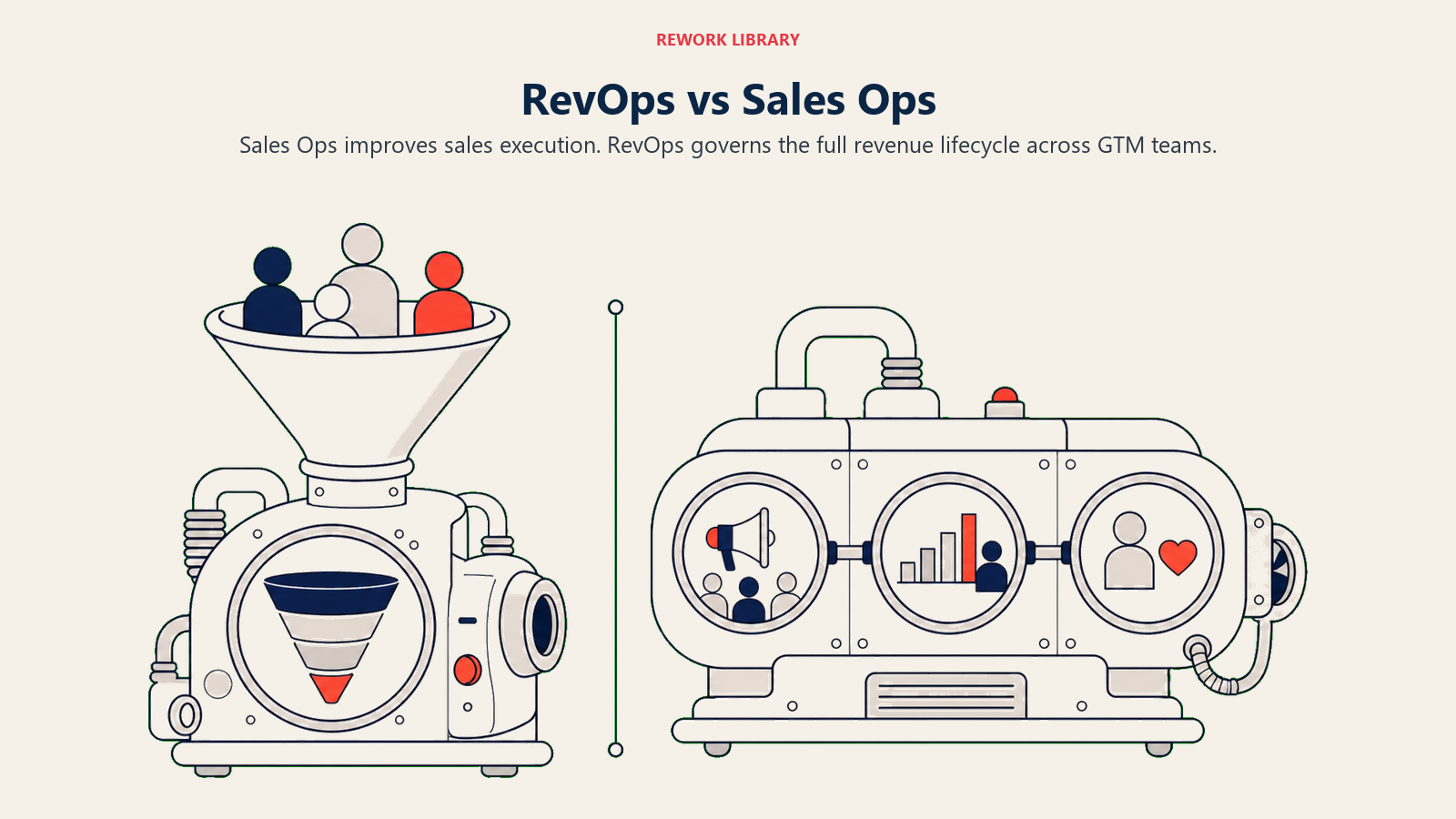
Sales Operations improves the sales team's execution. Revenue Operations improves the full revenue system across marketing, sales, customer success, finance, data, and systems.
Both functions can be valuable. The question is which operating problem the company needs solved.
Short answer
Sales Ops is the function that helps the sales team sell more effectively. It focuses on pipeline hygiene, territories, quotas, rep productivity, sales process, tools, compensation support, and forecast preparation.
Turn this article into takeaways for your work.


Each assistant summarizes the article only for you and suggests best practices for your work.
RevOps is the function that governs the full revenue operating system. It connects marketing, sales, customer success, finance, data, and systems through shared definitions, lifecycle stages, handoffs, dashboards, and operating cadence.
If your main problem is sales execution, you may need Sales Ops. If your main problem is cross-functional revenue friction, you need RevOps.
For the broader definition, start with What Is Revenue Operations?. For the operating model, use the Revenue Operations Framework. If the term you keep hearing is GTM Ops rather than Sales Ops, see GTM Operations vs Revenue Operations.
Key operating facts
- Sales Ops improves sales execution: territories, quota, pipeline hygiene, sales process, tools, and rep productivity.
- RevOps improves the shared revenue system: lifecycle, handoffs, source of truth, forecast governance, customer revenue, and cross-functional cadence.
- A company may need both when sales execution problems and cross-functional revenue friction exist at the same time.
- Renaming Sales Ops to RevOps does not create RevOps unless the mandate, scope, and decision rights expand.
What Sales Ops owns
Sales Ops is closest to the sales leader and the sales team.
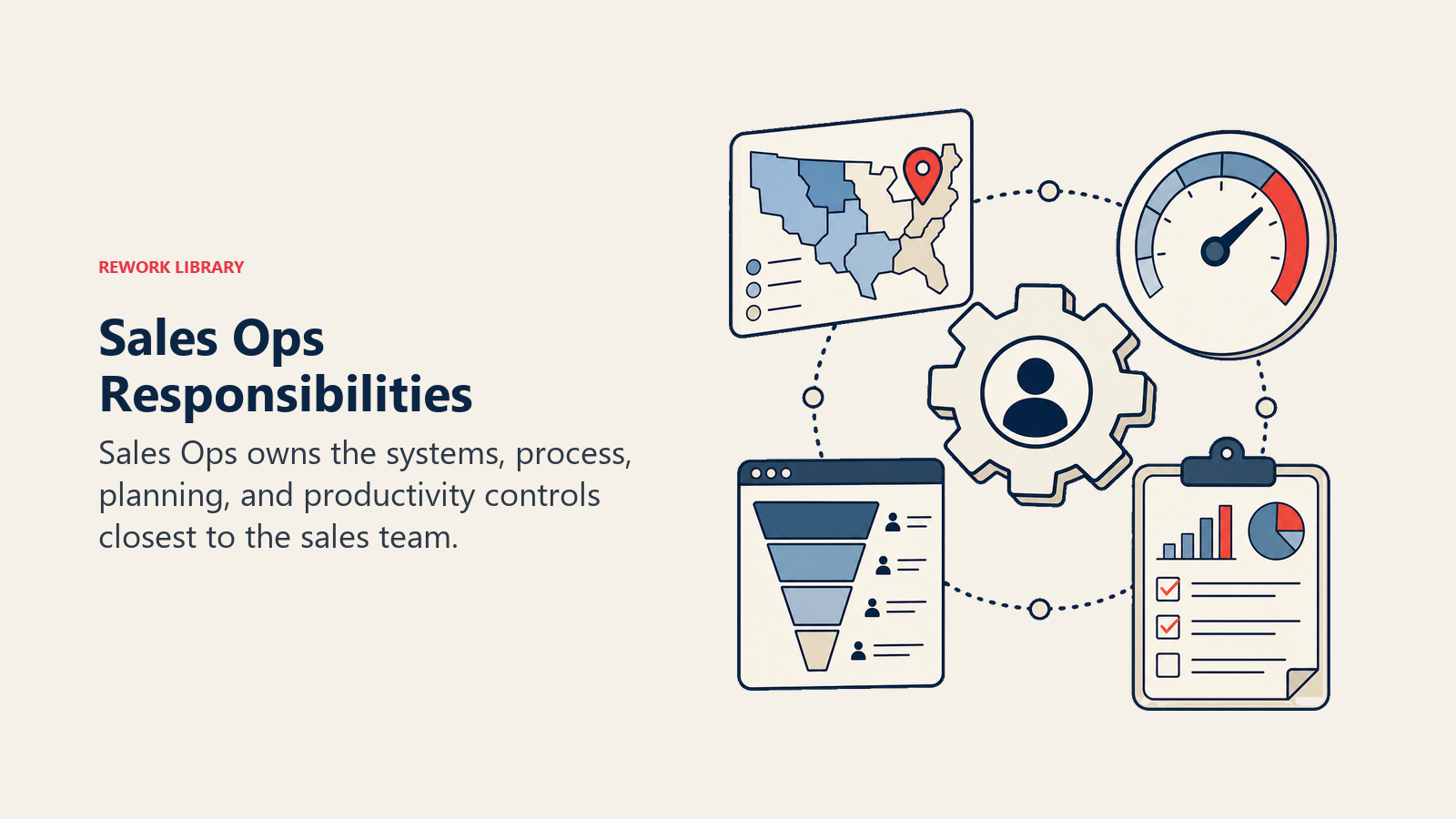
Typical Sales Ops responsibilities include:
- Sales process design
- CRM hygiene for sales records
- Territory and account assignment
- Quota planning support
- Pipeline reporting
- Forecast rollups
- Sales compensation support
- Sales tooling administration
- Rep productivity analysis
- Deal desk or approval workflow support
The primary customer is the sales organization. If sales reps cannot find their accounts, do not know their quota, do not trust pipeline stages, or spend too much time updating systems, Sales Ops is the team that fixes the operating friction.
That work is real. A company with poor Sales Ops usually feels it quickly: unclear territories, inconsistent stage usage, messy pipeline, slow quote approvals, and managers who spend forecast calls asking reps to update close dates.
Sales Ops is not inferior to RevOps. It is a specialist function with a narrower mandate.
The need is also bigger than admin support. Salesforce research measured that figure at 28% in December 2022, and its 2026 edition puts the current reading at 40%, still a minority of the week. Sales Ops exists partly because rep productivity is too important to leave to individual work habits and manual systems.
What RevOps owns
RevOps owns the shared system that sales depends on but does not control alone.
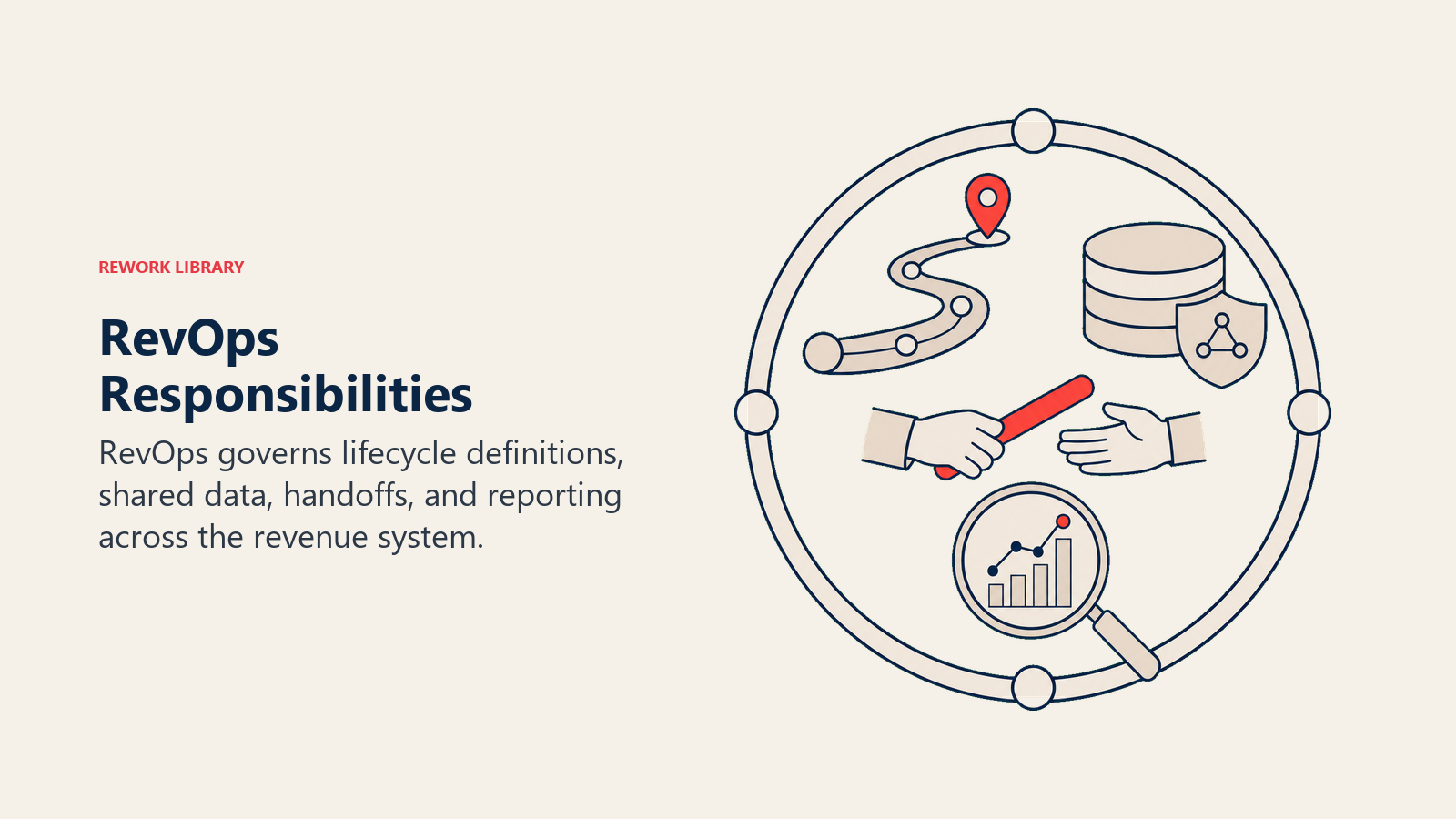
Typical RevOps responsibilities include:
- Full-funnel lifecycle definitions
- Lead source, lifecycle, and attribution governance
- Marketing-sales handoff rules
- Sales-CS handoff rules
- Cross-functional SLAs
- Revenue data model
- CRM, marketing automation, CS, billing, and BI alignment
- Shared dashboards
- Forecast and pipeline governance
- Revenue operating cadence
- Systems change control
The primary customer is the revenue leadership team and the revenue system itself. RevOps asks whether marketing, sales, customer success, and finance are operating from the same source of truth.
Forrester describes revenue operations as a capability that helps B2B organizations align operational responsibilities across the growth engine. That is the key distinction. RevOps is not only a sales support function. It is a cross-functional operating capability.
Side-by-side comparison
| Dimension | Sales Ops | RevOps |
|---|---|---|
| Scope | Sales execution | Full revenue lifecycle |
| Primary customer | VP Sales and sales team | CRO, revenue leadership, cross-functional GTM teams |
| Core question | How do we make sales more effective? | How do we make revenue more predictable across teams? |
| Main metrics | Pipeline hygiene, quota attainment, rep productivity, stage conversion | Funnel conversion, velocity, forecast quality, retention, expansion, data quality |
| Systems | CRM, sales engagement, CPQ, forecasting tools | CRM, MAP, CS platform, billing, enrichment, BI, workflow tools |
| Time horizon | Weekly and monthly sales execution | Quarterly and annual revenue operating model |
| Decision rights | Sales process and sales system rules | Shared definitions, handoffs, source of truth, revenue governance |
| Main failure mode | Sales process friction | Cross-functional misalignment |
The distinction becomes clear when a problem crosses team boundaries.
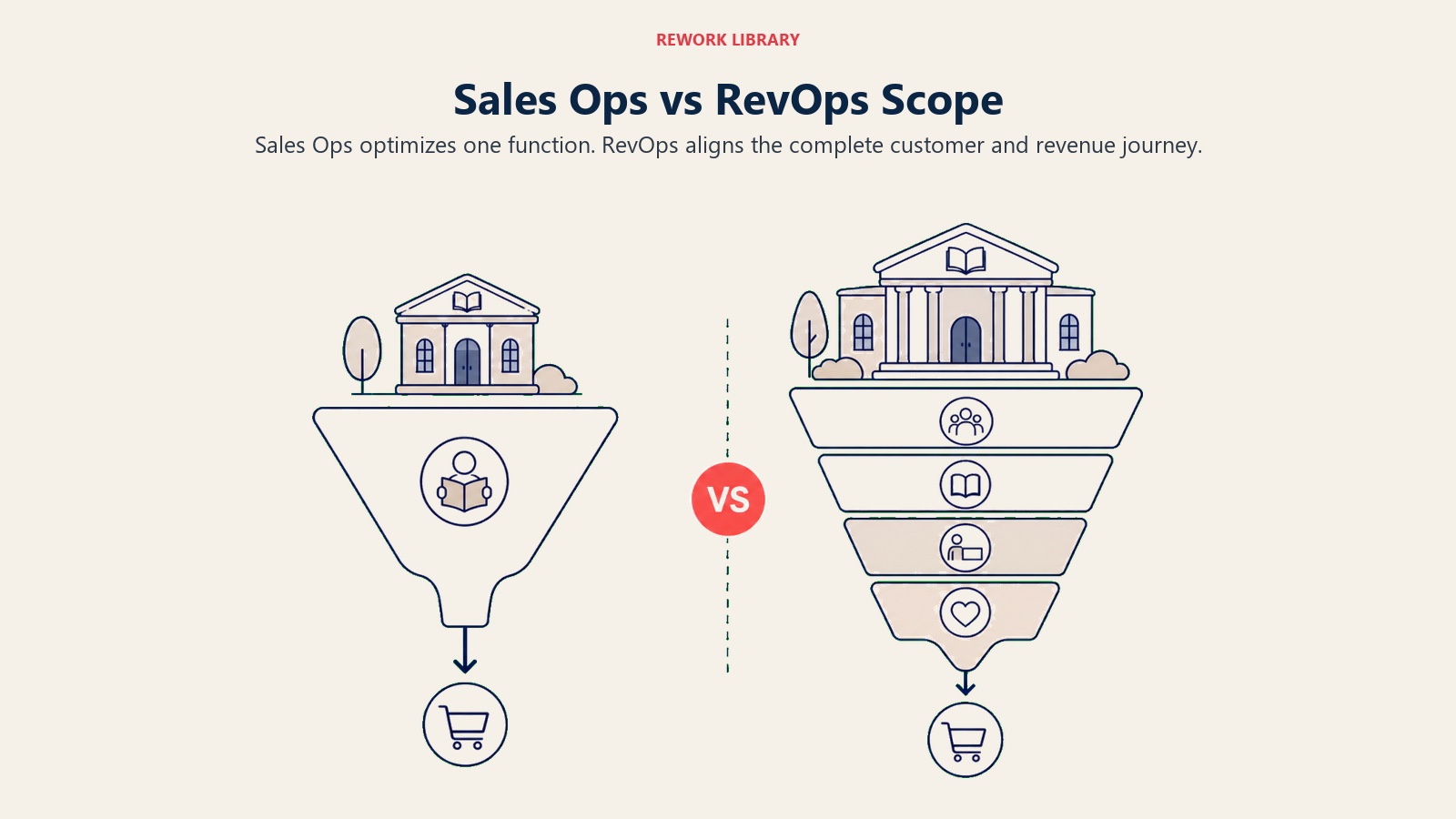
If a rep is not updating opportunity stages, Sales Ops can fix the process and manager inspection. If marketing and sales disagree on what should become an opportunity, RevOps needs to fix the lifecycle definition, handoff rule, and reporting view.
When Sales Ops is enough
Sales Ops may be enough when the company is still sales-led and operational complexity is low.
You can usually stay with Sales Ops if:
- Marketing is founder-led or generates a modest number of leads.
- Sales owns most pipeline creation directly.
- Customer success handoff is simple.
- The funnel has few stages and one main sales motion.
- Finance can trust sales forecast inputs without heavy reconciliation.
- Tooling is simple and mostly sales-owned.
At this stage, the immediate problem is often rep execution. Are reps working the right accounts? Are stages clear? Is the pipeline current? Are territories fair? Are quotas understandable? Sales Quota and Quota Attainment are sales operating questions first.
Do not create a RevOps department just because the title is popular. If the company does not yet have cross-functional revenue complexity, a strong Sales Ops function may be the cleaner model.
When RevOps becomes necessary
RevOps becomes necessary when growth depends on coordination between functions.
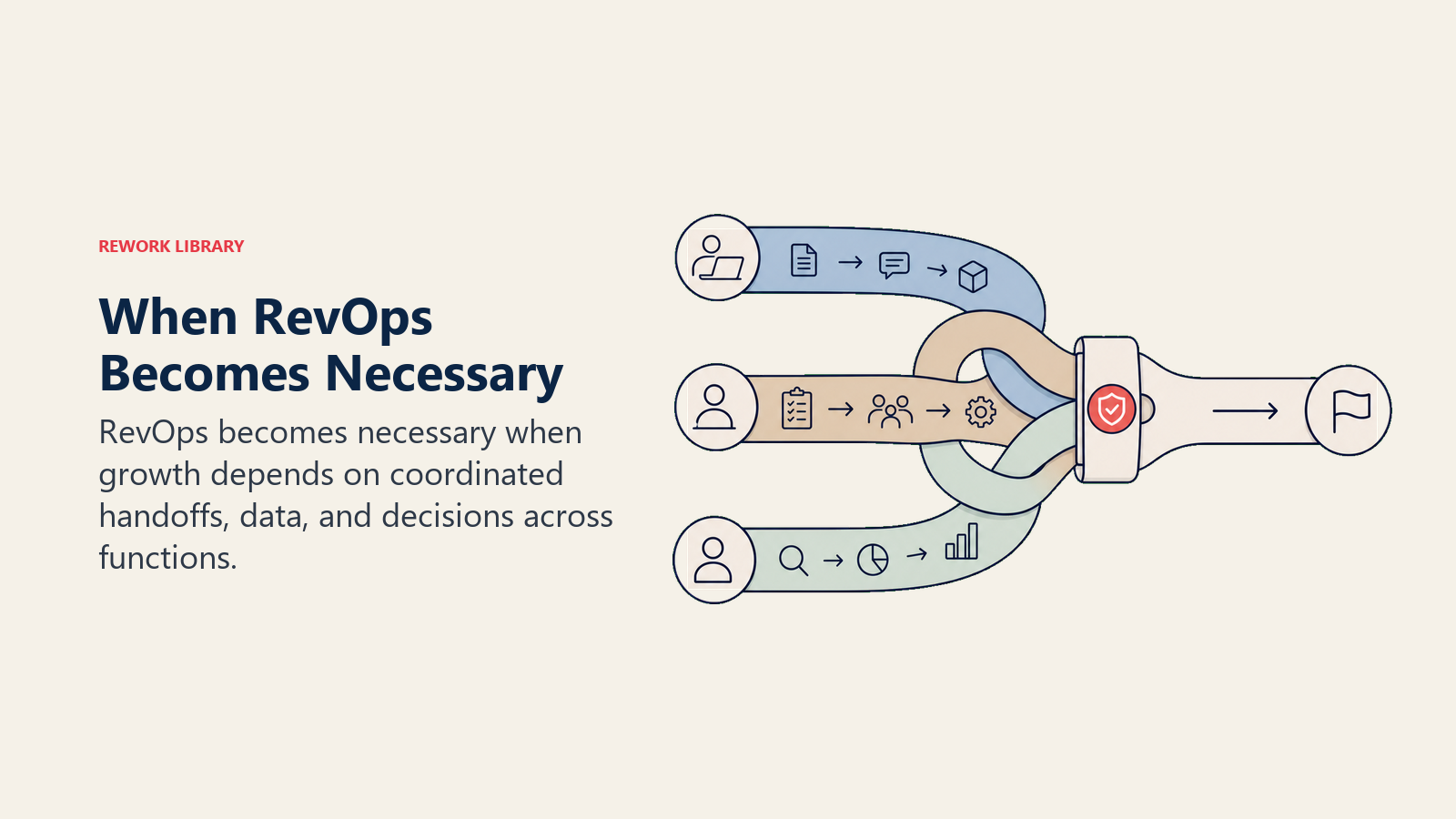
Common triggers include:
- Marketing and sales disagree on lead quality.
- Lead routing rules are maintained in multiple places.
- Forecasts miss despite enough pipeline volume.
- Customer success inherits bad-fit or poorly scoped customers.
- Finance does not trust CRM revenue data.
- Campaign attribution cannot be reconciled with closed-won reporting.
- Tool changes in one function break another function's reports.
- Leaders spend more time debating numbers than making operating decisions.
The lead distribution strategy is a useful example. Sales may care most about fair rep assignment. Marketing may care about campaign follow-up speed. Finance may care about channel ROI. RevOps has to design the system so all three concerns are visible and governed.
The same is true for smarketing and RevOps alignment. Alignment does not stick if each team owns only its local dashboard. It sticks when RevOps owns the shared definitions and process controls.
Harvard Business Review estimates that sales and marketing misalignment costs businesses more than $1 trillion each year. A RevOps model does not solve that by adding another meeting. It solves it by making definitions, handoffs, and data ownership operational.
How Sales Ops and RevOps work together
In a mature model, Sales Ops does not disappear. It becomes a specialist lane inside or alongside RevOps.
RevOps sets cross-functional standards:
- Lifecycle definitions
- Revenue data model
- Source of truth
- Shared dashboards
- Handoff rules
- Systems governance
- Operating cadence
Sales Ops drives the sales execution details:
- Territory rules
- Sales process discipline
- Quota support
- Rep productivity analysis
- Deal desk process
- Sales tool adoption
- Sales forecast inputs
The relationship works when decision rights are clear. RevOps should not micromanage every sales workflow. Sales Ops should not change shared revenue fields without governance.
What changes when Sales Ops becomes part of RevOps
The biggest change is not the org chart. It is the optimization target.
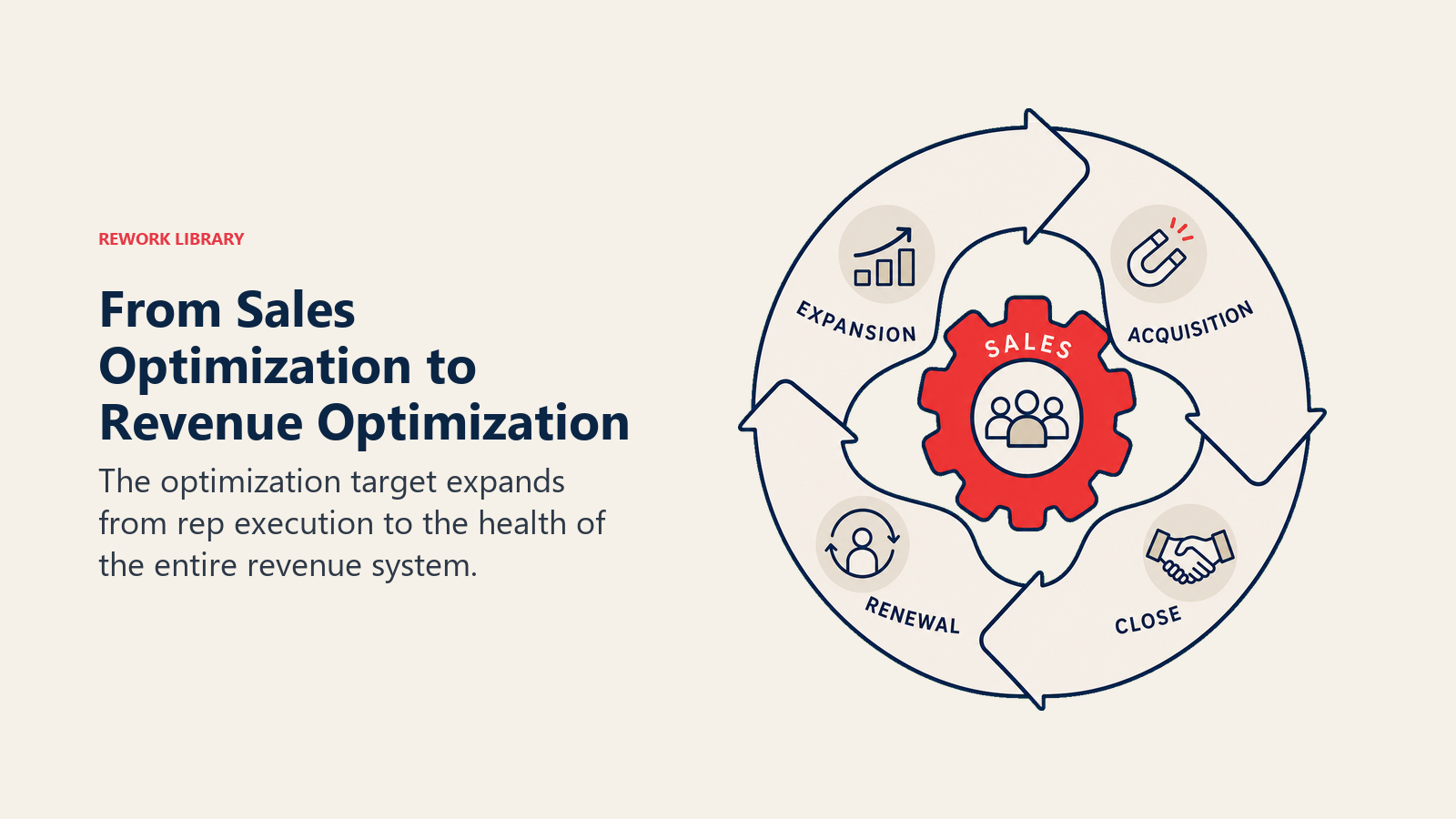
Sales Ops often optimizes for the sales team: cleaner pipeline, better rep productivity, clearer quotas, stronger forecast inputs, and more consistent sales process. RevOps keeps those goals but adds the cross-functional system around them.
That means a Sales Ops leader moving into RevOps needs to change the questions they ask.
| Sales Ops question | RevOps question |
|---|---|
| Are reps updating opportunities? | Does the opportunity data support forecast, finance, and CS handoff needs? |
| Are leads assigned fairly? | Does routing balance speed, fit, source quality, capacity, and conversion? |
| Is the forecast rollup ready? | Are forecast definitions, close dates, and stage rules trusted across sales and finance? |
| Are territories clean? | Do territories match ICP, capacity, campaign strategy, and account ownership? |
| Are sales tools adopted? | Does the revenue tech stack preserve one source of truth across teams? |
This shift can be uncomfortable. Sales Ops is usually rewarded for responsiveness to sales leaders. RevOps has to say no more often because a local sales request may damage shared reporting, attribution, or post-sale handoff quality.
For example, a sales manager may ask for a new opportunity stage called "Verbal Commit." Sales Ops might add it because the manager needs visibility. RevOps should ask what evidence moves a deal into that stage, whether it affects forecast categories, how finance should interpret it, and whether customer success needs any downstream field once the deal closes. The stage may still be added, but the decision is governed.
Decision rights in practice
The functions work together when local sales execution and shared revenue governance are separated.
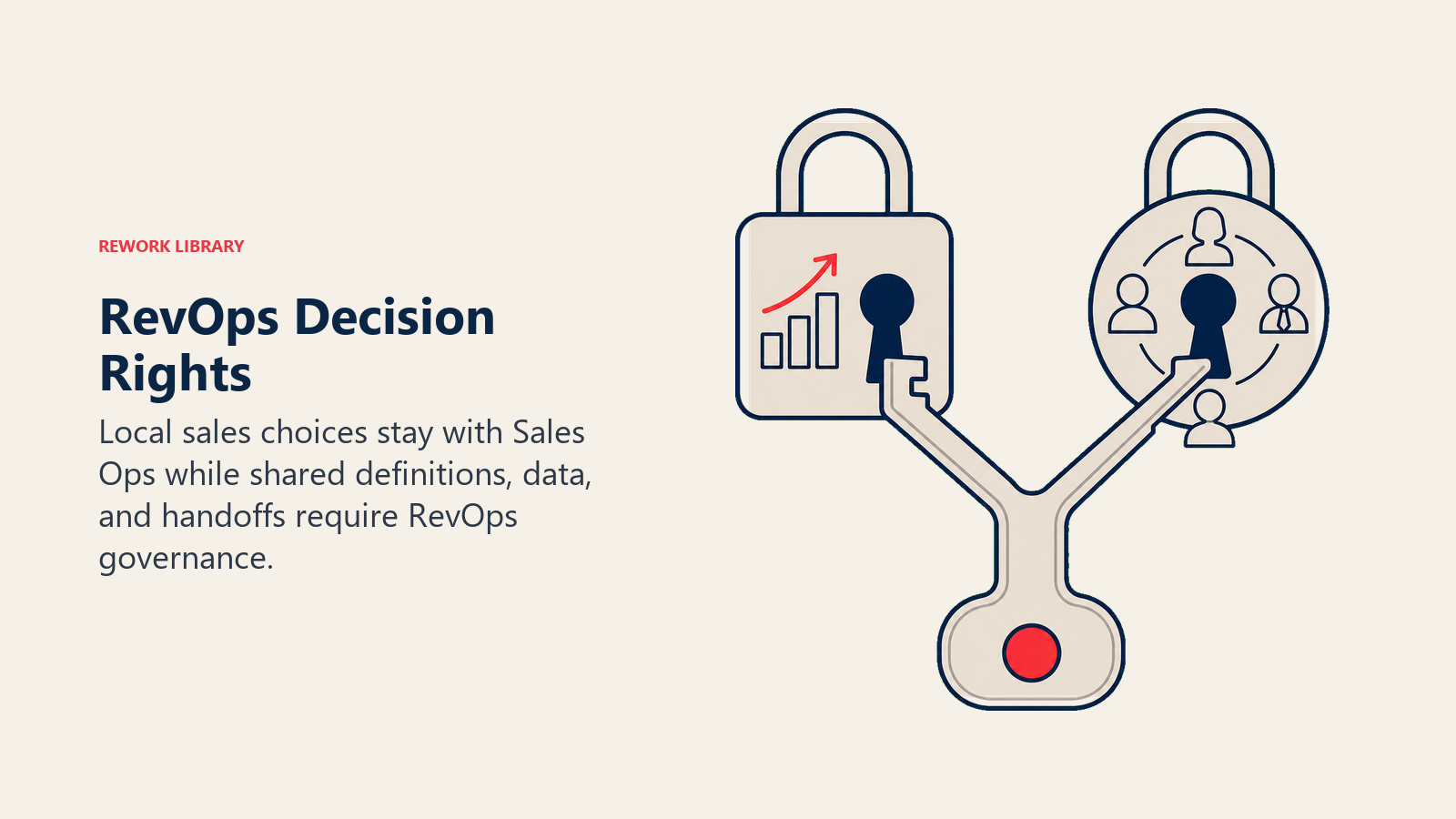
| Decision | Sales Ops should own | RevOps should govern |
|---|---|---|
| Sales view, list, or report for managers | Layout, usability, adoption | Whether it changes shared metric definitions |
| Opportunity stage process | Sales behavior, manager inspection, rep training | Stage definitions, exit criteria, forecast impact |
| Territory rule | Sales coverage need and account assignment | Segment consistency, routing impact, reporting impact |
| Quota support | Quota communication and sales planning input | Alignment to capacity model and plan assumptions |
| Forecast rollup | Manager submission workflow | Forecast category definitions and accuracy review |
| New CRM field | Sales use case and workflow fit | Source of truth, downstream reports, data quality burden |
| Closed-won handoff | Sales completion behavior | Required customer context and CS acceptance rule |
This keeps Sales Ops close to sellers while letting RevOps protect the system that marketing, finance, and customer success also depend on.
Migration path from Sales Ops to RevOps
Many companies do not hire RevOps from scratch. They evolve from Sales Ops.
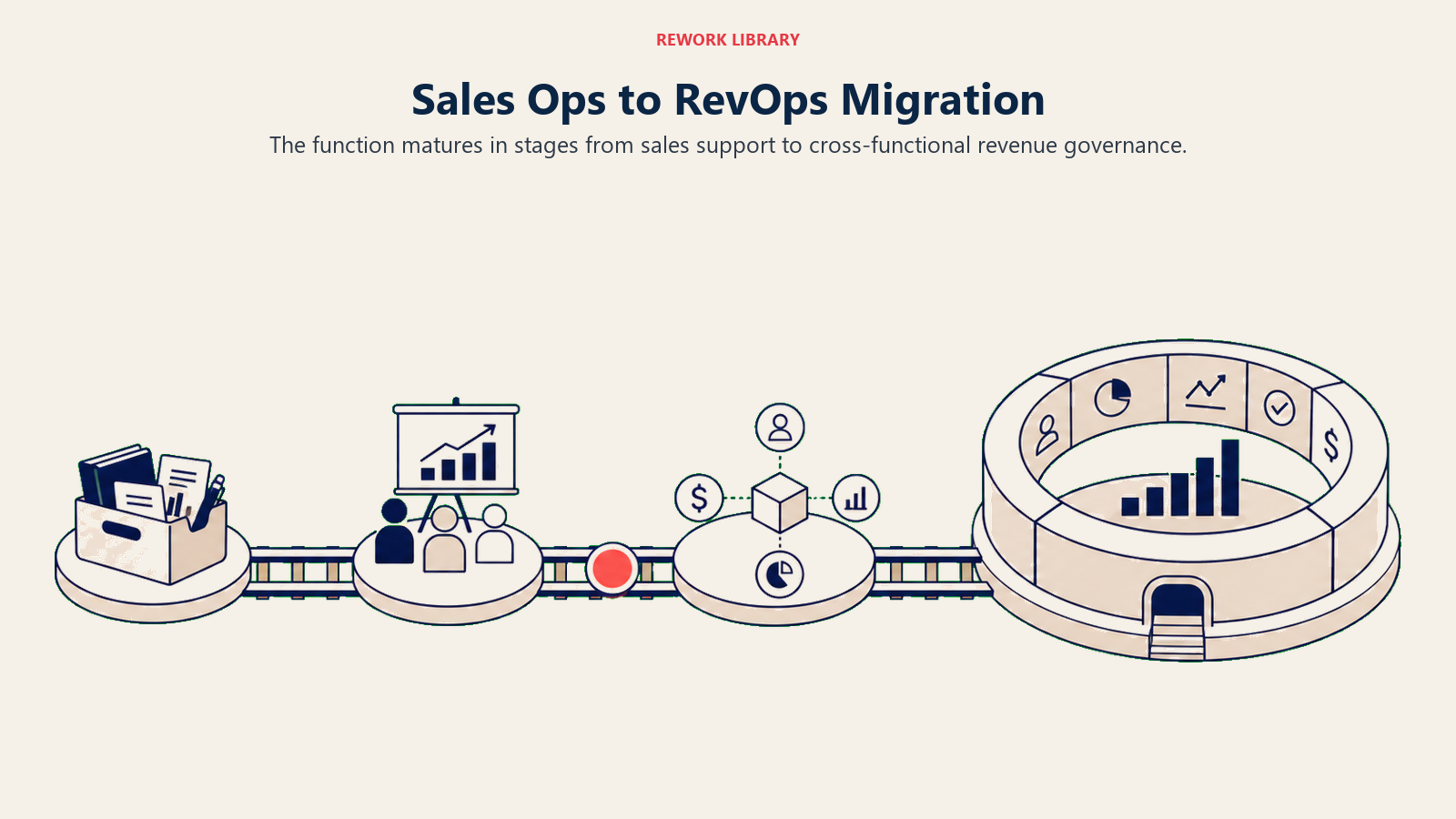
The migration should happen in stages.
| Stage | What changes | Success signal |
|---|---|---|
| Sales Ops foundation | Sales process, pipeline hygiene, territories, and forecast support become consistent | Sales managers trust the basic operating rhythm |
| Shared lifecycle governance | Marketing, sales, and CS agree on lifecycle stages and handoffs | MQL, SQL, opportunity, closed-won, and renewal definitions are no longer debated every month |
| Cross-system data model | CRM, marketing automation, CS, billing, and BI definitions are mapped | Finance and GTM leaders use the same core numbers |
| Full RevOps cadence | Funnel, forecast, retention, and systems reviews become repeatable | Revenue meetings produce decisions, not only status updates |
The title should change only when the mandate changes. If the team still serves only sales, call it Sales Ops and make it excellent. If the team governs shared revenue definitions, systems, handoffs, and cadence, the RevOps title is earned.
When both functions should coexist
Sales Ops and RevOps should coexist when sales execution needs depth and the revenue system also needs cross-functional governance.
That is common in mid-market companies. RevOps sets the shared model. Sales Ops keeps the sales engine working day to day.
Healthy coexistence looks like this:
- Sales Ops joins RevOps governance reviews when sales fields, stages, territories, or forecast rules are affected.
- RevOps does not approve every minor sales workflow change, but it reviews changes that affect shared data.
- Sales leaders know which requests go to Sales Ops and which require RevOps approval.
- Finance receives forecast definitions from RevOps, not from private spreadsheet logic.
- CS can trust closed-won handoff rules because they are governed, not optional.
If the two functions constantly collide, the problem is usually not personality. It is unclear decision rights.
Org design options
| Model | Best fit | Risk |
|---|---|---|
| Sales Ops only | Early sales-led company with simple funnel | Marketing, CS, and finance gaps emerge later |
| RevOps with Sales Ops embedded | Growth-stage company needing cross-functional governance and sales depth | Sales Ops may feel less responsive if priorities are unclear |
| Central RevOps plus functional ops partners | Mid-market or enterprise company with multiple motions | Decision rights can blur without a charter |
The reporting line matters. If RevOps reports only to sales, marketing and CS may see it as Sales Ops with broader access. If it reports only to marketing, sales may distrust attribution and lifecycle decisions. A CRO, COO, or CEO reporting line gives RevOps a better chance of staying neutral.
Decision framework by company stage
| Company stage | Recommended model | Why |
|---|---|---|
| Founder-led revenue | No formal ops or part-time ops generalist | Too early for specialization |
| First sales team | Sales Ops light | Sales execution discipline matters most |
| Marketing plus sales engine | RevOps owner or hybrid Sales Ops plus Marketing Ops governance | Handoffs and attribution become material |
| Sales plus CS renewal motion | RevOps with sales and CS operating coverage | Retention data must feed revenue planning |
| Multi-segment GTM | Central RevOps with specialist partners | Standardization and local nuance both matter |
Do not copy a late-stage org chart into an early-stage company. Structure should follow operating complexity.
Common mistakes
Renaming Sales Ops as RevOps without expanding authority. This creates expectation without real decision power. The person is now accountable for cross-functional outcomes but still only controls sales systems.
Centralizing everything too early. A small company may need one practical operator, not a formal RevOps structure. Too much governance too early slows learning.
Leaving Sales Ops outside RevOps with no governance rules. This can work, but only if shared data fields, dashboards, and system changes have clear approval paths.
Treating RevOps as the owner of every revenue decision. RevOps governs the system. Functional leaders still own strategy and team performance.
A practical decision rule
Use this rule when the title debate gets circular:
If the problem is inside the sales team, Sales Ops should probably own it. If the problem crosses marketing, sales, customer success, finance, or systems, RevOps should govern it.
Examples:
- A territory dispute between two AEs: Sales Ops.
- A campaign source that does not flow into opportunities: RevOps.
- Quota crediting for a rep: Sales Ops with finance.
- MQL rejection reasons not captured in CRM: RevOps.
- A rep productivity dashboard: Sales Ops.
- A source-to-revenue dashboard used by marketing, sales, and finance: RevOps.
That rule keeps the functions complementary. Sales Ops protects sales execution depth. RevOps protects system consistency across the revenue lifecycle.
Frequently Asked Questions about RevOps vs Sales Ops
Is RevOps just a new name for Sales Ops?
No. Sales Ops is focused on sales execution. RevOps has a broader mandate across the full revenue lifecycle, including marketing, sales, customer success, finance, data, and systems.
Can Sales Ops report into RevOps?
Yes. In many mature companies, Sales Ops is a specialist function inside RevOps. RevOps owns the shared operating model, while Sales Ops owns sales-specific execution details.
Do small companies need RevOps?
Small companies need revenue ownership, but not always a RevOps department. A single ops generalist or Sales Ops lead can cover the basics until marketing, sales, CS, and finance coordination becomes too complex.
Which should we hire first, Sales Ops or RevOps?
If your pain is mostly sales process, quota, territories, and CRM hygiene, hire Sales Ops. If your pain is cross-functional handoffs, lifecycle definitions, attribution, forecast trust, and customer handoff quality, hire RevOps.
Learn more

Principal Solution Architect
On this page
- Short answer
- What Sales Ops owns
- What RevOps owns
- Side-by-side comparison
- When Sales Ops is enough
- When RevOps becomes necessary
- How Sales Ops and RevOps work together
- What changes when Sales Ops becomes part of RevOps
- Decision rights in practice
- Migration path from Sales Ops to RevOps
- When both functions should coexist
- Org design options
- Decision framework by company stage
- Common mistakes
- A practical decision rule
- Learn more