AI in Revenue Operations: Use Cases, Limits, and Governance
AI can make RevOps faster, but it cannot rescue a poorly governed revenue system.
The best use cases improve coverage, speed, and signal detection. The worst use cases automate bad data and hide unclear process behind confident scores.
Gartner's guidance on reducing enablement complexity matters here because AI should remove work and sharpen decisions, not add another confusing layer. Forrester's RevOps operating model research also applies because AI workflows need ownership, governance, and operating cadence.
Key operating facts
- AI in RevOps is useful when it improves signal detection, prioritization, summarization, data quality, or workflow speed on top of governed data.
- AI is risky when it changes ownership, forecast category, customer communication, pricing, or executive metrics without human approval.
- RevOps should define approved use cases, data sources, permission boundaries, audit trails, and human review points before scaling AI workflows.
- AI output should be treated as a recommendation unless the rule is low-risk, tested, and easy to reverse.
Strong use cases
| Use case | Value |
|---|---|
| Lead scoring | Prioritize best-fit demand |
| Routing | Assign based on fit, capacity, and outcome history |
| CRM hygiene | Detect duplicates, stale records, missing fields |
| Forecast risk | Flag slipped, stale, or weak commit deals |
| Deal health | Surface risk signals for manager inspection |
| Renewal risk | Detect customer health changes |
| Expansion signals | Identify likely growth accounts |
See AI Lead Scoring Beyond Rules-Based Models and CRM Data Hygiene With an AI Copilot.
AI risk tiers
Classify AI use cases by risk before launch.
| Risk tier | Example | Governance |
|---|---|---|
| Low | Summarize a record, suggest missing fields, draft internal notes | User review and light audit |
| Medium | Recommend routing, flag deal risk, suggest renewal action | Owner approval and monitored outcomes |
| High | Change forecast category, send customer message, alter account owner | Human approval required |
| Critical | Pricing, contract, revenue recognition, board-facing metrics | Usually keep human-owned with strict controls |
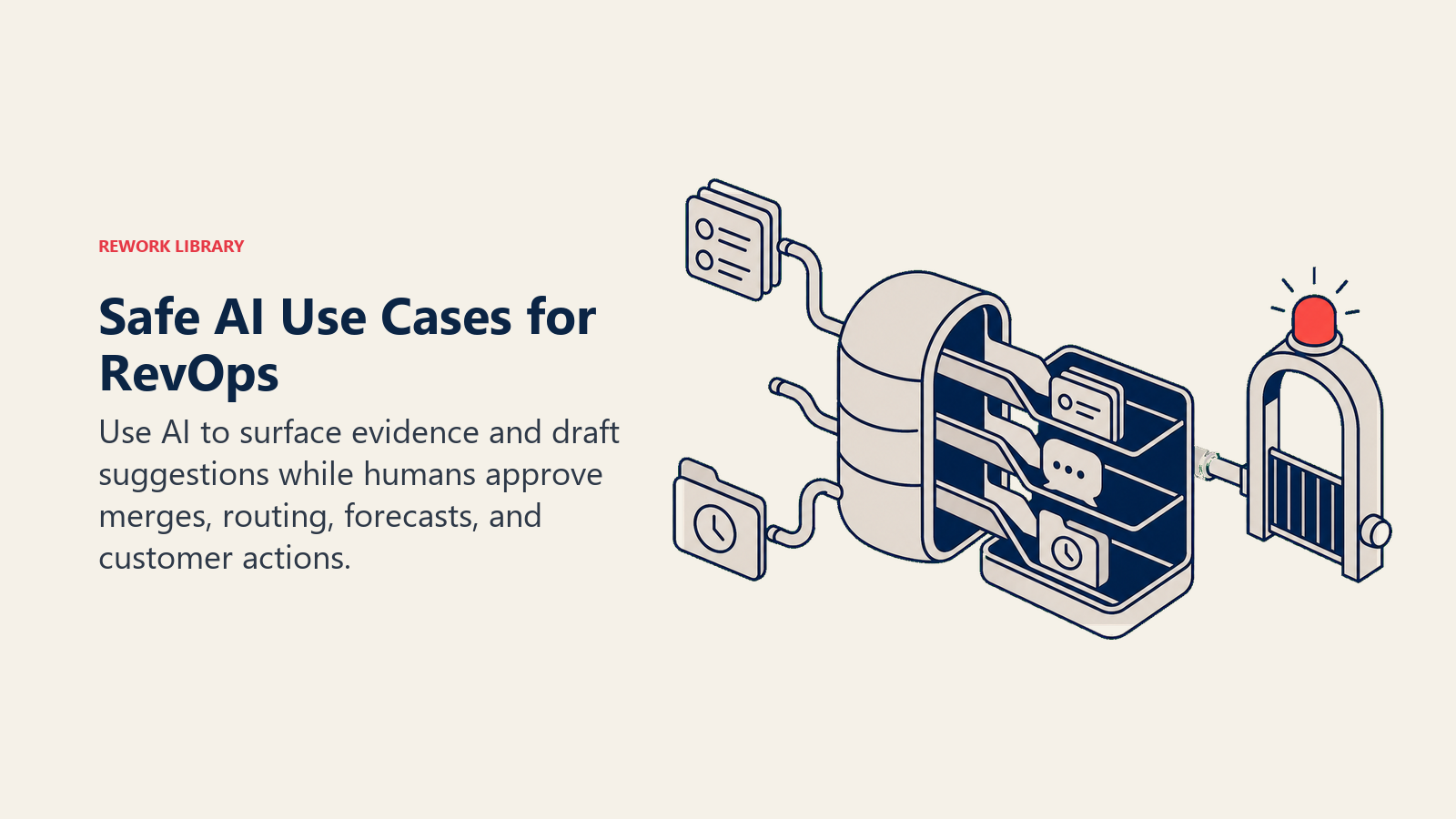
This keeps AI from quietly becoming an ungoverned operator. A model that summarizes a meeting can be helpful with limited risk. A model that changes a forecast or sends customer communication needs a much stricter approval path.
Start with governed data
AI depends on data quality.
If account ownership is wrong, AI routing suggestions will be wrong. If opportunity stages are subjective, AI forecast signals will inherit that weakness. If activity data is incomplete, AI deal summaries may miss context. If renewal health fields are stale, AI risk detection may create false confidence.
Before deploying AI, RevOps should review:
- System of record
- Data dictionary
- Field ownership
- Required fields
- Duplicate management
- Activity capture
- Integration quality
- Audit trail
- Permission model
AI can help detect data issues, but it should not be asked to compensate for a revenue system no one governs.
Use cases by maturity
Start with lower-risk workflows before moving to high-impact decisions.
| Maturity | Use cases |
|---|---|
| Early | Summaries, duplicate detection, missing-field prompts |
| Developing | Lead scoring, routing suggestions, deal risk flags |
| Mature | Forecast anomaly detection, renewal risk, expansion recommendations |
| Advanced | Multi-step workflow recommendations with human approval |
The maturity path matters. A team that cannot trust CRM ownership should not start with autonomous routing.
Human approval rules
Keep human approval for:
- Forecast category changes
- Pricing or discount changes
- Strategic account routing
- Customer-facing messages with sensitive context
- Renewal save decisions
- Territory changes
- High-value opportunity prioritization
- Employment or compensation decisions
AI can suggest. Humans should approve when the action materially affects customers, revenue, or people.
AI governance model
RevOps should define:
- Use case owner
- Data owner
- Model or vendor owner
- Human approver
- Audit log
- Confidence threshold
- Override process
- Review cadence
- Failure owner
- User feedback loop
Without governance, AI tools can spread across the revenue stack with inconsistent rules. That creates risk and makes it hard to explain decisions later.
Lead and account scoring
AI can improve scoring by finding patterns beyond simple rules.
But scoring should remain explainable enough for sales and marketing to act. If a lead is scored highly, users should know whether the reason is firmographic fit, intent behavior, product usage, source history, account similarity, or engagement pattern.
Good scoring outputs:
- Score or priority band
- Reason codes
- Suggested next action
- Confidence level
- Data caveats
Scoring without explanation often creates adoption problems.
Routing
AI-assisted routing can consider fit, capacity, ownership, past outcomes, and account context.
Use AI to suggest routes when matching is complex. Keep rule-based guardrails for territory, named accounts, partner ownership, and strategic exceptions. Log routing decisions so RevOps can audit fairness, speed, and accuracy.
Routing is a high-impact workflow because it affects response time and rep opportunity. Treat it with more care than a simple productivity feature.
CRM hygiene
AI can help with:
- Duplicate detection
- Account matching
- Missing-field suggestions
- Stale record detection
- Note summarization
- Contact role extraction
- Data enrichment review
Keep approval for merges and high-impact field changes. A wrong merge can damage reporting and customer history.
Forecast and deal risk
AI can flag:
- Slipping close dates
- Weak activity
- Missing buyer roles
- Risk language in notes
- Similar historical lost patterns
- Commit deals missing evidence
- Large changes in pipeline behavior
Use these signals in Deal Health Scoring and Forecast Governance. Do not let AI replace manager inspection. The best use is to focus inspection where risk is likely.
Renewal and expansion
For customer revenue, AI can combine usage, support, relationship, contract, and engagement data.
Useful outputs:
- Renewal risk summary
- Expansion signal
- Account health explanation
- Suggested stakeholder action
- Missing sponsor warning
- Product adoption pattern
Customer success and account teams should validate recommendations before action. Existing customer workflows often involve relationship context that data alone may miss.
Measurement
Measure AI use cases like operating workflows.
Metrics:
- Time saved
- Accuracy
- False positives
- False negatives
- Adoption
- Override rate
- Revenue impact
- Data quality improvement
- User trust
- Exception rate
If a model creates many suggestions but few accepted actions, it may not be useful. If users override frequently, inspect why.
Vendor evaluation
When evaluating AI vendors, ask:
- What data does the system need?
- Where is data stored?
- Can outputs be explained?
- Can humans approve actions?
- Is there an audit log?
- How are permissions handled?
- Can rules be configured?
- How are errors reviewed?
- What happens when data quality is weak?
- How does it integrate with current systems?
Vendor demos often show ideal data. RevOps should test with messy real data before committing.
Common mistakes
AI before data governance. Outputs inherit bad data.
No human approval. High-impact actions happen without judgment.
No explanation. Users do not trust recommendations.
Too many use cases at once. Governance cannot keep up.
No audit trail. Decisions cannot be reviewed.
Model treated as truth. Signals replace inspection.
Readiness checklist
Before launching AI in RevOps:
- Use case is specific.
- Data source is known.
- Data quality is acceptable.
- Owner is named.
- Human approval path exists.
- Audit log exists.
- Users can see reasons.
- Metrics are defined.
- Exception path is documented.
- Review cadence is scheduled.
What the checklist should prove
AI should make RevOps signals clearer and workflows faster. It should not make unclear process look scientific. Start with clean data, clear decisions, human approval, and visible governance.
Implementation roadmap
Roll out AI in stages.
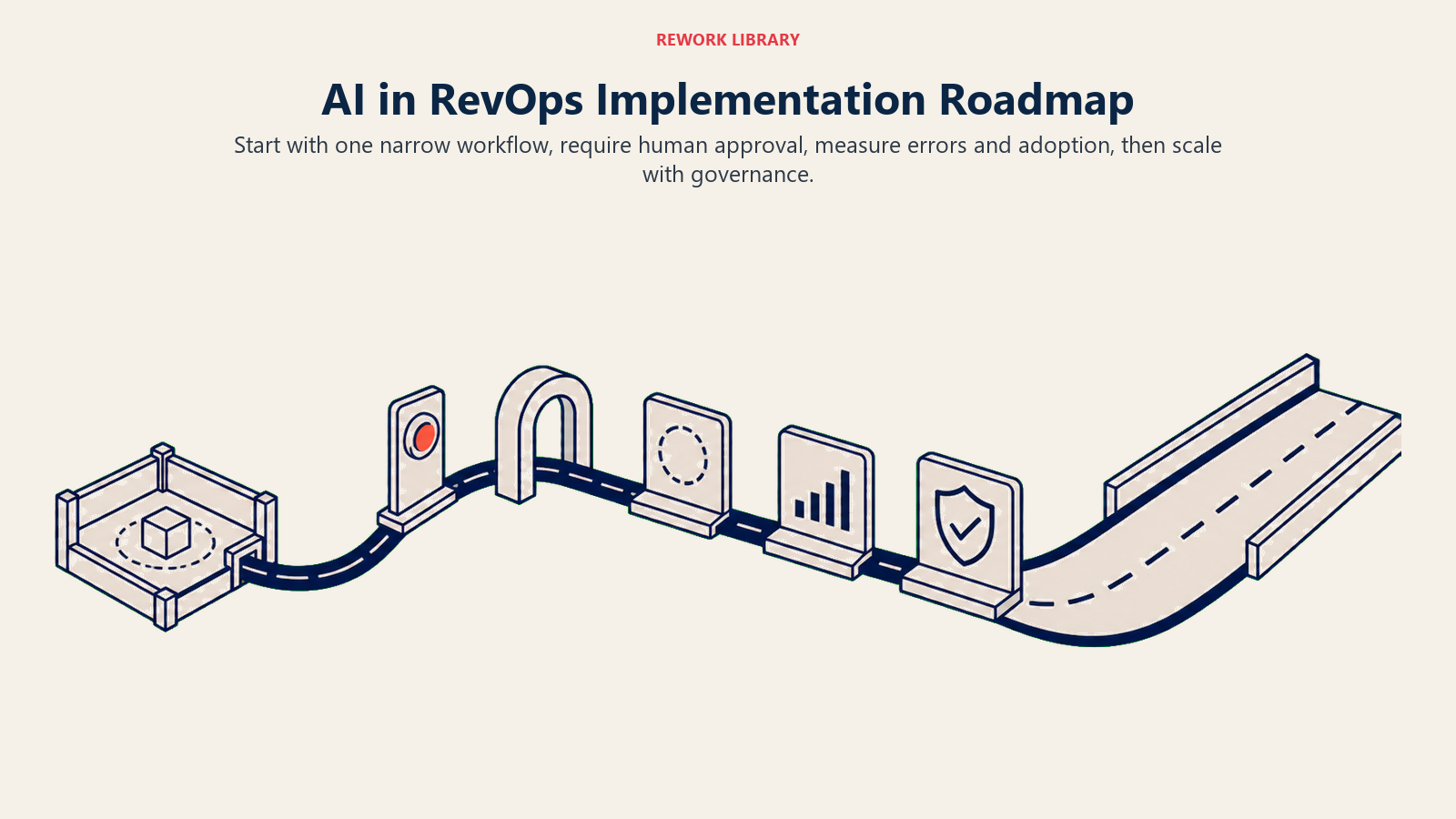
First, pick one narrow workflow with clear value and low risk. CRM hygiene, call summary review, duplicate detection, or stale opportunity prompts are usually safer than autonomous routing or forecast changes. Second, define the expected user action. Third, run the workflow in shadow mode and compare AI output with human review. Fourth, measure false positives, false negatives, adoption, and time saved. Fifth, decide whether to expand.
Turn this article into takeaways for your work.


Each assistant summarizes the article only for you and suggests best practices for your work.
A practical roadmap:
- Define the use case and owner.
- Identify data sources.
- Check data quality.
- Define approval path.
- Test on historical records.
- Run in shadow mode.
- Train users on reasons and actions.
- Launch with audit logging.
- Review performance monthly.
This staged approach prevents the team from deploying AI broadly before trust exists.
Implementation roadmap operating examples
Example: RevOps uses AI to flag duplicate accounts. The model suggests possible duplicates, but an admin approves merges. The output includes matching reasons such as domain, company name, address, and ownership. This saves time while protecting account history.
Example: AI reviews open commit deals and flags three risks: no next meeting, close date pushed twice, and no procurement status. The manager uses those signals in pipeline inspection. The AI does not change forecast category by itself.
Example: AI summarizes renewal risk from support tickets, usage data, and customer notes. The customer success manager reviews the summary before changing health status or renewal forecast.
Example: AI suggests expansion accounts based on usage growth and stakeholder engagement. Account managers see the reason codes and choose whether to create an opportunity.
The common pattern is simple: AI narrows attention, humans decide.
AI and source attribution
AI can help analyze source quality, but attribution data must be governed.
If campaign source, lead source, original source, and opportunity source are inconsistent, AI may find patterns that reflect data entry behavior rather than true revenue performance. RevOps should clean attribution definitions before using AI to recommend budget, routing, or prioritization changes.
Good AI outputs should expose the data used. If a recommendation depends heavily on source quality, the caveat should be visible.
AI and manager coaching
AI can support manager coaching by turning messy activity into inspectable signals.
Useful coaching prompts:
- Which deals have no next customer action?
- Which reps have repeated late-stage date pushes?
- Which opportunities lack economic buyer coverage?
- Which accounts show expansion signals but no owner action?
- Which renewal risks appeared before a save motion started?
Managers should use these prompts to coach behavior, not to replace conversation. The best AI workflow gives managers better questions.
AI failure modes
Watch for:
- Recommendations that users cannot explain
- Alerts that fire too often
- Data quality issues disguised as risk signals
- Overconfidence in forecast predictions
- Bias toward historical segments or sources
- Users accepting outputs without review
- Admins unable to audit changes
- Customer-facing actions without approval
RevOps should review failure modes openly. Trust improves when the team can see both where AI helps and where it is limited.
Minimum viable governance
At minimum, every AI workflow should have:
- Named owner
- Data source list
- User action
- Approval rule
- Audit log
- Review cadence
- Error reporting path
- Rollback plan
This is enough to start. More advanced governance can follow as AI touches higher-impact workflows.
Where AI should not start
Avoid starting with workflows where a wrong action has high cost:
- Automatically changing forecast categories
- Automatically sending sensitive customer emails
- Automatically approving discounts
- Automatically merging strategic accounts
- Automatically reassigning major opportunities
- Automatically deciding churn risk without CS review
These may become assisted workflows later. Start with suggestion and review, not direct action.
Review cadence
AI workflows should be reviewed like other revenue operations processes.
Weekly review is useful for active workflows that affect pipeline, routing, or customer risk. Monthly review should look at acceptance rate, override rate, false positives, false negatives, and user feedback. Quarterly review should decide whether the workflow should expand, change, or be retired.
Review questions:
- Are users acting on the recommendations?
- Are outputs explainable?
- Are errors concentrated in one segment or source?
- Are overrides reasonable?
- Has the underlying process changed?
- Has data quality improved or declined?
- Are approval rules still right?
AI is not a set-and-forget capability. Revenue processes change, and the model workflow has to change with them.
RevOps responsibilities
RevOps should own the operating side of AI.
That includes use-case selection, data readiness, workflow fit, user adoption, audit needs, reporting, and review cadence. IT and security should own architecture and risk review. Functional leaders should own the business judgment. Vendors may provide models, but the company owns the operating outcome.
This ownership split keeps AI from becoming an isolated experiment.
User training
Users need training on how to read AI output.
Training should cover:
- What the AI can see
- What it cannot see
- What the score or suggestion means
- What action is expected
- When to override
- How to report bad output
- Which actions require approval
Training should use real examples from the team's data. Generic demos are not enough.
Launch checklist
Before launch, confirm that the workflow has a named owner, clean enough data, a human approval path, visible reasons, user training, and an audit log. Confirm that users know what to do when the AI is wrong. Confirm that managers know whether the output is advisory or required. Confirm that RevOps has a review date on the calendar.
The launch is not complete when the tool is enabled. It is complete when the workflow is understood, measured, and governed.
Keep the first release narrow, measurable, and reversible. That protects user trust while the team learns.
Governance rules
- Keep humans in high-impact decisions.
- Log automated changes.
- Audit model outputs.
- Define confidence thresholds.
- Do not automate unclear definitions.
- Monitor bias by segment and source.
AI decision boundaries by use case
The safest AI programs define what the model may recommend, what it may draft, and what it may change.
| Use case | AI can do | Human must approve |
|---|---|---|
| Lead and account scoring | Suggest score changes, explain factors, flag low-fit records | Qualification definition, routing eligibility, exclusion rules |
| Routing | Recommend owner based on fit, capacity, territory, and SLA | Final routing policy and exception rules |
| CRM hygiene | Detect duplicates, stale records, missing fields, and likely wrong values | Field overwrites on high-value accounts or forecast records |
| Forecast risk | Flag stage aging, close-date movement, weak next steps, and missing evidence | Forecast category changes and commit judgment |
| Deal coaching | Draft coaching prompts and risk questions | Manager feedback to rep and customer strategy |
| Renewal risk | Surface usage, support, sentiment, and adoption signals | Renewal forecast change and customer escalation |
| Executive summaries | Draft weekly funnel or forecast summaries | Final narrative, caveats, and decisions |
This boundary table should be visible to users. If people do not know what AI is allowed to change, they will either overtrust it or ignore it.
Audit log requirements
AI-assisted RevOps needs a change trail.
At minimum, log:
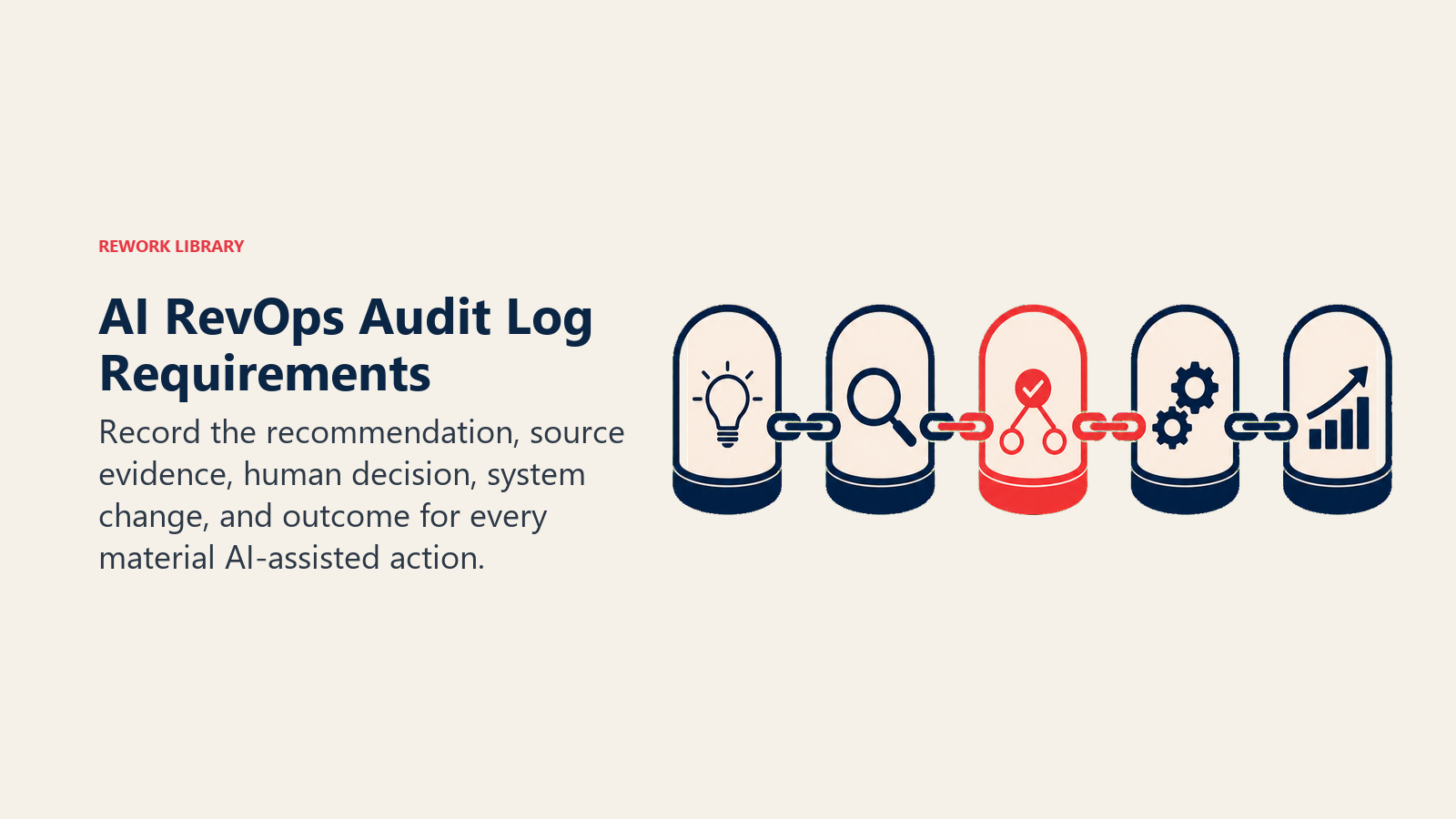
- What the model recommended.
- Which data inputs influenced the recommendation.
- Who accepted, edited, or rejected it.
- Which field, task, route, or forecast note changed.
- Whether the recommendation was later correct.
This matters because RevOps decisions affect routing, forecast, customer handoff, and planning. If an AI model changes behavior but the team cannot inspect why, the system becomes harder to govern than the manual process it replaced.
Frequently Asked Questions about AI in Revenue Operations
Should RevOps own AI in the revenue stack?
RevOps should own operating governance for AI workflows that affect revenue data, routing, forecasting, or customer handoffs.
What should AI not decide alone?
High-stakes customer, pricing, forecast, and employment decisions should keep human approval.
Learn more

Senior Operations & Growth Strategist
On this page
- Strong use cases
- AI risk tiers
- Start with governed data
- Use cases by maturity
- Human approval rules
- AI governance model
- Lead and account scoring
- Routing
- CRM hygiene
- Forecast and deal risk
- Renewal and expansion
- Measurement
- Vendor evaluation
- Common mistakes
- Readiness checklist
- What the checklist should prove
- Implementation roadmap
- Implementation roadmap operating examples
- AI and source attribution
- AI and manager coaching
- AI failure modes
- Minimum viable governance
- Where AI should not start
- Review cadence
- RevOps responsibilities
- User training
- Launch checklist
- Governance rules
- AI decision boundaries by use case
- Audit log requirements
- Learn more