Revenue Operations Framework: How to Design a Full-Funnel Operating System
RevOps fails when companies treat it as a reporting team.
The pattern is common. A company hires a strong operator, gives them CRM access, and asks for better dashboards. The dashboards improve for a quarter. Then the same problems return: lead definitions drift, sales stages are used inconsistently, forecast calls turn into cleanup sessions, and customer success still receives incomplete handoffs.
The issue is not reporting skill. The issue is framework design.
A useful Revenue Operations framework defines how the company runs revenue across strategy, funnel architecture, process, data, systems, metrics, cadence, and accountability. It gives leaders a way to audit the whole revenue system instead of chasing disconnected symptoms.
This article builds on What Is Revenue Operations?. The short version: RevOps is the operating layer across marketing, sales, customer success, finance, data, and systems. If your company frames this work as go-to-market motion design, GTM Operations vs Revenue Operations explains where the two overlap. The framework below turns that definition into a working model.
Forrester's operating model research makes the same point from another angle: revenue operations needs an operating model, not just a new team name or reporting structure.
Key operating facts
- A RevOps framework should define how the company runs revenue across strategy, lifecycle, process, data, systems, metrics, cadence, and accountability.
- Build the layers in order. Dashboards and automation should follow stage definitions, process rules, and data governance.
- The framework should cover acquisition, sales, customer success, renewal, and expansion.
- Use the framework as an audit tool: find which layer is weak before choosing a tool, report, or reorg as the fix.
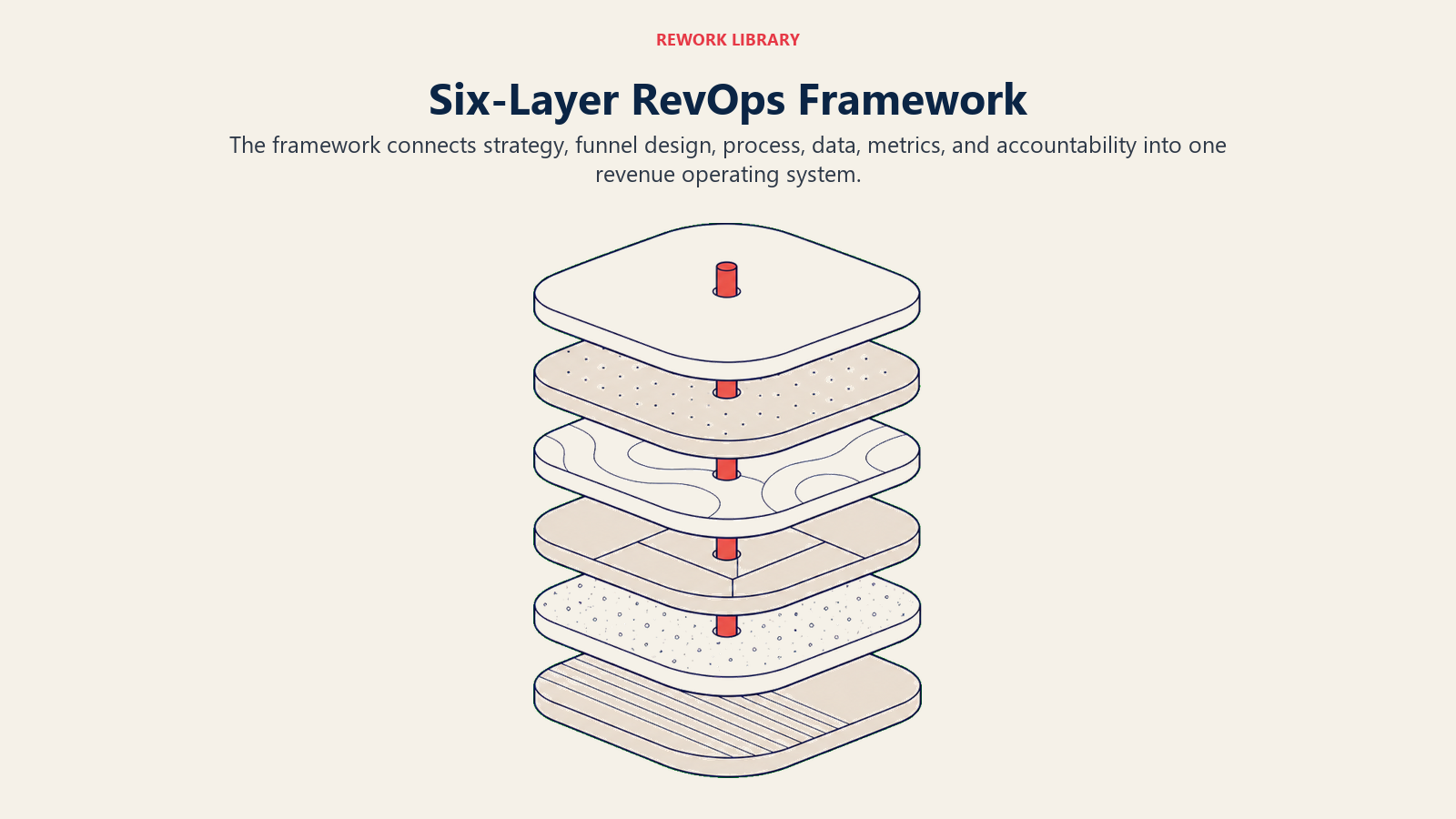
The six-layer RevOps framework
| Layer | Purpose | Output |
|---|---|---|
| 1. Revenue strategy | Define where growth should come from | ICP, segments, motion mix, targets |
| 2. Funnel architecture | Define the revenue lifecycle | Stages, entry criteria, exit criteria, ownership |
| 3. Process and SLA design | Define how work moves between teams | Handoffs, SLAs, exception paths |
| 4. Data model and system governance | Define what the systems must know | Fields, source of truth, integrations, change control |
| 5. Metrics and reporting | Define how performance is judged | Executive, RevOps, and functional dashboards |
| 6. Cadence and accountability | Define how decisions get made | Reviews, owners, decision rights, follow-through |
Most RevOps problems come from building these layers out of order. A dashboard built before stage definitions will expose confusion, not solve it. Automation added before SLA rules will accelerate broken handoffs. A CRM field added without governance will become one more inconsistent data point.
Turn this article into takeaways for your work.


Each assistant summarizes the article only for you and suggests best practices for your work.
The framework forces sequence. Strategy informs funnel design. Funnel design informs process. Process defines the data model. Data makes metrics credible. Metrics feed cadence. Cadence creates accountability.
How to use the framework as an audit
The framework is most useful when it is used against the current operating system, not as a blank design exercise.
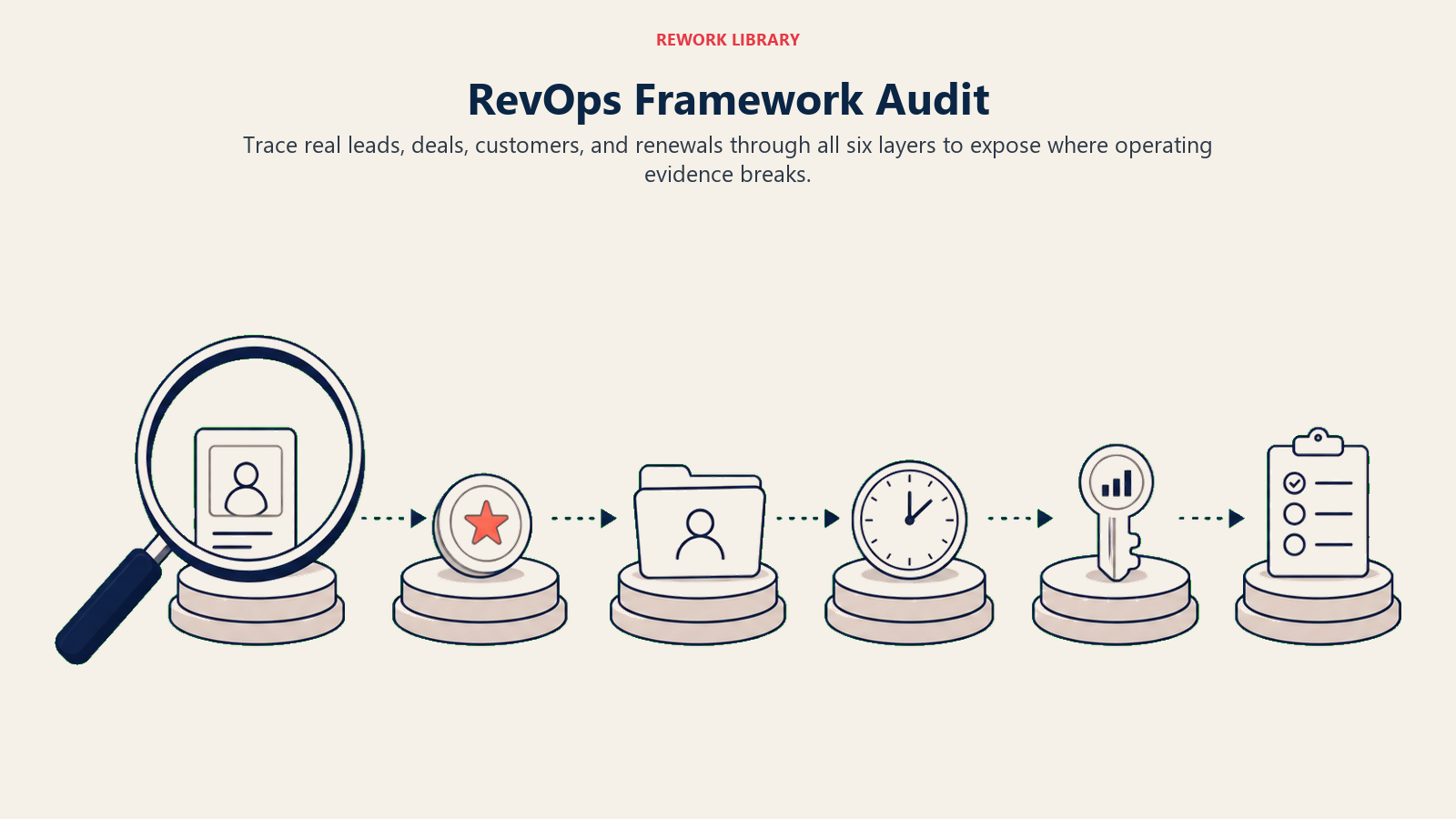
Pick a recent revenue path and walk it through all six layers. For example, choose five inbound demo requests, five outbound opportunities, five closed-won deals, and five renewal-risk customers. For each record, ask the same questions.
| Layer | Audit question | Evidence to inspect |
|---|---|---|
| Strategy | Does this record match the ICP, segment, motion, and plan? | ICP field, segment, source, owner, target account fit |
| Funnel architecture | Is the lifecycle stage correct and explainable? | Stage definition, entry evidence, exit evidence |
| Process and SLA | Did the right owner act at the right time? | Assignment timestamp, acceptance, rejection, next action |
| Data and systems | Is the record complete enough for downstream work? | Required fields, duplicates, source, integration status |
| Metrics | Does this record feed the right dashboard correctly? | Conversion report, pipeline report, forecast, handoff report |
| Cadence | Did a review create a decision when risk appeared? | Meeting notes, exception log, owner action |
This audit makes the framework concrete. If a lead meets the ICP but never reaches the right rep, the weak layer is process and SLA. If a closed-won customer reaches onboarding without success criteria, the weak layer is data and handoff design. If leaders saw the issue but no one made a decision, the weak layer is cadence.
Diagnostic scorecard
Use a simple scorecard before choosing the next RevOps project.
| Score | Meaning | Operating action |
|---|---|---|
| 1 | No shared rule exists | Define the rule and assign an owner |
| 2 | Rule exists but is informal | Document the rule and test it on real records |
| 3 | Rule is documented but weakly enforced | Add workflow checks, manager inspection, or SLA tracking |
| 4 | Rule is enforced and measured | Review exceptions and trend quality over time |
| 5 | Rule is measured and improved through cadence | Use the layer as a planning input |
Score each layer from 1 to 5. The lowest layer usually explains the recurring pain.
For example, if metrics score a 4 but funnel architecture scores a 2, do not start by rebuilding dashboards. The dashboard is probably reporting unclear stage behavior. If process scores a 2 and data scores a 2, do not automate yet. Automation would only move poor records faster.
How to prioritize fixes
RevOps teams often inherit a long backlog: dashboard requests, field cleanup, routing fixes, attribution disputes, forecast complaints, and tool changes. The framework helps rank that backlog by system impact.
Prioritize work that meets at least two of these conditions:
- It affects more than one revenue function.
- It changes a decision leaders make weekly or monthly.
- It improves forecast, pipeline, handoff, or renewal trust.
- It removes repeated manual cleanup.
- It prevents bad data from entering the system.
- It reduces customer-facing friction.
Deprioritize work that is only cosmetic, only local to one manager, or useful only once. A one-off board pull may be urgent, but it is not a framework improvement unless it becomes part of a governed reporting model.
Layer 1: Revenue strategy
Revenue strategy answers the first operating question: where should growth come from?
RevOps does not own strategy by itself. The CEO, CRO, CMO, VP Sales, CS leader, and finance leader make the strategy calls. RevOps turns those calls into operating requirements.
The strategy layer should define:
- ICP and non-ICP boundaries
- Target segments and priority accounts
- Sales motion mix, such as inbound, outbound, partner, expansion, or product-led
- Average contract value bands
- Growth target by segment or motion
- Capacity assumptions by team
- Retention and expansion expectations
Without this layer, RevOps becomes reactive. It can route leads, build dashboards, and maintain fields, but it cannot tell whether those systems support the current growth model.
Example: if the company moves from SMB inbound to mid-market outbound, RevOps must change account fields, lead scoring, routing, pipeline stages, forecast inspection, and onboarding handoff data. If strategy is not translated into system requirements, the old funnel keeps running under the new strategy.
McKinsey's B2B growth research points to integrated data, advanced analytics, and operational coordination across commercial teams as part of what separates stronger B2B performers. RevOps is where that coordination becomes operating work.
Layer 2: Funnel architecture
Funnel architecture defines the lifecycle of revenue from first touch to renewal.
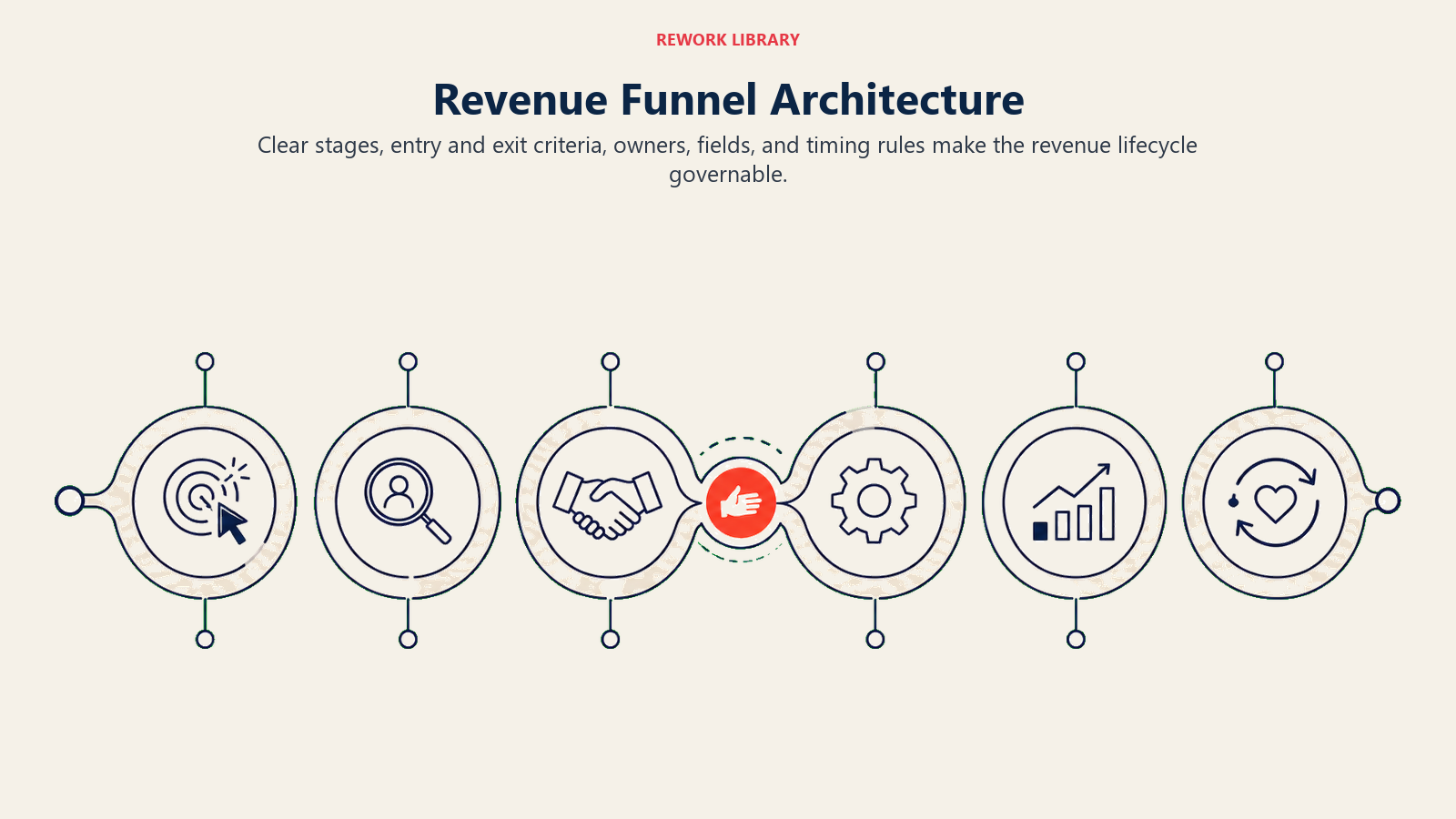
This layer is where RevOps documents stages and removes ambiguity. A good funnel architecture includes:
- Stage name
- Stage definition
- Entry criteria
- Exit criteria
- Primary owner
- Required fields
- SLA or timing rule
- Next system action
A simple acquisition funnel might move from visitor to lead, MQL, SQL, opportunity, closed-won, onboarded, active customer, renewal, and expansion. A more complex company may split by motion or segment. Either way, the discipline is the same: no stage should exist only because it sounds useful.
For lead intake, this connects directly to Lead Management vs CRM. A CRM stores the record. Lead management defines how the record should move. RevOps makes sure the two match.
The best test of funnel architecture is whether a new manager can inspect ten records and know exactly why each record is in its current stage. If not, the architecture is too vague.
Layer 3: Process and SLA design
Process turns funnel stages into work.
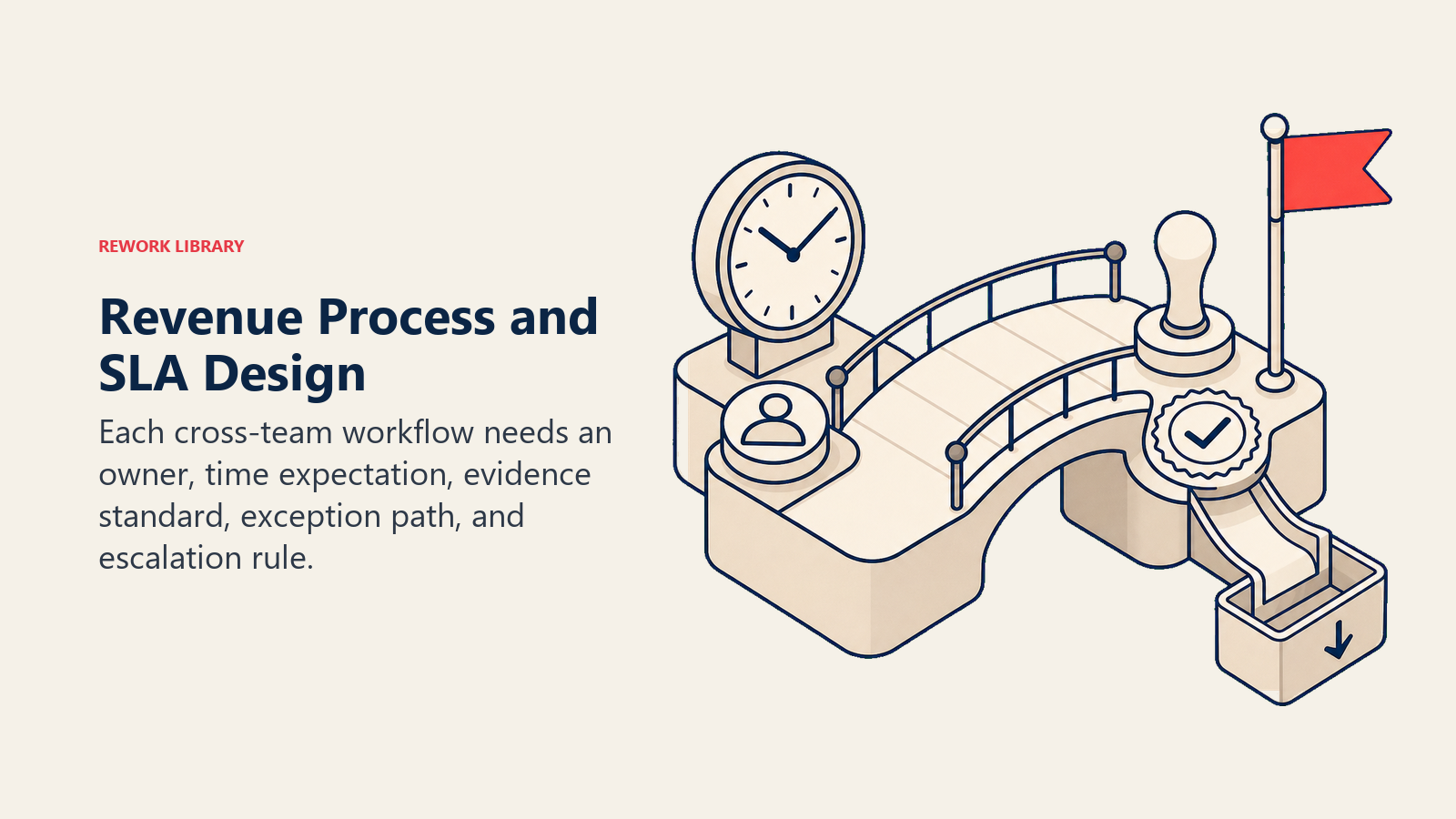
RevOps should document the main workflows that move revenue between teams:
- Lead capture and enrichment
- Lead assignment and acceptance
- MQL to SQL handoff
- Opportunity creation
- Pipeline inspection
- Quote or proposal approval
- Closed-won handoff
- Onboarding kickoff
- Renewal risk escalation
- Expansion trigger routing
Each workflow needs an SLA. The SLA does not have to be complicated. It just needs to answer: who acts, by when, with what data, and what happens if they do not act?
The Lead Assignment SLA is a good example. A lead assigned to a rep should not sit untouched because the rep was in meetings or the routing rule was unclear. The process should define assignment timing, acceptance criteria, escalation, and reassignment.
Process design also prevents handoff debt after the sale. If the sales-to-CS transition depends on a rep writing a thoughtful Slack message, the handoff will degrade during busy periods. A structured sales-CS handoff or closed-won workflow should make the required customer context unavoidable.
Layer 4: Data model and system governance
Data governance is where many RevOps teams either earn trust or lose it.
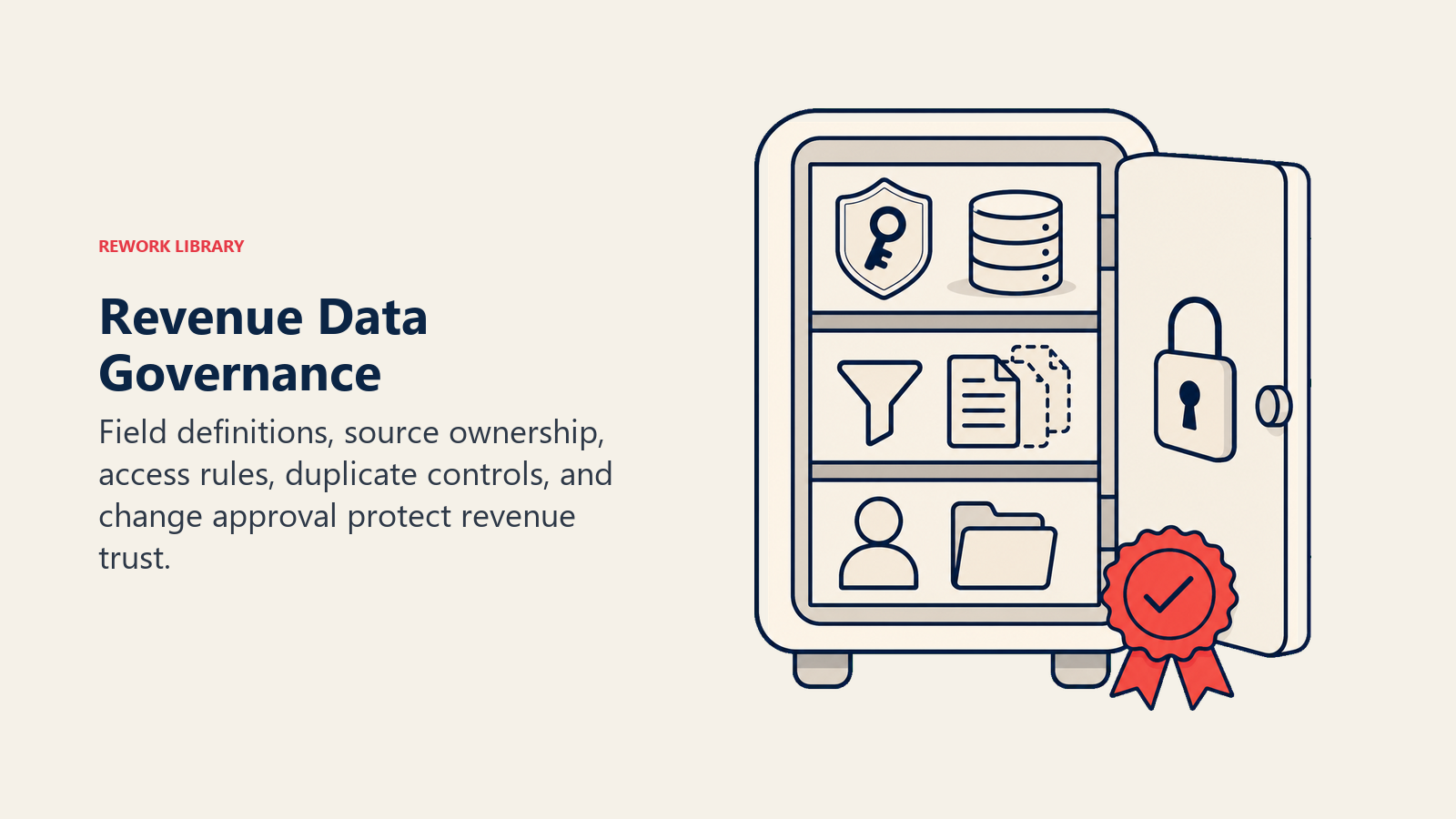
A revenue system needs clear rules for:
- Required fields by stage
- Field definitions
- Which system owns each field
- Which roles can edit critical fields
- How duplicates are handled
- How enrichment data is accepted
- How integration errors are monitored
- How system changes are requested and approved
This is not bureaucracy for its own sake. It protects the forecast, attribution, routing, and reporting layers from silent decay.
Forrester's research on RevOps technology alignment argues that B2B organizations moving to RevOps need sustained alignment across marketing, sales, and customer success technologies. That is exactly what this layer handles. The CRM, marketing automation platform, customer success tool, billing system, enrichment provider, and BI layer cannot each define customer truth independently.
At minimum, RevOps should maintain a revenue data dictionary. It should include field name, definition, owning system, owner, required stage, allowed values, and downstream reports affected.
Layer 5: Metrics and reporting
Metrics should tell leaders what to fix next.
A RevOps metrics layer should separate three reporting views:
| View | Audience | Purpose |
|---|---|---|
| Executive dashboard | CEO, CRO, finance, board | Inspect revenue health, risk, and plan performance |
| RevOps working dashboard | RevOps and functional operators | Identify bottlenecks, data issues, SLA misses, and process drift |
| Functional dashboards | Marketing, sales, CS | Manage team-specific execution |
The executive dashboard should stay small. Pipeline created, conversion by stage, pipeline coverage, forecast accuracy, win rate, sales cycle, retention, expansion, and revenue plan variance are usually enough.
The RevOps working dashboard can be deeper. It should include routing failures, lead aging, SLA breaches, field completeness, duplicate rates, stale opportunities, source conversion, and handoff completeness.
This is where Pipeline vs Forecast matters. Pipeline is the inventory of potential revenue. Forecast is the expected revenue outcome over a period. RevOps needs both, but they answer different operating questions.
CIO Dive summarized Gartner research showing that less than half of sales leaders and sellers had high confidence in forecast accuracy. That is not only a sales judgment problem. It is usually a data model, stage discipline, and inspection cadence problem.
Layer 6: Cadence and accountability
Cadence is not the same as meetings.
A meeting is a calendar event. A cadence is a repeatable decision system with inputs, owners, outputs, and follow-through.
RevOps should help define the core revenue cadence:
| Cadence | Frequency | Main decision |
|---|---|---|
| Pipeline review | Weekly | Which deals or stages need action now? |
| Forecast review | Weekly or biweekly | What revenue is likely to close this period? |
| Retention review | Monthly | Which customers create renewal or expansion risk? |
| Funnel review | Monthly | Where is conversion or velocity changing? |
| Systems governance review | Monthly | Which data, workflow, or tooling changes are approved? |
| Planning review | Quarterly | Which assumptions change next quarter's operating model? |
Every cadence needs a decision owner. Otherwise the meeting becomes discussion without operating change.
The strongest RevOps teams are strict about meeting purpose. Forecast review is not the place to clean CRM fields. Monthly funnel review is not the place to inspect one rep's stuck deal. Systems governance is not the place to relitigate company strategy.
Implementation sequence
If your RevOps foundation is weak, fix it in this order.
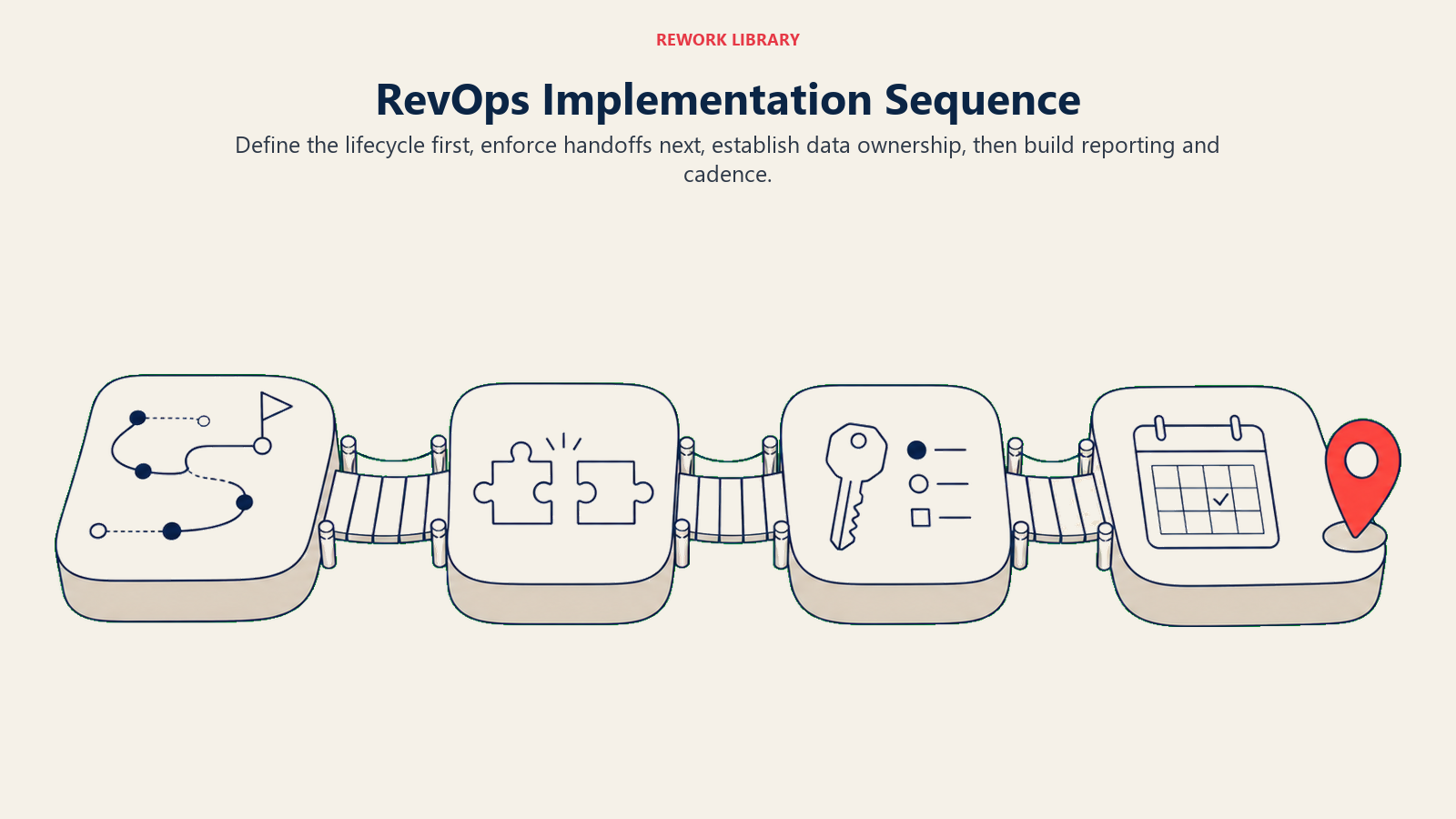
First: define the lifecycle. Agree on the stages from lead to renewal. Write entry and exit criteria. Remove duplicate or vague stages. Make stage definitions visible.
Second: enforce the handoffs. Pick the highest-friction handoffs and define ownership, SLA, required fields, and escalation. Usually this means lead assignment, MQL to SQL, opportunity creation, and closed-won to onboarding.
Third: clean the reporting layer. Build the smallest useful shared dashboard from the agreed definitions. Do not start with twenty charts. Start with the metrics that drive weekly and monthly decisions.
Fourth: govern systems changes. Lock down critical fields, document source of truth, and create a change request process. Most data decay starts with well-intentioned local changes.
Fifth: improve cadence. Rebuild meetings around decisions. Every recurring revenue meeting should have an owner, data packet, decision type, and follow-up log.
Minimum viable RevOps framework
You do not need an enterprise operating model to start using this framework. A 60-person B2B company can apply a lighter version in a few weeks.
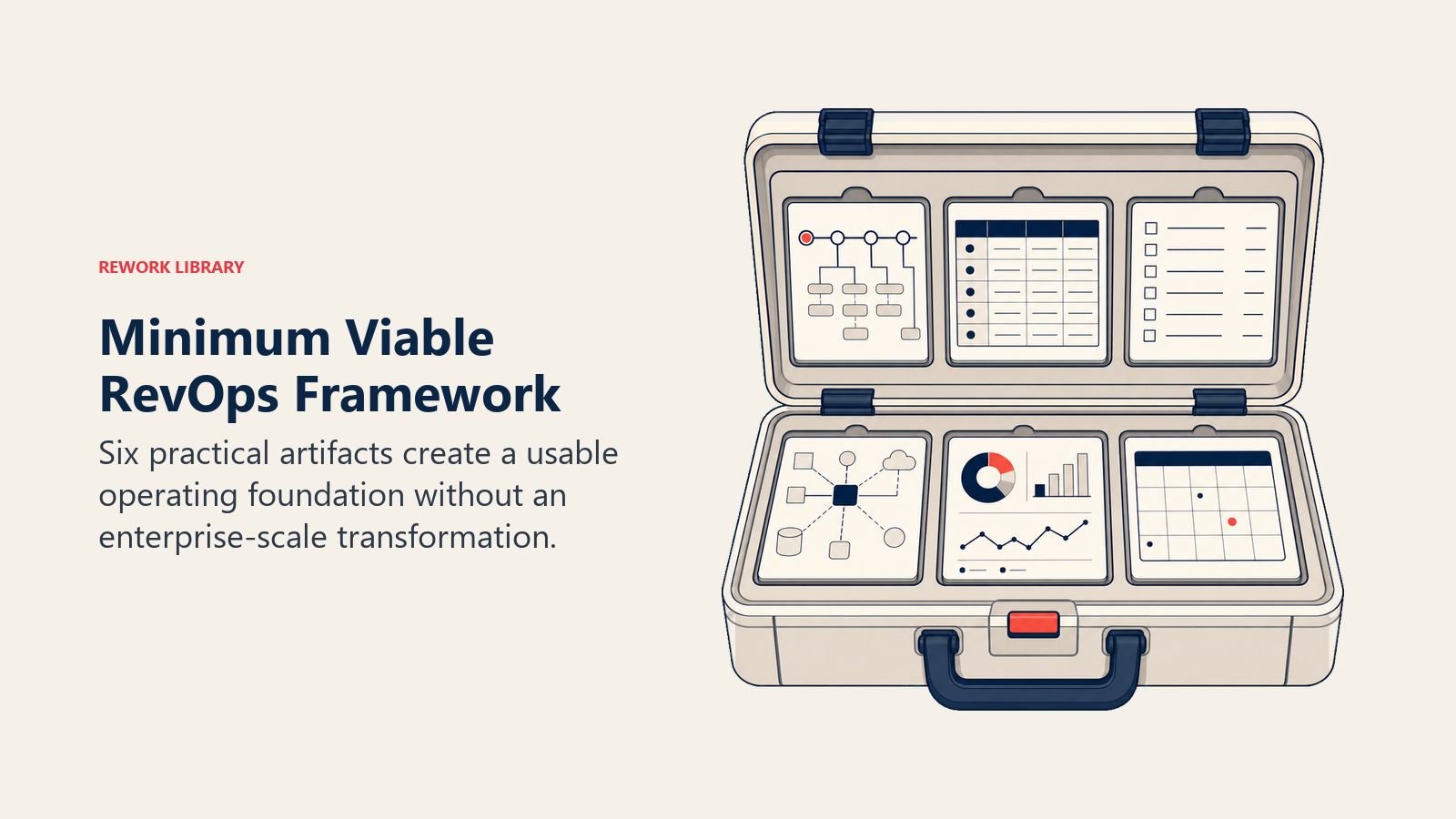
The minimum viable version has six artifacts:
| Artifact | What it answers |
|---|---|
| Revenue lifecycle map | What stages exist from lead to renewal? |
| Handoff table | Who owns each stage change and by when? |
| Required-field list | What data is needed before a record moves? |
| Source-of-truth map | Which system owns each revenue fact? |
| Metrics scorecard | Which numbers drive weekly and monthly decisions? |
| Cadence calendar | Which meeting makes which decision? |
This is enough to expose most operating gaps. If the lifecycle map is unclear, do not start with dashboards. If the handoff table is missing owners, do not start with automation. If required fields are bloated, fix the capture process before asking reps for more updates.
A useful first pass can be built from real records. Pull ten recent leads, ten opportunities, five closed-won deals, and five churned or renewal-risk customers. For each one, ask whether the stage, owner, required data, next action, and reporting source are obvious. Where the answer is no, the framework needs work.
This record-based audit keeps the framework honest. Leaders can debate process diagrams for hours, but real records show where the operating model actually breaks: missing fields, unclear owners, stale stages, and handoffs that depend on memory.
Use the findings to rank fixes by revenue risk.
Example: applying the framework
Imagine a company with strong lead volume but weak pipeline creation.
At first, the leadership conversation sounds like a marketing-sales conflict. Marketing says campaigns are working. Sales says the leads are poor. RevOps should not begin by asking who is right. It should apply the framework.
Revenue strategy may show the company shifted toward mid-market accounts while the campaign mix still targets small businesses. Funnel architecture may show that MQL criteria were never updated after the ICP changed. Process design may show that leads are routed to reps without a required industry field. The data layer may show that source values are inconsistent across forms. Metrics may show high MQL volume but low SQL acceptance from two sources. Cadence may show that no monthly funnel review exists, so the pattern has been visible in data but never turned into a decision.
The fix is not one dashboard. The fix is a sequence: update ICP fit rules, change routing inputs, define rejection reasons, rebuild source reporting, and add a monthly funnel review where marketing and sales make one operating decision from the same data.
That is how the framework should work. It turns a complaint into an operating diagnosis.
Common mistakes
Starting with dashboards. Dashboards are tempting because they create visible output. But if the lifecycle, fields, and definitions are wrong, a dashboard only makes confusion more attractive.
Automating broken process. Automation should enforce a good workflow, not hide a bad one. If no one agrees what counts as an SQL, routing SQLs faster will not fix quality disputes.
Adding fields without governance. Every new field creates maintenance cost. If no one owns the definition and completeness rule, the field will become unreliable.
Confusing meetings with cadence. More meetings do not create operating discipline. A good cadence has fewer meetings with clearer decisions.
Making RevOps a ticket queue. If RevOps spends all its time responding to report requests and field changes, it cannot improve the system. Reserve capacity for proactive process and data work.
Frequently Asked Questions about Revenue Operations Framework
What is a Revenue Operations framework?
A Revenue Operations framework is a structured model for running the full revenue system. It defines the layers RevOps must govern: strategy, funnel architecture, process, data, systems, metrics, cadence, and accountability.
What should RevOps fix first?
Fix lifecycle definitions first. Then fix handoffs and SLAs. Dashboards and automation should come after the company agrees how records move through the revenue lifecycle.
Who owns the RevOps framework?
RevOps owns the operating framework, but leadership owns the strategy. The CRO, CEO, finance leader, marketing leader, sales leader, and CS leader must agree on the growth model RevOps operationalizes.
How often should the framework be reviewed?
Review the framework quarterly, and any time the company changes ICP, segment focus, pricing, sales motion, customer success model, or major revenue tooling.
Learn more

Principal Solution Architect
On this page
- The six-layer RevOps framework
- How to use the framework as an audit
- Diagnostic scorecard
- How to prioritize fixes
- Layer 1: Revenue strategy
- Layer 2: Funnel architecture
- Layer 3: Process and SLA design
- Layer 4: Data model and system governance
- Layer 5: Metrics and reporting
- Layer 6: Cadence and accountability
- Implementation sequence
- Minimum viable RevOps framework
- Example: applying the framework
- Common mistakes
- Learn more