Revenue Cadence: Weekly, Monthly, and Quarterly RevOps Rhythm
A revenue cadence is a decision system.
It is not a pile of recurring meetings. Each meeting should have a purpose, data packet, decision owner, and follow-up path. If the same issues are discussed every week without change, the cadence is failing.
Forrester's RevOps operating model research is relevant because cadence is where the operating model becomes behavior. McKinsey's sales productivity research also points to the value of focused performance management, not generic activity review.
Revenue cadence should make decisions faster and cleaner.
Key operating facts
- Revenue cadence is the recurring rhythm of meetings, packets, decisions, and follow-through loops that keeps the revenue system moving.
- Weekly cadence should focus on near-term risk and current-period execution. Monthly cadence should identify patterns. Quarterly cadence should inform planning, capacity, and operating model changes.
- A meeting is not a cadence unless it has inputs, decision rights, outputs, owners, and a follow-up path.
- RevOps should govern the rhythm, but functional leaders still own performance in their areas. The cadence should make accountability visible without turning RevOps into the owner of every revenue outcome.
Core cadence
| Cadence | Frequency | Decision |
|---|---|---|
| Pipeline review | Weekly | Which deals or stages need action? |
| Forecast review | Weekly or biweekly | What revenue is likely to close? |
| Funnel review | Monthly | Where is conversion or velocity changing? |
| Retention review | Monthly | Which customers create risk or expansion? |
| Systems governance | Monthly | Which process or CRM changes are approved? |
| Planning review | Quarterly | Which assumptions change next quarter? |
RevOps should design the cadence with the CRO, finance, marketing, sales, and CS leaders.
Cadence design principles
Use these principles:
| Principle | Meaning |
|---|---|
| Separate decision types | Forecast, funnel, systems, and retention should not blur |
| Send data first | Meetings should not start with dashboard reading |
| Assign owners | Every decision needs a clear owner |
| Keep action logs | Recurring issues should not disappear |
| Review the cadence | Meetings should be removed when they stop creating decisions |
Cadence is a system. If the system creates repeated discussion without action, redesign it.
Cadence layers
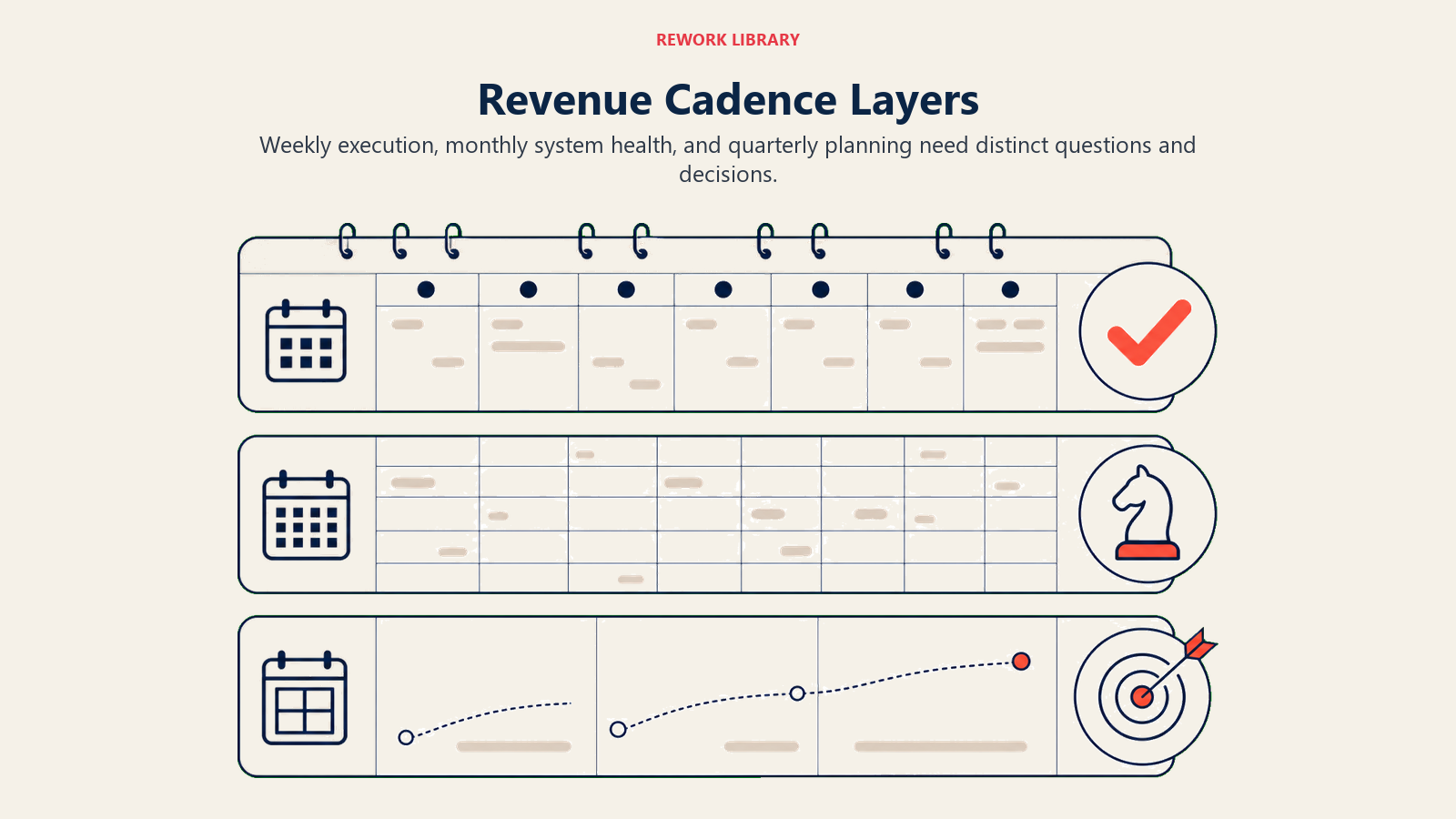
The easiest way to design revenue cadence is to separate the layers by time horizon.
Turn this article into takeaways for your work.


Each assistant summarizes the article only for you and suggests best practices for your work.
| Layer | Main question | Example meeting |
|---|---|---|
| Weekly execution | What needs action now? | Forecast call, pipeline inspection, renewal risk review |
| Monthly diagnosis | What pattern is emerging? | Funnel review, handoff review, data quality review |
| Quarterly planning | What operating model needs to change? | Capacity planning, territory review, lifecycle review |
When these layers are mixed, meetings get worse. A weekly forecast call becomes slow if it turns into a debate about next quarter's territory model. A quarterly planning meeting becomes weak if leaders discover basic pipeline hygiene issues live in the room. Each cadence layer should protect the others.
RevOps should be explicit about what belongs where. Current-period deal risk belongs weekly. Source-quality trends belong monthly. Hiring capacity and market coverage belong quarterly. Exceptions can happen, but the default rhythm should be clear.
Weekly cadence
Weekly meetings should focus on near-term movement.
Common weekly reviews:
- Pipeline inspection
- Forecast review
- High-risk deal review
- SLA exception review
- Renewal risk review for urgent accounts
Do not use weekly cadence for broad strategy. Weekly meetings should answer: what needs action now?
For example, a forecast call should inspect commit, close-date movement, stage evidence, risk, and next actions. It should not become basic CRM cleanup. If CRM cleanup dominates, RevOps should fix data hygiene outside the meeting.
Weekly cadence should be short enough that teams can sustain it. If every weekly meeting needs a large custom packet, the process will decay. Use a standard view and reserve live discussion for exceptions: large deal movement, missed SLA, stale commit, renewal risk, customer escalation, or a handoff that affects this period's number.
The output should be an action log, not a recap of activity. A weak action is "sales to follow up." A better action is "manager to confirm procurement path for Acme by Friday and update forecast category if procurement is not active." The action should make next week's review easier.
Monthly cadence
Monthly cadence should focus on system health.
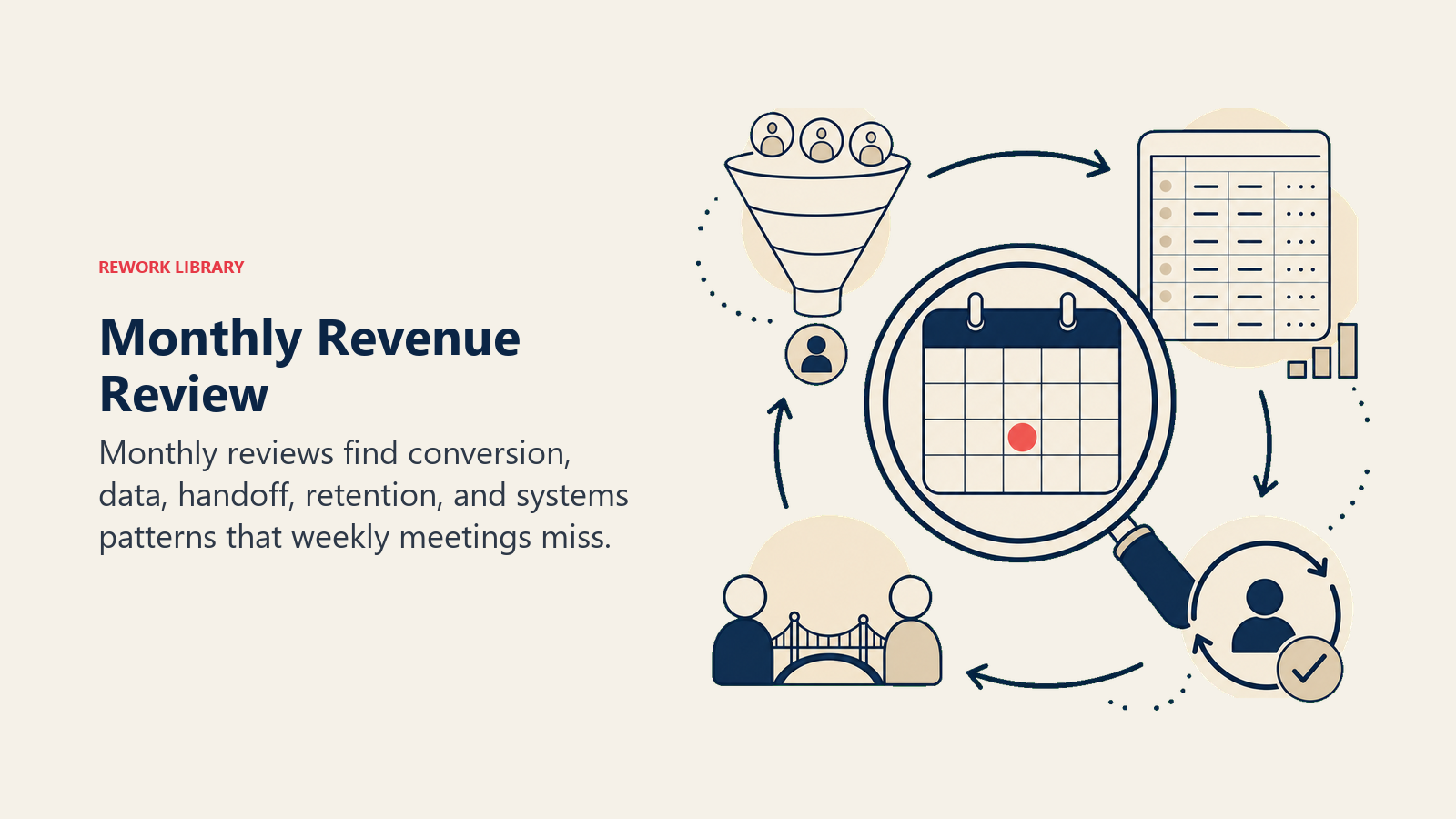
Common monthly reviews:
- Funnel conversion
- Source quality
- Stage aging
- Data quality
- Handoff completeness
- Expansion signals
- Churn reasons
- Systems changes
Monthly cadence is where RevOps identifies patterns. A single SLA miss may be a one-off. A month of SLA misses from one source or segment is a process issue.
Monthly cadence is where RevOps earns strategic value. The weekly meeting may clean a late-stage deal. The monthly review should explain why late-stage deals keep missing required evidence. The weekly meeting may escalate a renewal risk. The monthly review should explain whether renewal risk is concentrated by segment, onboarding path, product, or acquisition source.
Good monthly questions include:
| Topic | Monthly question |
|---|---|
| Funnel | Which conversion point changed, and why? |
| Pipeline | Which source or segment creates lower-quality opportunities? |
| Forecast | Which category or manager produced the most variance? |
| Handoffs | Which handoff repeatedly creates missing data or slow action? |
| Customer revenue | Which churn or expansion pattern should affect acquisition? |
| Data quality | Which fields block decisions most often? |
If a monthly review does not lead to a process change, criteria change, coaching theme, or data fix, it is probably just reporting.
Quarterly cadence
Quarterly cadence should focus on planning and operating model.
Review:
- Funnel assumptions
- Pipeline coverage
- Segment performance
- Forecast accuracy trend
- Retention and expansion assumptions
- RevOps roadmap
- Systems and data governance
- Capacity and territory implications
Finance should be closely involved because quarterly cadence affects plan, hiring, spend, and board reporting.
Quarterly cadence should be selective. It should not repeat every weekly dashboard. It should answer whether the operating model still fits the business.
Examples:
- Do territories still match market coverage?
- Does the sales capacity plan match pipeline creation?
- Do lifecycle stages still reflect how customers buy and renew?
- Does the revenue tech stack support the next motion?
- Are forecast assumptions still valid by segment?
- Does the RevOps roadmap match the highest-risk handoffs?
This is where recurring issues become roadmap decisions. If every month shows poor closed-won handoff completeness, quarterly planning should not only say "improve handoff." It should decide whether to change stage exit criteria, required fields, CS ownership, manager inspection, or system workflow.
Meeting packets
Every recurring meeting should have a packet.
The packet should include:
- Purpose
- Metrics
- Caveats
- Decisions needed
- Prior action status
- Owner recommendations
If there is no decision needed, cancel the meeting or send an update.
Action log
The action log is the operating memory of the cadence.
Track:
- Decision
- Owner
- Due date
- Status
- Blocker
- Follow-up meeting
RevOps should maintain the log for cross-functional revenue cadence. Functional leaders should own actions in their lanes.
Common cadence failures
Forecast review becomes pipeline cleanup. Data quality work is happening too late.
Funnel review becomes a campaign report. The team misses cross-stage leakage.
Systems governance becomes request approval. No one discusses downstream impact.
Retention review excludes sales and finance. Renewal risk does not affect forecast or planning.
Quarterly planning ignores operating data. Assumptions are not tied to funnel reality.
Cadence audit
Audit the cadence quarterly.
Ask:
- Which meetings created decisions?
- Which meetings repeated the same issue?
- Which metrics were trusted?
- Which actions were completed?
- Which meetings should merge or stop?
- Which missing decision needs a new cadence?
This prevents meeting sprawl.
Readiness checklist
Before launching a revenue cadence:
- Each meeting has a purpose.
- Each meeting has a decision owner.
- Data is sent before the meeting.
- Action log exists.
- Metrics use governed definitions.
- Finance is included where planning is affected.
- RevOps owns cadence hygiene.
Revenue cadence works when leaders spend less time reconciling and more time deciding.
Example weekly rhythm
A practical weekly rhythm might include:
| Meeting | Purpose | Owner |
|---|---|---|
| Pipeline inspection | Identify stuck deals and stage risks | Sales leadership |
| Forecast review | Align on likely revenue and risk | CRO with RevOps and finance |
| SLA exceptions | Fix urgent handoff misses | RevOps |
| Renewal risk review | Review urgent customer risk | CS leadership |
These meetings should be short and action-oriented. If the team needs long explanations every week, the data packet or definitions are not clear enough.
Example monthly rhythm
Monthly cadence looks for patterns:
- Full-funnel conversion
- Source quality
- Stage aging
- Data quality
- Handoff completeness
- Churn reasons
- Expansion signals
- Systems change requests
Monthly review should answer: what changed in the system and what will we fix next?
Example quarterly rhythm
Quarterly cadence connects operations to planning.
Review:
- Forecast accuracy trend
- Pipeline coverage by segment
- Conversion assumptions
- Sales capacity assumptions
- Renewal and expansion assumptions
- RevOps roadmap
- Systems and data risks
This is where finance and RevOps should work closely. Planning assumptions should be grounded in operating evidence.
Cadence ownership
RevOps should own cadence design, but not every decision.
| Area | Decision owner | RevOps role |
|---|---|---|
| Forecast call | CRO or sales leader | Process, data, definitions |
| Funnel review | CRO with marketing and sales | Conversion diagnosis |
| Retention review | CS leader | Data model and risk visibility |
| Systems governance | RevOps and systems owner | Impact review and change control |
| Planning review | Finance | Operating assumptions and caveats |
This keeps RevOps neutral and useful.
Meeting hygiene
Use strict meeting hygiene:
- Cancel if no decision is needed.
- Send data in advance.
- Start with changes since last review.
- Keep one owner per action.
- Track repeated issues.
- Move cleanup work outside leadership meetings.
Meetings are expensive. Revenue cadence should earn its time.
Anti-patterns
Every metric gets a meeting. This creates fatigue.
Same people attend everything. Leaders lose focus.
No pre-read. Meetings become dashboard narration.
No decision log. Work repeats because memory is informal.
No cadence owner. Meetings drift until they become habits.
Cadence rule
Cadence should match the decisions the business needs.
If the company changes motion, segment, product, or reporting line, review the cadence. A meeting rhythm that worked for founder-led sales may not work for a multi-segment revenue team.
Decision log example
A decision log should be simple:
| Date | Meeting | Decision | Owner | Due date | Status |
|---|---|---|---|---|---|
| June 5 | Funnel review | Tighten MQL criteria for paid search | RevOps and marketing | June 19 | Open |
| June 7 | Forecast review | Move stale commit deals to best case | Sales managers | June 10 | Open |
| June 10 | Systems governance | Reject low-value required field request | RevOps | Done | Closed |
This gives the cadence memory. Without it, meetings feel active while the same work repeats.
Data packet example
A forecast packet should include:
- Forecast rollup
- Commit and best-case movement
- Close-date slippage
- Stage aging
- Missing risk fields
- Deals changed since last review
- Prior action status
A funnel packet should include:
- Conversion by stage
- Conversion by source and segment
- SLA misses
- Rejection reasons
- Stage aging
- Data caveats
- Recommended actions
Packets make meetings shorter because participants arrive ready.
Cadence by company stage
| Stage | Cadence focus |
|---|---|
| Founder-led sales | Simple pipeline and CRM hygiene review |
| Early sales team | Weekly pipeline, monthly funnel |
| Marketing plus sales | Lead handoff, source quality, forecast |
| Sales plus CS | Renewal risk and closed-won handoff |
| Multi-segment company | Segment reviews, planning assumptions, systems governance |
Do not copy an enterprise cadence into an early team. Add meetings only when decision complexity requires them.
Removing meetings
RevOps should remove meetings when:
- No decision is made.
- The same owner handles all actions elsewhere.
- The data can be sent as an update.
- The meeting duplicates another cadence.
- Attendance is broad but ownership is narrow.
Removing meetings is part of cadence design. A lean cadence has more authority than a crowded calendar.
Meeting cleanup checklist
Before launch:
- Every meeting has a purpose.
- Every meeting has a required data packet.
- Every meeting has a decision owner.
- Action log is shared.
- Review cadence is scheduled.
- Duplicate meetings are removed.
- Finance is included where planning is affected.
The best cadence feels boring in a good way: the right data appears at the right time, the right owners make decisions, and follow-up is visible.
Removing meetings operating example
If the forecast call repeatedly starts with stale close dates, do not make the forecast call longer. Fix the upstream cadence.
RevOps can:
- Send stale deal lists before the call.
- Require managers to clean high-risk deals first.
- Move basic hygiene to pipeline inspection.
- Keep forecast review focused on risk and judgment.
This protects executive time.
Cadence and trust
Cadence builds trust when teams see decisions carried through.
If leaders decide to tighten MQL criteria, the next funnel review should show whether acceptance improved. If sales agrees to clean commit criteria, the next forecast review should show whether commit conversion changed. If CS flags renewal risk, the next planning review should show whether finance adjusted assumptions.
Cadence fails when decisions disappear between meetings.
RevOps role
RevOps should act as the keeper of the operating rhythm:
- Maintain meeting purpose.
- Prepare data packets.
- Track decisions.
- Escalate blockers.
- Retire stale meetings.
- Update cadence when the business changes.
That role is practical, not administrative. It keeps revenue leadership from running the business through disconnected conversations.
RevOps ownership rule
Every recurring revenue meeting should earn its place by producing decisions, accountability, or learning. If it produces none of those, remove it or redesign it.
RevOps role checklist
Before rollout, map every revenue meeting to a decision. If two meetings make the same decision, merge them. If a meeting has no decision, replace it with an update. If a meeting needs data that no one trusts, fix the source before adding more discussion.
The cadence should also show how weekly, monthly, and quarterly reviews connect. Weekly pipeline issues should inform monthly funnel review. Monthly funnel changes should inform quarterly planning. Quarterly planning should update the next RevOps roadmap.
That connection is what turns meetings into an operating system.
Practical rollout
Roll out cadence in stages. Start with the meetings that already exist, then tighten purpose, packet, owner, and action log. Do not add new meetings until the existing ones are clean.
In the first month, RevOps should observe where meetings drift. If forecast review becomes deal coaching, move coaching elsewhere. If funnel review becomes campaign reporting, bring the conversation back to conversion and handoffs. If systems governance becomes a request queue, add impact scoring and decision rights.
The goal is not a perfect calendar. The goal is a rhythm leaders can trust.
Trust shows up when people come prepared, decisions are made in the right forum, and follow-up appears in the next review. If the company needs constant side meetings to clarify what happened in the official cadence, the rhythm is not yet working.
Rollout should include meeting retirement. Adding a new revenue cadence without removing older meetings usually creates fatigue. Before launching a new review, identify which existing meeting, report, or Slack thread it replaces. If it replaces nothing, ask why the new cadence deserves time.
RevOps should treat that as a design problem, not a personality problem.
Cadence health signals
Healthy cadence has visible signals:
- Meetings start with decisions, not definitions.
- Pre-reads are opened before the meeting.
- Owners know what they owe.
- Follow-up is reviewed.
- Repeated issues are escalated or redesigned.
- Meetings get shorter as trust improves.
Unhealthy cadence has the opposite pattern: long explanations, unclear ownership, repeated cleanup, and side channels doing the real work.
When that happens, reduce meeting scope, clarify the decision owner, and move cleanup work into a separate operating queue.
Then review whether the meeting still deserves its place on the calendar.
If not, remove it and protect that time.
That discipline matters.
Keep it visible.
Meeting rules
- Forecast review is not CRM cleanup.
- Funnel review is not a single-deal inspection.
- Systems governance is not a strategy debate.
- Every decision gets an owner and deadline.
- Dashboards should be sent before the meeting.
Cadence decision packet
Every recurring revenue meeting should have a decision packet.
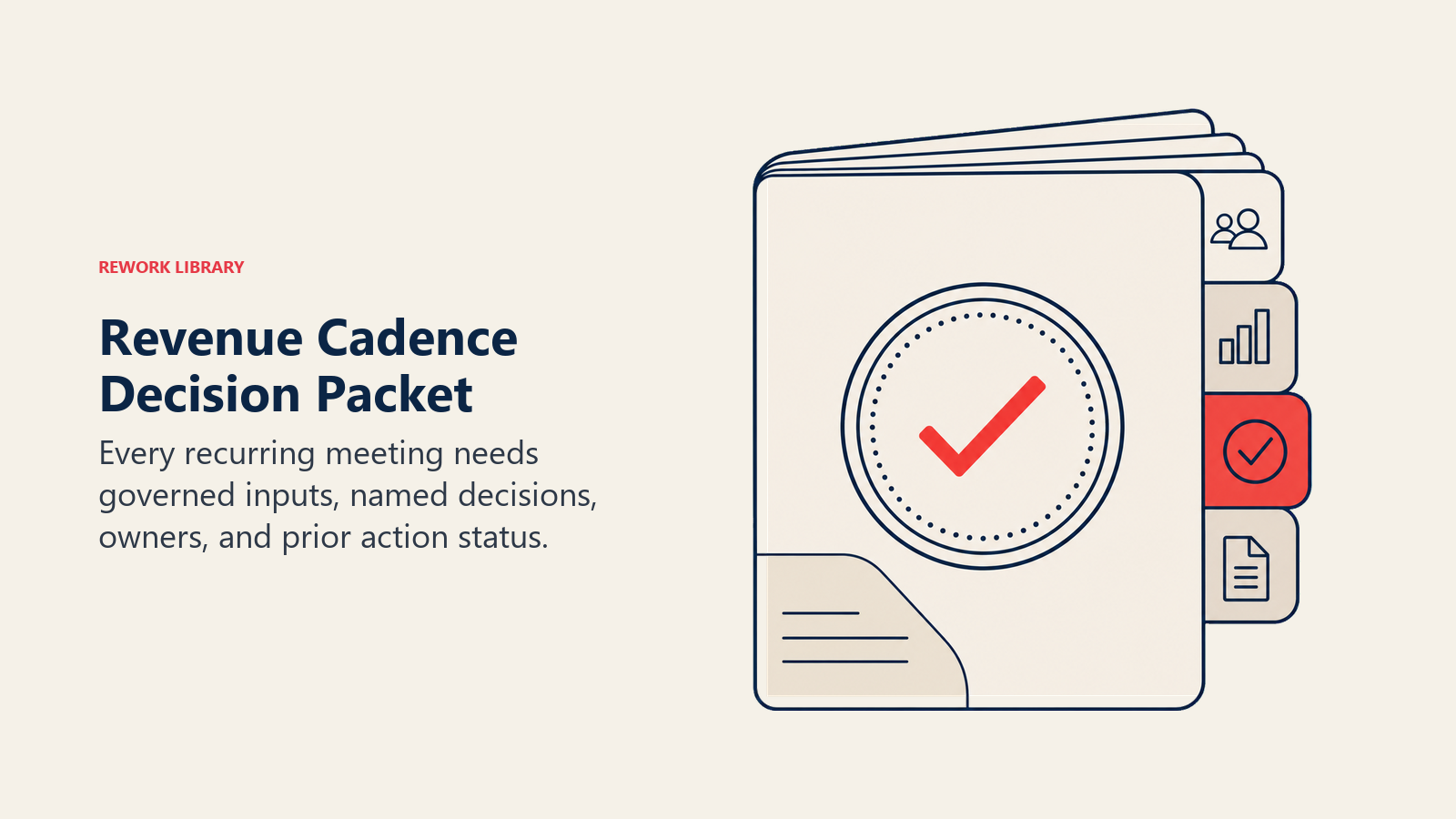
| Packet item | Purpose |
|---|---|
| Meeting owner | Keeps accountability clear |
| Decision type | Defines why the meeting exists |
| Data inputs | Prevents last-minute report pulls |
| Required pre-work | Keeps the meeting from becoming cleanup |
| Decision log | Captures what changed |
| Action owner | Turns discussion into work |
| Review date | Prevents unresolved issues from drifting |
If a meeting has no decision packet, it is at risk of becoming status theater. RevOps should either redesign it or remove it.
Frequently Asked Questions about Revenue Cadence
Who owns revenue cadence?
RevOps usually designs and maintains the cadence. Functional leaders own decisions in their areas.
How many revenue meetings should we have?
As few as needed to make decisions. Add cadence only when it creates a decision that does not happen elsewhere.
Learn more

Senior Operations & Growth Strategist
On this page
- Core cadence
- Cadence design principles
- Cadence layers
- Weekly cadence
- Monthly cadence
- Quarterly cadence
- Meeting packets
- Action log
- Common cadence failures
- Cadence audit
- Readiness checklist
- Example weekly rhythm
- Example monthly rhythm
- Example quarterly rhythm
- Cadence ownership
- Meeting hygiene
- Anti-patterns
- Cadence rule
- Decision log example
- Data packet example
- Cadence by company stage
- Removing meetings
- Meeting cleanup checklist
- Removing meetings operating example
- Cadence and trust
- RevOps role
- RevOps ownership rule
- RevOps role checklist
- Practical rollout
- Cadence health signals
- Meeting rules
- Cadence decision packet
- Learn more