Pipeline Inspection Cadence: How RevOps Keeps Deal Reviews Useful
Pipeline inspection checks whether opportunities are real, current, and moving.
It should happen before forecast judgment. If the forecast call is the first time stale close dates, missing next steps, or weak stage evidence appear, the cadence is too late.
Gartner's forecast confidence research shows why teams need better inspection before leadership commits to a number. McKinsey's sales productivity research also supports a disciplined focus on the actions and management habits that improve commercial productivity.
Pipeline inspection is where those habits become visible.
Key operating facts
- Pipeline inspection is a pre-forecast discipline. It should surface stale data, weak stage evidence, close-date risk, and missing next steps before the forecast call.
- The cadence should have different layers. Weekly inspection catches current-period risk, monthly inspection finds process patterns, and quarterly inspection supports planning and coverage.
- RevOps should not own deal coaching alone. Sales managers inspect deal quality. RevOps owns views, definitions, caveats, action logs, and trend analysis.
- Inspection should connect pipeline quality to planning. A pipeline number is not useful unless leaders understand timing, stage quality, conversion history, and pipeline coverage ratio.
Inspect these signals
- Stage age
- Last activity
- Next meeting
- Close date changes
- Buyer role coverage
- Deal amount changes
- Required fields
- Forecast category
- Risk notes
Tie inspection to Forecast Governance and Pipeline Velocity.
Why inspection needs a cadence
Pipeline inspection fails when it is treated as a one-time cleanup project.
Deals age every week. Close dates move. Champions change jobs. Procurement introduces new steps. Legal review takes longer than expected. A competitor appears late. A rep adds a large opportunity because the account seems interested but does not have a real buying process yet.
Without cadence, those changes appear only when the forecast misses.
A good inspection cadence creates regular moments for managers and RevOps to ask:
- Is this opportunity still real?
- Is it in the right stage?
- Is the close date tied to buyer action?
- Does the next step show momentum?
- Is the forecast category supported by evidence?
- Does this deal need leadership help?
- Should this deal remain in the current period?
The cadence should be predictable enough that reps know when cleanup is expected and managers know when risk should be surfaced.
Cadence layers
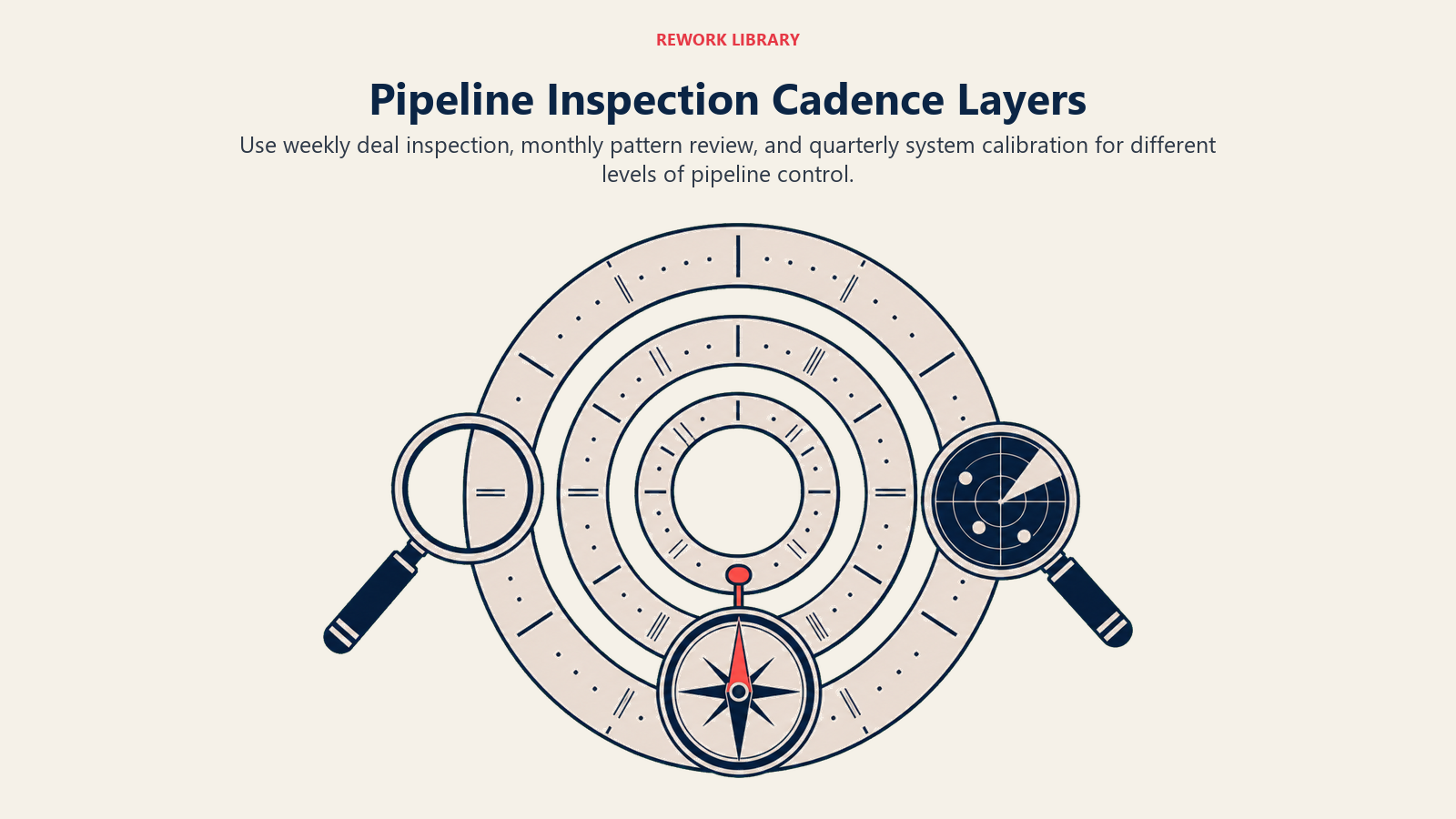
Pipeline inspection works best when each layer has a different job.
| Cadence layer | Main purpose | Typical output |
|---|---|---|
| Weekly | Catch current-period deal risk and obvious hygiene gaps | Deal actions, owner follow-up, forecast caveats |
| Monthly | Find repeated pipeline quality patterns | Process fixes, manager coaching topics, source or segment insights |
| Quarterly | Support planning and capacity decisions | Coverage view, conversion assumptions, territory or segment concerns |
The weekly layer should be narrow. It protects the next forecast call. The monthly layer should be diagnostic. It explains why the same problems keep appearing. The quarterly layer should be strategic enough to affect planning, but still grounded in deal evidence.
Turn this article into takeaways for your work.


Each assistant summarizes the article only for you and suggests best practices for your work.
Many teams collapse all three into one meeting. That creates a meeting that is too detailed for planning, too broad for coaching, and too slow for forecast preparation. Separate the jobs and the cadence becomes easier to sustain.
RevOps should also define which questions belong in each layer:
| Question | Best cadence |
|---|---|
| Does this commit deal still belong in the period? | Weekly |
| Why are discovery deals aging in one segment? | Monthly |
| Do we have enough qualified pipeline for next quarter? | Quarterly |
| Which source creates stale opportunities? | Monthly |
| Which large deal needs executive help this week? | Weekly |
| Should territory coverage change next half? | Quarterly |
This separation reduces meeting drift. When a strategic question appears in a weekly inspection, park it for monthly or quarterly review. When a deal-level cleanup issue appears in a quarterly planning meeting, push it back into manager inspection.
Weekly inspection
Weekly inspection should focus on current-period risk and immediate cleanup.
Review:
- Opportunities closing this month or quarter
- Late-stage deals with no recent activity
- Deals with close dates in the past
- Deals with repeated date pushes
- Commit or best-case deals missing evidence
- Large opportunities with no next meeting
- Deals that changed amount, stage, or category
The output should be a short action list. Do not turn weekly inspection into a full pipeline strategy meeting. The purpose is to make the forecast call cleaner and make manager coaching more targeted.
Monthly inspection
Monthly inspection should look for patterns.
Questions:
- Which stages have the highest aging?
- Which sources create low-quality pipeline?
- Which segments have the most date pushes?
- Which managers have inconsistent stage discipline?
- Which required fields are missing most often?
- Which deal risks appear too late?
- Which handoffs create bad opportunity data?
Monthly inspection is where RevOps identifies system fixes. A weekly review might clean ten stale deals. A monthly review should explain why those stale deals keep appearing.
Quarterly inspection
Quarterly inspection should support planning.
Review:
- Pipeline coverage by future period
- Stage conversion by segment
- Sales cycle by motion
- Source quality
- Win rate
- Rep capacity and territory coverage
- Forecast accuracy trend
- Stage definition quality
This connects pipeline inspection to planning, not only cleanup. If the next quarter starts with weak qualified coverage, leaders need to know early. If one segment shows strong nominal coverage but poor conversion, the plan should not treat that coverage as equal to healthier pipeline.
Inspection roles
| Role | Responsibility |
|---|---|
| Reps | Keep opportunities current and explain buyer evidence |
| Managers | Inspect stage quality, risk, and next actions |
| RevOps | Own reports, definitions, caveats, and cadence |
| Sales leadership | Set expectations and resolve repeated behavior gaps |
| Finance | Use inspected pipeline for planning assumptions |
RevOps should not become the only team that cares about pipeline hygiene. Sales managers own inspection behavior. RevOps gives them the system, visibility, and trend analysis.
Inspection views
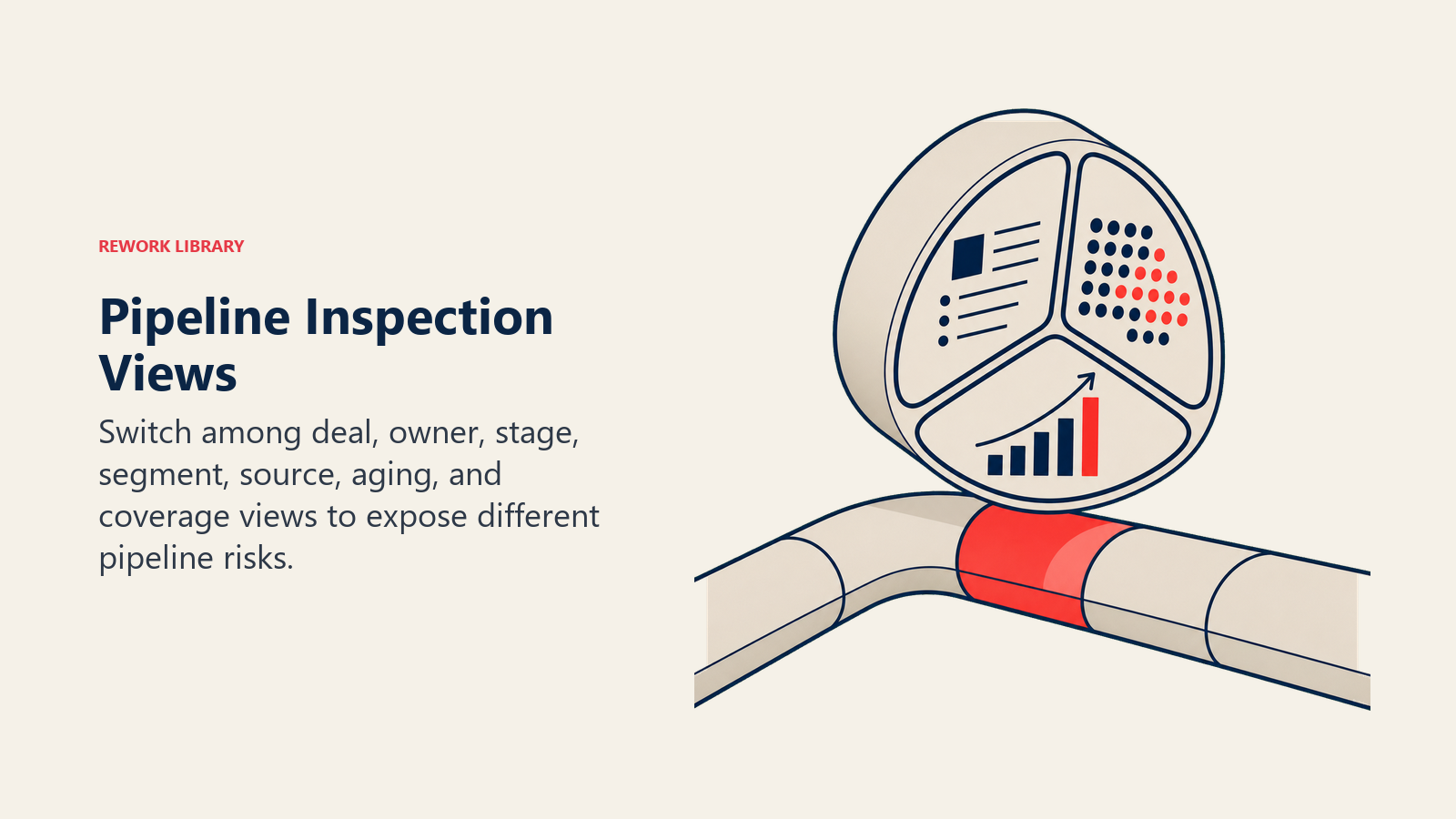
A useful inspection workspace should include several views:
| View | Purpose |
|---|---|
| Current-period risk | Deals that can affect the near-term forecast |
| Stale opportunities | Deals with old activity or no next step |
| Stage aging | Deals sitting too long in a stage |
| Close-date movement | Deals with repeated timing changes |
| Commit evidence | Commit deals missing required proof |
| Manager review | Deals not inspected recently |
| Large deal watchlist | High-impact opportunities needing attention |
These views should be easy for managers to use. If the report is too complicated, managers will avoid it and RevOps will own cleanup alone.
Inspection and forecast calls
Pipeline inspection should happen before the Forecast Call Operating Model.
The handoff should be clear:
- Inspection identifies dirty data and weak evidence.
- Managers clean and coach before the call.
- RevOps updates the forecast packet with caveats.
- Forecast call focuses on movement, risk, and decisions.
If inspection and forecasting are mixed, the company pays twice. The meeting is slower, and the forecast is still less reliable.
Inspection output
Each inspection should produce a small set of actions:
- Deals to clean before forecast review
- Deals that need manager coaching
- Deals that should move stage
- Deals that should leave the period forecast
- Process issues RevOps should fix upstream
This keeps inspection practical. The goal is not to discuss every opportunity. The goal is to remove noise before the forecast call and make real risk visible early.
Action log
Every inspection should produce actions with owners.
Weak action: "Update pipeline."
Better action: "Manager to confirm procurement step for Acme by Friday and update commit category if procurement is not active."
Useful action fields:
- Opportunity
- Issue
- Owner
- Due date
- Required decision
- Status
- Next review date
The action log does not need to be heavy. It needs to stop repeated discussion without movement.
Deal selection rules
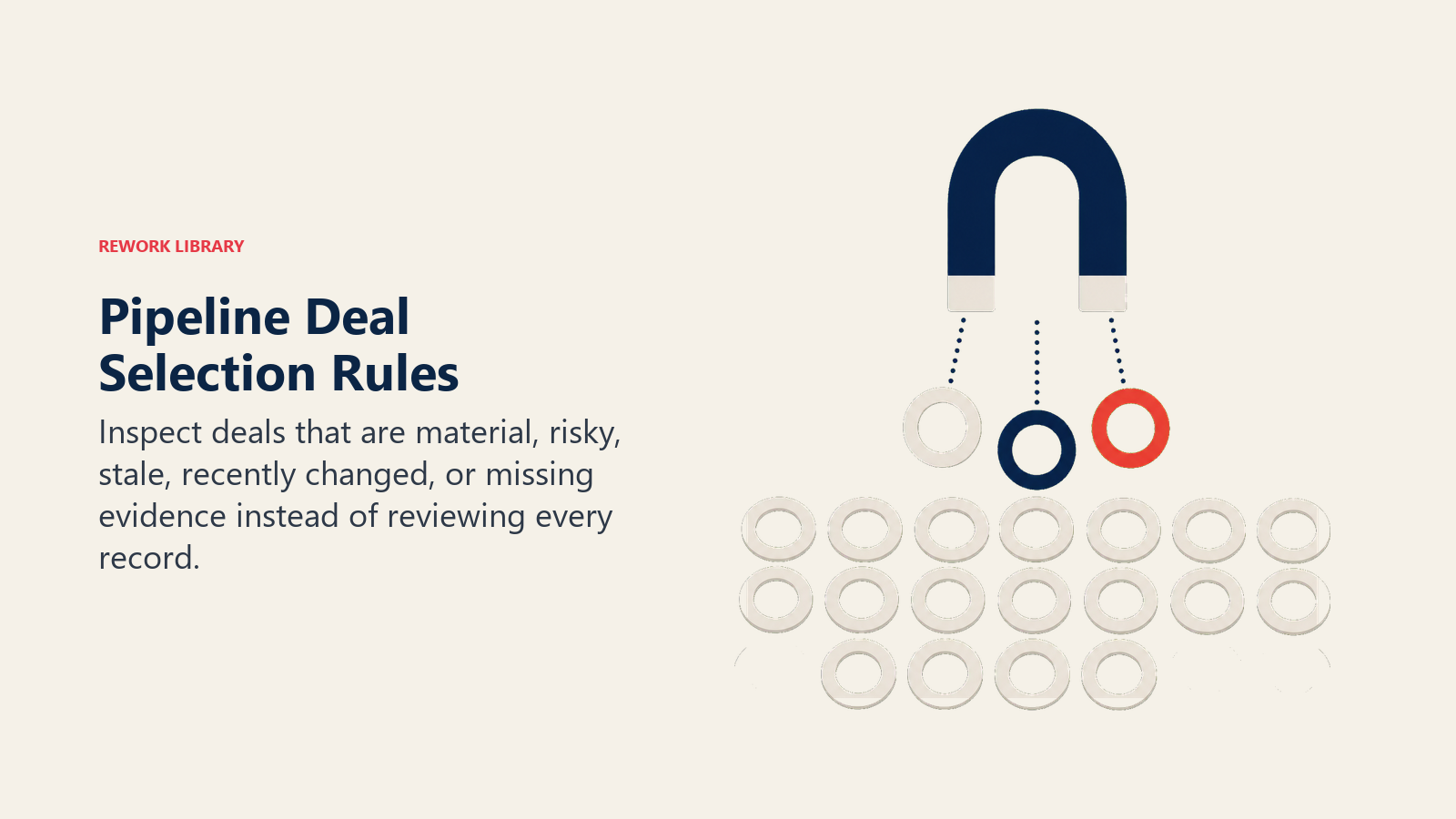
Do not inspect every deal in every meeting.
Select deals based on risk:
- Largest amount
- Current-period close date
- Commit or best-case category
- No next step
- Stage age above threshold
- Close date pushed more than once
- Amount changed materially
- Important logo or strategic account
- Manager has not reviewed recently
This keeps inspection focused on risk and productivity.
Example inspection agenda
A weekly inspection agenda can be simple:
- Review current-period stale deals.
- Review commit and best-case deals with missing evidence.
- Review large deal movements.
- Confirm owner actions.
- Identify process issues RevOps should fix.
Keep it short. The purpose is to make sure the next forecast call is based on cleaner data and clearer judgment.
Common failure modes
Inspection becomes CRM cleanup only. The team fixes fields but misses deal risk.
Managers wait for RevOps. Sales management does not build the habit.
Every opportunity is reviewed. The meeting becomes slow and unfocused.
No action tracking. The same issues appear every week.
Stage rules are vague. Inspection becomes opinion instead of evidence.
Finance sees pipeline before inspection. Planning uses inflated or dirty pipeline.
Pipeline inspection metrics
Track the health of the cadence:
- Percent of current-period deals with next step
- Percent of commit deals inspected by manager
- Number of stale late-stage opportunities
- Close-date pushes by stage
- Stage aging by segment
- Inspection actions closed on time
- Data issues found during forecast call
- Forecast slips that were visible in inspection
The best metric is not a perfect pipeline. It is fewer avoidable surprises.
Inspection and deal health scoring
Deal Health Scoring can help prioritize inspection.
A score should not decide the forecast. It should tell managers where to look. For example, a high-value commit deal with no next meeting and two close-date pushes should appear on the inspection list automatically. A small early-stage deal with complete data may not need discussion.
Transparent rules are usually enough for the first version. Add AI later only when the underlying data is reliable and managers understand the signals.
Readiness checklist
Before launching the cadence:
- Stage definitions are written.
- Close-date rules are clear.
- Forecast categories are defined.
- Inspection reports exist.
- Manager ownership is explicit.
- Action log is ready.
- Forecast call handoff is defined.
- Monthly pattern review is scheduled.
Pipeline inspection is working when forecast calls spend less time discovering basic issues and more time deciding what to do about real risk.
What the checklist should prove
Pipeline inspection should protect forecast quality before leadership makes a call. If the inspection cadence does not reduce surprise, shorten cleanup time, or improve manager coaching, it is not yet doing its job.
Inspection examples
Example: a late-stage opportunity has no activity for 21 days and a close date in the current month. The inspection action is not simply to update the close date. The manager should ask what buyer action is still expected and whether the deal should remain in the period.
Example: a commit opportunity has moved close date twice. The inspection action is to review timing evidence, procurement status, and next customer action. If the evidence is weak, the deal may need to move to best case before the forecast call.
Example: one source creates many opportunities that sit in discovery for more than 45 days. This is not only a rep cleanup issue. RevOps should inspect qualification rules, source quality, and handoff expectations with marketing or SDR leadership.
Manager coaching through inspection
Pipeline inspection should make manager coaching more specific.
Instead of asking "what is happening with this deal?", managers can ask:
- What buyer action supports the current stage?
- Why did the close date move?
- What evidence supports the forecast category?
- Who else needs to be involved?
- What would make this opportunity unqualified?
- What is the next customer-owned step?
Specific questions improve rep behavior over time. Reps learn what evidence matters, and managers spend less time chasing vague updates.
RevOps improvements from inspection
RevOps should use inspection findings to improve upstream systems.
Repeated findings may show:
- Stage definitions are unclear.
- Required fields are poorly timed.
- Lead qualification is weak.
- Handoff context is missing.
- Managers use different standards.
- CRM automation creates bad tasks.
- Forecast categories need better rules.
This is where inspection becomes more valuable than cleanup. It reveals the process defects that create bad pipeline data in the first place.
Inspection by motion
Different revenue motions need different inspection emphasis.
| Motion | Inspection focus |
|---|---|
| Enterprise | Buying committee, legal, procurement, executive sponsor |
| Commercial | Stage age, next meeting, decision process, pricing |
| SMB | Volume, source quality, speed, qualification |
| Expansion | Product adoption, stakeholder, commercial scope |
| Renewal | Health, sponsor, renewal date, churn risk |
Using the same checklist for every motion can create either too much friction or too little control.
Change management
Pipeline inspection changes behavior, so rollout needs care.
Managers should understand that inspection is not an audit of personal effort. It is a way to protect forecast quality and improve coaching. Reps should see the criteria before they are measured against them. Sales leaders should reinforce the cadence until it becomes a normal operating habit.
Start with a small set of signals, prove the value, and then add detail.
Minimum viable cadence
A small team can start with a 30-minute weekly review.
Review only:
- Current-period deals above a material value
- Commit and best-case deals
- Deals with no next step
- Deals with close-date movement
- Deals above stage-age threshold
That version is enough to reduce surprise without creating a heavy process. As the team grows, add monthly pattern review, segment views, and manager calibration.
What good looks like
Good inspection has a visible effect.
Forecast calls become shorter. Reps update opportunities before being asked. Managers know which deals need coaching. RevOps spends less time chasing fields and more time finding patterns. Finance sees fewer unexplained changes. Leaders hear risk earlier.
Those are better success signals than a perfect CRM report.
Keep the cadence focused, visible, and action-oriented.
Review the cadence monthly and remove steps that do not improve decisions.
The best cadence is light enough to run every week and strong enough to reveal risk before leadership has to explain a miss. Keep it practical.
If the team cannot sustain the cadence, reduce scope before reducing discipline.
Keep managers accountable for follow-through.
When to change the cadence
The cadence should change when the business motion changes or when inspection stops improving decisions.
Tighten the cadence when:
- Forecast calls still discover basic data issues.
- Commit deals slip without early warning.
- Managers apply stage criteria differently.
- Finance discounts pipeline because it does not trust quality.
- Close-date pushes cluster late in the period.
- Large deals need more executive coordination.
Loosen or simplify the cadence when:
- Managers are inspecting the same low-risk deals every week.
- The meeting creates more updates than decisions.
- Most action items are administrative and can be automated.
- The company has fewer active deals and high direct visibility.
- Sales leaders can review exceptions asynchronously.
Changing cadence does not mean lowering discipline. It means matching the process to risk. A small team with ten active opportunities may not need a formal weekly meeting, but it still needs clear stage rules and a short inspection habit before forecast calls. A larger team with multiple managers, regions, and segments needs a more formal cadence because deal risk can hide inside rollups.
RevOps should review cadence health monthly. Ask whether the meeting found risk earlier, improved manager coaching, reduced data issues in the forecast call, and created actions that closed. If not, change the scope, inputs, or owner model.
Inspection operating rules
Set a few rules so the cadence stays useful:
- Inspect exceptions and material deals, not every opportunity.
- Require buyer evidence for stage and close-date confidence.
- Use the same stage definitions across managers.
- Record actions with owner and due date.
- Review repeated patterns monthly, not only deal-by-deal.
- Keep finance caveats visible when pipeline quality affects planning.
- Retire inspection views that no one uses.
The last rule matters. RevOps teams often keep adding reports because each report once answered a useful question. Over time, managers face too many views and stop using any of them. A lean inspection workspace with trusted views is better than a dashboard library that no one can interpret quickly.
Calibration across managers
Pipeline inspection loses value when managers apply different standards.
One manager may let a deal stay in late stage because the rep "feels good." Another may require written buyer confirmation. One manager may accept a close date based on internal hope. Another may require a customer-owned milestone. The report may show the same stage and forecast category, but the underlying evidence is different.
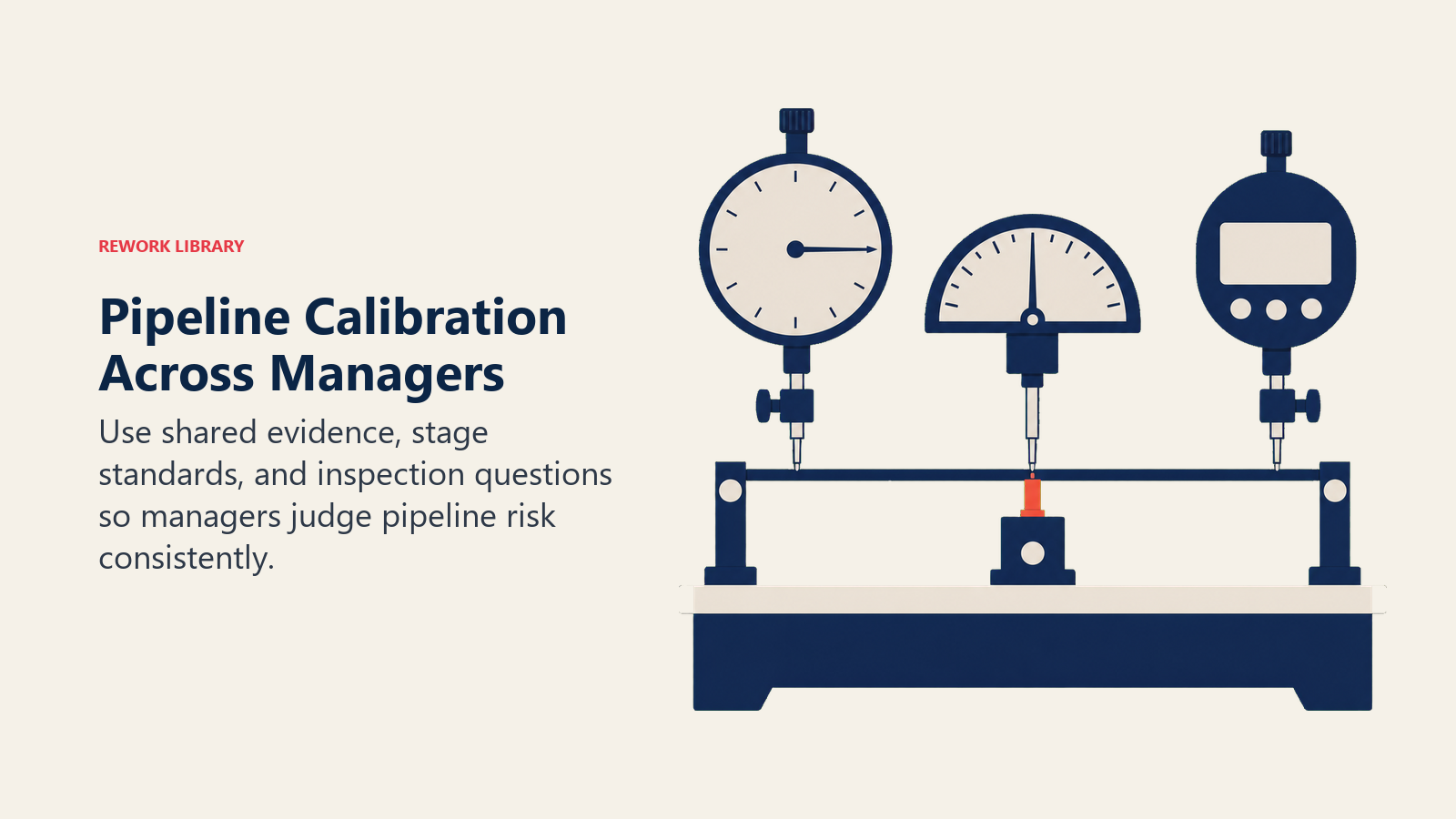
RevOps should help sales leadership run calibration reviews. Pick a small set of opportunities from different teams and inspect them together:
| Calibration topic | Question |
|---|---|
| Stage evidence | Would every manager place this deal in the same stage? |
| Close date | Is the date based on buyer process or seller target? |
| Forecast category | Does the evidence support commit, best case, or pipeline? |
| Next step | Is the next step customer-owned or seller-owned? |
| Risk | Is the risk specific enough to act on? |
Calibration is not about catching managers out. It is about building a shared standard. Without it, RevOps can create perfect reports and still see weak forecast quality because each manager uses the fields differently.
Run calibration monthly at first. Once the standard is stable, move it to quarterly or use it only when forecast quality declines.
What RevOps should bring to inspection
RevOps should arrive with evidence, not opinions.
Useful inputs include:
- Deals that meet inspection rules
- Prior action log status
- Stage age thresholds
- Close-date movement since last review
- Commit and best-case changes
- Missing next steps
- Data caveats affecting forecast confidence
- Pattern notes from the last monthly review
This preparation keeps the discussion focused. The manager owns deal judgment. RevOps owns the operating evidence that makes the judgment easier to test.
The best inspection meetings are short because the prep is clear. Everyone knows why each deal is on the list, what evidence is missing, and what decision is needed.
That clarity is also what makes the cadence easier to defend with sales. Reps may dislike inspection when it feels like administrative pressure. They tend to accept it when the questions are consistent, deal risk is material, and managers use the output to help move deals instead of only checking fields.
Inspection decision packet
Pipeline inspection should produce action, not only commentary.
For each review, prepare:
- Deals by stage and age.
- Deals with no next customer action.
- Close-date movement.
- Forecast category movement.
- Missing required evidence.
- Manager action from last review.
- New action owner and due date.
This packet keeps the inspection cadence focused on deal movement, risk, and evidence. If the meeting ends without owners, it was a status review, not inspection.
Frequently Asked Questions about Pipeline Inspection Cadence
Who owns pipeline inspection?
Sales managers inspect deal quality. RevOps owns reporting, stage hygiene, and cadence design.
How often should inspection happen?
Weekly for active pipeline. Monthly for deeper trend analysis.
Learn more

Senior Operations & Growth Strategist
On this page
- Inspect these signals
- Why inspection needs a cadence
- Cadence layers
- Weekly inspection
- Monthly inspection
- Quarterly inspection
- Inspection roles
- Inspection views
- Inspection and forecast calls
- Inspection output
- Action log
- Deal selection rules
- Example inspection agenda
- Common failure modes
- Pipeline inspection metrics
- Inspection and deal health scoring
- Readiness checklist
- What the checklist should prove
- Inspection examples
- Manager coaching through inspection
- RevOps improvements from inspection
- Inspection by motion
- Change management
- Minimum viable cadence
- What good looks like
- When to change the cadence
- Inspection operating rules
- Calibration across managers
- What RevOps should bring to inspection
- Inspection decision packet
- Learn more