Full-Funnel SLA Model: Service Levels Across the Revenue Lifecycle
A full-funnel SLA defines how quickly teams must act at key revenue handoffs.
It should cover more than inbound lead response. RevOps should define service levels for lead assignment, MQL acceptance, opportunity follow-up, closed-won handoff, renewal risk escalation, and expansion triggers.
Harvard Business Review's sales and marketing alignment research is a useful reminder that handoff problems are often operating problems, not only team attitude problems. McKinsey's research on sales productivity also points to targeted performance steering as a way to improve commercial execution.
SLA design is one of the clearest ways RevOps can make that steering practical.
Key operating facts
- A full-funnel SLA should cover the revenue lifecycle, not only inbound lead response. Lead acceptance, opportunity hygiene, closed-won handoff, renewal risk, and expansion signals all need service levels when they create revenue risk.
- The SLA should define an action, not only a timer. "Respond within 15 minutes" is weaker than "first touch, accept or reject, and log outcome within the SLA window."
- SLA quality matters as much as SLA speed. A fast but incomplete handoff still creates leakage.
- Start with the handoffs that create the most risk. For many teams, that means lead-to-opportunity governance, stage exit criteria, closed-won handoff, and renewal risk escalation.
SLA examples
| Handoff | SLA |
|---|---|
| New high-fit inbound lead | Assigned within minutes, accepted same business day |
| MQL to SDR | Accept or reject with reason within SLA window |
| SQL to AE | Opportunity created only when criteria are met |
| Closed-won to CS | Handoff record complete before onboarding starts |
| Renewal risk | Escalated to owner when risk threshold is met |
| Expansion signal | Routed to CS or sales owner within defined window |
Governance
Each SLA needs an owner, measurement, exception path, and review cadence. Otherwise it becomes a policy no one enforces.
What a full-funnel SLA should include
Every SLA should define:
- Trigger
- Owner
- Required action
- Time window
- Measurement source
- Exception path
- Escalation owner
- Review cadence
For example, "follow up quickly" is not an SLA. "High-fit demo requests route instantly, receive first touch within 15 minutes during business hours, and are accepted or reassigned within one business day" is closer.
SLA by funnel area
| Funnel area | SLA question |
|---|---|
| Lead capture | How fast is the record created and enriched? |
| Lead routing | How fast is it assigned to an owner? |
| Sales acceptance | How fast must sales accept or reject? |
| Opportunity follow-up | How current must next step and close date be? |
| Forecast risk | How fast must high-risk deals be reviewed? |
| Closed-won handoff | When must CS receive complete context? |
| Renewal risk | How quickly must risk be escalated? |
| Expansion signal | How quickly must the owner act? |
This prevents the company from over-focusing on top-of-funnel speed while ignoring later handoffs.
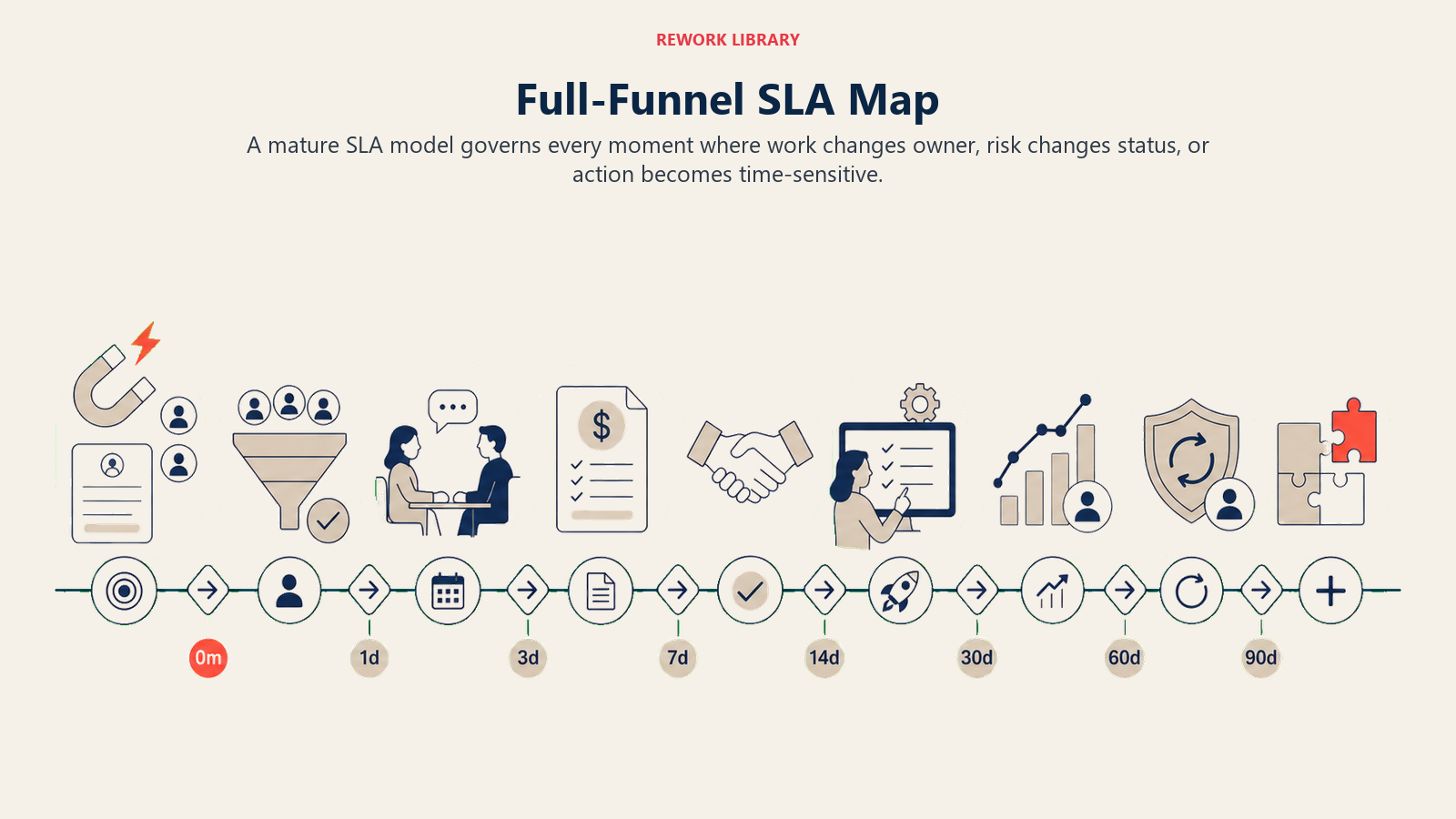
Full-funnel SLA map
A mature SLA model follows the moments where work changes owner, risk changes status, or leadership needs an updated view.
Turn this article into takeaways for your work.


Each assistant summarizes the article only for you and suggests best practices for your work.
| Lifecycle point | Trigger | Required action | Common failure |
|---|---|---|---|
| Lead captured | New high-fit lead enters the system | Create, enrich, route, and start SLA clock | Record exists but owner is missing |
| MQL routed | Lead meets agreed readiness criteria | Sales accepts or rejects with reason | Sales ignores or rejects vaguely |
| SQL confirmed | Sales validates fit and intent | Create next step or disqualify | Lead sits in limbo |
| Opportunity created | Deal meets creation criteria | Populate source, value, stage, close period, next step | Weak deal becomes pipeline |
| Stage advanced | Opportunity moves forward | Meet stage exit criteria before advancement | Stage inflation hurts forecast |
| Commit reviewed | Deal enters forecast category | Update evidence, risk, close date, and next step | Commit is opinion, not evidence |
| Closed-won | Deal is booked | Complete handoff before onboarding starts | CS receives missing context |
| Renewal risk | Risk signal crosses threshold | Assign owner, escalation, and forecast update | Risk lives only in notes |
| Expansion signal | Usage or stakeholder signal appears | Route to CS, AE, or joint owner | Signal never becomes action |
The map should tie directly to real operating workflows. If the team already has a strong opportunity-to-customer process, the closed-won SLA can be simple. If that handoff is weak, the SLA needs more detail: required fields, handoff meeting trigger, escalation, and review cadence.
The same logic applies post-sale. If CS already runs a strong renewal risk process, RevOps may only need to standardize categories and reporting. If customer health is scattered across notes and spreadsheets, the SLA has to define both the trigger and the evidence required before risk reaches finance planning. See RevOps and Customer Success for the operating model behind that connection.
SLA design principles
Use these principles:
| Principle | Meaning |
|---|---|
| Tie SLA to customer or revenue risk | Do not create SLA for low-value internal preferences |
| Keep ownership clear | Every SLA needs one accountable leader |
| Measure from system timestamps | Manual tracking will decay |
| Require action, not only notification | Alerts do not equal process |
| Include exceptions | Teams need a path when normal flow breaks |
| Review patterns | Repeated misses usually indicate process design issues |
SLA should improve flow. It should not become another way to blame teams for broken systems.
Lead SLA
Lead SLA usually includes assignment, first touch, and acceptance.
For high-intent inbound leads, response speed matters because buyer intent can decay quickly. But speed alone is not enough. The owner must also accept, reject, or reassign with a reason.
Track:
- Time to route
- Time to first touch
- Time to accept or reject
- Overdue leads
- Reassignment rate
- Rejection reason quality
Connect this to Lead Response Time.
Opportunity SLA
Opportunity SLA is less about minutes and more about freshness.
RevOps should define standards for:
- Next step recency
- Close-date age
- Stage aging
- Manager inspection timing
- Risk update timing
- Commit review timing
An opportunity sitting in late stage with an old next step and a slipping close date is not a timing issue only. It is a forecast trust issue.
Closed-won handoff SLA
Closed-won handoff SLA should define what must be complete before onboarding starts.
Include:
- Success criteria
- Use case
- Stakeholders
- Contract scope
- Implementation notes
- Risks
- Promises made
- Renewal date
The SLA should not only say "handoff within two days." It should say what complete handoff means.
Renewal and expansion SLA
Post-sale SLA should cover risk and growth.
Examples:
- Renewal risk above threshold must be reviewed within a defined window.
- Executive sponsor loss must trigger escalation.
- Expansion signal must be routed to CS or sales owner.
- High-value renewal must have forecast category updated before review.
These SLAs connect CS operating work to revenue planning.
Exception management
Every SLA will be missed sometimes. The important question is what happens next.
Common exception categories:
- Owner unavailable
- Wrong routing
- Missing data
- Duplicate record
- Customer requested delay
- System error
- Capacity issue
- Unclear criteria
RevOps should track exceptions and review patterns monthly. If many misses come from wrong routing, fix routing. If they come from missing data, fix capture. If they come from capacity, functional leadership needs to address coverage.
SLA scorecard
Track:
- SLA compliance by handoff
- Missed SLA volume
- Exception reason mix
- Time to resolve exceptions
- Revenue or pipeline affected
- Trend by source, segment, owner, and team
The scorecard should show where the funnel slows down and why.
Pick the first two SLAs carefully
Do not start by writing a full policy for every handoff. Pick two handoffs where missed action creates visible revenue or customer risk.
Use this selection test:
| Candidate SLA | Choose it first when |
|---|---|
| Lead response and acceptance | High-intent leads sit unworked or sales rejects without reason |
| Opportunity freshness | Pipeline reviews are full of stale close dates and vague next steps |
| Forecast commit hygiene | Commit calls rely on judgment with weak evidence |
| Closed-won handoff | CS regularly starts onboarding without sold context |
| Renewal risk escalation | Risk appears late, usually near renewal date |
| Expansion trigger routing | Expansion signals are noticed but not acted on |
The first two SLAs should be narrow enough to enforce. A broad "all leads must be handled correctly" policy will fail. A specific "high-fit demo requests must be assigned instantly, touched within 15 minutes, and accepted or rejected with reason within one business day" is much easier to inspect.
After launch, run weekly reviews for the first month. Look for timestamp issues, owner confusion, exception patterns, and quality problems. Many SLA models fail because they are announced before the data can measure them. Fix the measurement before using the numbers to judge teams.
Evidence model for each SLA
Every SLA should define what evidence proves the action happened. This is where many policies become vague. A notification sent is not the same as a lead worked. A handoff meeting held is not the same as a handoff complete. A renewal risk flag set is not the same as an escalation owned.
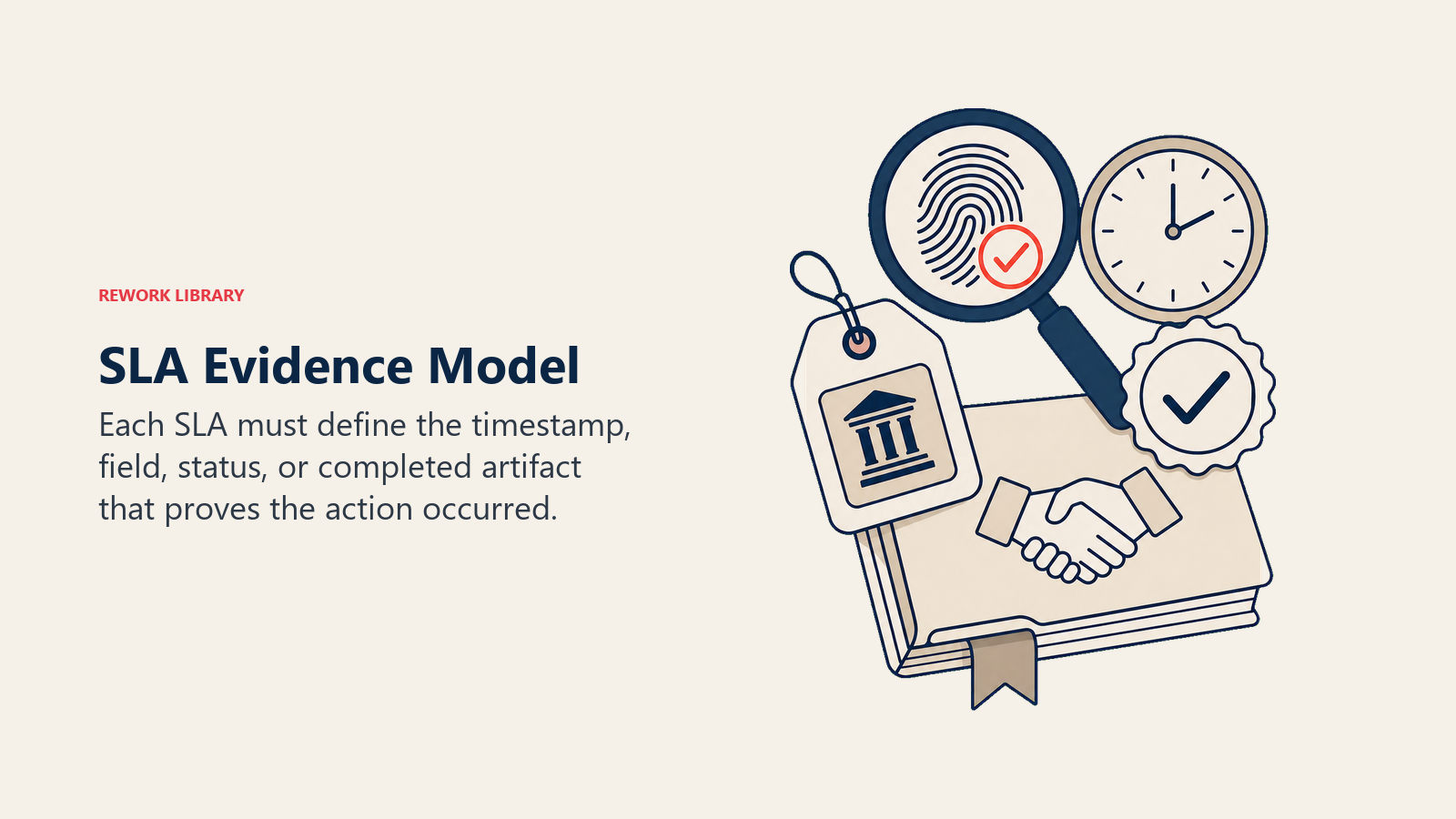
Use an evidence model:
| SLA action | Weak evidence | Stronger evidence |
|---|---|---|
| Lead first touch | Email notification sent to rep | Logged call, email, or meeting attempt tied to the lead |
| Sales acceptance | Owner changed | Accepted status, timestamp, next action, and owner |
| Lead rejection | Status changed to rejected | Specific reason with source, segment, and reviewer visibility |
| Opportunity freshness | Stage updated | Current next step, close date, risk, and stage evidence |
| Forecast commit review | Deal marked commit | Commit category plus evidence, risk note, and manager inspection |
| Closed-won handoff | Deal moved to closed-won | Success criteria, stakeholders, scope, risks, and promises captured |
| Renewal risk | Health score changed | Risk category, cause, owner, escalation date, and next action |
| Expansion signal | Usage threshold crossed | Trigger routed, owner assigned, acceptance or rejection recorded |
This does not mean every action needs a long form. It means the system should capture enough evidence for a manager to inspect whether the SLA was meaningful. If the evidence is too thin, teams will hit the timer while the handoff still fails.
RevOps should also separate proof of action from proof of outcome. A rep can meet the first-touch SLA and still fail to create pipeline. A CSM can escalate renewal risk and still lose the customer. The SLA measures whether the right operating action happened on time. Outcome metrics show whether the action was good enough. Both are needed, but mixing them creates confusion.
Rollout governance
A full-funnel SLA model changes how teams are inspected, so rollout needs careful sequencing.
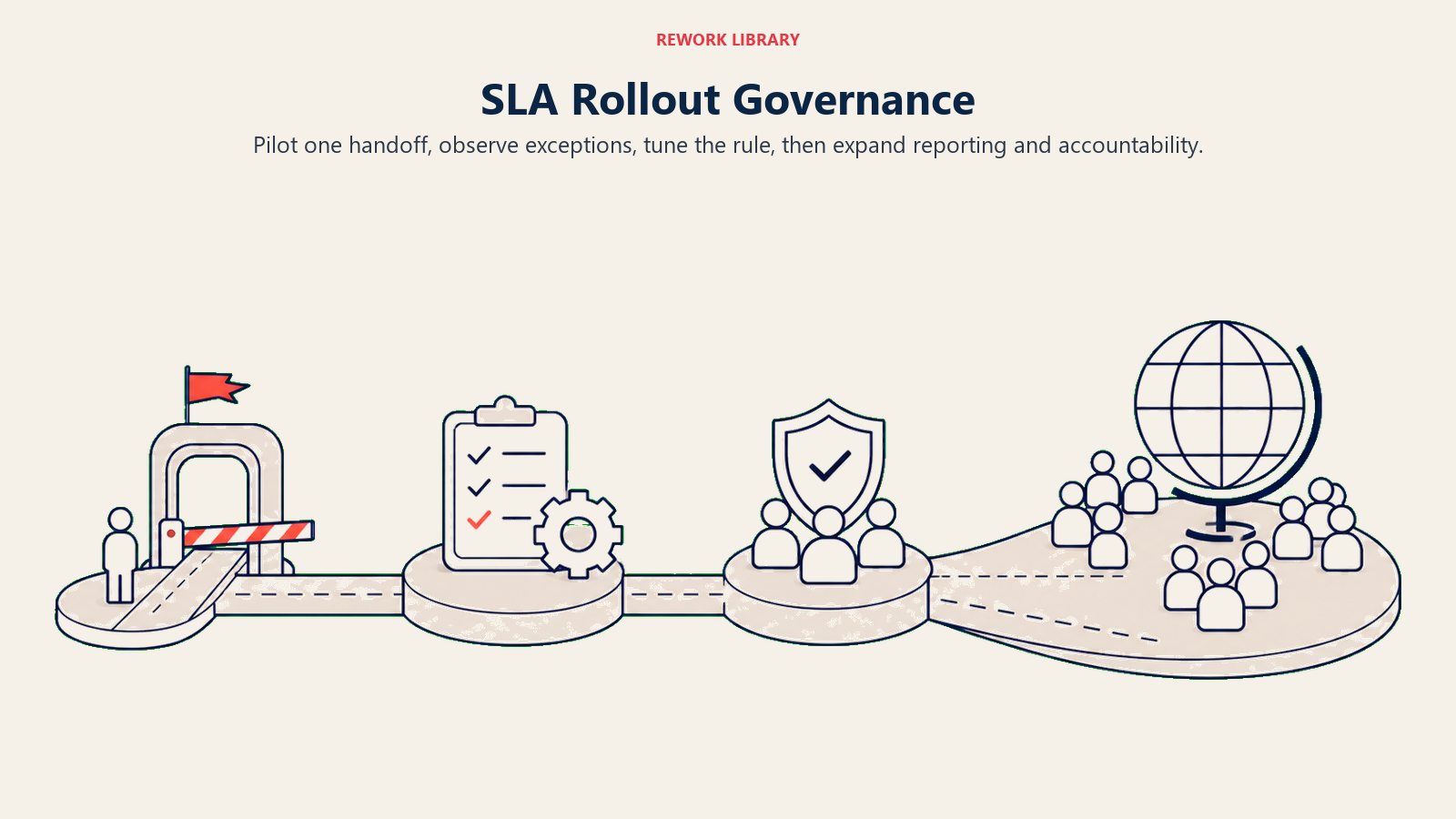
Start with a pilot group or one handoff. Run the model quietly for two to four weeks before broad reporting. During that period, check:
- Are timestamps reliable?
- Do owners understand the required action?
- Do exception reasons match real cases?
- Are managers willing to inspect misses?
- Are quality metrics visible beside speed metrics?
- Does the SLA create work that changes outcomes?
Only after those checks pass should the SLA appear in executive reporting. If the first public dashboard is wrong, teams will distrust the model. If the first public dashboard is used to shame teams, they will work around it. RevOps should use the pilot to prove the SLA is fair, measurable, and tied to real risk.
The rollout should also include a rule for changes. Teams will ask for exceptions: a different window for enterprise leads, a softer rule for partner referrals, a special path for strategic renewals. Some exceptions are valid. But each one should be documented with trigger, owner, measurement, and review date. Otherwise the model becomes a patchwork of local rules no one can explain.
Good governance keeps the SLA useful without making it rigid.
Readiness checklist
Before rollout:
- SLA triggers are written.
- Owners are named.
- Timestamps are reliable.
- Exceptions are defined.
- Escalation path exists.
- Managers know how to inspect compliance.
- Dashboards show both speed and outcome.
If the SLA cannot be measured from the system, it will probably become a slide instead of an operating control.
SLA examples by role
Different teams need different SLA behavior.
| Team | SLA responsibility |
|---|---|
| Marketing Ops | Capture source, campaign, and form data cleanly |
| SDR team | Accept, reject, or work routed leads on time |
| Sales managers | Inspect overdue leads and stale opportunities |
| Account executives | Keep next steps, stages, and close dates current |
| Customer success | Accept handoff and escalate renewal risk |
| Finance | Review planning-impacting exceptions |
| RevOps | Govern rules, reporting, exceptions, and improvement |
This keeps SLA ownership from becoming "RevOps owns everything." RevOps governs the system. Functional leaders own behavior inside the system.
SLA windows
SLA windows should match motion and urgency.
A high-intent demo request may need action in minutes. A low-intent content lead may route to nurture. A strategic account handoff may need a live meeting rather than a strict hour-based timer. A renewal risk may need review within days, not minutes.
Define windows by revenue risk:
- Immediate: high-intent inbound, urgent customer risk, active buying request
- Same day: routed MQL, hot expansion signal, urgent handoff gap
- Weekly: manager inspection, stale opportunity cleanup, renewal risk review
- Monthly: SLA trend review, exception category review, policy adjustment
Not every SLA should be fast. It should be appropriate.
Escalation paths
Every SLA needs an escalation path.
Examples:
- Unworked high-fit lead escalates to SDR manager.
- Repeated rejection without reason escalates to sales and marketing leadership.
- Stale late-stage opportunity escalates to sales manager.
- Missing closed-won handoff escalates to sales manager and CS leader.
- Renewal risk without owner action escalates to CS leadership.
- System errors escalate to systems owner.
Escalation should be visible. If escalation happens only through private messages, RevOps cannot learn whether the process is improving.
SLA and capacity
SLA misses are not always discipline problems.
They can indicate capacity problems:
- Too many inbound leads for the SDR team
- Territory rules assigning work unevenly
- Managers overloaded with inspection
- CS carrying too many renewal risks
- Systems team unable to process change requests
RevOps should report misses by owner, team, source, segment, and workload. If one team misses because it has twice the workload, the fix is capacity or routing, not pressure.
SLA and quality
Speed without quality is dangerous.
A rep can respond quickly but reject good leads. A handoff can happen fast but miss success criteria. An expansion signal can route quickly but create a weak opportunity.
Pair speed metrics with quality metrics:
- First-touch time plus acceptance quality
- Handoff time plus handoff completeness
- Renewal escalation time plus risk resolution
- Expansion routing time plus signal-to-opportunity conversion
This stops teams from optimizing the timer while hurting the outcome.
SLA review template
Use this template monthly:
| Review item | Question |
|---|---|
| Compliance | Which SLA missed most often? |
| Pattern | Is the miss tied to source, segment, owner, or workflow? |
| Cause | Is it capacity, criteria, routing, system, or behavior? |
| Impact | Did it affect pipeline, customer risk, or forecast? |
| Fix | What rule, owner, or workflow changes? |
The review should end with a change, not only a status report.
Common mistakes
Only measuring lead response. Full-funnel SLA includes sales, CS, renewal, and expansion handoffs.
No exception categories. Teams know SLA was missed but not why.
No owner for follow-up. Reports identify misses but nothing changes.
Too many SLA rules. Teams stop caring because everything is urgent.
No quality metric. Teams hit the timer and still create poor outcomes.
Common mistakes test
Ask whether a handoff can sit unnoticed.
If a high-intent lead, stale commit deal, incomplete closed-won handoff, renewal risk, or expansion signal can sit without an owner, SLA governance is incomplete.
Implementation plan
Do not launch every SLA at once.
Start with the two handoffs creating the most leakage. For many teams, that is inbound lead response and closed-won handoff. For a renewal-heavy business, it may be renewal risk escalation and expansion signal routing.
A practical rollout:
- Pick the handoff.
- Define the trigger.
- Define the owner.
- Define the required action.
- Define the timestamp source.
- Define the exception path.
- Build a simple report.
- Review misses weekly for the first month.
After the first SLA is stable, expand to the next handoff.
SLA documentation
Each SLA should have a short policy:
| Field | Example |
|---|---|
| Trigger | High-fit demo request submitted |
| Owner | Assigned SDR |
| Required action | First touch and accept or reject |
| Window | First touch within 15 minutes during business hours |
| Measurement | CRM timestamps |
| Exception | Owner unavailable, duplicate, bad data, system issue |
| Escalation | SDR manager after SLA breach |
| Review | Weekly for misses, monthly for trend |
This makes the SLA operational. Without this level of detail, people will interpret the policy differently.
SLA tuning
SLA windows should be reviewed after launch.
If compliance is near zero, the target may be unrealistic or ownership may be wrong. If compliance is near 100 percent but outcomes do not improve, the SLA may measure the wrong action. If quality drops, the timer may be pushing people to act too quickly.
RevOps should tune SLAs based on both speed and outcome.
What not to measure
Avoid measuring actions that do not affect revenue or customer risk.
For example, a notification opened within five minutes may not matter if the owner takes no useful action. A handoff form completed quickly may not matter if success criteria are vague. A renewal risk alert may not matter if no escalation happens.
Measure the behavior that changes the outcome.
Cultural risk
SLA can feel punitive if introduced badly.
Position it as a handoff reliability model. The goal is to protect customers, prospects, and teams from work falling through gaps. When teams see SLA as a way to expose broken process instead of shame individuals, adoption is much stronger.
Launch checklist
Before launch, confirm:
- Each SLA has a trigger.
- Each trigger has a timestamp.
- Each SLA has one accountable owner.
- Exceptions are categorized.
- Escalation path is written.
- Managers can see misses.
- Teams understand the reason for the SLA.
- Quality metrics are paired with speed metrics.
Start reporting in a small review before sending broad executive summaries. Early reports often reveal timestamp issues, routing gaps, and unclear exception rules. Fix those before using SLA performance to judge teams.
The model is mature when teams trust it enough to discuss the root cause of misses, not just the miss count.
The practical goal is reliable handoff behavior. A good SLA model does not make every team faster at every task. It makes the most important handoffs visible, owned, measured, and improved. That is enough to reduce leakage across the funnel without turning operations into policing.
If the SLA helps teams catch misses earlier and fix process causes faster, it is doing its job.
The best SLA model is quiet: fewer surprises, fewer dropped handoffs, cleaner accountability, and faster correction when the process breaks.
SLA exception packet
Every SLA model needs an exception packet.
Capture:
- SLA missed.
- Record or workflow affected.
- Owner at the time of miss.
- Root cause.
- Customer or revenue impact.
- Corrective action.
- Repeat-prevention rule.
This makes SLA review constructive. The goal is not to shame teams for misses. The goal is to learn which rules, capacity gaps, routing errors, or data problems cause repeated handoff failure.
Frequently Asked Questions about Full-Funnel SLA Model
Who owns full-funnel SLAs?
RevOps governs the model. Functional leaders own team compliance.
What is the most important SLA?
The highest-leakage handoff. For many companies, that is lead acceptance or closed-won handoff.
Learn more

Senior Operations & Growth Strategist
On this page
- SLA examples
- Governance
- What a full-funnel SLA should include
- SLA by funnel area
- Full-funnel SLA map
- SLA design principles
- Lead SLA
- Opportunity SLA
- Closed-won handoff SLA
- Renewal and expansion SLA
- Exception management
- SLA scorecard
- Pick the first two SLAs carefully
- Evidence model for each SLA
- Rollout governance
- Readiness checklist
- SLA examples by role
- SLA windows
- Escalation paths
- SLA and capacity
- SLA and quality
- SLA review template
- Common mistakes
- Common mistakes test
- Implementation plan
- SLA documentation
- SLA tuning
- What not to measure
- Cultural risk
- Launch checklist
- SLA exception packet
- Learn more