Opportunity to Customer Process: RevOps Governance from Pipeline to Handoff
The opportunity-to-customer process turns pipeline into a customer obligation.
That means the process cannot end with "deal closed." By the time a deal becomes closed-won, the company has made promises about scope, timing, value, delivery, billing, stakeholders, and customer outcomes. If those promises are not captured and handed off cleanly, the company may book revenue while creating churn risk.
RevOps should govern this process because sales execution, forecast quality, finance planning, and customer success handoff all depend on it.
Gartner has reported that confidence in forecast accuracy is often weak across sales organizations. Forrester's customer success platforms landscape also reinforces why post-sale outcomes and customer engagement need operating systems. The opportunity-to-customer process sits between those two issues: what sales says will happen and what the customer team must deliver.
Key operating facts
- Opportunity-to-customer governance protects forecast trust, deal quality, finance readiness, and customer handoff.
- Stage movement should be evidence-based, not optimism-based.
- Closed-won should require enough commercial, finance, and customer context for the next team to act.
- Customer success should have an acceptance path for incomplete or risky handoffs.
- Post-sale feedback should change sales process when patterns repeat.
Why this process matters
Opportunity-to-customer governance protects three things:
Turn this article into takeaways for your work.


Each assistant summarizes the article only for you and suggests best practices for your work.
- Forecast trust
- Deal quality
- Customer handoff quality
Forecast trust depends on opportunity stages, close dates, amount accuracy, and commit criteria. Deal quality depends on whether sales has confirmed fit, value, decision path, risk, and scope. Handoff quality depends on whether customer success receives enough context to onboard the customer well.
These are connected. A deal that is forecast as likely to close but has no success criteria, no implementation scope, and no stakeholder map may be a forecast risk and a retention risk.
The weak version of this process treats every function as a separate downstream checkpoint. Sales closes the deal, finance cleans billing fields, customer success reconstructs context, and RevOps explains why the dashboard does not match reality. That may work for a few deals, but it breaks as volume, deal complexity, and customer expectations rise.
The strong version treats the deal as one continuous operating object.
| Symptom | Process issue | Downstream cost |
|---|---|---|
| Forecast looks strong but slips late | Stage evidence is weak | Finance loses timing confidence |
| Deal closes but billing is delayed | Finance fields checked after signature | Cash and reporting cleanup |
| Customer repeats discovery after signing | Handoff context is missing | Lower trust at onboarding |
| Implementation risk appears after close | Deal risk was not captured earlier | Delivery pressure and churn risk |
| Closed-lost reasons are vague | Loss learning is not governed | Marketing and product get weak feedback |
This is why RevOps should not treat opportunity governance and customer handoff as separate projects. The same deal record should carry enough truth for forecast, close, billing, onboarding, and future account growth.
Process controls
The process needs controls from opportunity creation through onboarding acceptance.
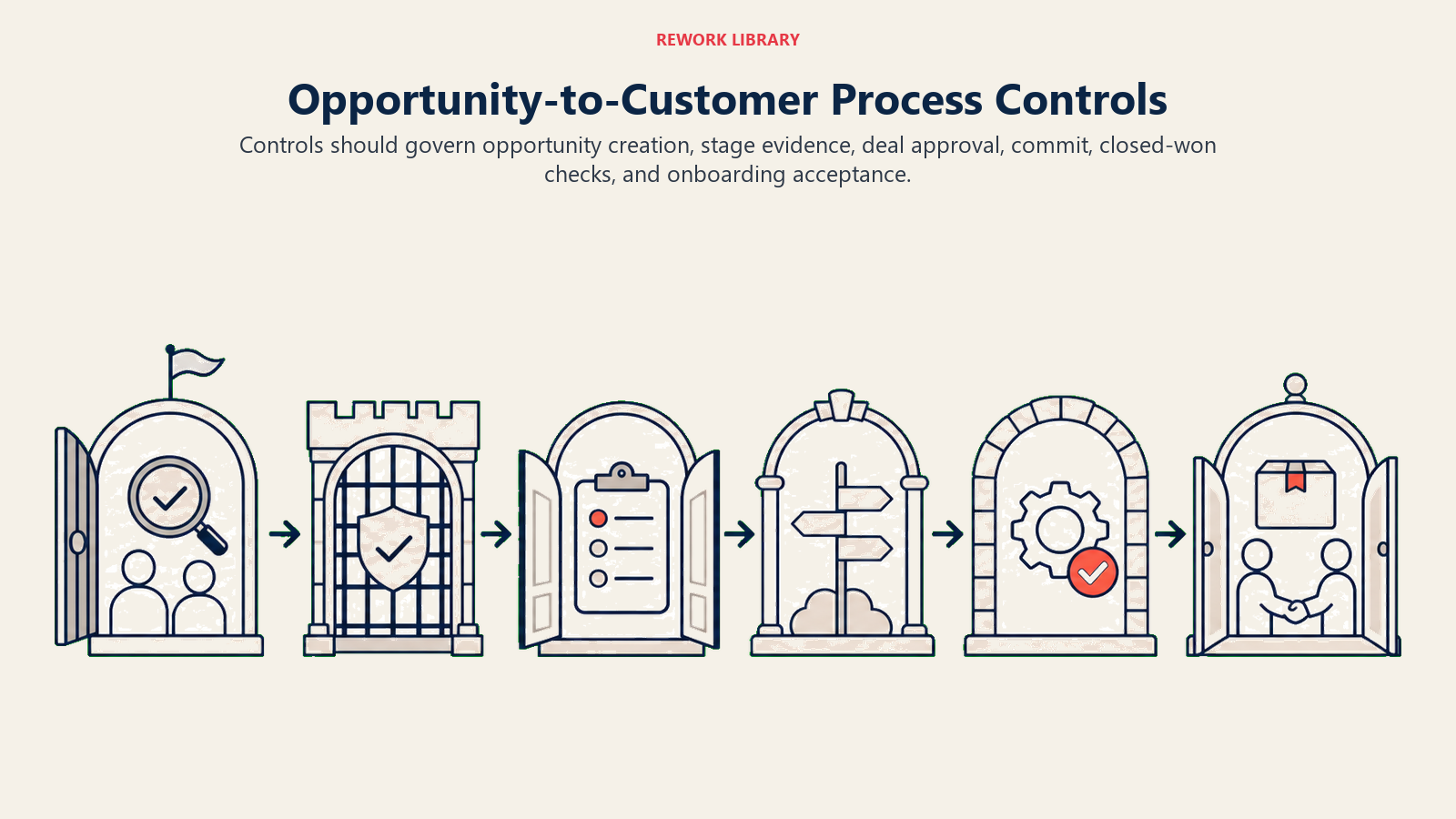
| Control | Purpose |
|---|---|
| Stage criteria | Keep opportunity movement evidence-based |
| Close-date hygiene | Prevent stale forecast timing |
| Amount and product fields | Support finance and delivery planning |
| Deal risk fields | Surface blockers early |
| Closed-won requirements | Ensure handoff data is complete |
| Customer success acceptance | Confirm the next team has enough context |
| Post-sale feedback | Improve sales process from onboarding issues |
Connect the forecast side to forecast governance. Connect the stage evidence to stage exit criteria.
Define the process boundary
The opportunity-to-customer process starts earlier than many teams think.
It starts when an opportunity is created because that is when pipeline begins affecting forecast, capacity, and customer expectations. It ends when the customer is accepted into the post-sale operating motion with enough context to deliver.
That boundary includes:
- Opportunity creation
- Qualification
- Discovery
- Solution fit
- Commercial review
- Commit or forecast submission
- Closed-won review
- Finance and billing readiness
- Customer success handoff
- Onboarding acceptance
- Post-sale feedback
If RevOps only governs the CRM before closed-won, the company misses the handoff risk. If RevOps only cares after closed-won, forecast and deal quality issues appear too late.
Opportunity creation standards
The process starts with deciding when an opportunity should exist.
If opportunities are created too early, pipeline is inflated. If they are created too late, sales managers and finance lose visibility. RevOps should define a clear creation standard.
Useful opportunity creation evidence:
- A real account or buying group exists
- A business problem has been identified
- There is a potential product or service fit
- A next step is scheduled or agreed
- The opportunity owner is clear
- Source or origin is known enough for reporting
- The opportunity is not a duplicate buying motion
Do not create opportunities only because a lead filled out a form. Do not wait until procurement either. The right point is when the business has enough evidence to inspect the potential revenue motion.
Qualification handoff into pipeline
Lead-to-opportunity movement should have its own handoff standard.
Before an opportunity is created, sales or qualification teams should capture:
- Business problem
- Buyer role
- Urgency or trigger
- Company fit
- Source context
- Known stakeholders
- Initial value hypothesis
- Disqualification risk
This prevents weak opportunities from becoming pipeline simply because a meeting was booked. It also helps managers coach earlier, before forecast risk appears.
Deal desk and approval path
Some opportunities need approval before they can close.
Examples:
- Non-standard discounts
- Custom contract terms
- Security or legal exceptions
- Product commitments
- Implementation scope changes
- Payment term changes
- Partner margin issues
- Multi-year or multi-entity contracts
RevOps should document when deal desk or approval review is required. Finance, legal, sales leadership, and delivery teams should know which fields trigger review and which team owns the decision.
A clean approval path prevents late-quarter surprises. It also keeps sales from treating approval as an informal Slack negotiation after the forecast has already assumed the deal will close.
Handoff tiers
Not every customer needs the same handoff.
Use tiers.
| Handoff tier | Best for | Handoff requirement |
|---|---|---|
| Standard | Low-risk, simple scope, clear package | Required fields and automated task |
| Managed | Mid-size customer, moderate complexity | Handoff note plus sales-to-CS review |
| Strategic | Large, complex, high-risk, executive visibility | Live handoff, risk review, success plan, finance check |
This keeps the process practical. A simple customer should not need a heavy ceremony. A strategic customer should not be thrown over the wall with only a closed-won status.
Promises made log
One of the most valuable handoff artifacts is a promises made log.
It should capture:
- Outcomes promised
- Product capabilities discussed
- Timeline expectations
- Services or implementation commitments
- Reporting expectations
- Stakeholder-specific commitments
- Commercial concessions
- Known limitations explained during sales
This is not about policing sales. It protects the customer experience. Customer success should not discover promises only after the buyer asks about them.
The promises made log also helps product, delivery, finance, and sales leadership see where the sales motion creates recurring delivery pressure.
Stage movement rules
Opportunity stages should move based on evidence.
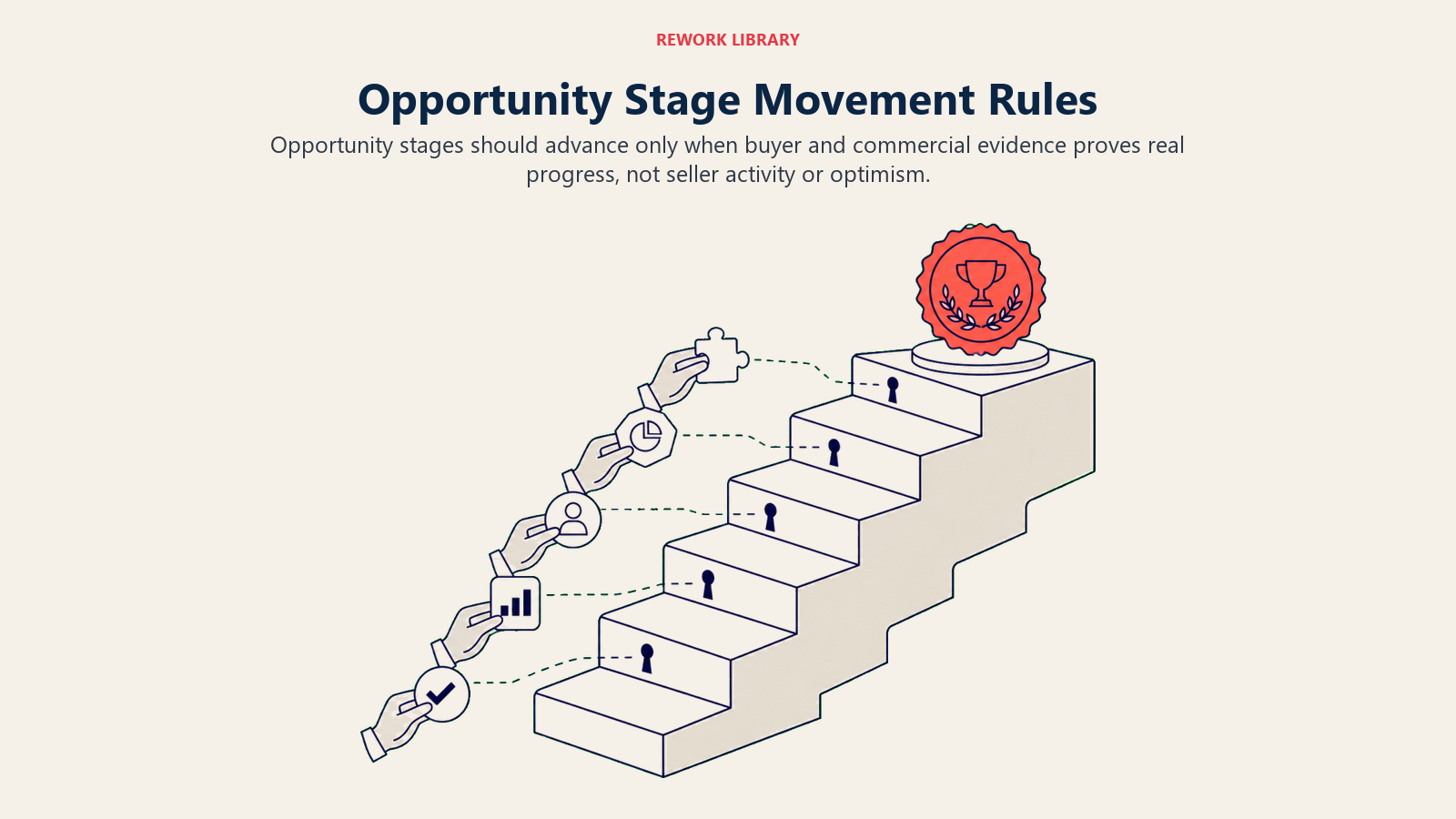
Example stage movement:
| Stage movement | Evidence needed |
|---|---|
| Qualified to discovery | Business problem and buyer context confirmed |
| Discovery to solution fit | Buyer agrees proposed approach addresses the problem |
| Solution fit to commercial review | Scope, value, and decision process are active |
| Commercial review to commit | Mutual close plan, economic buyer, risk, and timing are clear |
| Commit to closed-won | Contract, scope, billing, and handoff data are complete |
The names can differ by company. The important rule is that stages should not move because a rep feels optimistic.
Forecast controls
RevOps should inspect forecast controls throughout the process.
Key controls include:
- Close date is realistic
- Amount matches commercial scope
- Stage matches evidence
- Forecast category matches deal risk
- Next step is current
- Decision process is known
- Economic buyer is identified
- Blockers are documented
- Commit criteria are met
Managers own deal inspection. RevOps owns the process and data rules that make inspection possible.
See commit criteria for the forecast standard.
Deal risk data
Deal risk should be captured before the deal is closed, not after the customer is unhappy.
Useful risk fields include:
- Missing executive sponsor
- Unclear success criteria
- Complex procurement
- Product gap
- Integration dependency
- Security review
- Implementation capacity issue
- Competitive pressure
- Timeline risk
- Pricing or discount risk
These fields should not be busywork. They should support forecast review, manager coaching, delivery planning, and handoff quality.
Closed-won should mean ready to receive
Closed-won should require more than a signed contract.
At minimum, the handoff should include:
- Primary use case
- Success criteria
- Key stakeholders
- Champion and executive sponsor
- Contract scope
- Products or services sold
- Implementation notes
- Promises made
- Risks surfaced during the sale
- Renewal date
- Expansion signals
If the company allows deals to close without this data, customer success will reconstruct context after the customer has already formed expectations.
That creates avoidable friction.
Finance and billing handoff
Finance also depends on opportunity-to-customer governance.
RevOps should make sure the close process supports:
- Correct billing entity
- Contract start and end dates
- Payment terms
- Discount approval
- Product or package mapping
- Renewal date
- Bookings attribution
- Revenue reporting fields
If finance has to clean this manually after close, the process is not complete.
The process should connect to the same definitions finance uses in planning. Otherwise sales can close the deal and still leave finance with an incomplete revenue record.
Customer success handoff workflow
The handoff should have a defined trigger and agenda.
A simple workflow:
- Sales marks the deal ready for closed-won review.
- Required commercial, finance, and customer success fields are checked.
- Manager confirms deal quality and forecast close.
- Customer success receives the handoff package.
- Sales and customer success hold a handoff meeting when risk or complexity is high.
- Onboarding owner confirms acceptance.
- Missing handoff data is reported back to sales leadership.
This turns handoff quality into an operating metric, not a courtesy.
Operating RACI
The process works better when ownership is explicit.
| Activity | Sales | RevOps | Finance | Customer success |
|---|---|---|---|---|
| Opportunity qualification | Accountable | Supports rules | Informed | Informed |
| Stage criteria | Accountable | Owns governance | Consulted | Consulted |
| Forecast submission | Accountable | Supports process | Consulted | Informed |
| Deal approval | Accountable | Coordinates data | Accountable for financial terms | Consulted on delivery risk |
| Closed-won requirements | Accountable | Owns workflow | Owns billing fields | Owns handoff needs |
| Onboarding acceptance | Consulted | Tracks completeness | Informed | Accountable |
| Post-sale feedback | Consulted | Owns pattern review | Consulted | Accountable |
This RACI does not need to be formal for every deal. It needs to be clear enough that handoff failures do not become everyone's problem and nobody's responsibility.
Customer acceptance
Customer success should have a defined acceptance point.
That does not mean customer success can refuse every difficult customer. It means customer success can flag incomplete handoff data and require correction.
A customer acceptance checklist might include:
- Contract and scope are clear.
- Success criteria are documented.
- Primary stakeholders are listed.
- Implementation risks are noted.
- Promises made are visible.
- Renewal date is captured.
- Account owner is assigned.
- Kickoff timing is clear.
If key information is missing, sales should fix it before or during handoff.
Closed-lost learning
Opportunity governance should include closed-lost data.
Closed-lost reasons should be specific:
- No decision
- Competitor
- Price
- Missing feature
- Poor fit
- Timing
- Budget shift
- Procurement failure
- Security or legal blocker
- Champion lost
These reasons should feed marketing, sales, product, finance, and customer success.
If "no decision" is common, discovery or business case quality may be weak. If "missing feature" is common, product and sales need a clearer fit policy. If "price" is common, finance and sales leadership may need to inspect discounting, packaging, or value messaging.
Manager inspection questions
Sales managers should inspect opportunity quality with consistent questions:
- What problem is the customer trying to solve?
- Why now?
- Who is the economic buyer?
- Who will use the product or service?
- What value has been agreed?
- What is the decision process?
- What could delay or block the deal?
- What has been promised after signature?
- What does customer success need to know before onboarding?
RevOps should not replace manager judgment. It should make sure the system captures enough evidence for managers to judge well.
Manager inspection should also distinguish activity from progress. A meeting happened is activity. A buyer confirmed the problem, shared the approval path, or agreed to a next action is progress. Stage movement should follow progress.
This distinction matters because activity-heavy deals often look healthy in CRM. They have recent calls, emails, and notes. But if the buyer has not advanced the decision, the stage may be overstated. RevOps should help managers inspect customer movement, not only seller effort.
Data dictionary alignment
The opportunity-to-customer process depends on shared field definitions.
RevOps should define:
- Amount
- Close date
- Stage
- Forecast category
- Primary product
- Use case
- Implementation complexity
- Success criteria
- Contract start date
- Renewal date
- Handoff status
Each field needs an owner, source, and use case. If the field affects finance reporting or customer delivery, the definition should be reviewed before it changes.
Use revenue data dictionary to keep this clean.
Metrics to track
Track:
- Stage aging by opportunity stage
- Close-date slippage
- Forecast accuracy by category
- Commit conversion
- Closed-won handoff completeness
- Time from closed-won to onboarding kickoff
- Missing implementation data
- Post-sale risk tied to sales promises
- Discount and approval exceptions
- Closed-lost reason completeness
- Finance field completeness
The metrics should help leaders see whether the opportunity process is creating reliable revenue or hidden downstream work.
Governance cadence
Review opportunity-to-customer quality monthly.
Include sales, customer success, finance, and RevOps.
Agenda:
- Forecast slippage
- Stage aging
- Commit conversion
- Closed-won handoff completeness
- Missing finance fields
- Onboarding delays tied to sales handoff
- Closed-lost reasons
- Post-sale risks from promises made
The meeting should not be about blame. It should identify where the process is creating unreliable revenue or downstream work.
Example workflow
A clean opportunity-to-customer workflow might look like this:
- Sales qualifies the opportunity with fit, need, value, and next step.
- The manager confirms stage criteria during pipeline inspection.
- RevOps monitors stage aging, close-date changes, and required data.
- Finance reviews amount, terms, discount, and forecast impact when needed.
- Sales moves the deal into commit only when commit criteria are met.
- Before closed-won, the deal passes commercial and handoff checks.
- Customer success receives the handoff package.
- A handoff meeting occurs for complex or risky customers.
- Onboarding owner accepts the customer record.
- Missing data and exceptions are reviewed in the monthly governance cadence.
This workflow keeps the process connected. Forecast, finance, and customer success are not separate downstream cleanups. They are part of the same revenue movement.
Example closed-won review
Before a deal is marked fully ready for onboarding, review:
- Is the contract signed and attached?
- Is the scope clear?
- Are products, services, and dates correct?
- Is the use case documented?
- Are success criteria specific?
- Are stakeholders listed?
- Are implementation risks visible?
- Are promises made recorded?
- Are billing and renewal fields complete?
- Does customer success know what happens next?
If the deal is simple and low-risk, this review can be automated through required fields. If the deal is strategic, risky, or complex, it should include manager and customer success review.
Post-sale feedback loop
Customer success should send feedback back to sales and RevOps when handoff quality is weak.
Examples:
- Success criteria missing
- Customer expected a feature not in scope
- Timeline was oversold
- Stakeholder map was wrong
- Implementation effort was underestimated
- Renewal risk appeared immediately
RevOps should categorize this feedback and review it with sales leadership. If the same issue appears repeatedly, it should change discovery, stage criteria, deal review, or handoff requirements.
Dashboard design
A useful opportunity-to-customer dashboard includes:
- Opportunities by stage and age
- Close-date slippage
- Commit conversion
- Closed-won handoff completeness
- Missing finance fields
- Deals with implementation risk
- Time from closed-won to kickoff
- Post-sale issues tied to handoff
The dashboard should help leaders manage the process before the customer is affected.
Handoff quality scorecard
Handoff quality should be measured from the receiver's point of view.

Customer success does not need a perfect CRM record. It needs enough accurate context to start the customer relationship without redoing discovery.
Useful scorecard fields:
| Signal | What it shows |
|---|---|
| Handoff completeness | Required fields are present |
| Handoff acceptance rate | Customer success accepted the record without major follow-up |
| Time to kickoff | Customer moved from closed-won to kickoff quickly |
| Missing promise rate | Customer asked about a promise not visible in the handoff |
| Implementation risk accuracy | Sales risk matched onboarding reality |
| Finance correction rate | Billing or contract fields needed cleanup |
| Post-sale escalation source | Escalation tied back to sales scope, product gap, or delivery issue |
This scorecard should be reviewed with sales and customer success together. If customer success owns the complaint but sales never hears the pattern, the process will not improve.
Exception path
Some deals should close even when the handoff is imperfect.
That is why the process needs an exception path, not only hard blocks.
Examples:
- Customer signs at quarter end but kickoff is two weeks away.
- Legal signs before final implementation owner is assigned.
- A strategic deal has known delivery risk that leadership accepts.
- Billing entity is still being confirmed by finance.
Exceptions should be visible. Capture the missing item, owner, due date, and risk. A visible exception is manageable. An invisible exception becomes post-sale surprise.
First 90 days
To improve this process:
Days 1 to 30: audit recent opportunities, closed-won deals, and handoff records. Identify missing data and recurring slippage.
Days 31 to 60: define stage exit criteria, commit criteria, and closed-won handoff requirements.
Days 61 to 90: launch a handoff completeness report, update forecast inspection, and review exceptions with sales, customer success, finance, and RevOps.
Keep the first version practical. The goal is cleaner revenue movement, not a process manual no one uses.
Common failure modes
Opportunities are created too early. Pipeline looks larger than it is.
Stages move without evidence. Forecast calls become opinion reviews.
Close dates roll repeatedly. Finance loses confidence in timing.
Closed-won data is incomplete. Customer success starts with missing context.
Sales promises are not captured. Delivery teams discover expectations too late.
Finance data is checked after close. Billing and reporting require manual cleanup.
Post-sale feedback never returns to sales. The same handoff issue repeats.
Readiness checklist
Before rollout, confirm:
- Opportunity stages have exit criteria.
- Commit rules are written.
- Close-date slippage is tracked.
- Deal risks have defined fields.
- Closed-won requirements are enforced.
- Finance fields are checked before reporting.
- Customer success handoff data is visible before kickoff.
- Handoff exceptions are reviewed with sales managers.
- Closed-lost reasons are specific.
- Post-sale feedback changes sales process when patterns repeat.
If these are missing, the company may still close revenue, but it will create hidden work for finance, customer success, and future RevOps cleanup.
What good looks like
The operating owner should be named before rollout. Sales leadership owns deal execution and manager inspection. RevOps owns stage rules, data quality, handoff governance, and reporting. Finance owns planning and billing implications. Customer success owns onboarding acceptance and customer delivery.
When those roles are clear, closed-won becomes a clean transfer of context instead of a messy end-of-quarter scramble.
That clarity also protects the customer. A buyer should not feel the company's internal handoff problems after signing. The experience should feel continuous from sales promise to onboarding action, with no avoidable context gaps.
Opportunity-to-customer handoff packet
Before a deal becomes an active customer workflow, capture:
- Business problem.
- Purchased scope.
- Success criteria.
- Stakeholders.
- Implementation risks.
- Promises made.
- Timeline commitments.
- Billing or contract caveats.
- CS owner.
- First customer action.
This packet protects customer experience and revenue quality. A deal can be closed-won and still create churn risk if the handoff lacks usable context.
Frequently Asked Questions about Opportunity to Customer Process
Who owns opportunity-to-customer?
Sales owns deal execution. RevOps owns process governance. Customer success owns onboarding after handoff. Finance owns billing and planning implications.
Why does RevOps care after closed-won?
Because bad handoffs damage retention and make revenue reporting incomplete. RevOps should protect the movement from pipeline to customer, not only the CRM status change.
What should be required before closed-won?
At minimum, require use case, success criteria, stakeholders, contract scope, implementation notes, risks, promises made, billing fields, and renewal date.
How do you know the handoff is working?
Customer success receives enough context to start onboarding without reconstructing the sale, finance can bill without manual cleanup, and post-sale risk tied to sales promises decreases.
Learn more

Senior Operations & Growth Strategist
On this page
- Why this process matters
- Process controls
- Define the process boundary
- Opportunity creation standards
- Qualification handoff into pipeline
- Deal desk and approval path
- Handoff tiers
- Promises made log
- Stage movement rules
- Forecast controls
- Deal risk data
- Closed-won should mean ready to receive
- Finance and billing handoff
- Customer success handoff workflow
- Operating RACI
- Customer acceptance
- Closed-lost learning
- Manager inspection questions
- Data dictionary alignment
- Metrics to track
- Governance cadence
- Example workflow
- Example closed-won review
- Post-sale feedback loop
- Dashboard design
- Handoff quality scorecard
- Exception path
- First 90 days
- Common failure modes
- Readiness checklist
- What good looks like
- Opportunity-to-customer handoff packet
- Learn more