Revenue Process Audit: A Checklist for Finding Full-Funnel Friction
A revenue process audit checks whether the revenue system works the way leaders think it works.
Do not audit only the official process. Audit records, fields, handoffs, dashboards, meetings, and exceptions. The gap between documented process and actual behavior is where revenue leaks.
Most teams already know something feels off. Leads are routed late. Opportunities move stages without evidence. Forecast calls debate the same stale deals. Customer success asks sales for context after close. Finance rebuilds revenue reports manually. Leaders see dashboards, but still ask for side spreadsheets.
A good audit turns that vague friction into evidence, root causes, and a short action plan.
Forrester's RevOps responsibilities model is a useful frame because the audit should cover the full commercial operating system, not only sales process. Gartner's forecast confidence research is also relevant because weak process and weak data often show up first as forecast distrust.
Key operating facts
- Audit records, not only process diagrams.
- The best audit separates symptoms from root causes.
- Handoffs, meetings, and dashboards are part of the revenue process.
- Data caveats should be visible in the audit output.
- A process audit is only useful if it produces a first 30-day action plan.
What a revenue process audit covers
A revenue process audit should inspect the full operating system.
| Area | Questions |
|---|---|
| Lifecycle | Are stages defined with entry and exit criteria? |
| Handoffs | Does each handoff have an owner, SLA, and required data? |
| CRM data | Are decision-critical fields complete and trusted? |
| Reporting | Do leaders use one source of truth? |
| Forecast | Are stage and commit rules evidence-based? |
| Post-sale | Does customer success receive enough closed-won context? |
| Cadence | Do meetings create decisions or only discussion? |
| Systems | Do tools support the process or create workarounds? |
The audit should find where the revenue system stops matching reality.
Start with the business question
Do not start with a giant checklist.
Start with the question leaders need answered.
Examples:
- Why is forecast accuracy weak?
- Why does sales reject so many MQLs?
- Why does pipeline look healthy but revenue miss?
- Why does customer success receive poor handoff context?
- Why does finance rebuild reporting manually?
- Why are expansion signals not turning into pipeline?
The question shapes the sample and the depth. A forecast audit should inspect opportunity stage evidence, close dates, commit criteria, manager inspection, and forecast cadence. A handoff audit should inspect closed-won records, promises made, success criteria, onboarding acceptance, and post-sale feedback.
Scope matters because "audit the revenue process" can become too broad to finish. RevOps should choose one of three audit modes.
| Audit mode | Best when | Output |
|---|---|---|
| Focused audit | One workflow is visibly broken | Specific fixes for one journey |
| Full-funnel audit | Leaders do not trust the revenue system | Cross-functional root-cause map |
| Governance audit | Process works but definitions keep drifting | Owners, definitions, cadence, and controls |
A focused audit is often the right first move. For example, if closed-won handoff is hurting onboarding, audit opportunity-to-customer first. If forecast trust is weak, audit stage criteria, close dates, manager inspection, and forecast cadence before auditing the entire lifecycle.
The audit should be wide enough to find root causes but narrow enough to produce a decision.
Audit principles
Use these principles:
| Principle | Meaning |
|---|---|
| Inspect records, not only opinions | Interviews show perception, records show behavior |
| Follow the full lifecycle | Do not stop at closed-won |
| Separate symptom and cause | Bad dashboards may come from weak fields |
| Document caveats | Leaders need to know what data can and cannot prove |
| Prioritize leaks | The audit should produce action, not a giant issue list |
The audit should be practical enough that leaders can decide what to fix next.
Build the record sample
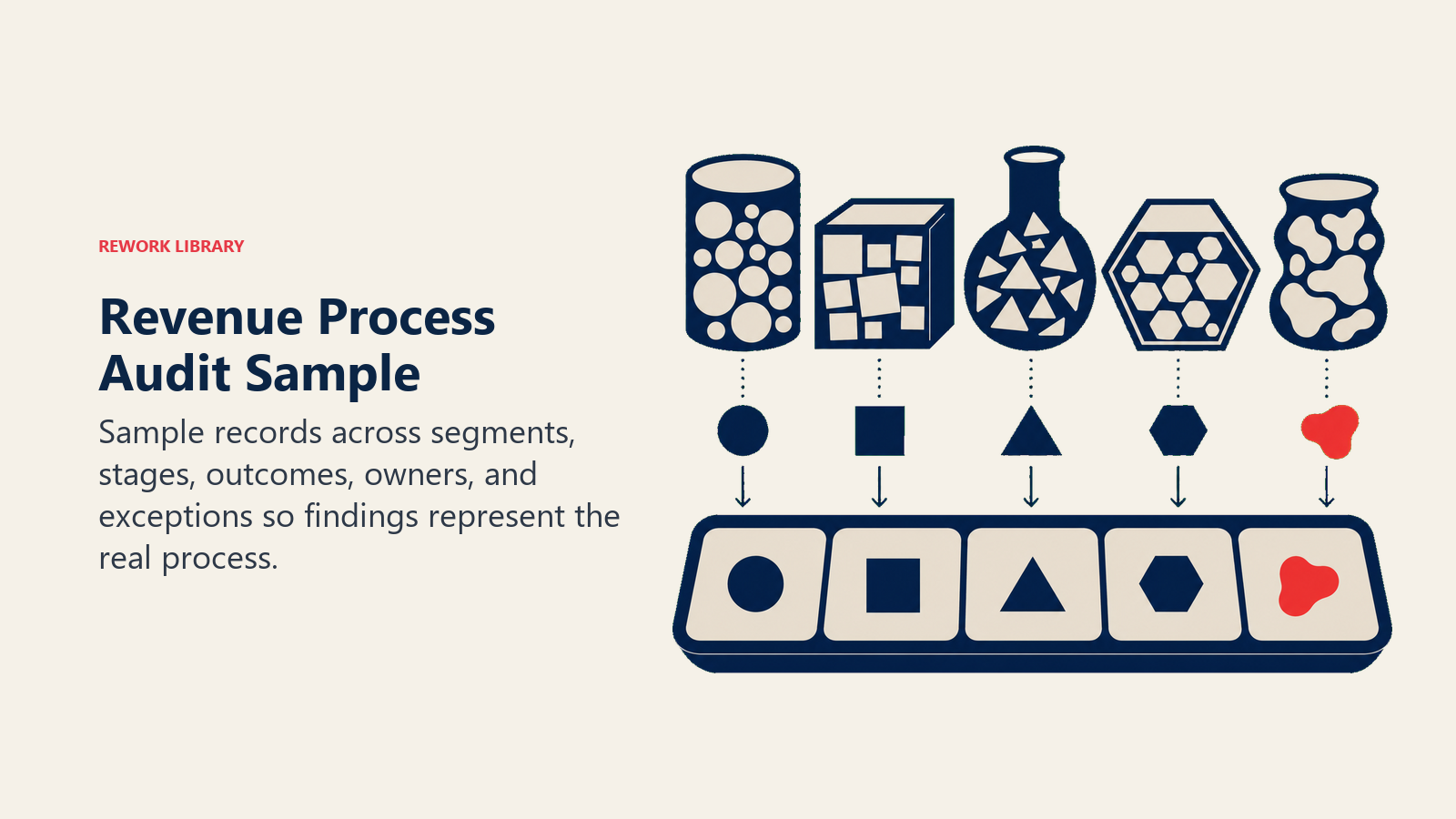
A strong audit uses a record sample.
Example sample:
Turn this article into takeaways for your work.


Each assistant summarizes the article only for you and suggests best practices for your work.
- 20 new leads
- 20 MQLs
- 20 rejected leads
- 20 opportunities
- 10 closed-won deals
- 10 closed-lost deals
- 10 onboarding records
- 10 renewal-risk customers
- 10 expansion candidates
The sample does not need to be statistically perfect. It needs to expose patterns.
For focused audits, reduce the sample. For example, an opportunity-to-customer audit may inspect only late-stage opportunities, closed-won deals, handoff records, and onboarding feedback.
Lifecycle audit
Check:
- Are stages defined?
- Are entry and exit criteria visible?
- Are records in the correct stage?
- Are stale stages common?
- Are stage dates populated?
- Are negative outcomes captured?
- Are customer and expansion stages included?
This connects directly to revenue funnel stages. If lifecycle stages are unclear, conversion reports will not be trustworthy.
Lifecycle worksheet
Use a worksheet for each lifecycle stage.
| Question | Evidence to inspect |
|---|---|
| What is the stage called? | CRM stage field and lifecycle definition |
| Who owns movement? | Functional owner or manager |
| What is entry evidence? | First record sample entering the stage |
| What is exit evidence? | Records that moved forward |
| How long do records stay? | Stage aging report |
| What creates exceptions? | Stale or blocked records |
| Which report uses this stage? | Dashboard or operating meeting |
This makes stage problems specific. Instead of saying "the funnel is messy," RevOps can say "SQL exit criteria are unclear, and 35 percent of sampled SQLs had no accepted next step."
Handoff audit
Audit the major handoffs:
- Lead capture to routing
- MQL to sales acceptance
- SQL to opportunity
- Opportunity to closed-won
- Closed-won to onboarding
- Customer to renewal
- Customer to expansion
For each handoff, ask:
- Who owns it?
- What data is required?
- What SLA applies?
- What exception path exists?
- What happens when it fails?
- Is failure visible to managers?
Many revenue leaks are handoff leaks.
Handoff worksheet
For each handoff, document the operating contract.
| Handoff item | Audit question |
|---|---|
| Trigger | What causes the handoff to start? |
| Sender | Which role sends the work forward? |
| Receiver | Which role accepts it? |
| Required data | What fields or context must exist? |
| SLA | How fast should the receiver act? |
| Exception path | What happens when data is missing? |
| Feedback loop | How does the receiver report quality issues? |
Weak handoffs usually fail in one of three places: unclear trigger, missing data, or no receiver acceptance. The audit should show which one is happening.
CRM and data audit
Check data quality for decision-critical fields:
- Source
- Segment
- Owner
- Lifecycle stage
- Close date
- Amount
- Forecast category
- Rejection reason
- Closed-lost reason
- Success criteria
- Renewal date
- Churn reason
Do not audit every field equally. Focus on fields that affect routing, qualification, forecast, handoff, reporting, or planning.
This should connect to CRM data hygiene, because recurring data issues usually have workflow, ownership, or timing causes.
Data-quality worksheet
For each decision-critical field, capture:
| Field question | Why it matters |
|---|---|
| What decision depends on it? | Separates useful fields from clutter |
| Who owns the definition? | Prevents shared neglect |
| When should it be filled? | Prevents fake completeness |
| What is the completion rate? | Shows visible gaps |
| What is the placeholder rate? | Shows hidden quality issues |
| Which reports use it? | Shows reporting impact |
| Which systems write to it? | Shows integration risk |
This helps RevOps find whether a field problem is a definition issue, a workflow issue, or a system issue.
Dashboard audit
Ask:
- Which dashboards do leaders use?
- Which numbers conflict?
- Which definitions are undocumented?
- Which metrics have data-quality caveats?
- Which dashboards drive decisions?
- Which dashboards are ignored?
- Which reports are rebuilt manually?
If leaders use shadow spreadsheets, find out why. It may be a definition problem, a trust problem, a timing problem, or an access problem.
The audit should identify whether the revenue operations dashboard is a working decision surface or a decorative reporting layer.
Dashboard trust test
For each important dashboard, ask five questions.
- Who uses it?
- What decision does it support?
- Which field definitions does it depend on?
- What caveats should appear with the data?
- What action changed because of it in the last month?
If no one can name the decision, the dashboard may be decorative. If the definitions are unclear, the dashboard may be dangerous. If leaders export it and rebuild the numbers, the dashboard is not trusted.
Forecast audit
Forecast distrust is often a symptom, not the root cause.
Inspect:
- Stage definitions
- Stage aging
- Close-date movement
- Commit criteria
- Manager inspection
- Forecast category changes
- Late-quarter deal creation
- Amount changes after commit
- Data-quality caveats
Tie findings back to forecast governance. If forecast confidence is weak, the audit should show whether the issue is stage evidence, manager behavior, data hygiene, finance definitions, or sales judgment.
Forecast evidence sample
Pull a sample of committed, best-case, and slipped opportunities.
For each deal, inspect:
- Current stage
- Forecast category
- Close date history
- Next customer action
- Economic buyer or approver path
- Known blockers
- Amount changes
- Manager notes
- Last meaningful activity
- Whether the deal closed, slipped, or was downgraded
This sample usually shows whether the forecast process is evidence-based or optimism-based.
Cadence audit
Review meetings:
- Forecast call
- Pipeline review
- Funnel review
- Renewal review
- Expansion review
- Systems governance
- Quarterly planning
For each meeting, ask:
- What decision is made?
- What data packet is used?
- Who owns follow-up?
- Are actions completed?
- Does the same issue repeat?
- Are managers using the same definitions?
Meetings are part of the revenue process. If they do not create decisions, they are process noise.
Cadence decision test
Every recurring revenue meeting should pass a decision test.
| Meeting | Decision it should create |
|---|---|
| Forecast call | What has changed in confidence, risk, or timing? |
| Pipeline review | Which deals need action, coaching, or removal? |
| Funnel review | Which stage or source needs fixing? |
| Renewal review | Which customers need risk action or expansion work? |
| Systems governance | Which field, workflow, or report change should ship? |
| Quarterly planning | Which assumptions need to change? |
If a meeting does not create a decision, action, or owner, audit why it exists.
Interview guide
Interviews still matter, but they should be compared with record evidence.
Ask marketing:
- Which leads should sales accept?
- Which sources create quality demand?
- Where does attribution break?
Ask sales:
- Which leads are worth follow-up?
- Which stage definitions are unclear?
- Where does forecast inspection fail?
Ask customer success:
- What context is missing after closed-won?
- Which churn reasons repeat?
- Where do expansion signals get lost?
Ask finance:
- Which numbers do you rebuild manually?
- Which forecast assumptions are least trusted?
- Which metrics affect planning?
Then compare the answers with actual records.
Evidence log
Keep an evidence log.
For each finding, document:
- Record sample
- Screenshot or field evidence if needed
- Affected process
- Root cause hypothesis
- Owner
- Severity
- Recommended fix
This prevents the audit from becoming opinion-based.
Weak finding: "Sales does not update opportunities."
Strong finding: "In the 20 sampled late-stage opportunities, 9 had close dates in the past and 6 had no next customer action. Most were under two managers. Forecast call notes did not inspect close-date movement."
The second finding can be acted on.
Evidence standards matter. A finding should show the sample, pattern, and operating impact. It should avoid vague claims like "sales is inconsistent" or "data quality is poor." Those statements may be true, but they do not tell leaders what to fix.
Use this standard:
| Weak evidence | Stronger evidence |
|---|---|
| Lead routing is slow | 8 of 20 sampled inbound leads missed SLA, mostly from partner source |
| Forecast is unreliable | 6 of 15 commit deals slipped after close-date moved twice |
| Handoff is poor | 7 of 10 closed-won deals missed success criteria or promises made |
| Dashboard is not trusted | Finance rebuilds ARR and pipeline coverage from exports each month |
The audit becomes useful when each finding can point to a record, field, meeting, or report.
Scoring model
Use a simple score.
| Score | Meaning |
|---|---|
| 1 | Undefined or not used |
| 2 | Defined but inconsistent |
| 3 | Partially governed |
| 4 | Governed and mostly trusted |
| 5 | Trusted, measured, and improving |
Score lifecycle, handoffs, data, dashboard, forecast, post-sale, and cadence. This helps leaders see where to focus.
Severity examples
Severity keeps the audit from treating every finding equally.
| Severity | Example | Why it matters |
|---|---|---|
| High | Finance cannot trust forecast source data | Affects planning and board reporting |
| High | Closed-won handoff misses success criteria in most sampled deals | Creates customer risk |
| Medium | Rejection reasons are inconsistent by team | Weakens funnel learning |
| Medium | Dashboard definitions are undocumented | Reduces trust but may not block work |
| Low | Unused fields create clutter but do not affect decisions | Cleanup issue, not urgent operating risk |
Leaders need severity because audit findings can multiply quickly. Without severity, the loudest stakeholder wins instead of the highest-risk process.
Prioritization model
Score findings by:
- Revenue impact
- Customer impact
- Reporting trust impact
- Effort
- Cross-functional dependency
- Urgency
Pick fixes that are meaningful and achievable. The first fixes should show momentum without requiring a full systems rebuild.
Priority matrix
Use a simple matrix.
| Priority | Pattern | Example |
|---|---|---|
| Fix now | High impact, low to medium effort | Add closed-won handoff required fields |
| Design next | High impact, high effort | Rebuild lifecycle definitions across teams |
| Monitor | Medium impact, low urgency | Track duplicate rate by source |
| Defer | Low impact or unclear value | Clean old inactive records with no reporting use |
This prevents the audit from becoming a long undifferentiated backlog.
Root-cause grouping
Group findings into root causes:
- Definition gap
- Ownership gap
- Data capture gap
- Workflow gap
- System limitation
- Manager inspection gap
- Cadence gap
- Training gap
Root-cause grouping makes the roadmap cleaner. Ten symptoms may come from one weak definition.
Root-cause examples
Examples:
| Symptom | Likely root cause |
|---|---|
| Sales rejects many MQLs | MQL definition, source quality, or routing mismatch |
| Forecast misses late | Stage criteria, manager inspection, close-date hygiene |
| CS lacks onboarding context | Closed-won handoff fields and acceptance path |
| Finance rebuilds reports | Definition gaps or source-of-truth issue |
| Dashboards conflict | Different field logic or refresh timing |
| Expansion signals missed | Customer lifecycle stage and ownership gap |
This is where the audit becomes useful. It tells leaders which system to fix, not only which symptom to notice.
Common audit findings
Common findings include:
- MQL definition is documented but not trusted.
- Rejection reasons are too vague.
- Opportunities are created too early.
- Close dates are stale.
- Forecast category rules differ by manager.
- Closed-won handoff fields are incomplete.
- Finance rebuilds revenue reports manually.
- Customer success churn reasons never influence qualification.
- Dashboards use different source fields.
These findings should be grouped by root cause, not just listed.
Audit outputs by audience
Different audiences need different outputs.
| Audience | Output |
|---|---|
| Executive team | Top risks, business impact, decision needed |
| RevOps | Detailed issue list and roadmap |
| Functional leaders | Their ownership gaps and actions |
| Systems team | Field, workflow, and data fixes |
| Finance | Reporting caveats and planning risks |
Do not send everyone the same long document. The audit should create alignment, not overwhelm.
Audit report structure
Use a short report:
- Executive summary
- Top risks
- Evidence sample
- Findings by area
- Root causes
- Recommended first fixes
- Decisions needed
- Appendix with detailed evidence
Executives need the decision. RevOps needs the details. Put each in the right place.
First 30 days after audit
Pick three fixes.
Examples:
- Rewrite MQL and SQL criteria.
- Clean source and lifecycle fields.
- Add closed-won handoff requirements.
- Define commit criteria.
- Remove unused required fields.
- Create one trusted executive dashboard.
- Launch monthly funnel governance review.
The first fixes should be visible, measurable, and tied to revenue decisions.
30-day action plan template
Each first fix should have:
| Item | Example |
|---|---|
| Fix | Add closed-won handoff completeness rule |
| Owner | RevOps plus sales and CS leaders |
| Why it matters | CS starts onboarding with missing context |
| Evidence | 7 of 10 sampled closed-won deals missed success criteria |
| Metric | Handoff completeness rate |
| Due date | 30 days |
| Review cadence | Weekly |
| Success test | CS accepts handoff without extra Slack context in most standard deals |
A good action plan is narrow enough to execute and visible enough for leaders to see progress.
Fix sequencing
Good audits create sequencing.
Not every finding should be fixed immediately. Some fixes depend on others.
Example sequence:
- Define lifecycle stages before rebuilding conversion dashboards.
- Define source fields before auditing attribution.
- Fix closed-won handoff requirements before measuring onboarding delay.
- Align forecast categories before measuring manager forecast accuracy.
- Clean required-field timing before blaming users for poor completion.
Sequencing prevents wasted work. A dashboard built on unstable definitions will need to be rebuilt. A cleanup project without ownership will decay again. A meeting cadence without trusted data will become another opinion review.
The audit should tell leaders which fix unlocks the next fix.
Decision log
Keep a decision log during and after the audit.
Capture:
- Decision needed
- Options
- Owner
- Date
- Chosen path
- Tradeoff accepted
- Follow-up action
Examples:
| Decision | Tradeoff |
|---|---|
| Tighten opportunity creation criteria | Pipeline volume may drop but quality improves |
| Lock original source | Manual corrections need a governed path |
| Require handoff fields before closed-won | Some deals may need visible exceptions |
| Retire unused fields | Historical reporting needs archive plan |
The decision log prevents the same debate from reopening every week.
Follow-up cadence
After the audit, run a weekly 30-day follow-up.
Review:
- Action status
- Blockers
- Data fixes completed
- Handoff changes launched
- Dashboard changes made
- Decisions still needed
At day 30, report what changed and what remains.
Audit timeline
A practical audit can run in two weeks.
| Day | Work |
|---|---|
| 1 | Confirm scope and business questions |
| 2 to 4 | Pull record samples and dashboards |
| 5 to 7 | Inspect lifecycle, handoffs, data, and forecast |
| 8 to 9 | Interview functional leaders |
| 10 | Group findings by root cause |
| 11 | Draft action plan |
| 12 | Review with RevOps and functional owners |
| 13 | Finalize executive summary |
| 14 | Launch first fixes |
Longer audits can be useful, but the first version should produce action quickly.
Anti-patterns
Audit becomes blame. The goal is system repair, not fault finding.
Audit ignores records. Interviews alone miss actual behavior.
Audit produces too many fixes. Teams cannot act on everything.
Audit skips finance. Planning risk is missed.
Audit stops at closed-won. Retention and expansion leaks stay hidden.
Audit recommends tools before process fixes. Software will not fix unclear ownership or definitions.
Readiness checklist
Before presenting:
- Evidence is tied to records.
- Findings are grouped by root cause.
- Top risks are ranked.
- Decisions needed are explicit.
- First fixes are realistic.
- Owners and dates are assigned.
- Data caveats are clear.
- Leadership accepts the tradeoffs.
The process audit should give RevOps permission to focus. That is its real value.
What good looks like
A good audit creates a before-and-after path.
Before the audit, leaders know revenue feels messy. After the audit, they know which definitions, handoffs, fields, dashboards, and meetings are causing the mess.
That clarity lets RevOps focus. It also helps leaders fund the fixes that matter most.
Vague audits create vague roadmaps. Evidence-based audits create decisions.
The final output should also make tradeoffs explicit. A tighter MQL definition may reduce reported lead volume. Stricter opportunity creation may reduce pipeline. Better closed-won handoff may slow a few end-of-quarter deals unless exceptions are designed well.
Those tradeoffs are not signs of failure. They are the cost of making the process more honest. The audit should help leaders choose those tradeoffs deliberately instead of discovering them after rollout.
The best result is focus. RevOps should leave the audit knowing which three fixes matter next, which owner is accountable, which metric should move, and which decision leadership has already accepted.
Audit output packet
A revenue process audit should end with a concise packet:
- Process map.
- Evidence from real records.
- Top handoff failures.
- Data quality risks.
- Systems ownership gaps.
- Meeting or cadence gaps.
- Revenue impact estimate.
- Prioritized fixes.
- Owner and timing for each fix.
This keeps the audit from becoming documentation. The output should tell leaders what to fix first, why it matters, and who owns the next step.
Frequently Asked Questions about Revenue Process Audit
How often should RevOps audit the revenue process?
Run a lightweight audit quarterly and a deeper audit when the company changes segment, motion, CRM structure, or reporting model.
Who should participate?
RevOps should lead. Marketing, sales, customer success, and finance should provide input and review findings.
How long should a revenue process audit take?
A focused audit can run in one to two weeks. A deeper full-funnel audit may take three to four weeks, but it should still produce a first action plan quickly.
What is the most common audit mistake?
Producing a long backlog without priority. The audit should identify the few fixes that matter first, with owners and dates.
Learn more

Senior Operations & Growth Strategist
On this page
- What a revenue process audit covers
- Start with the business question
- Audit principles
- Build the record sample
- Lifecycle audit
- Lifecycle worksheet
- Handoff audit
- Handoff worksheet
- CRM and data audit
- Data-quality worksheet
- Dashboard audit
- Dashboard trust test
- Forecast audit
- Forecast evidence sample
- Cadence audit
- Cadence decision test
- Interview guide
- Evidence log
- Scoring model
- Severity examples
- Prioritization model
- Priority matrix
- Root-cause grouping
- Root-cause examples
- Common audit findings
- Audit outputs by audience
- Audit report structure
- First 30 days after audit
- 30-day action plan template
- Fix sequencing
- Decision log
- Follow-up cadence
- Audit timeline
- Anti-patterns
- Readiness checklist
- What good looks like
- Audit output packet
- Learn more