RevOps Charter: How to Define the Mandate, Scope, and Decision Rights
A RevOps charter is the document that prevents Revenue Operations from becoming responsible for everything and authorized to change nothing.
Without a charter, RevOps becomes whatever the loudest stakeholder needs that week: a dashboard team, a CRM admin queue, a forecast cleanup function, or an escalation path for cross-functional frustration.
A charter gives the function a mandate.
Forrester's RevOps operating model research makes the core issue clear: RevOps success depends on operating design, not just a team name. Gartner's guidance on reducing revenue enablement complexity points to the same problem from the sales side: disconnected initiatives create noise unless someone manages the shared model.
A charter turns that model into plain language. It tells leaders what RevOps owns, what it influences, what it does not own, and how decisions get made.
Key operating facts
- A RevOps charter defines mandate, scope, decision rights, governance cadence, systems authority, metrics, and escalation paths.
- The charter should protect RevOps from becoming both responsible for everything and authorized to change nothing.
- A strong charter separates functional performance ownership from shared operating-system ownership.
- The charter should be reviewed when the company changes GTM motion, systems, leadership, reporting needs, or RevOps structure.
What a RevOps charter should include
| Section | Purpose |
|---|---|
| Mission | Why RevOps exists |
| Scope | What RevOps owns and does not own |
| Decision rights | What RevOps can change or approve |
| Operating cadence | Which meetings and reviews RevOps runs or supports |
| Systems governance | How revenue tools, fields, and workflows are changed |
| Metrics | How RevOps success is measured |
| Escalation | How disputes are resolved |
The charter should be short enough for leaders to read and specific enough to settle arguments.
Why RevOps needs a charter
RevOps often starts because one person is good at finding order in messy systems. They clean reports, fix fields, translate between marketing and sales, and help finance understand what is happening in the funnel.

Turn this article into takeaways for your work.


Each assistant summarizes the article only for you and suggests best practices for your work.
That usefulness creates demand. Soon everyone wants something from RevOps.
Marketing wants attribution cleanup. Sales wants territory changes. CS wants better handoff fields. Finance wants forecast confidence. Leadership wants a dashboard. Systems wants fewer rushed workflow requests. Every request may be reasonable, but the combined load can turn RevOps into a queue.
A charter prevents that drift.
It answers five practical questions:
- What is RevOps here to improve?
- Which parts of the revenue system does it own?
- Which decisions can it make?
- Which decisions require executive approval?
- How will leaders know whether RevOps is working?
Without those answers, RevOps gets responsibility without authority. That is one reason the function fails even when the team is talented.
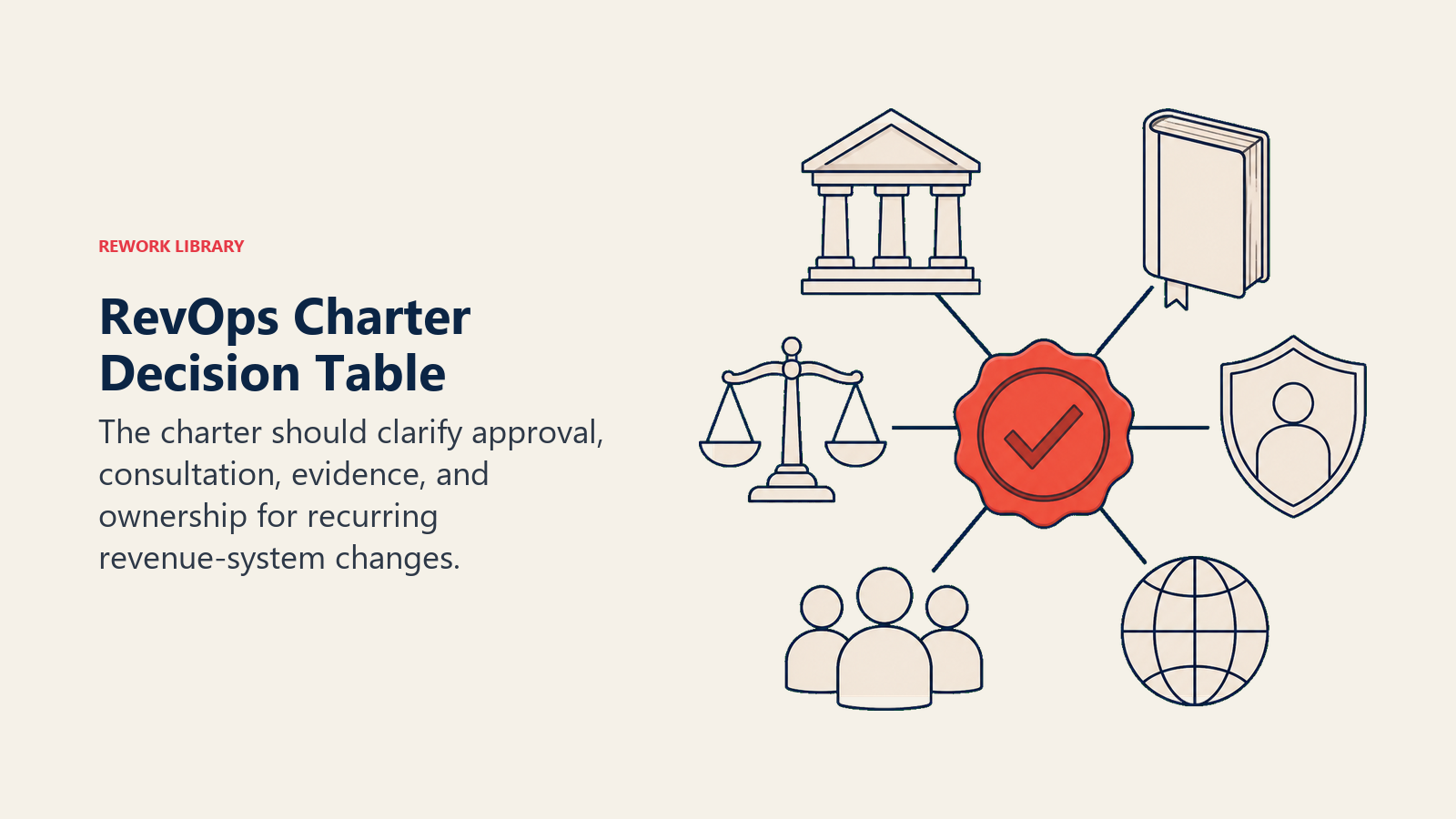
Charter decision table
The charter should make common decisions easier.
| Decision | Charter should clarify |
|---|---|
| New required CRM field | Who approves, who is consulted, and what evidence is needed |
| Forecast definition change | Who owns category rules and finance review |
| Dashboard source-of-truth dispute | Which system and owner decide |
| Lead routing change | Who owns routing logic, capacity, and exception rules |
| Closed-won handoff requirement | Who owns handoff completeness and escalation |
| RevOps roadmap priority | How company-level impact is weighed against local urgency |
This is where a charter becomes practical. It should not only describe RevOps in broad language. It should help leaders resolve the decisions that usually create friction.
Mission statement
A useful RevOps mission statement sounds like this:
RevOps owns the operating system that makes revenue predictable across marketing, sales, customer success, finance, data, and systems.
That mission connects directly to What Is Revenue Operations?. It positions RevOps as a system owner, not a task queue.
Scope
RevOps should own:
- Revenue lifecycle definitions
- Cross-functional handoffs
- Shared revenue dashboards
- CRM and revenue data governance
- Forecast process governance
- Revenue operating cadence
- Systems change control for revenue workflows
RevOps should not own:
- Marketing strategy
- Sales coaching and deal execution
- Customer success relationship management
- Finance plan ownership
- Product roadmap decisions
The charter should make this explicit. RevOps operationalizes strategy. It does not replace functional leadership.
Scope boundaries
The hardest part of writing a charter is deciding what RevOps will not do.
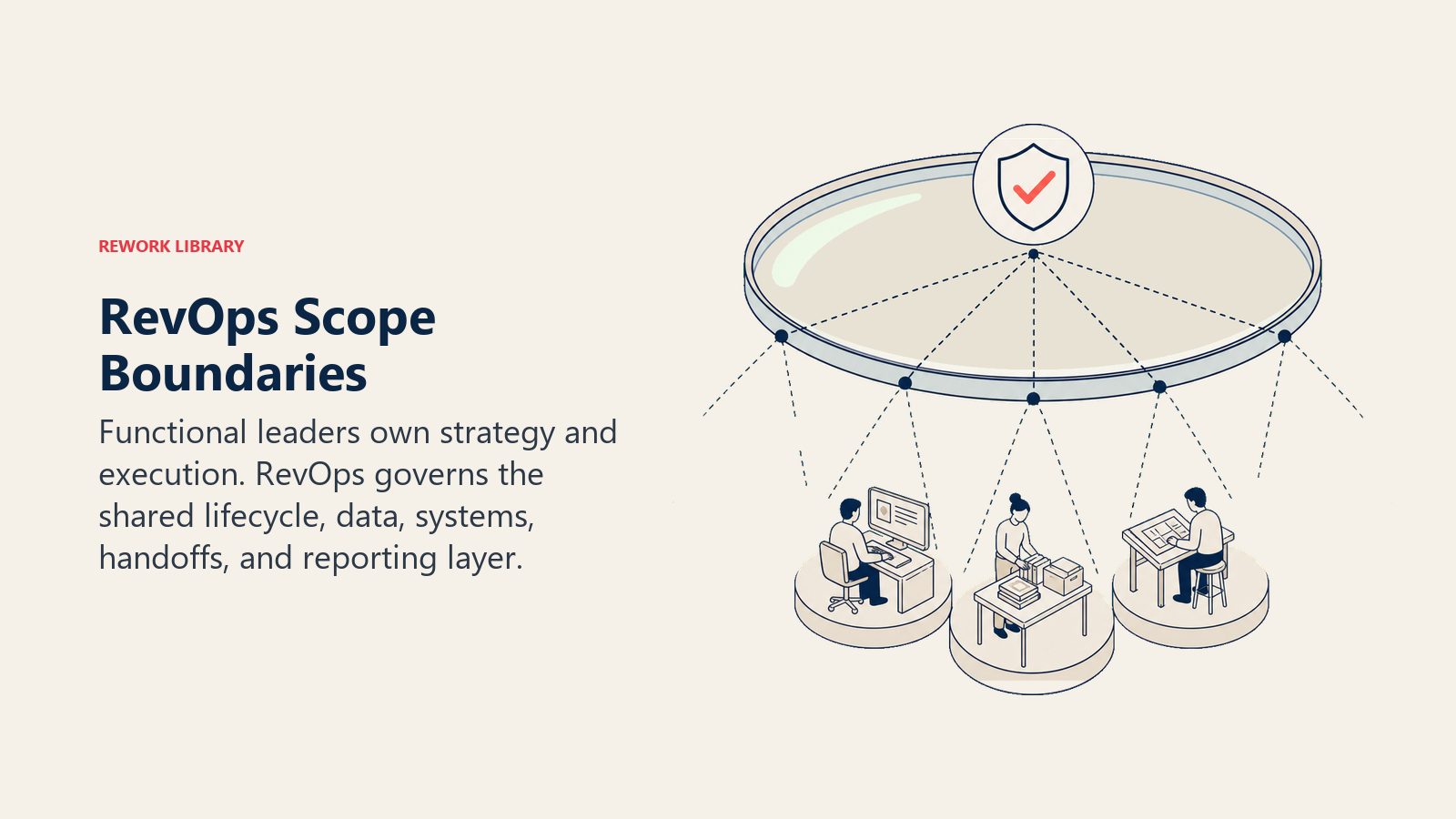
A charter that says RevOps owns "revenue growth" is too broad. Revenue growth is the outcome of strategy, market demand, product, pricing, sales execution, customer success, and financial planning. RevOps can improve the system behind that outcome, but it should not be held accountable for every commercial result.
A cleaner boundary looks like this:
| Function | Owns | RevOps supports by |
|---|---|---|
| Marketing | Demand strategy, campaign execution, audience choices | Lifecycle definitions, source governance, conversion reporting |
| Sales | Pipeline creation, deal execution, manager coaching | Stage rules, forecast process, CRM hygiene, pipeline inspection |
| Customer Success | Adoption, renewal conversations, customer outcomes | Handoff process, health data model, renewal visibility |
| Finance | Plan, budget, board reporting, financial controls | Operating data, funnel assumptions, forecast inputs |
| Systems or IT | Security, integration standards, platform administration | Revenue workflow requirements and change governance |
This boundary protects both sides. Functional leaders keep ownership of performance. RevOps gets authority over the shared operating layer.
Decision rights
Decision rights are the most important part of the charter.
Define who can approve:
- New lifecycle stages
- CRM field changes
- Dashboard metric definitions
- Routing rule changes
- Forecast category rules
- Handoff requirements
- New revenue tools or integrations
For detailed ownership design, see RevOps RACI.
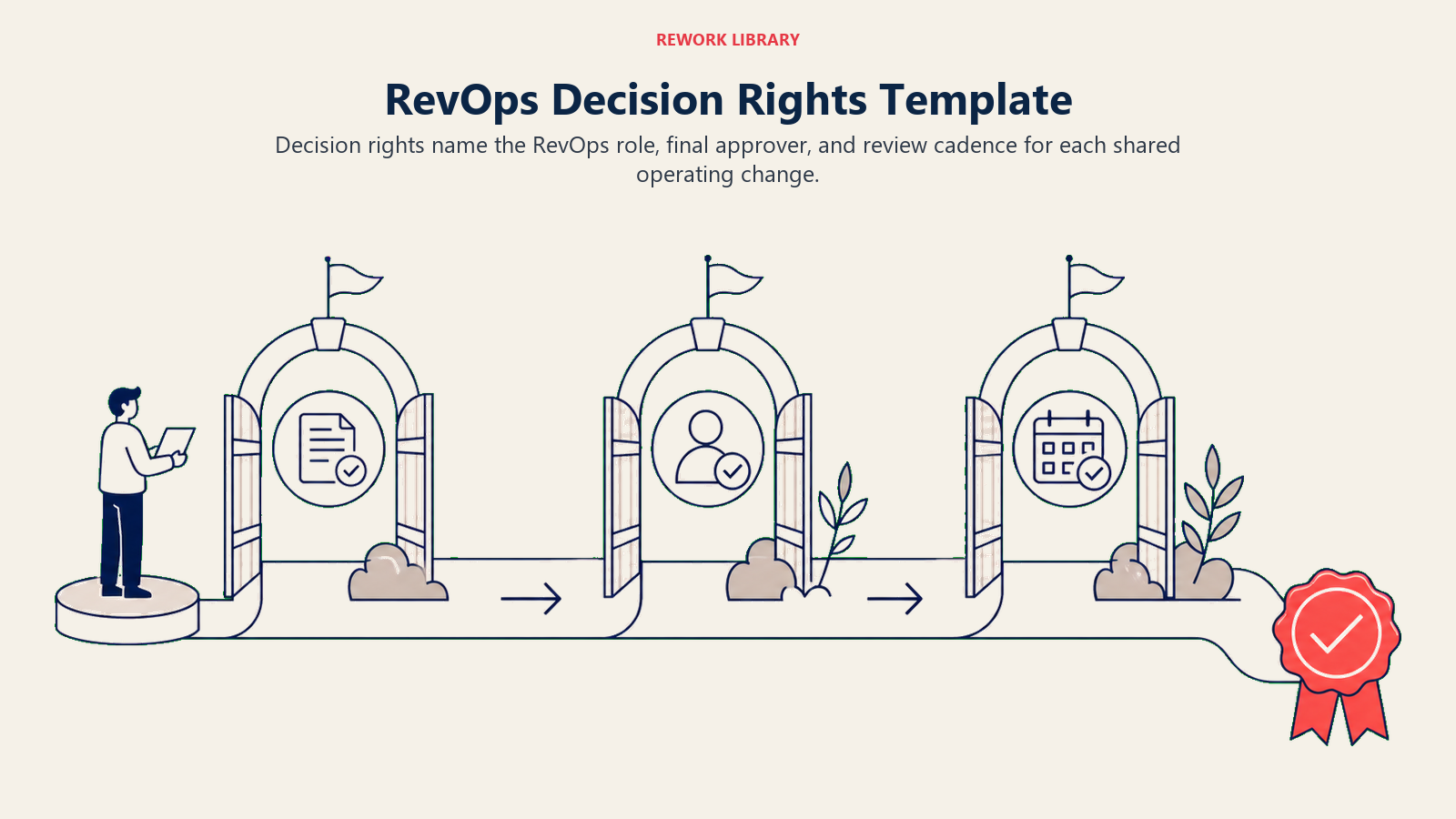
Decision-rights template
Decision rights should be written as a table, not buried in a paragraph.
| Decision | RevOps role | Final approver | Review cadence |
|---|---|---|---|
| Lifecycle stage definitions | Drafts, governs, audits | CRO or GTM leadership team | Quarterly |
| New required CRM field | Evaluates impact and recommends | RevOps plus affected leader | Monthly or as needed |
| Lead routing rule | Designs and monitors | RevOps or CRO, depending on impact | Monthly |
| Forecast category definition | Governs process and data rules | CRO with finance input | Quarterly |
| Executive dashboard metric | Owns definition and data source | RevOps with finance signoff | Quarterly |
| New revenue tool | Reviews workflow and data impact | Executive sponsor plus systems owner | As needed |
The exact names can change, but the principle should not. RevOps can only own system quality if it has approval rights over changes that affect system quality.
Operating cadence
A charter should also define the meetings RevOps runs or supports.
Common cadences include:
- Weekly pipeline inspection
- Weekly or biweekly forecast review
- Monthly funnel review
- Monthly data quality review
- Monthly systems change review
- Quarterly lifecycle and dashboard definition review
- Quarterly RevOps roadmap review
The goal is not more meetings. The goal is fewer ad hoc escalations.
When cadence is missing, every disagreement becomes a special meeting. When cadence exists, leaders know where to raise issues, how decisions will be made, and when changes will be reviewed.
For the broader operating rhythm, see Revenue Cadence.
Systems governance
Most RevOps charters fail because they under-specify systems governance.
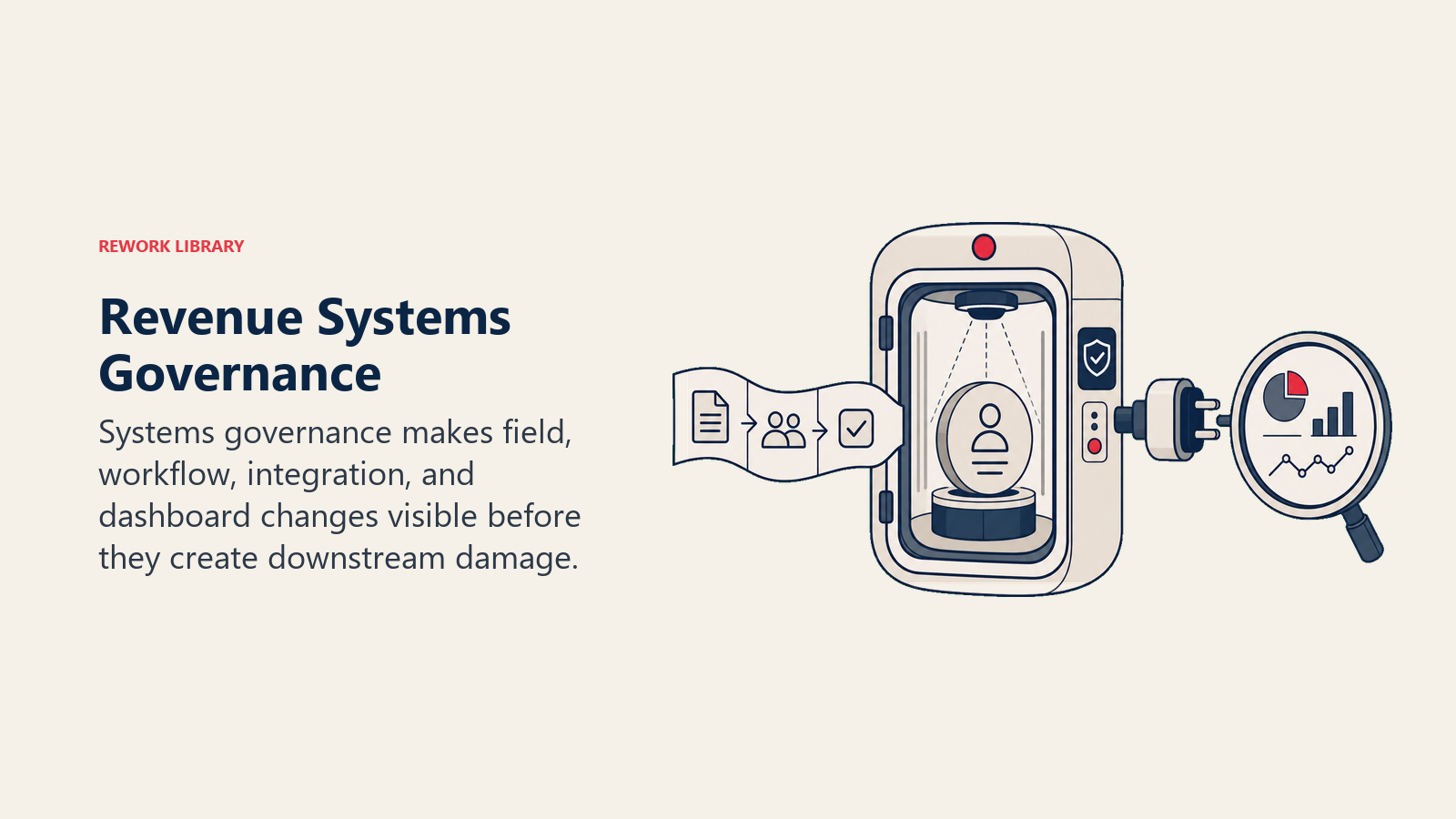
If the CRM is the operating core, then field changes, workflows, integrations, required data, lead routing, stage rules, and dashboard definitions cannot be changed casually. Small changes create downstream effects.
A charter should define:
- Who can request a change
- What information the request must include
- How RevOps evaluates impact
- Who approves high-risk changes
- How changes are documented
- How users are notified
- How adoption is checked after launch
This is especially important when multiple teams share the same objects. A field that helps marketing segmentation might slow sales entry. A workflow that helps sales routing might affect CS handoff. A dashboard definition that helps the CRO might conflict with finance reporting.
RevOps does not need to block change. It needs to make change visible before it breaks something.
Charter rollout
Do not publish the charter as a finished document and expect adoption.
The rollout should be a leadership alignment process:
- RevOps drafts the charter from current pain points.
- Functional leaders review scope and decision rights.
- Finance reviews metric definitions and planning touchpoints.
- Systems or IT reviews platform governance.
- The executive sponsor resolves conflicts.
- The final charter is shared with revenue managers.
- RevOps uses the charter in intake, prioritization, and roadmap reviews.
The charter should be short enough to use in real decisions. If no one opens it after launch, it is too theoretical.
Example charter language
Use simple language:
RevOps owns the shared revenue operating system across marketing, sales, customer success, finance, and systems. RevOps governs lifecycle definitions, handoffs, CRM data quality, source-of-truth reporting, forecast process, revenue cadence, and systems change impact. Functional leaders own team performance, strategy, coaching, and customer execution. RevOps has authority to approve or reject changes that affect shared revenue data, workflows, dashboards, and handoffs, with executive escalation when tradeoffs affect company-level priorities.
That paragraph does not solve every dispute, but it gives the company a starting point. It also makes the function concrete. RevOps is not "alignment." It is the owner of a defined operating layer.
Metrics
RevOps should be measured by system health, not ticket volume.
Good metrics include:
- Forecast accuracy
- SLA compliance
- Handoff completeness
- Required-field completeness
- Source-to-revenue visibility
- Dashboard trust
- Reduction in manual reporting
- Stage aging reduction
Use RevOps Metrics as the metric base.
Charter approval workflow
A RevOps charter should be approved through the same cross-functional lens it will govern.
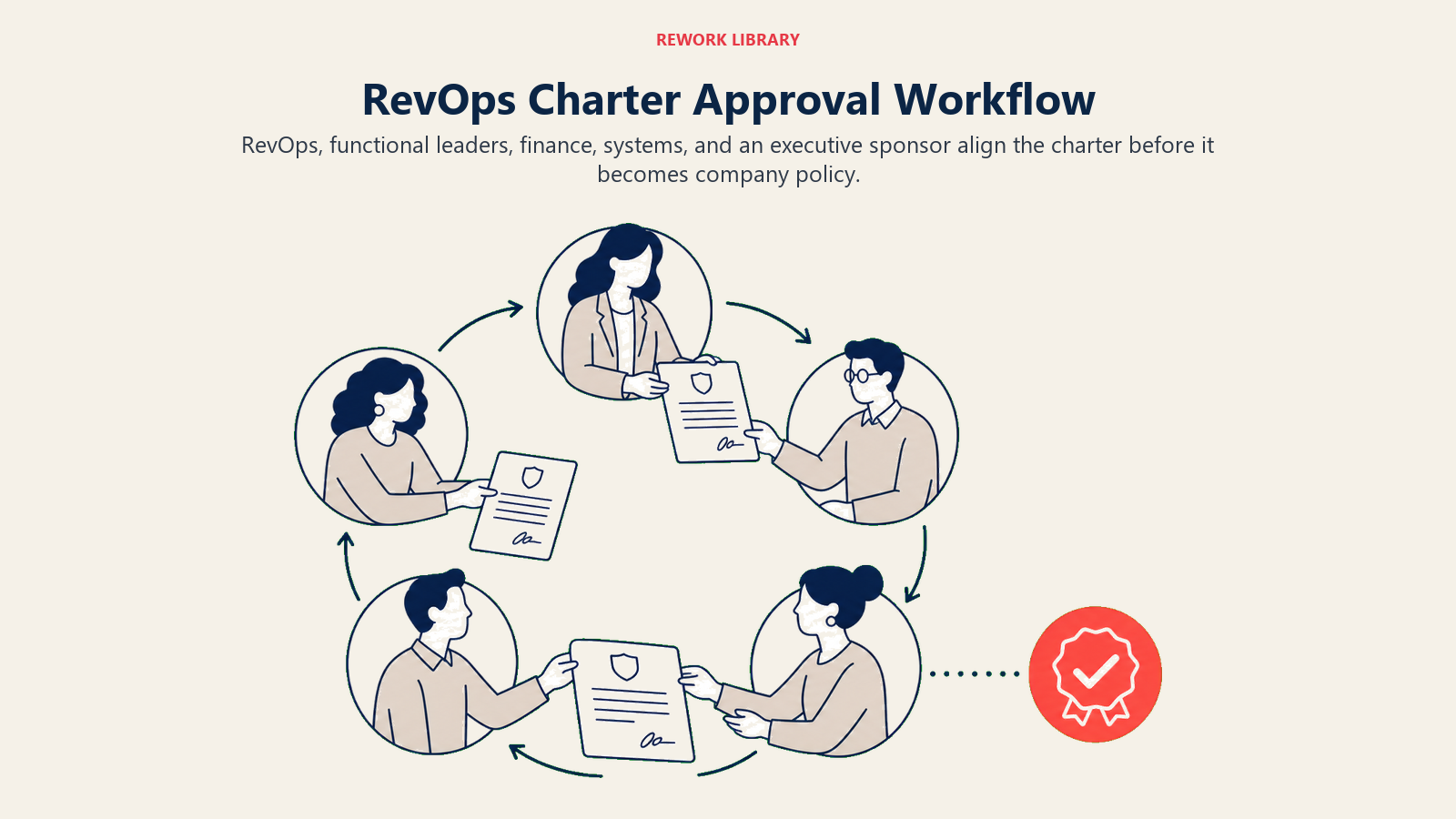
| Step | Owner | Output |
|---|---|---|
| Draft pain points | RevOps | Current operating problems and proposed scope |
| Review functional boundaries | Marketing, sales, CS, finance | What each function owns and what RevOps governs |
| Review systems authority | RevOps, systems, IT, security if relevant | Field, workflow, integration, and permission rules |
| Review metric definitions | RevOps and finance | Source of truth for executive reporting |
| Resolve conflicts | Executive sponsor | Final decision rights and escalation path |
| Publish working version | RevOps | Charter, intake rules, roadmap process, review date |
The approval process matters because the charter is a power document. It defines who can approve or reject changes that affect shared revenue truth. If only RevOps approves it, other teams may treat it as internal preference rather than company operating policy.
How to use the charter in real requests
The charter should change everyday behavior.
| Request | Charter response |
|---|---|
| "Add this required CRM field." | Which decision needs the field, which teams are affected, and who owns data quality? |
| "Build a new dashboard for my team." | Is this local reporting or a shared metric definition? |
| "Change the MQL threshold." | What happens to routing, acceptance, conversion reporting, and sales capacity? |
| "Let sales skip this handoff field." | What downstream CS or finance decision depends on the field? |
| "Create a new opportunity stage." | What evidence defines the stage, and how does it affect forecast? |
| "Pull a board number manually." | Should the metric become part of the governed reporting layer? |
If the charter cannot answer these common requests, it is too vague. Tighten decision rights before adding more process.
How to keep the charter current
A RevOps charter should change when the company changes.
Review it when:
- The company adds a new GTM motion
- Marketing, sales, or CS reorganizes
- RevOps reporting line changes
- A new CRM or major revenue system is introduced
- Finance changes planning model
- The company moves from new business focus to renewal and expansion focus
- Leadership starts escalating the same ownership conflict repeatedly
Do not rewrite the charter every month. But do not let it become an artifact from an old operating model. A stale charter is worse than no charter because it gives people false clarity.
The best charters are living tools: referenced in roadmap reviews, systems governance, intake decisions, and cross-functional disputes.
Intake rules
The charter should change how RevOps receives work.
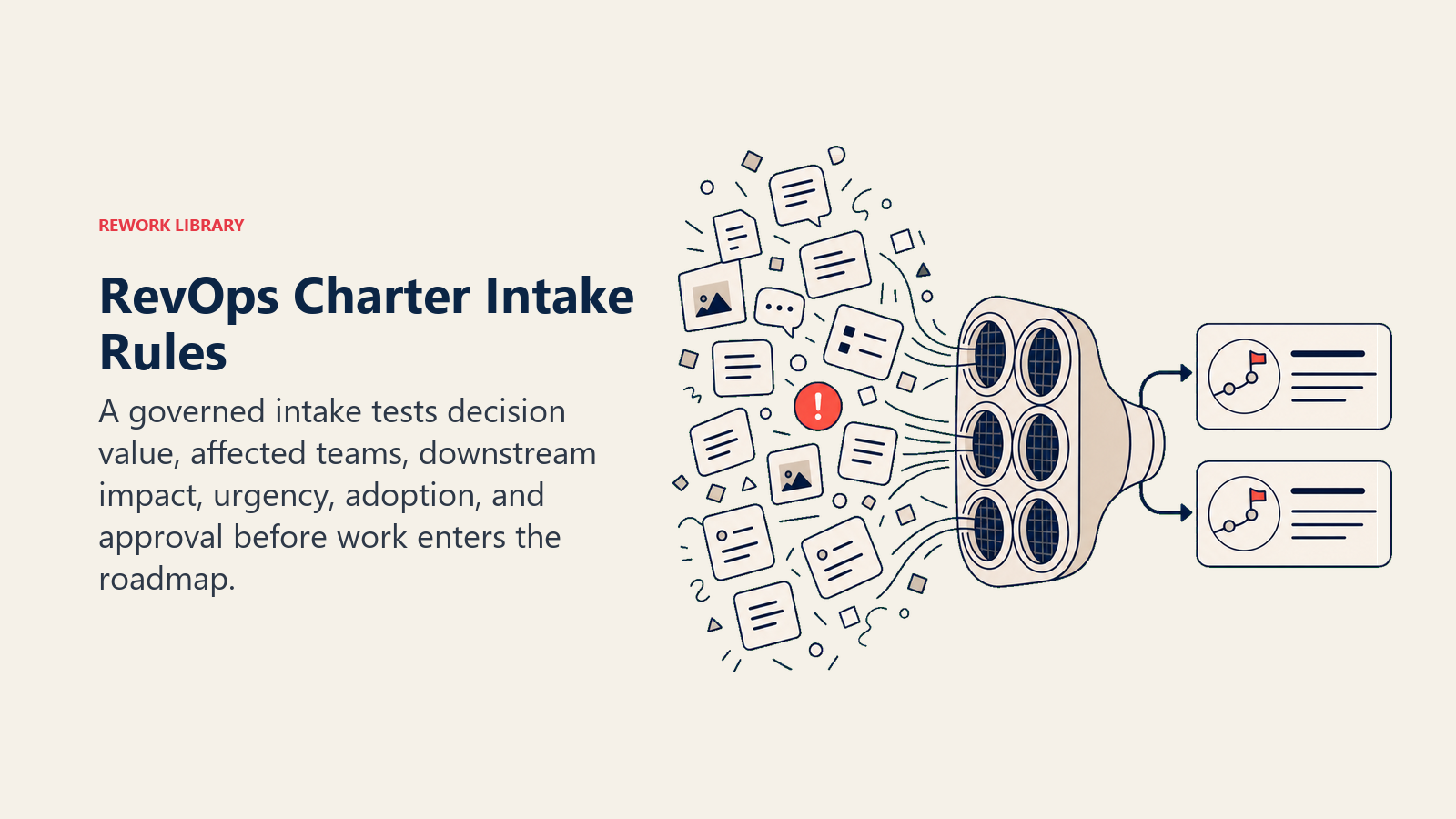
Without intake rules, every request looks equally urgent:
- "Can you add this field?"
- "Can you build this dashboard?"
- "Can you fix routing?"
- "Can you pull this report for the board meeting?"
- "Can you automate this follow-up?"
RevOps needs a way to separate support tasks from operating decisions.
A simple intake form should ask:
| Question | Why it matters |
|---|---|
| What decision or workflow does this affect? | Prevents low-value reporting requests |
| Which teams are affected? | Shows whether the change is local or shared |
| Which metric, field, stage, or handoff changes? | Reveals downstream impact |
| What happens if we do nothing? | Tests urgency |
| Who will use the output? | Tests adoption |
| Who approves the change? | Connects request to decision rights |
The charter should let RevOps reject or defer work when the request lacks a clear owner, decision, or adoption path. That does not mean RevOps becomes unhelpful. It means the function protects the system from low-quality change.
Anti-patterns
Watch for these charter mistakes:
The charter is only a mission statement. A mission statement is useful, but it does not define authority. The charter needs scope, decisions, metrics, and escalation.
RevOps owns every revenue problem. This creates resentment and failure. Functional leaders still own strategy and execution.
Decision rights are vague. If the charter says RevOps "partners on" everything, no one knows when RevOps can say no.
Systems governance is missing. Field, workflow, and dashboard changes are where operating quality often breaks.
The charter is approved by RevOps only. A charter needs executive backing. Otherwise it is a wish list.
The charter is never used in roadmap tradeoffs. If leaders approve a charter but still escalate every request around it, the charter has no power.
A practical first charter
The first RevOps charter does not need to cover every edge case.
For a growth-stage company, the first version can be a two-page operating agreement:
- Mission
- Owned systems and processes
- Not-owned responsibilities
- Decision-rights table
- Intake rules
- Escalation path
- Top five health metrics
- Quarterly review date
That is enough to start. The document should improve as RevOps learns where the real conflicts are.
The point is not perfect governance on day one. The point is to stop pretending that cross-functional revenue work can run on informal goodwill forever.
Charter readiness checklist
Before calling the charter finished, check whether it can answer real operating disputes:
- Can RevOps say no to a field request that hurts data quality?
- Can leaders tell which dashboard is the source of truth?
- Can finance see where planning metrics come from?
- Can sales and marketing resolve lifecycle definition disputes without a special escalation?
- Can CS require handoff data without negotiating deal by deal?
- Can systems teams see which revenue workflow changes need review?
If the answer is no, the charter is probably still too soft. Tighten the decision-rights table before rollout.
Frequently Asked Questions about RevOps Charter
Who writes the RevOps charter?
RevOps should draft it, but the CRO, CEO, finance, marketing, sales, and CS leaders should review and approve it.
How long should a RevOps charter be?
Usually two to four pages. It should be specific, not legalistic.
How often should it be updated?
Review quarterly or whenever the company changes GTM motion, reporting line, systems, or major revenue process.
Learn more

Senior Operations & Growth Strategist
On this page
- What a RevOps charter should include
- Why RevOps needs a charter
- Charter decision table
- Mission statement
- Scope
- Scope boundaries
- Decision rights
- Decision-rights template
- Operating cadence
- Systems governance
- Charter rollout
- Example charter language
- Metrics
- Charter approval workflow
- How to use the charter in real requests
- How to keep the charter current
- Intake rules
- Anti-patterns
- A practical first charter
- Charter readiness checklist
- Learn more