Lead to Opportunity Process: How RevOps Governs MQL to Pipeline
The lead-to-opportunity process is where demand becomes pipeline.
It is also where many revenue teams lose trust. Marketing says leads are qualified. Sales says they are not ready. SDRs say routing is unclear. Finance sees pipeline created inconsistently.
RevOps should govern the process so each step has criteria, owner, timing, and data.
Harvard Business Review's sales and marketing alignment research is directly relevant here: lead handoff problems often look like performance problems, but they are usually definition and operating problems. McKinsey's research on sales productivity also highlights the value of targeted performance steering instead of broad activity metrics.
The lead-to-opportunity process is where that steering begins.
Key operating facts
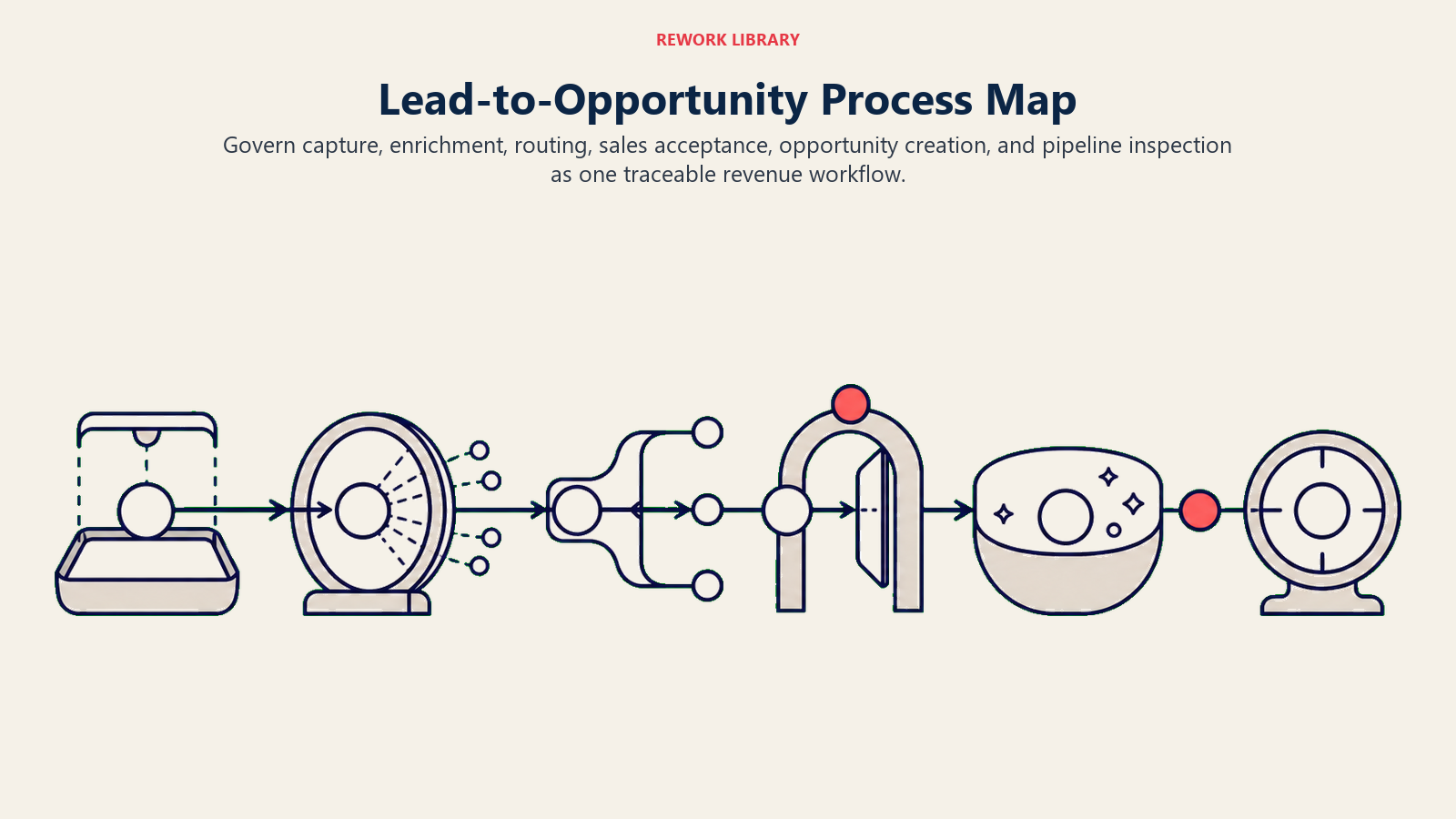
- Lead-to-opportunity is not one handoff. It is a governed chain: capture, enrich, qualify, route, accept or reject, convert, and inspect.
- The weakest point is usually not the CRM workflow. It is unclear stage criteria. If MQL, SQL, accepted, rejected, and opportunity do not have shared definitions, automation only moves confusion faster.
- Rejection reasons are a control point. A rejected lead without a specific reason gives marketing no useful feedback and gives RevOps no way to improve scoring or routing.
- Opportunity creation should require evidence. Pipeline created without business problem, next step, source, owner, and expected timing will inflate reporting and weaken forecast trust.
The process map
The process should connect to Lead Routing Automation, Lead Assignment SLA, and the MQL to SQL handoff process.
Turn this article into takeaways for your work.


Each assistant summarizes the article only for you and suggests best practices for your work.
| Step | Owner | Control |
|---|---|---|
| Capture lead | Marketing Ops | Source and campaign fields |
| Enrich and score | RevOps or Marketing Ops | ICP and engagement rules |
| Route | RevOps | Assignment logic and SLA |
| Accept or reject | SDR or sales | SQL criteria and rejection reason |
| Convert to opportunity | Sales | Opportunity creation criteria |
| Inspect pipeline | Sales and RevOps | Stage, value, close date, source |
Define the lifecycle in plain language
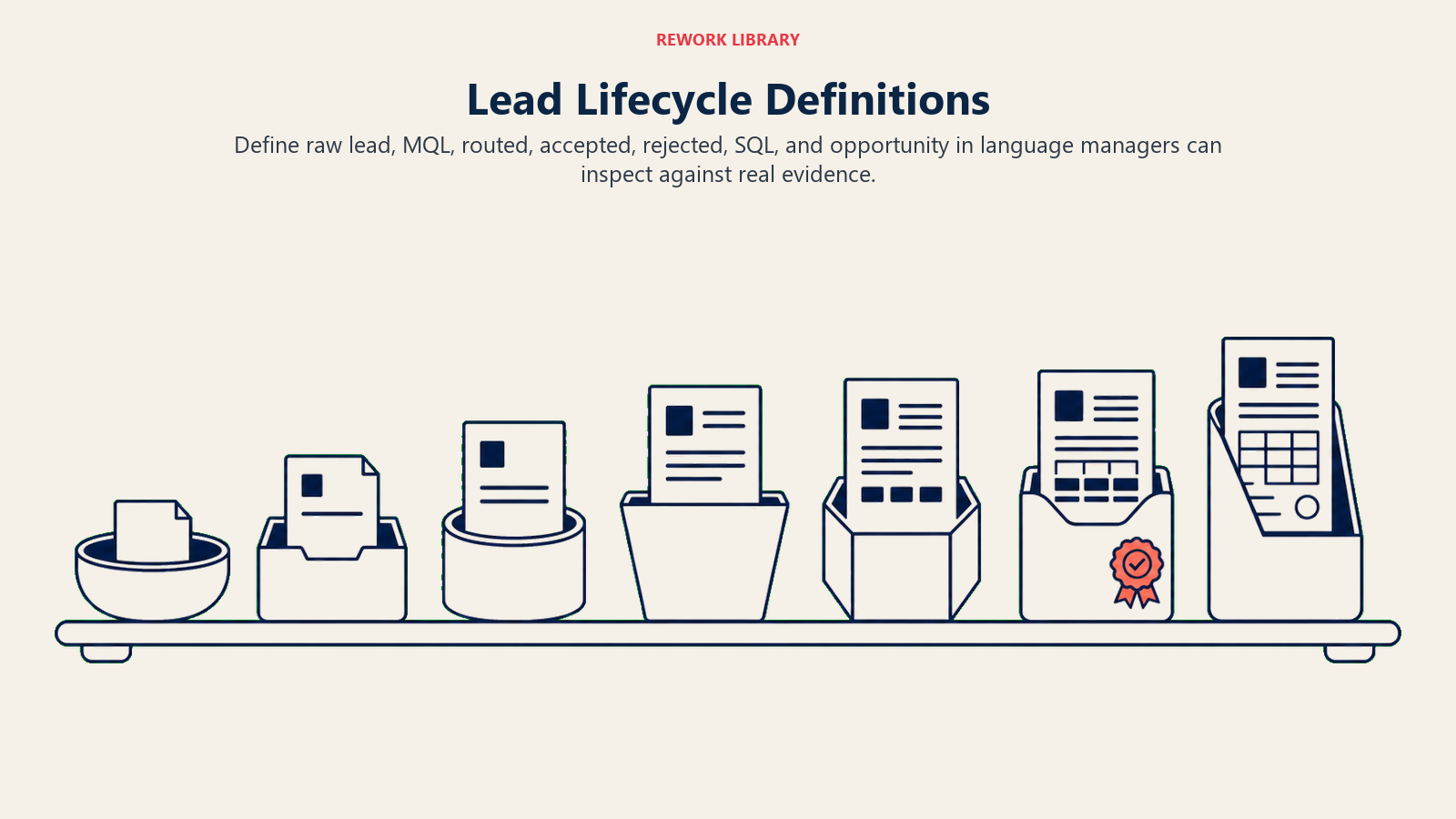
Before changing workflow rules, define each status in words a manager can inspect.
| Status | Plain-language definition | Evidence required |
|---|---|---|
| Raw lead | A person or account entered the system, but fit and intent are not yet verified | Source, contact, company, consent or capture context |
| MQL | Marketing believes the record is sales-ready based on agreed fit and intent criteria | Score or qualification reason, source, segment |
| Routed | The record has a named owner and SLA clock | Owner, routed timestamp, assignment rule |
| Accepted | Sales agrees the lead is worth active follow-up | Acceptance timestamp, owner, next action |
| Rejected | Sales does not accept the lead under agreed criteria | Specific rejection reason |
| SQL | Sales has confirmed enough interest and fit for active sales work | Discovery evidence, buyer or account fit |
| Opportunity | There is a real deal to manage in pipeline | Business problem, value, next step, close period |
These definitions should be short enough to use in manager inspection. If a manager cannot look at five records and tell whether the status is correct, the definition is too vague.
The plain-language version also protects the process from tool bias. CRM fields can change. Scoring tools can change. The operating meaning should remain stable enough for marketing, sales, finance, and RevOps to understand the same funnel.
Why this process leaks
Most lead-to-opportunity leakage comes from five causes:
- Qualification is unclear.
- Routing is slow or wrong.
- Sales acceptance is informal.
- Rejection reasons are missing.
- Opportunity creation rules are too loose.
When this happens, marketing optimizes for lead volume, sales distrusts the handoff, and finance sees pipeline that is hard to trace back to demand.
RevOps should make the process inspectable. Every important transition should answer: why did this record move, who owns it now, what action is due, and what data proves it?
Qualification model
A lead should become sales-ready only when it meets enough fit and intent criteria.
A practical model separates:
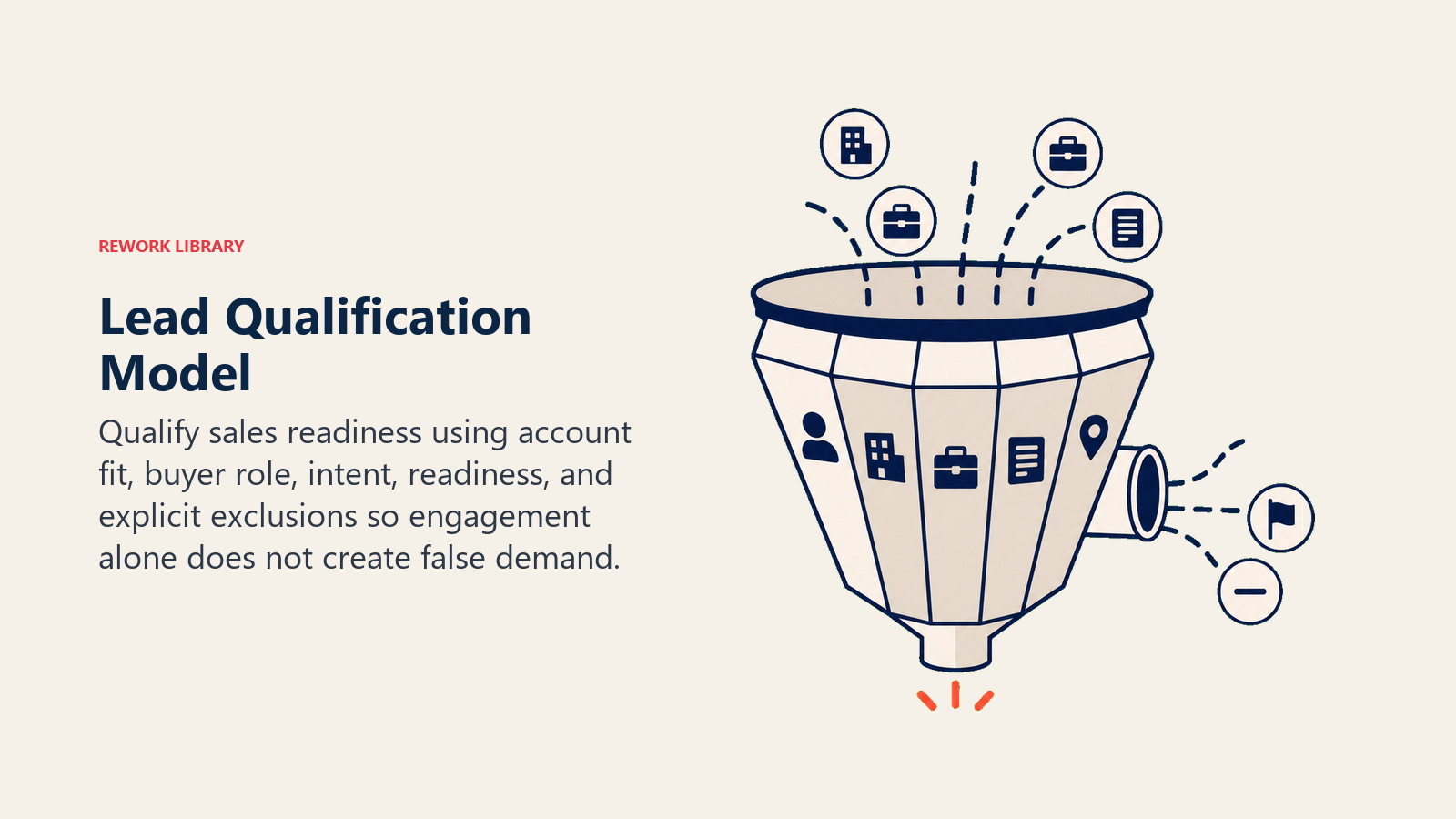
| Criteria type | Examples |
|---|---|
| Fit | Company size, industry, region, use case, segment |
| Role | Buyer, influencer, practitioner, student, vendor |
| Intent | Demo request, pricing page, high-fit content, event engagement |
| Readiness | Clear problem, timing, project signal, active evaluation |
| Exclusions | Competitor, student, vendor, unsupported region, bad-fit size |
This prevents scoring from becoming a black box. A high engagement score should not override bad fit. A perfect-fit account with low intent may belong in nurture, not immediate SDR follow-up.
See Lead Scoring Systems and lead qualification frameworks for related models.
Routing and SLA
Routing should be fast, transparent, and easy to audit.
Define:
- Which records route automatically
- Which records need manual review
- Which owner receives each segment
- What happens when the owner is unavailable
- How fast the owner must act
- How reassignment works
- Which fields are required for routing
The SLA should include both assignment and action. Routing a lead in two minutes does not matter if no one follows up for two days.
Common SLA metrics:
- Time to assign
- Time to first touch
- Time to accept or reject
- Overdue lead count
- Reassignment rate
- Acceptance rate by source
RevOps should review SLA misses with managers. The goal is not punishment. The goal is to find process design issues: bad routing rules, weak staffing coverage, unclear ownership, or low-quality leads.
Acceptance and rejection
Sales acceptance should be a formal step.
Accepted means sales agrees the lead is worth active follow-up. Rejected means sales does not accept it, and the reason is captured.
Useful rejection reasons include:
- Bad fit
- No buying intent
- Existing customer
- Duplicate
- Student or vendor
- Unsupported region
- Too small
- Unreachable
- Competitor
- Already in active opportunity
Do not allow "other" to become the default. If most rejected leads use a vague reason, RevOps cannot improve scoring, targeting, or routing.
Opportunity creation criteria
An SQL should not automatically become an opportunity.
Opportunity creation should require evidence:
- Business problem
- Qualified account or buyer fit
- Potential value
- Next step
- Expected close period
- Owner
- Source
- Use case
Some teams also require budget, authority, need, and timing. Others use a lighter model for high-velocity motions. The exact framework matters less than consistency.
The main rule is simple: do not create pipeline before there is a real deal to manage.
Data model
RevOps should define the fields that make lead-to-opportunity reporting reliable.
Important fields include:
- Original source
- Latest source
- Campaign
- Segment
- Lead score or qualification reason
- Routing owner
- Routed timestamp
- First-touch timestamp
- Acceptance status
- Rejection reason
- SQL date
- Opportunity created date
- Opportunity source
The source fields are especially important. If source data is weak, the company cannot understand which demand programs create pipeline.
This connects to Lead to Revenue Attribution.
Minimum viable governance
RevOps does not need a complicated governance model to make lead-to-opportunity reliable. It needs a few non-negotiable controls.
| Control | What it prevents |
|---|---|
| Written MQL and SQL definitions | Marketing and sales using different readiness standards |
| Routed timestamp | Assignment delays hidden inside lifecycle reporting |
| Acceptance status | Leads appearing worked when sales never accepted them |
| Specific rejection reasons | Feedback loop collapsing into anecdotes |
| Opportunity creation criteria | Weak SQLs becoming inflated pipeline |
| Source field preservation | Demand programs losing attribution after conversion |
| Monthly review | Rules drifting without anyone noticing |
Each control should have an owner. Marketing may own MQL quality, sales may own acceptance behavior, and RevOps may own the rules and reporting. But no control should be ownerless.
This is where many teams fail. They define a process in a workshop, then no one owns drift. Three months later, managers have invented local exceptions, reps use rejection reasons inconsistently, and finance does not trust source-to-pipeline reporting. Governance is not the workshop. Governance is the operating rhythm that keeps the workshop decisions alive.
Operating cadence
Review the process monthly with marketing, SDR, sales, and RevOps leaders.
The review should cover:
- MQL volume by source
- Acceptance rate
- Rejection reason mix
- SLA compliance
- SQL-to-opportunity conversion
- Opportunity quality by source
- Duplicate rate
- Routing exceptions
The meeting should end with actions: adjust scoring, fix routing, improve campaign targeting, retrain reps, clean data, or change criteria.
Quality checklist
A healthy lead-to-opportunity process has:
- Clear MQL and SQL definitions
- Auditable routing rules
- Fast assignment and first-touch SLA
- Required acceptance or rejection
- Specific rejection reasons
- Evidence-based opportunity creation
- Source-to-opportunity reporting
- Feedback loop to marketing
- Manager inspection
If any of these are missing, demand may still turn into pipeline, but leaders will not know whether the process is working.
Common operating scenarios
High MQL volume, low acceptance. This usually means scoring is too loose, targeting is too broad, or sales acceptance criteria are not shared. RevOps should inspect rejection reasons by source and segment.
Fast response, low opportunity conversion. This suggests speed is not the only problem. The team may be routing low-fit leads quickly or creating SQLs before business need is clear.
High acceptance, low pipeline quality. Sales may be accepting leads to avoid conflict, then failing to create qualified opportunities. RevOps should compare SQL-to-opportunity conversion and opportunity stage aging.
Many rejected leads have no reason. The feedback loop is broken. Marketing cannot improve targeting, and RevOps cannot improve scoring.
Opportunities are created from weak SQLs. Pipeline inflates, forecast quality drops, and finance loses trust.
Manager inspection
Managers should inspect the process, not only the outcome.
Useful inspection questions:
- Was the lead routed to the right owner?
- Was first touch within SLA?
- Was acceptance or rejection recorded?
- If rejected, was the reason specific?
- If accepted, was the next step real?
- If converted, did the opportunity meet creation criteria?
- Did the source and campaign data carry into the opportunity?
This prevents the process from becoming a CRM automation that no one manages.
Marketing feedback loop
Marketing needs structured feedback, not anecdotes.
RevOps should give marketing:
- Acceptance rate by source
- Rejection reasons by campaign
- SQL-to-opportunity conversion
- Opportunity value by source
- Sales notes on fit and intent
- Duplicate and invalid lead trends
This helps marketing improve quality without relying on vague comments like "the leads are bad."
Marketing should also receive examples, not only charts. A source may have a low acceptance rate because the ICP is wrong, because the form attracts students, because enrichment is weak, or because sales does not understand the offer. The numbers point to the problem. Sample records explain it.
The best reviews include five to ten records from each major pattern:
| Pattern | Sample record question |
|---|---|
| High volume, low acceptance | Are these bad-fit companies, low-intent actions, or unclear criteria? |
| High acceptance, low opportunity creation | Are SDRs accepting too loosely, or is discovery weak? |
| High opportunity creation, poor win rate | Are opportunity criteria too loose, or is sales stage discipline weak? |
| Many duplicates | Is capture, enrichment, or lead-to-account matching broken? |
| Source unknown | Which system lost attribution and when? |
This keeps the conversation grounded. It is harder to argue in generalities when everyone is looking at the same records.
Sales feedback loop
Sales also needs feedback.
RevOps should show:
- SLA compliance by team
- Acceptance behavior by owner
- Rejection reason quality
- Opportunity creation consistency
- Stage aging of converted opportunities
- Pipeline quality by source
If sales rejects high-fit leads without clear reason, that is a coaching issue. If sales accepts low-fit leads and creates weak opportunities, that is also a coaching issue.
Bottleneck diagnosis
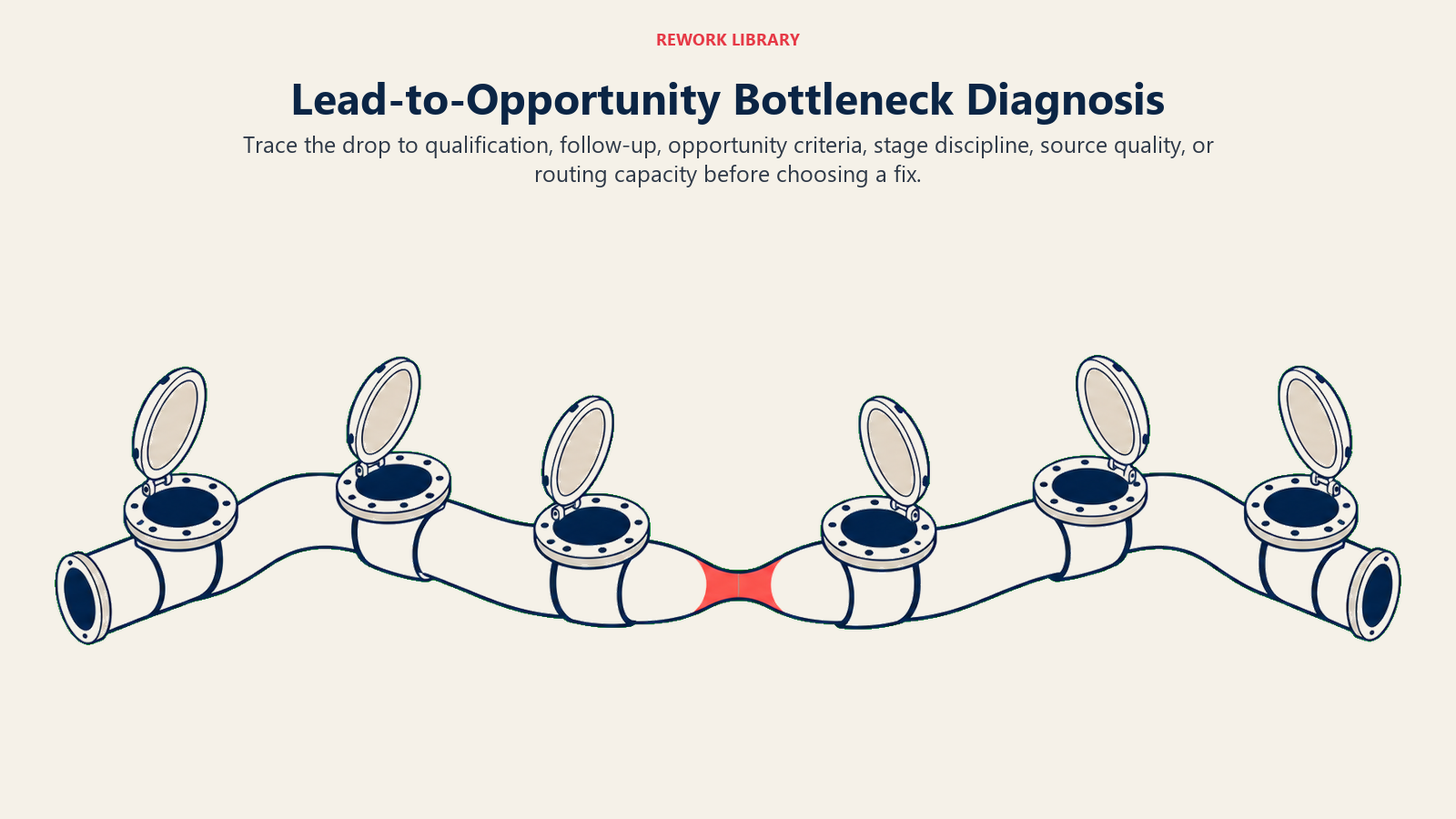
When performance drops, diagnose the exact transition before changing the whole funnel.
| Symptom | Likely bottleneck | First inspection |
|---|---|---|
| MQL volume high, accepted leads low | Qualification mismatch | Rejection reasons by source and segment |
| Accepted leads high, SQLs low | Follow-up or discovery issue | Activity timing and conversation notes |
| SQLs high, opportunities low | Opportunity criteria or buyer readiness issue | SQL evidence and next-step quality |
| Opportunities high, forecast weak | Stage and close-date discipline issue | Stage age, next step, close-date movement |
| Win rate low by source | Targeting or qualification issue | Closed-lost reasons by campaign and segment |
| Slow routing | Assignment rule or capacity issue | Routed timestamp and owner availability |
Do not let one metric drive a broad fix. A low MQL-to-opportunity rate can mean poor marketing quality, weak SDR follow-up, strict opportunity criteria, bad routing, duplicate records, or a sales capacity problem. The process map tells you where to look.
RevOps should bring this diagnosis into the monthly review. The conversation should move from "marketing quality is down" or "sales is not following up" to "event leads from this segment are rejected for bad fit, while demo requests from target accounts are accepted but not converted because discovery notes lack business problem." That level of detail changes the action.
When to tighten or loosen criteria
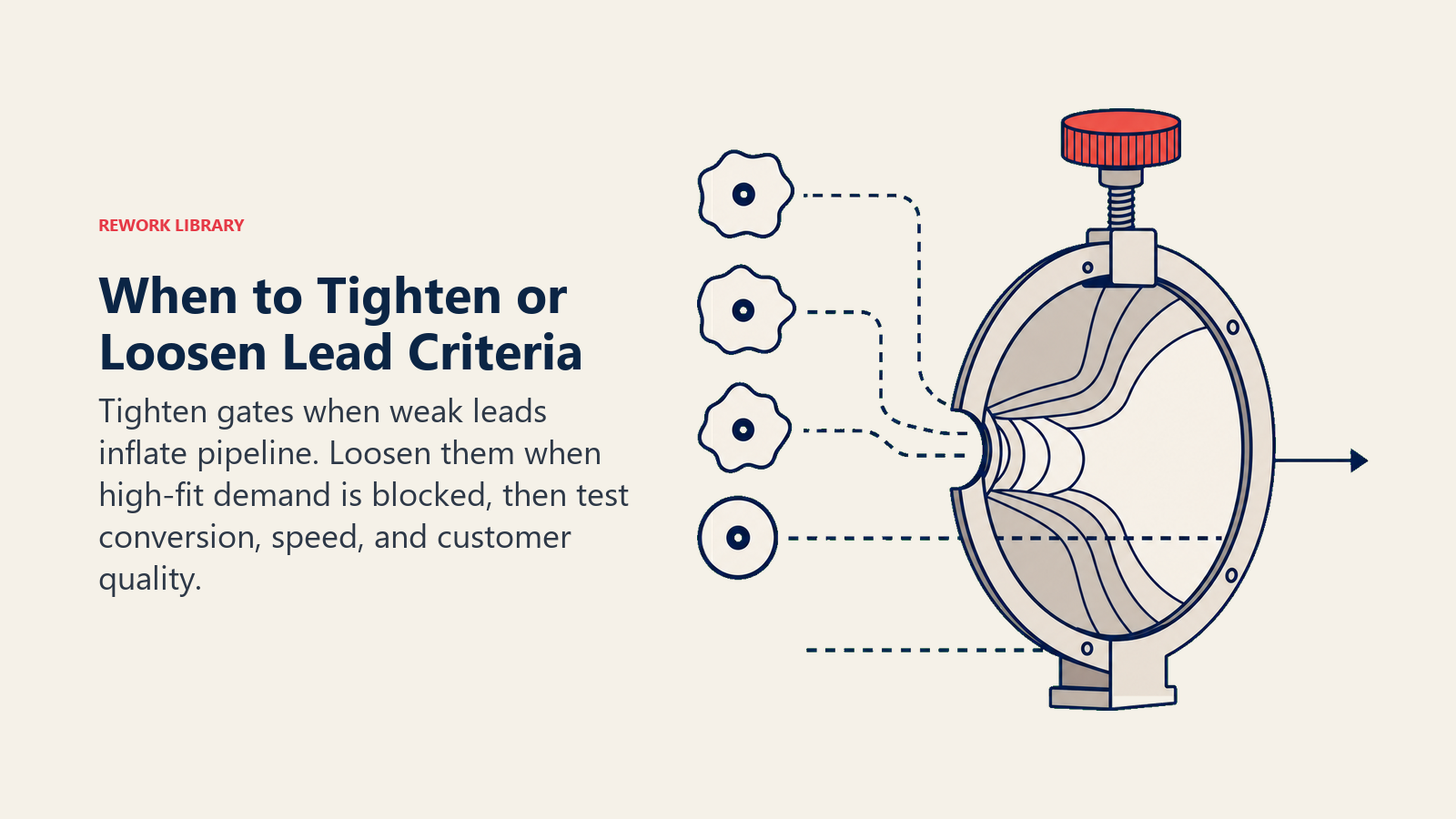
Lead-to-opportunity governance is not about making every gate stricter. Sometimes the process is too loose. Sometimes it is too tight. RevOps should use evidence before changing thresholds.
Tighten criteria when:
- Sales accepts many leads but few become real opportunities.
- Rejection reasons show repeated bad fit from the same source.
- Opportunities are created with no business problem, next step, or expected timing.
- Pipeline grows while win rate, stage conversion, or forecast trust gets worse.
- CS later finds that customers from a source or segment churn for predictable fit reasons.
Loosen criteria when:
- High-fit accounts are stuck in nurture because intent thresholds are too high.
- Sales manually works leads that the system never routes.
- Reps create opportunities from records that never reached SQL status.
- Expansion or referral leads are slowed by rules designed for cold inbound.
- Marketing programs generate smaller buying committees where strict role rules miss real buyers.
The goal is not a perfect gate. The goal is a gate that matches the revenue motion. A high-velocity inbound team may need fast routing with lighter qualification and stronger post-acceptance inspection. An enterprise account-based team may need tighter account-fit rules before any rep spends time. RevOps should document why the criteria fit the motion, then review the evidence monthly.
Changes should be tested in small windows. If the team lowers the score threshold, compare acceptance, SQL conversion, opportunity quality, and win rate before rolling it out broadly. If the team requires more fields before opportunity creation, watch whether reps create better pipeline or simply delay accurate updates. Every rule creates behavior. RevOps needs to inspect the behavior the rule actually creates.
Automation controls
Automation can improve speed, but it can also hide bad rules.
RevOps should audit:
- Routing logic
- Duplicate matching
- Lead-to-account matching
- Territory assignment
- Scoring thresholds
- SLA timers
- Reassignment rules
- Notifications
Any automation that changes ownership or lifecycle stage should have a visible owner and change log.
First 90 days
To improve lead-to-opportunity governance:
Days 1 to 30: audit recent MQLs, SQLs, rejected leads, and created opportunities. Identify where data or criteria are weak.
Days 31 to 60: rewrite MQL, SQL, rejection, routing, and opportunity creation rules. Align marketing, sales, SDRs, and RevOps.
Days 61 to 90: launch a monthly review, update dashboards, and track source-to-opportunity conversion with SLA and rejection quality.
The first goal is trust. Marketing should trust that accepted leads become real follow-up. Sales should trust that routed leads meet agreed criteria. Finance should trust that pipeline has a traceable source.
Example workflow
A simple workflow might look like this:
- A lead is captured from a demo request.
- Source, campaign, company, email, and country are validated.
- The record is matched to an existing account if possible.
- Fit rules confirm that the account is in the target segment.
- Intent rules identify the demo request as high priority.
- Routing assigns the lead to the right SDR or AE.
- The SLA timer starts.
- The owner accepts or rejects the lead.
- If accepted, the owner completes discovery.
- If the deal meets opportunity criteria, sales creates an opportunity.
- Source and qualification data carry into the opportunity.
- RevOps reports conversion and SLA results.
Each step should be auditable. If the lead skips from capture to opportunity with missing qualification data, pipeline reporting will look better than reality.
Handoff agreement
Marketing and sales should agree on the handoff in writing.
The agreement should define:
- MQL criteria
- Routing logic
- SLA
- Acceptance criteria
- Rejection reasons
- Opportunity creation criteria
- Feedback cadence
- Escalation path
RevOps should own the operating version of the agreement. Leaders can debate strategy, but the system needs one active set of rules.
Dashboard design
The dashboard should show the process, not only volume.
Useful views:
- Leads captured by source
- MQLs by source and segment
- Acceptance rate
- Rejection reasons
- SLA compliance
- SQL-to-opportunity conversion
- Opportunity value by source
- Stage aging for newly created opportunities
Avoid a dashboard that celebrates MQL volume while hiding acceptance and opportunity quality. That rewards the wrong behavior.
Bad data examples
RevOps should watch for:
- Source set to unknown
- Duplicate leads routed to multiple owners
- Rejection reason set to "other"
- SQL date missing
- Opportunity source overwritten
- Created opportunity with no next step
- MQLs sitting unworked past SLA
- Leads routed to inactive owners
These are small issues individually. At scale, they make demand reporting unreliable.
Decision checklist
Before changing the process, ask:
- Will this improve lead quality or only volume?
- Will sales accept the rule?
- Can the system enforce it?
- Can managers inspect it?
- Will finance still trust source-to-pipeline reporting?
- Will the change improve customer fit downstream?
The best lead-to-opportunity process is not the most automated one. It is the one that creates pipeline sales can work and leaders can trust.
Readiness checklist
Before rollout, confirm:
- MQL and SQL criteria are written.
- Routing logic has an owner.
- SLA timers are visible.
- Rejection reasons are specific.
- Opportunity creation criteria are enforced.
- Source fields carry into opportunity reporting.
- Managers review overdue leads.
- Marketing receives structured feedback.
- Sales receives SLA and conversion feedback.
- Finance can trace pipeline back to source.
If several of these are missing, the process may still generate activity, but it will not create reliable pipeline governance.
The operating owner should be named before launch. In most teams, RevOps owns the rules and reporting, marketing owns demand quality, SDR or sales leadership owns follow-up behavior, and finance is consulted when source-to-pipeline reporting affects planning. If ownership is not clear, the process will drift within weeks, especially during growth.
Required rules
Define:
- What makes a lead eligible for routing
- Which leads stay in nurture
- How fast a rep must accept or reject
- Which rejection reasons are allowed
- When an SQL becomes an opportunity
- Which fields are required at conversion
Also define who can change these rules. If marketing changes qualification alone, sales trust may drop. If sales changes opportunity creation alone, marketing attribution may break. If finance changes reporting definitions alone, operating dashboards may drift.
RevOps should govern the rule change process through Funnel Governance.
Lead-to-opportunity review packet
A monthly review should show:
- Leads created by source and segment.
- MQLs routed and accepted.
- Rejection reasons.
- SLA misses.
- SQL-to-opportunity conversion.
- Opportunity creation criteria misses.
- Pipeline created by source.
- Actions to improve qualification, routing, or follow-up.
This turns the handoff into an inspectable operating system. Marketing, sales, and RevOps should leave the review with one or two changes, not only a conversion chart.
Frequently Asked Questions about Lead to Opportunity Process
Who owns lead-to-opportunity?
Marketing, SDRs, and sales each own part of the process. RevOps owns the governance layer that connects them.
What is the main metric?
Track MQL-to-SQL conversion, SQL-to-opportunity conversion, lead response time, and source-to-opportunity conversion.
Learn more

Senior Operations & Growth Strategist
On this page
- The process map
- Define the lifecycle in plain language
- Why this process leaks
- Qualification model
- Routing and SLA
- Acceptance and rejection
- Opportunity creation criteria
- Data model
- Minimum viable governance
- Operating cadence
- Quality checklist
- Common operating scenarios
- Manager inspection
- Marketing feedback loop
- Sales feedback loop
- Bottleneck diagnosis
- When to tighten or loosen criteria
- Automation controls
- First 90 days
- Example workflow
- Handoff agreement
- Dashboard design
- Bad data examples
- Decision checklist
- Readiness checklist
- Required rules
- Lead-to-opportunity review packet
- Learn more