Thought Leadership: What It Is and How to Build It
Turn this article into takeaways for your work.


Each assistant summarizes the article only for you and suggests best practices for your work.
Thought leadership is a phrase a lot of executives have quietly stopped believing in, and they're half right to. Search the term and most of the first page is written by agencies selling ghostwriting, which is a bit like asking a barber whether you need a haircut. But the idea survives the marketing done to it. Some leaders genuinely change how their industry thinks, and it's worth being precise about what they do that everyone else doesn't.
What thought leadership actually is
The phrase has a specific origin. Joel Kurtzman, a former Harvard Business Review editor, coined "thought leader" in the first issue of strategy+business, the management magazine he founded in the mid-1990s, as a rubric for interviews with people who had genuinely original ideas. His own publication credits him with having "forever changed the world of management writing" by doing it, according to its obituary of him. It began as a label a magazine applied to other people, never something you declared about yourself.
That distinction is most of what's been lost. The research definition stayed tight: Edelman and LinkedIn defined thought leadership as free content an organization or individual produces in its area of expertise, published because they believe others benefit from the perspective. They explicitly excluded content that describes or promotes products, and noted that case studies, however good, don't qualify (2019 edition).
A working version for a leader rather than a marketer: thought leadership is a defensible, non-obvious point of view on a problem your audience actually has, published consistently, backed by something you genuinely know that others don't. Four load-bearing words:
- Defensible. You can hold the position under challenge from someone who disagrees and knows the domain. If you can't, it's an opinion you borrowed.
- Non-obvious. If your audience already believed it before reading, you summarized consensus. That's a service. It isn't leadership.
- A problem your audience has. Not a problem your product solves. Those overlap, and the overlap is where honest thought leadership lives, but they're not the same set.
- Something you know that others don't. The constraint most people skip, and the only one that can't be faked.
Key Facts: Thought Leadership
- 2025 edition: 64% of target buyers and 63% of "hidden buyers" (finance, legal, procurement, compliance) average more than an hour a week consuming thought leadership, and 56% and 55% use it in vendor evaluation. Source: LinkedIn Marketing Blog, Sept 2025
- 2024 edition: decision-makers consume a lot of it and rate very little of it well. Less than half said the overall quality was good, and only 15% called it very good. Source: LinkedIn Marketing Blog, Feb 2024
- 2019 EMEA edition: 28% had decided against awarding business to a company because its thought leadership was disappointing, and 42% said it lowered their respect for the business. Source: LinkedIn Marketing Blog, May 2019
- 94% of B2B buying groups now consult a large language model before talking to a salesperson, which changes what published expertise is for. Source: LinkedIn, June 2026
Thought leadership vs the five things it gets confused with
These six all involve a senior person publishing something, they get bundled under one budget line, and they optimize for genuinely different outcomes.
| Dimension | Thought leadership | Personal branding | Content marketing | Public relations | Subject-matter expertise | Influencer |
|---|---|---|---|---|---|---|
| What it optimizes for | How a specific audience thinks about a problem | Recognition and optionality for one person | Qualified demand for a product | Reputation and narrative control | Being correct and useful in a domain | Attention and audience size |
| Who it serves first | The reader | The individual | The company's pipeline | The company's standing | Whoever asks the question | The advertiser or the platform |
| What proves it worked | Others use your framing in arguments you aren't in | Inbound offers, speaking invitations | Pipeline sourced and influenced | Coverage, sentiment, absence of damage | Being right when it's checked | Reach, followers, engagement rate |
| How it fails | Repeats consensus, so nobody's mind moves | The persona outruns the substance | The "insight" is a product pitch in a hat | Everything true, nothing interesting | Deep knowledge nobody can find | Volume with nothing behind it |
The sharpest line is between thought leadership and personal branding. Personal branding optimizes for the person: recognition, optionality, being known. Thought leadership optimizes for the reader, so the idea has to be worth more to them than the visibility is to the author. They frequently coexist, and when they conflict, which one wins tells you what you're actually doing. The tell is a position that would be right but unpopular. A charismatic leader building a brand softens it. A thought leader publishes it and takes the hit.
The line against content marketing is about who the content is for. Content marketing is a legitimate discipline, but the research definition is strict: content whose main job is describing or promoting a product doesn't qualify, and neither do case studies. The in-house test is whether the piece would still be worth publishing if your product didn't exist. If not, plan and measure it as marketing.
The line against subject-matter expertise is the one senior technical leaders get wrong most often. Expertise is knowing. Thought leadership is knowing, plus taking a position, plus making it legible to people who don't share your context. Many of the most knowledgeable people in any industry are not thought leaders, and that's a fine career. The gap isn't intelligence, it's willingness to commit to a claim in public.
What the evidence actually says
The main body of data here is the Edelman and LinkedIn B2B Thought Leadership Impact Report, which has run annually for several years. The figures move between editions, so name the year each number comes from rather than treating it as permanent.
| Finding | Figure | Edition |
|---|---|---|
| Averaging more than an hour a week consuming it | 64% target, 63% hidden | 2025 |
| A C-suite exec urged them to consider a vendor after reading its content | 41% target, 35% hidden | 2025 |
| B2B deals that stall on misalignment inside the buying group | more than 40% | 2025 |
| Rate the overall quality of what they read as "very good" | 15% | 2024 |
| Decided against awarding business because a company's was disappointing | 28% | 2019 (EMEA) |
Three things fall out of that table.
Senior people really do read it. The 2025 edition puts around two thirds of both visible and hidden buyers at more than an hour a week, a serious allocation of the scarcest resource a senior person has. And it reaches people your sales team can't. That year's headline finding was the hidden buyer: the finance, legal, compliance and procurement stakeholders who shape the outcome, rarely take a sales meeting, and mostly meet you through what you've published.
It moves shortlists, not just awareness. The 2024 edition found 75% saying a piece led them to research something they weren't considering, and 70% of C-suite respondents saying it had at least occasionally made them question staying with a supplier. That cuts both ways. Your competitors' published thinking is doing the same to your accounts.
Most of it is judged mediocre, and bad versions cost you. The finding that never makes the agency deck. In the 2024 edition, less than half rated the overall quality of what they read as good and only 15% called it very good. The 2019 EMEA edition is older and narrower (decision-makers in the UK, Germany and France), but it's the sharpest reading on downside: 28% had decided against awarding business to a company because its thought leadership disappointed them. Publishing weak thinking under your own name is not neutral.
Demand is real and the ceiling is high, but the market is saturated with material its readers consider mediocre, and joining that pile has a cost. The opportunity is in the quality gap, not the volume.
The four kinds of substance that make it real
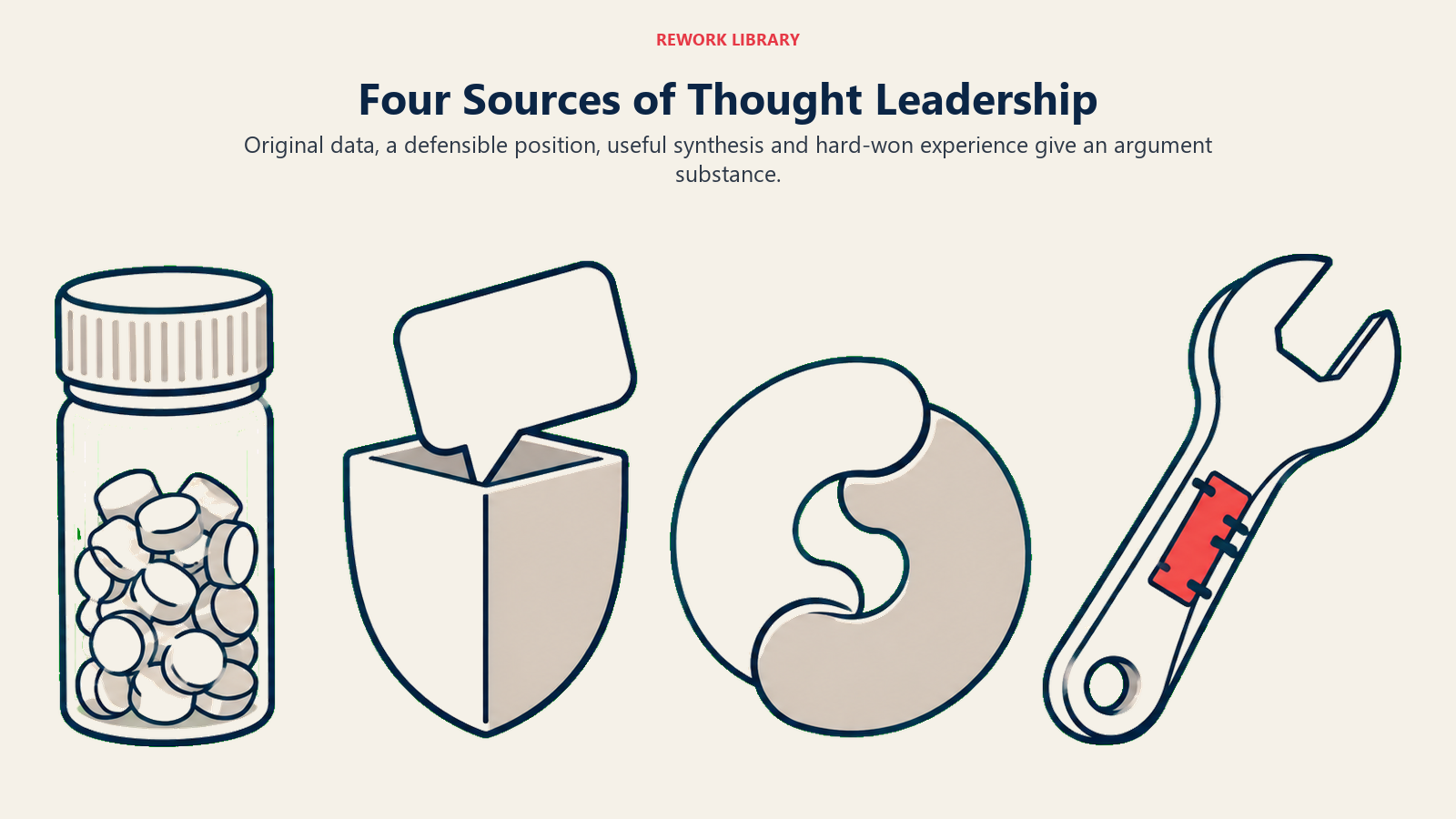
Something has to sit underneath the argument. Four things qualify, and which one a piece is built on usually decides whether it gets cited for years or scrolled past.
| Type of substance | What it looks like | Why it can't be copied | Failure mode |
|---|---|---|---|
| Original data you own | A benchmark or analysis drawn from what only you can see: your customer base, your logs, your position | They lack the data, and gathering it takes quarters | A self-serving cut that flatters your product, which readers detect |
| A contrarian position you can defend | A claim your industry disagrees with, argued with evidence and stated conditions under which you'd be wrong | Copying it means adopting the risk you took | Contrarianism as a pose: different for attention, no argument |
| A synthesis nobody has assembled | Research, practice and cases from several fields connected into one usable model | The work is in the reading, not the writing | A literature review with no thesis, a summary in a framework's clothes |
| Hard-won operational detail | What happened when you did the difficult thing, including the parts that went badly | They haven't lived it, and sanitized versions read as false | Scrubbing the failure out, which removes the useful part |
The contrarian category deserves a caveat. A defensible non-obvious position isn't the same as a provocative one, and the difference is whether you've thought about what would make you wrong. Anyone can be contrarian for a quarter. Holding the position after the industry pushes back is closer to what contrarian strategy demands of a business: a bet you can articulate and be measured against, not disagreement for its own sake. If you can't say what would change your mind, you don't have a position, you have a personality.
Hard-won operational detail is the most underused and the easiest to produce, because you already have it. You just have to publish the version with the mistakes still in, which is a question of authentic leadership more than of writing skill.
Why most executive thought leadership fails
There's no point of view in it
The most common failure by a wide margin. A piece surveys what's happening, quotes three analysts, notes that the situation is complex, and concludes that leaders should be thoughtful. Nothing in it could be disagreed with, which means nothing in it could be believed either. Summarizing consensus can be worth publishing. It just isn't leadership, and calling it that is the source of most of the term's bad reputation. Visionary leadership has the same requirement: a vision nobody could object to isn't a vision, it's a mood.
The voice is recognizably not the person's
Ghostwriting isn't automatically dishonest. An editor who makes a leader's thinking clearer is doing legitimate work. The failure is when the published voice and the person in the room are visibly different people. Readers who meet you afterwards notice instantly, and that discovery is worse than never publishing. The workable arrangement: the executive supplies the position, the argument and the specifics, the writer supplies structure and prose. The unworkable one has an agency supplying the thinking and the executive supplying a headshot.
It's published on a cadence instead of when there's something to say
Somebody decided the CEO posts weekly. Now the CEO posts weekly, and roughly one week in eight there's an actual idea. The other seven train the audience that your name isn't a signal. Set the cadence at the rate you can genuinely fill, not the rate a template suggests. Monthly with something real beats weekly with filler.
It chases reach instead of the specific hundred people who matter
For most executives, the audience that changes anything is small and nameable: a few dozen buyers, a handful of analysts, some competitors, the twenty people you'd like to hire. A post reaching 400 people that gets forwarded to three of that hundred beats one reaching 40,000 strangers. Follower count can't tell those two outcomes apart.
You're claiming expertise you can't demonstrate
The credibility trap. Publishing on a topic implies you can hold a conversation about it at depth, and someone will eventually test that. Your claimed expertise should be narrower than what you actually know, not wider. Here ethical leadership and self-interest point the same way: overclaiming is fragile, because the correction comes from someone who knows more, in public.
The AI problem: undifferentiated content is now worth less than nothing
This one is new and it changes the calculus. When generating fluent, competent, on-topic prose costs nothing, the market value of fluent, competent, on-topic prose collapses toward zero. The whole "summarize the consensus, add three trends, close with a call to be thoughtful" genre can now be produced in seconds by anyone. Publishing it under your name no longer signals effort or expertise. It signals that you had nothing, which is worse than silence.
What survives is the four categories above, because all four are expensive in ways generation isn't. LinkedIn's research makes the point from the buyer's side: output got dramatically cheaper, but as Mimi Turner writes, "more output does not mean more confidence," and AI "is not a discovery system, it's a retrieval system" that pulls from the record already out there (LinkedIn, June 2026). With 94% of buying groups consulting an LLM before they talk to sales, the question is no longer how much you publish but whether anything in the record is worth retrieving.
A related finding is worth sitting with. LinkedIn's B2B Institute research on credibility argues that buying groups don't choose what they like, they choose what they can defend, citing Matthew Dixon and Ted McKenna's finding that 40% of B2B deals are lost not to a competitor but to indecision. An executive quoted there sums it up: "It's a lot harder to get into trouble for making the decision that everyone else would have made" (LinkedIn, Aug 2026). That's what good thought leadership is for: handing the person who wants to pick you the argument to defend it.
When an executive should not invest in this
Most articles on this topic skip this section, because the people writing them sell the service. Three situations where the honest answer is don't.
You're pre-product-market-fit. If you don't know what you're selling or to whom, the best use of a founder's week is talking to customers. Thought leadership converts knowledge into reach; it can't manufacture the knowledge, and publishing an untested position locks you into it prematurely. The writing takes weeks. The insight takes quarters.
Your buyers don't read. In some categories the buying committee genuinely doesn't consume published thinking, and decisions run through procurement mechanics, existing relationships or a few gatekeepers. The research above is broad but not universal. The test is cheap: ask ten recent buyers what they read before shortlisting you. If the honest answer is "nothing," believe them.
Your actual goal is recruiting, not sales. A legitimate objective, and a different play with a different audience and different content. Engineers evaluating an employer want to see how you make technical decisions and treat people, which is closer to publishing about culture that scales than to publishing your market thesis. Confusing the two serves neither.
One more warning rather than a "don't": if you can't sustain it for two years, don't start. The mechanism runs on accumulated recognition, and six months of posts followed by silence leaves nothing but a stale profile.
How to build one
Step 1: Find the position you already hold
Don't start by picking a topic. Find the argument you already make in private, repeatedly, that people in your industry find surprising or push back on. It's usually visible in your behavior: what you say in every strategy meeting, the objection you always raise, the practice your team does differently. Write down three sentences you believe that most peers don't. If you can't fill three, you're not ready to publish, and that's the useful finding.
Step 2: Test it in conversation before you publish it
Take the position to five people who know the domain and will argue. Not your team, who are incentivized to agree. You want the strongest counterargument, and whether it survives. This costs a week and prevents the most expensive failure mode: discovering your central claim is wrong in public.
Step 3: Choose one audience and one channel
Name the audience specifically: not "operations leaders" but "VPs of ops at 200 to 2,000 person logistics companies deciding whether to rebuild or buy." Then pick the one place those people already are and commit for a year. One channel beats being thin across five.
Step 4: Build one proof asset
In the first six months, publish one thing that took real work: a data set, a framework people can apply without you, a teardown of something that succeeded or failed. This is the piece still cited long after the posts scroll away, and it converts a stream of opinions into a body of work. It's also what an LLM finds when it assembles an answer about your domain.
Step 5: Set a cadence you can hold on your worst month
Halve whatever frequency you're considering, then ask whether you could still hit it during a quarter close or a crisis. That's your real cadence. Consistency at a lower frequency compounds. An ambitious schedule you abandon in March does not.
Step 6: Say the thing that costs you something
Every body of work worth reading contains at least one position the author was nervous to publish: a disagreement with a large customer, a contradiction of something you said two years ago, a failure admitted in detail. That's not a flourish, it's the mechanism. A position that costs nothing to hold is evidence of nothing, because anyone could hold it. This is where thought leadership draws on expert power rather than positional power. Your title gets you published. The argument gets you believed.
How to measure it without lying to yourself
Nearly every dashboard built for this measures the easy things, which are the useless ones.

| Commonly measured | Why it misleads | Measure instead |
|---|---|---|
| Impressions and reach | Counts strangers equally with the twenty people who matter | Inbound conversations from named target accounts |
| Follower count | Grows on personality and frequency, not ideas | Whether people you never contacted quote your framing back to you |
| Engagement rate | Rewards agreement and outrage, both cheap | Being cited in someone else's argument, especially a critical one |
| Content volume published | The metric AI made meaningless overnight | Whether one asset is still being linked to 18 months later |
| Attributed pipeline alone | Undercounts, because influence lands before anyone is trackable | Cycle length and objection quality on warm deals |
Two proxies matter more than the rest. The first is citation: when someone in your industry uses your framing to make their own argument, especially someone who doesn't like you, the idea has moved beyond your audience. That's the thing working. The second is what your sales calls sound like. When a prospect opens by referencing your position rather than asking what you do, you've skipped the explanation phase, and that shows up in cycle length. The 2025 edition's 41% of target buyers whose C-suite urged them toward a vendor after reading that vendor's thought leadership is the same effect from the buyer's side.
Recruiting is the third signal and often the first to move: applications citing something you wrote run months ahead of pipeline.
The organizational version: whose job is this
Everything above is written for an individual leader, but the durable version is a company capability, not one executive's hobby. The difference shows when that executive leaves. If the ideas go with them, you had a personal brand on the payroll.
That means naming an owner, and each of the three usual homes has a failure mode: marketing owns it and it drifts toward demand generation, communications owns it and it drifts toward safety, research or strategy owns it and it drifts toward rigor nobody reads. The version that works has an editorial owner with the standing to reject a piece for being boring, a rule that the company's own data and operational experience are the raw material, and more than one credible voice, because a single-spokesperson model is a succession risk dressed as a strategy. It works or fails much the way purpose-driven business strategy does: a position stated once at the top and never operationalized decays into a slogan.
One structural point to close on. Leadership and management differ partly in whether influence depends on the reporting line, and thought leadership is the purest case of influence that doesn't. Nobody has to read you. That's exactly why, when they do, it means something.
Frequently Asked Questions about Thought Leadership
What is thought leadership?
A defensible, non-obvious point of view on a problem your audience has, published consistently and backed by knowledge others don't have. The definition Edelman and LinkedIn use is narrower than common marketing usage: free content in your area of expertise, explicitly excluding material whose main job is describing or promoting a product.
What's the difference between thought leadership and personal branding?
Personal branding optimizes for the individual: recognition, optionality, being known. Thought leadership optimizes for the reader, so the idea has to be worth more to them than the visibility is to you. They often coexist in one person, and the way to tell them apart is what happens to a position that would be correct but unpopular.
Is thought leadership the same as content marketing?
No, though they often share a budget. Content marketing exists to generate demand for a product and should be measured that way. A useful test is whether the piece would still be worth publishing if your product didn't exist. If not, it's marketing, which is fine, but calling it thought leadership sets a bar it isn't trying to clear.
Does thought leadership actually influence B2B buying decisions?
Yes, with a caveat. The 2025 Edelman-LinkedIn edition found 64% of target buyers and 63% of hidden buyers spend more than an hour a week on it, and 41% of target buyers said a C-suite executive pushed them toward a vendor after reading its content. The 2024 edition found 75% had researched something they weren't considering because of a piece, but also that only 15% rate the overall quality as very good.
Why does most executive thought leadership fail?
Usually because it has no point of view: it summarizes consensus, which nobody can disagree with and therefore nobody believes. Other causes are a ghostwritten voice that visibly isn't the person's, publishing on a fixed cadence rather than when there's something to say, and claiming more expertise than you can demonstrate.
When should an executive not invest in thought leadership?
Skip it pre-product-market-fit, where time with customers produces more. Skip it if your buyers genuinely don't read, which you can test by asking ten recent buyers what they consumed before shortlisting you. And if you can't sustain it for two years, don't start.
Has AI made thought leadership less valuable?
It's made undifferentiated thought leadership worthless and sharpened the value of the rest. When fluent on-topic prose costs nothing to generate, publishing it signals you had nothing to say. What holds value is what generation can't produce: data you own, a position you took risk on, a synthesis that took years of reading, operational detail you earned.
Thought leadership is a bad phrase for a real thing, and the real thing is narrow: you know something others don't, you'll state a position that could be wrong, and you keep doing it in front of the people it matters to. Almost everything else under the label is marketing with better manners or consensus with a byline. Find the three sentences you believe that your peers don't. If you can't, that's the more useful discovery, and it costs far less than a year of posting.

Senior Operations & Growth Strategist
On this page
- What thought leadership actually is
- Thought leadership vs the five things it gets confused with
- What the evidence actually says
- The four kinds of substance that make it real
- Why most executive thought leadership fails
- There's no point of view in it
- The voice is recognizably not the person's
- It's published on a cadence instead of when there's something to say
- It chases reach instead of the specific hundred people who matter
- You're claiming expertise you can't demonstrate
- The AI problem: undifferentiated content is now worth less than nothing
- When an executive should not invest in this
- How to build one
- Step 1: Find the position you already hold
- Step 2: Test it in conversation before you publish it
- Step 3: Choose one audience and one channel
- Step 4: Build one proof asset
- Step 5: Set a cadence you can hold on your worst month
- Step 6: Say the thing that costs you something
- How to measure it without lying to yourself
- The organizational version: whose job is this