Tannenbaum-Schmidt Leadership Continuum
Turn this article into takeaways for your work.


Each assistant summarizes the article only for you and suggests best practices for your work.
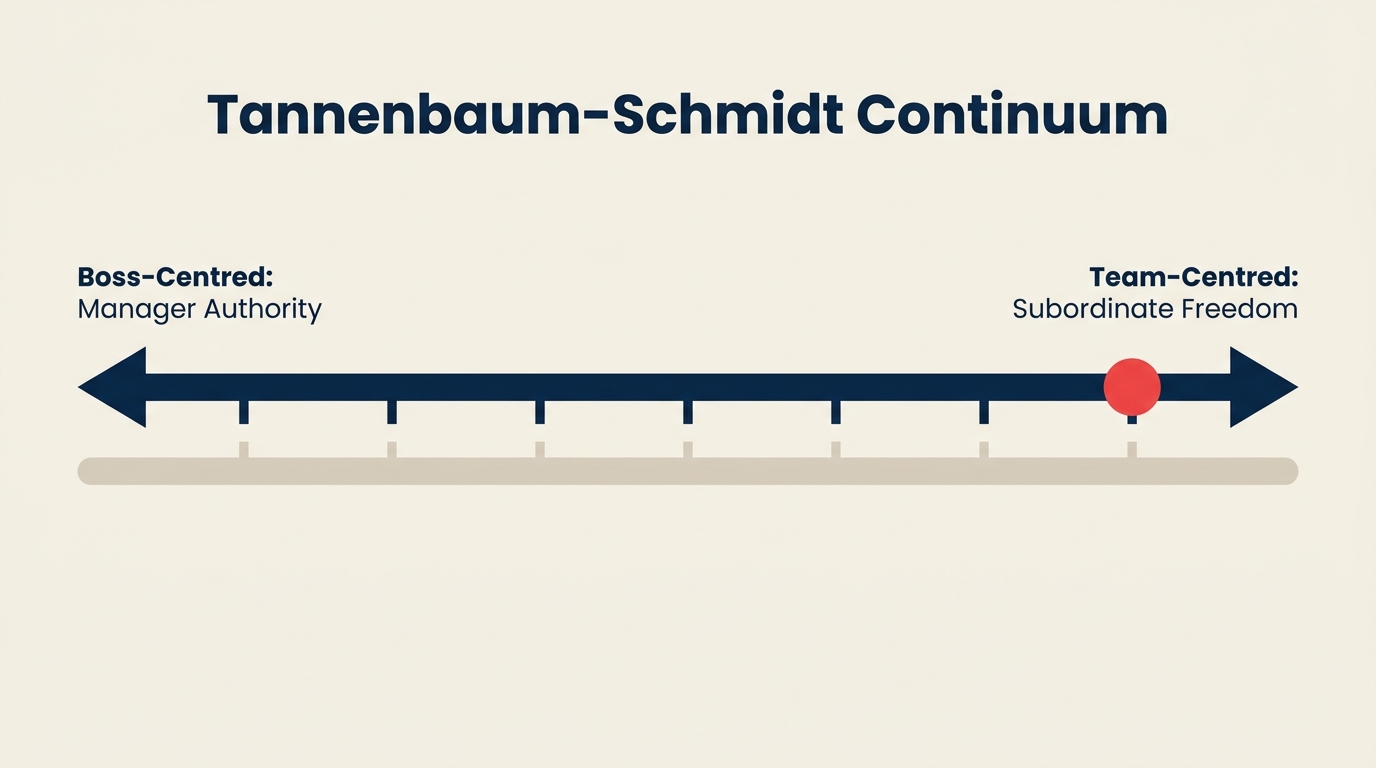
The Tannenbaum-Schmidt continuum is one of the most practical leadership frameworks ever published, precisely because it refuses to pick a single "best" style. Introduced by Robert Tannenbaum and Warren Schmidt in a 1958 Harvard Business Review article, it maps seven distinct leadership behaviours along a spectrum from complete manager authority to complete team freedom. Every point on that spectrum is legitimate; the question is which one fits your specific context.
That question matters more than most leaders realise. Pick the wrong point and you either micromanage people who don't need it or abandon people who do. The continuum gives you a language and a logic for making that call deliberately.
What Is the Tannenbaum-Schmidt Continuum?
The Tannenbaum-Schmidt continuum is a leadership model, first published by Robert Tannenbaum and Warren Schmidt in the 1958 HBR article "How to Choose a Leadership Pattern," which arranges seven leadership behaviours on a single spectrum from boss-centred management (where the leader uses authority to make all decisions) to subordinate-centred management (where the team has maximum freedom to decide and act). As a leader moves right along the continuum, they release more decision-making authority to their team and rely less on positional power.
The original model was updated by Tannenbaum and Schmidt in a 1973 HBR retrospective, which added environmental forces (the wider organisation and society) to the three internal forces they had originally described. But the seven-point structure, and the underlying insight about matching style to situation, remains unchanged.
Key Facts
- Robert Tannenbaum and Warren Schmidt published "How to Choose a Leadership Pattern" in the Harvard Business Review in 1958; the article became one of HBR's most-reprinted pieces of the twentieth century.
- The model predates situational leadership by more than a decade: Hersey and Blanchard's situational model appeared in 1969, building on the same core idea that no single style works in all contexts.
- In a 1973 HBR follow-up, Tannenbaum and Schmidt acknowledged that societal changes, including rising expectations for employee participation, had made the subordinate-centred end of the continuum more relevant than it was in 1958.
The Seven Points on the Continuum
The classic model names seven recognisable behaviours. Each one shifts the balance of authority a little further toward the team. The headings "boss-centred" and "subordinate-centred" are the original language from the 1958 paper.
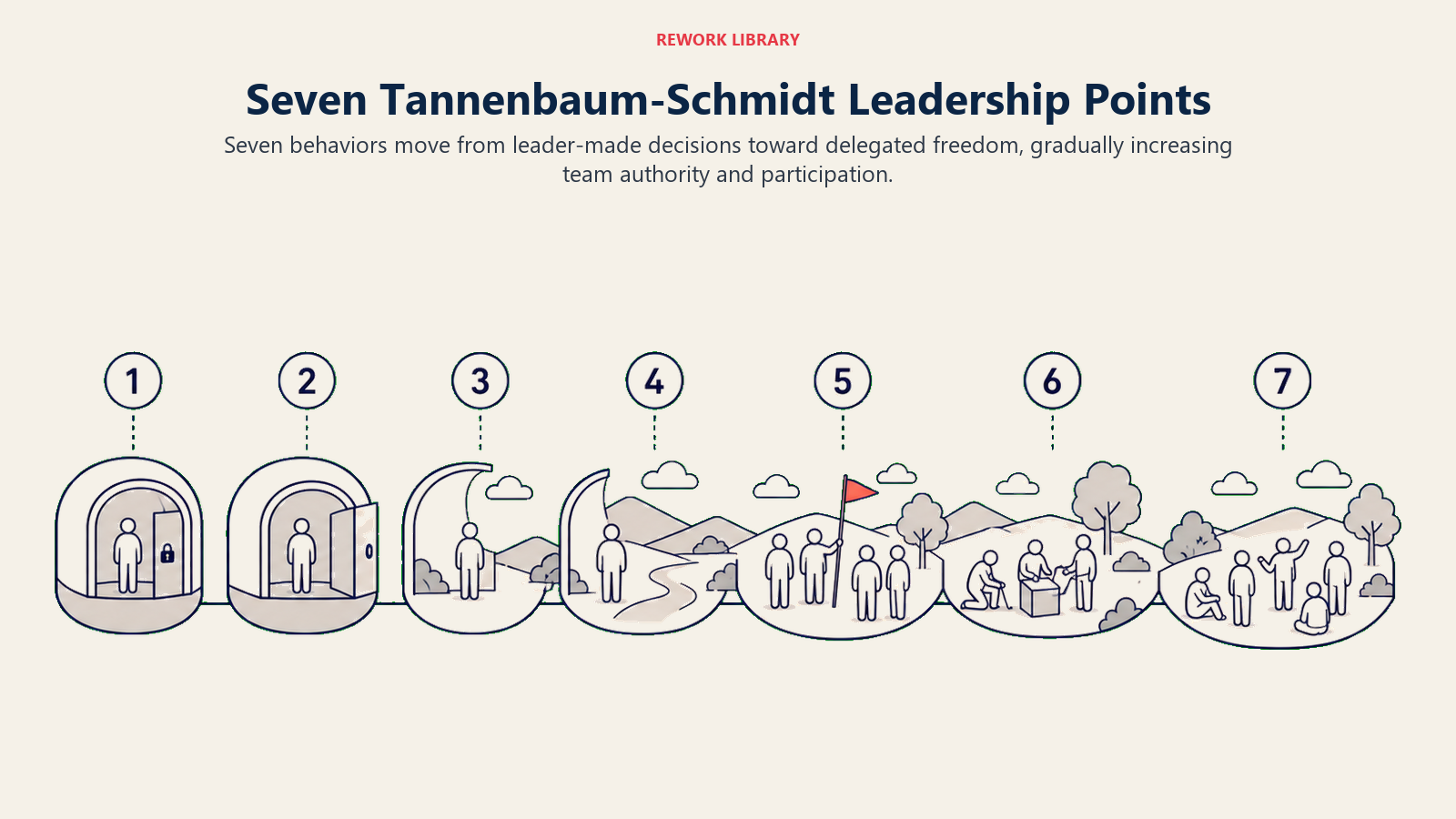
| Point | Label | What the leader does | Who decides |
|---|---|---|---|
| 1 | Tells | Announces the decision. No input sought, no explanation required. | Manager alone |
| 2 | Sells | Makes the decision, then explains the reasoning to gain buy-in. | Manager alone |
| 3 | Suggests | Presents the decision as a proposal, invites questions, but retains authority. | Manager (after fielding questions) |
| 4 | Consults | Defines the problem, asks the team for ideas, then makes the final call. | Manager (informed by team) |
| 5 | Joins | Defines the boundaries, then joins the team as an equal participant in making the decision. | Manager and team together |
| 6 | Delegates | Sets parameters and accountability, then hands decision-making to the team entirely. | Team, within set limits |
| 7 | Abdicates | Steps back entirely. The team defines the problem and solves it with minimal manager involvement. | Team, with near-full autonomy |
A note on the seventh point: some versions of the model stop at six (delegates), treating abdication as an extreme that slips into negligence rather than leadership. Tannenbaum and Schmidt's original paper focuses on the first six. Abdication is worth naming, though, because it helps leaders recognise the boundary between healthy delegation and simply opting out.
The most important insight from the table is not any single row. It's that every behaviour from "tells" to "delegates" can be appropriate. "Tells" is not a failure mode; it's the right call when a building is on fire. "Delegates" is not laziness; it's the right call when a highly skilled team owns a domain you don't.
The Three Forces That Determine Your Position
Tannenbaum and Schmidt identified three clusters of forces that determine where a leader should sit on the continuum at any given time. These forces pull in different directions and change from situation to situation.
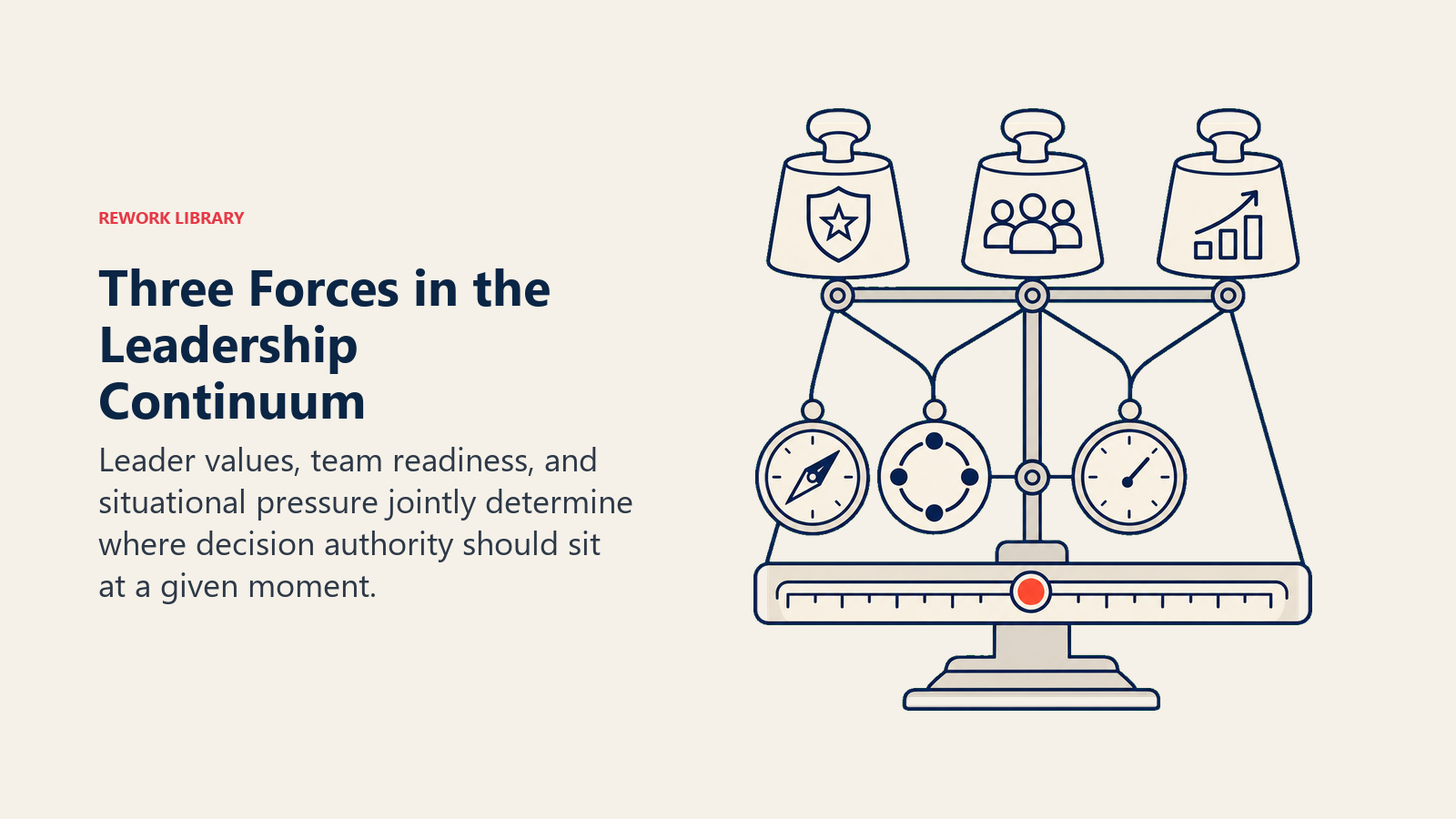
Forces in the manager
The manager's own values, preferences, and confidence all shape which behaviours feel natural. A leader who genuinely believes that teams produce better decisions than individuals will lean toward the subordinate-centred end by default. A leader who is anxious about losing control will pull toward "tells" even when the situation doesn't call for it. Self-awareness here is not optional: if you don't know where your defaults sit, you can't correct for them.
Forces in the subordinates
The team's readiness, expertise, and tolerance for ambiguity set a floor on how much freedom it's safe to give. Four questions are useful here:
- Do the team members have the knowledge and experience to make this decision well?
- Do they expect to be involved, or are they comfortable being directed?
- Are they invested in the outcome, and do they have the same organisational goals you do?
- Have they shown the ability to handle ambiguity before?
A team that scores low on these questions needs more direction, not because they're not trusted as people, but because handing them a decision they can't yet make sets them up to fail. A team that scores high on all four is being disrespected by a leader who still "tells" them what to do.
Forces in the situation
Even if the manager and the team are well-matched to a collaborative style, the situation itself may override that. The relevant situational factors include:
- Time pressure. When a decision needs to be made in hours, consulting the team may not be possible.
- Organisational norms. Some cultures expect strong directive leadership; others reward visible participation.
- The nature of the problem. A decision with clear criteria and known data lends itself to a manager call. An ambiguous problem with distributed knowledge usually benefits from team input.
- Stakes and accountability. When the consequences of an error fall entirely on the manager, centralising the decision is rational. When the consequences fall on the team, including them is both fair and pragmatic.
Common Mistakes
The continuum is simple to describe and harder to use. These are the mistakes that show up most often.
Staying at one point regardless of context. Most leaders have a default position they return to under pressure. That default was probably developed in a specific type of role and may have been entirely appropriate there. The problem is treating it as universally correct. Situational leadership makes the same point: the style that served you well with one team at one stage may be exactly wrong for a different team at a different stage.
Calling consultation without acting on it. Moving to "consults" creates an expectation. If a manager asks for team input and then ignores it without explanation, the result is worse than not asking at all. People read it as theatre. If you consult and then override the team's view, be direct about why.
Confusing abdication with empowerment. Real delegation (point six) includes clear parameters, defined accountability, and ongoing access to support. Abdication means dropping responsibility without any of that structure. Teams left in abdication mode often don't know what freedom they actually have, which leads to paralysis or bad calls in areas they were never meant to own.
Moving too fast. A manager who jumps from "tells" to "joins" overnight, without building the relationship or capability that would make joint decision-making safe, usually creates confusion rather than engagement. The continuum is not a speed run; it's a calibration tool.
Using the wrong point for the person, not just the team. The forces analysis in the original paper applies at the individual level too. Within the same team, one person may need clear direction on a specific task while another is ready to own a project entirely. Democratic leadership instincts can lead managers to apply the same point to everyone, which ends up serving no one well.
How to Choose Where to Operate
The original Tannenbaum-Schmidt paper frames this as a set of diagnostic questions. Here is a structured way to work through them before making a significant decision.
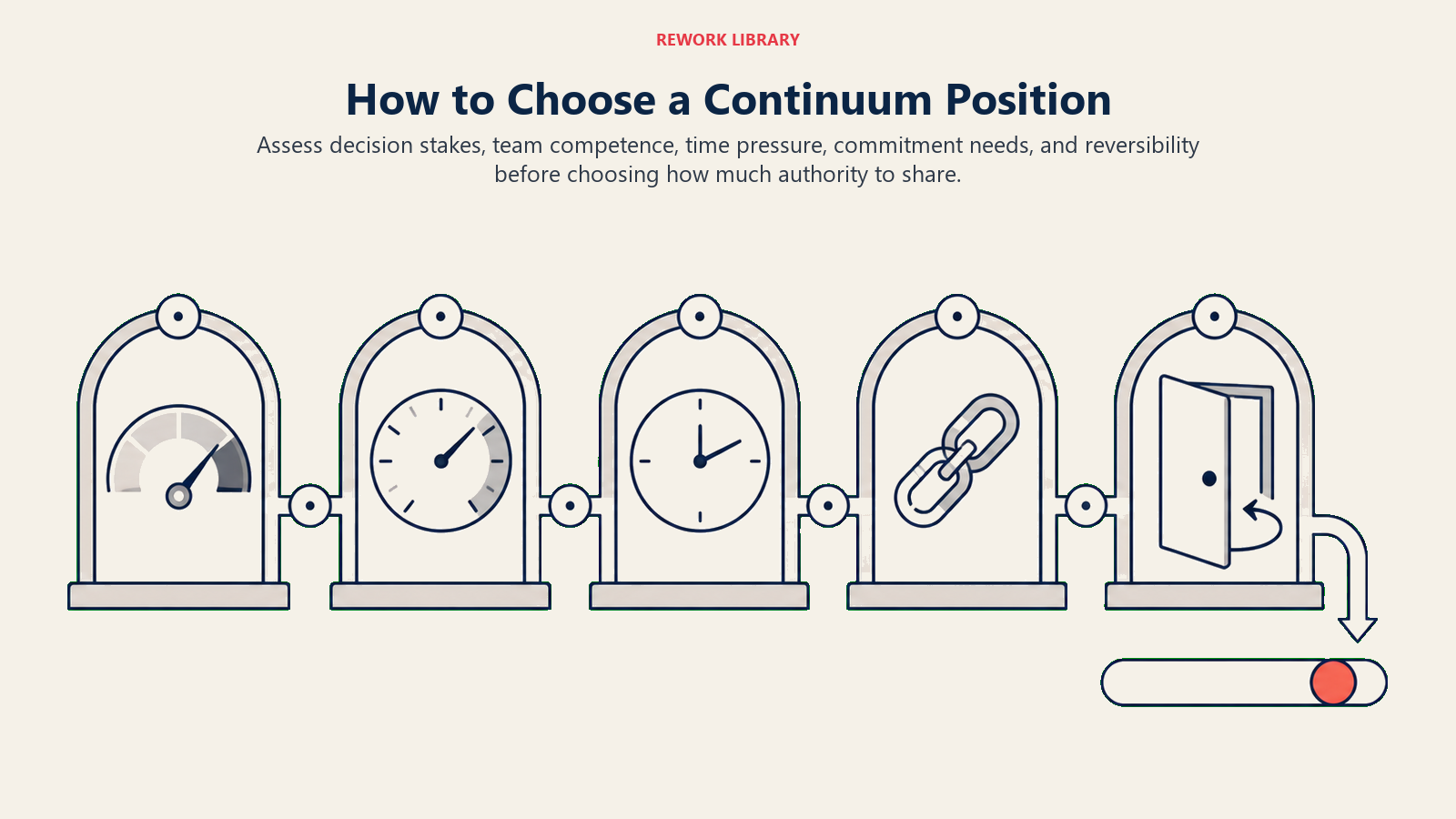
Step 1: Assess the decision itself
Ask: what kind of decision is this? Technical, strategic, or interpersonal? Time-sensitive or open-ended? Does it require information that's distributed across the team, or is it held by you? A crisis decision with a two-hour window is rarely a candidate for the consult-or-join range. A six-month strategic direction with cross-functional implications usually is.
Step 2: Evaluate the team's readiness
Score the four readiness questions from the forces-in-subordinates section: knowledge, expectation of involvement, alignment with goals, and tolerance for ambiguity. If the average score is low, stay closer to "tells" or "sells." If it's high, move toward "consults," "joins," or "delegates." This step forces you to base your style on actual team capability rather than gut feel.
Step 3: Check your own defaults
Ask: where do I naturally sit on this continuum? Am I moving toward "tells" because the situation calls for it, or because I'm uncomfortable letting go? Am I moving toward "delegates" because the team is ready, or because I want to avoid a difficult conversation? Autocratic leadership and laissez-faire leadership are both legitimate at specific points on the continuum; the mistake is arriving at them by accident.
Step 4: Read the situational constraints
Run through the situational forces: time available, organisational norms, stakes, and the nature of the problem. These can override the step-2 and step-3 assessments. A team that's ready for delegation may still need a "consults" approach if the organisation expects the leader to own a particular type of call.
Step 5: State your position explicitly
Once you've chosen a point, tell the team which one. "I'm going to consult you on this, and I'll make the final call" is more honest and more productive than leaving them to guess. It also makes it harder to slip into abdication by accident.
Tannenbaum-Schmidt Continuum Example
A regional sales director at a B2B software company is deciding how to respond to a competitor who has just cut prices by 20%. The team includes five senior account managers, a pricing analyst, and a marketing lead.
| Decision factor | Assessment |
|---|---|
| Time pressure | Moderate. Customers are asking. Response needed within two weeks. |
| Team knowledge | High. Account managers have direct customer insight; pricing analyst owns the data. |
| Alignment with goals | Strong. Everyone's commission structure aligns with revenue retention. |
| Organisational norms | Leadership team expects the director to own pricing decisions, but welcomes structured input. |
| Nature of problem | Ambiguous. No single right answer; customer segment reactions will vary. |
Based on this assessment, "consults" (point 4) fits well. The director defines the decision: should we match the cut, differentiate on value, or create a targeted retention offer? The team provides customer intelligence and pricing data. The director makes the final call and owns it upward.
If the competitor cuts had happened during a live deal negotiation that needed an answer in two hours, "tells" or "sells" would have been the right call regardless of the team's readiness. The situation would have overridden everything else.
Best Practices
Revisit your position regularly. A team that needed "sells" six months ago may be ready for "delegates" now. Leadership style should evolve with team capability, not stay fixed because it once worked.
Use the continuum for delegation reviews, not just crisis decisions. Many leaders only think about style when something goes wrong. Running through the Tannenbaum-Schmidt diagnostic before delegating a new project or promoting someone into a leadership role is just as valuable.
Pair it with other models. The Tannenbaum-Schmidt continuum describes where to sit on the authority spectrum; it doesn't tell you how to lead once you're there. Action-centred leadership and the Full Range Leadership Model add depth to the behaviours themselves. Lewin's leadership styles and situational leadership address similar questions from slightly different angles and are worth reading alongside it.
Document your reasoning. When a decision goes badly, teams often want to know why the leader chose the level of involvement they did. Having thought through the forces in advance, and being able to explain your reasoning, builds trust even when the outcome isn't good.
Watch for context drift. The forces that made "tells" appropriate last quarter may not apply this quarter. If your team's capability has grown, if the time pressure has eased, or if the norms of the organisation have shifted, your position on the continuum should shift too.
The Tannenbaum-Schmidt continuum turns what can feel like an instinctive choice, how much control to keep or release, into a deliberate diagnostic. The seven points give you a vocabulary for talking about style with your team. The three forces give you a structured way to audit your reasoning. And the model's longevity, still widely taught more than sixty years after the original paper, suggests it maps something real about how leadership authority actually works. Leaders who use it consistently tend to delegate more confidently, consult more honestly, and direct more purposefully.
Related Reading

Senior Operations & Growth Strategist
On this page
- What Is the Tannenbaum-Schmidt Continuum?
- The Seven Points on the Continuum
- The Three Forces That Determine Your Position
- Common Mistakes
- How to Choose Where to Operate
- Step 1: Assess the decision itself
- Step 2: Evaluate the team's readiness
- Step 3: Check your own defaults
- Step 4: Read the situational constraints
- Step 5: State your position explicitly
- Tannenbaum-Schmidt Continuum Example
- Best Practices
- Related Reading