Shared Leadership: How Teams Lead Together
Turn this article into takeaways for your work.


Each assistant summarizes the article only for you and suggests best practices for your work.
A design team is three weeks into a rebuild. On Monday the researcher pushes back on the scope and the team narrows it. On Tuesday the engineer says the migration path won't hold and the sequencing changes. On Wednesday the product manager reprioritizes based on both. Nobody was promoted between Monday and Wednesday. Influence just moved to whoever had the strongest read on the problem in front of them, and everyone else let it move.
That pattern has a name and, unusually for a leadership idea, a measurement. Shared leadership is a property of a team that researchers can score, compare and correlate with outcomes. A team can have more of it or less of it, which separates it from most of the flat-team talk it gets lumped in with.
It's closely related to distributed leadership, and the two get used interchangeably far too often. The honest difference: distributed leadership is a descriptive lens on whole systems, arguing that leadership practice is already stretched across people, routines and tools whether anyone chose it or not, while shared leadership is a team-level practice a specific group adopts and can be scored on. For the systems view, read that article. This one stays inside the team.
What is shared leadership?
The definition almost every paper here starts from comes from Craig Pearce and Jay Conger's 2003 volume on the subject: "a dynamic, interactive influence process among individuals in groups for which the objective is to lead one another to the achievement of group or organizational goals or both." It gets quoted in most of the empirical work that follows, including a study of engineering design teams in Frontiers in Psychology.
Three words carry the weight. Process, because it's something a team does repeatedly and can lose between March and June without anyone changing job titles. Interactive, because influence has to travel in more than one direction: a manager who consults everyone and then decides is not doing this, however consultative it feels. Among individuals, because the influence is lateral. Peers lead peers, and that's what organizations find hardest, since most of the machinery (reviews, headcount, budget) still points up and down.
What mutual influence looks like on a Tuesday
- Someone who doesn't run the meeting changes what the meeting decides, and nobody treats that as a challenge to authority.
- A person outside a workstream flags a risk, and the plan actually changes rather than the risk being logged and ignored.
- Two people disagree, and the tiebreaker is whose evidence is better rather than whose title is higher. See types of power in leadership for why expert power has to be allowed to outrank position power here.
- Somebody says "I'll own that" without being assigned it, and the team lets them.
If you can't find those moments in the last two weeks of a team's calendar and chat history, that team doesn't have much shared leadership, whatever it says about itself.
Key Facts: Shared Leadership
- Pearce and Conger's 2003 definition, the one most of the literature builds on, frames shared leadership as a dynamic, interactive influence process among individuals in groups aimed at leading one another toward group or organizational goals. Source: Frontiers in Psychology
- In a study of 59 consulting teams, both the internal team environment (shared purpose, social support and voice) and external coaching were important predictors of shared leadership emerging, which in turn predicted team performance as rated by clients. Source: Carson, Tesluk and Marrone, Academy of Management Journal, 2007
- A meta-analysis cumulating 42 independent samples found an overall positive relationship between shared leadership and team effectiveness of ρ = .34, with stronger effects when member work is more complex. Source: Wang, Waldman and Zhang, Journal of Applied Psychology, 2014
- A second meta-analysis, using 50 effect sizes across 3,198 teams, found network density and decentralization measures produced significantly higher effect sizes than aggregation-based surveys, so how you measure shared leadership changes what you find. Source: D'Innocenzo, Mathieu and Kukenberger, Journal of Management, 2016
- In 26 engineering design teams (119 people) studied with social network analysis, shared leadership related positively to task performance and team viability, and the relationship was stronger early in the project life cycle than later. Source: Frontiers in Psychology
Shared, distributed, participative, delegated, co-leadership, rotating chair
Six labels, one family, genuinely different mechanics. The distinction that matters isn't philosophical, it's operational: who can change a decision, and by what right.
| Shared | Distributed | Participative | Delegated | Co-leadership | Rotating chair | |
|---|---|---|---|---|---|---|
| In one line | Members lead one another by mutual influence | Leadership is already stretched across people, routines and tools | The leader gathers input, then decides | The leader assigns a decision to a named person | Two people hold one role jointly | The lead role passes on a schedule |
| Influence flows | Laterally, every direction | Across roles, situations and artifacts | Up to the leader, then down | Down, on loan | Between two peers, then down | Down, from this week's chair |
| How it's scored | Peer ratings of who leads whom | Described, not scored | Not a team-level measure | Task completion | Not a team-level measure | Rotation logs |
| Typical failure | The same person leads every time | Work spreads but authority doesn't | Consultation becomes theater | The manager reclaims it mid-flight | The two disagree, the org stalls | The chair is ceremonial |
Two boundaries deserve spelling out.
Against participative leadership. Participation is about the leader's decision process. A highly participative manager can run a beautifully consultative meeting and still be the only person in the room whose influence changes the outcome. Shared leadership requires a peer's influence to land on another peer without routing through the manager at all. The Tannenbaum-Schmidt continuum maps how much room a leader gives a team, but that axis assumes a single leader deciding how much to give. Shared leadership is scored on a different one: how much of the leading comes from members.
Against democratic leadership. Democratic teams resolve things by vote or consensus. Shared leadership doesn't require voting and often doesn't use it. A team can be high in shared leadership and still have one person make the final call on a topic, as long as different people carry that role across different topics.
And it isn't laissez-faire leadership, which is the absence of leadership behavior. Shared leadership means more leading is happening, not less. The volume of influence goes up. It's just sourced from more people.
How shared leadership is measured, and why the method changes the answer
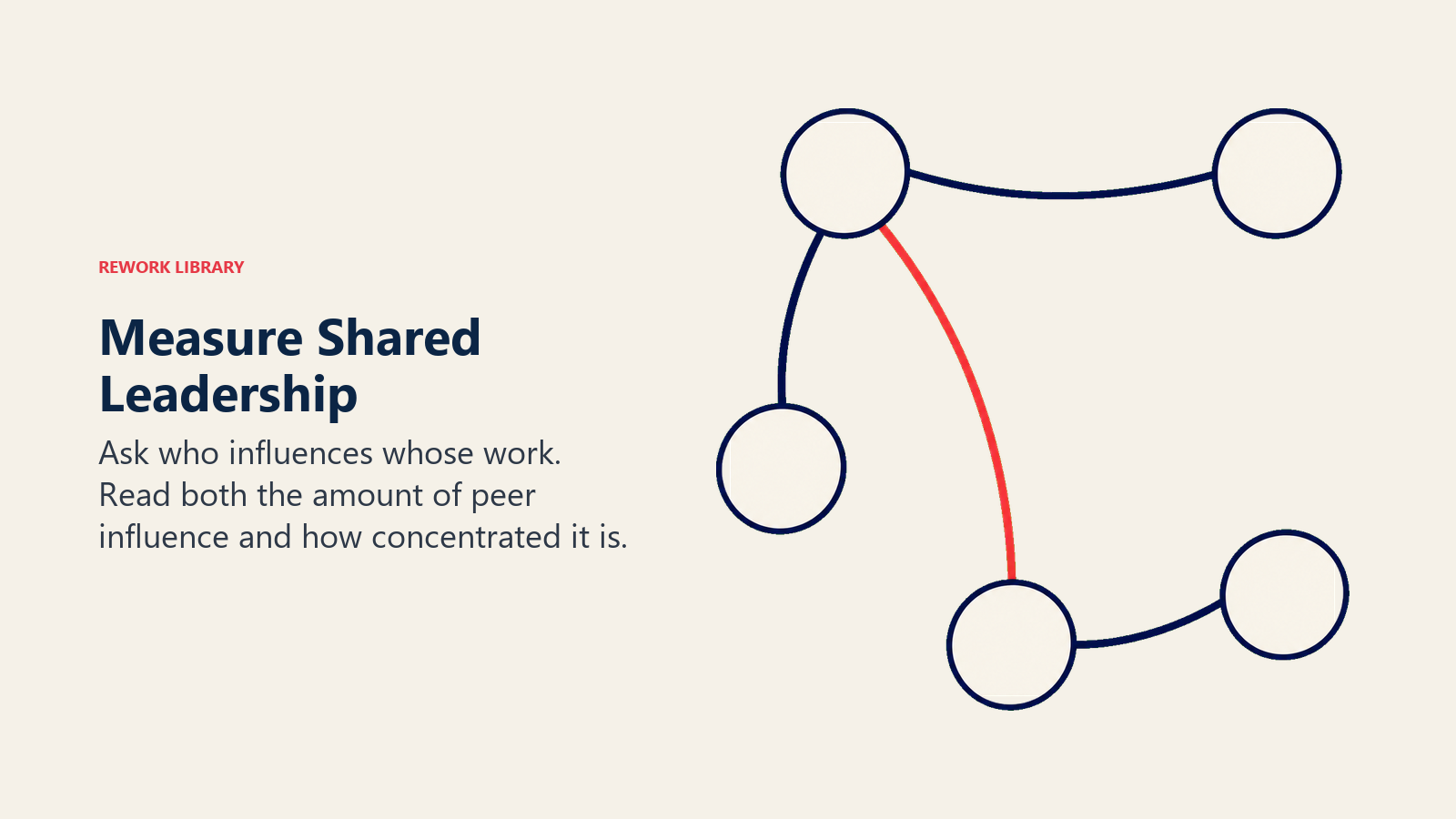
This is what turns shared leadership from a slogan into a construct. There are two families of method, and they don't agree.
| Approach | What you collect | What the score means | Weakness |
|---|---|---|---|
| Network density | Every member rates every other on how much that person leads | Actual leadership ties divided by all possible ties, 0 to 1 | Effortful, and painful as the team grows |
| Network centralization | The same matrix, scored for concentration | Low means influence is spread, high means it funnels to one node | Same heavy data collection |
| Aggregated rating | Survey items about the team ("in this team, we share leadership") | The team's average on a shared leadership scale | Measures a belief, which drifts from the real pattern |
The choice isn't academic housekeeping. Pooling 50 effect sizes across 3,198 teams, D'Innocenzo, Mathieu and Kukenberger found both density and decentralization approaches showed significantly stronger relationships to performance than surveys asking members to rate the team overall.
The lesson underneath the methodology: ask a team "do we share leadership?" and you get a self-image, ask each person "who on this team leads you, and how much?" and you get a map. The map is less flattering, and what it most often reveals is a team that believes it's flat while routing most of its influence ties to two people.
You can run a crude version without a research budget. Ask each member privately to name the people whose input actually changed their work in the last month, scoring each from 0 to 4, then divide the total by the maximum possible and read both the number and the shape. Spread evenly, that's real shared leadership. Concentrated on two names, you have a strong informal leader. Low across the board, members are working next to each other, not with each other.
What the research says, including where it disagrees
Shared leadership is unusually well studied, and the honest summary has more texture than "research proves it works."
| Study | Design | Key finding | Practical read |
|---|---|---|---|
| Carson, Tesluk and Marrone (2007), Academy of Management Journal | 59 consulting teams | Internal team environment and external coaching predicted shared leadership emerging, which predicted client-rated performance | Downstream of conditions you can build, not of personality |
| Wang, Waldman and Zhang (2014), Journal of Applied Psychology | Meta-analysis, 42 samples | ρ = .34 with team effectiveness; stronger when member work is more complex; ties to attitudes and processes stronger than to hard performance | Real but moderate, visible in how a team works before it shows in output |
| D'Innocenzo, Mathieu and Kukenberger (2016), Journal of Management | Meta-analysis, 50 effect sizes, 3,198 teams | Network measures beat aggregated surveys; lower effect sizes on more complex tasks; no significant effect of interdependence | Measurement method matters, and the complexity story is unsettled |
| Frontiers in Psychology | 26 engineering design teams, social network analysis | Positive for task performance and team viability, stronger in the early project phase | Front-load it. It pays most while the problem is being framed |
Two things worth taking from that honestly.
What gets shared matters. Wang and colleagues found that sharing traditional leadership behaviors like initiating structure and consideration related less strongly to effectiveness (ρ = .18) than sharing newer-genre behaviors such as charismatic and transformational leadership (ρ = .34) or cumulative overall shared leadership (ρ = .35). Distributing task supervision isn't the same intervention as distributing vision and encouragement.
The two meta-analyses disagree about complexity. Wang and colleagues found stronger effects when member work was more complex. D'Innocenzo and colleagues found the opposite, plus no significant influence of task interdependence at all. Different pooled studies with different measurement assumptions is the likeliest explanation, but the consequence stands: the popular claim that shared leadership is a guaranteed multiplier on complex interdependent knowledge work is not settled evidence. Treat it as a prior, not a law.
The conditions that build it
Carson and colleagues found shared leadership was predicted by an internal team environment plus external coaching. That's the most actionable finding in the literature, because both halves are things a manager builds rather than waits for.
| Condition | How you build it | Signal it's missing |
|---|---|---|
| Shared purpose | Write the goal down until two people can settle a dispute with it, without you | Priority conflicts escalate to the manager |
| Voice | Change something visible in response to a challenge, and say publicly that you did | Issues reach you privately, never the room |
| Social support | Reward the assist, not just the finish. Name who helped | Credit language is always singular |
| Psychological safety | Handle the first public disagreement well. Everyone is watching | Agreement in meetings, disagreement in DMs |
| External coaching | Ask what the team will do, don't tell it | Your involvement ends with you deciding |
| Familiarity and tenure | Protect team stability. Resist reshuffling for utilization | Members can't name who is best at what |
| Clear decision rights | Publish the boundary in writing, including what isn't negotiable | The team's decisions keep getting reversed |
Psychological safety is the load-bearing one, because shared leadership requires people to challenge peers in public. Where that challenge is expensive it doesn't happen, and influence quietly collapses onto whoever is most comfortable talking. You'll still get a team that calls itself collaborative, but a density map would show the difference immediately. Maturity matters too: a team still storming in the Tuckman stages of group development hasn't built norms that make mutual influence readable rather than threatening.
What the formal leader still does
Sharing leadership doesn't delete the manager's job, it changes what the job consists of. In Carson's data, coaching from outside the team was one of the two significant predictors of shared leadership emerging at all. The leader isn't a bystander to shared leadership. They're one of its causes.
Set the boundary conditions. The team decides how, inside a frame it didn't set: budget, headcount, the deadline that came from elsewhere, the compliance line that can't move. Write the frame down. A team with an unstated boundary finds it by crossing it, and that lesson is expensive.
Supply coaching from outside the team. This is the specific thing the research points at, and it isn't the same as attending the team's meetings. Coaching means noticing that the same person has spoken first in nine consecutive design reviews, or pushing the team to name its own decision rule. The moment coaching turns into deciding, you've taken the leadership back. It overlaps with servant leadership, though that describes how a leader relates to a team while shared leadership describes a measurable outcome in it.
Protect resources and attention. Peers negotiating with peers is slower per decision than one person calling it. If the team also carries a full utilization target and three interrupts a day, that negotiation won't happen and the fastest talker wins by default. Buying the team slack is a leadership act only the formal leader can perform.
Hold the single accountable line outward. Inside the team, influence is distributed. Outward, to the executive team, the client, the regulator, the board, there is one name. That asymmetry lets a team experiment with internal authority without the organization losing its ability to ask one person what happened. Keep one named owner per outcome even when the leading is genuinely shared.
Decide when to take it back. Some conditions need a single voice immediately: a live incident, a legal exposure, a safety event, a values breach. Naming those triggers up front stops the team from reading your intervention as a betrayal of the model, and it's what makes the model survivable.
How shared leadership fails
The failure modes are specific, predictable, and mostly not the ones people expect.
| Failure mode | What it looks like | The fix |
|---|---|---|
| Diffusion of responsibility | Everyone contributed, nobody owns it, the decision slips | Share influence, never share the owner |
| The permanent volunteer | One member leads every time, the team calls it shared | Measure centralization, not just density. Rotate deliberately |
| Coordination cost | Decisions take three days that used to take an hour | Shrink the deciding group, not the team |
| Cover for an absent manager | "The team self-organizes" means nobody is coaching or protecting it | Reinstate the leader's five jobs. Shared is additive |
| Collapse under low safety | Public disagreement stops, the dominant member's preferences win | Fix safety first. Shared leadership on unsafe ground is a costume |
| Shared credit, unshared blame | Wins are the team's, losses find one name | Align review and recognition with the operating model |
Two deserve more than a table row.
The dominance collapse. This is the most common outcome of announcing shared leadership without building the conditions for it. When challenging a peer is socially costly, the team stops challenging, and influence concentrates on whoever is least deterred by that cost. That person isn't necessarily the one with the best judgment. They're the one with the highest tolerance for friction. The team ends up run on a single member's preferences with none of the accountability a formal leader carries, and its own language ("we decide together") makes the problem harder to name. From inside it looks a lot like toxic leadership, except there's nobody to hold responsible.
Shared credit, unshared blame. If leading a decision that goes well produces a group win, and leading one that goes badly produces a personal mark on your review, the rational move is to never lead a decision. You get people carefully offering opinions and carefully declining to own anything. The fix isn't a values statement, it's changing what the review rewards.
How to build it
Step 1: Check the floor first
Shared leadership on a team without psychological safety produces the dominance collapse above, reliably. Before introducing the idea, get evidence that disagreement survives in the open. If the last three meetings contained no visible disagreement, that's your project.
Step 2: Write the purpose until it settles arguments
The test for shared purpose is behavioral, not aspirational. Take a real disagreement the team has had and ask whether your written goal resolves it. If it doesn't, the goal is too vague to distribute leadership against, because two people applying it in good faith reach opposite conclusions.
Step 3: Publish the decision boundary
List what the team decides, what you decide, and what neither of you decides because it comes from elsewhere. Three columns, one page. Ambiguity here makes teams either overreach and get reversed, or escalate everything, and both teach them not to lead.
Step 4: Move the first leadership role on purpose
Pick a real decision with real stakes and name someone other than the obvious person to lead it. Then don't rescue them. The team isn't learning whether that person can lead the decision. It's learning whether you actually let go when the leading moves.
Step 5: Coach the process, never the answer
After each cycle, ask the team what it will do differently and resist supplying it. Every time you supply it, the team learns that your read is the real decision procedure and everything before it was consultation.
Step 6: Re-map the influence pattern quarterly
Rerun the crude density exercise from the measurement section and read both total and shape. Rising total with flattening shape means it's working. Rising total with concentrating shape means you've grown a strong informal leader instead.
Step 7: Match the mechanism to the team size
| Team size | What it realistically looks like | Coordination cost | What stays central |
|---|---|---|---|
| 2 to 4 | Mutual influence on nearly everything, low ceremony | Very low | Little beyond external commitments |
| 5 to 8 | The sweet spot. Members lead different domains | Manageable | Boundary conditions, the accountable line |
| 9 to 12 | Sub-domains form. It works inside them, thins across | Rising fast | Cross-domain sequencing and priority calls |
| 13 and up | Influence across the whole group stops being possible | Negates the benefit | Split the team, or run a small deciding core |
Above roughly a dozen people, possible influence ties grow faster than anyone can maintain them, and shared leadership across the whole group becomes a claim rather than a practice. The answer isn't more process, it's a smaller unit.
Where it fits and where it doesn't
| Setting | Verdict | Why |
|---|---|---|
| Cross-functional product teams | Strong fit | No one person holds all the domains |
| R&D and design teams | Strong fit | The engineering design evidence points here, especially early |
| Surgical and flight crews | Fits within protocol | Speaking up across rank is the point; protocol supplies accountability |
| Agile delivery teams | Strong fit | Agile leadership already assumes squads decide without escalating |
| Professional partnerships | Native fit | Peer authority is the founding structure, not an intervention |
| Acute crisis response | Poor fit | One voice, immediately. Distribute the preparation, not the command |
| Regulated command structures | Poor as a substitute | The authority chain is deliberate and audited |
| Junior or high-turnover teams | Not yet | Members can't judge whose expertise should win, and churn resets familiarity |
| Simple, independent work | Low value | If members don't need each other, there's little to lead one another about |
That last row is the one to be honest about. Mutual influence only has something to act on when people's work is genuinely entangled. Where it isn't, shared leadership adds coordination cost and returns little, and picking a simpler leadership style there is a legitimate call, not a failure of ambition.
Frequently Asked Questions about Shared Leadership
What is shared leadership?
Shared leadership is a team-level practice in which members lead one another through mutual influence rather than depending on a single designated leader. Pearce and Conger (2003) define it as a dynamic, interactive influence process among individuals in groups aimed at leading one another toward group goals. It's a measurable property, so a team can have more or less of it.
How is shared leadership different from distributed leadership?
Shared leadership is a team-level practice a specific group adopts and can be scored on, mostly out of organizational psychology. Distributed leadership is a broader descriptive lens, largely from education research, arguing that leadership practice is already stretched across people, routines and tools whether anyone chose it or not. One is something a team builds, the other is something an organization already has.
How do you measure shared leadership?
Network methods ask every member to rate every other member on how much that person leads, then score the matrix for density (leadership ties out of all possible ties) and centralization (how concentrated those ties are). Survey methods instead ask members to rate the team overall. A 2016 meta-analysis found network measures produced stronger relationships with team performance.
Does shared leadership actually improve team performance?
Yes, moderately. A meta-analysis of 42 independent samples found an overall relationship with team effectiveness of ρ = .34, and a separate meta-analysis of 50 effect sizes across 3,198 teams also supported a positive relationship. Effects show up more strongly in team attitudes and processes than in raw output.
Does shared leadership work better on complex work?
This is genuinely unsettled. Wang, Waldman and Zhang (2014) found effects were stronger when member work was more complex. D'Innocenzo, Mathieu and Kukenberger (2016) found the opposite, plus no significant effect of task interdependence. Treat the complexity claim as a reasonable prior, not settled evidence.
What does the manager do in a team with shared leadership?
Five things that don't move: set the boundary conditions, coach from outside without taking over decisions, protect the time peer negotiation costs, hold the single accountable line outward, and decide in advance what triggers a return to single-point decision-making. External coaching was one of two significant predictors of shared leadership emerging in Carson's research.
Why does shared leadership fail?
The common failures are diffusion of responsibility (influence and ownership both get shared, so nobody owns the outcome), the permanent volunteer who leads every time while the team still calls it shared, coordination cost past about a dozen people, use as cover for an absent manager, and collapse in teams without psychological safety, where the dominant member's preferences quietly become the team's decisions.
What size team does shared leadership work best in?
Roughly five to eight people. Below that, mutual influence happens easily without much structure. Above about a dozen, possible influence relationships grow faster than members can maintain them, and coordination cost starts to cancel the benefit.
Shared leadership is one of the few leadership ideas with a measurement attached, and the measurement is the most useful thing about it. Build the conditions the research points to, keep one named owner per outcome, and check the shape of the influence map, not just its size.

Senior Operations & Growth Strategist
On this page
- What is shared leadership?
- What mutual influence looks like on a Tuesday
- Shared, distributed, participative, delegated, co-leadership, rotating chair
- How shared leadership is measured, and why the method changes the answer
- What the research says, including where it disagrees
- The conditions that build it
- What the formal leader still does
- How shared leadership fails
- How to build it
- Step 1: Check the floor first
- Step 2: Write the purpose until it settles arguments
- Step 3: Publish the decision boundary
- Step 4: Move the first leadership role on purpose
- Step 5: Coach the process, never the answer
- Step 6: Re-map the influence pattern quarterly
- Step 7: Match the mechanism to the team size
- Where it fits and where it doesn't