The 4 I's of Transformational Leadership Explained
Turn this article into takeaways for your work.


Each assistant summarizes the article only for you and suggests best practices for your work.
The 4 I's of transformational leadership are the four specific behaviors that define how transformational leaders operate. They aren't personality traits you either have or don't have. They're concrete practices that Bernard Bass identified, named, and connected to measurable outcomes in follower performance, satisfaction, and commitment.
If you've heard the term "transformational leadership" but want to understand what it actually looks like in practice, the four I's are the right place to start.
What are the 4 I's of transformational leadership?
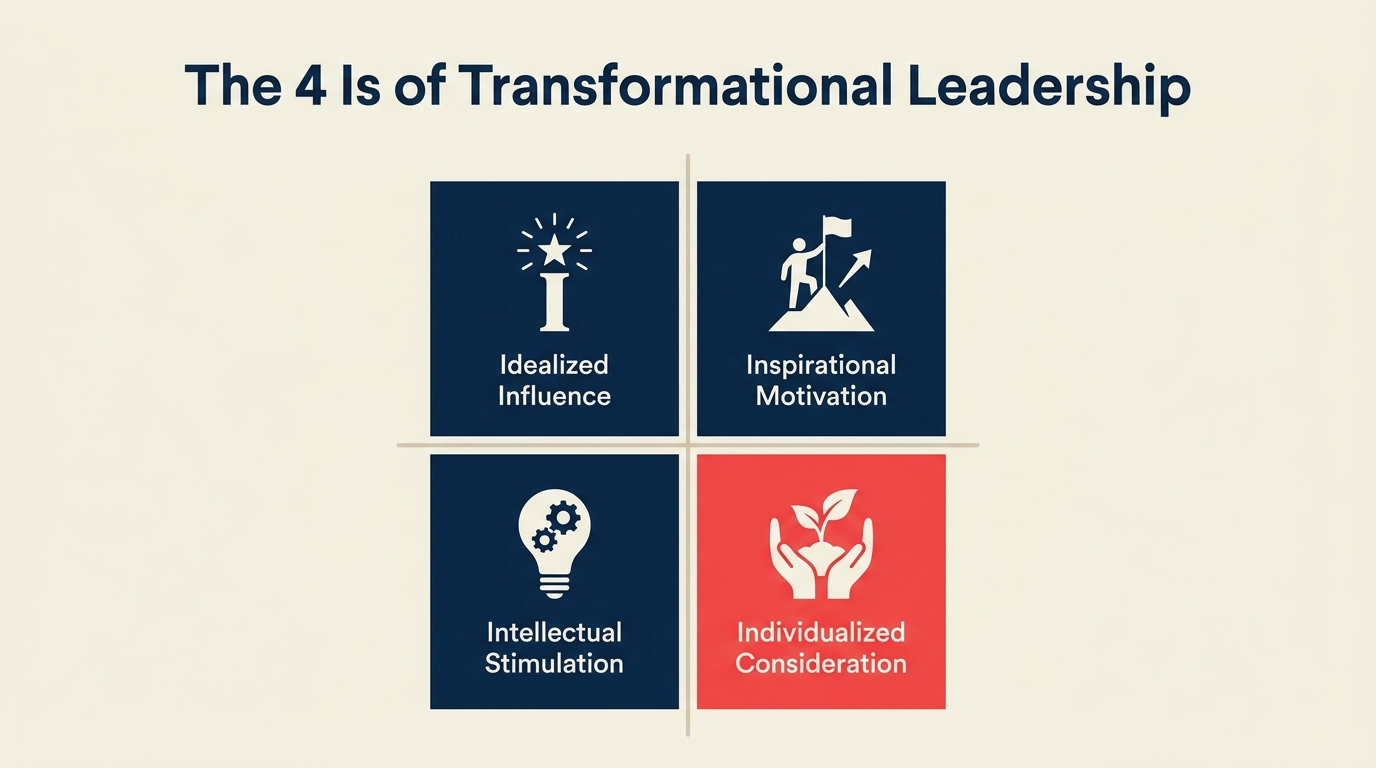
The 4 I's of transformational leadership are Idealized Influence, Inspirational Motivation, Intellectual Stimulation, and Individualized Consideration. Bernard Bass introduced this four-component structure in his 1985 book "Leadership and Performance Beyond Expectations," building on James MacGregor Burns's earlier distinction between transactional and transformational leadership. Together, the four I's describe how a transformational leader raises followers' motivation and performance beyond what they thought possible.
For the broader theory behind transformational leadership and its history, see what is transformational leadership theory.
Key Facts
- A quantitative study examining all four I's found the model statistically significant (F(4, 87) = 22.873, p = .001, R2 = .513), meaning the four components together explained approximately 51% of the variance in employee engagement (Waldenu Scholarworks, 2021).
- A meta-analysis covering 25 years of transformational leadership research found a mean corrected correlation of r = 0.41 between transformational leadership and job performance across 25 years of research (Frontiers in Psychology, 2022).
- Bass and Avolio's Multifactor Leadership Questionnaire (MLQ), the primary instrument for measuring the four I's, has been validated across nine organizational samples with reliability scores ranging from .74 to .94 (Mind Garden, 2023).
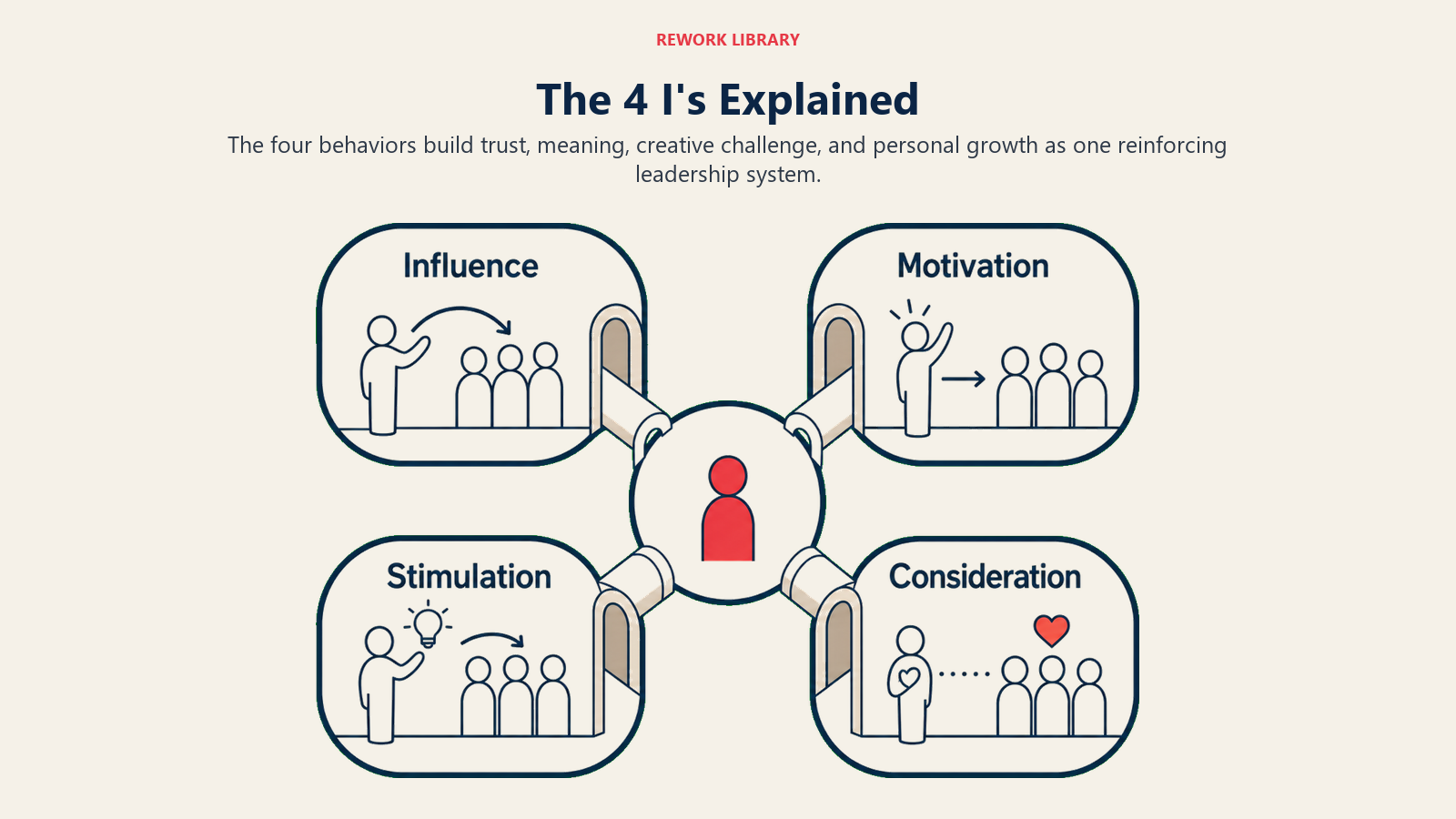
The 4 I's work as a set, not a menu. A leader can score high on one or two and still underdeliver the outcomes transformational leadership promises if the other components are missing. Bass was clear on this: the behaviors reinforce each other.
The 4 I's explained
Idealized Influence
Idealized Influence is the "role model" component. A leader with strong Idealized Influence earns the trust and respect of their team to the degree that followers want to emulate them. Bass sometimes called this "charismatic leadership," though the term Idealized Influence is more precise because it focuses on the leader's behavior rather than personality.
What it looks like in practice: the leader places the team's interests above personal gain, takes principled stands even when they're costly, and behaves consistently whether or not they're being observed. They're willing to say "I don't know" when they don't, and to take responsibility when things go wrong rather than deflecting.
A concrete example: imagine a VP of engineering who passes on a high-visibility project because it would pull three senior engineers off a product launch the team has been building toward for eight months. The short-term career cost is real. But the team notices, and their trust deepens. That trust compounds over time into the kind of commitment that makes a team resilient when real pressure hits.
Idealized Influence is often split into two dimensions in MLQ research: "attributed" (the trust followers place in the leader) and "behavioral" (the specific actions that generate that trust). Both matter. You can behave correctly and still fail to earn trust if the relationship history isn't there yet.
For comparison, charismatic leadership covers a related but distinct concept, focused more on personal magnetism than on the behavior-based model Bass describes.
Inspirational Motivation
Inspirational Motivation is how a transformational leader articulates and communicates a compelling vision of the future. It's not about being a gifted orator. It's about giving people a reason to care about the work that goes beyond the job description and the paycheck.
What it looks like in practice: the leader sets ambitious goals, communicates them in terms that connect to something the team actually values, and maintains visible optimism even when progress is hard. They repeat the "why" often enough that it becomes part of how the team talks about its own work.
A concrete example: a sales director facing a difficult quarter doesn't walk into the kickoff meeting and project the quota spreadsheet. Instead, she spends the first ten minutes talking about what winning this quarter would mean for the company's ability to expand into a market they've been building toward for three years. The quota becomes a milestone in a story, not a number to hit for its own sake. The team's approach to the quarter changes because their frame changes.
The distinction from Idealized Influence is important. Idealized Influence is about who the leader is (reliable, principled, trustworthy). Inspirational Motivation is about how the leader communicates (with vision, with purpose, with confidence in the team's capacity to get there).
Intellectual Stimulation
Intellectual Stimulation is the practice of encouraging followers to question assumptions, think creatively, and approach old problems from new angles. The leader doesn't have to be the smartest person in the room. They need to create conditions where intellectual risk-taking is safe.
What it looks like in practice: the leader asks "why do we do it this way?" without the question being a criticism. They present problems to the team rather than solutions. They reward people who surface inconvenient truths. They publicly credit team members whose ideas improve the work, even when those ideas push back on the leader's own position.
A concrete example: a product manager inherits a process where the team has been gathering user feedback through quarterly surveys for three years. Rather than defending the process, she brings the team together and asks: "If we had to design our feedback system from scratch today, knowing what we now know, what would we build?" Two engineers suggest a lightweight interview cadence. A designer proposes an in-app signal they hadn't been tracking. Within a month, the team is getting more actionable insight in real time than the quarterly survey ever produced.
The risk leaders make with Intellectual Stimulation is confusing it with just "having a creative culture." The behavior is more specific: the leader consistently and visibly invites challenge, even to their own ideas, and treats that challenge as a contribution rather than a threat.
Individualized Consideration
Individualized Consideration is the most personal of the four I's. It means treating each follower as an individual with their own needs, aspirations, and developmental trajectory. Not everyone wants the same thing from their work, and not everyone needs the same type of support from a leader.
What it looks like in practice: the leader has substantive one-to-one conversations that go beyond status updates. They know what each team member is working toward, what they find draining, and where they want to be in two or three years. They match challenges to developmental readiness rather than defaulting to "give it to whoever is least busy."
A concrete example: a team of six analysts includes one who is eager for visibility and stretch assignments, and another who is technically strong but very introverted and finds high-exposure projects draining rather than motivating. A leader practicing Individualized Consideration doesn't treat these two the same way. The first gets nominated for cross-functional project work. The second gets deep technical challenges and recognition through internal channels that don't require presenting to senior leadership.
This component is sometimes the hardest to sustain at scale. As teams grow, the number of individual relationships a leader has to maintain becomes harder to manage. But it doesn't require perfection. Even simple practices, like reviewing your team list before a one-to-one to ask yourself what you know about that person's current priorities and how they're doing, can preserve the intent of Individualized Consideration even in a busy week.
For more on how to calibrate support and direction to individual team members, the full range leadership model provides useful scaffolding alongside the four I's.
The 4 I's at a glance
| Component | Core Idea | Leader Behaviors | Employee Impact |
|---|---|---|---|
| Idealized Influence | Lead by example, earn deep trust | Put team before self, take accountability, behave consistently | Followers trust and want to emulate the leader |
| Inspirational Motivation | Articulate a vision worth working toward | Connect goals to purpose, stay optimistic, repeat the "why" | Followers commit to outcomes beyond the immediate task |
| Intellectual Stimulation | Invite challenge and creative thinking | Question assumptions publicly, reward dissent, present problems not solutions | Followers innovate and bring real ideas forward |
| Individualized Consideration | Treat each person as a person | Know each person's needs, tailor development, match challenges to readiness | Followers grow and feel genuinely seen |
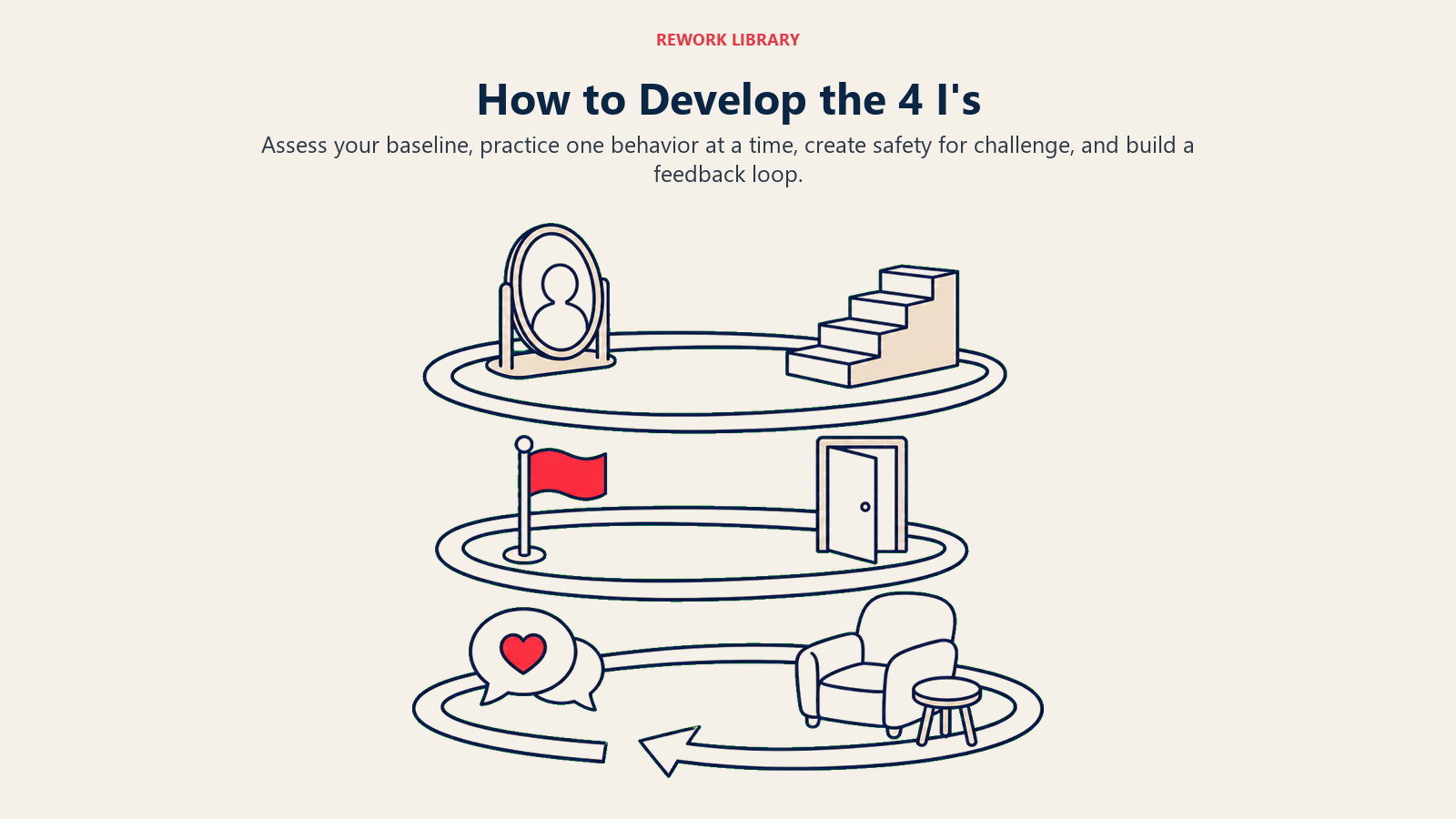
How to develop the 4 I's
Step 1: Assess your current baseline
Before you try to develop any of the four I's, get a clear picture of where you stand now. The MLQ (Multifactor Leadership Questionnaire) is the validated instrument Bass and Avolio developed for exactly this purpose. You can also run an informal 360: ask three or four people who know your leadership well to describe one situation where they saw each component at work, and one situation where they noticed it was missing. Their answers will be more actionable than any survey score.
Step 2: Build Idealized Influence through consistency
Trust is built in ordinary moments, not dramatic ones. Focus on one concrete behavior this month: do what you say you'll do, every time, for 30 days. Keep a running note of commitments you make in meetings and conversations, and track your completion rate. When you can't keep a commitment, name it and explain the change rather than hoping no one noticed. Most trust deficits trace back to small inconsistencies that accumulate, not to big failures.
Step 3: Develop Inspirational Motivation by practicing the vision narrative
Write a one-paragraph version of where your team is headed and why it matters. Use it to open your next all-hands or team meeting. Then ask your team to tell you, in their own words, what they think the team is working toward. The gap between what you said and what they heard is your development target. The 4 I's come alive when the whole team can articulate the vision without you in the room.
For context on how vision-setting fits into broader leadership practice, transformational vs transactional leadership covers the contrast in useful depth.
Step 4: Create psychological safety for Intellectual Stimulation
You can't command people to challenge you. You can only create conditions where it feels safe. Start with a single weekly practice: in your next team meeting, bring one decision you've already made and ask whether anyone sees it differently. Listen to the response without defending the decision. Then, if something useful comes up, say so specifically. That sequence (invitation, listening, visible acknowledgment) tells the team that challenge is welcome. Do it enough times and you'll start to see real ideas emerge.
Step 5: Build Individualized Consideration through knowledge
Before your next round of one-to-ones, write one sentence per person capturing: what they're proud of in their current work, what they find difficult, and where they want to be in 18 months. If you can't write those sentences, you need more conversations. The knowledge you're building here is the foundation of Individualized Consideration. You can't tailor development to a person you don't know.
Step 6: Use the 5 levels of leadership as a diagnostic
The five-level model maps closely to where a leader sits on the transformational spectrum. Levels 1 and 2 (position and permission) are transactional by nature. Levels 3 through 5 increasingly depend on Idealized Influence and Individualized Consideration to function. Knowing where you sit helps you identify which I's are most relevant to your current leadership context.
Step 7: Build a feedback loop
Developing the 4 I's is not a one-time project. Set a 90-day checkpoint: ask one or two trusted team members to tell you what they've noticed changing, if anything. Keep the question specific: "Have you noticed any change in how I respond when someone pushes back on an idea I've proposed?" Specific questions get specific answers. Specific answers are the only feedback you can act on.
4 I's examples by setting
Corporate team (technology company). A VP of product at a mid-size SaaS company notices her team has become risk-averse after a product failure the previous year. She uses Intellectual Stimulation to open up a "postmortem on our postmortems" session, asking the team to evaluate whether their failure analysis processes actually produce learning or just documentation. The session surfaces three process changes. The VP credits the team publicly. Over the next two quarters, the number of new feature proposals from the team triples.
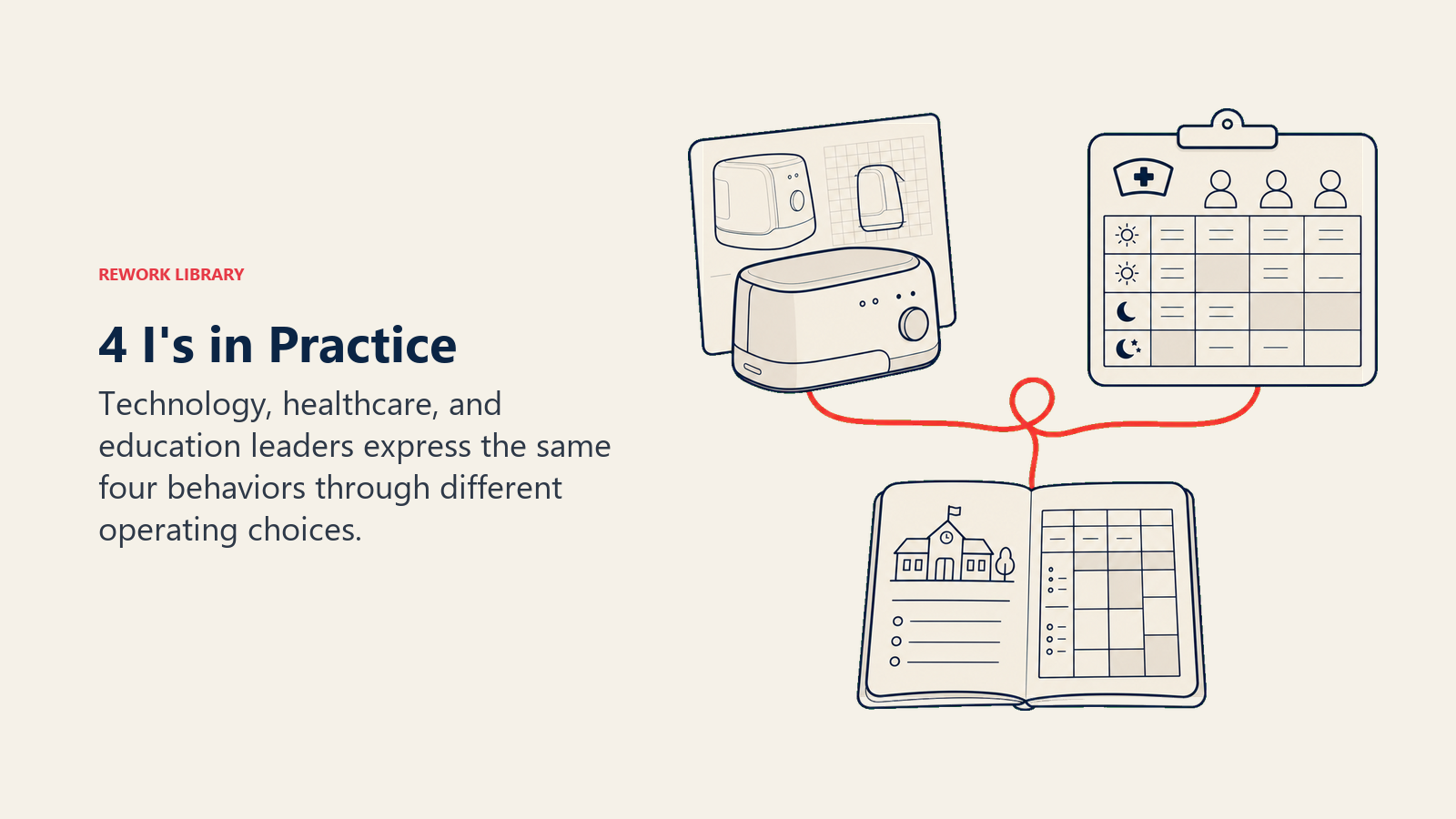
Healthcare (hospital unit). A head nurse on a busy hospital ward knows that two nurses on her team are early in their careers and find high-complexity cases overwhelming. Rather than assigning cases purely on availability, she pairs them with experienced nurses on the most complex cases for three months, debriefs with them after each shift, and tracks their confidence explicitly. That's Individualized Consideration built into a roster.
Education (school leadership). A principal sees low staff morale after a difficult inspection. Rather than presenting an improvement plan, he brings all teaching staff together and says: "I want to understand what makes this school worth fighting for, from your perspective." He listens for two hours, takes notes, and feeds the themes back into the school development plan. The act itself is Inspirational Motivation: it signals that the vision belongs to the whole staff, not just the administration.
For more on how the leadership pipeline model places these behaviors at different career levels, see the leadership pipeline model.
Common mistakes
Treating Idealized Influence as about image. Some leaders confuse it with projecting confidence or managing their personal brand. Idealized Influence is built on behavior, not perception management. Followers can tell the difference.
Using Inspirational Motivation as a substitute for clarity. A rousing speech about the company mission doesn't replace clear goals, defined roles, and realistic timelines. Both are necessary. Vision without structure produces enthusiasm and no results.
Using Intellectual Stimulation only in brainstorms. The behavior needs to be consistent across all settings, not confined to designated creative sessions. A leader who invites challenge in a workshop but shuts down pushback in a weekly status meeting sends a confusing signal.
Confusing Individualized Consideration with favoritism. Treating people differently based on their individual needs is not the same as treating people unequally. The distinction is the purpose: development-focused tailoring is equitable. It gives everyone what they need to succeed, which may not look identical for every person.
Trying to develop all four at once. The four I's reinforce each other over time, but they're each developed through specific behaviors. Pick one for 60 days. Build a feedback loop around it. Then move to the next.
Best practices
- Connect each I to your context. The four I's are a framework, not a script. What Individualized Consideration looks like for a team of five looks different on a team of fifty. Adapt the behaviors to your actual situation rather than following a generic playbook.
- Let the 4 I's be visible. Transformational leadership works partly because followers observe it. When you publicly credit an idea that challenged your own, when you visibly put the team's interests first, when you repeat the vision with genuine conviction, you're not just behaving correctly, you're modeling what the behavior looks like.
- Pair the 4 I's with the full range model. The four I's describe transformational behaviors, but most leadership situations require a mix of transformational and transactional elements. The full range leadership model shows how both fit together in a complete leadership repertoire.
- Use peer accountability. Find one other leader you trust and share what I you're working on this quarter. Check in monthly. Having to explain your progress to someone else makes the development work more concrete.
- Don't skip Individualized Consideration when you're under pressure. It's the one component that most often disappears when leaders get busy. But it's also the one that has the most direct effect on whether your best people stay. Build it into your calendar, not just your intentions. See the leadership pipeline model for how senior leaders systematically allocate development time.
- Apply the five exemplary practices alongside the 4 I's. Kouzes and Posner's model maps closely to Bass's framework. Five practices of exemplary leadership is a natural companion read.

Senior Operations & Growth Strategist
On this page
- What are the 4 I's of transformational leadership?
- The 4 I's explained
- Idealized Influence
- Inspirational Motivation
- Intellectual Stimulation
- Individualized Consideration
- The 4 I's at a glance
- How to develop the 4 I's
- Step 1: Assess your current baseline
- Step 2: Build Idealized Influence through consistency
- Step 3: Develop Inspirational Motivation by practicing the vision narrative
- Step 4: Create psychological safety for Intellectual Stimulation
- Step 5: Build Individualized Consideration through knowledge
- Step 6: Use the 5 levels of leadership as a diagnostic
- Step 7: Build a feedback loop
- 4 I's examples by setting
- Common mistakes
- Best practices