Bureaucratic Leadership: Definition, Pros, and Cons
Turn this article into takeaways for your work.


Each assistant summarizes the article only for you and suggests best practices for your work.
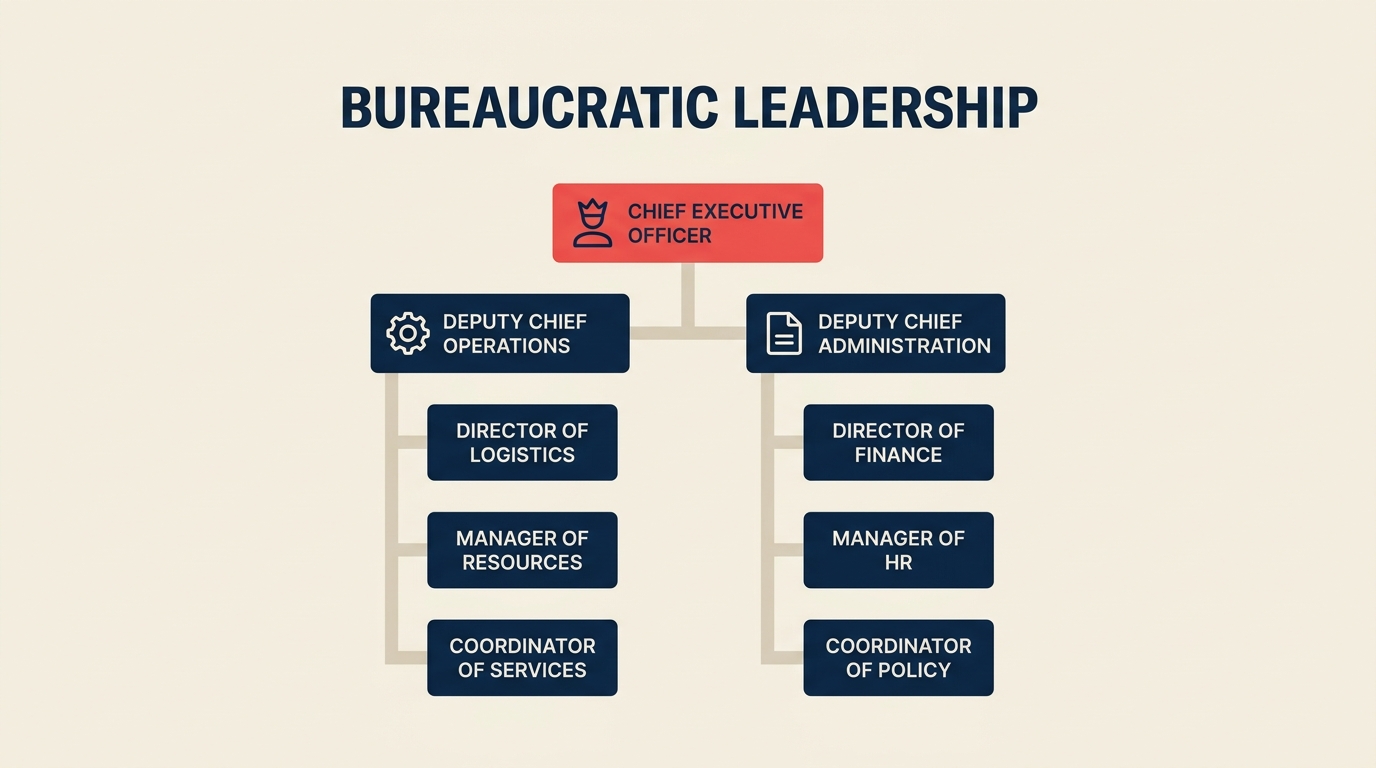
Bureaucratic leadership is the style built entirely on structure: defined roles, documented procedures, and a clear chain of command that everyone follows without exception. It doesn't rely on the personality of the leader, and it doesn't change based on individual circumstances. Rules are the authority here.
What is bureaucratic leadership?
Bureaucratic leadership is a management style where leaders and followers operate within a fixed set of rules, procedures, and a formal hierarchy. Decisions flow through defined channels, roles carry specific responsibilities, and authority comes from position rather than personal qualities.
The concept was formalized by German sociologist Max Weber in his 1922 work Economy and Society. Weber described bureaucracy as the most rational and efficient form of organization for large institutions, because it removes personal favoritism and replaces it with predictable, rule-based governance. He called legitimate positional authority "legal-rational authority," which is explored further on the page about types of power in leadership.
Key Facts
Max Weber's Economy and Society (1922) laid the theoretical foundation for bureaucratic leadership. Weber argued that bureaucracy, not charisma or tradition, was the dominant mode of authority in modern industrial societies.
Gallup's State of the Global Workplace 2024 found that employee engagement correlates strongly with role clarity. In organizations where people know exactly what is expected of them, engagement scores run significantly higher than in ambiguous environments.
A widely cited framing from Weber: "Bureaucracy develops the more perfectly, the more it is 'dehumanized', the more completely it succeeds in eliminating from official business love, hatred, and all purely personal, irrational, and emotional elements which escape calculation." Whether that is a virtue or a flaw depends on your context.
Key characteristics of bureaucratic leadership
Bureaucratic leadership has a consistent fingerprint across industries and organization sizes. The core traits are:
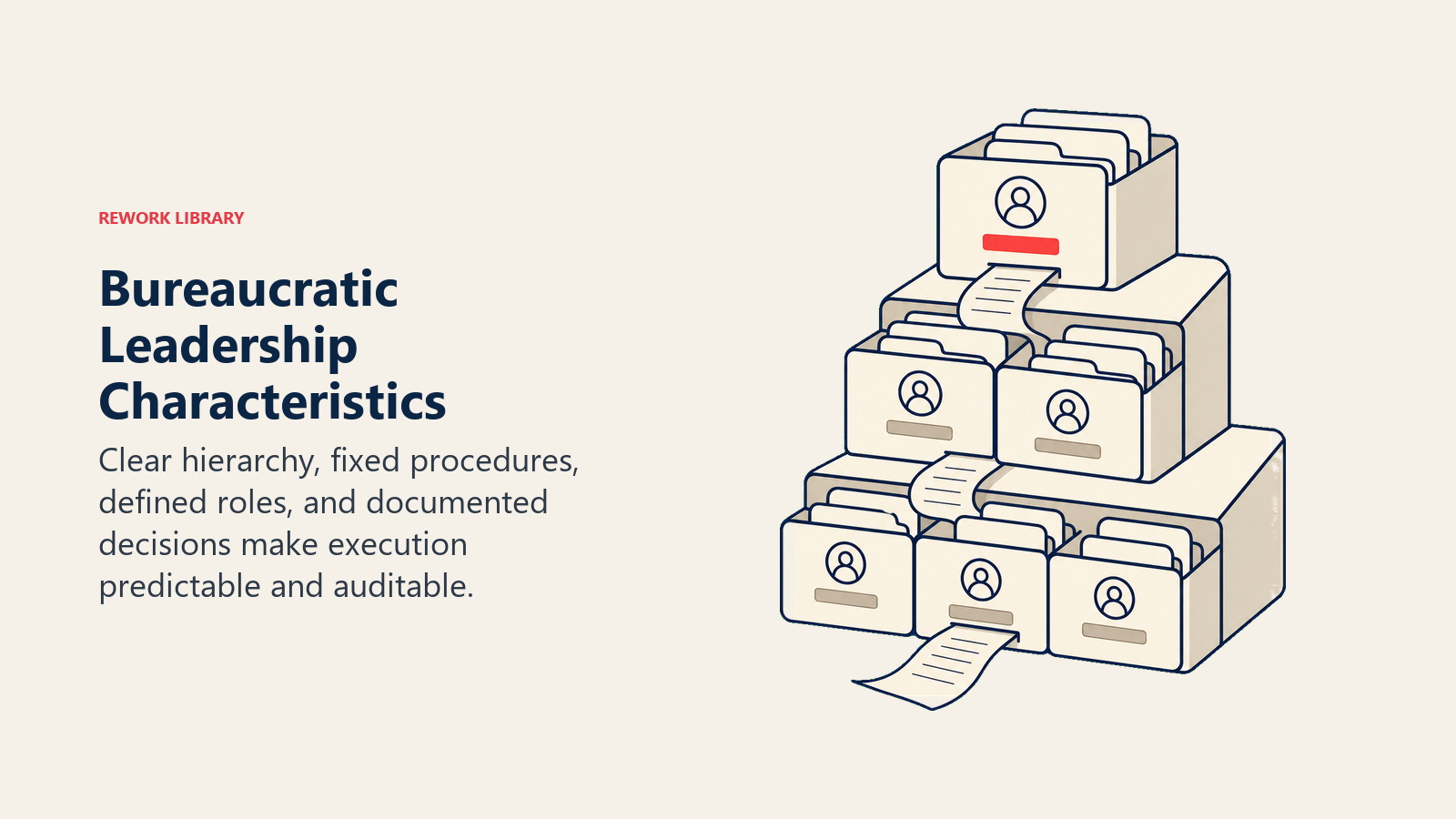
- Clear hierarchy. Every person reports to someone, and authority flows strictly top-down through the chain of command. This mirrors the scalar chain and unity of command that Henri Fayol set out in his administrative management principles.
- Fixed rules and procedures. Decisions follow documented policies. Leaders apply the rulebook consistently, not situationally.
- Defined roles. Each position has a specific job description. Overlapping responsibilities are resolved by formal protocol, not informal negotiation.
- Impersonal decision-making. Personal relationships don't influence how rules are applied. Everyone is subject to the same standards.
- Merit-based advancement. Promotions and assignments are tied to qualifications, performance metrics, or seniority rather than personal connections.
- Documentation. Actions, approvals, and decisions are recorded. There is always a paper trail.
This style sits at the opposite end of the spectrum from participative leadership, which invites team input before decisions are made. Bureaucratic leadership does not ask; it refers to the manual.
Bureaucratic vs autocratic vs democratic leadership
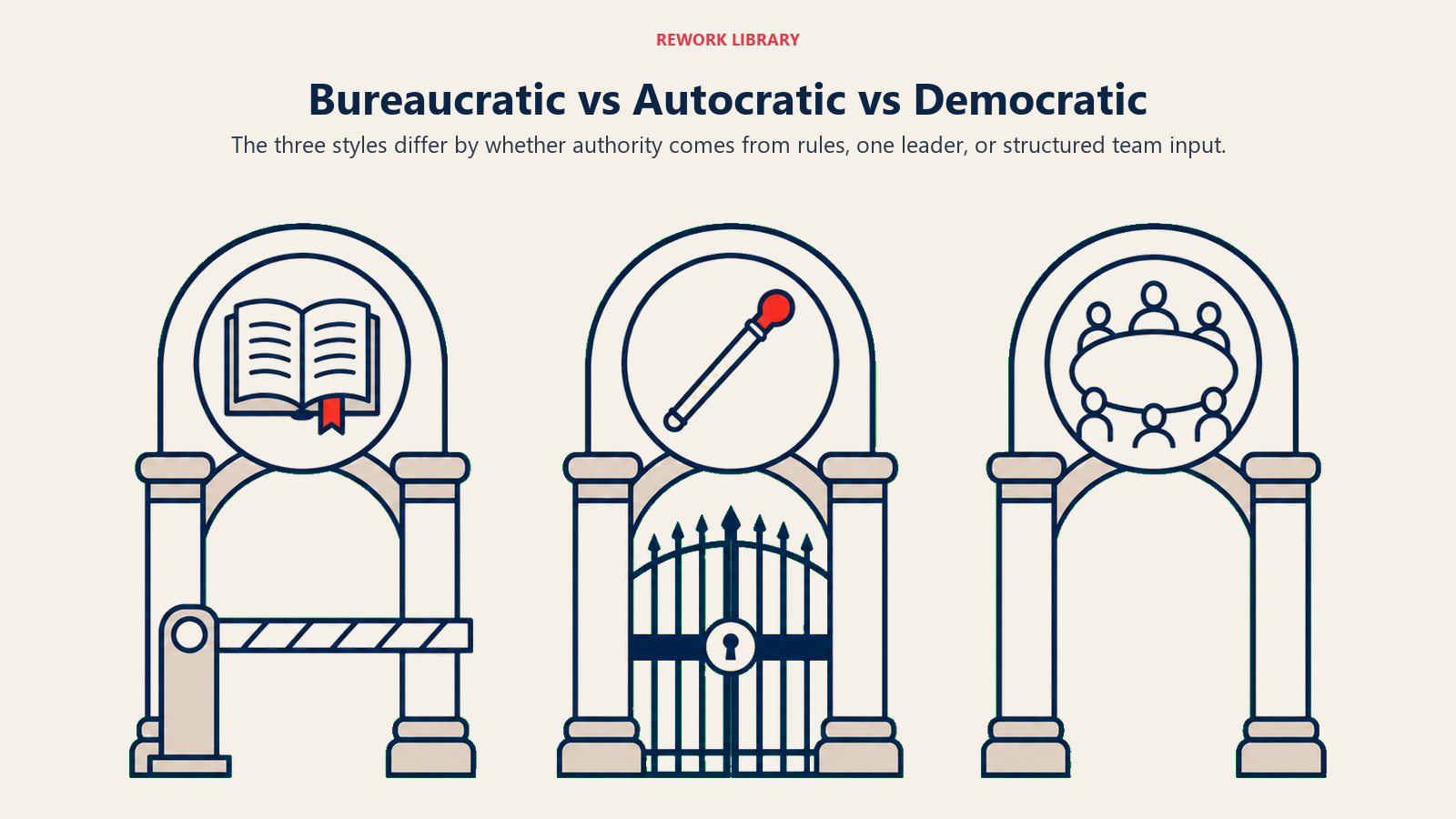
These three styles are often confused because all three involve a leader with clear authority. The differences matter in practice.
| Dimension | Bureaucratic | Autocratic | Democratic |
|---|---|---|---|
| Decision-making | Follows written rules and procedures | Leader decides unilaterally, often without documented process | Leader seeks team input before deciding |
| Source of authority | The position and the rulebook | Personal authority of the leader | Shared authority between leader and group |
| Flexibility | Low: rules apply to everyone equally | Moderate: leader can override rules personally | High: decisions adapt to context and team feedback |
| Consistency | Very high: identical situations get identical treatment | Variable: depends on leader's mood and priorities | Moderate: process is consistent but outcomes vary |
| Best-fit context | High-compliance industries, regulated environments, large public institutions | Crisis response, military operations, turnaround situations | Creative teams, knowledge work, collaborative cultures |
Autocratic leadership and bureaucratic leadership are related: both centralize control. But the autocratic leader is the authority, while the bureaucratic leader defers to the process. If the rulebook says the answer is no, a bureaucratic leader says no even if they personally disagree. An autocratic leader can override anything they want.
Lewin's leadership styles framework groups autocratic, democratic, and laissez-faire as the three anchors. Bureaucratic leadership maps most closely to the autocratic end of that spectrum but is distinguished by its impersonal, rule-bound nature.
Pros of bureaucratic leadership
1. Consistency and fairness. Every employee, client, or citizen is subject to the same rules. This reduces favoritism and makes the organization's behavior predictable.
2. Clear accountability. When something goes wrong, the chain of command and the paper trail make it straightforward to identify where the process broke down.
3. Compliance readiness. Regulated industries (banking, healthcare, government, aviation) need to demonstrate to auditors and regulators that defined procedures were followed. Bureaucratic leadership makes that evidence easy to produce.
4. Reduced decision fatigue. Front-line managers don't need to make judgment calls from scratch each time. The procedure tells them what to do. This speeds up routine decisions.
5. Scalability. Large organizations, including national governments and global corporations, rely on bureaucratic structures because informal or personality-driven leadership doesn't scale across tens of thousands of employees.
6. Stability during leadership transitions. Because authority lives in the role rather than the person, organizations don't collapse when a leader leaves. The next person steps into the same rulebook and keeps the operation running.
Cons of bureaucratic leadership
1. Slow adaptation. Changing a rule requires going through the formal change process. By the time the policy updates, the environment may have moved on.
2. Creativity is suppressed. When every action requires approval and must fit within documented procedures, unconventional ideas rarely survive the first approval gate.
3. Employee disengagement. Talented people who want ownership and autonomy find bureaucratic environments frustrating. Turnover risk is higher in highly-controlled settings.
4. Rules over common sense. The process can produce technically correct but practically absurd outcomes. Staff who could solve a customer problem in two minutes instead send them through a five-step form because the rules require it.
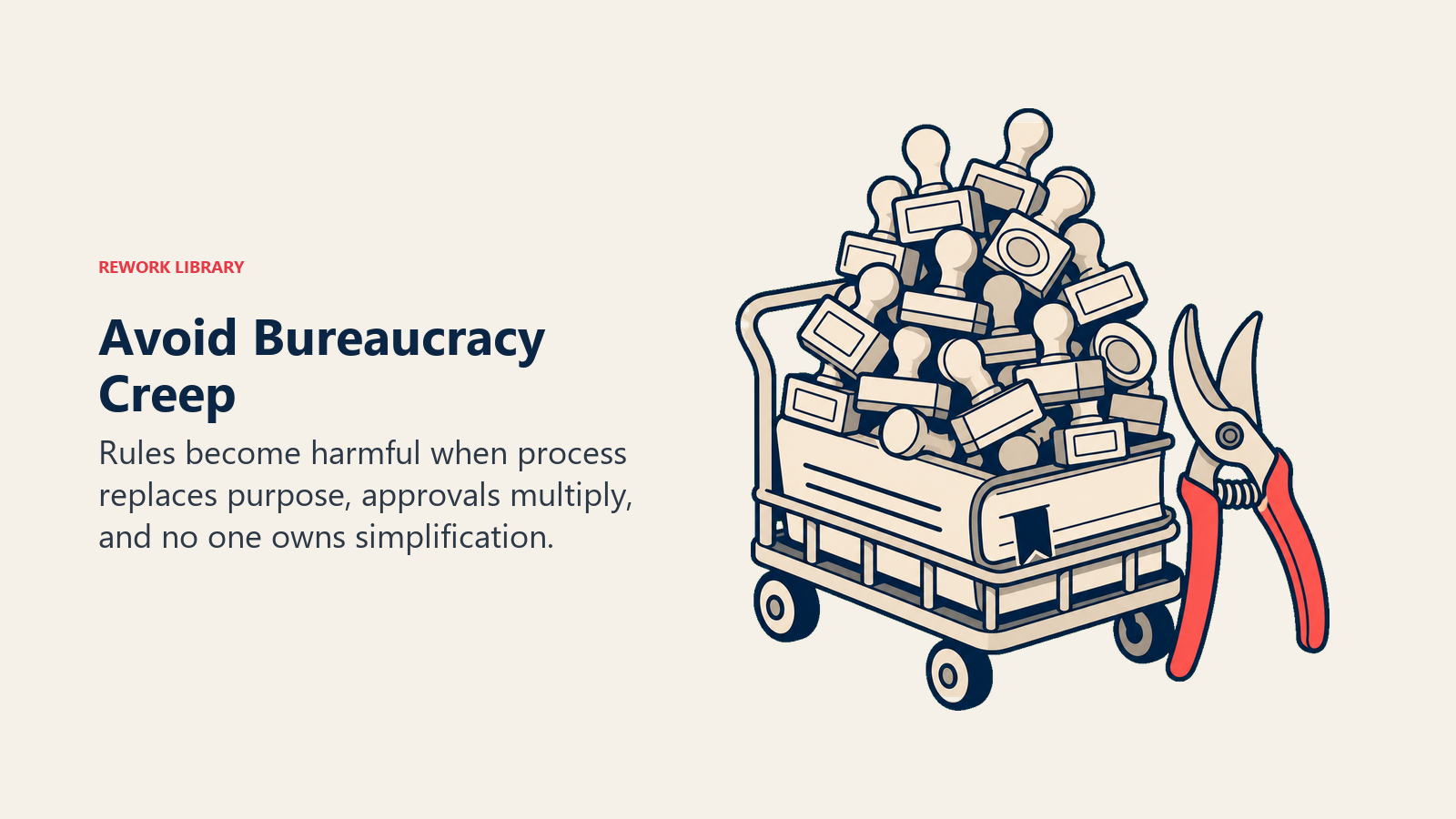
5. Bureaucracy creep. Over time, organizations add more rules and procedures without removing outdated ones. The system gets heavier each year, and no one has the authority to simplify it.
6. Poor fit for fast-moving sectors. Technology, startups, and creative agencies need rapid iteration. A bureaucratic structure can paralyze teams that need to move and adjust weekly.
When bureaucratic leadership works best
Some environments genuinely benefit from strict rules and defined authority. The key variable is whether consistency and safety matter more than speed and innovation.
| Setting | Why bureaucratic leadership fits |
|---|---|
| Government agencies | Must apply laws and policies uniformly across millions of citizens; consistency is a legal obligation |
| Healthcare and hospitals | Patient safety protocols require identical execution every time; a "judgment call" in surgery prep is a liability |
| Banking and financial services | Regulatory requirements mandate documented decision trails and consistent treatment of clients |
| Manufacturing (safety-critical) | Factory floor procedures prevent accidents; deviation from protocol carries physical risk |
| Military organizations | Rank-based authority and fixed procedures are essential for coordinated action under stress |
| Aviation | Pre-flight checklists and standardized crew procedures exist specifically because improvisation causes crashes |
Outside these contexts, the costs typically outweigh the benefits. Laissez-faire leadership or collaborative models tend to perform better in knowledge work, where the goal is good judgment rather than procedure compliance.
How to apply bureaucratic leadership effectively
If your organization requires a bureaucratic structure, these steps help you implement it without the worst downsides.
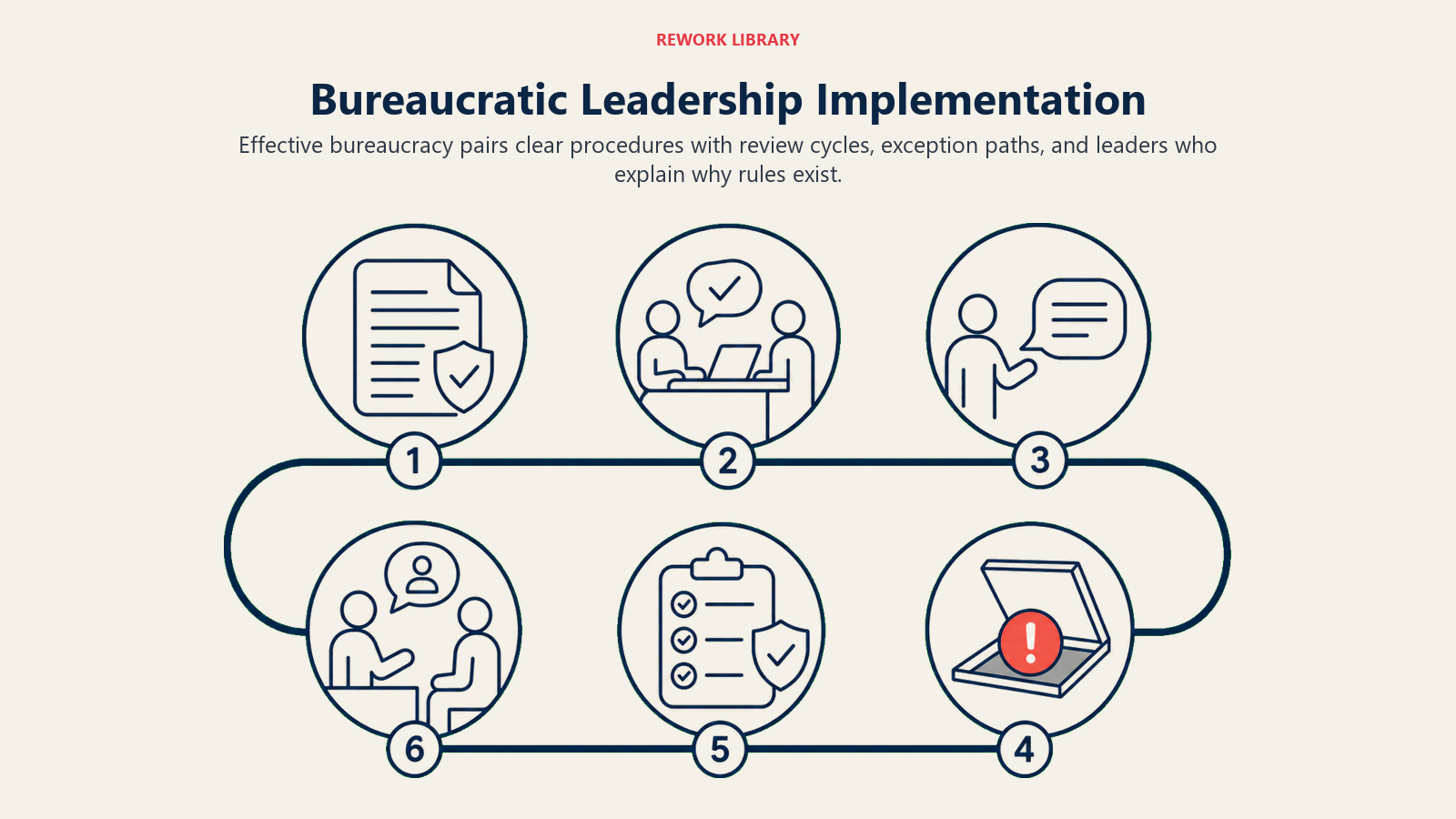
Step 1: Document your core procedures clearly
Vague rules create more arguments than no rules. Every procedure should specify who does what, under what conditions, and what approval is required. If a new employee couldn't follow the procedure from the document alone, rewrite it.
Step 2: Set up a formal review cycle for rules
Outdated procedures are the primary driver of bureaucracy creep. Assign ownership to each policy and schedule an annual review. Any rule that no longer serves a real purpose should be retired or simplified.
Step 3: Train leaders to explain the "why" behind rules
One of the biggest failure modes is telling staff to follow a rule without explaining its origin. When people understand the compliance, safety, or fairness rationale, they apply rules with better judgment in edge cases.
Step 4: Create an exception process
Not every situation fits the procedure perfectly. Build a formal path for exceptions that includes a named approver and a documented rationale. This preserves the benefits of consistency while preventing the most absurd rigid-rule outcomes.
Step 5: Protect compliance functions from informal workarounds
In practice, bureaucratic systems erode when senior people bypass the rules informally because they find them inconvenient. Leadership must model the same compliance it requires from front-line staff, or the whole structure loses credibility.
Step 6: Combine with coaching on interpersonal dimensions
Classic leadership styles research consistently shows that the compliance-focused dimensions of bureaucratic leadership need to be balanced with genuine attention to the people doing the work. Scheduled one-on-ones, growth conversations, and recognition for contribution reduce the disengagement risk inherent in high-control environments.
Common mistakes to avoid
Mistaking process for purpose. The rules exist to serve the organization's goals. When following the process prevents achieving the outcome, the process needs updating, not defending.
Applying bureaucratic structures to small teams. A five-person startup doesn't need a seven-step approval chain. Imposing bureaucratic procedures on small, agile teams kills the speed advantage that makes them competitive.
Leaving the change process unclear. If staff don't know how to get a rule updated, they work around it quietly or leave in frustration. A visible, functional change process keeps the system legitimate.
Confusing micromanagement with structure. Micromanagement is about personal control over individual behavior. Bureaucratic leadership is about institutional control through rules. Leaders who confuse the two add personal surveillance on top of procedural compliance, which compounds disengagement.
Treating all roles as equal in need of structure. Front-line roles in regulated industries benefit from clear procedures. Senior strategy roles in the same organization need room to exercise judgment. A single bureaucratic policy applied to every level is a design error.

Senior Operations & Growth Strategist
On this page
- What is bureaucratic leadership?
- Key Facts
- Key characteristics of bureaucratic leadership
- Bureaucratic vs autocratic vs democratic leadership
- Pros of bureaucratic leadership
- Cons of bureaucratic leadership
- When bureaucratic leadership works best
- How to apply bureaucratic leadership effectively
- Step 1: Document your core procedures clearly
- Step 2: Set up a formal review cycle for rules
- Step 3: Train leaders to explain the "why" behind rules
- Step 4: Create an exception process
- Step 5: Protect compliance functions from informal workarounds
- Step 6: Combine with coaching on interpersonal dimensions
- Common mistakes to avoid