Fiedler's Contingency Model of Leadership
Turn this article into takeaways for your work.


Each assistant summarizes the article only for you and suggests best practices for your work.
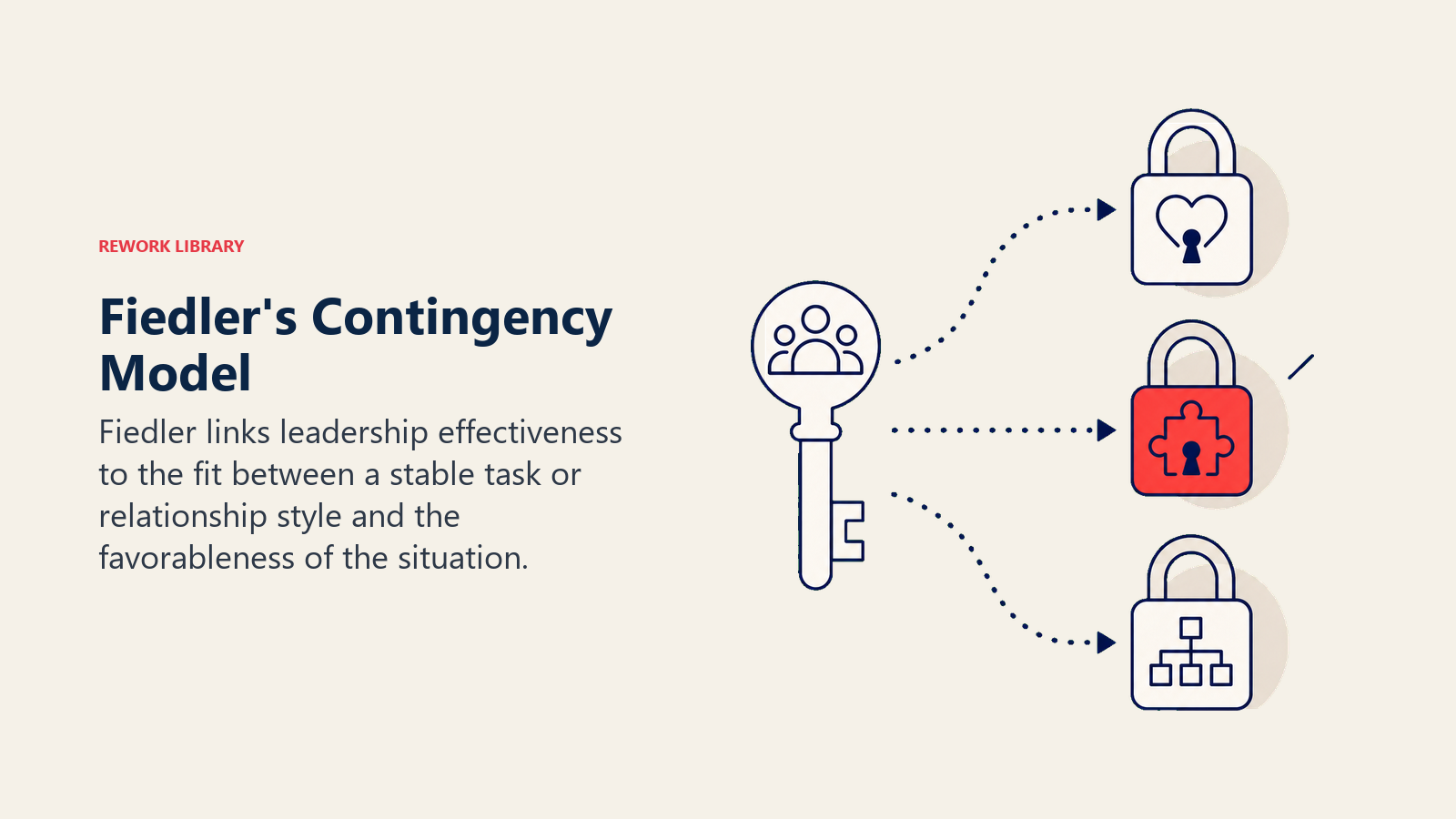
The Fiedler contingency model says that leadership effectiveness depends on how well a leader's natural style matches the demands of the situation. It's one of the most studied frameworks in organizational psychology, and its core premise cuts against a popular assumption: that great leaders can simply adapt their style to any context.
Fred Fiedler didn't buy that. His research, developed through the 1960s at the University of Illinois, concluded that leadership style is relatively fixed. So instead of changing the person, you change the situation.
What Is Fiedler's Contingency Model?
Fiedler's contingency model is a leadership theory that links a leader's effectiveness to the match between their dominant leadership style (measured by the Least Preferred Coworker (LPC) scale) and the degree of situational favorableness. When the match is strong, performance improves. When it's misaligned, even a capable leader underperforms.
The model is called a "contingency" theory because it argues that the right leadership approach is contingent on external conditions, not inherent to the leader alone. This places it in the same family as situational leadership theory and the path-goal theory of leadership, though Fiedler takes the sharpest position: he believed leadership style is a personality trait, not a learned behavior.
Key Facts
- Fred Fiedler introduced the contingency model in 1967 in his book A Theory of Leadership Effectiveness, based on over a decade of empirical research.
- Fiedler's studies spanned more than 800 groups across military, educational, and industrial settings, making it one of the largest leadership research programs of its era (Fiedler, 1967).
- A meta-analysis published in the Journal of Applied Psychology (Strube & Garcia, 1981) reviewed 145 studies of the model and found support for the basic contingency predictions across most situational octants.
The Least Preferred Coworker (LPC) Scale
The least preferred coworker (LPC) scale is a short survey that asks leaders to think about the person they found hardest to work with (not necessarily someone they dislike personally, but the colleague whose working relationship felt most frustrating). Respondents rate that person on a set of bipolar adjectives (pleasant/unpleasant, friendly/unfriendly, efficient/inefficient, and so on).
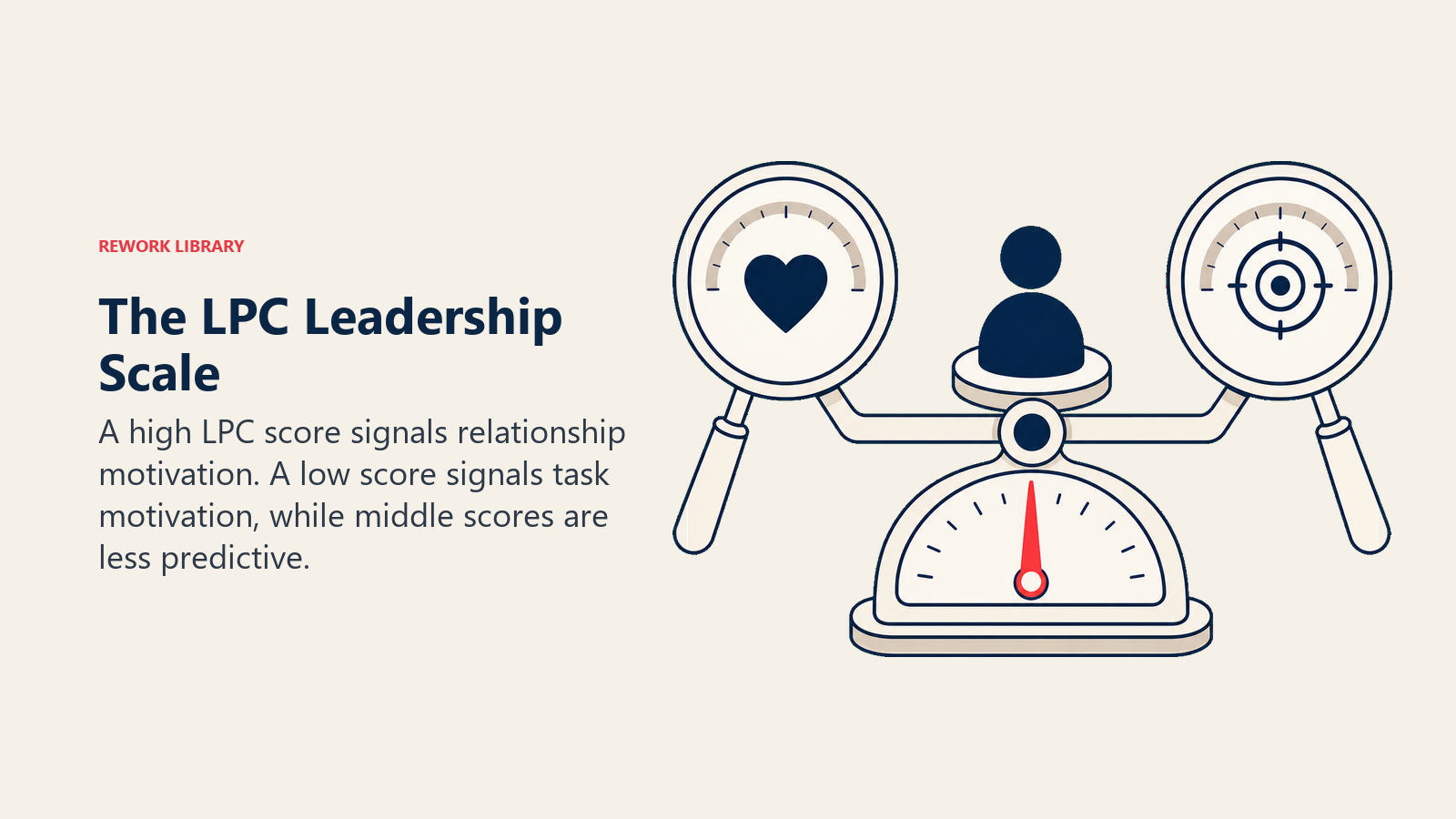
The score determines a leader's primary orientation:
| LPC Score | Orientation | What it means |
|---|---|---|
| High LPC (64+) | Relationship-motivated | Even when describing their worst collaborator, the leader finds redeeming qualities. They prioritize interpersonal connection and use task completion as a secondary path to self-esteem. |
| Low LPC (57 or below) | Task-motivated | The leader rates their least preferred coworker harshly across all dimensions. Getting work done is the primary driver; relationships matter less. |
| Middle range (58-63) | Mixed | Results are less predictive; additional context is needed. |
High-LPC leaders tend to build strong team morale and perform well in moderately favorable situations where relationships matter. Low-LPC leaders tend to focus on structure and productivity, and perform well at the extremes: highly favorable or highly unfavorable situations where clear direction is most valuable.
The LPC measure is unusual in one respect: it says more about the rater than about the person being rated. Fiedler treated this as a proxy for motivational hierarchy, not interpersonal judgment.
For more on how style taxonomies compare, see behavioral leadership theory.
The 3 Situational Factors
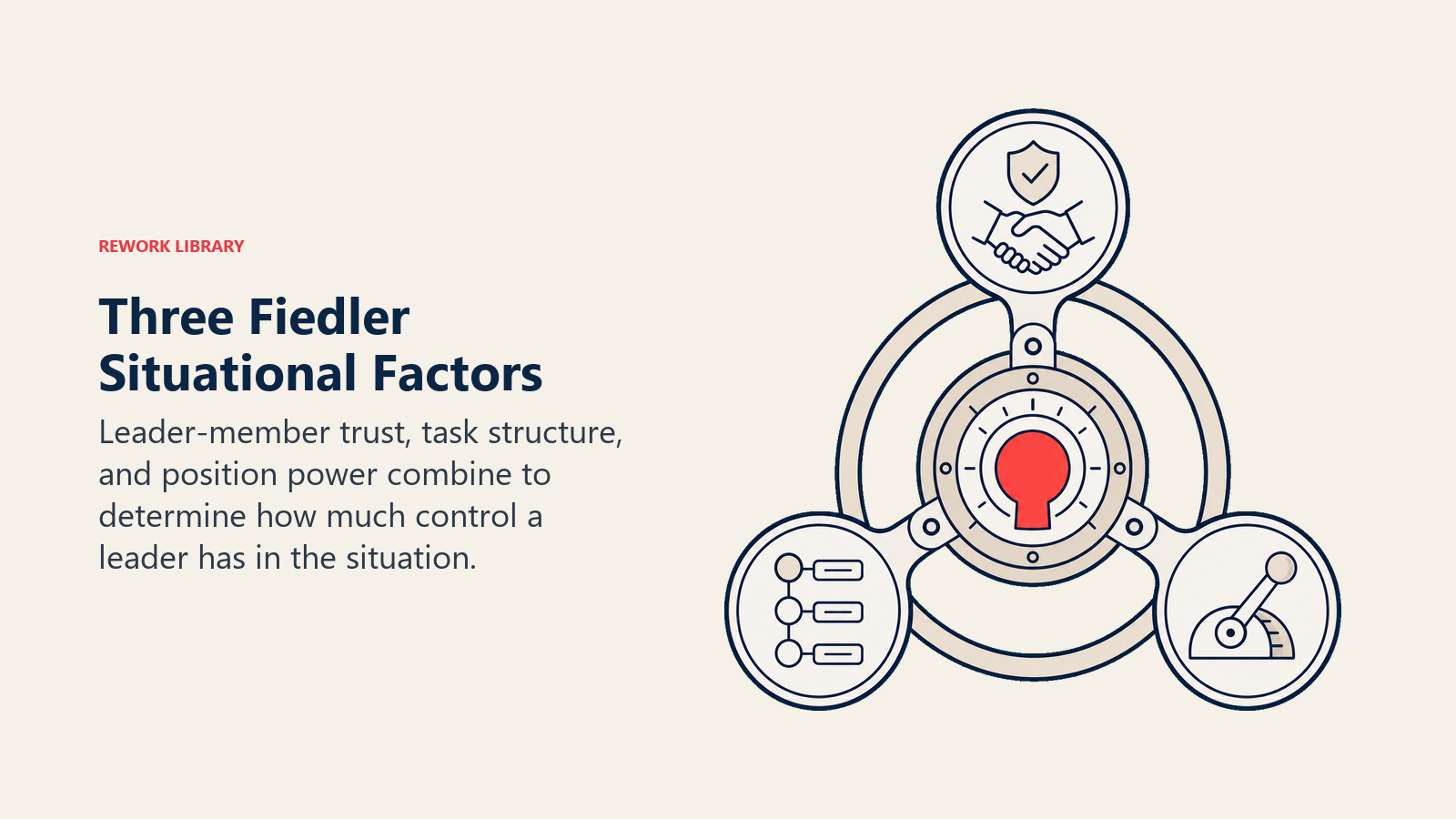
Fiedler measured situational favorableness using three variables. Together they determine how much control and influence a leader has over the group and its outcomes.
| Factor | What it measures | Favorable end | Unfavorable end |
|---|---|---|---|
| Leader-Member Relations | The degree of trust, respect, and confidence the group has in the leader | High trust, willing followers | Distrust, poor morale |
| Task Structure | How clearly defined the task, goals, and procedures are | Clear tasks, step-by-step procedures | Ambiguous goals, no clear method |
| Position Power | The formal authority the leader holds, including the power to reward or punish | Strong formal authority | Weak or no formal authority |
Leader-member relations carries the most weight of the three. Fiedler argued that a leader who has the group's trust can often compensate for a poorly structured task or weak positional authority. But the reverse isn't true: all the formal authority in the world doesn't help if the team fundamentally doesn't trust the person leading them.
Matching Style to Situation
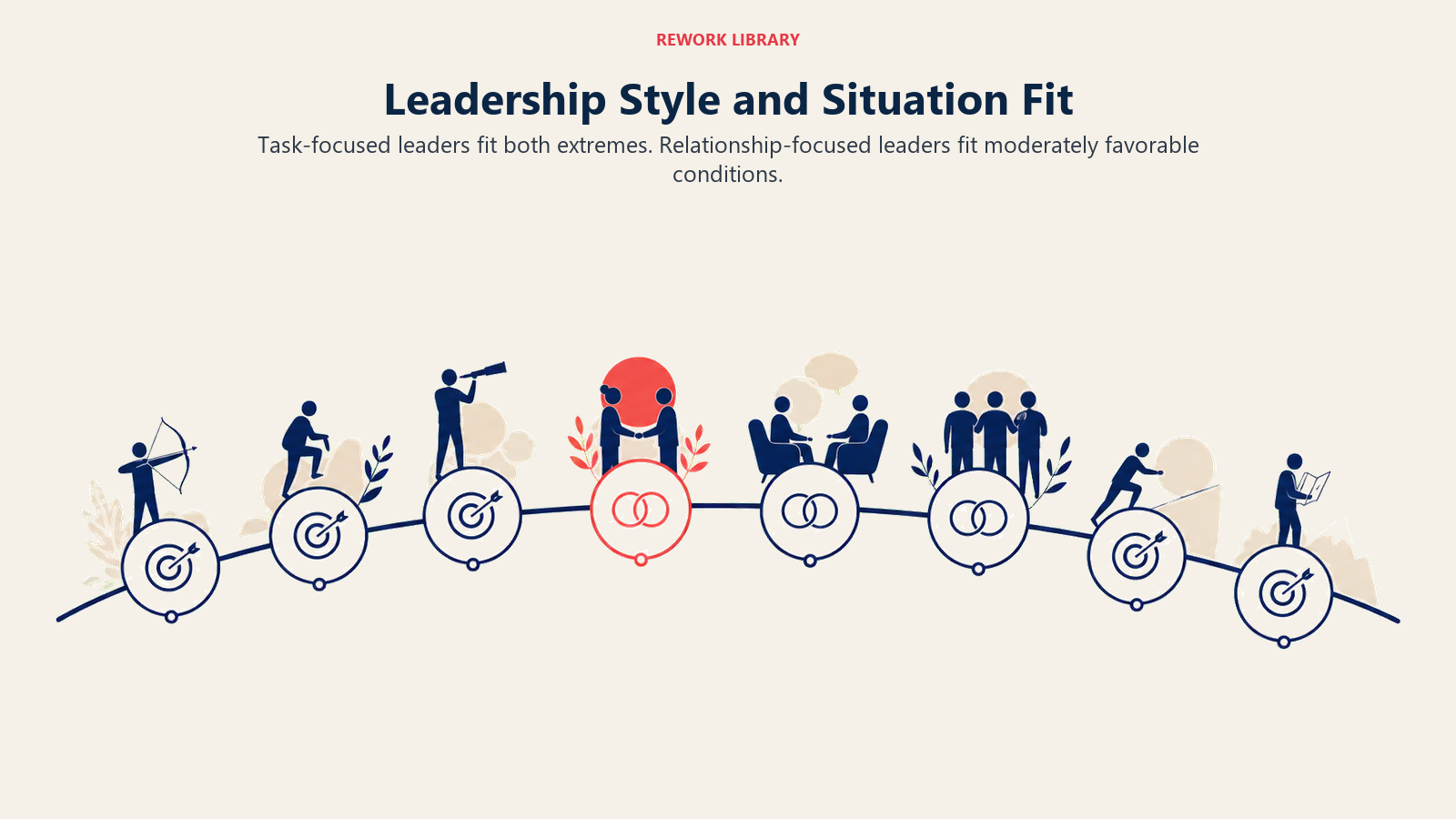
Combining the three factors produces eight possible situational combinations, called octants. Fiedler ranked these from most favorable (Octant I) to least favorable (Octant VIII).
| Octant | Leader-Member Relations | Task Structure | Position Power | Best Fit |
|---|---|---|---|---|
| I | Good | High | Strong | Low-LPC (task-motivated) |
| II | Good | High | Weak | Low-LPC |
| III | Good | Low | Strong | Low-LPC |
| IV | Good | Low | Weak | High-LPC (relationship-motivated) |
| V | Poor | High | Strong | High-LPC |
| VI | Poor | High | Weak | High-LPC |
| VII | Poor | Low | Strong | Low-LPC |
| VIII | Poor | Low | Weak | Low-LPC (task-motivated) |
The pattern that emerges: low-LPC (task-motivated) leaders perform best in the most favorable situations (I-III) and the least favorable situations (VII-VIII). High-LPC (relationship-motivated) leaders perform best in the middle ground (IV-VI) where interpersonal trust and flexibility matter more than task control.
Why the extremes favor task-motivated leaders: In very favorable conditions, the work is clear, the team is on board, and the leader mainly needs to keep things organized and moving. In very unfavorable conditions, structure collapses and the leader needs to impose direction quickly. In both cases, a task focus wins. The middle range requires more social navigation, where relationship-oriented leaders have an edge.
How to Apply Fiedler's Model
Fiedler's practical advice is counterintuitive but direct: rather than coaching leaders to adapt their style, organizations should engineer situations to match the leader they have.
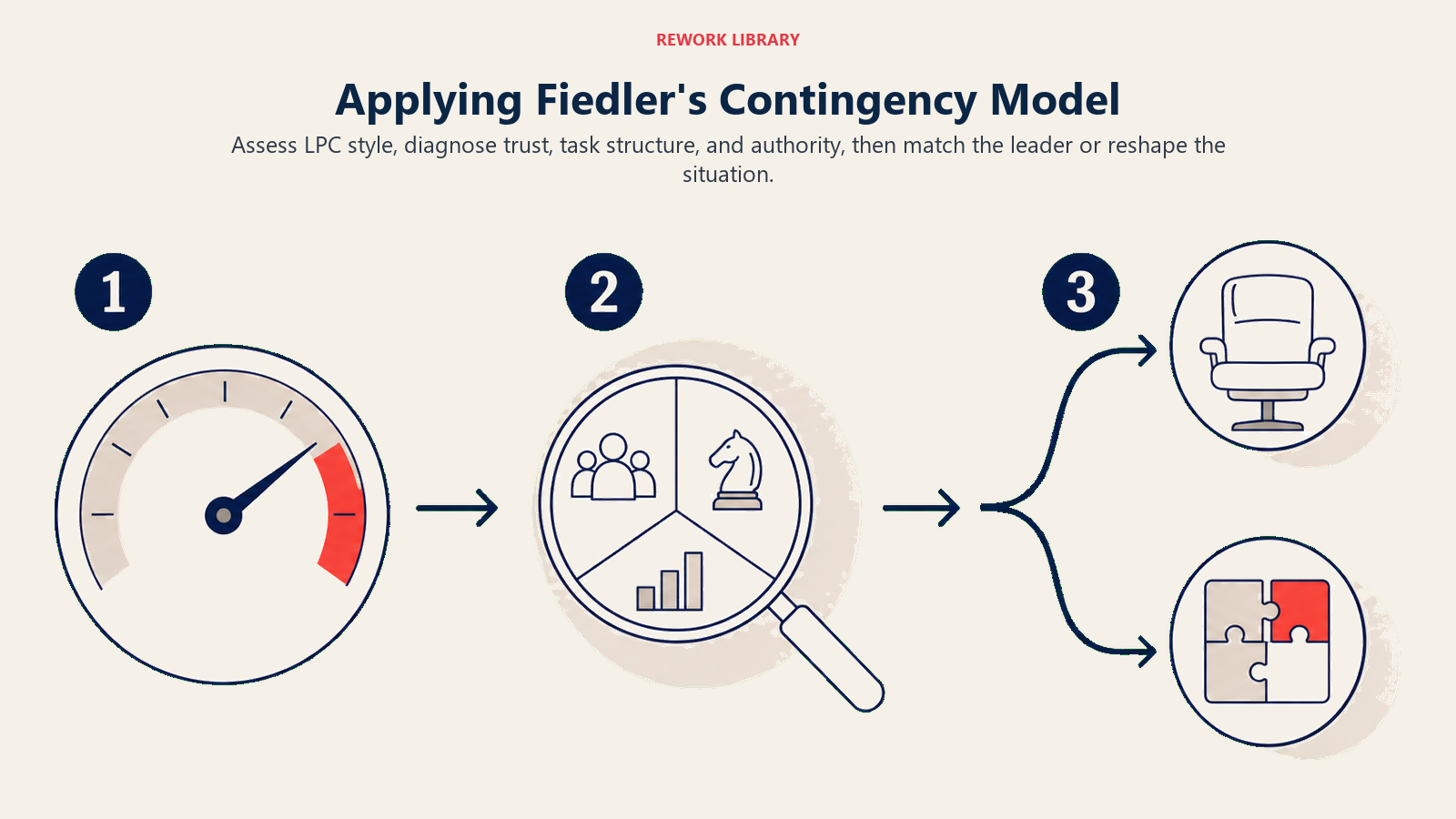
Step 1: Assess Your LPC Style
Complete the LPC survey honestly. Think of the person you found most difficult to work with and rate them on the bipolar scales. If your score is high, you're relationship-motivated. If it's low, you're task-motivated. Treat this as a stable trait, not a flaw.
Step 2: Diagnose the Situation
Rate your current environment on the three factors:
- Leader-member relations: Do your direct reports trust and respect your judgment? Be honest, not optimistic.
- Task structure: Are your team's goals and procedures clear, or does significant ambiguity exist?
- Position power: Do you have formal authority to assign work, give raises, or make personnel decisions?
Map where you land across the eight octants. The goal isn't to game the system but to understand the actual conditions you're working in.
Step 3: Match or Change the Situation
If your style matches the octant, proceed. If it doesn't, look at what situational variables you can adjust:
- Improve leader-member relations by spending more time with team members, addressing conflict early, or asking for input on decisions.
- Increase task structure by creating clearer SOPs, breaking work into smaller defined steps, or introducing project management tools.
- Adjust position power by negotiating more formal authority (budget sign-off, hiring input) or by clarifying decision rights with your own manager.
The underlying logic: if you can't change the leader's style, change the conditions until they match. This is the diagnostic move that separates Fiedler's model from purely prescriptive leadership theories.
Strengths and Criticisms
Fiedler's model has held up better than most 1960s leadership theories, largely because it's built on empirical data rather than normative ideals. But it attracts real criticism too.
| Dimension | Strength | Criticism |
|---|---|---|
| Empirical base | Grounded in research across 800+ groups; meta-analyses confirm core predictions | Many studies used self-report data; LPC validity has been questioned |
| Practical focus | Gives leaders a diagnostic tool and actionable levers | The three-factor model oversimplifies complex organizational dynamics |
| View of leadership style | Reflects real-world observation that some leaders are more consistent than adaptable | Treats style as fixed, which underestimates how much leaders can grow and shift |
| Situational engineering | Offers a way to improve effectiveness without personality change | Restructuring situations is often politically and practically difficult |
| LPC scale | Simple to administer; produces consistent scores | The psychological basis for LPC as a motivational measure remains contested |
The strongest critique: the model says you can't change a leader's style, which sits uneasily with most modern leadership development programs. Fiedler's response was that development should focus on matching people to situations, not on trying to make relationship-motivated people into task-focused ones and vice versa.
Fiedler's Model vs Other Contingency Theories
Fiedler's model launched an entire family of contingency frameworks. Here's how it compares to two that built on its foundation.
| Theory | Core claim | Who adapts | Key variable |
|---|---|---|---|
| Fiedler's Contingency Model (1967) | Style is fixed; change the situation | The organization | Situational favorableness |
| Situational Leadership Theory (Hersey & Blanchard, 1969) | Leaders should flex style based on follower readiness | The leader | Follower development level |
| Path-Goal Theory (House, 1971) | Leaders should clear obstacles and align rewards to the path | The leader | Follower motivation and task characteristics |
The defining split: Fiedler's model asks the organization to engineer the situation around the leader. Situational leadership and path-goal theory both ask the leader to adapt. In practice, most managers blend the approaches: they work on developing range while also being honest about the situations where they genuinely shine.
For a broader view of how these theories connect, see leadership theories overview and contingency leadership theory.
Fiedler's contingency model remains useful not because it solves the leadership puzzle, but because it forces a more honest question: are you in the right situation for your style? Before spending months trying to become a different kind of leader, it's worth diagnosing whether the problem is the match, not the person. Sometimes the most effective leadership development move is moving to a situation where you're actually set up to win.
Related reading
- Contingency leadership theory for the broader framework family
- Situational leadership theory for the adaptive style alternative
- Path-goal theory for motivation-centered contingency thinking
- Behavioral leadership theory for how style research evolved before Fiedler
- Leadership theories overview for context across all major schools

Senior Operations & Growth Strategist
On this page
- What Is Fiedler's Contingency Model?
- The Least Preferred Coworker (LPC) Scale
- The 3 Situational Factors
- Matching Style to Situation
- How to Apply Fiedler's Model
- Step 1: Assess Your LPC Style
- Step 2: Diagnose the Situation
- Step 3: Match or Change the Situation
- Strengths and Criticisms
- Fiedler's Model vs Other Contingency Theories
- Related reading