Stakeholder Management: How Executives Build Alignment and Protect Decisions

Turn this article into takeaways for your work.


Each assistant summarizes the article only for you and suggests best practices for your work.
Every significant decision an executive makes has a stakeholder landscape. Some of those stakeholders will make the decision easier to execute. Some will make it harder. Some will block it entirely if not engaged correctly.
Stakeholder management is the discipline of understanding that landscape and working it deliberately, before a decision needs defending, not after it has already run into opposition.
What Stakeholder Management Actually Is
Stakeholder management is often misunderstood as either political maneuvering or box-ticking. Neither captures it.
At its core, stakeholder management is about identifying whose support you need for important decisions, understanding what they care about, and building relationships and communication cadences that generate that support rather than having to battle for it at the last minute.
It is a leadership discipline, not an administrative one. Organizations where leaders manage stakeholders well make faster decisions, implement them more successfully, and recover more quickly from mistakes.
Identifying Your Stakeholders
Stakeholder identification starts with a simple question: who has influence over this decision, or who will be materially affected by it?
The answer usually produces a longer list than executives expect. A budget reallocation decision might involve the CFO, the board, affected department heads, key customers who depend on the investments being cut, and external partners whose contracts may be implicated.
There are three broad categories of stakeholder:
Internal stakeholders are within the organization: board members, executive peers, department heads, key individual contributors whose buy-in is needed for execution, employee representatives or unions where applicable.
External stakeholders are outside the organization: customers, investors, regulators, partners, suppliers, media, community or advocacy groups.
Informal influencers hold influence that is not captured by their title. The long-tenured executive who is technically a peer but commands disproportionate organizational loyalty. The large customer whose opinion shapes what the industry thinks. The former board member who still takes calls from current directors. These are as important as the formal stakeholders and often more neglected.
Stakeholder Mapping
Once stakeholders are identified, the most useful next step is mapping them on two dimensions: influence (how much power do they have to affect the outcome?) and interest (how much do they care about this particular issue?).
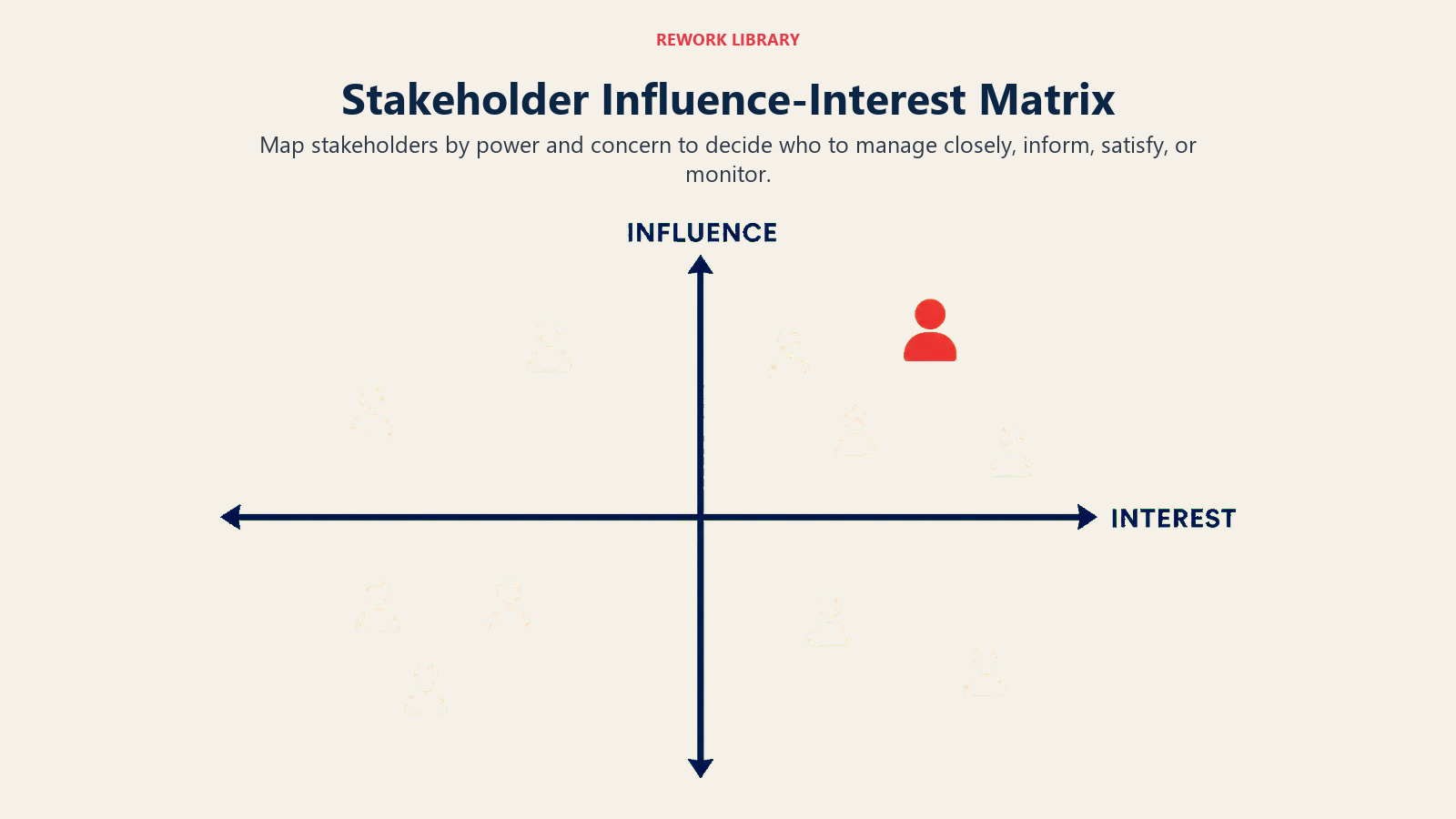
This produces four quadrants:
High influence, high interest: these are your primary stakeholders. They require the most engagement, the most transparency, and the earliest involvement in significant decisions.
High influence, low interest: these stakeholders can be decisive if they engage. The risk is that something activates their interest late in the process, at which point they can derail decisions they barely knew existed. Keeping them informed, even when they are not actively engaged, reduces that risk.
Low influence, high interest: these stakeholders care deeply and can be vocal, but their ability to block decisions is limited. They deserve genuine engagement, not just management. Dismissing their concerns tends to push them toward other stakeholders who do have influence.
Low influence, low interest: light-touch communication is appropriate. The risk to manage here is ignoring them so completely that they migrate into a more engaged category without you noticing.
The map is not static. Influence and interest shift with context. A regulatory agency that is low interest on normal operational decisions becomes high interest if the company enters a new regulated activity. A customer who is low influence becomes high influence if they represent a significant revenue concentration and go public with a complaint.
Building Stakeholder Relationships
The most common mistake executives make with stakeholders is treating the relationship as instrumental: I only engage when I need something.
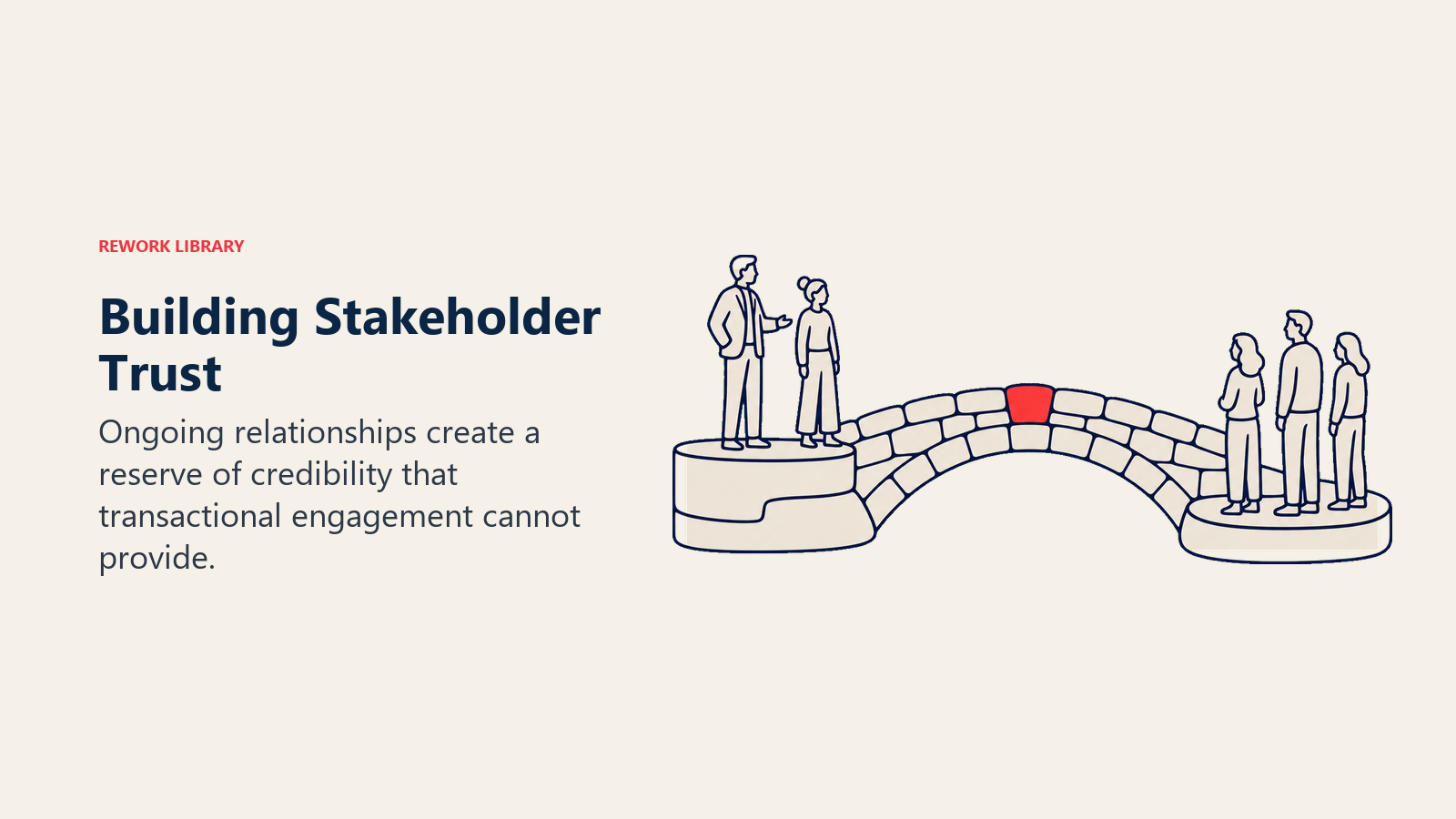
Stakeholder relationships built on a transactional basis are fragile. They require constant renewal because there is no reserve of trust and goodwill to draw on when things get hard.
The executives who manage stakeholders most effectively build ongoing relationships, not episodic ones. They know what their key stakeholders care about beyond the immediate issue at hand. They understand their stakeholders' constraints, their political contexts, their definitions of success. And they invest in those relationships during quiet periods, not just before a significant decision needs to be made.
Practical mechanics for building ongoing relationships:
Regular check-ins with no agenda. A thirty-minute quarterly call with a key board member, a regular lunch with a major customer, a biannual conversation with a key regulator or industry body. The value is not in any single conversation. It is in the relationship that accumulates over many of them.
Sharing information early. Stakeholders who hear about significant decisions from you before they hear about them from others develop trust. Stakeholders who find out about decisions through the grapevine or the press develop wariness. The discipline of identifying your key stakeholders and making sure they hear important news from you first, even when the news is not fully formed, pays off consistently.
Following up on things they raised. If a stakeholder raised a concern in a previous conversation and you committed to look into it, actually look into it and report back. This sounds obvious but is poorly practiced. The track record of taking stakeholder input seriously and visibly acting on it (or explaining why you did not) is one of the strongest trust builders available to an executive.
Communicating With Stakeholders
Stakeholder communication is not a one-size-fits-all activity. Different stakeholders have different communication preferences, different levels of technical depth they need, and different decision-relevant questions they bring.
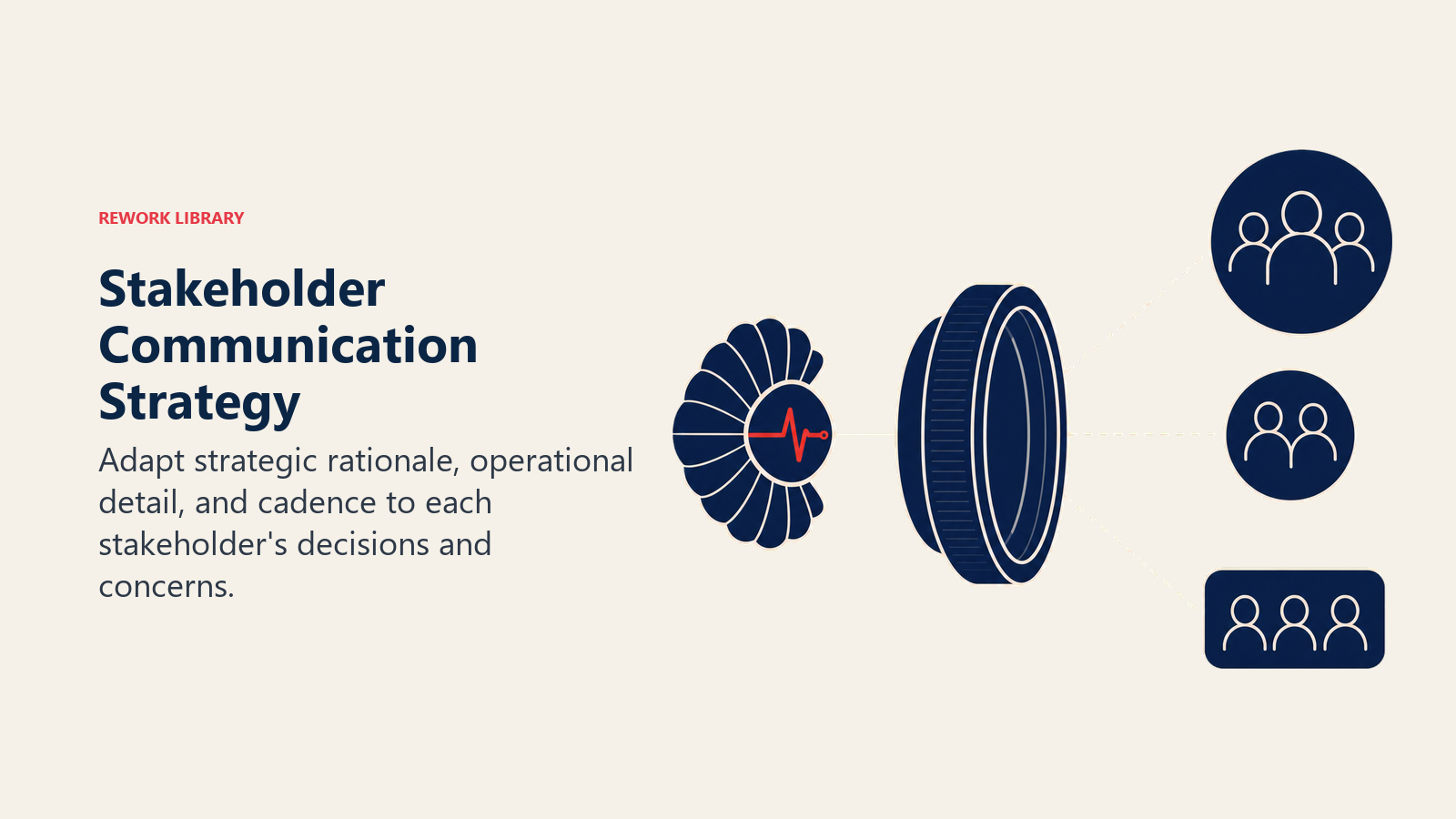
A board member wants to understand the strategic rationale, the financial implications, and the key risks. They do not want a detailed project plan. A department head affected by a change wants to understand what it means for their team, what their role in implementation is, and how their concerns will be heard. A major customer wants to understand how it affects them, whether their service continuity is protected, and who to call if they have questions.
Developing a stakeholder communication plan for significant decisions means:
Sequencing. Who hears about it first? The sequence matters. Getting it out of order, where a downstream stakeholder hears about a decision before an upstream one who should have been consulted, can damage relationships that take months to repair.
Mode. Some stakeholders need a personal conversation. Others can be managed through written updates. Getting the mode wrong (sending an email to someone who needed a conversation) communicates carelessness.
Message customization. The core message is consistent: what the decision is, why it was made, what happens next. The framing and emphasis should be tailored to what each stakeholder group cares about.
Feedback loops. Communication should not be entirely one-directional. Building in structured opportunities for stakeholders to raise concerns or ask questions, and then genuinely engaging with what you hear, is the difference between communication that builds alignment and communication that creates resentment.
Managing Conflict and Resistance
Stakeholder conflicts and resistance are inevitable in any organization making consequential decisions. The question is not whether resistance will arise, but how it will be handled.
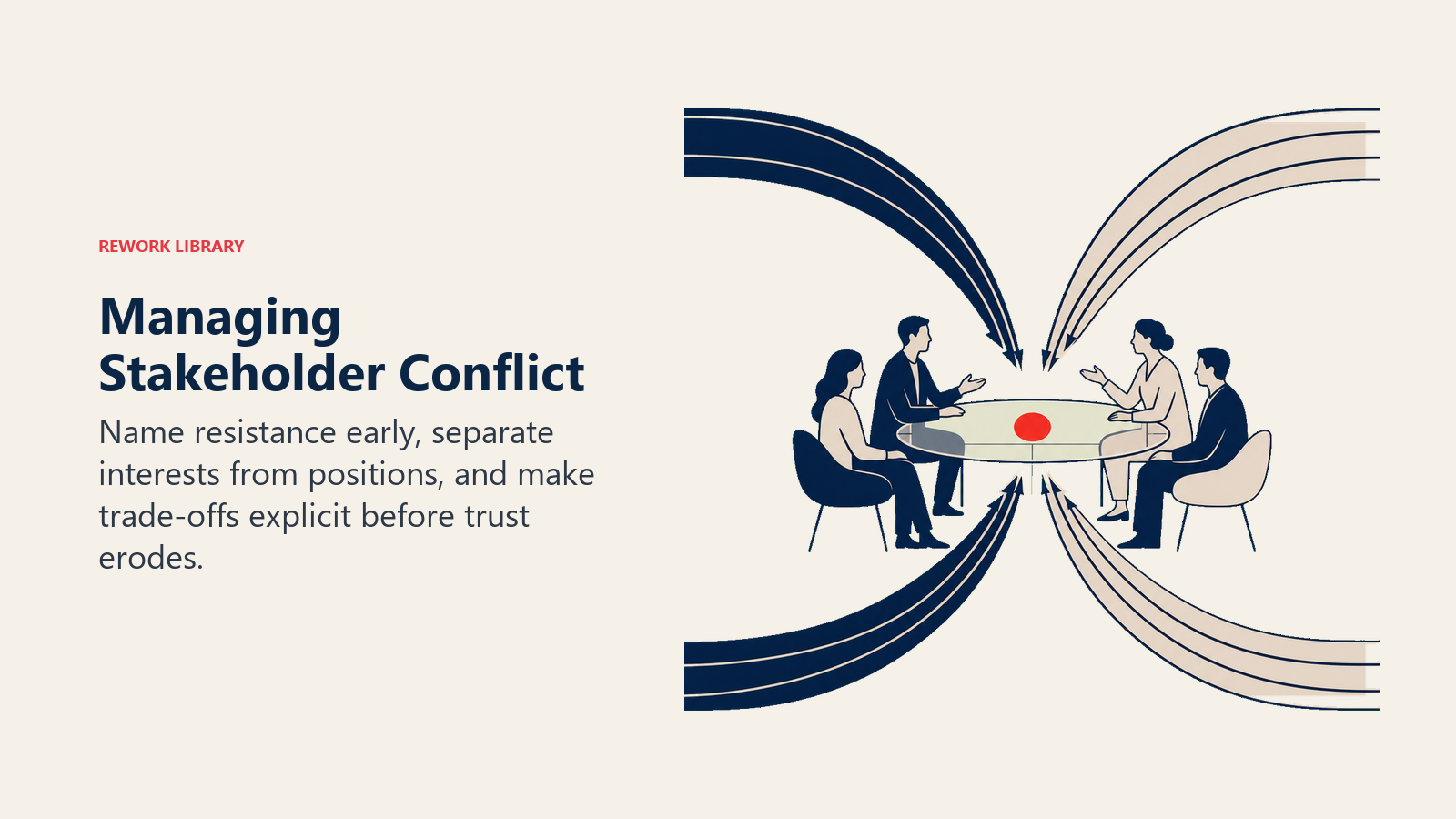
Name the conflict early. When two stakeholders have conflicting interests or positions, the least effective approach is to hope that neither notices, or to tell each one what they want to hear. Stakeholders who discover they were told different things are permanently more skeptical of everything the executive says afterward. Naming the conflict explicitly and working through it, even when that is uncomfortable, is more effective and more durable.
Distinguish legitimate opposition from political opposition. Legitimate opposition is based on substantive concerns: the decision will create problems the executive hasn't considered, the analysis is missing important data, the implementation plan has a flaw. This deserves genuine engagement. Political opposition, which is resistance motivated by territorial or personal interests rather than substantive concerns, requires a different approach, one focused on understanding what the stakeholder actually needs rather than engaging the surface position.
Do not promise things you can't deliver. The desire to satisfy stakeholders creates pressure to over-commit. Commitments made to secure support that the executive cannot actually keep produce far more damage than a clear "no" at the outset. The stakeholder who was promised something and did not receive it becomes a persistent critic. The stakeholder who was told clearly why their preference could not be accommodated has a chance to move on.
Stakeholder Management at Different Executive Levels
The scope of stakeholder management shifts as executives move up.
Managers and directors primarily manage internal stakeholders: peers, direct reports, their own managers, key cross-functional partners.
VPs and senior directors add external stakeholder dimensions: key customers, vendor partners, sometimes investors or industry bodies.
C-suite executives manage the full landscape, including the board, investors, regulators, major customers, the media, and the public in some industries. The skill required is not different in kind, but in scale and in the stakes attached to each relationship.
Developing stakeholder management capability early in a career, even when the stakeholder landscape is primarily internal, builds habits that scale. Executives who treat internal stakeholder management as beneath them because "it's just politics" tend to be unprepared for the full external landscape when they reach senior roles.
Common Failure Modes
Engaging too late. The most common failure: bringing stakeholders in after the decision is made and framing their input as a formality. Stakeholders who recognize this pattern (and most do, quickly) disengage from future processes or become actively adversarial.
Over-indexing on formal authority. The stakeholder map built only on reporting lines misses the informal influencers who often determine whether a decision actually gets implemented. Pay attention to who people call when they want something to happen, not just who is in the org chart.
Treating stakeholder management as a project, not a practice. Leaders who engage stakeholders intensively before major decisions and then go quiet for months build relationships that cannot support the weight of the next significant decision. The practice has to be ongoing.
Confusing stakeholder satisfaction with stakeholder alignment. A stakeholder who says they are satisfied after a conversation has not necessarily aligned. Check for genuine understanding of the decision and its rationale, not just absence of visible resistance.
Key Facts
- Research on organizational decision implementation consistently finds that decisions made with early stakeholder input are implemented faster and with fewer costly reversals than those announced without prior engagement.
- The average significant organizational change initiative loses thirty to forty percent of stakeholder support between announcement and full implementation, most of it through communication gaps rather than substantive disagreement.
- Executive credibility is built more through stakeholder management (keeping commitments, engaging honestly with concerns) than through technical expertise.
Frequently Asked Questions about Stakeholder Management
What is the difference between stakeholder management and stakeholder engagement?
Stakeholder management is the broader discipline: identifying who matters, mapping their influence and interest, building ongoing relationships, and planning communications. Stakeholder engagement is a component of that, referring specifically to the interactions and communication activities with stakeholders.
How many stakeholders should an executive actively manage?
Quality matters more than quantity. The stakeholders who have high influence over your organization's most important decisions and initiatives should receive deliberate, regular attention. For most executives, this means five to fifteen high-priority relationships rather than broad engagement with every stakeholder.
How do you manage a stakeholder who is consistently obstructionist?
First, understand the actual source of their resistance. Often it is a legitimate concern that has not been adequately addressed. If the opposition is substantive, engage with it. If it is primarily territorial or personal, understand what the stakeholder actually needs (recognition, inclusion, assurance of their position) and address that directly, rather than the surface position.
Does stakeholder management apply in non-profit and government contexts?
Yes, and often with higher complexity. Non-profit executives typically manage more diverse and less commercially aligned stakeholders. Government leaders manage stakeholders whose interests are more politically structured. The principles are the same; the specific dynamics require contextual adaptation.
Related reading: What Is Leadership? | Inclusive Leadership | Ethical Leadership | Democratic Leadership | Leadership vs Management

Co-Founder, Rework.com