Administrative Management: Fayol's 14 Principles
Turn this article into takeaways for your work.


Each assistant summarizes the article only for you and suggests best practices for your work.
Henri Fayol changed how people think about running organizations. Writing in the early 1900s, he argued that management itself was a discipline you could study, teach, and improve, and he backed that claim with 14 specific principles that any manager could apply regardless of industry.
His framework is called administrative management theory, and it remains one of the most influential ideas in the history of management thinking.
What is administrative management theory?
Administrative management theory is Henri Fayol's early-1900s framework that describes how to manage an entire organization through a set of universal principles and defined management functions. Rather than focusing on individual workers or tasks, it looks at the organization as a whole: how authority flows, how work gets divided, and how departments coordinate.
Key terms to know:
- Administrative management refers to the coordination of an organization's structure, authority, and processes from the top down.
- Universal principles means Fayol believed these rules applied across industries, company sizes, and countries.
- Management functions are the distinct activities every manager performs: planning, organizing, commanding, coordinating, and controlling.
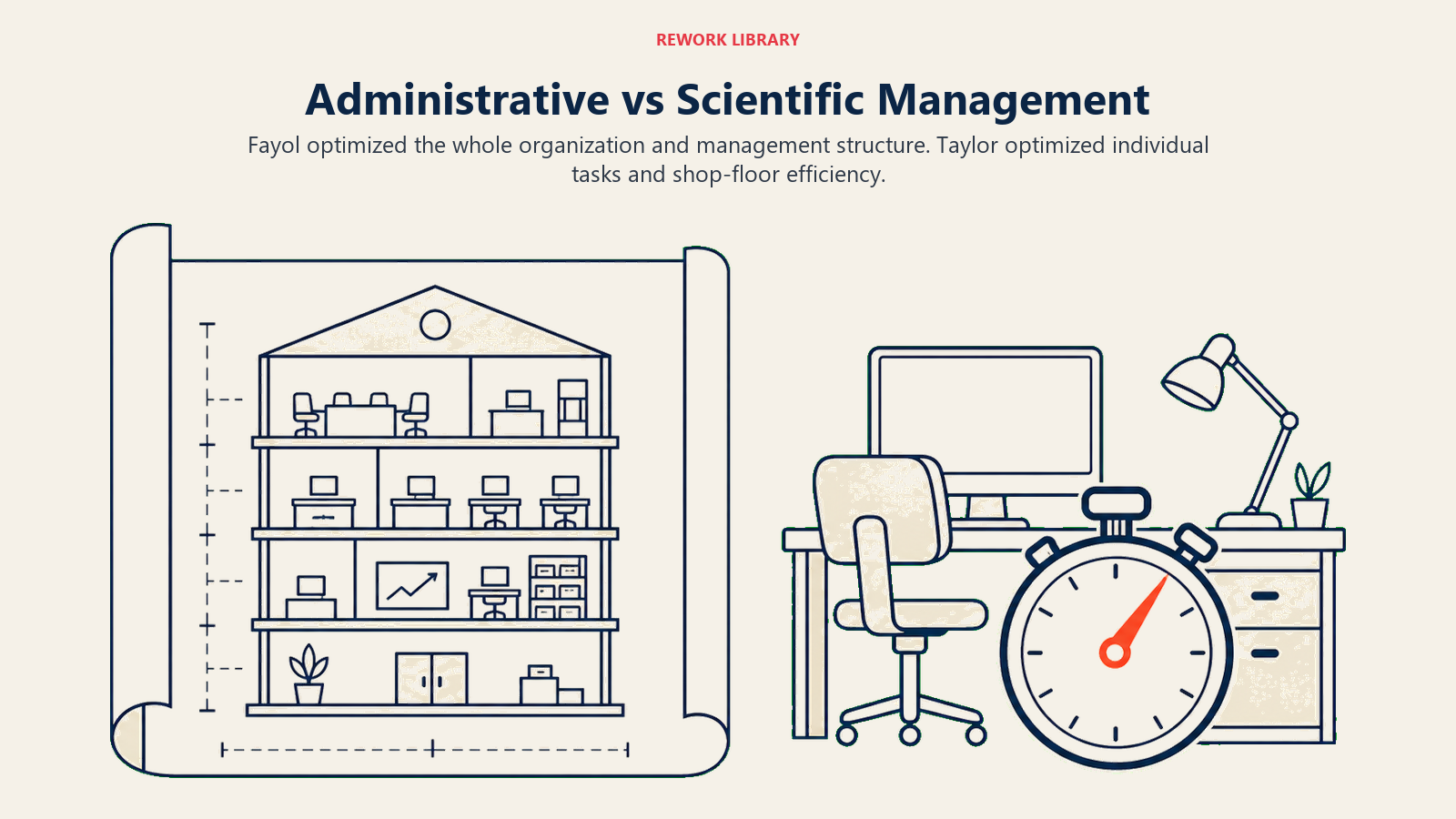
This stands in direct contrast to Frederick Taylor's scientific management, which zoomed in on the individual worker and how to optimize specific tasks for efficiency. Fayol zoomed out. He asked: what does the person running the whole organization actually do, and what rules should guide them?
Key Facts
- Source: Fayol's ideas appeared in "Administration Industrielle et Generale," published in French in 1916 and translated into English in 1949. (Source: Fayol, H., 1916)
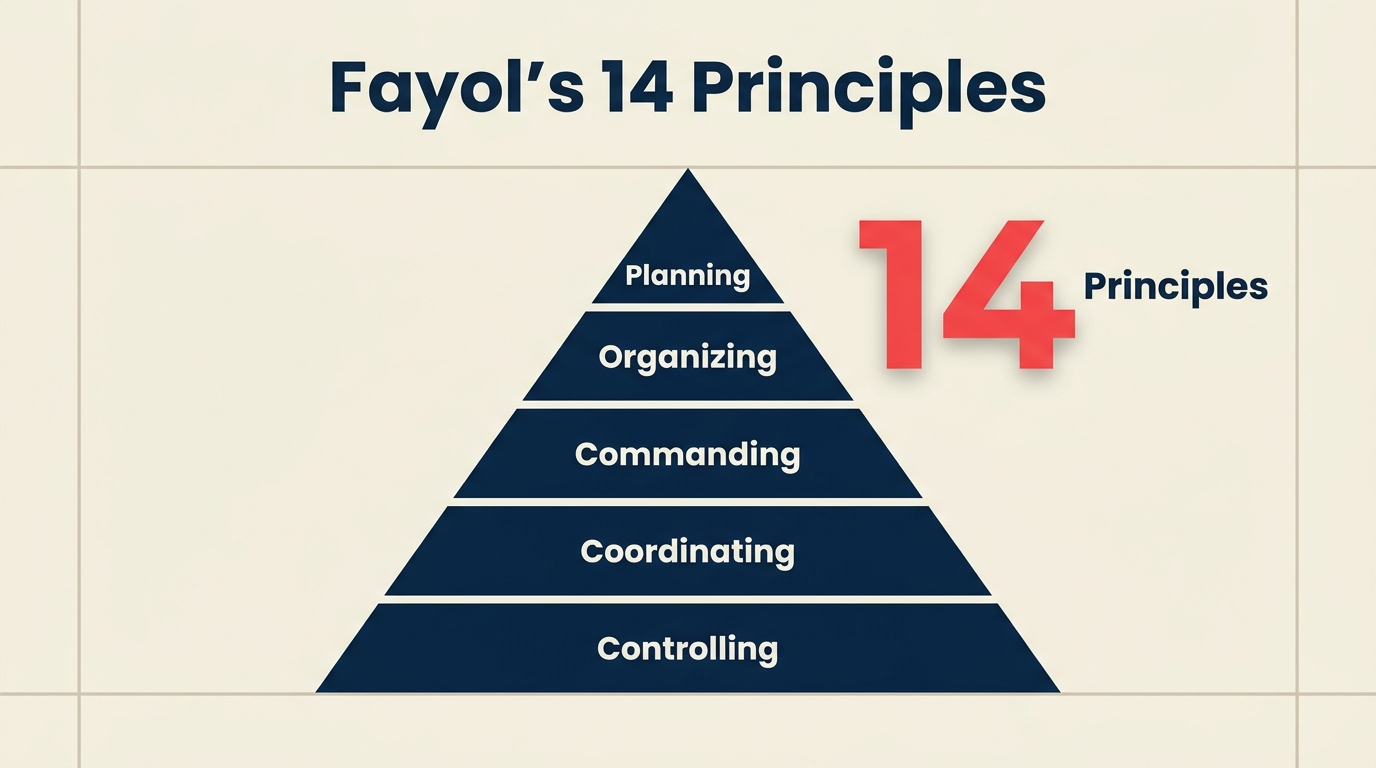
- Five functions: Fayol identified five core management functions: Planning, Organizing, Commanding, Coordinating, and Controlling, a structure still echoed in business school curricula today.
- Background: Fayol developed his theory while serving as managing director of the French mining company Commentry-Fourchambault, which he helped turn around from near-bankruptcy. (Source: Wren, D.A., "The History of Management Thought," 2005)
Fayol's 5 functions of management
Before listing the 14 principles, it helps to understand what Fayol thought managers actually did. He described five core functions:
| Function | What it involves |
|---|---|
| Planning | Setting objectives and deciding how to achieve them |
| Organizing | Arranging resources, tasks, and people to meet those objectives |
| Commanding | Directing employees and ensuring they carry out assigned work |
| Coordinating | Aligning activities across departments so efforts support each other |
| Controlling | Monitoring performance and correcting deviations from the plan |
These functions form the backbone of leadership vs management discussions to this day. Fayol was describing what managers do operationally, not what inspires followers.
Fayol's 14 principles of management
These are the 14 principles Fayol laid out in his 1916 book. They were meant as flexible guidelines, not rigid laws. He said managers should apply judgment when using them.
| Principle | Meaning | Modern example |
|---|---|---|
| Division of work | Specialize tasks to increase productivity through focus and repetition | Separate sales, support, and product teams rather than expecting generalists to do everything |
| Authority and responsibility | Managers need formal authority to give orders, but they must accept equal responsibility for outcomes | A department head who can hire staff is also accountable for that team's results |
| Discipline | Employees follow agreed rules; managers enforce them consistently | Clear performance expectations with documented consequences for violations |
| Unity of command | Each employee should receive orders from only one supervisor | Avoiding matrix structures where two managers give conflicting instructions to the same person |
| Unity of direction | One plan and one leader for any group of activities with the same goal | A single campaign owner for a product launch rather than two teams running parallel efforts |
| Subordination of individual interest | Organizational goals take priority over personal interests | A manager sets aside a preferred vendor relationship when a competitor offers better value |
| Remuneration | Pay should be fair and satisfying to both employee and employer | Transparent salary bands tied to role and performance, not to negotiating skill |
| Centralization | Decide how much decision-making authority to concentrate at the top based on context | A startup may centralize decisions; a large chain delegates to regional managers |
| Scalar chain | A clear line of authority runs from the top of the organization to the bottom | An org chart where reporting lines are visible and unambiguous |
| Order | People and materials should be in the right place at the right time | A manufacturing floor where tools have assigned locations and shifts are scheduled without gaps |
| Equity | Managers should treat employees with fairness and kindness | Consistent application of leave policies regardless of who the employee is |
| Stability of tenure | High turnover is costly; organizations benefit from keeping good people | Investing in onboarding, career paths, and retention rather than constant rehiring |
| Initiative | Employees should be encouraged to propose and act on new ideas | A suggestion program where ideas receive a formal response within 30 days |
| Esprit de corps | Building team spirit and unity strengthens the organization | Regular team retrospectives and recognition rituals that reinforce shared purpose |
A few of these principles create useful tensions. Centralization, for example, requires judgment: too much and the organization becomes slow; too little and it loses coherent direction. Fayol knew this, which is why he framed them as guidelines rather than commandments.
Administrative management vs scientific management
These two theories often get confused because they both emerged around the same time and both aimed to improve organizational performance. But they operate at entirely different levels.
| Dimension | Administrative management (Fayol) | Scientific management (Taylor) |
|---|---|---|
| Primary focus | The whole organization and management functions | Individual tasks and worker productivity |
| Level of analysis | Top management and structure | Shop floor and task execution |
| Key thinker | Henri Fayol | Frederick Winslow Taylor |
| Central question | How should managers lead? | How should workers work? |
| Approach to rules | Universal principles, applied with judgment | Scientific study of tasks, one best method |
| View of workers | People who need fair treatment and direction | Inputs to be optimized through incentives and method |
The two theories are complementary more than competing. A well-run factory in 1920 might have used Taylor's time-and-motion studies on the production line while its executives applied Fayol's scalar chain and unity of command in the boardroom. That combination (task efficiency at the bottom, structural clarity at the top) describes a lot of 20th-century business organization.
For a deeper look at how Taylor's approach differs, see the scientific management article. For how both fit into broader leadership theory, what-is-leadership-theories maps the full intellectual timeline.
How to apply Fayol's principles today
Fayol wrote for early industrial enterprises, but his principles translate surprisingly well to modern knowledge work, service businesses, and even remote teams. Here's how to apply them practically.
Step 1: Audit your reporting lines
Start with unity of command. Draw an org chart (or check that your existing one is accurate) and identify anyone who reports to more than one manager. Dual reporting creates ambiguity about priorities, blame, and credit. It's not always avoidable, but it should be a conscious choice with clear protocols, not an accident.
Step 2: Match authority to accountability
Fayol's authority-and-responsibility principle is violated constantly in large organizations. A manager responsible for hitting a revenue target but unable to hire, fire, or set team priorities will fail. Not because they're incompetent, but because the design is broken. When you assign accountability, check whether the person actually controls the inputs needed to deliver the result.
Step 3: Find the right centralization level for your context
This is the most situational of the 14 principles. Early-stage companies often need centralized decisions to move fast and stay coherent. Mature companies with multiple regions or product lines usually need to push decisions down to where the information lives. Periodically ask: which decisions are being escalated that shouldn't be, and which ones are being made locally without enough context?
Step 4: Pay fairly and communicate the rationale
Remuneration, to Fayol, meant more than just salary. It meant employees understood why they were paid what they were paid and believed it was fair. Opaque pay structures corrode trust even when the underlying numbers are reasonable. Publishing salary bands and promotion criteria (even internally) addresses this directly.
Step 5: Invest in stability and initiative at the same time
These two principles look like opposites. Stability of tenure suggests keeping people around; initiative suggests encouraging them to challenge the status quo. But in practice, people take more initiative when they feel secure. Psychological safety and low turnover reinforce each other. Organizations that constantly churn staff get neither. For more on how these dynamics play out, see behavioral leadership theory and management skills.
Criticisms and limitations
Fayol's framework has real weaknesses, and it's worth being clear about them.
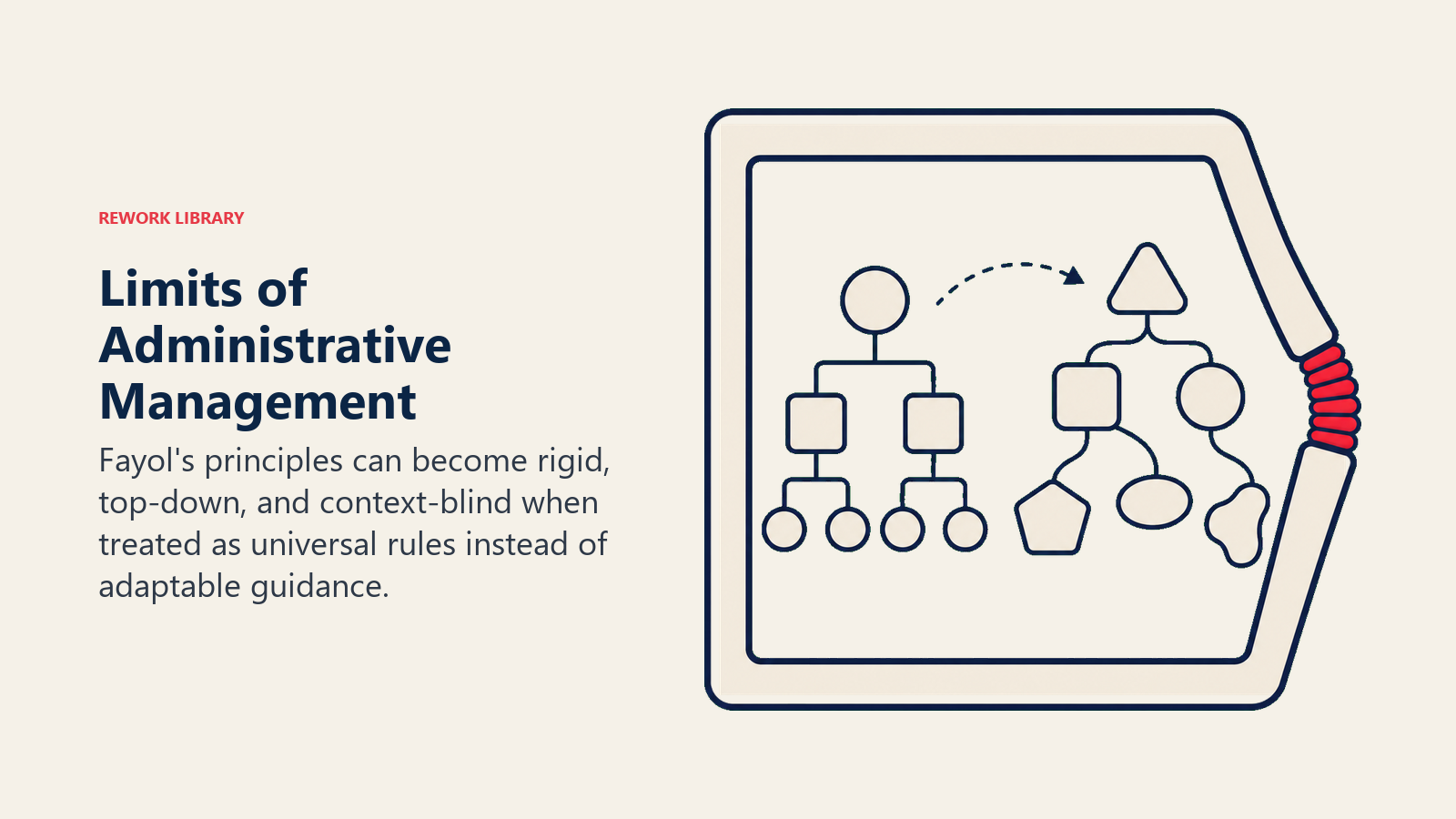
Rigidity in flat or agile organizations. The scalar chain and unity-of-command principles assume a clear hierarchy. That model fits traditional enterprises but sits awkwardly in flat structures, cross-functional squads, or organizations where decision authority is deliberately distributed. Forcing a rigid chain of command onto a team designed to move fast will slow it down.
Limited attention to motivation. Fayol treated workers largely as people to be directed fairly. He didn't develop a rich theory of intrinsic motivation, growth, or purpose. That gap was later filled by Herzberg's two-factor theory and Maslow's hierarchy of needs, which both address what actually drives people beyond adequate compensation.
Industrial-era assumptions. Fayol built his theory in a context of physical factories, clear outputs, and stable environments. Knowledge work, creative industries, and volatile markets require more flexibility than his framework explicitly provides. Bureaucratic leadership, which shares some of Fayol's structural emphasis, faces similar critiques.
Western and managerial bias. The theory was built from the perspective of a European executive. Cross-cultural research has shown that preferences for centralization, hierarchy, and individual initiative vary significantly across national cultures, meaning these principles require adaptation rather than universal application.
None of this makes Fayol irrelevant. But it does mean applying his framework thoughtfully, combining it with other tools rather than treating it as a complete theory of management.
Frequently Asked Questions about Administrative Management
Who was Henri Fayol?
Henri Fayol (1841-1925) was a French mining engineer who became managing director of Commentry-Fourchambault, a large industrial company he led for three decades. He developed his management theory through direct practice, not academic research, which is one reason it has a practical rather than theoretical character. His 1916 book "Administration Industrielle et Generale" was the primary vehicle for his ideas.
What is the difference between Fayol and Taylor?
Fayol studied how to manage an organization from the top. Taylor studied how to make individual workers more productive. Fayol's 14 principles address structure, authority, and coordination across the whole enterprise. Taylor's scientific management focuses on task analysis, time-and-motion studies, and incentive pay at the worker level. Both contributed to modern management thinking, and both are worth understanding on their own terms.
Are Fayol's 14 principles still relevant today?
Yes, with important caveats. Principles like unity of command, matching authority to responsibility, fair remuneration, and building team spirit remain relevant to any organization. The scalar chain and heavy centralization fit some contexts less well, especially agile teams or flat organizations. The smart approach is to treat the 14 principles as a checklist of organizational health questions rather than a rigid recipe.
What are Fayol's five functions of management?
Fayol described management as consisting of five functions: planning (setting objectives), organizing (arranging resources), commanding (directing work), coordinating (aligning departments), and controlling (monitoring performance). These functions are still widely taught, though some modern frameworks merge commanding and coordinating, or replace commanding with "leading."
What is the scalar chain principle?
The scalar chain is the unbroken line of authority from the highest executive to the lowest-level employee. It defines who reports to whom and how formal communication flows. Fayol did allow for a "gang plank" (direct communication between peers at the same level) when going up and down the chain would cause harmful delays. In practice, most organizations informally apply this exception constantly.
Administrative management theory gave the management profession its first coherent vocabulary. Concepts like unity of command, scalar chain, and equity weren't invented by Fayol. They existed in practice long before he wrote, but he named them, organized them, and argued they could be taught. That contribution shaped how we talk about leadership and process management to this day.
The 14 principles work best when treated as a diagnostic tool. Run through them against your current organization and ask where the gaps are. Most teams will find at least two or three principles being violated in ways they hadn't consciously noticed.

Senior Operations & Growth Strategist
On this page
- What is administrative management theory?
- Fayol's 5 functions of management
- Fayol's 14 principles of management
- Administrative management vs scientific management
- How to apply Fayol's principles today
- Step 1: Audit your reporting lines
- Step 2: Match authority to accountability
- Step 3: Find the right centralization level for your context
- Step 4: Pay fairly and communicate the rationale
- Step 5: Invest in stability and initiative at the same time
- Criticisms and limitations