Ethical Leadership: Principles, Traits, and Examples
Turn this article into takeaways for your work.


Each assistant summarizes the article only for you and suggests best practices for your work.
Ethical leadership is what happens when the person in charge consistently makes decisions guided by clear values rather than convenience, politics, or short-term gain. It sounds obvious. But in practice, it's one of the harder things to sustain.
What Is Ethical Leadership?
Ethical leadership is a leadership approach in which leaders model and actively promote normatively appropriate conduct through their personal actions and interpersonal relationships. In plain terms: ethical leaders do the right thing, explain why it matters, and hold themselves and others to the same standard.
The concept draws from both management research and moral philosophy. Psychologists Michael Brown and Linda Trevino, who authored some of the most cited work in this field, define it through two lenses: the moral person dimension (integrity, fairness, care for people) and the moral manager dimension (using authority and visibility to reinforce ethical standards across the organization).
What separates ethical leadership from simple personal virtue is that last part. An individual can be honest and still lead an organization that behaves dishonestly. Ethical leadership is about making values operational, through decisions, systems, and the behavior you reward or tolerate.
Key Facts
Key Facts: Research by Brown, Trevino, and Harrison (2005) in Organizational Behavior and Human Decision Processes introduced the Ethical Leadership Scale (ELS), validated across multiple organizations and now among the most-used instruments in leadership research. A 2019 meta-analysis published in Journal of Business Ethics covering 151 independent samples found ethical leadership was significantly linked to employee voice behavior (r = 0.44), organizational citizenship behavior (r = 0.46), and reduced counterproductive work behavior (r = -0.35). Gallup's 2023 State of the Global Workplace report found that employees who strongly agree their manager "does what is right" are 2.4x more likely to be engaged at work.
Core Principles of Ethical Leadership
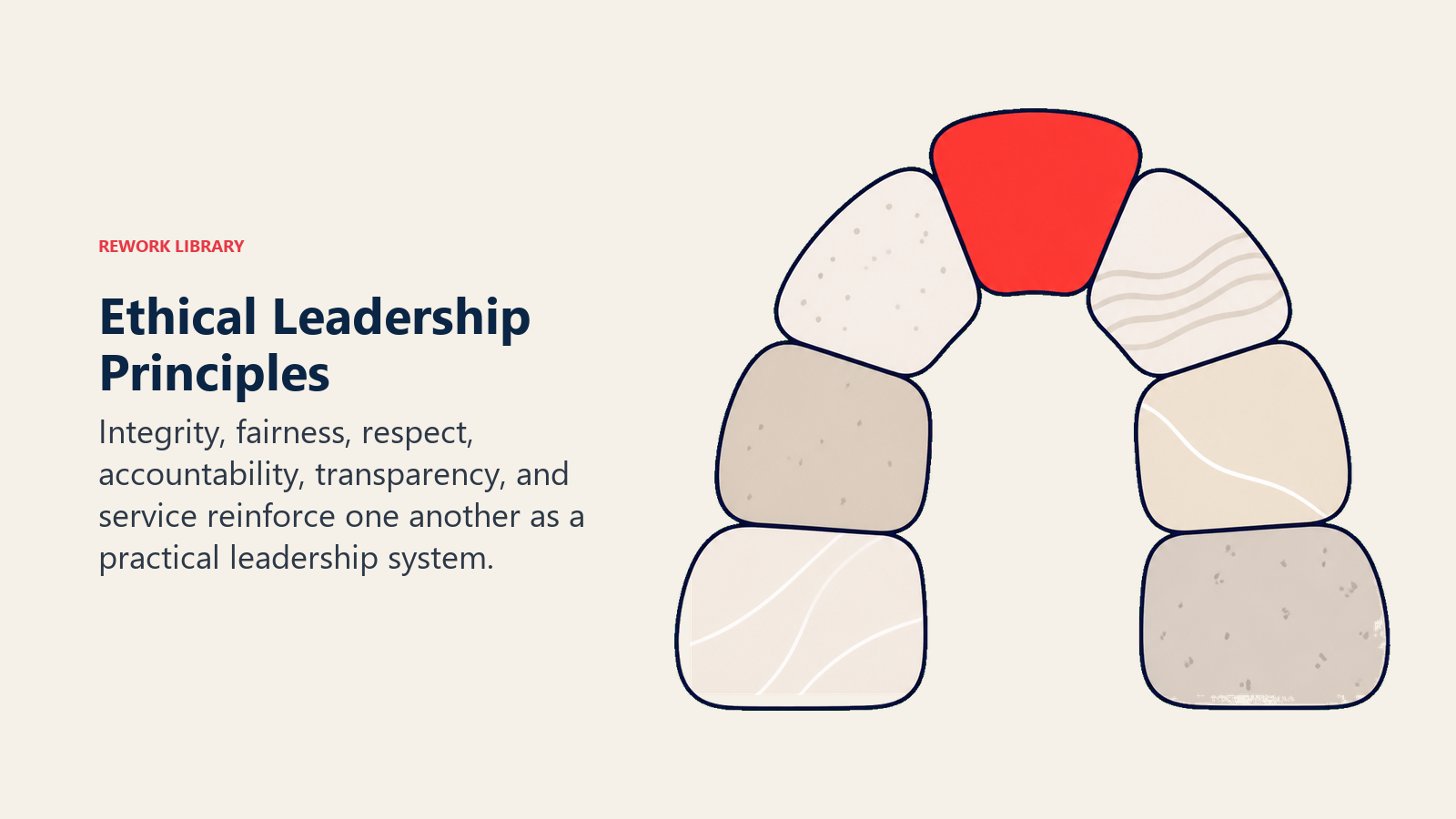
Ethical leadership isn't a single trait. It's a cluster of behaviors and orientations that reinforce each other. The core principles most consistently cited in research and practice are:
| Principle | What It Looks Like in Practice |
|---|---|
| Honesty | Telling the truth even when the news is bad; no spin, no selective omission |
| Fairness | Applying the same standards to everyone; decisions based on merit, not favoritism |
| Accountability | Owning mistakes publicly; not deflecting blame onto teams or circumstances |
| Respect for people | Treating everyone's time, opinions, and dignity as worth protecting |
| Transparency | Making your reasoning visible so people can trust the logic, not just the outcome |
| Concern for stakeholders | Weighing impact on employees, customers, and community, not only shareholders |
These principles don't operate independently. A leader who is honest but not fair creates confusion. One who is transparent but never accountable erodes trust. The combination is what makes ethical leadership durable.
Traits of an Ethical Leader
Beyond principles, certain personal traits appear consistently in leaders who sustain ethical behavior over time:
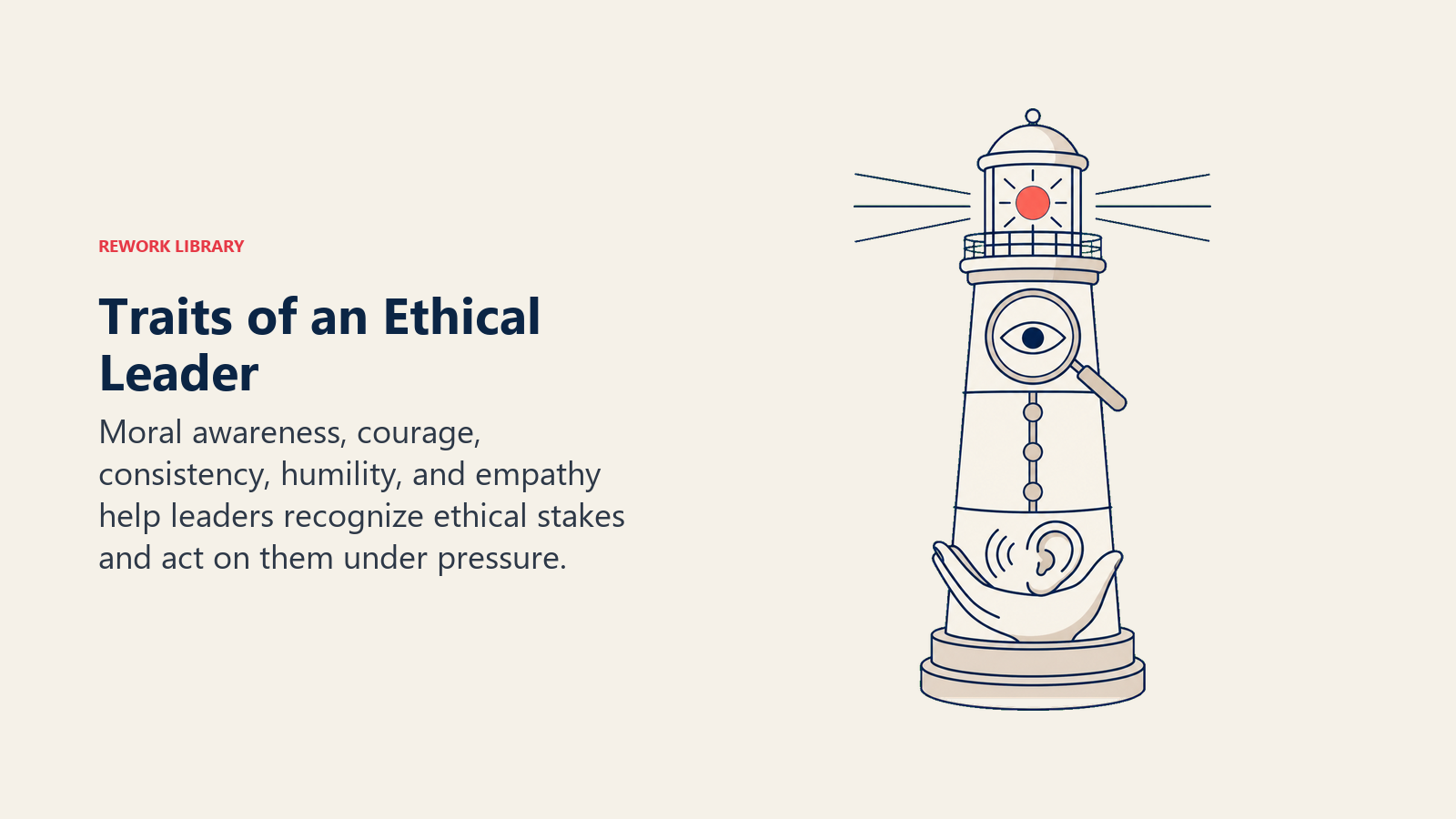
Moral awareness. They notice the ethical dimension of a decision before defaulting to the expedient option. They ask "who does this affect and how?" even when no one is forcing the question.
Consistency. Their behavior doesn't change based on who is watching. The same standards apply in public and private, with senior stakeholders and with junior staff.
Courage. Ethical leadership often requires saying no to profitable but harmful choices, disagreeing with powerful people, or raising uncomfortable issues. Leaders who lack courage tend to rationalize their way around it.
Empathy. They can genuinely understand the impact of decisions on others. Not as a PR exercise, but as real data that shapes how they decide.
Humility. They're willing to be wrong, to hear criticism, and to change course without treating it as a threat to their authority. This is closely related to what authentic leadership research identifies as self-awareness.
Long-term orientation. Ethical leaders are willing to accept short-term costs (losing a deal, missing a target, having a hard conversation) in exchange for long-term trust and sustainability.
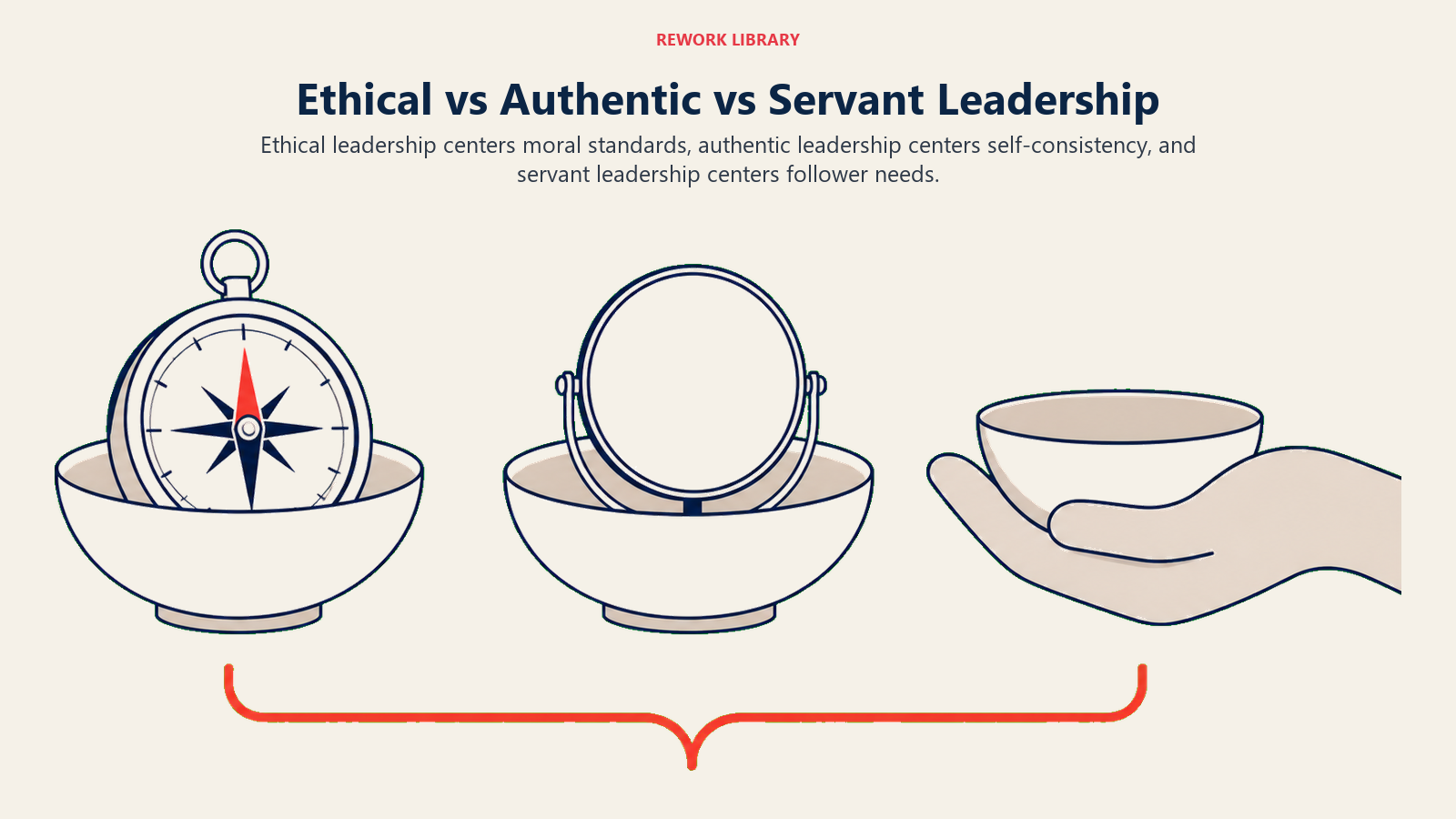
Ethical Leadership vs. Authentic vs. Servant Leadership
Ethical leadership is sometimes conflated with related styles. The distinctions matter:
| Dimension | Ethical Leadership | Authentic Leadership | Servant Leadership |
|---|---|---|---|
| Core focus | Moral standards and conduct | Self-awareness and value alignment | Team needs and service |
| Primary goal | Right behavior at scale | Genuine self-expression in leadership | Follower development and wellbeing |
| Key mechanism | Modeling + reinforcing norms | Transparency about who you are | Removing obstacles for others |
| Risk if done poorly | Moralism without empathy | Self-focus without accountability | Dependency without direction |
| Overlap | All three require personal integrity | Shares honesty and values-alignment | Shares care for people and fairness |
All three are what researchers call "people-first" approaches. Servant leadership prioritizes follower growth above the leader's own agenda. Authentic leadership is more about alignment between inner values and outer behavior. Ethical leadership extends further into organizational systems: what rules exist, what's rewarded, what's tolerated.
Two other people-first frameworks worth knowing: inclusive leadership broadens participation by actively reducing exclusion, and psychological safety creates the environment in which ethical concerns can actually be voiced without retaliation. Ethical leadership is weakened significantly without psychological safety underneath it.
Benefits of Ethical Leadership
The business case for ethical leadership is not abstract. The evidence is fairly direct:
Lower turnover. People don't leave managers who treat them fairly. A significant share of voluntary attrition traces back to perceptions of unfairness or distrust at the leadership level.
Stronger organizational voice. Teams with ethical leaders are more likely to speak up about problems, including problems the leader doesn't yet know about. That's a real operational advantage.
Reduced misconduct. Brown and Trevino's research consistently shows that where ethical leadership is strong, employees engage in less counterproductive behavior, including fraud, sabotage, and covering up mistakes.
Customer and stakeholder trust. Over time, organizations known for integrity attract better partnerships, better talent, and greater latitude from regulators. The inverse is also true: ethical failures are expensive to recover from.
Team performance. Research connecting ethical leadership to engagement is consistent. Engaged teams outperform disengaged ones on almost every productivity measure. The transformational vs. transactional leadership literature shows this pattern clearly: leaders who appeal to values and purpose get more from their teams than those who rely on reward and punishment alone.
Challenges and Common Pitfalls
Knowing what ethical leadership requires and actually practicing it are different things. The common failure points are worth naming:
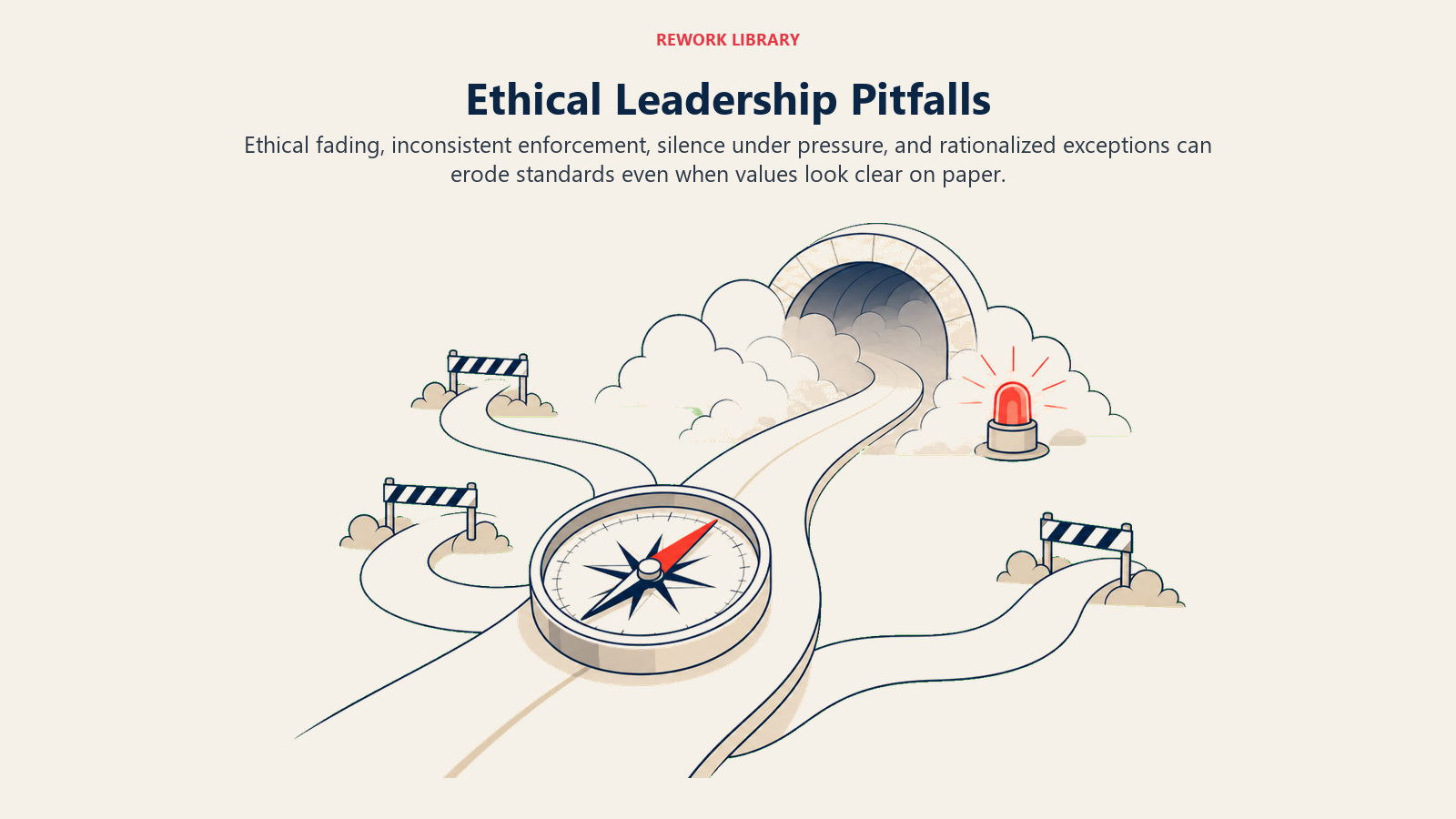
Ethical fading. Decisions that start as clear ethical choices become routine over time. The line between "acceptable shortcut" and "bad practice" drifts. Leaders who don't periodically recalibrate lose their moral clarity without noticing.
Pressure to perform. Quarterly targets, investor expectations, and competitive pressure create real incentives to cut corners. Ethical leaders feel this pressure too. The difference is they don't let it override their principles without at least naming the tension explicitly.
Inconsistency at scale. It's easier to be ethical in a team of ten than in an organization of ten thousand. As organizations grow, leaders must build systems (policies, feedback channels, training, consequence frameworks) that carry their values further than their direct influence can reach.
Confusing ethics with rule-following. Ethics isn't about compliance. Leaders who check legal and policy boxes while treating people poorly have not solved the problem. Ethical leadership requires genuine moral reasoning, not just procedural adherence.
Retaliation sensitivity. If employees believe raising concerns will hurt them, they won't raise them. This makes the leader effectively blind to the ethical failures happening in their organization. Building psychological safety is a prerequisite for this not happening.
How to Practice Ethical Leadership
Ethical leadership isn't a fixed state you arrive at. It's an ongoing practice. These steps are practical starting points:
Define your non-negotiables. Write down two or three principles you won't compromise regardless of pressure. Being explicit makes them harder to rationalize away in the moment.
Audit your recent decisions. Look back at the last month. Where did you choose convenience over fairness? Where did you avoid a hard conversation? Patterns reveal drift you might not notice in real time.
Make your reasoning visible. When you make a difficult call, explain why. Not just what you decided, but what values or considerations drove it. This builds trust and models the same reasoning in others.
Create channels for honest feedback. Ask people directly what concerns they have. Consider anonymous mechanisms for issues that carry perceived risk. If no one ever tells you about problems, that's a signal, not a sign things are fine.
Hold yourself accountable publicly. When you make a mistake, say so. Explicitly. Modeling accountability at the top is the fastest way to normalize it throughout a team.
Align incentives with values. If you reward results and don't ask how they were achieved, you're implicitly tolerating whatever methods worked. Review whether your performance metrics create pressure for unethical behavior.
Develop your team's ethical reasoning. Coaching conversations about "what would the right call be here?" build moral muscle across the organization. The coaching leadership style is useful here: asking questions rather than dictating answers builds judgment, not just compliance.
Review your culture regularly. What gets celebrated? What gets ignored? What happens to people who raise uncomfortable truths? These signals tell you whether your stated values are the real ones.
Ethical Leadership Examples
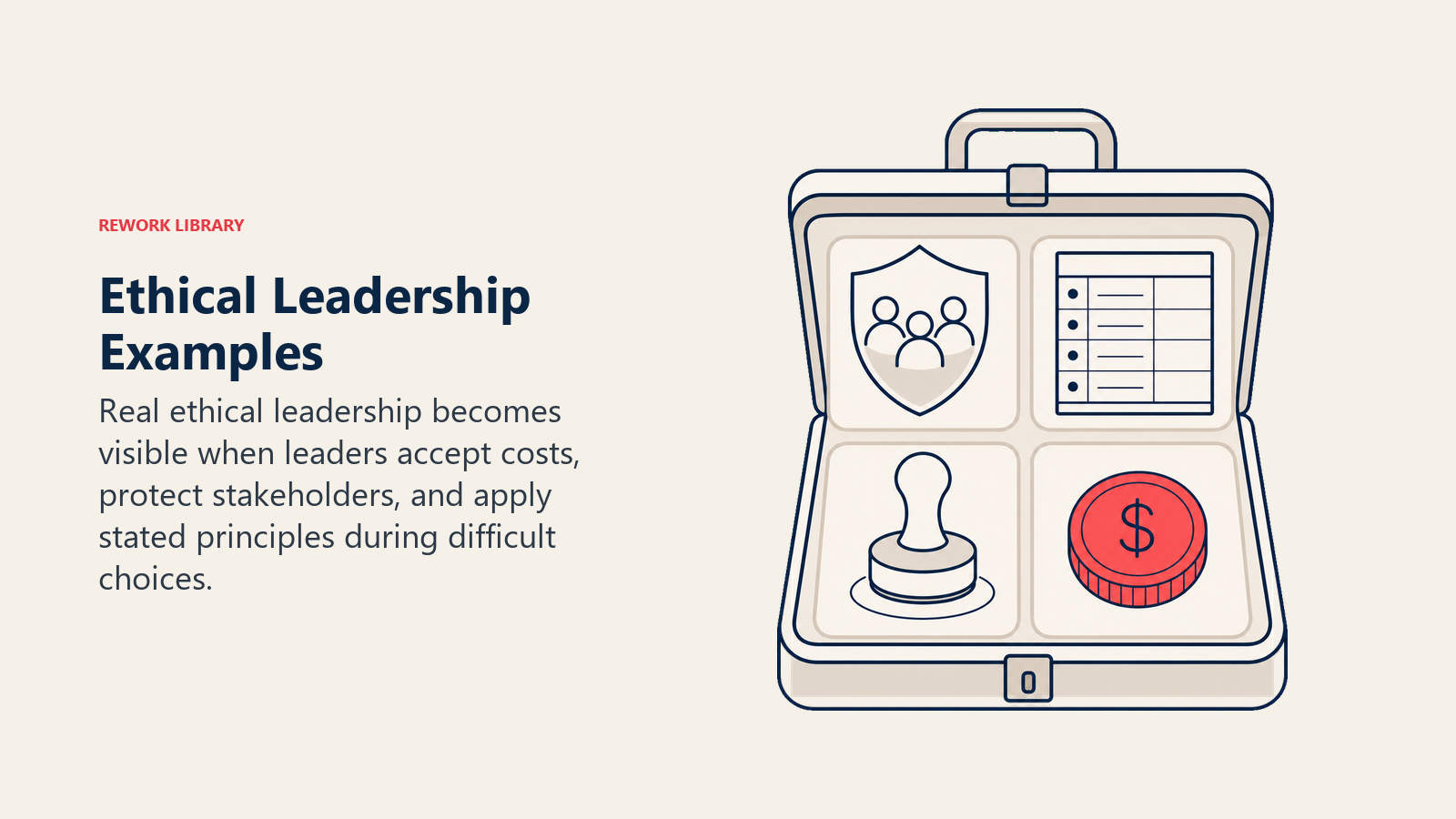
History and business offer clear cases of ethical leadership done well and done poorly. Here are four concrete examples:
| Leader / Organization | Situation | Ethical Choice | Outcome |
|---|---|---|---|
| Paul Polman (Unilever, 2009-2019) | Faced pressure from activist investors demanding short-term profit maximization | Eliminated quarterly earnings guidance; committed Unilever to 10-year sustainable business goals | Delivered above-average shareholder returns while reducing environmental footprint |
| Johnson & Johnson (1982 Tylenol recall) | Seven people died after bottles of Tylenol were laced with cyanide | CEO James Burke recalled 31 million bottles nationwide at a cost of $100M before a mandated recall existed | Brand recovered fully within a year; set the industry standard for crisis ethics |
| Aaron Feuerstein (Malden Mills, 1995) | Factory burned down in a fire | Continued paying 3,000 employees full wages and benefits for three months while rebuilding | Widely cited as a landmark example of stakeholder-first leadership; factory rebuilt and employees returned |
| Wells Fargo (2016 accounts scandal) | Sales pressure led employees to open millions of unauthorized accounts | Leadership either missed or tolerated an incentive system that made fraud nearly inevitable | $3B settlement, CEO resignation, lasting reputational damage; a case study in how misaligned incentives corrupt ethical culture |
The Wells Fargo case illustrates that ethical leadership isn't just about personal virtue. It's about building systems where ethical behavior is the path of least resistance, not the path of most resistance.
Ethical leadership doesn't guarantee perfect decisions. What it does guarantee is that your team knows where you stand, trusts that you'll apply your principles consistently, and feels safe enough to tell you when something is wrong. That combination is harder to build than most leadership tools, and harder to replace when it's gone.

Senior Operations & Growth Strategist