Scientific Management: Taylor's Theory Explained
Turn this article into takeaways for your work.


Each assistant summarizes the article only for you and suggests best practices for your work.
Scientific management is the systematic study of work to find the most efficient method for every task. Frederick Winslow Taylor developed the theory in the late 19th century, and his 1911 book The Principles of Scientific Management became one of the most influential management texts ever written.
What is scientific management?
Scientific management (also called Taylorism) is a management approach that applies scientific methods to the organization and analysis of work. Instead of relying on rules of thumb or craft tradition, it breaks jobs down into discrete tasks, studies each one objectively, and redesigns them for maximum output per unit of time.
The core idea is deceptively simple: there is one best way to do any job, and you can find it by observing, measuring, and experimenting rather than by guessing.
Taylor developed the framework while working as a machinist and then a chief engineer at the Midvale Steel Company in Philadelphia in the 1880s. He was frustrated by systematic "soldiering," the deliberate restriction of output by workers who feared that working faster would cost them their jobs. His answer was to restructure work so that high output benefited both workers (through higher wages) and employers (through lower unit costs).
Key Facts
- Taylor published The Principles of Scientific Management in 1911. The book was one of the first management texts to be translated into multiple languages and distributed globally (Source: Peter Drucker, Management, 1973).
- A famous time-and-motion study at Bethlehem Steel showed that the right shovel design and work method cut the number of yard workers needed from 500 to 140 while increasing individual wages by roughly 60% (Source: Taylor, Principles of Scientific Management, 1911).
- By 1914, Henry Ford's Highland Park plant was producing a complete Model T chassis every 93 minutes, down from 728 minutes before the assembly-line reorganization that drew heavily on Taylor's methods (Source: David Hounshell, From the American System to Mass Production, 1984).
Taylor's four principles of scientific management
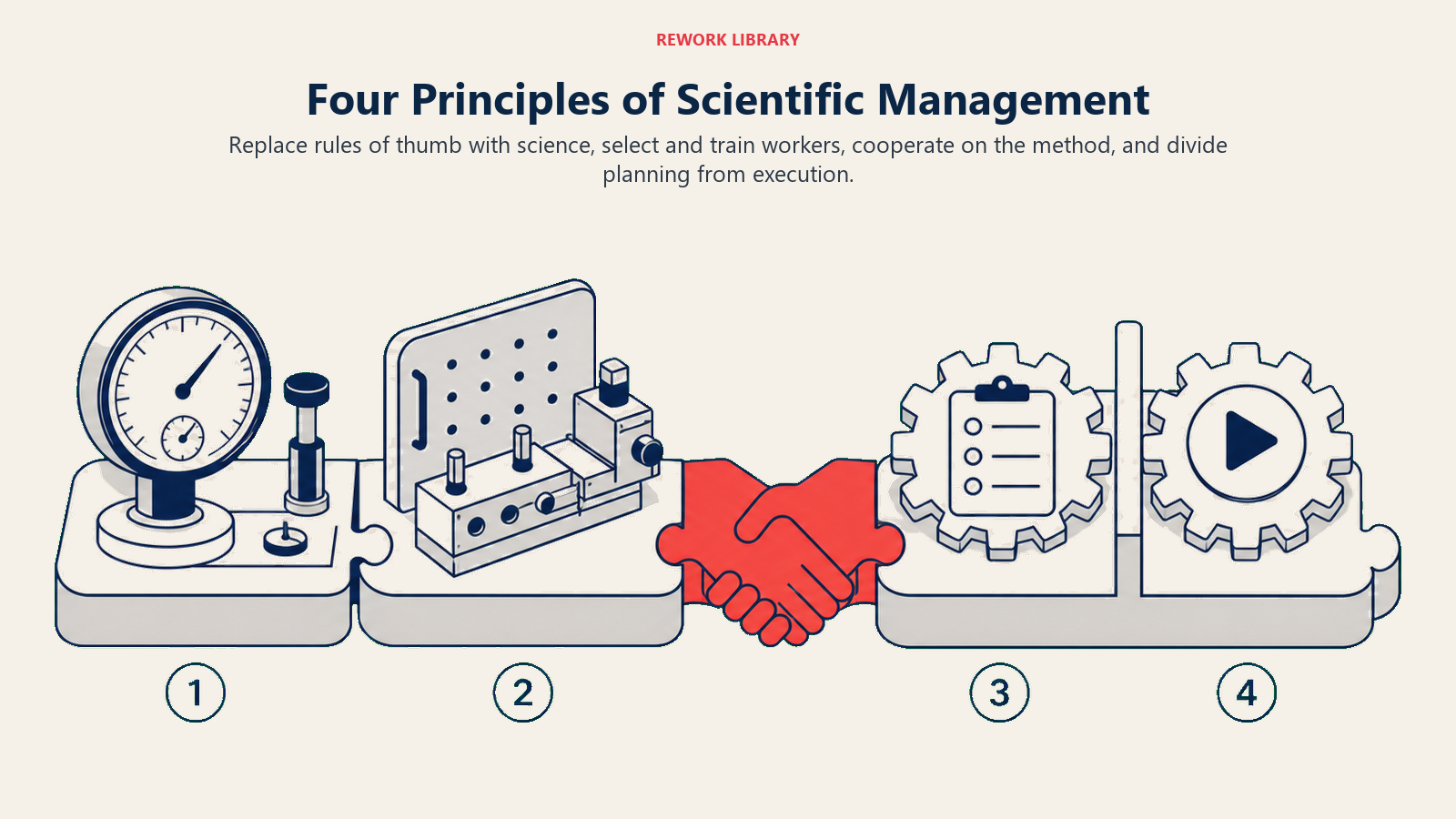
Taylor laid out four core principles that separated scientific management from the informal management practices of his day. Each principle attacked a different form of inefficiency.
| Principle | What it means | Real example |
|---|---|---|
| Science, not rule of thumb | Replace guesswork and tradition with systematic observation and measurement to determine the optimal method for each task. | Taylor timed each phase of shoveling at Bethlehem Steel and prescribed the exact shovel weight (21 lbs optimal) for different materials. |
| Scientific selection and training | Select workers based on their physical and mental aptitude for the task, then train them in the one best method rather than letting them self-teach. | Workers at Ford's assembly line were matched to specific stations based on dexterity tests and trained to a precise motion sequence. |
| Cooperation between workers and management | Management takes responsibility for planning and method design; workers execute. Both sides share the productivity gains. | Taylor proposed piece-rate bonuses so that faster workers earned more, aligning individual incentives with company output targets. |
| Equal division of work | Management designs the work and sets standards; workers perform the standardized tasks. Neither side carries the full burden. | Engineers at Ford set cycle times and station layouts; assembly workers followed the prescribed sequence and reported deviations. |
Benefits of scientific management
Taylor's framework delivered measurable results in the industrial environments where it was applied, and many of its benefits remain relevant in operations today.
Higher productivity. By eliminating wasted motion and standardizing methods, organizations typically saw significant output gains without adding labor. Taylor's own steel yard experiments cut labor costs per ton substantially while raising individual worker output.
Lower unit costs. Standardized tasks are faster to learn, faster to perform, and easier to supervise. As each worker's output rises, the cost to produce each unit falls.
Clear accountability. When roles are broken down into defined tasks with measurable outputs, it becomes straightforward to identify where bottlenecks or quality failures originate.
Fairer pay for high performers. Taylor's differential piece-rate system rewarded workers who hit or exceeded the scientifically set standard. This was a step forward from flat daily wages that paid slow and fast workers the same.
Foundation for continuous improvement. The habit of measuring baseline performance and then systematically testing improvements is the intellectual ancestor of lean manufacturing, Six Sigma, and modern operations research. See lean methodology for how that lineage developed.
Criticisms and limitations
Scientific management attracted fierce opposition almost from the moment it was introduced, and many of its weaknesses remain relevant to management theory.
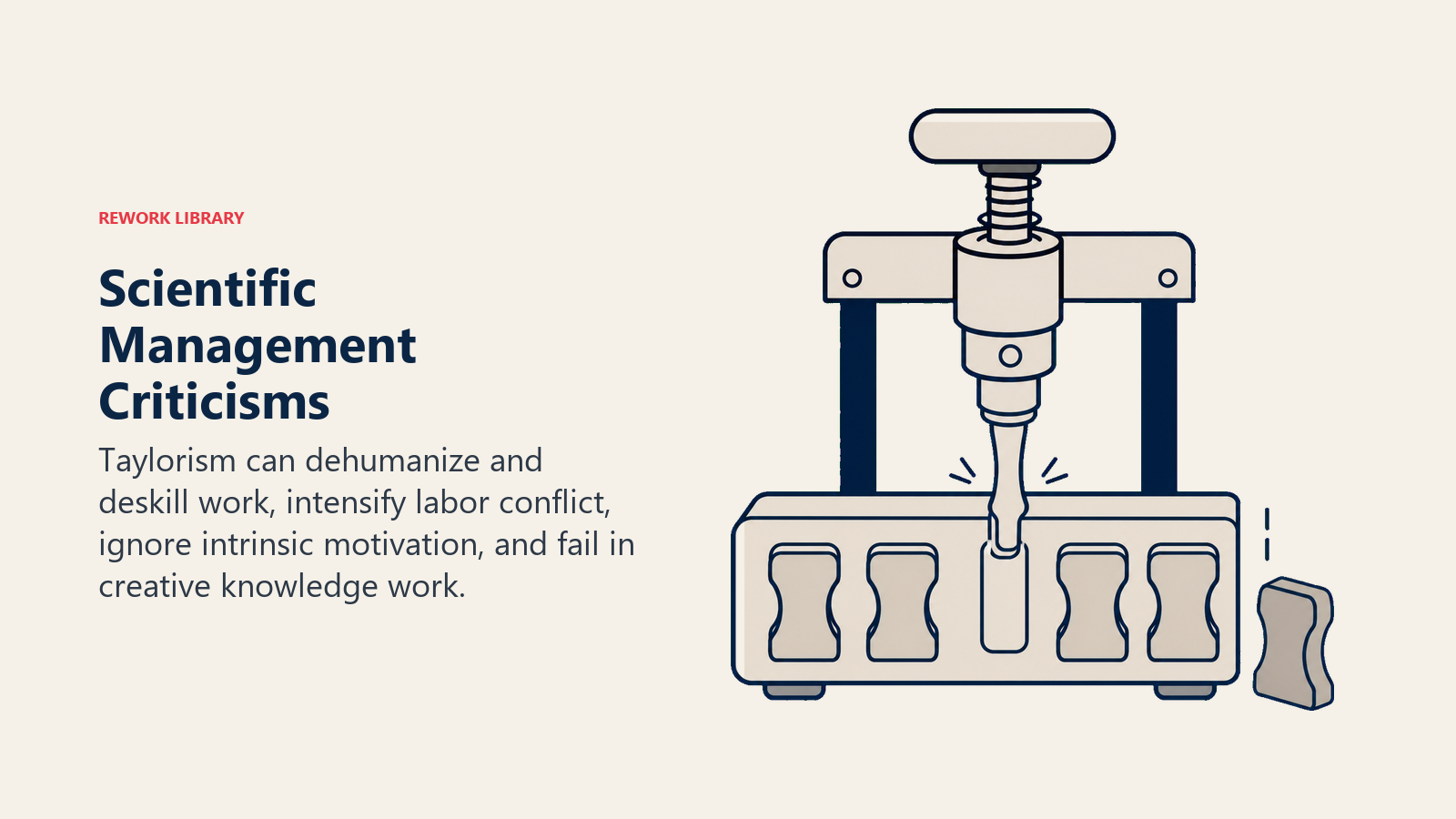
Dehumanizing work. Critics argued that breaking jobs into tiny, repetitive fragments stripped work of skill, judgment, and meaning. Workers became extensions of machines rather than craftspeople. Charlie Chaplin's 1936 film Modern Times is the most famous cultural expression of this critique.
Deskilling the workforce. When management holds all the knowledge about how tasks should be done, workers lose the ability to adapt, problem-solve, or improve methods independently. This creates fragility when conditions change and reduces the cognitive investment workers bring to their jobs.
Management-worker adversarial tension. Despite Taylor's promise of shared gains, the system was often implemented without the cooperative spirit he envisioned. Time-and-motion studies were used to set faster quotas without raising wages, fueling distrust between labor and management. Congressional hearings in 1912 examined whether Taylorism violated labor rights.
Ignores intrinsic motivation. Taylor assumed that workers are primarily motivated by money. This turns out to be an incomplete picture. Research by Frederick Herzberg (see Herzberg's Two Factor Theory) and others showed that recognition, autonomy, and meaningful work matter independently of pay.
Poorly suited to knowledge work. Time-and-motion study works well when tasks are physical and repetitive. It struggles to measure or optimize creative, collaborative, or diagnostic work. You can't easily standardize how long it takes to solve a novel engineering problem.
Ignores social dynamics. The Hawthorne Studies in the late 1920s and early 1930s found that productivity was strongly influenced by social relationships, group norms, and workers' sense of being observed and valued, factors that scientific management treated as irrelevant. This finding launched the human relations movement.
Scientific management vs the human relations approach
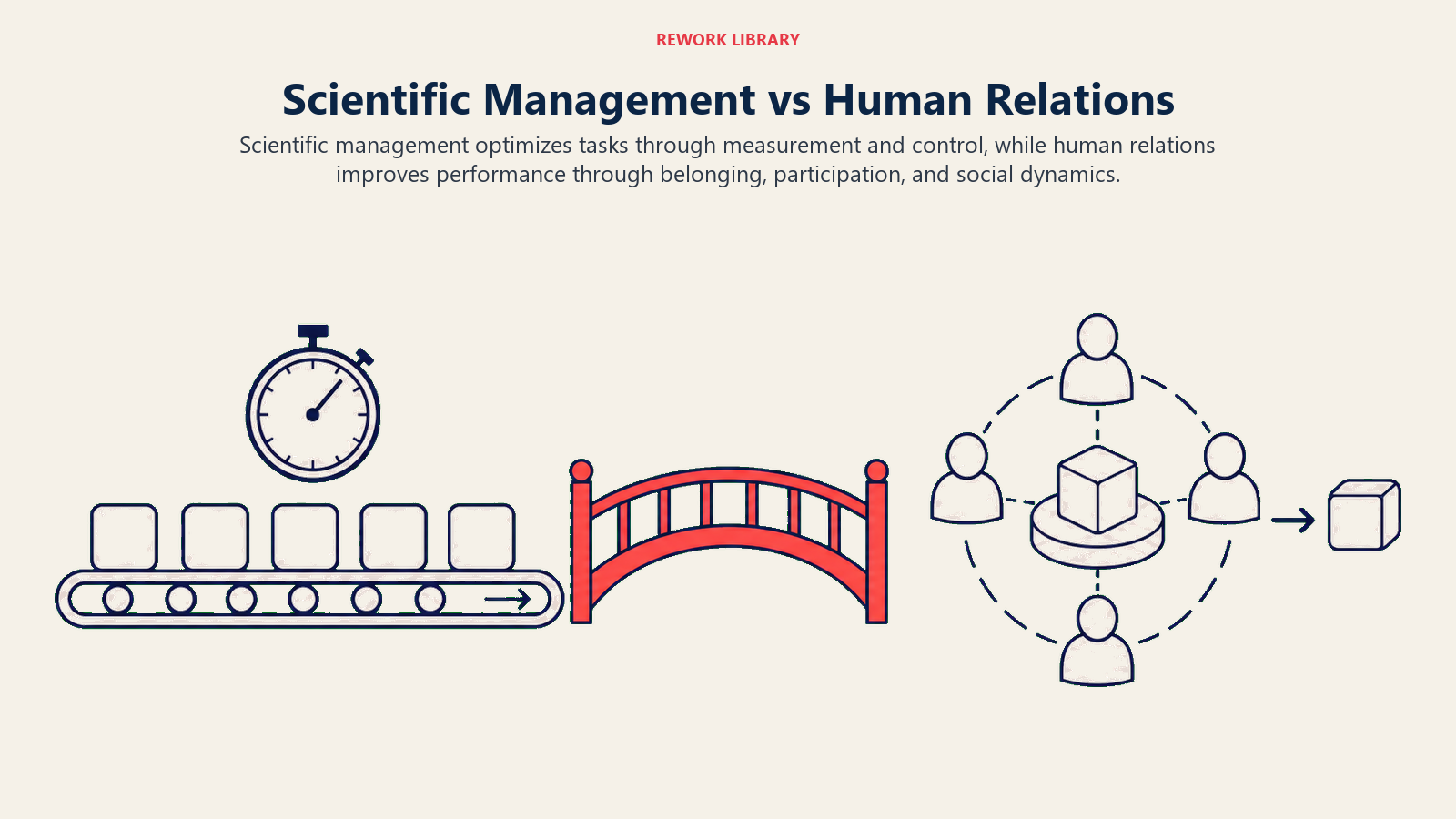
The human relations approach emerged directly as a counterpoint to Taylorism, and understanding the contrast clarifies why both frameworks have survived in management practice.
| Dimension | Scientific management | Human relations approach |
|---|---|---|
| View of workers | Rational economic agents motivated primarily by pay | Social beings motivated by belonging, recognition, and meaningful work |
| Role of management | Plan, measure, and control; separate thinking from doing | Facilitate, support, and develop; treat workers as whole people |
| Key tool | Time-and-motion study, standards, piece rates | Group dynamics, communication, employee participation |
| Primary metric | Output per unit of time | Employee satisfaction and group cohesion as drivers of performance |
| Roots | Midvale and Bethlehem Steel, 1880s-1900s | Hawthorne Works experiments, 1924-1932 |
| Key figures | Frederick Taylor, Frank and Lillian Gilbreth, Henry Gantt | Elton Mayo, Fritz Roethlisberger |
| Core weakness | Treats humans like machines; ignores intrinsic motivation | Can underweight the real value of structured methods and accountability |
Both approaches have partial validity. Modern management practice generally combines structured work design (from Taylor) with attention to employee engagement and autonomy (from the human relations tradition). For a broader view of where these frameworks sit, see what is leadership theories and leadership vs management. Taylor's shop-floor focus also pairs with Henri Fayol's administrative management, which built the classical view from the executive's chair down.
The Gilbreths and Gantt: extending Taylor's ideas
Taylor was not working in isolation. Three contemporaries extended his methods in important directions.
Frank Gilbreth was a bricklayer-turned-engineer who developed motion study as a discipline distinct from time study. Where Taylor focused on how long a task took, Gilbreth focused on the physical movements themselves. His analysis of bricklaying reduced the motions required per brick from 18 to 5, tripling output per worker. His wife Lillian Gilbreth brought psychology into the picture, arguing that work design had to account for fatigue, skill development, and worker wellbeing.
Henry Gantt, another Taylor collaborator, rejected the harsh differential piece-rate system in favor of a task-and-bonus scheme that rewarded workers for meeting daily targets. He also developed the Gantt chart, the bar-chart scheduling tool that remains a staple of project management today.
How to apply a basic time-and-motion study
Scientific management's most practical surviving tool is the time-and-motion study. You can run a simplified version without a team of industrial engineers.
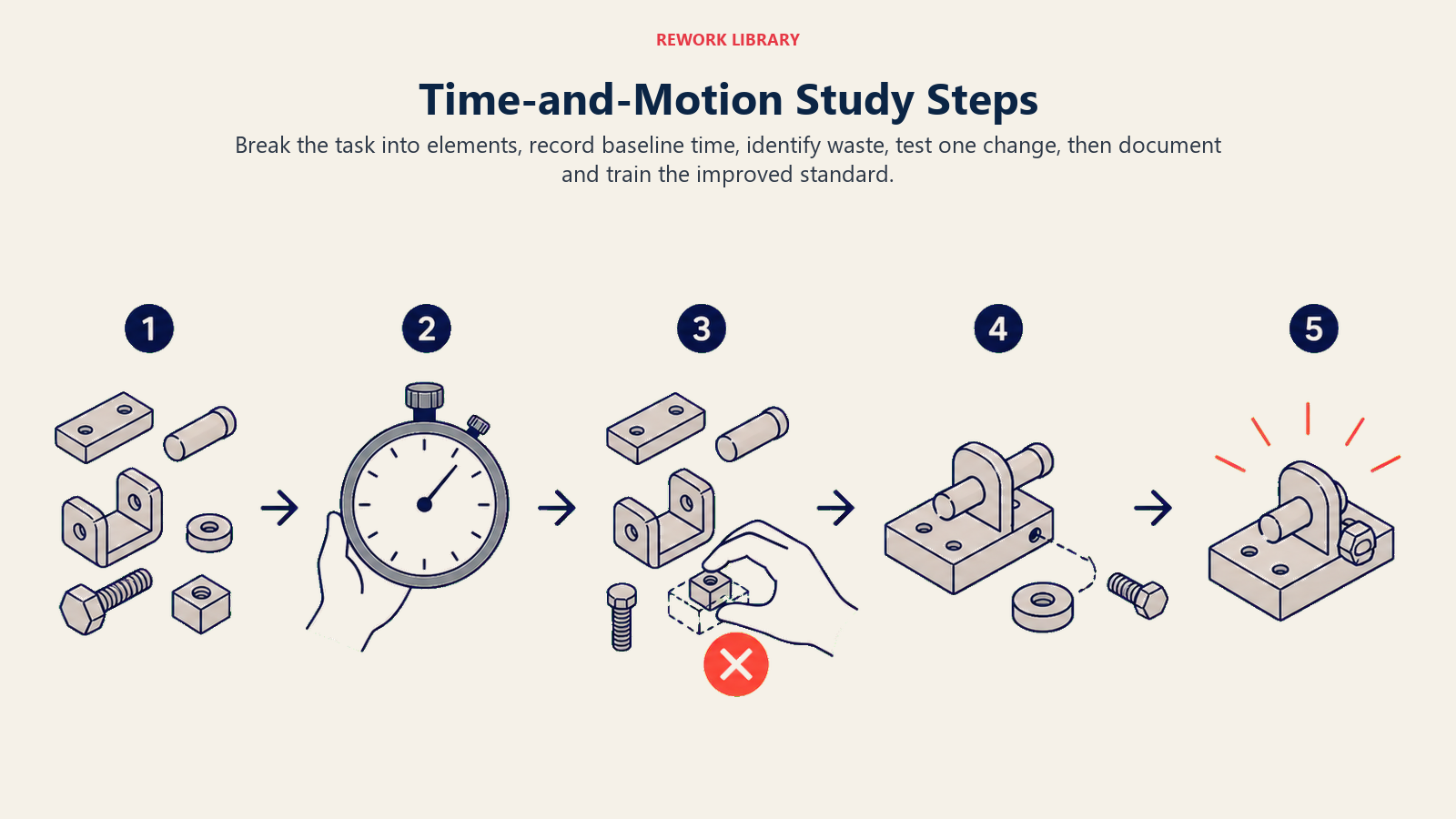
Step 1: Define the task and break it into elements
Pick a specific, repeatable task. A customer service team handling returns. A warehouse team picking orders. Break it into discrete sequential steps written as observable actions, not outcomes.
Step 2: Observe and record baseline times
Watch the task being performed by several workers across multiple repetitions. Record the time for each element, not just the total. Note which workers you observe and any conditions that varied (different equipment, time of day, order type).
Step 3: Identify waste and variation
Compare times across workers and repetitions. Large variation in a single element usually signals an unclear method or a physical obstacle. Consistently slow elements are candidates for redesign.
Step 4: Design and test the improved method
Change one variable at a time. A different tool, a different sequence, a different station layout. Test the new method with a small group, measure the result, and compare to baseline.
Step 5: Document the standard and train the team
Once you confirm an improvement, document the method precisely, not as a general guideline but as a specific sequence with defined tools and checkpoints. Train all workers to the new standard. Then repeat: scientific management treats standardization as a floor to improve from, not a ceiling.
This process is the DNA of lean continuous improvement. See lean methodology for how it is formalized in modern operations.
Examples of scientific management in practice
Historical: Bethlehem Steel pig iron experiment (1899). Taylor selected 75 of the fittest workers from a gang of 75 men loading pig iron, studied their movements, prescribed rest periods, and introduced financial incentives. Individual daily output rose from 12.5 tons to 47 tons per worker. This became the founding case study of scientific management.
Historical: Ford's moving assembly line (1913). Henry Ford's engineers used Taylor's principles to design the Highland Park assembly line. Each worker performed a single defined task. The line moved continuously, setting the pace. The result was a dramatic reduction in build time and cost, making the Model T affordable to the middle class.
Modern: Amazon fulfillment centers. Amazon's warehouse operations use sophisticated algorithmic management that is recognizably Taylorist: tasks are broken into defined steps, workers are timed on every action, deviations from expected productivity rates trigger automated warnings, and layout is continuously optimized. The company has faced significant labor-relations criticism that echoes the 1912 Congressional hearings about Taylor's methods.
Modern: Gig-economy platforms. Uber, DoorDash, and similar platforms use algorithmic time-and-motion logic to set expected delivery or ride times, rate driver efficiency, and allocate work. Workers follow prescribed routes and sequences without visibility into the optimization logic, a digital update of Taylor's separation of planning from doing.
Modern: Lean manufacturing (Toyota Production System). Toyota's system explicitly builds on standardized work (the Taylorist core) but adds worker involvement in improving those standards, a direct response to the human relations critique. See lean methodology for the full framework.
Frequently Asked Questions about Scientific Management
What is scientific management in simple terms?
Scientific management is the idea that you can find the most efficient way to do any job by carefully observing and measuring how it is currently done, then redesigning the task based on what the data shows works best. Frederick Taylor developed the approach in the late 1800s to increase industrial output without increasing headcount.
What are Taylor's four principles of scientific management?
Taylor's four principles are: (1) replace rules of thumb with scientifically determined methods, (2) scientifically select and train workers for each task, (3) cooperate with workers to ensure methods are followed and gains are shared, and (4) divide work equally between management (planning and design) and workers (execution).
What is the difference between scientific management and the human relations approach?
Scientific management treats workers as economic units motivated by pay and focuses on standardizing tasks for maximum output. The human relations approach, which emerged from the Hawthorne Studies, treats workers as social beings whose performance is shaped by group dynamics, recognition, and meaningful work. Most modern management practice combines both.
Is scientific management still used today?
Yes, though often without the label. Lean manufacturing, Six Sigma, logistics optimization, gig-economy algorithms, and warehouse management systems all draw on Taylorist principles of task analysis, standardization, and continuous measurement. The stopwatch is now software, but the logic is the same.
What were the main criticisms of scientific management?
The main criticisms are that it dehumanizes work by reducing workers to machine-like task executors, deskills the workforce by centralizing knowledge in management, ignores intrinsic motivation, creates adversarial labor relations when productivity gains are not shared fairly, and fails to apply to creative or knowledge-intensive work.
Scientific management reshaped how the world thinks about work. Its insistence on measurement, standardization, and continuous improvement was genuinely transformative, and those ideas did not die with the industrial age. But the human relations movement taught us that people are not machines, and that a productivity system ignoring that fact will always underperform one that takes it seriously.
The most effective operations leaders today use both lenses. They design work carefully (Taylor's legacy) and build cultures where people want to do that work well (the human relations corrective). For more on how leadership theory developed from these early frameworks, see what is leadership theories, McGregor Theory X and Y, bureaucratic leadership, behavioral leadership theory, the Great Man Theory, and Herzberg Two Factor Theory.

Senior Operations & Growth Strategist
On this page
- What is scientific management?
- Taylor's four principles of scientific management
- Benefits of scientific management
- Criticisms and limitations
- Scientific management vs the human relations approach
- The Gilbreths and Gantt: extending Taylor's ideas
- How to apply a basic time-and-motion study
- Step 1: Define the task and break it into elements
- Step 2: Observe and record baseline times
- Step 3: Identify waste and variation
- Step 4: Design and test the improved method
- Step 5: Document the standard and train the team
- Examples of scientific management in practice