Emotional Intelligence in Leadership: Why It Matters
Turn this article into takeaways for your work.


Each assistant summarizes the article only for you and suggests best practices for your work.
Emotional intelligence (EI) in leadership is the ability to recognize, understand, and manage your own emotions while reading and influencing the emotions of the people around you. It sounds soft. But the research makes a hard case: EI consistently outpredicts IQ and technical skills when explaining why some leaders build high-performing teams and others struggle.
This article covers what emotional intelligence is, the five components Daniel Goleman identified, why they matter for leaders, and how to build each one.
What is emotional intelligence in leadership?
Emotional intelligence (EI, sometimes called emotional quotient or EQ) is the capacity to perceive, evaluate, and regulate emotions in yourself and others. The concept entered mainstream management in 1995 when psychologist Daniel Goleman published his landmark book and later refined it in a 1998 Harvard Business Review article titled "What Makes a Leader."
Goleman's core argument: the higher the level of a role, the more EI matters relative to raw technical competence. Senior leaders spend most of their time motivating people, managing conflict, building coalitions, and navigating uncertainty. Those tasks run on emotional skill, not spreadsheet proficiency.
Key terms in this article:
- EI / EQ: emotional intelligence / emotional quotient (used interchangeably)
- Self-awareness: knowing your own emotional states and how they affect behavior
- Social skill: managing relationships to move people in desired directions
Key Facts
- In a study of 200 large global companies, Goleman found that EI competencies accounted for roughly 90% of the difference between average and star performers in senior leadership roles (Harvard Business Review, 1998).
- Research by TalentSmart tested EQ alongside 33 other workplace skills and found emotional intelligence to be the strongest predictor of performance, explaining 58% of success across all job types (TalentSmart, 2014).
- A Yale School of Management study found that leaders who expressed positive emotions saw teams perform better on creative and collaborative tasks, while negative emotional contagion from leaders reduced team output measurably (Barsade, 2002).
The five components of emotional intelligence
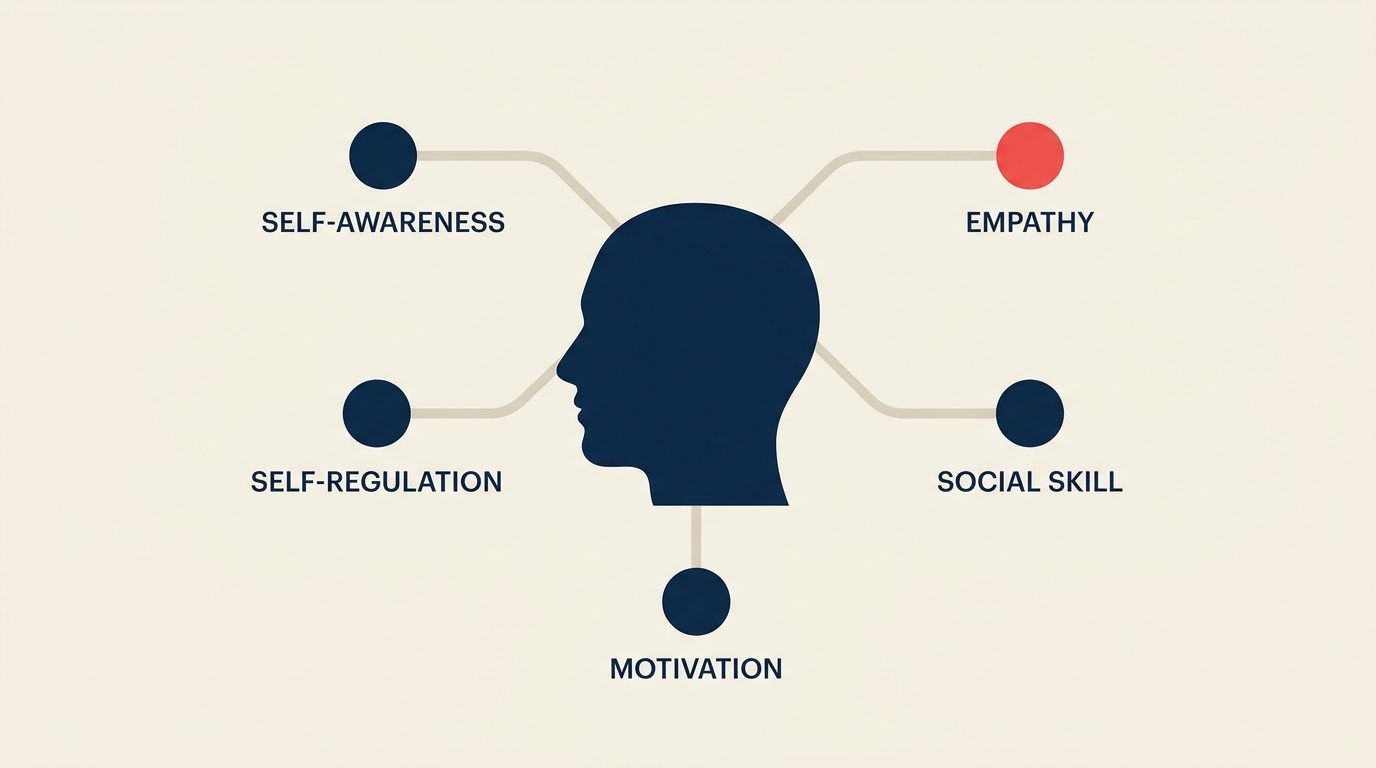
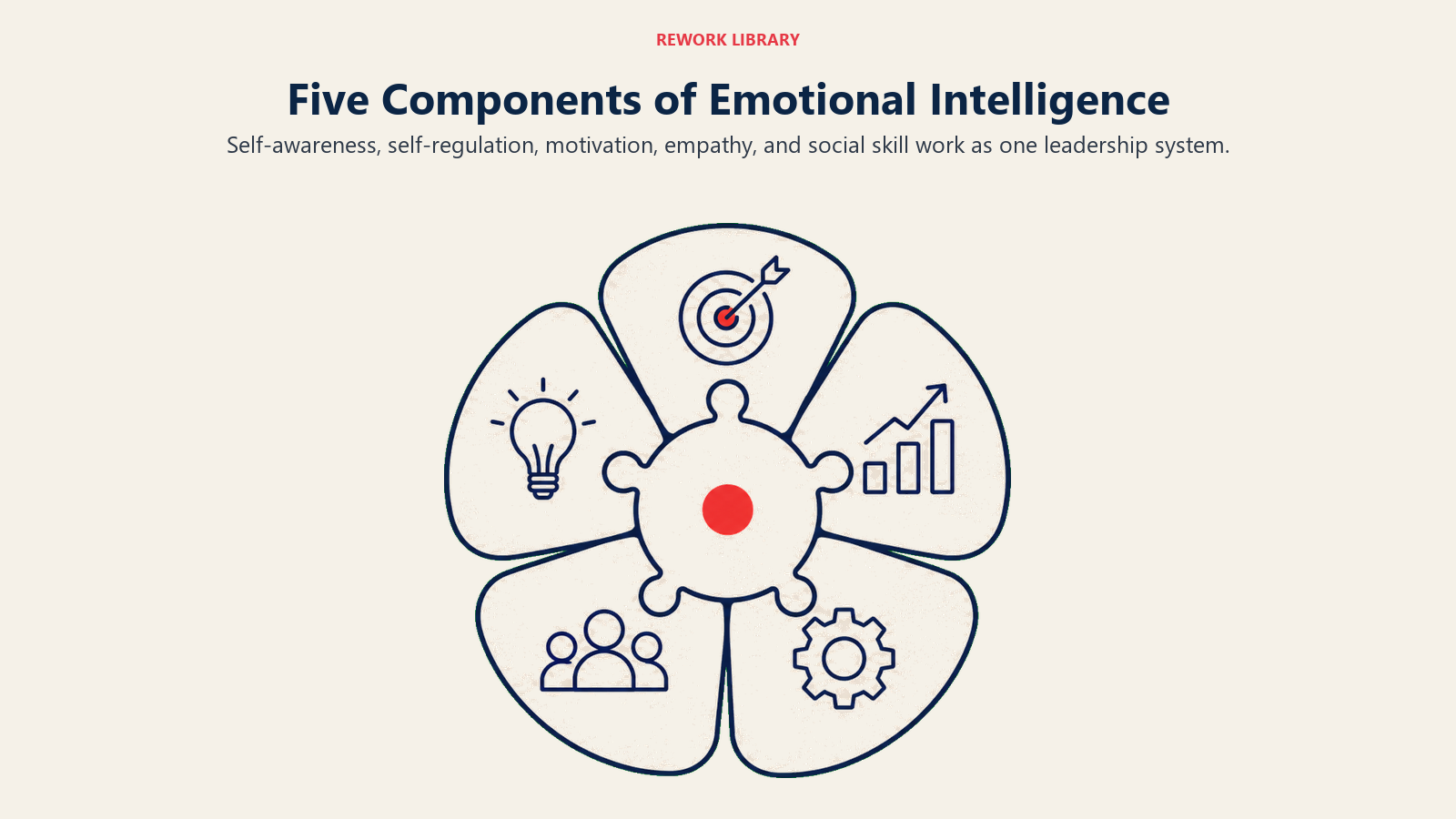
Goleman broke EI into five distinct capabilities. The table below shows each one and what it looks like in a leadership context.
| Component | What it means | Leadership behavior |
|---|---|---|
| Self-awareness | Knowing your emotions, strengths, limits, and values as they happen | Acknowledges mistakes publicly; asks for feedback without defensiveness; knows when stress is distorting judgment |
| Self-regulation | Managing disruptive emotions and impulses; thinking before acting | Stays calm during a crisis; doesn't react with blame in the heat of a difficult meeting; creates trust through consistency |
| Motivation | Pursuing goals with energy and persistence beyond external reward | Maintains optimism after setbacks; sets challenging goals and holds themselves accountable; communicates a compelling purpose |
| Empathy | Considering others' feelings in decision-making; reading the room | Notices when a team member is struggling before they say so; adjusts communication style to the individual; builds loyalty through genuine attention |
| Social skill | Building networks, managing relationships, finding common ground | Moves disputes toward resolution; builds cross-functional influence; gives recognition in ways that land |
These five components are the building blocks. But they don't operate in isolation. A leader with strong empathy and zero self-regulation creates a different kind of problem than a leader with strong motivation but no social skill. The combination is what defines leadership quality.
Why emotional intelligence matters for leaders
The case breaks into three practical areas.
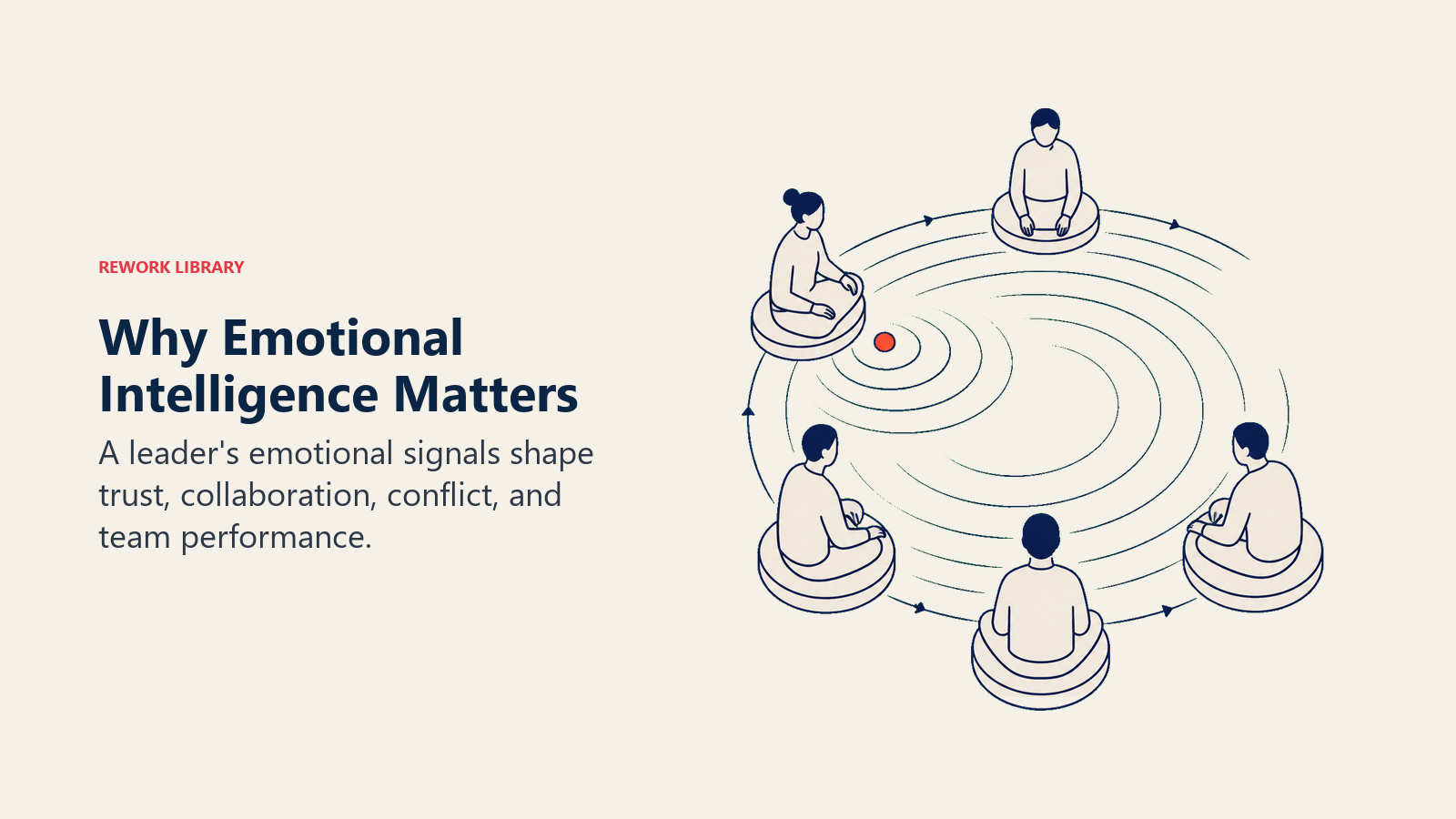
Team performance. Emotions are contagious. Leaders set the emotional climate of a team, and that climate directly affects how well people collaborate, take risks, and handle pressure. Barsade's "ripple effect" research showed that a leader's mood spread through a team within minutes, shaping decisions and energy levels for the rest of the day. A leader who walks in angry and stays there bleeds that into every interaction.
Retention and trust. People don't leave companies; they leave managers. A leader who lacks empathy or self-regulation creates an environment where people feel unsafe raising problems, which accelerates turnover and suppresses innovation. Psychological safety, the team condition most linked to high performance, is built primarily through leader behavior. See our deeper treatment in psychological safety.
Decision-making under pressure. Leaders who can't regulate their emotions make worse decisions under stress. Neuroscience research by Antonio Damasio showed that people with damage to emotion-processing brain areas struggled to make basic decisions, even when their logical reasoning was intact. Emotion isn't the enemy of good judgment; unmanaged emotion is.
Cross-functional influence. The higher you go in an organization, the less formal authority you have over the people you need to influence. Directors and VPs spend much of their time getting buy-in from peers, not reports. Social skill, one of Goleman's five components, is what makes that possible. Leaders who can read a room, adjust their approach, and build genuine relationships get things done faster than those who rely solely on positional power.
The connection to specific leadership styles is worth noting. The coaching, affiliative, and democratic styles that Goleman describes as the most consistently effective are each built on strong EI foundations. Read more in emotional leadership styles.
Signs of low emotional intelligence
Low EI tends to show up in recognizable patterns. These aren't character flaws but skill gaps, which means they're addressable.
Frequent blame and defensiveness. When something goes wrong, a low-EI leader's first instinct is to identify who caused it rather than what can be fixed. Team members learn quickly to hide problems rather than surface them early.
Difficulty reading people. A leader who misses that someone is burned out, disengaged, or holding back frustration misses the moment to intervene. Problems compound until they become crises.
Inconsistent behavior. If direct reports can't predict how a leader will respond on a given day, they spend cognitive energy managing up instead of doing actual work. Consistency is a byproduct of self-regulation.
Tunnel-focused motivation. A leader who is personally driven but can't connect that drive to the team's goals ends up with a culture of "heroic individual," where only the leader's vision counts. This blocks the distributed ownership that high-performing teams need.
Conflict avoidance or overreaction. Both extremes signal low social skill. Some leaders avoid any confrontation, letting interpersonal issues fester. Others escalate too fast, creating a climate where people stop disagreeing entirely.
These patterns don't disqualify a leader. But they do predict specific outcomes: higher attrition, lower psychological safety, and worse performance on ambiguous, collaborative work.
How to develop emotional intelligence as a leader
EI isn't fixed. Multiple longitudinal studies have shown it increases with deliberate practice. These six steps are grounded in what Goleman and subsequent researchers have found to work.
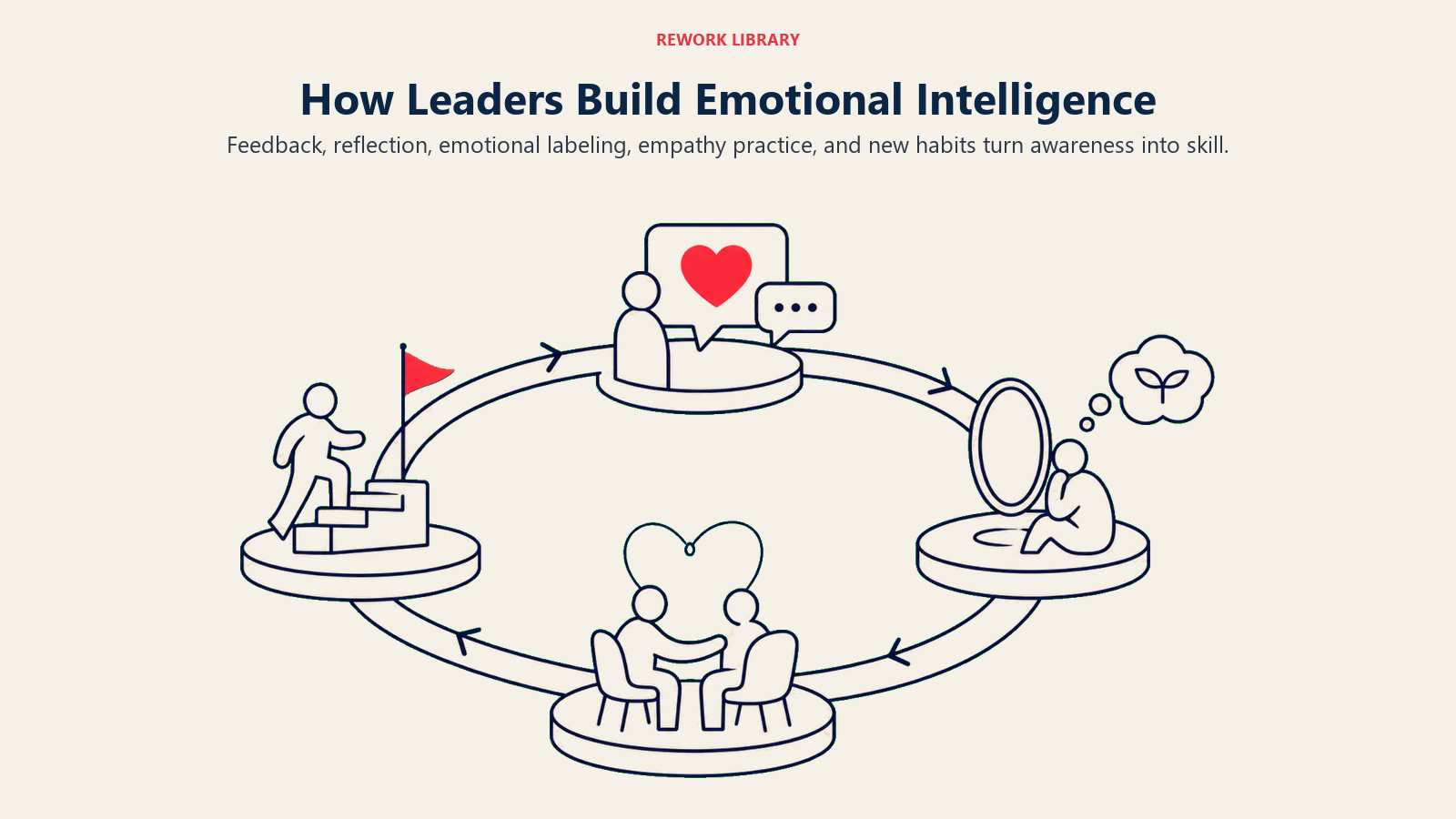
Step 1: Start with a 360-degree feedback process
You can't improve what you can't see. A structured 360 collects anonymous input from peers, direct reports, and your own manager, giving you a picture of how your emotions and behavior land on others. Many leaders discover a meaningful gap between their self-perception and what their team actually experiences. That gap is the starting point.
Step 2: Build a daily reflection habit
Set aside five minutes at the end of each day to review emotional moments. What triggered you? How did you respond? What would you do differently? This isn't journaling for its own sake. It trains self-awareness, which is the foundation all four other components build on.
Step 3: Practice the pause
Self-regulation comes down to the gap between stimulus and response. When something frustrating happens, leaders with high EI don't react in the moment. They create a small delay: a breath, a brief reframe, a walk down the hall. Over time this becomes automatic. Start by identifying your personal triggers, the types of situations, people, or comments that reliably destabilize you, and plan your pause response in advance.
Step 4: Expand empathy through active listening
Empathy isn't just a feeling; it's a skill built through attention. In your next one-on-one, listen without planning your response. Ask one follow-up question before offering an opinion. Notice non-verbal cues. When someone describes a problem, reflect back what you heard before moving to solutions. This kind of structured listening practice is what separates leaders who "care" in the abstract from those who actually make people feel heard. Our article on active listening goes deeper on technique.
Step 5: Find a coach or trusted peer
EI development accelerates with external feedback. A coach who can observe your leadership behavior and give real-time input on blind spots compresses what might take years of self-observation into months. If a coach isn't available, a trusted peer who will tell you the truth, not just affirm you, serves a similar function. The coaching leadership style is particularly effective partly because it models this kind of developmental relationship.
Step 6: Invest in motivation by connecting to purpose
Intrinsic motivation, one of Goleman's five components, is harder to manufacture than the others. But research on self-determination theory points to a reliable approach: identify the aspects of your work that connect to something bigger than individual output, your team's growth, the organization's mission, the customers you serve. Leaders who can articulate that connection clearly are more resilient after setbacks and more energizing for the people around them.
Emotional intelligence in leadership examples
Abstract capability matters less than how it shows up in real situations. Here are three scenarios.
| Scenario | Low-EI response | High-EI response |
|---|---|---|
| A high performer gives notice unexpectedly | Reacts with surprise and hurt; pushes for the "real reason"; makes the exit awkward | Stays composed; thanks them genuinely; asks what they would have changed; uses the conversation to learn |
| A cross-functional project stalls because two team members keep clashing | Avoids the conflict or issues a directive to "just work it out" | Meets with each person separately to understand their perspective; surfaces the underlying tension in a structured conversation; builds agreement on shared goals |
| A critical product launch fails | Assigns blame in a post-mortem meeting; uses frustration to drive urgency | Acknowledges their own role in what went wrong; runs a blameless retrospective; maintains team morale while still holding people to learning outcomes |
The high-EI response in each case isn't softer. It's more effective. It preserves relationships, surfaces information earlier, and keeps the team functional under pressure.
For a full treatment of leadership modes built on EI, read emotional leadership styles. For the quality that makes these behaviors possible at scale, see psychological safety.
Best practices
| Do | Don't |
|---|---|
| Name your emotional state out loud when it's affecting a meeting | Suppress emotions until they come out sideways |
| Ask "how are you actually doing?" and wait for a real answer | Treat one-on-ones as status updates only |
| Build self-awareness from 360 data, not self-report alone | Assume your impact on others matches your intent |
| Make feedback specific, timely, and behavior-based | Deliver feedback only in formal review cycles |
| Model the vulnerability you want to see from the team | Expect openness from direct reports while staying closed yourself |
| Celebrate progress on team EI, not just output metrics | Measure success by deliverables alone |
Emotional intelligence won't replace strategic vision or operational discipline. But leaders who build their EI get more out of both, because people follow them more willingly, surface problems more honestly, and stay longer. The five components Goleman identified aren't personality traits to admire in others; they're skills with a proven development path. Start with self-awareness, and the rest follows.
For related reading: what is transformational leadership?, servant leadership, authentic leadership, inclusive leadership, emotional intelligence (employee competency).

Senior Operations & Growth Strategist
On this page
- What is emotional intelligence in leadership?
- The five components of emotional intelligence
- Why emotional intelligence matters for leaders
- Signs of low emotional intelligence
- How to develop emotional intelligence as a leader
- Step 1: Start with a 360-degree feedback process
- Step 2: Build a daily reflection habit
- Step 3: Practice the pause
- Step 4: Expand empathy through active listening
- Step 5: Find a coach or trusted peer
- Step 6: Invest in motivation by connecting to purpose
- Emotional intelligence in leadership examples
- Best practices