Servant vs Transformational Leadership Compared
Turn this article into takeaways for your work.


Each assistant summarizes the article only for you and suggests best practices for your work.
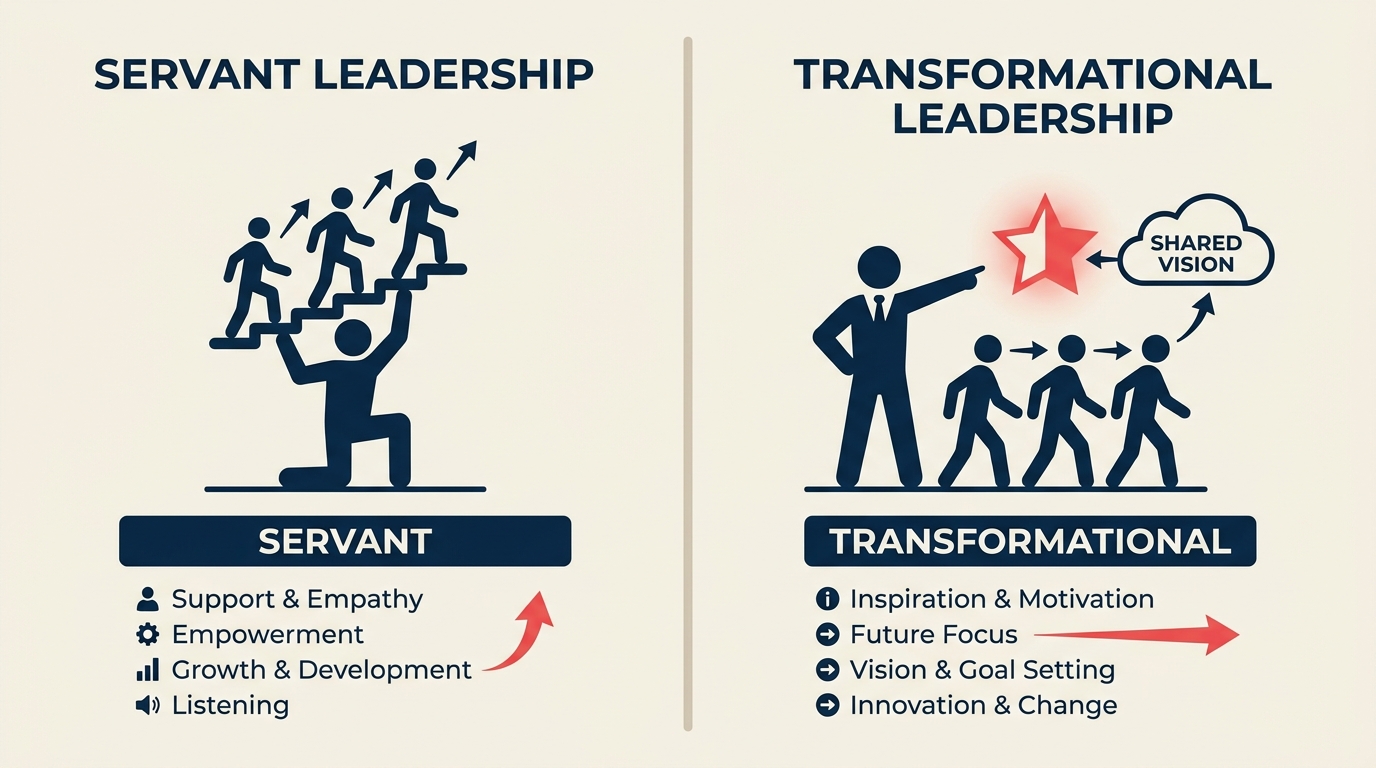
Servant vs transformational leadership is one of the most useful comparisons any manager can make, because both styles are genuinely people-focused, yet they pull in different directions. Servant leadership puts the leader's energy into what followers need right now. Transformational leadership puts that energy into where the organization is going. Understanding the difference helps you lead intentionally rather than by default.
What Is the Difference Between Servant and Transformational Leadership?
Servant leadership places followers' growth and needs first. The leader's primary role is to serve: to remove obstacles, listen deeply, and create conditions where people can do their best work. Robert Greenleaf coined the term in his 1970 essay "The Servant as Leader," arguing that the best leaders ask first what their people need, not what they can extract from them.
Transformational leadership inspires followers toward a shared vision and higher performance. The leader elevates the team's aspirations and capabilities, connecting daily work to a larger purpose. James MacGregor Burns introduced the concept in 1978, and Bernard Bass formalized it as a management framework in 1985.
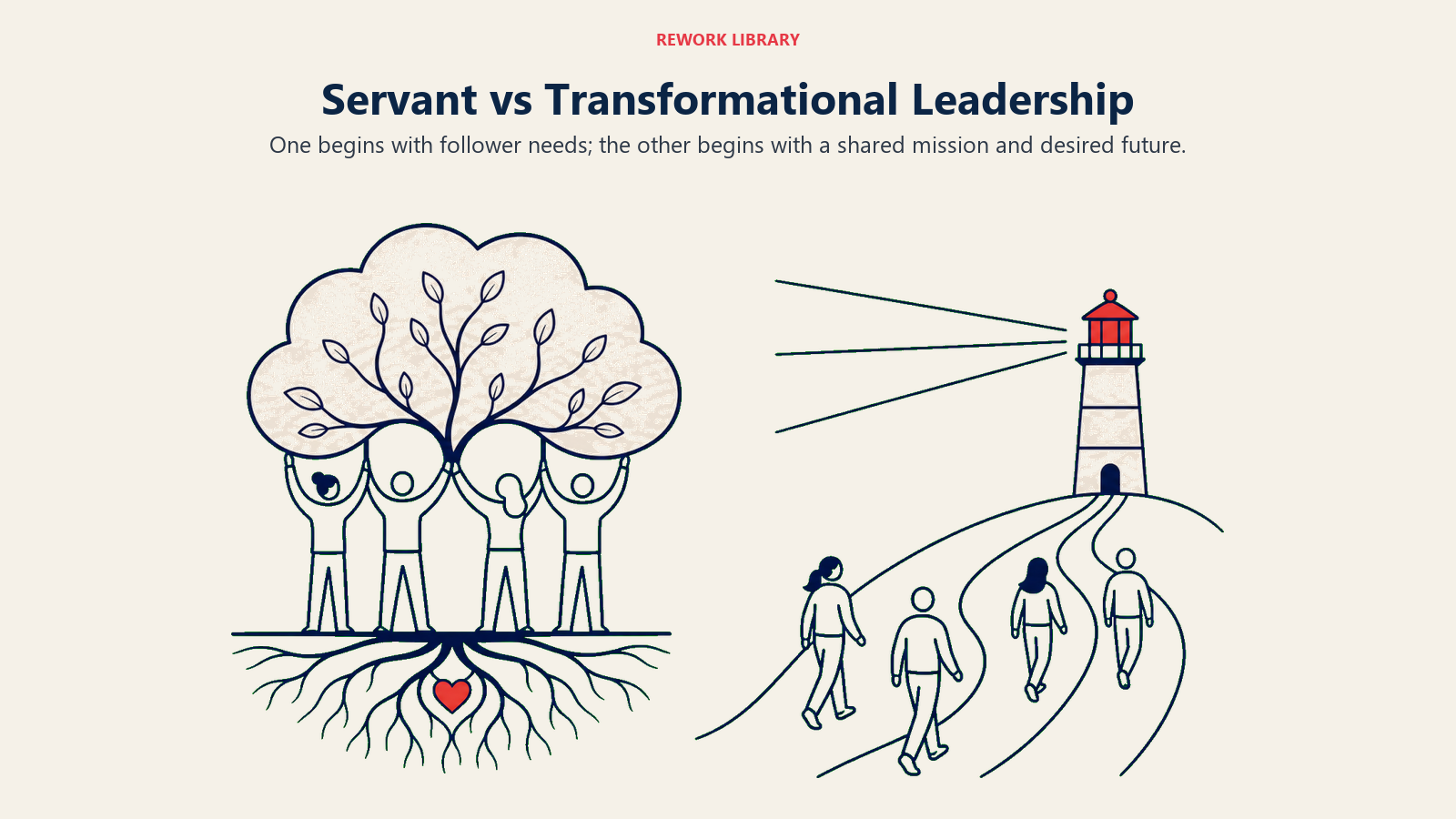
The key contrast: servant leadership's primary focus is the person, while transformational leadership's primary focus is the mission and vision. Both care about people, but for different reasons and through different mechanisms.
Key Facts
Evidence base: Robert Greenleaf published "The Servant as Leader" in 1970, founding the modern servant leadership movement. James MacGregor Burns introduced transformational leadership in his 1978 book Leadership, and Bernard Bass operationalized it with the Four I's framework in 1985. A 2019 meta-analysis in the Leadership Quarterly (Hoch et al.) found servant leadership significantly predicted follower job performance, organizational citizenship behavior, and team effectiveness. A 2020 meta-analysis in the Journal of Applied Psychology confirmed transformational leadership's positive relationship with follower motivation and performance across 87 studies.
"Servant leaders ask what their people need; transformational leaders ask where they can go." If you can only remember one line from this comparison, make it that one.
What Is Servant Leadership?
The leader removes obstacles and develops people so they can perform, grow, and lead themselves.
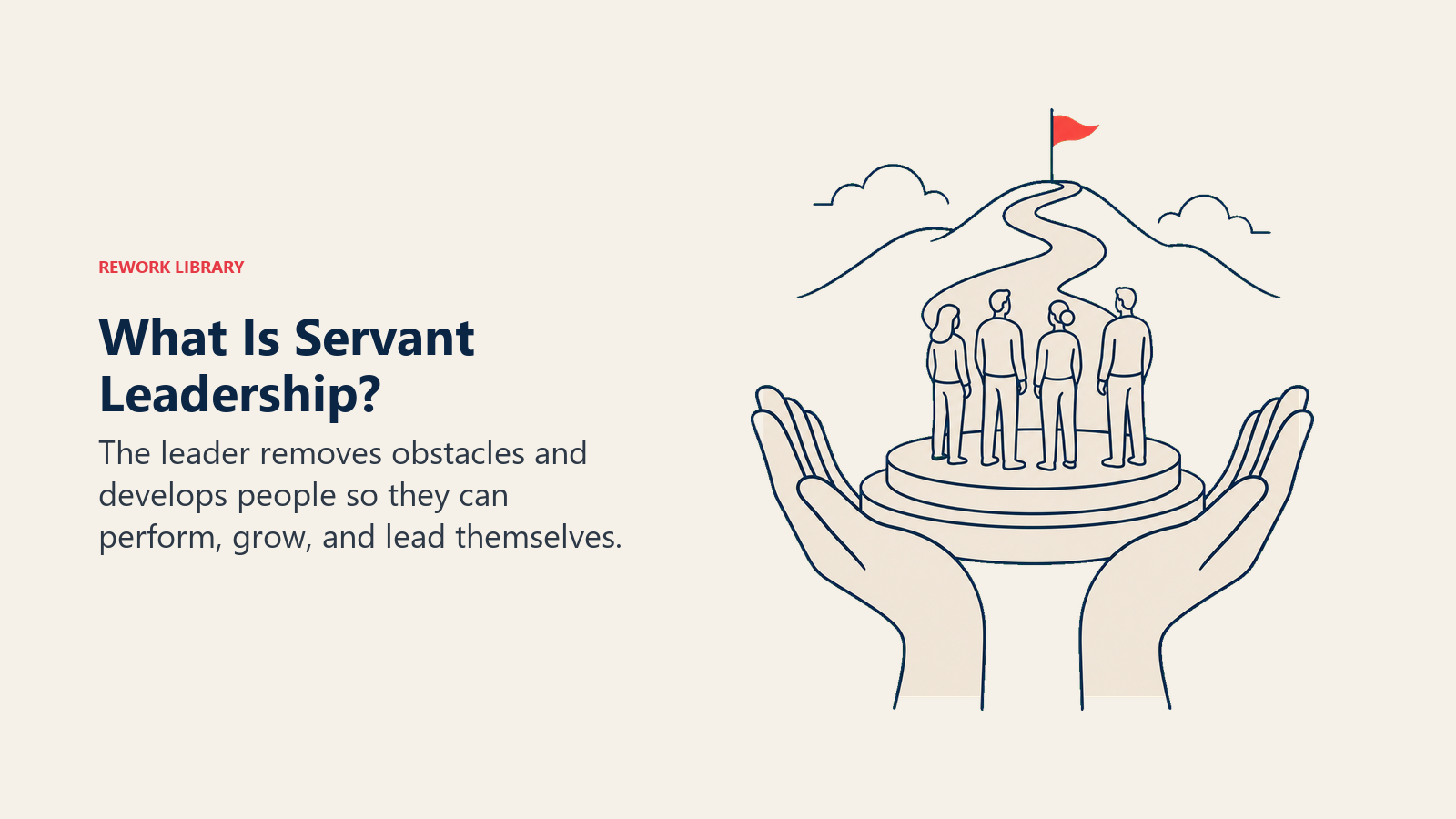
Servant leadership flips the traditional power structure. Instead of followers serving the leader, the leader serves the followers. The measure of success is not the leader's authority or visibility but whether the people around them are growing, performing better, and becoming more capable over time.
Greenleaf identified several core behaviors that define servant leaders:
Listening. Servant leaders prioritize understanding before responding. They spend more time hearing concerns, ideas, and struggles than broadcasting direction.
Empathy. They assume good intent and try to understand each person's context. This doesn't mean they avoid difficult conversations. It means they approach those conversations from genuine curiosity, not judgment.
Stewardship. Servant leaders see themselves as holding the organization in trust, not as owning it. They make decisions that benefit the long-term health of the team, even when that's harder in the short run.
Commitment to people's growth. They invest in the development of each person, not just the ones who are already performing well. A servant leader treats potential as a responsibility.
This style shows up in organizations that take culture seriously. Patagonia's leadership model is frequently cited as servant-oriented: decisions about people, environment, and product are made with a clear hierarchy of values, and the people closest to the work have real influence. Leaders like Ken Blanchard have built entire management systems around Greenleaf's original idea.
What Is Transformational Leadership?
The leader connects a compelling vision to higher motivation, new beliefs, and stronger collective performance.
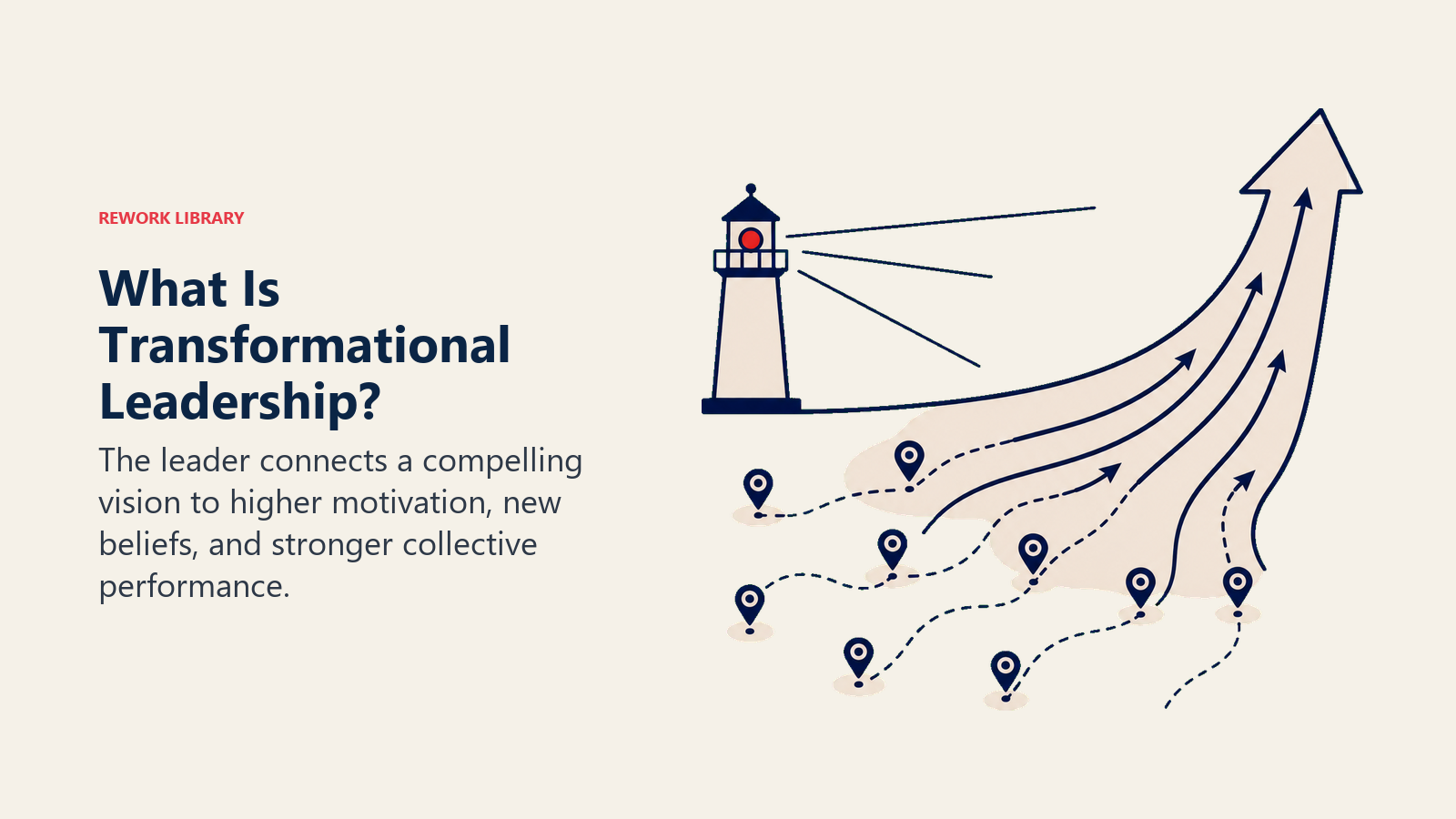
Transformational leadership works by changing what people believe is possible. The leader creates a compelling vision, models the values that vision requires, and challenges the team to grow beyond their current limits. People follow because they believe in where the leader is taking them, not just because they were told to.
Bernard Bass gave us the Four I's, the behavioral framework that still defines transformational leadership today:
Idealized Influence: The leader models the values and behaviors they expect from the team. Followers respect and trust the leader as a result. This is the "lead by example" component, but deeper. It's about earning moral authority, not just demonstrating competence.
Inspirational Motivation: The leader articulates a future that followers want to be part of. The vision is communicated clearly and repeatedly, and followers feel genuine energy about working toward it. It's not manipulation. It's meaning.
Intellectual Stimulation: The leader challenges people to question assumptions, try new approaches, and think independently. There's no penalty for raising a hard question or a different view. This is where innovation comes from.
Individualized Consideration: The leader pays attention to each person's unique strengths, goals, and development needs. Coaching and mentoring are not occasional. They're built into how the leader works.
Satya Nadella rebuilding Microsoft around a growth mindset culture is the most-cited recent example of transformational leadership at scale. But you don't need a global company to practice it. A team manager who connects each person's work to the company's direction, invests genuinely in their development, and challenges people to think bigger is practicing transformational leadership in a real and measurable way.
Servant vs Transformational: Side-by-Side Comparison
One begins with follower needs; the other begins with a shared mission and desired future.
| Dimension | Servant Leadership | Transformational Leadership |
|---|---|---|
| Primary focus | The person's needs and growth | The mission, vision, and shared goals |
| Motivation source | Belonging, growth, being heard and valued | Inspiration, purpose, belief in the vision |
| View of followers | People to serve and develop | People to elevate and align with a greater goal |
| Success measure | Are people flourishing and capable? | Is the team achieving the vision? |
| Risk | May lack direction if vision is unclear | May neglect individual needs in pursuit of the mission |
| Best context | Mature teams, culture-building, trust repair | Change initiatives, high-stakes growth, innovation pushes |
Where They Overlap
These two styles are often contrasted, but they share more than most comparisons acknowledge.
Both are relational. Neither relies on authority or control as the primary tool. Both require genuine connection with the people being led.
Both are values-driven. Servant leaders act from a clear set of values about what people deserve. Transformational leaders act from a clear set of values about what the organization should become. The content differs. The commitment to values does not.
Both develop people. The servant leader develops people as an end in itself. The transformational leader develops people because it serves the larger mission. The outcome for the individual can look nearly identical: better skills, more confidence, a clearer sense of purpose.
Both have been associated with higher engagement, lower turnover, and stronger team performance in the research literature. That's not a coincidence. At their core, both styles ask leaders to invest in people rather than extract from them.
When to Use Each Style
Use servant leadership when:
- Trust has been damaged and needs to be rebuilt through consistent, visible care
- Your team is performing well but burning out under pressure
- You're leading highly skilled professionals who need autonomy, not direction
- Culture is the primary work (onboarding, transformation of norms, post-merger integration)
- The team has the vision but is blocked by systemic or resource obstacles
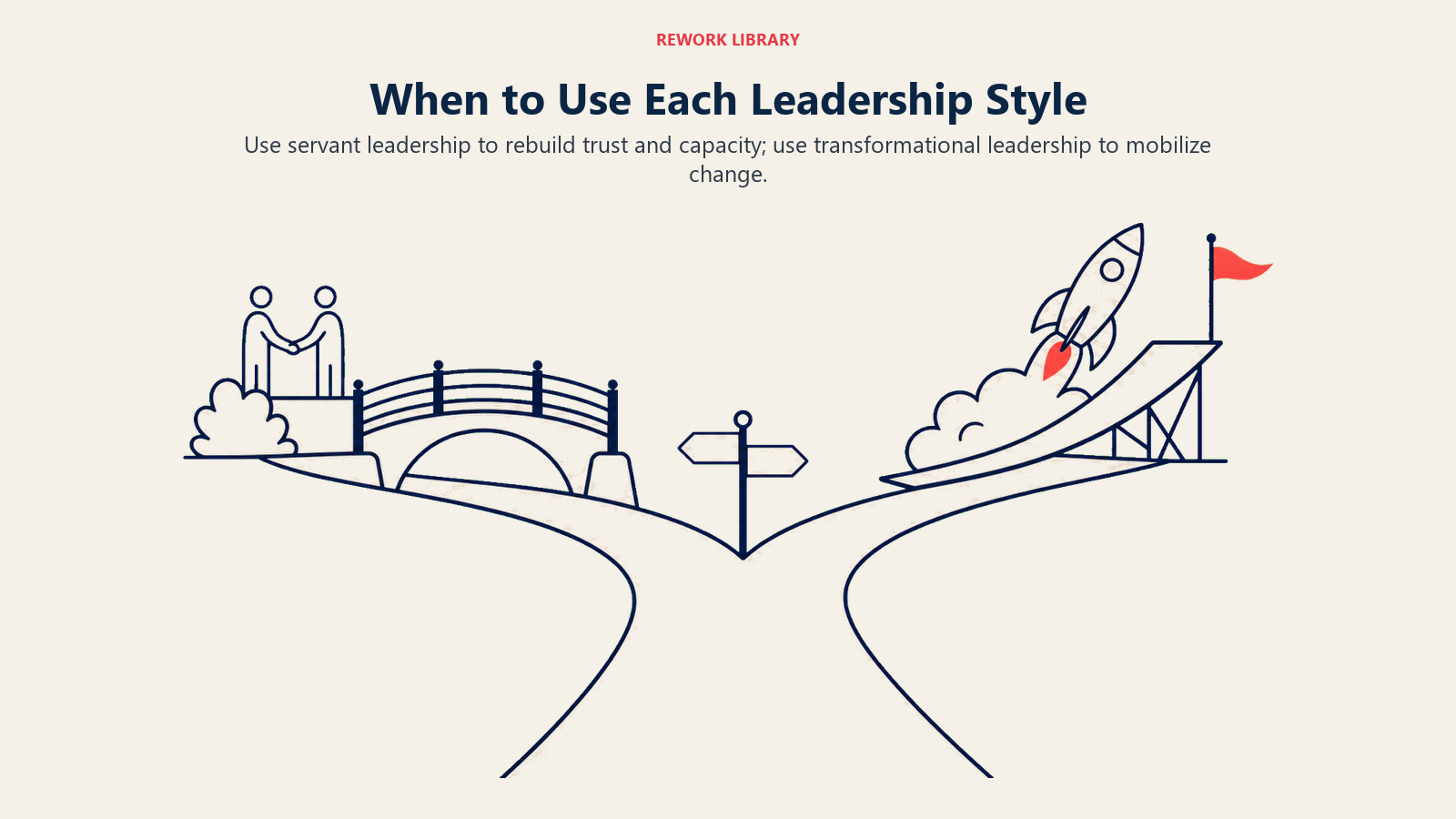
Use transformational leadership when:
- The organization is entering a period of significant change
- The team lacks direction or belief in what they're working toward
- You need to attract and retain people who have options and want to be part of something
- Creative, complex work is the core output and intrinsic motivation is the engine
- The status quo is no longer working and you need people to commit to something new
Many effective leaders move between both. A servant leader who stays permanently in service mode without ever articulating a direction can leave a team without purpose. A transformational leader who focuses entirely on the vision without attending to individual needs can burn people out chasing a goal that doesn't feel human.
How to Choose Between Them
Step 1: Clarify your primary goal
Are you trying to help people grow and feel supported? Or are you trying to move people and the organization toward a specific destination? Both are real leadership goals. But they require different approaches, and trying to do both simultaneously without intentionality leads to neither.
Step 2: Read the team's current needs
Spend a week genuinely listening before deciding. Is the team discouraged and in need of care? Servant behaviors will land better. Is the team stagnant and in need of a reason to move? Transformational behaviors are what's needed. Misreading this is the most common leadership mistake.
Step 3: Consider the change context
Turnarounds, crises, and rapid-growth phases typically call for clearer transformational direction. Stable environments with strong performers typically respond better to servant behaviors. Teams in transition need both: someone who listens and serves while also pointing toward a better future.
Step 4: Blend the strengths
The most effective leaders don't choose one and ignore the other. They bring servant-leader habits (listening, empathy, genuine care for each person) into their transformational work. And they bring transformational habits (vision, challenge, intellectual stimulation) into their servant-leader work. These styles are not opposites. They're different instruments in the same leadership toolkit.
Examples
| Leader / Scenario | Style | What It Looks Like |
|---|---|---|
| Patagonia executives | Servant | Decisions center on employee wellbeing, sustainable culture, and long-term stewardship over short-term gain |
| Satya Nadella at Microsoft | Transformational | Rebuilt culture around growth mindset, articulated a new vision, elevated the entire company's aspirations |
| A manager after layoffs | Servant | Prioritizes listening, visible presence, and removing obstacles for a grieving team |
| A CEO launching a new product line | Transformational | Rallies the team around the opportunity, connects each person's role to the larger mission |
Common Mistakes
Treating servant leadership as passive or soft. It isn't. Greenleaf's model requires leaders to make hard decisions, hold people accountable, and sometimes say no. Serving people means helping them grow, which is often uncomfortable. Leaders who confuse servant leadership with conflict avoidance end up creating comfortable mediocrity, not high performance.
Pursuing vision without service. Transformational leaders who focus entirely on the mission can lose sight of the individuals inside it. When people feel like instruments of a vision rather than participants in it, engagement drops, even when the vision is genuinely compelling. The individualized consideration component of Bass's Four I's exists precisely to prevent this.
Picking a style and never updating it. What a team needs changes. The leader who served a team through a difficult period needs to shift toward more transformational behaviors once the team is stable and ready to grow. The leader who pushed a team hard through a transformation needs to shift toward servant behaviors once the work is done. Staying in one mode too long is as limiting as never developing range in the first place.
Frequently Asked Questions about Servant vs Transformational Leadership
Can a leader be both servant and transformational?
Yes, and the best ones usually are. Servant leadership and transformational leadership are not mutually exclusive. A leader can serve their people's growth and needs (servant) while also inspiring them toward a shared vision (transformational). In practice, the servant leadership foundation of listening and genuine care makes transformational vision more credible. When people feel served, they're more willing to follow.
Who created servant leadership?
Robert K. Greenleaf coined the term and developed the concept in his 1970 essay "The Servant as Leader," later expanded into a book. Greenleaf argued that the best test of a servant leader is whether those served "grow as persons" and whether "the least privileged in society" benefit. The Greenleaf Center for Servant Leadership continues to promote the model today.
Who developed transformational leadership theory?
James MacGregor Burns introduced the idea of transformational versus transactional leadership in his 1978 book Leadership. Bernard M. Bass operationalized it as a practical management framework in 1985, contributing the Four I's (Idealized Influence, Inspirational Motivation, Intellectual Stimulation, Individualized Consideration) and the Full Range Leadership Model, which became the standard for empirical research.
Which is more effective, servant or transformational leadership?
Neither is universally more effective. Research shows both styles outperform purely transactional or autocratic approaches across most outcomes. The right choice depends on context: servant leadership shows stronger effects in stable, trust-sensitive environments and with highly skilled teams; transformational leadership shows stronger effects in change contexts, creative work, and situations requiring strong alignment around a new direction. Most evidence points to blending both as the most effective long-run approach.
What is the main risk of each style?
Servant leadership's main risk is a lack of direction. If the leader is so focused on what people need that they never articulate where the team is going, people can feel cared for but purposeless. Transformational leadership's main risk is neglecting individual needs in pursuit of the mission. A leader who pushes hard toward a vision without attending to each person can create burnout or a team that achieves the goal but doesn't want to stay for the next one.
Both servant and transformational leadership reflect a fundamental shift away from command-and-control: the leader's job is not to be obeyed but to be useful to the people and the work. Authentic leadership adds another layer by anchoring leadership in genuine self-awareness. Coaching leadership goes further into individual development as the primary tool.
If you're working through how these styles compare to other frameworks, democratic vs autocratic leadership and contingency vs situational leadership cover adjacent comparisons worth reading alongside this one. For the foundational theory behind transformational leadership, see transformational vs transactional leadership. And what is leadership gives the broadest starting point if you're building your framework from scratch.
The leaders who grow most aren't the ones who pick servant or transformational and stay there. They're the ones who develop enough range to know which posture a given moment calls for, and then actually shift into it.

Senior Operations & Growth Strategist
On this page
- What Is the Difference Between Servant and Transformational Leadership?
- Key Facts
- What Is Servant Leadership?
- What Is Transformational Leadership?
- Servant vs Transformational: Side-by-Side Comparison
- Where They Overlap
- When to Use Each Style
- How to Choose Between Them
- Step 1: Clarify your primary goal
- Step 2: Read the team's current needs
- Step 3: Consider the change context
- Step 4: Blend the strengths
- Examples
- Common Mistakes