Hersey-Blanchard Situational Leadership Model
Turn this article into takeaways for your work.


Each assistant summarizes the article only for you and suggests best practices for your work.
The Hersey-Blanchard model is one of the most widely taught leadership frameworks in the world, and for good reason: it treats people as individuals rather than interchangeable parts. Developed by Paul Hersey and Ken Blanchard in the late 1960s, it gives managers a concrete, repeatable method for deciding how to lead each person based on where that person actually is right now, not on what role they hold or how long they've been in the company.
What Is the Hersey-Blanchard Model?
The Hersey-Blanchard model, also called Situational Leadership, holds that no single leadership style works for every person or every situation. The right approach depends on the follower's current development level: a combination of their competence (skills and knowledge) and commitment (motivation and confidence) for a specific task.
Hersey and Blanchard introduced the framework as part of the broader situational leadership theory that emerged in the late 1960s. Their specific contribution was to operationalize it: four clearly named leadership styles mapped to four clearly defined development levels, with a diagnostic tool to help managers decide which combination to use.
Ken Blanchard later updated the model into SLII, which refined the language around development levels and added more structured assessment tools. The core matching logic remains the same.
Key Facts
- Paul Hersey and Ken Blanchard first published the model in the 1969 book Management of Organizational Behavior, now in its tenth edition.
- A 2018 review in the Journal of Leadership and Organizational Studies found that situational leadership training consistently improved follower performance in field studies across industries.
- Blanchard's SLII program has been used by more than 70 percent of Fortune 500 companies, according to The Ken Blanchard Companies.
The 4 Leadership Styles (S1 to S4)
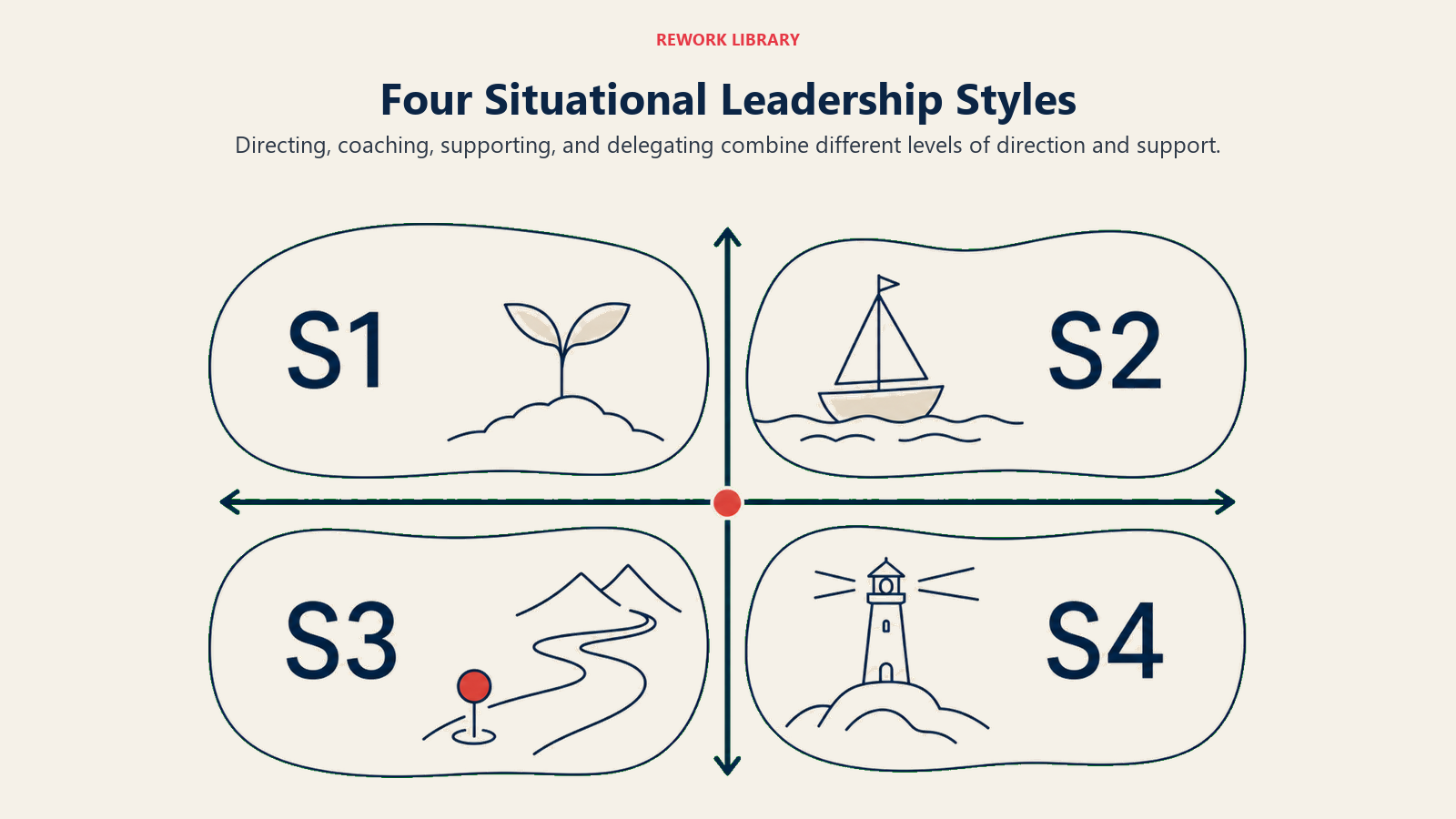
Hersey and Blanchard defined four leadership styles along two behavioral dimensions: directive behavior (task structure, clear instructions, close supervision) and supportive behavior (two-way communication, encouragement, listening). The four styles arise from high-or-low combinations of those two dimensions.
| Style | Name | Directive Behavior | Supportive Behavior | What you actually do |
|---|---|---|---|---|
| S1 | Telling / Directing | High | Low | You define the task, explain how to do it, and check the work closely. |
| S2 | Selling / Coaching | High | High | You still provide structure but you explain the reasoning and invite questions. |
| S3 | Participating / Supporting | Low | High | You share decision-making and give emotional support rather than step-by-step direction. |
| S4 | Delegating | Low | Low | You hand over responsibility and trust the person to manage the task independently. |
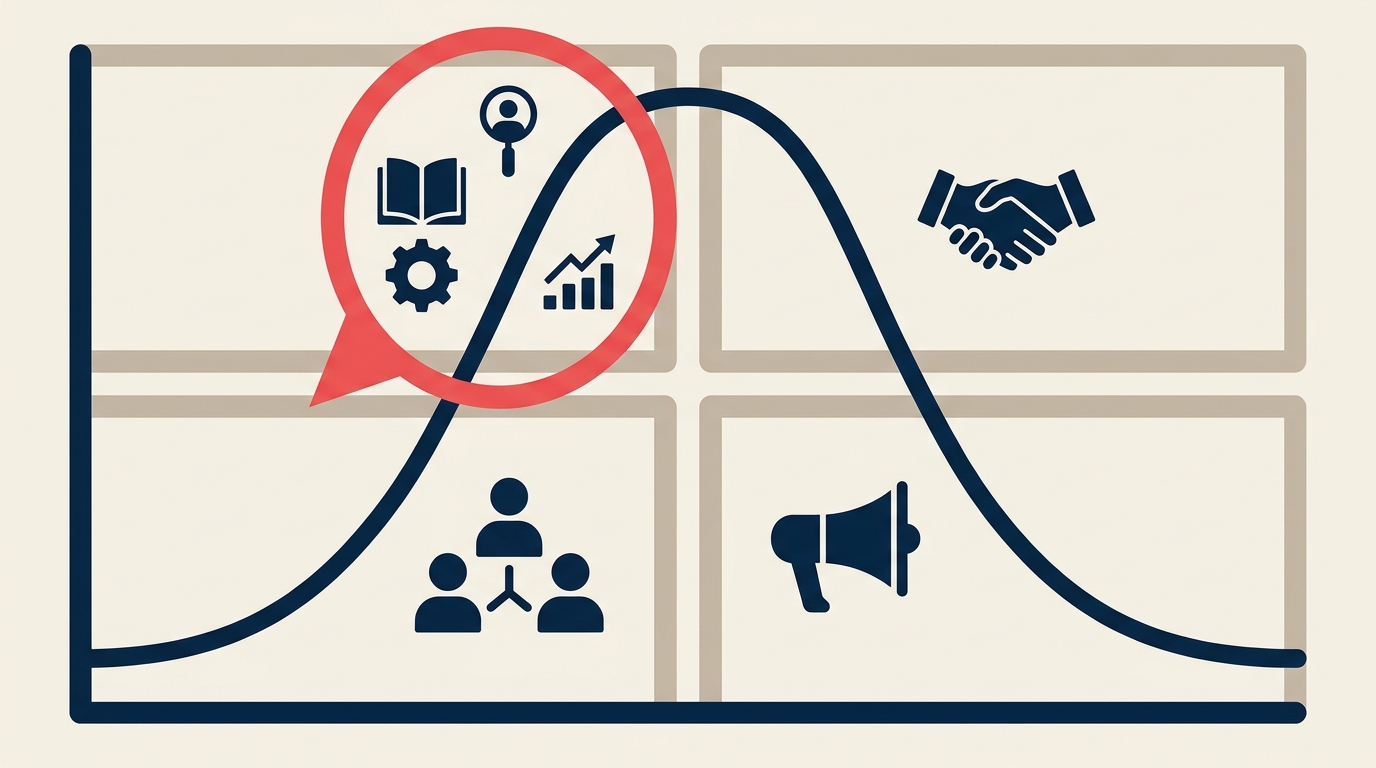
The model plots these on a bell-shaped curve running from S1 to S4. The curve signals that effective leaders move through styles fluidly as their people develop, rather than choosing one style and sticking to it forever. This is the core logic that distinguishes Hersey-Blanchard from fixed-style models like the Fiedler Contingency Model.
The 4 Development / Readiness Levels (D1 to D4)
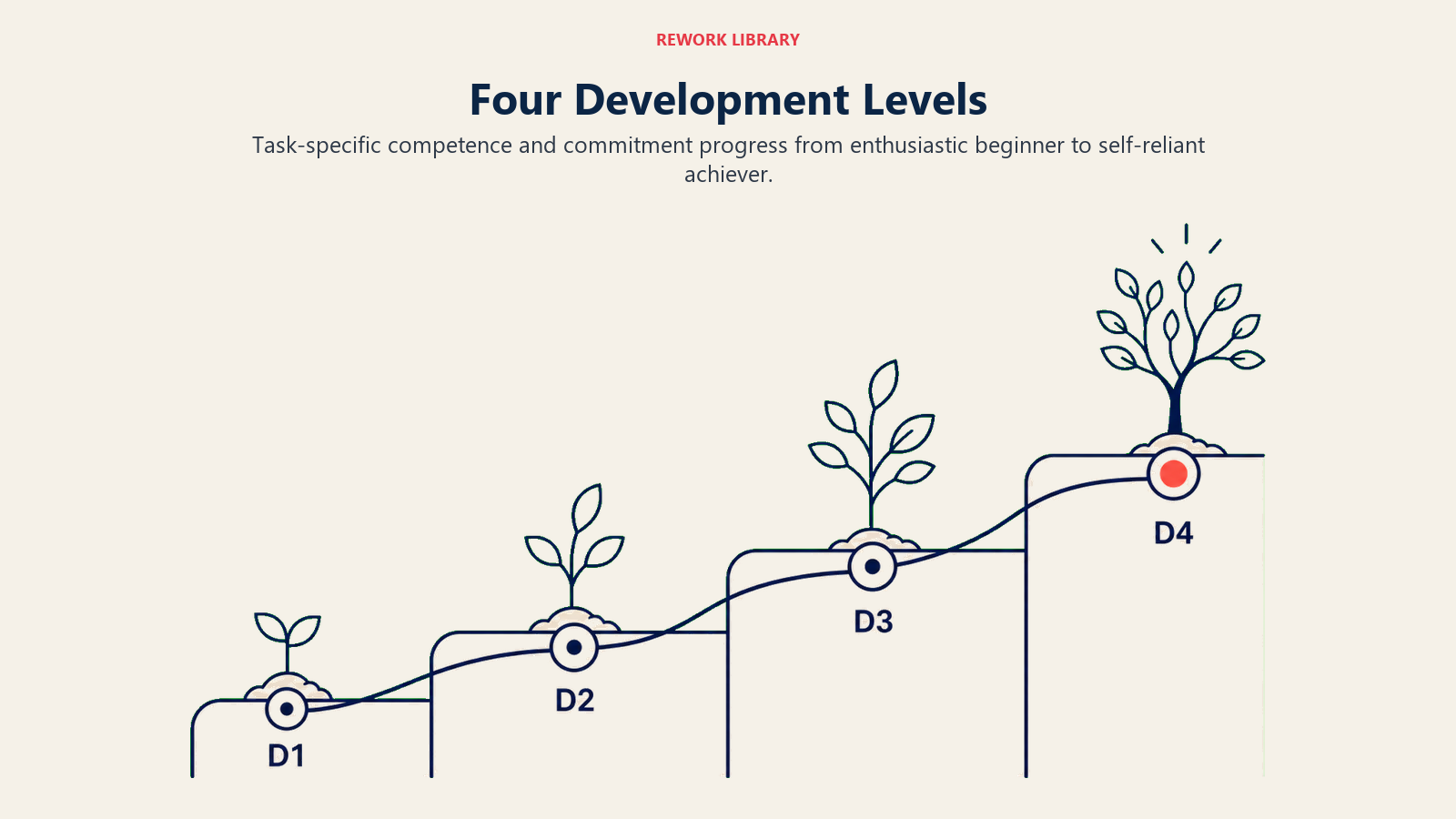
Development level describes the follower's state on a specific task, not their overall competence as a person. Someone who is a D4 on one task might be D1 on a new assignment they've never tried before.
| Level | Name | Competence | Commitment | Typical mindset |
|---|---|---|---|---|
| D1 | Enthusiastic Beginner | Low | High | "I'm excited and ready. I just don't know how yet." |
| D2 | Disillusioned Learner | Low to some | Low | "This is harder than I thought, and I'm not sure I can do it." |
| D3 | Capable but Cautious | Moderate to high | Variable | "I can do this, but I second-guess myself sometimes." |
| D4 | Self-Reliant Achiever | High | High | "I've got this. I know what to do and I'm confident doing it." |
The D1-to-D4 progression is not guaranteed or linear. People can regress under stress, after a team change, or when moved to unfamiliar work. A manager's job is to diagnose the current level accurately, not assume upward movement.
Matching Style to Readiness Level
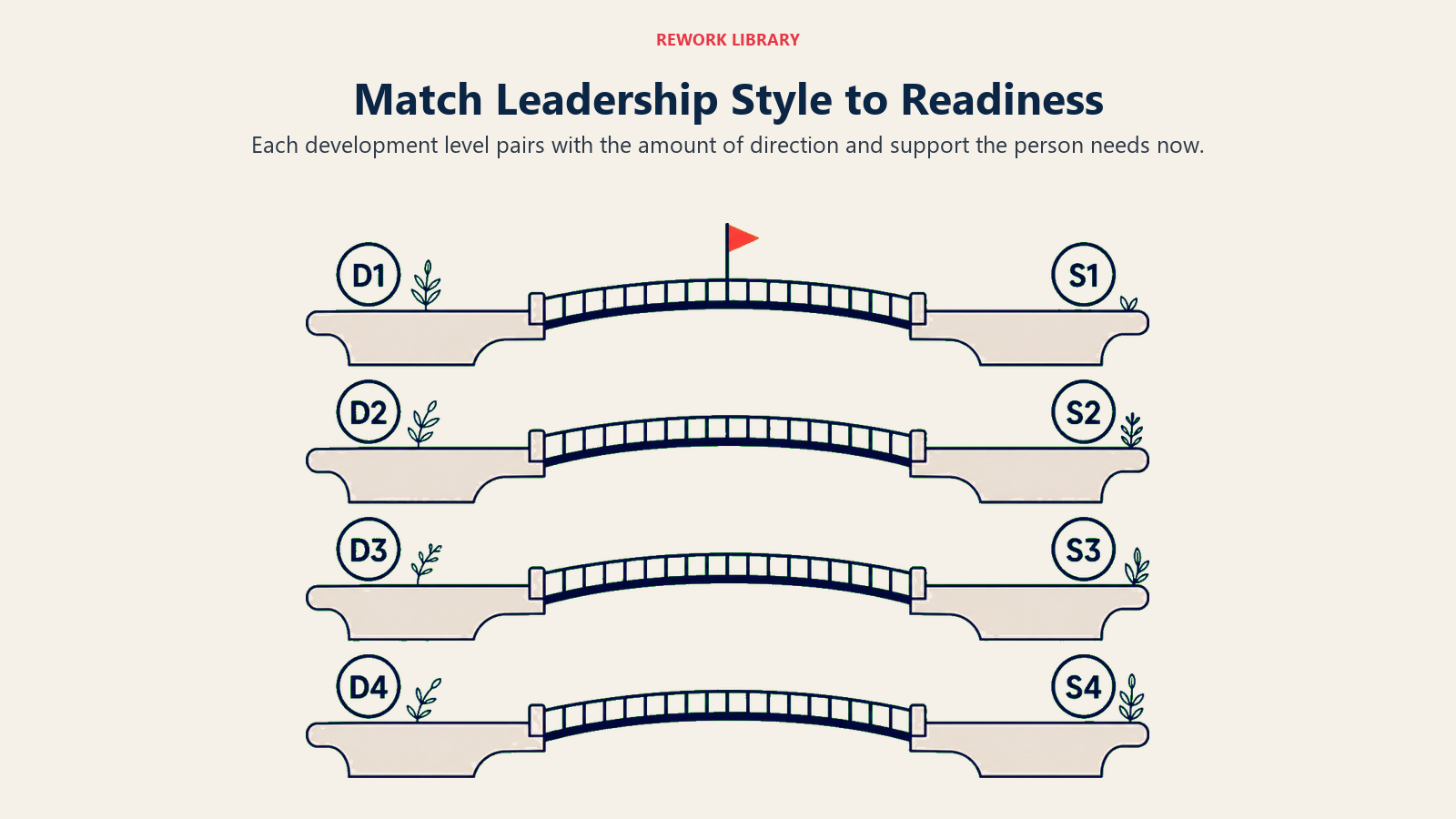
The matching is the heart of the model. Each development level pairs with one leadership style.
| Development Level | Matched Leadership Style | The logic |
|---|---|---|
| D1 (Enthusiastic Beginner) | S1 (Telling / Directing) | High energy, low skill. The follower needs clear structure, not cheerleading they can't yet act on. |
| D2 (Disillusioned Learner) | S2 (Selling / Coaching) | Skill is growing but confidence has dipped. They need both direction AND encouragement to stay engaged. |
| D3 (Capable but Cautious) | S3 (Participating / Supporting) | Skills are there. The gap is confidence. Step back from direction and focus on support and shared problem-solving. |
| D4 (Self-Reliant Achiever) | S4 (Delegating) | Fully competent and motivated. Over-managing creates friction. Hand over autonomy and get out of the way. |
The diagonal line from D1+S1 to D4+S4 is the developmental arc. A manager who misreads the level and applies the wrong style creates problems: directing a D4 demotivates them; delegating to a D1 sets them up to fail.
The model also explains why a well-intentioned manager can underperform: they default to one style they're comfortable with (often S3 or S4, which feel "nicer") regardless of what the follower actually needs.
For a broader survey of how these styles sit within contingency thinking, see situational leadership styles and path-goal theory.
How to Apply the Hersey-Blanchard Model
Diagnose the task, choose the matching style, observe performance, and adjust as readiness changes.
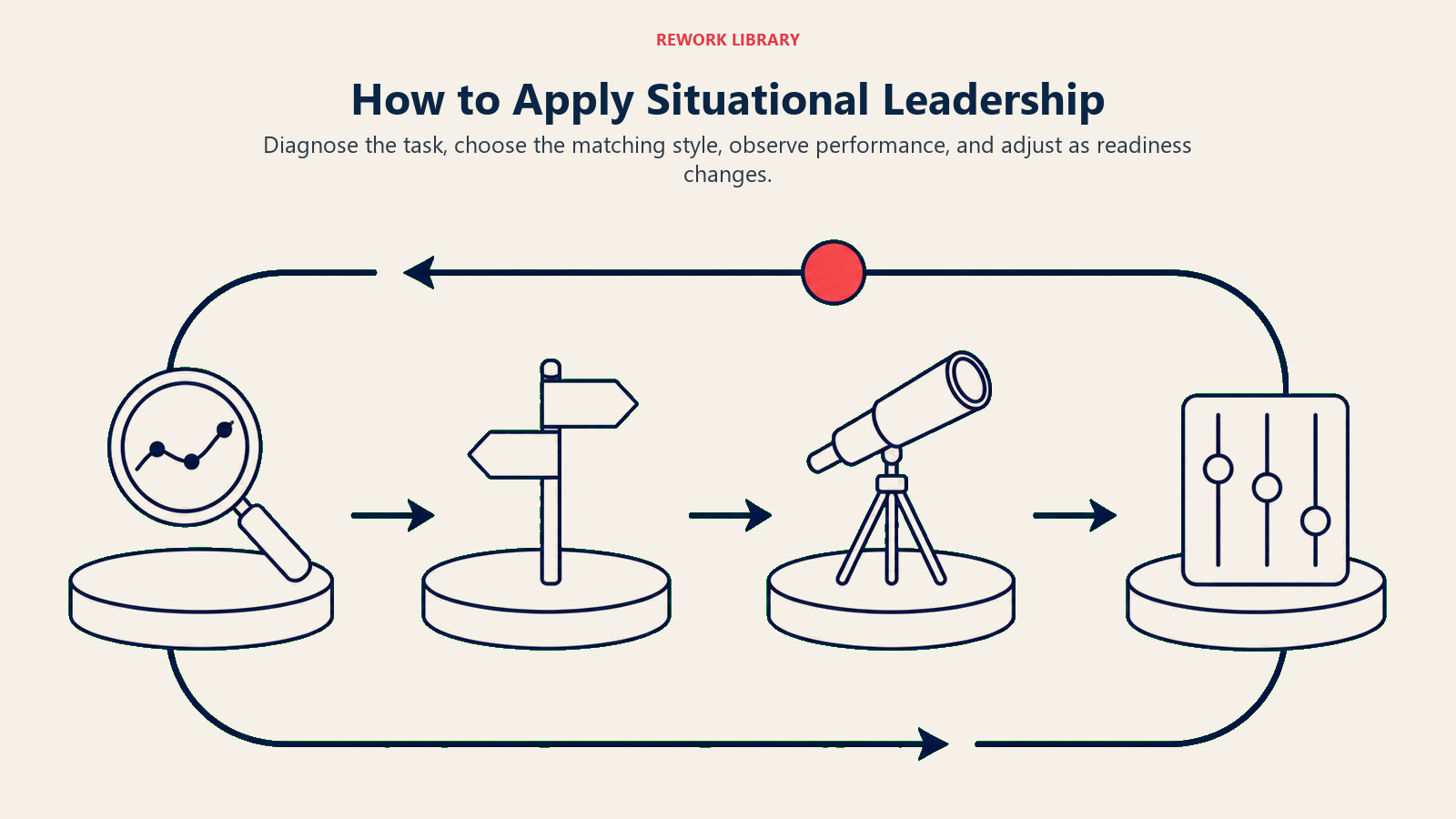
Step 1: Diagnose the Development Level
Start with the specific task, not the person's general reputation. Ask: For this particular assignment, what is this person's skill level? And right now, how motivated and confident are they?
Avoid two common traps. First, assuming seniority equals high development level (a senior employee can be D1 on a new technology). Second, conflating past performance with current commitment (a capable person going through a difficult quarter might be temporarily at D3 on tasks they've handled well before).
Talk to the person. A short conversation about their confidence and any questions they have will tell you more than a performance review.
Step 2: Pick the Matching Style
Once you've diagnosed D1 through D4, apply the corresponding style. The match is not a suggestion, it's the mechanism. Using S4 on a D1 person doesn't feel empowering to them; it feels like abandonment.
If you're uncertain between two levels, lean toward more directive rather than less. It's easier to pull back structure as someone grows than to recover from a failure caused by insufficient guidance.
Step 3: Adjust as People Grow
The model is dynamic. As a person's competence and commitment evolve, your style should shift. Building checkpoints into your one-on-ones (monthly or per-project) gives you a natural moment to reassess the development level and decide whether to move the style along the curve.
Blanchard's SLII version formalizes this with structured "contracting" conversations where leader and follower agree explicitly on the appropriate style for a given task. Even without the formal tool, the habit of having that conversation is valuable.
Step 4: Communicate the Shift
When you move from S1 to S2, or from S3 to S4, tell the person. A sudden drop in check-ins feels like disengagement unless you explain it as recognition of growth. A good framing: "You've shown you can run this independently, so I'm stepping back from the weekly reviews. Come to me if you hit something unexpected." That makes the style shift feel like a promotion rather than neglect.
Strengths and Criticisms
| Strengths | Criticisms |
|---|---|
| Simple enough to remember and use without a consultant in the room | Development level is self-reported or manager-assessed, which introduces bias |
| Puts the follower's current state at the center of the decision | The D1-D4 model can be too linear; real development is messier |
| Encourages managers to adapt rather than rely on a single style | Limited empirical validation compared to transformational or servant leadership research |
| Bridges management and development: leadership becomes a growth tool | Does not address how leader style interacts with team dynamics or organizational culture |
| Practical for one-on-one coaching conversations and performance planning | Some critics argue the "commitment" dimension is harder to assess reliably than competence |
The research base for situational leadership has grown since the original publication, but it remains thinner than advocates sometimes imply. The model's real value is practical: it gives managers a shared language and a decision procedure that is far better than intuition or habit.
Hersey-Blanchard vs Other Contingency Models
Hersey-Blanchard sits within a family of contingency leadership theories that all argue context determines effective leadership. But each model defines "context" differently and arrives at different prescriptions.
| Model | Context variable | Leader flexibility | Key distinction |
|---|---|---|---|
| Hersey-Blanchard | Follower development level (competence + commitment) | High: style shifts with the follower | Follower-centered; developmental arc |
| Fiedler Contingency Model | Situational favorability (LPC scale) | Low: match the leader to the situation | Leader style is fixed; change the context instead |
| Vroom-Yetton Decision Model | Decision quality and acceptance needs | Moderate: select decision process | Focused on decision-making, not broad leadership style |
The Fiedler model is often described as the structural alternative to Hersey-Blanchard: rather than developing a flexible leader, you engineer situations where the leader's natural style fits. Vroom-Yetton is narrower in scope, addressing specifically when to involve followers in decisions rather than how to lead day-to-day.
For a broader context on where these models sit within contingency thinking, the contingency leadership theory overview covers the full landscape.
Frequently Asked Questions about Hersey-Blanchard Situational Leadership Model
What is the difference between the Hersey-Blanchard model and SLII?
SLII is Ken Blanchard's updated version, developed after Hersey and Blanchard's professional partnership ended. It uses the same four-style, four-level structure but refines the naming (D1 through D4 instead of M1 through M4), adds structured assessment tools, and formalizes the "contracting" conversation between leader and follower. For practical purposes in organizations using the original framework, the differences are modest.
Can someone be at different development levels for different tasks?
Yes, and this is one of the model's most useful insights. Development level is task-specific. A seasoned sales director can be D1 on a new CRM platform and D4 on client negotiation simultaneously. A good manager diagnoses by task, not by title.
What happens if a manager always defaults to one style?
Research on leadership flexibility suggests that defaulting to one style creates consistent mismatches for some portion of your team. S4-default managers tend to under-support D1 and D2 employees, who then either fail or leave. S1-default managers tend to stifle D3 and D4 employees, who disengage. The cost shows up in turnover, slower development, and missed output.
How does the model handle regression?
Blanchard's SLII explicitly accounts for regression: when a previously high-performing person drops in confidence or performance (due to stress, a role change, or a difficult project), the leader should move the style back toward S2 or even S1 temporarily. This is a normal part of development, not a failure. It also applies when a capable person takes on a genuinely new challenge.
Is the Hersey-Blanchard model still relevant?
Yes, especially in environments where managers lead people at very different experience levels: fast-growing teams, roles with high new-hire volume, cross-functional projects. Its simplicity is a feature. Teams that learn the D1-D4 language together can have more honest conversations about what kind of support someone needs, which on its own improves performance.
Related Reading
For context on the broader theoretical family this model belongs to, see what is situational leadership theory. For practical application of related frameworks, situational leadership styles covers the full range of style options across contingency models. If you're exploring complementary motivational frameworks, path-goal theory addresses how leaders can remove obstacles and structure paths to goals, which pairs naturally with the Hersey-Blanchard developmental lens.

Senior Operations & Growth Strategist
On this page
- What Is the Hersey-Blanchard Model?
- The 4 Leadership Styles (S1 to S4)
- The 4 Development / Readiness Levels (D1 to D4)
- Matching Style to Readiness Level
- How to Apply the Hersey-Blanchard Model
- Step 1: Diagnose the Development Level
- Step 2: Pick the Matching Style
- Step 3: Adjust as People Grow
- Step 4: Communicate the Shift
- Strengths and Criticisms
- Hersey-Blanchard vs Other Contingency Models
- Related Reading