Theory Z: Ouchi's Management Approach Explained
Turn this article into takeaways for your work.


Each assistant summarizes the article only for you and suggests best practices for your work.
Theory Z is a management model that treats long-term employment, collective decision-making, and genuine care for employees not as soft perks but as core strategy. William Ouchi introduced it in 1981, and the ideas feel just as relevant now as they did when Japanese manufacturing was outpacing American industry.
What is Theory Z?
Theory Z is a management philosophy developed by William Ouchi, a professor at UCLA Anderson School of Management, and published in his 1981 book Theory Z: How American Business Can Meet the Japanese Challenge. Ouchi studied hundreds of companies in both the United States and Japan, and noticed that the most productive ones shared a set of cultural traits that neither pure American nor pure Japanese management fully captured.
He called the dominant American approach Type A (individualistic, short-term, specialized, contractual) and the dominant Japanese approach Type J (collective, long-term, holistic, implicit). Theory Z, sometimes called the American Type Z, is a hybrid. It keeps the individual accountability and explicit performance standards of Type A, but borrows the long-term employment commitment, consensus-building, and holistic concern for employees from Type J.
The result is a model built on trust, subtlety, and intimacy between managers and employees. Ouchi argued these aren't cultural quirks. They're structural choices any organization can make.
Key Facts
William Ouchi published Theory Z: How American Business Can Meet the Japanese Challenge in 1981. The book reached number one on the New York Times bestseller list for business. Ouchi drew on research across hundreds of US and Japanese firms, identifying that the highest-performing American companies (Hewlett-Packard, IBM, and Procter & Gamble were among his reference cases) already practiced many Type Z characteristics long before the term existed. Douglas McGregor coined the Theory X / Theory Y framework in his 1960 book The Human Side of Enterprise, giving Ouchi the naming convention he built on. A 2023 Gallup workplace study found that organizations with high employee engagement report 23% higher profitability and 43% lower turnover, consistent with the long-term loyalty outcomes Ouchi described.
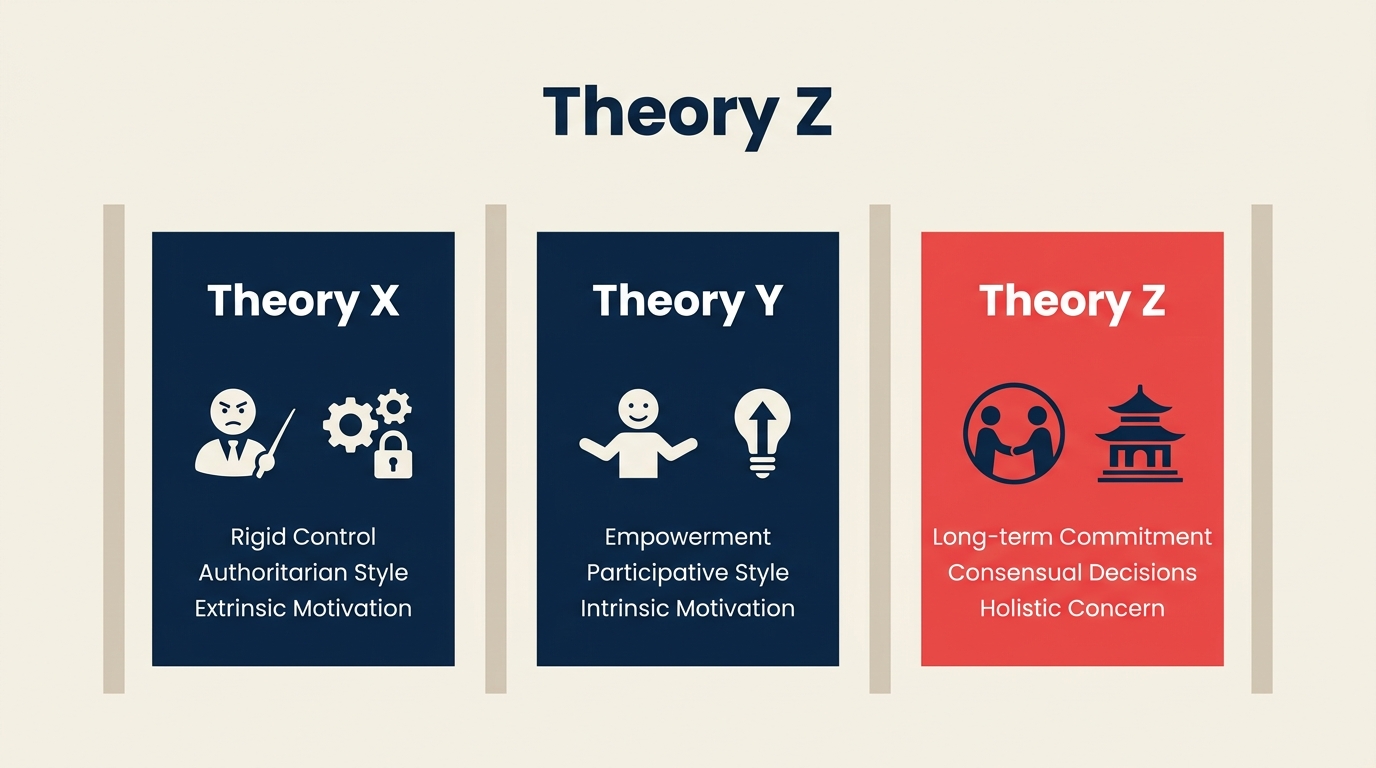
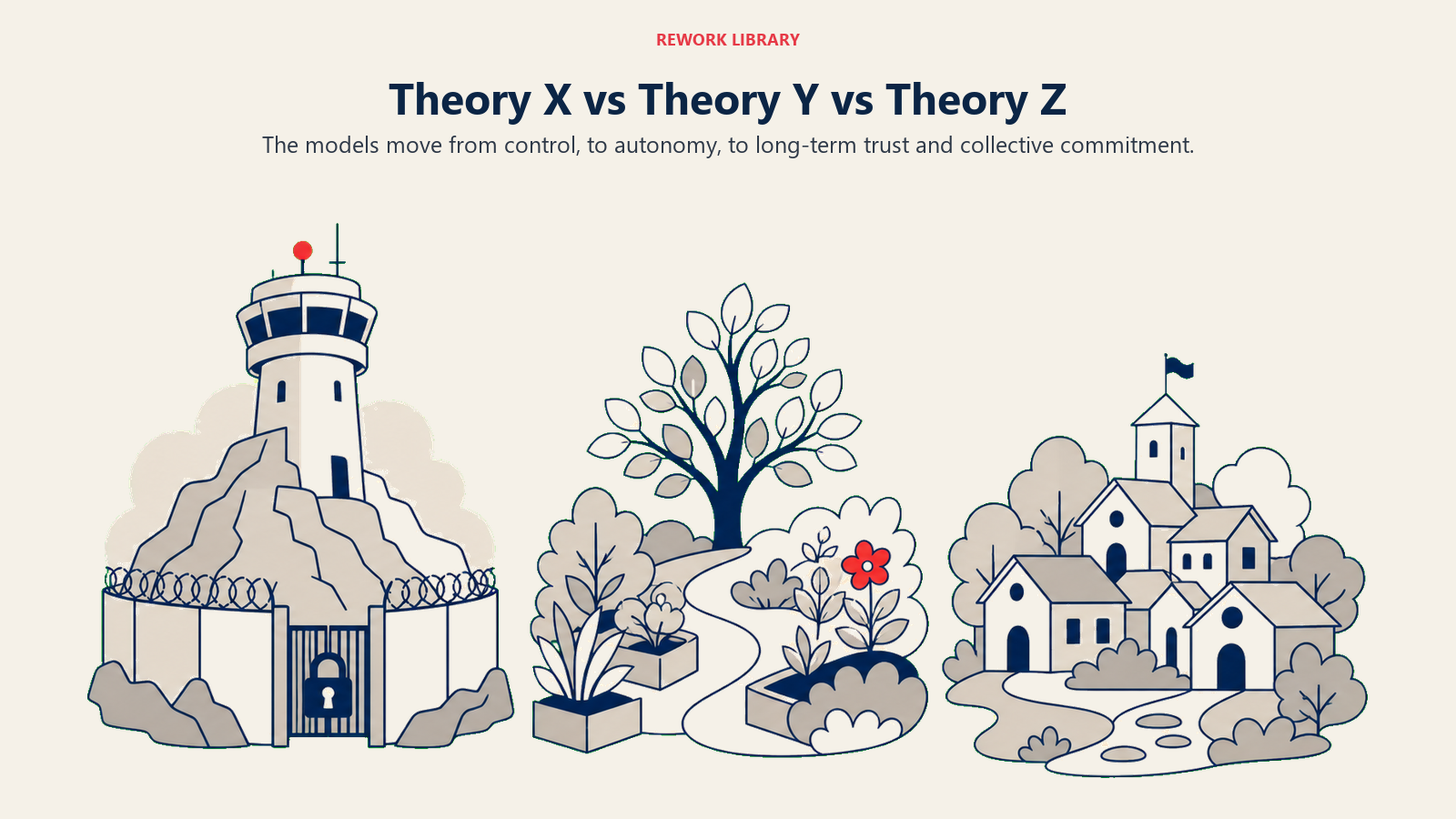
Theory X vs Theory Y vs Theory Z
It's easy to confuse these three theories because the names are sequential. But they come from different researchers, different eras, and different questions.
| Theory X | Theory Y | Theory Z | |
|---|---|---|---|
| Origin | Douglas McGregor, 1960 | Douglas McGregor, 1960 | William Ouchi, 1981 |
| Assumption about workers | Workers dislike work, avoid responsibility, need control | Workers seek responsibility, are self-motivated when conditions are right | Workers want long-term relationships, shared goals, and holistic support |
| Motivation lever | External pressure, rules, monitoring | Intrinsic satisfaction, autonomy, purpose | Trust, job security, collective belonging |
| Decision-making | Top-down, unilateral | Decentralized to individuals | Collective, consensus-based |
| Employment model | Transactional, short-term | Flexible, merit-driven | Long-term, near-lifetime |
| Manager role | Controller | Enabler | Partner and mentor |
| Evaluation pace | Frequent, short cycle | Performance-based, varies | Slow, holistic |
Theory X and Theory Y are McGregor's opposing poles. Theory Z is Ouchi's third path, built from empirical observation rather than theoretical opposition. It's not simply "more Y" or a continuation of McGregor's framework. It adds an organizational layer (culture, shared values, clan-style accountability) that McGregor's individual-focused model doesn't address.
For a deeper look at McGregor's framework, see Theory X and Theory Y: McGregor's Management Styles.
Key Principles of Theory Z
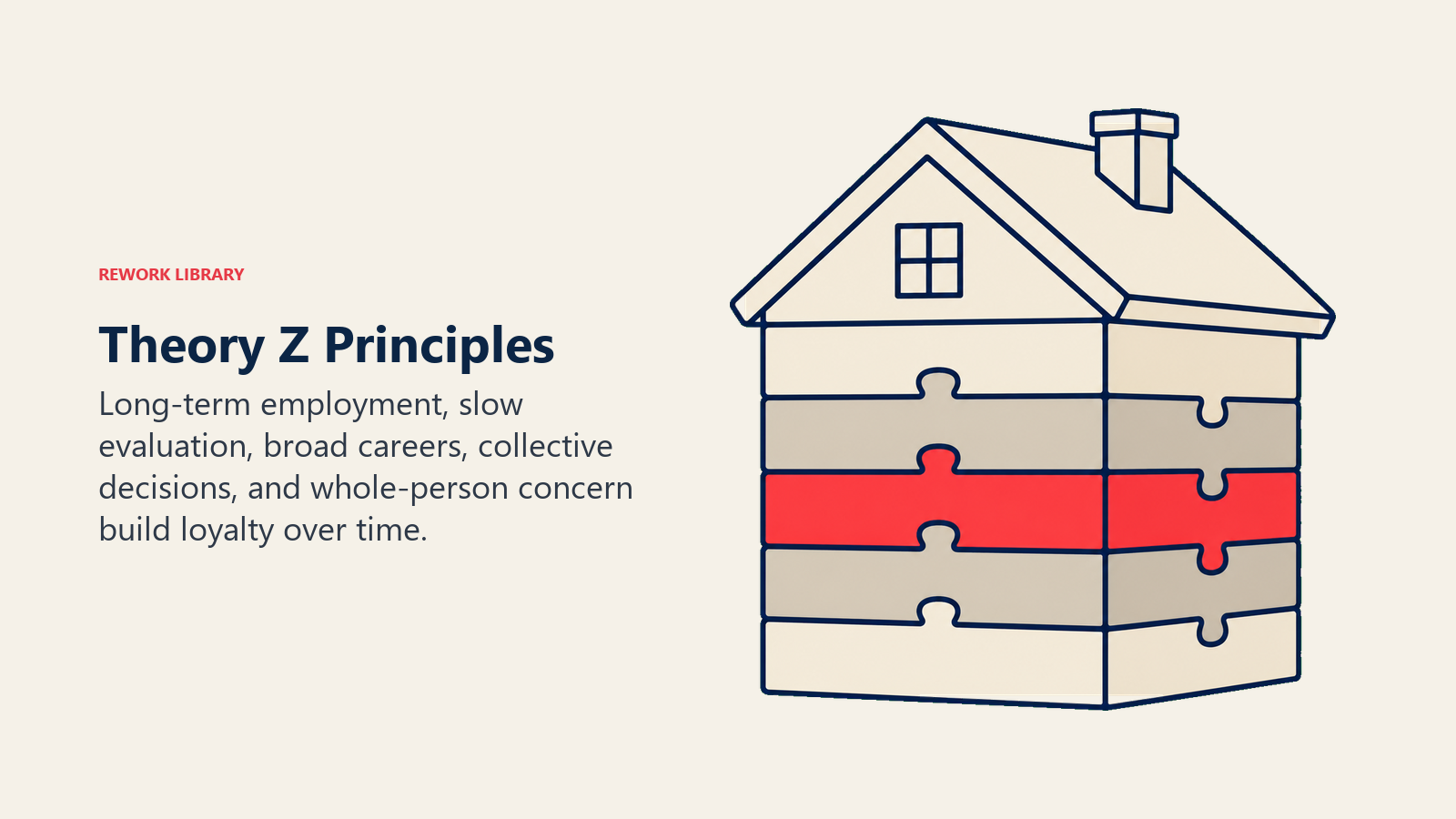
Ouchi identified seven distinguishing characteristics of Type Z organizations. Each one reinforces the others. You can't pull just one out and call it Theory Z.
1. Long-term employment
Type Z companies offer stable employment as a signal of trust. When employees know their job isn't at risk every quarter, they invest in the organization. They share information freely, take on difficult projects, and mentor others. The calculation changes from "what's in it for me right now?" to "what helps us succeed over time?"
2. Collective decision-making
Decisions get made through consensus (ringi-style consultation), not committee votes. Before a decision is finalized, relevant people are consulted. This slows the decision process but speeds implementation, because the people executing the plan were part of shaping it.
3. Individual responsibility
Despite collective input, accountability is individual and explicit. One person owns each outcome. This keeps consensus from becoming a way to avoid responsibility.
4. Slow evaluation and promotion
Type Z companies evaluate performance over years, not quarters. Promotions are gradual. This removes pressure to chase short-term metrics at the expense of long-term health, and it gives managers time to know their people deeply.
5. Implicit informal control with explicit measures
The primary control mechanism is shared culture and values, not rules and surveillance. Employees know what the organization stands for and act accordingly. But there are also clear, explicit performance measures. The combination means the culture does the heavy lifting while metrics catch the outliers.
6. Moderately specialized career paths
Unlike pure Type J companies (where rotation is extreme), Type Z organizations allow meaningful specialization. Employees develop real expertise but still rotate enough to understand adjacent functions. This builds the cross-functional perspective needed for collective decision-making.
7. Holistic concern for employees
Type Z managers treat employees as whole people, not just productive units. This includes concern for work-life integration, family wellbeing, and long-term health. Ouchi documented this as a structural feature, not a feel-good add-on. When managers know their people personally, communication is faster, trust is higher, and problems surface earlier.
These principles connect directly to the motivation research in Maslow's Hierarchy of Needs and Herzberg's Two-Factor Theory, both of which point to belonging, recognition, and growth as the real drivers of sustained performance.
Benefits of Theory Z
High retention. Long-term employment as a stated value reduces involuntary turnover and the informal "why would I stay?" calculation employees run constantly.
Faster implementation. Collective decision-making front-loads alignment. Once a decision is made, execution is smoother because resistance has already been addressed.
Stronger institutional knowledge. When employees stay for years and rotate moderately, the organization accumulates expertise that doesn't walk out the door when someone leaves.
Trust as a cost-reducer. High-trust organizations spend less on monitoring, auditing, and enforcement. Implicit control through culture costs far less than explicit control through surveillance.
Improved engagement. The holistic care component builds psychological safety. Employees who feel seen as people, not headcount, bring problems forward rather than hiding them. For more on the dynamics that enable this, see Psychological Safety.
Limitations and Criticisms
Culture fit is slow to build. Theory Z takes years to establish. It can't be bolted onto an organization that has run on Theory X for a decade. Changing the underlying trust contract requires consistent behavior over time, not a policy memo.
Consensus can stall decisions. The ringi consultation model works well in stable environments. In fast-moving markets, the deliberation required for true consensus can leave organizations unable to respond quickly.
Long-term employment assumptions strain some industries. In sectors with high structural turnover (retail, gig-economy platforms, project-based consulting), the lifetime employment signal is hard to credibly make. And a misapplied promise of security that later gets broken is worse than no promise at all.
Western individual-achievement cultures can resist it. The collective accountability model can feel counterintuitive in organizations where individual recognition and rapid advancement are the primary retention tools.
Risk of groupthink. Shared culture as the primary control mechanism can suppress dissent. When "how we do things here" becomes the answer to every challenge, organizations lose the diversity of thought they need to adapt.
How to Apply Theory Z in a Modern Workplace
Theory Z isn't all-or-nothing. You can adopt its principles incrementally, starting with the behaviors that build trust fastest.
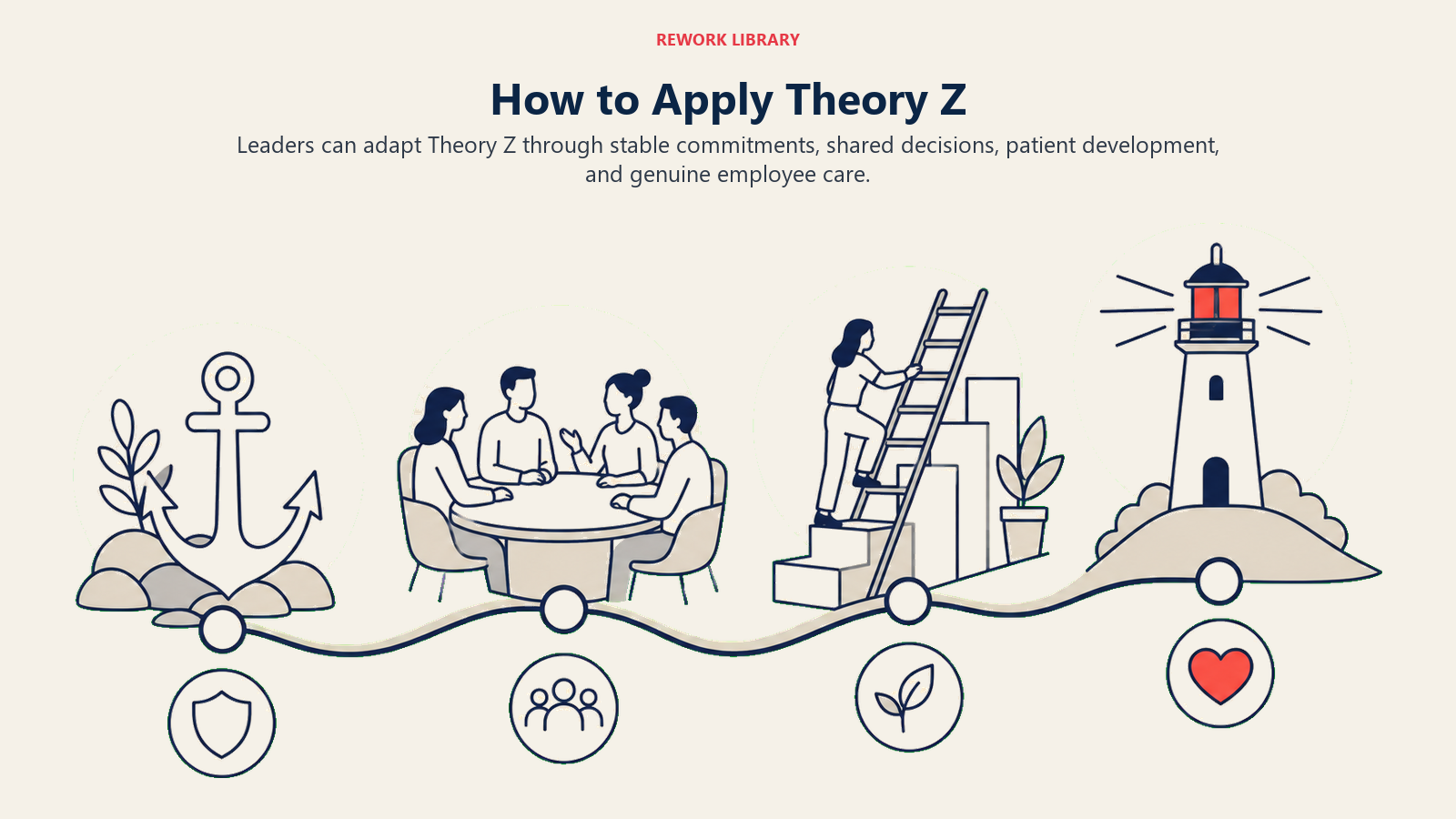
Commit to employment stability where you can. You don't have to promise lifetime employment. But you can be explicit about what would trigger workforce changes and give employees a realistic picture of job security. Vague insecurity is corrosive; honest clarity is not.
Build consensus on decisions that affect daily work. Identify one recurring decision type (team structure, process changes, priority-setting) and shift it from top-down to consultative. Run it with the relevant people before the decision is final, not as an announcement after.
Separate input from accountability. Make clear that collective input doesn't dilute individual ownership. The person responsible for a project still owns the outcome. Others contribute context and expertise.
Slow down promotion timelines deliberately. Resist promoting people before they have genuinely mastered their current role. Fast promotions signal urgency, not trust. Slow, well-explained promotions signal confidence.
Know your people beyond their job description. This doesn't mean therapy sessions. It means knowing that someone on your team is dealing with a family health situation before their output drops, or noticing that someone who used to be enthusiastic has gone quiet. Act on what you know.
Define and model your culture explicitly. Implicit control through shared values only works when those values are clearly articulated and consistently demonstrated by leadership. Write them down. Then behave accordingly.
The participative leadership approach overlaps directly with steps 2 and 3 here. Theory Z provides the why; participative leadership provides specific practices for the day-to-day how.
For an understanding of how power dynamics shape the trust environment Theory Z requires, see French and Raven's Bases of Power.
Theory Z Examples
These companies were cited by Ouchi or recognized as practicing Type Z characteristics in research:
| Company / Context | Theory Z Characteristic |
|---|---|
| Hewlett-Packard (1980s) | Long-term employment, consensus culture, holistic employee care ("the HP Way") |
| Procter & Gamble | Slow promotion, rotational career paths, strong internal culture |
| IBM (pre-1990s restructuring) | Near-lifetime employment, strong implicit culture, individual accountability within collective norms |
| Toyota (Type J adapted for US) | Consensus-based kaizen, moderate specialization, long-term supplier relationships |
| Patagonia (contemporary example) | Explicit commitment to employee wellbeing, slow deliberate culture-building, holistic concern for workforce |
Note that several of these companies later shifted away from Type Z behaviors during major restructurings. That's consistent with Ouchi's finding: Theory Z is fragile when executive leadership turns over and the trust contract gets broken by layoffs.
What is Leadership in This Context?
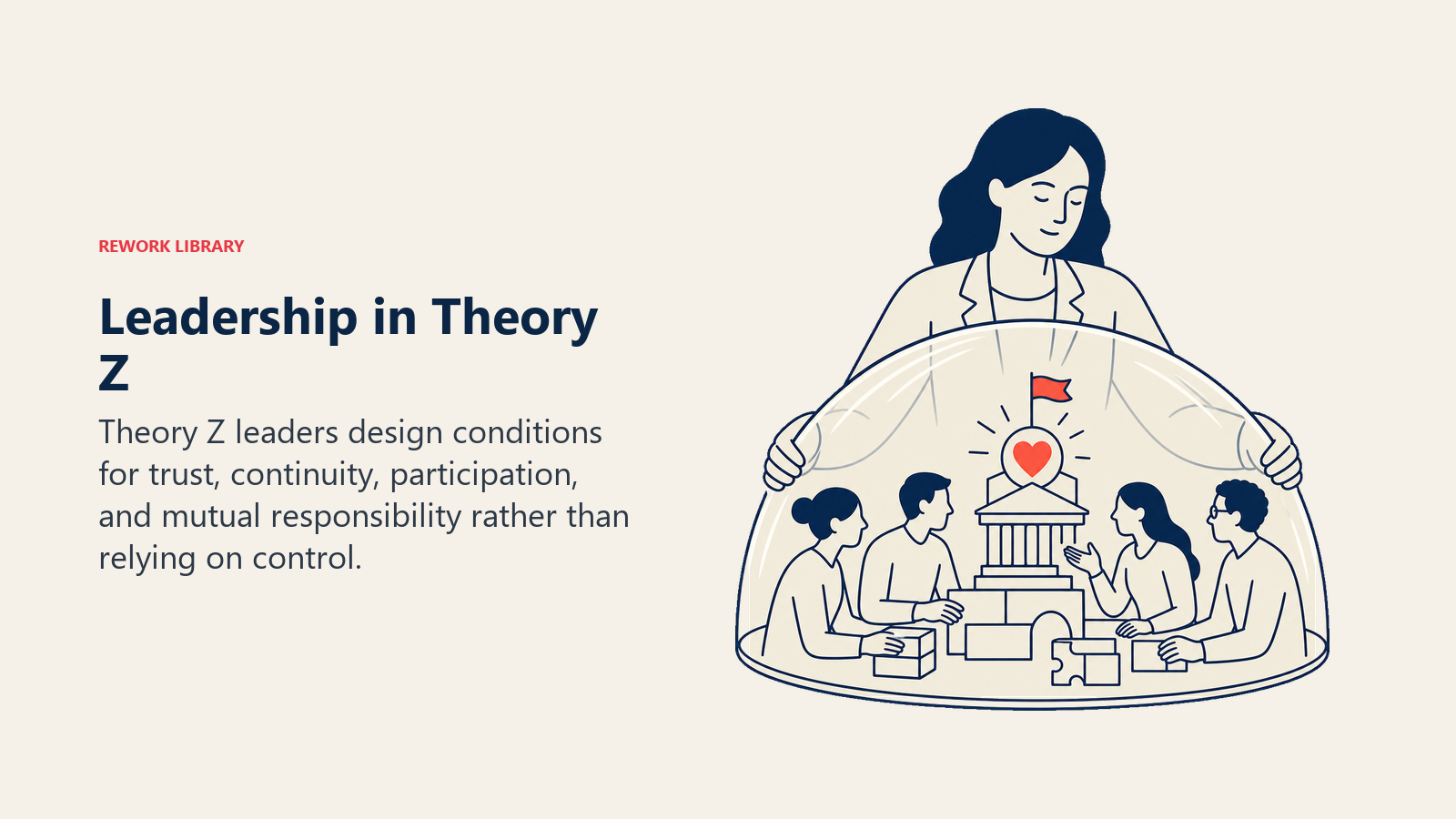
Understanding Theory Z deepens your understanding of what leadership actually is and why the same management style produces radically different results depending on the trust environment it operates in. Theory Z argues that leadership isn't just direction-setting. It's creating the organizational conditions where people choose to perform over the long term.
Frequently Asked Questions about Theory Z
Who developed Theory Z?
William Ouchi, a professor at UCLA Anderson School of Management, developed Theory Z and published it in his 1981 book Theory Z: How American Business Can Meet the Japanese Challenge. Ouchi built on Douglas McGregor's earlier Theory X and Theory Y framework (1960) by adding a third model based on his empirical research across US and Japanese corporations.
How is Theory Z different from Theory X and Theory Y?
Theory X and Theory Y are Douglas McGregor's models from 1960. They describe opposing assumptions a manager might hold about worker motivation: Theory X assumes workers are naturally lazy and need control; Theory Y assumes workers are self-motivated when conditions are right. Theory Z is a separate framework by a different researcher (Ouchi, 1981). It operates at the organizational level rather than the individual level, focusing on culture, employment structure, career paths, and collective decision-making. Think of X and Y as diagnosing manager mindset. Theory Z is a blueprint for organizational design.
Is Theory Z still used today?
Yes, though rarely under that name. Organizations like Patagonia, Costco, and various Japanese manufacturing subsidiaries in the US practice most of Theory Z's core principles: long-term employment signals, consensus-building before major decisions, and holistic employee support. The language of "employee experience," "psychological safety," and "culture-driven performance" reflects the same underlying logic Ouchi described. The theory's influence is more embedded in current management culture than the citation frequency suggests.
What is the main criticism of Theory Z?
The most substantive criticism is that the model assumes cultural conditions (particularly collectivist values and patient capital) that many Western organizations don't have. When companies try to implement Theory Z in high-turnover or fast-pivot environments, the trust infrastructure takes too long to build and often gets dismantled before it delivers results. The reliance on implicit cultural control also carries a groupthink risk that Ouchi acknowledged but underweighted.
Can small companies use Theory Z?
Yes, and they often do naturally. Small teams tend to develop the holistic familiarity and long-term relationships Ouchi described without formally naming it Theory Z. The challenge for small companies is preserving those qualities as they scale. Growth typically brings specialization, faster hiring, and performance pressure that erodes the informal trust structures Theory Z depends on.
Theory Z remains one of the clearest frameworks for thinking about what organizational culture actually does mechanically. It doesn't ask you to be nice. It asks you to build structures that make trust the efficient choice for everyone involved. That's a design problem, and design problems have solutions.

Senior Operations & Growth Strategist
On this page
- What is Theory Z?
- Key Facts
- Theory X vs Theory Y vs Theory Z
- Key Principles of Theory Z
- 1. Long-term employment
- 2. Collective decision-making
- 3. Individual responsibility
- 4. Slow evaluation and promotion
- 5. Implicit informal control with explicit measures
- 6. Moderately specialized career paths
- 7. Holistic concern for employees
- Benefits of Theory Z
- Limitations and Criticisms
- How to Apply Theory Z in a Modern Workplace
- Theory Z Examples
- What is Leadership in This Context?