French and Raven's 5 Bases of Power Explained
Turn this article into takeaways for your work.


Each assistant summarizes the article only for you and suggests best practices for your work.
French and Raven's bases of power give managers a precise vocabulary for something most leaders do by instinct but rarely examine: where does my influence actually come from? Understanding that question changes how you lead, how you develop people, and how you build credibility that survives a title change.
What are French and Raven's bases of power?
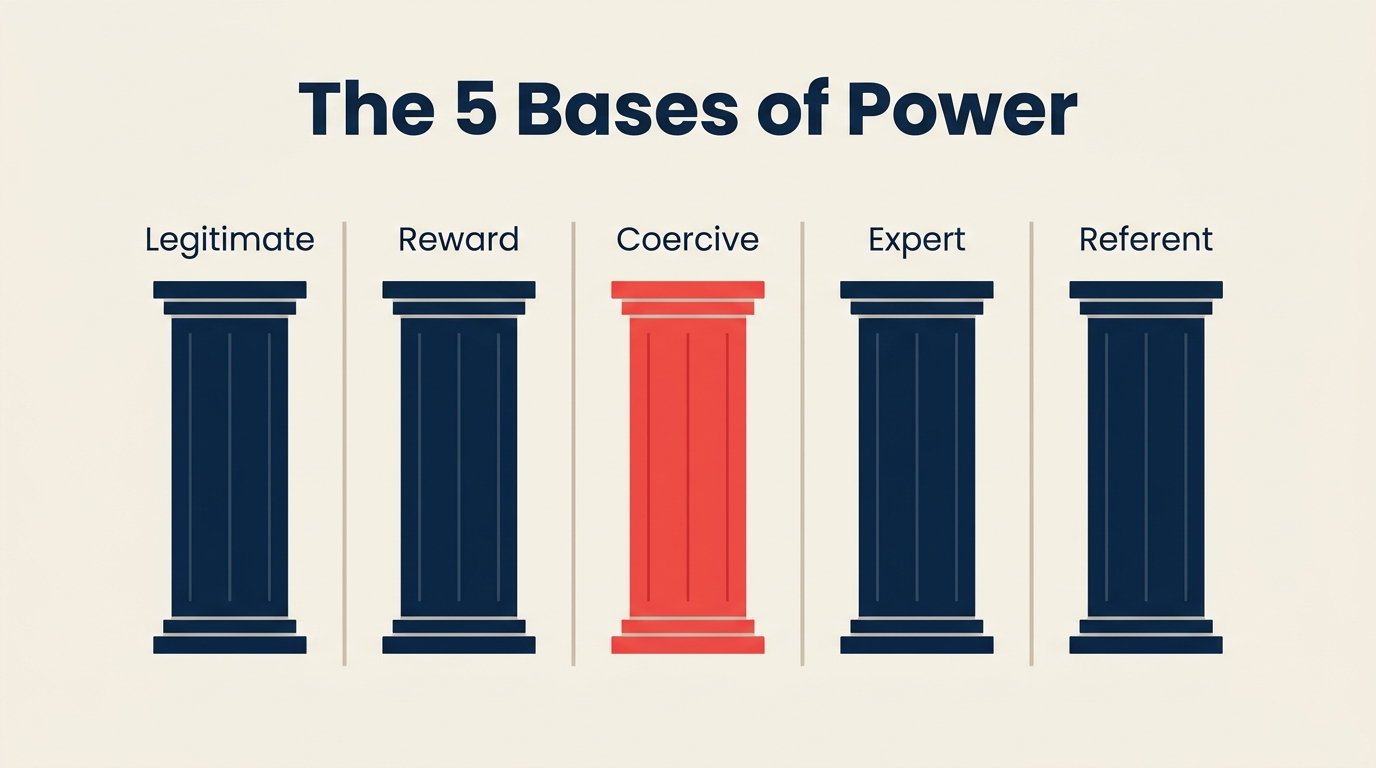
French and Raven's bases of power are a framework that classifies the sources from which a person derives influence over others. Social psychologists John French and Bertram Raven introduced the original five bases in a 1959 paper, "The Bases of Social Power," published in Studies in Social Power (edited by Dorwin Cartwright). Their central argument was that influence is not a single thing: it comes from fundamentally different sources, and each source creates a different psychological response in the person being influenced.
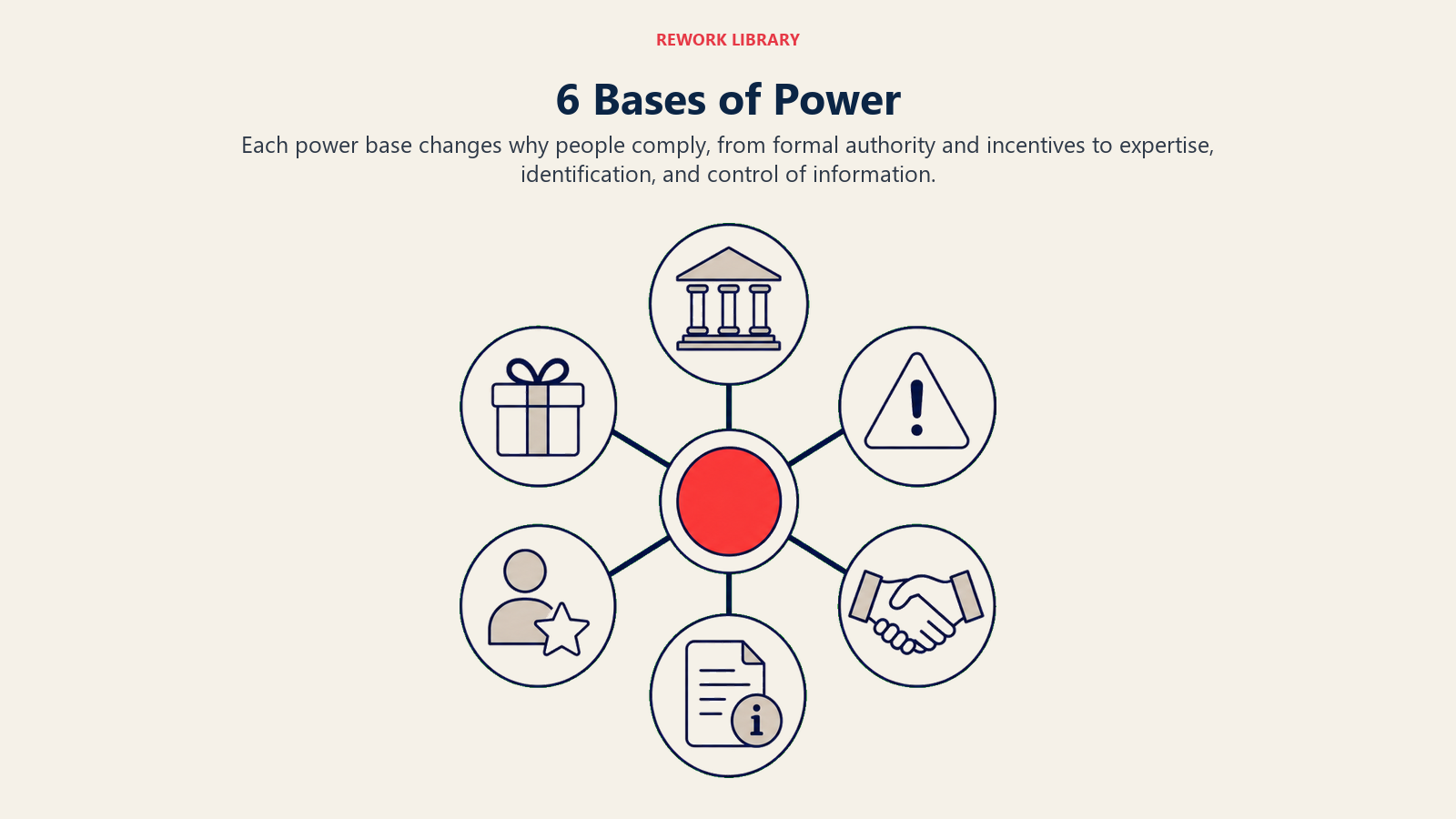
In 1965, Raven revised the model in a follow-up paper and added a sixth base, informational power, distinguishing it from expertise. That sixth base is covered briefly at the end of this section.
Key Facts
French and Raven introduced the five bases of power in their 1959 chapter "The Bases of Social Power" in Studies in Social Power (Cartwright, ed.), which became one of the most-cited frameworks in organizational behavior and social psychology.
Raven added informational power as a sixth base in his 1965 paper "Social Influence and Power" (Current Studies in Social Psychology, Steiner and Fishbein, eds.), noting that influence through the content of a message itself is distinct from influence through the credibility of the source.
A 2019 meta-analysis in Journal of Applied Psychology (Pierro et al.) covering 37 studies found that expert and referent power are the strongest positive predictors of employee job satisfaction and organizational commitment, while coercive power consistently predicts lower satisfaction and higher turnover intent.
The framework is foundational to understanding types of power in leadership and remains the primary reference for what is leadership scholars use when discussing influence at the organizational level.
The 5 (and 6th) bases of power explained
Each base works through a different mechanism. A person may hold several simultaneously, but they are not interchangeable: switching from one to another shifts the follower's experience of being influenced.
Legitimate power
Legitimate power comes from a formal role or position. A VP of Sales has legitimate power over their team; a board has legitimate power over a CEO. People comply because they accept that the authority structure is valid, not because they personally admire the leader or fear punishment.
Workplace example: A department head announces a new reporting process. The team adopts it primarily because the person giving the instruction has the formal authority to set processes, not because they've explained why it's better.
Legitimate power works efficiently but has a ceiling: it operates only inside the zone people recognize as your formal jurisdiction. Ask people to do something outside that zone and they push back.
Reward power
Reward power is the ability to deliver outcomes that others want: promotions, bonuses, favorable assignments, public recognition, or even just a sincere thank-you that carries weight. People comply because doing so is likely to earn a valued outcome.
Workplace example: A manager who controls annual review ratings holds significant reward power. Team members who want a strong rating are more responsive to that manager's requests, even informal ones.
Reward power is effective but creates a transactional relationship. Remove the reward and compliance often drops.
Coercive power
Coercive power is the mirror of reward power: the capacity to punish, withhold benefits, or make things harder. People comply to avoid a negative outcome, whether that's formal discipline, loss of access, public criticism, or exclusion.
Workplace example: A leader who regularly assigns the worst shifts or most tedious work to people who challenge them is using coercive power, whether consciously or not.
Coercive power is the most damaging base. Research consistently links it to lower morale, reduced creativity, and higher turnover. It's also self-defeating: people comply when watched and find workarounds when not.
Expert power
Expert power comes from knowledge, skill, or experience that others perceive as genuinely valuable. People defer to the expert not because of their title but because they trust that person knows something they don't.
Workplace example: A senior engineer who has no direct reports but whose technical judgment the team consistently seeks is exercising expert power. Product managers regularly incorporate their input even without any formal authority requiring it.
Expert power travels well: it persists even when a person changes roles or companies, because it's tied to the person, not the job.
Referent power
Referent power comes from admiration, identification, and respect. People comply or are influenced because they want to be like the leader, share their values, or simply like and trust them. This is the power underlying charismatic leadership.
Workplace example: A founder who has left day-to-day operations still shapes culture because team members genuinely admire them and ask "what would she do?" when facing hard calls.
Referent power is the most durable and most transferable of all bases. It's also the hardest to manufacture: it comes from consistent behavior over time, not from any single action.
Informational power (6th base, added 1965)
Raven added informational power to capture influence that comes from the specific content of information a person provides, independent of who is saying it. The distinction from expert power: expert power depends on trust in the source; informational power works even when you don't know or trust the source, because the data or logic itself is compelling.
Workplace example: An analyst who circulates a well-documented market report shifts leadership decisions based on the information alone, not their personal credibility.
Positional power vs personal power
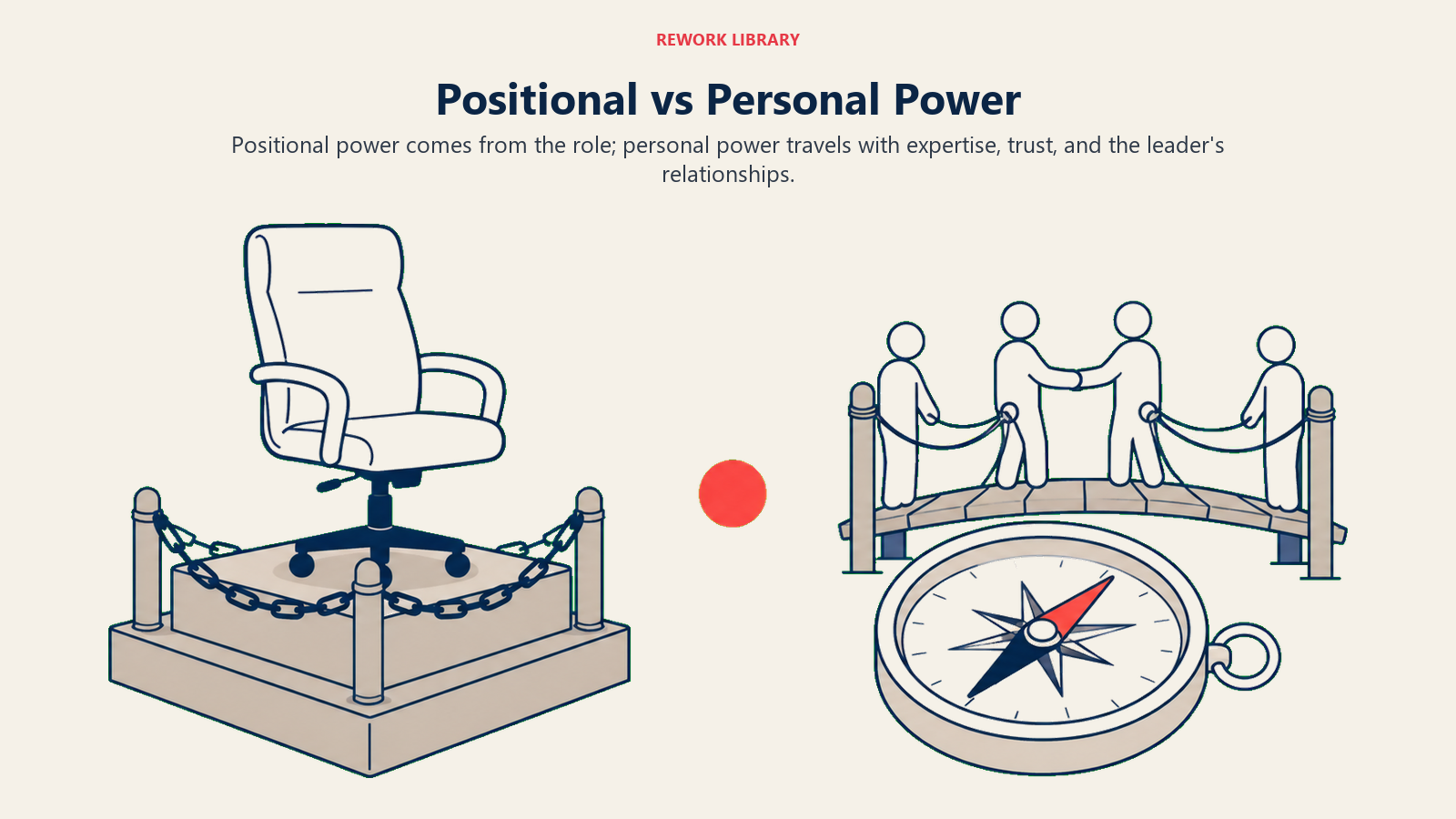
The six bases split cleanly into two groups, a distinction that has direct practical implications for leaders:
| Group | Bases included | Where the power lives |
|---|---|---|
| Positional power | Legitimate, Reward, Coercive | The role, not the person. It transfers with the title. |
| Personal power | Expert, Referent (and largely Informational) | The person, not the role. It stays when you leave. |
This grouping matters for leadership vs management. Managers who rely exclusively on positional power become ineffective the moment their formal authority is ambiguous or removed. Leaders with strong personal power retain influence across contexts.
A common mistake is confusing the two: assuming that a title confers genuine influence, or conversely, that influence without a title can't be legitimate.
Which bases of power are most effective?
The research is fairly consistent on this. Expert and referent power produce better outcomes than positional power across most organizational contexts. The 2019 Pierro et al. meta-analysis found these two bases were the strongest predictors of job satisfaction and organizational commitment. Coercive power reliably harms both.
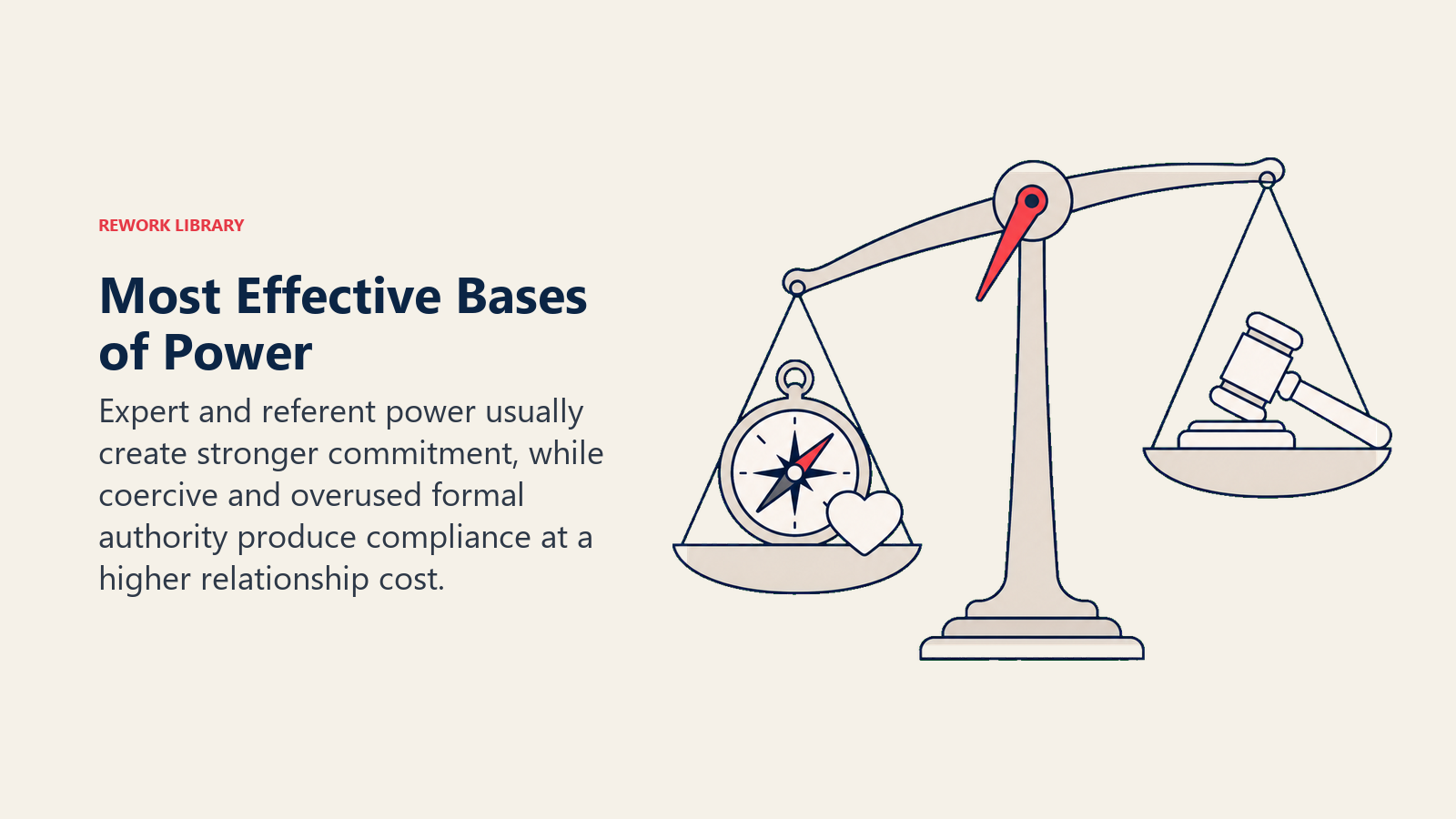
That said, "most effective" depends on what you're optimizing for:
- Speed and compliance: Legitimate and reward power get quick behavioral compliance, which matters in a genuine emergency or a highly procedural context.
- Sustained performance and creativity: Expert and referent power are better. People do more, think harder, and stay longer when they respect rather than fear their leader.
- Long-term influence: Referent power is the compounding asset. It builds over years and survives organizational change.
The 5 levels of leadership model makes a parallel point: the higher the level, the more the leader has shifted from positional to personal power. Trust-based management styles such as Theory Z lean almost entirely on expert and referent power rather than coercion, which is part of why they tend to sustain commitment over time.
How to build each base of power
Legitimate power
- Understand exactly where your formal authority starts and stops.
- Use it consistently and predictably, not erratically.
- Be transparent about decisions made inside your authority scope.
Reward power
- Know what your team members actually value (it varies more than most managers assume).
- Connect rewards clearly and quickly to the behaviors you want to see.
- Don't ration recognition: low-cost recognition (specific verbal praise, public acknowledgment) is underused in almost every team.
Coercive power
- Reserve it for genuine boundary violations, not preference gaps.
- Apply it consistently: selective enforcement destroys trust faster than the original infraction.
- Recognize that overuse erodes every other base you've built.
Expert power
- Go deep in the domains your team depends on, and keep deepening: expertise erodes if you stop learning.
- Share your reasoning, not just your conclusions. This builds trust and develops your team.
- Be honest about what you don't know. Fake expertise is quickly detected and permanently damages credibility.
Referent power
- Act consistently with stated values, especially when it costs you something.
- Invest genuinely in people's growth without quid-pro-quo expectations.
- Practice the coaching leadership style: referent power compounds when people see you as someone who helped them succeed.
Informational power
- Invest in data quality and the ability to synthesize it clearly.
- Share useful information proactively rather than hoarding it for strategic advantage.
- Credit sources rigorously: borrowed credibility from good sources is still useful credibility.
Examples of the 5 bases at work
| Base | Role / scenario | How the power operates |
|---|---|---|
| Legitimate | Division VP announces a strategic pivot | Team realigns priorities because the VP holds decision authority |
| Reward | Sales manager controls quarterly bonus allocations | Reps prioritize the manager's coaching sessions ahead of optional training |
| Coercive | Team lead reassigns someone's project after a missed deadline | Others treat deadlines as non-negotiable to avoid the same outcome |
| Expert | Senior data scientist reviews the team's model architecture | Junior engineers implement the recommendation without pushback |
| Referent | A respected department head moves to a different business unit | Former team members still seek their input on major decisions |
| Informational | Competitive analyst presents pricing data at a product review | Product team changes direction based on the data, not the analyst's seniority |
Common mistakes when using power
Defaulting to legitimate power when it isn't working. When people stop complying willingly, the instinct is to invoke formal authority more forcefully. This rarely solves the underlying problem and usually accelerates disengagement.
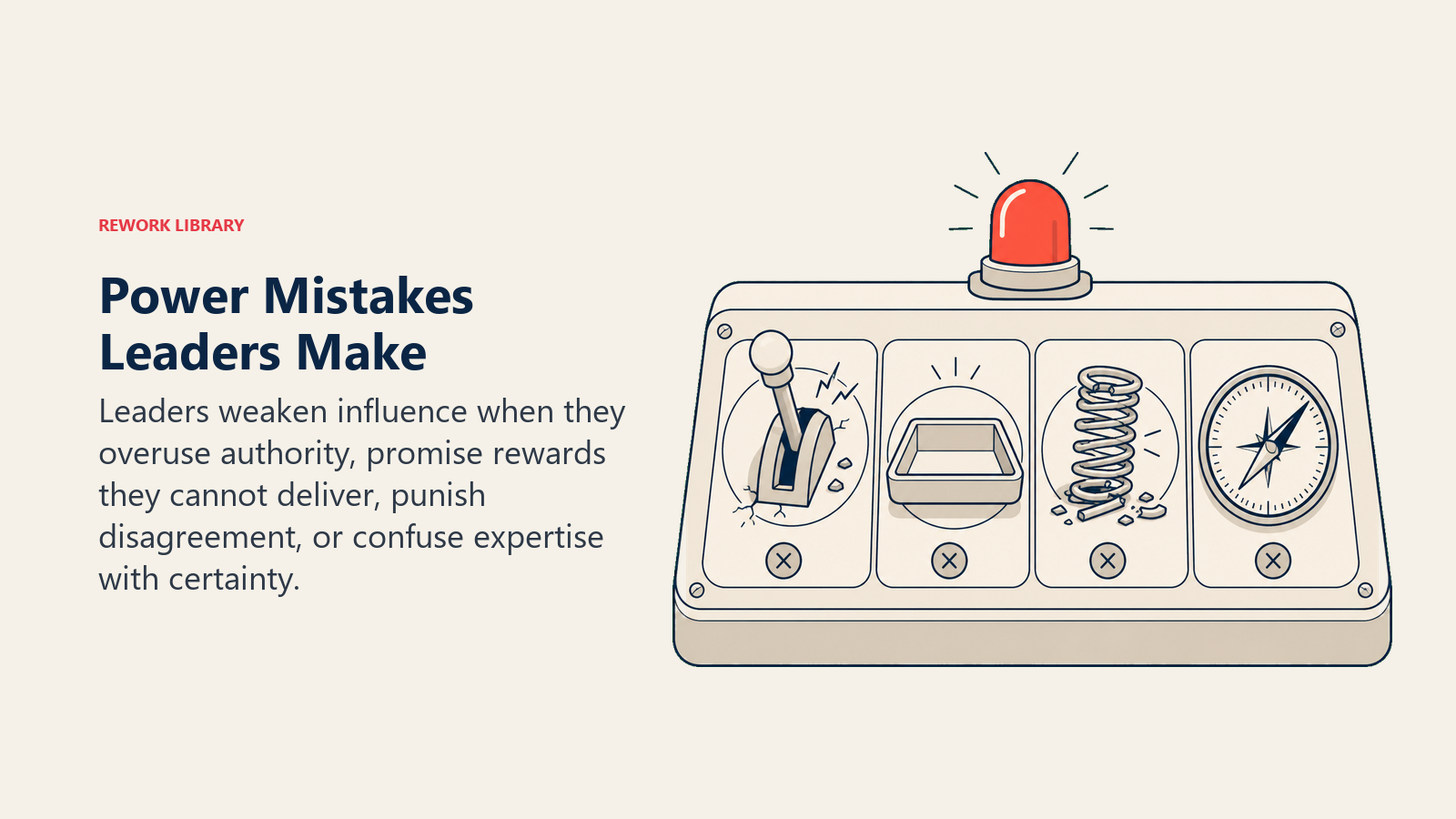
Mistaking compliance for influence. Coercive and reward power can generate compliance that looks like influence until the enforcement mechanism disappears. Real influence changes what people think and choose, not just what they do while you're watching.
Neglecting expert power after a promotion. Many technical experts get promoted into management and stop developing the skills that gave them credibility. The title gives them legitimate power, but they lose the expert power that made people genuinely want to follow them.
Treating referent power as a given. Admiration and trust are earned through consistent behavior over time and destroyed much faster than they're built. Leaders who act on "they respect me" as a fixed asset tend to overspend it.
Using all bases at maximum intensity simultaneously. Wielding reward, coercive, and legitimate power all at once in the same interaction overwhelms people and creates the kind of performative compliance that tanks psychological safety. A lighter touch on position often creates more actual influence.
Frequently Asked Questions about French and Raven's 5 Bases of Power Explained
What are the 5 bases of power?
The five bases are legitimate power (authority from a formal role), reward power (ability to deliver valued outcomes), coercive power (ability to punish or withhold), expert power (influence from knowledge and skill), and referent power (influence from admiration and identification). French and Raven identified all five in their 1959 paper.
Who created the bases of power framework?
Social psychologists John French and Bertram Raven published the original five-base framework in 1959 in a chapter titled "The Bases of Social Power," included in Studies in Social Power edited by Dorwin Cartwright. Raven later extended the model by adding informational power in 1965.
What is the 6th base of power?
Informational power is the sixth base, added by Raven in 1965. It describes influence that comes from the content and logic of information itself, independent of the source's credibility or position. It differs from expert power because it doesn't require trust in the person sharing the information.
Which type of power is most effective for leaders?
Expert and referent power consistently produce better organizational outcomes: higher job satisfaction, stronger commitment, and lower turnover. Coercive power is the weakest in terms of sustained performance and the most damaging to team culture. Legitimate and reward power are useful but produce more transactional compliance than genuine engagement.
Can a leader hold multiple bases of power at once?
Yes, and most effective leaders do. A high-performing VP might hold legitimate power from their role, expert power from deep domain knowledge, and referent power from years of consistent, values-driven behavior. The bases are not mutually exclusive, and building multiple bases makes a leader more resilient when one source of influence is unavailable or inappropriate for a given situation.
Understanding the bases of power isn't an academic exercise. It's a practical map for auditing your own influence, spotting gaps before they cost you, and making deliberate choices about how you show up as a leader. Start by identifying which base you lean on most heavily, and ask yourself whether that base would survive a change in title or context. The answer tells you a lot about where to invest next.

Senior Operations & Growth Strategist
On this page
- What are French and Raven's bases of power?
- The 5 (and 6th) bases of power explained
- Legitimate power
- Reward power
- Coercive power
- Expert power
- Referent power
- Informational power (6th base, added 1965)
- Positional power vs personal power
- Which bases of power are most effective?
- How to build each base of power
- Examples of the 5 bases at work
- Common mistakes when using power