Types of Power in Leadership: A Complete Guide
Turn this article into takeaways for your work.


Each assistant summarizes the article only for you and suggests best practices for your work.
The types of power in leadership you rely on determine whether people follow you because they want to or because they have to. That distinction shapes team culture, performance, and retention more than most leaders realize.
This guide covers the full picture: what power actually means in a leadership context, how it differs from authority and influence, the core classification of positional versus personal power, and a breakdown of every major type with concrete examples. You'll also find guidance on which types build trust over time and which ones quietly erode it.
What is power in leadership?
Power in leadership is the capacity to influence the behavior, decisions, or attitudes of others. It doesn't require a formal title. A project coordinator with deep institutional knowledge can hold real power even without direct reports. A newly promoted VP may have the title but not yet the influence.
Three terms often get used interchangeably, but they're distinct:
- Power is the potential to influence. It exists whether or not you act on it.
- Authority is the formal, role-based right to direct others. It comes from the organization chart.
- Influence is the active exercise of power: what happens when you actually change someone's thinking or behavior.
You can have authority without real power (a manager everyone ignores), power without formal authority (a respected senior contributor), or influence that extends far beyond your official role.
Understanding what leadership is at its core makes this distinction clearer. Authority is assigned; power is earned, built, or inherited through position. Influence is the result.
Key Facts
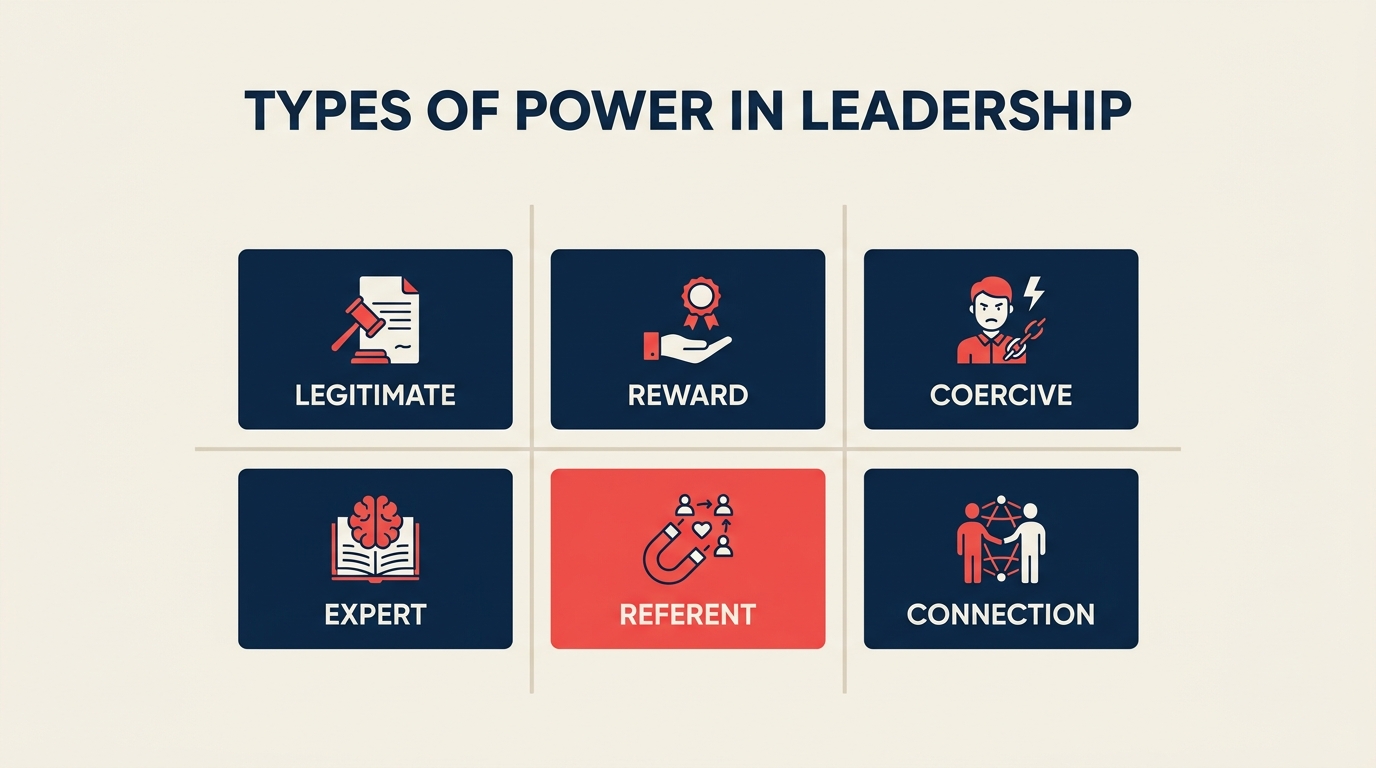
- French and Raven (1959) established the foundational taxonomy of social power with five bases: legitimate, reward, coercive, expert, and referent. It remains the most cited framework in leadership and organizational behavior research.
- Raven (1965) later added a sixth base, informational power, recognizing that controlling the content and framing of information is a distinct source of influence, separate from expertise.
- Research published in the Journal of Applied Psychology found that leaders who rely primarily on coercive power experience significantly higher team turnover and lower performance outcomes than those using expert or referent power (Yukl & Falbe, 1991).
Positional power vs personal power
Every type of power falls into one of two parent categories. This is the most useful organizing principle for leaders.
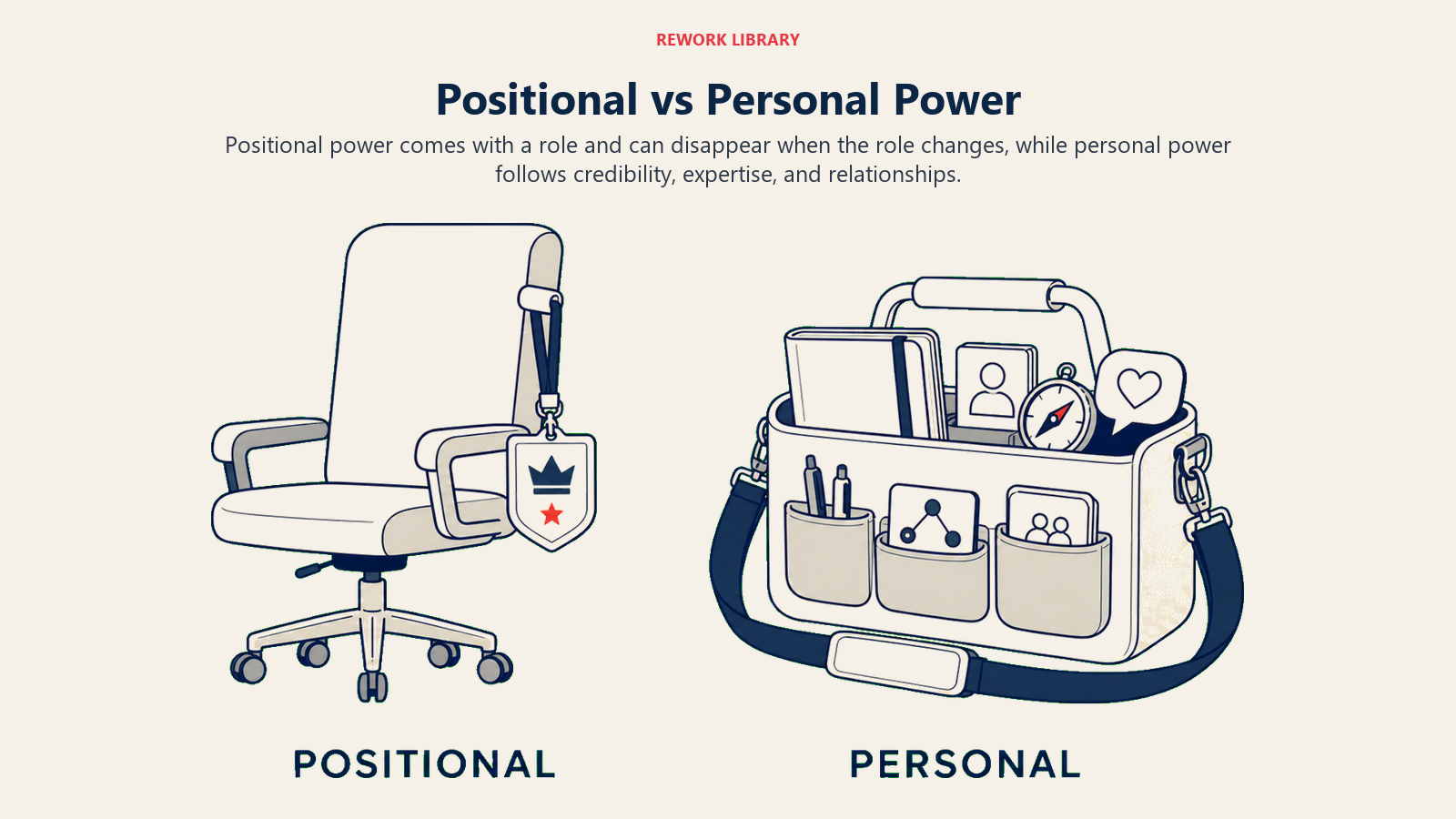
| Category | Source | Transfers with the role? | Examples |
|---|---|---|---|
| Positional power | Your place in the org chart | Yes (next person in the role gets it too) | Legitimate, Reward, Coercive |
| Personal power | Who you are and what you know | No (it stays with you) | Expert, Referent, Informational, Connection |
Positional power gives you a platform. Personal power determines what you do with it. The most effective leaders develop both. But when positional power evaporates (a reorg, a career change, a role shift), personal power travels with you.
The main types of power in leadership
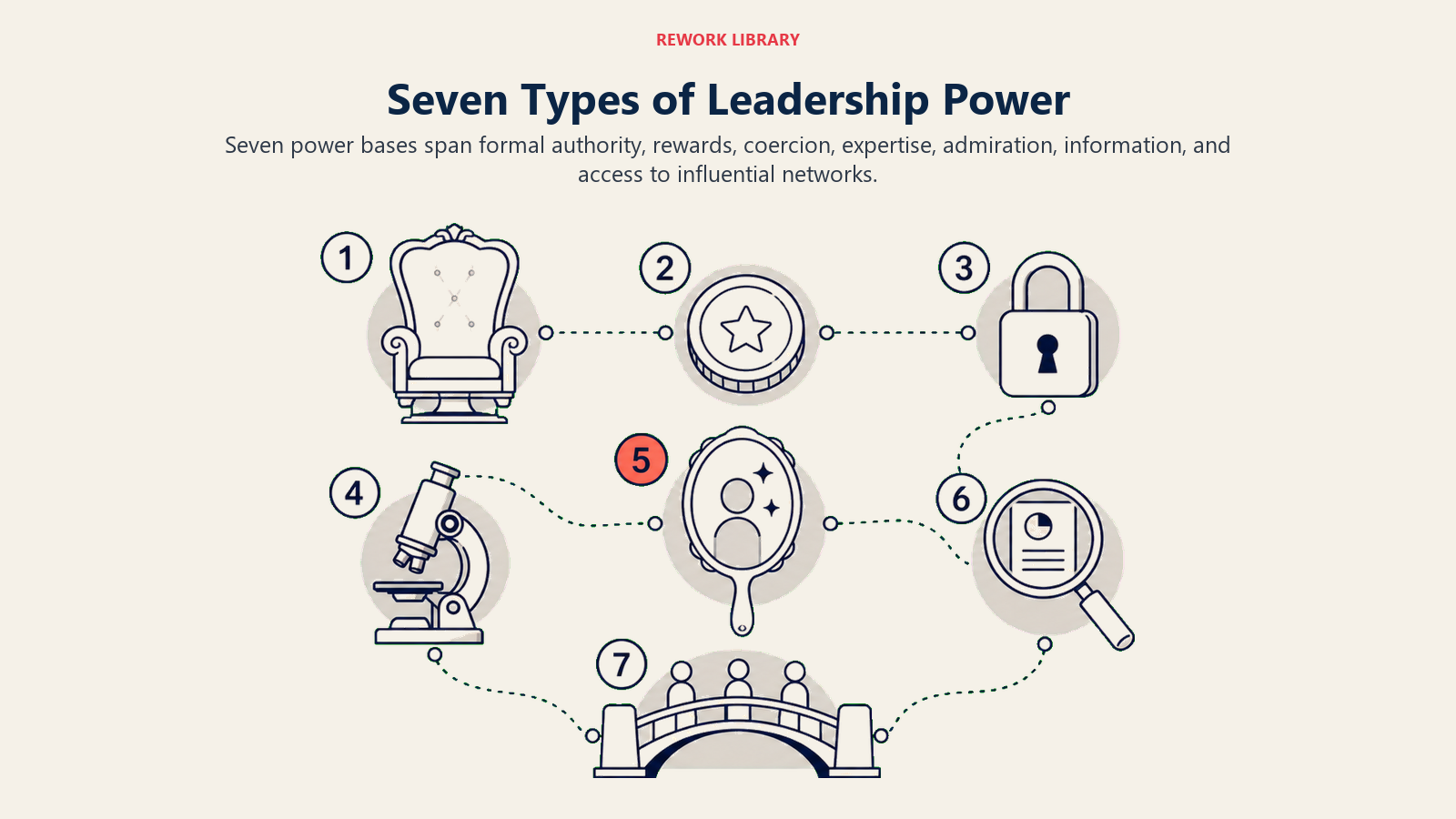
These seven types cover everything from formal authority to relationship-based influence. The first five build directly on the taxonomy French and Raven introduced. For a detailed treatment of that foundational model, see the French and Raven power bases deep dive.
Legitimate power
Legitimate power comes from your formal position. A manager can assign tasks, approve leave, and run performance reviews because the organization grants those rights to the role.
Example: A department head schedules a mandatory team meeting. People attend not because of affection for the leader but because the role carries that expectation.
Legitimate power is wide but shallow. It creates compliance, not commitment. And it disappears the moment you leave the role.
Reward power
Reward power is the ability to give people something they want: a raise, a promotion, a high-visibility assignment, public recognition.
Example: A sales manager controls quarterly bonuses. Reps prioritize her guidance because strong performance has a direct financial payoff.
Reward power works well for short-term motivation. The risk is dependency: if the rewards stop, the behavior often stops too.
Coercive power
Coercive power is the flip side of reward: the ability to punish, restrict, or apply negative consequences. Formal coercive tools include write-ups, demotion, reassignment, and termination.
Example: A team lead threatens to remove someone from a desirable project if targets aren't met.
Of all power types, coercive power is the most corrosive to trust and engagement. It creates compliance through fear, which suppresses initiative and causes people to avoid rather than engage. Used in all but the most urgent situations, it does lasting damage.
Expert power
Expert power comes from knowledge, skill, or demonstrated competence that others don't have and depend on. It's earned through track record, not title.
Example: A data engineer who is the only person on the team who understands the pipeline architecture. When she recommends an approach, people follow without needing to be asked twice.
Expert power is one of the most durable forms. It's portable, it scales with your knowledge, and it creates genuine credibility rather than just compliance. Coaching leadership leans heavily on expert power to develop others.
Referent power
Referent power is influence that comes from personal qualities: charisma, integrity, warmth, and the sense that someone genuinely cares. People follow referent leaders because they like and respect them, not because of what those leaders control.
Example: A team member with no formal authority who everyone turns to for advice before a difficult conversation because they trust her judgment and discretion.
Referent power is also the foundation of charismatic leadership, where the leader's personality is the primary driver of team cohesion and direction.
Informational power
Informational power comes from controlling access to knowledge, data, or context that others need to make decisions. This type doesn't require being the smartest person in the room. It requires being the person who has, filters, or frames the relevant information.
Example: A chief of staff who controls which data reaches the executive team. Her framing of a quarterly review shapes the strategic decisions that follow.
Informational power is increasingly significant in knowledge-work environments. It can be used constructively (synthesizing complex information for faster decisions) or destructively (hoarding knowledge to maintain relevance).
Connection power
Connection power comes from your network: who you know, who trusts you, and who you can mobilize on behalf of others. Sometimes called network power, it's distinct from referent power because it's about relationships beyond the immediate team rather than personal qualities within it.
Example: A program manager who can get a direct introduction to any product lead in the company. When a team member needs a fast cross-functional decision, her network is the fastest path.
Connection power often develops quietly over years. It's highly valuable in large or matrixed organizations where formal authority alone rarely gets things done.
Power vs authority vs influence
This comparison comes up constantly, especially when distinguishing between leadership and management. Here's a clear breakdown.
| Concept | What it is | Source | Transferable? | Can exist without title? |
|---|---|---|---|---|
| Power | Capacity to influence | Varies by type | Depends on type | Yes |
| Authority | Formal right to direct | Org chart / role | Yes | No (requires a role) |
| Influence | Active change in behavior/thinking | Exercise of power | N/A (it's a result) | Yes |
The practical implication: authority is a tool you're given; power is a resource you develop. Influence is what you produce when you use them well.
Which types of power build trust (and which erode it)
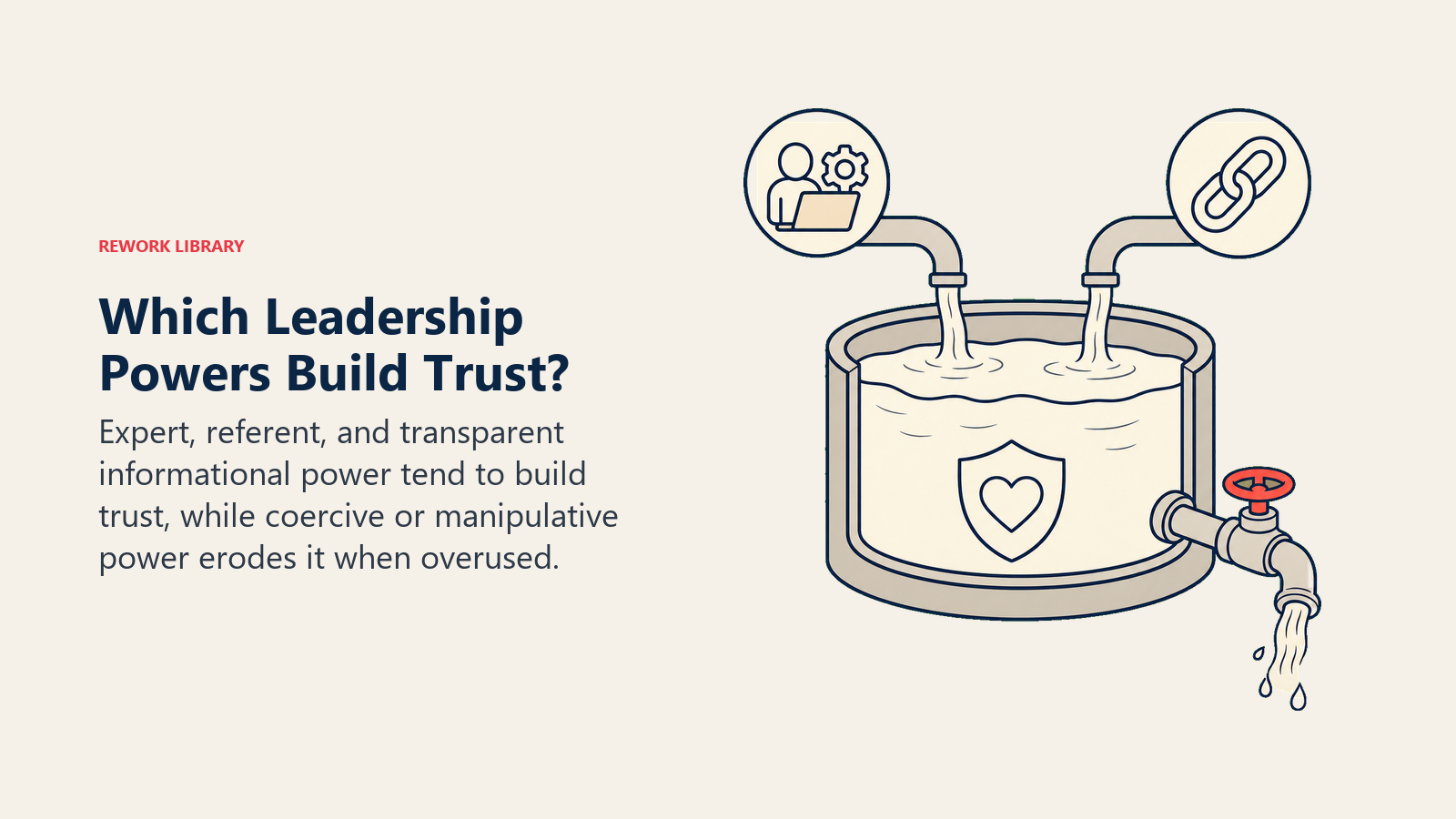
Not all power types have the same effect on team health over time.
Trust-building types:
Expert and referent power consistently produce the strongest trust outcomes. When people follow you because you're credible and genuinely invested in their success, that relationship deepens over time. Informational power, used transparently (sharing context, explaining reasoning), also strengthens trust.
Context-dependent types:
Legitimate and reward power are neutral in themselves. A respected leader using legitimate authority to set clear expectations builds confidence. An insecure leader using the same authority to micromanage erodes it. Reward power motivates well when it's fair, transparent, and aligned with real performance.
Trust-eroding types:
Coercive power almost always damages trust. Research by Yukl and Falbe (1991) found that coercion-heavy leadership was associated with lower team performance, higher turnover, and reduced commitment. Informational power used to hoard or manipulate, rather than to illuminate, has a similar effect. Connection power can feel like gatekeeping if it's used to exclude rather than enable.
The pattern is consistent: power used in service of others builds trust; power used to protect the leader's position erodes it.
How leaders can build and use power responsibly
Develop your expertise continuously. Expert power compounds. Every skill you build, every problem you solve publicly, and every time you're right when others are uncertain adds to your credibility base.
Invest in relationships before you need them. Connection power takes years to build and is depleted quickly by a single act of bad faith. Treat every introduction and every favor as a long-term investment.
Be transparent about what you control. If you have reward power, name it clearly. Ambiguity about incentives breeds cynicism. People handle explicit trade-offs far better than hidden ones.
Earn referent power through consistency. Charisma that isn't backed by follow-through fades fast. Referent power compounds when your behavior matches your stated values over time.
Use coercive power sparingly and as a last resort. There are situations (safety violations, ethical breaches, persistent underperformance after coaching) where formal consequences are necessary. But leaders who reach for coercion first train their teams to hide problems rather than surface them.
Share informational power. The instinct to hold information as leverage is natural but counterproductive in high-performing teams. Leaders who share context freely enable faster decisions and signal trust.
Audit your power mix periodically. Ask yourself: which types am I relying on most? If the honest answer is legitimate and coercive, it's worth investing in expert and referent power. Both are buildable.
Examples of power types in the workplace
| Type | Scenario |
|---|---|
| Legitimate | HR director updates the company leave policy and all managers implement it |
| Reward | Engineering manager recommends a senior IC for promotion after strong project delivery |
| Coercive | VP places a team member on a performance improvement plan for repeated missed deadlines |
| Expert | CFO's financial model is adopted by the board because no one else has her depth in cash flow analysis |
| Referent | A mid-level product manager's opinion on roadmap priorities carries more weight than the formal spec because the team trusts her instincts |
| Informational | Chief of staff summarizes a 60-page market research report for the leadership team, shaping how the CEO frames the strategic discussion |
| Connection | Operations lead fast-tracks a vendor contract by calling in a relationship with the procurement lead |
Power doesn't come from a title alone, and it doesn't evaporate when one changes. Leaders who invest in expert and referent power over time build something that no reorg can reassign. The best starting point is an honest audit: which types of power am I currently relying on, and are those the ones I want to be known for?

Senior Operations & Growth Strategist
On this page
- What is power in leadership?
- Positional power vs personal power
- The main types of power in leadership
- Legitimate power
- Reward power
- Coercive power
- Expert power
- Referent power
- Informational power
- Connection power
- Power vs authority vs influence
- Which types of power build trust (and which erode it)
- How leaders can build and use power responsibly
- Examples of power types in the workplace