Reinforcement Theory of Motivation Explained
Turn this article into takeaways for your work.


Each assistant summarizes the article only for you and suggests best practices for your work.
Most motivation theories ask what is going on inside a person. Maslow asks which need is unmet. Vroom asks what someone believes about effort and reward. Adams asks whether they feel treated fairly. Reinforcement theory refuses the question. It says never mind what they think, look at what happens right after they act, because that is what decides whether they do it again. It's the bluntest theory in the management canon, and also the one managers use constantly without noticing. Every bonus scheme, every safety walkthrough, every "great catch" in a standup is a reinforcement decision, made well or badly.
What is reinforcement theory?
Reinforcement theory holds that behavior is a function of its consequences. Actions followed by favorable outcomes get repeated. Actions followed by unfavorable outcomes, or by nothing at all, fade. The theory is associated with B.F. Skinner and his work on operant conditioning, where an organism operates on its environment and the environment answers back, either strengthening or weakening whatever came before.
It descends from Edward Thorndike's law of effect, which came out of putting cats in puzzle boxes in the 1890s and timing how long they took to escape. Thorndike also added a clause most summaries drop: the greater the satisfaction or discomfort, the greater the strengthening or weakening. A 2026 review in the Journal of the Experimental Analysis of Behavior by Michael Domjan traces how the taught version drifted, with Skinner's 1953 Science and Human Behavior as the pivot that recast the law as behavior simply being stamped in by consequences. Textbooks inherited the truncated version, so the original 1911 chapter is worth a few minutes.
The critical design decision is what the theory leaves out: needs, beliefs, fairness perceptions, expected value. It treats the person as a black box and works only on observable behavior and observable consequences. That's deliberate, and it buys real clarity, because you can count behaviors, change consequences, and measure whether the count moved. It also costs the theory everything the other frameworks in the leadership theories family exist to capture. Maslow's hierarchy of needs and McClelland's needs theory are content theories that name what people want. Vroom's expectancy theory and Adams' equity theory are cognitive process theories that model the calculation people run before deciding to try. Reinforcement theory is neither. It's a consequence theory, and the only one here that would still function if human beings had no inner life at all.
Key Facts: Reinforcement Theory
- Thorndike's first definitive statement of the law of effect appeared in Animal Intelligence (1911, p. 244): responses "accompanied or closely followed by satisfaction to the animal" become more firmly connected with the situation that produced them. Source: Classics in the History of Psychology, York University
- Stajkovic and Luthans meta-analyzed 72 behavioral management studies in real organizations and found an average effect size of d = .47, reported as a 16% improvement in task performance and a 63% probability of success. Source: Personnel Psychology, 2003
- In the same analysis, money improved performance 23%, social recognition 17% and performance feedback 10%. Used together the three produced a synergistic effect, 21% greater than adding the individual effects. Source: Personnel Psychology, 2003
- Deci, Koestner and Ryan's meta-analysis of 128 experiments found tangible rewards significantly undermined free-choice intrinsic motivation (engagement-contingent d = -0.40, completion-contingent d = -0.36, performance-contingent d = -0.28), while positive feedback enhanced it (d = 0.33). Source: Psychological Bulletin, 1999
- Of the four schedules, variable ratio is both the most productive and the most resistant to extinction, which is why unpredictable rewards are so hard to unwind. Source: OpenStax, Psychology 2e
The four consequences
Reinforcement theory gives you exactly four moves. Two increase a behavior, two decrease it. The vocabulary is unfortunate, because "positive" and "negative" here mean adding and removing, not good and bad.
| Consequence | What happens | Effect | Workplace example |
|---|---|---|---|
| Positive reinforcement | Something desirable is added | Increases | An engineer flags config drift before it causes an outage, and the incident lead names them in the next standup |
| Negative reinforcement | Something unpleasant is removed | Increases | A team that files its weekly status on time stops getting the daily chase-up pings |
| Punishment | Something unpleasant is added, or something valued removed | Decreases | A repeat safety violation triggers a formal warning, or someone is pulled off a high-visibility project |
| Extinction | Nothing at all happens | Decreases | Someone raises process problems in three straight retros, nothing is ever done, and they stop raising them |
Negative reinforcement is not punishment, and most management writing gets this wrong
This is the single most common error in writing about reinforcement at work, so it's worth being blunt. Negative reinforcement increases a behavior. It does that by taking away something aversive: the nagging stops, the alarm quiets, the escalation chain ends. The relief is the reinforcer.
Punishment decreases a behavior by adding something aversive or removing something valued. The two are opposites in effect and easily confused in wording. OpenStax's Psychology 2e keeps the distinction clean: positive means adding, negative means removing, reinforcement increases, punishment decreases. Four combinations, no overlap.
This isn't pedantry. Mistake one for the other and you'll read "negative reinforcement works" as license to lean on threat, when the finding is about relief from ongoing pressure. It also hides a useful diagnostic: how much of your team's behavior is currently maintained by relief rather than reward? Teams that only move when something unpleasant is looming are running on negative reinforcement, and that works right up until the unpleasant thing becomes background noise.
The two decreasing consequences each have a catch. Punishment suppresses behavior fast but teaches nothing about what to do instead, and it reliably teaches people to avoid the punisher, which means fewer visible errors and no fewer actual errors. That mechanism is what quietly destroys psychological safety, and it's why organizations that punish bad news end up with the worst information.
Extinction is slower and stranger. When a previously reinforced behavior stops paying, the first response is usually an extinction burst: it gets louder and more frequent before it stops. The colleague who used to get quick answers by pinging you directly will ping harder after you route them to the queue. Managers who don't expect the burst conclude the change failed and restore the old reward at the worst possible moment, teaching persistence rather than the new routine.
Schedules of reinforcement
Deciding what to reinforce is the easy half. When you reinforce matters just as much, and this is where the theory produces its least obvious practical findings.
Continuous reinforcement means every instance gets the consequence. It teaches fastest, which makes it right while someone is learning, and it extinguishes fastest, because the missing reward is immediately obvious. Reinforce every single time and you're building a behavior that collapses the moment the reward stops.
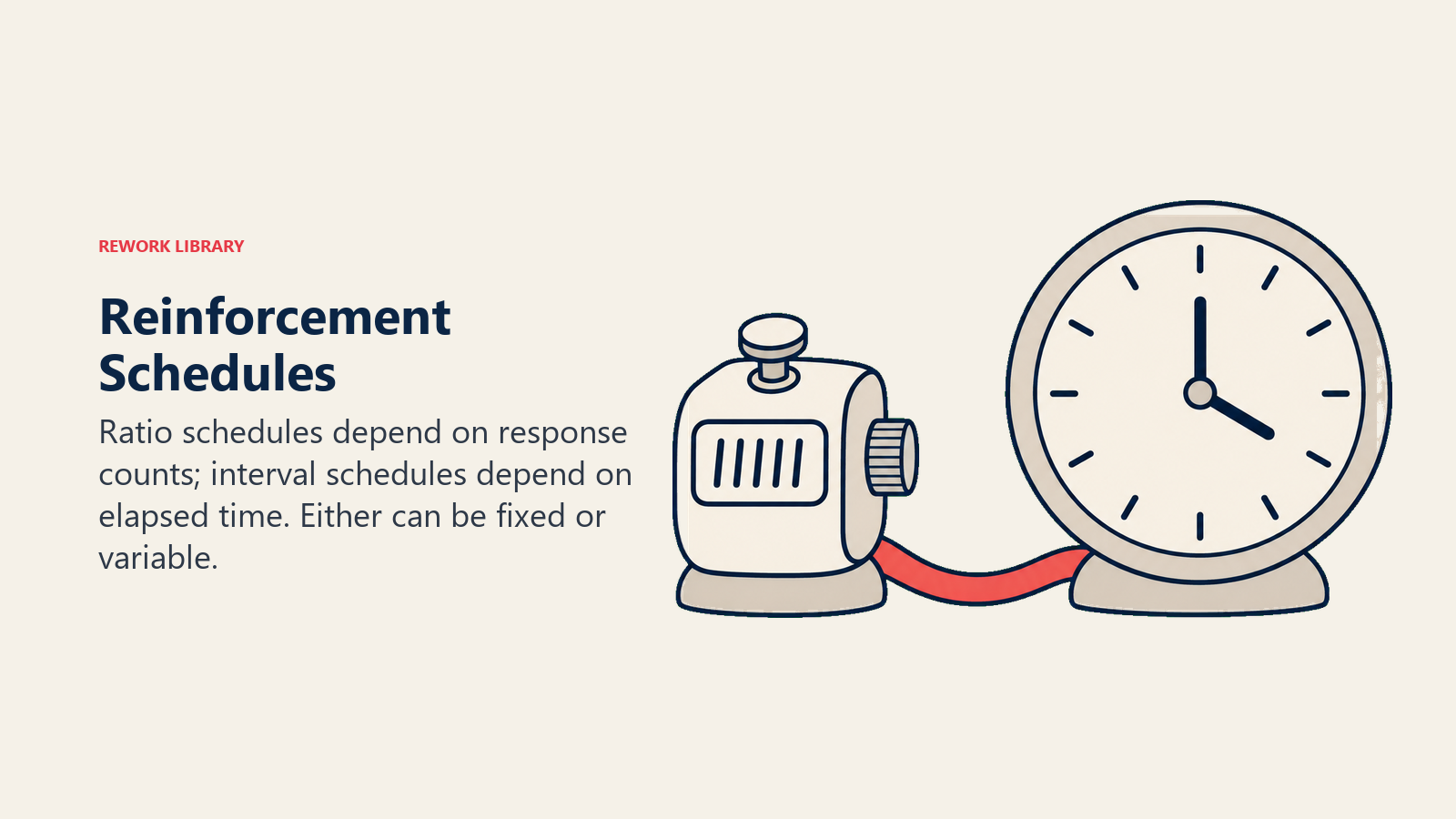
Intermittent reinforcement means only some instances get the consequence. It teaches more slowly and holds far longer. Ferster and Skinner's 1957 work mapped the four basic intermittent schedules, which sit on two axes: ratio versus interval (counted responses versus elapsed time) and fixed versus variable.
| Schedule | Reinforcement rule | Workplace analogue | Response pattern | Persistence when the reward stops |
|---|---|---|---|---|
| Fixed ratio | After a set number of responses | Piece rate, commission per unit sold, a bonus at every tenth qualified demo | High output with a distinct pause right after each payout | Moderate, and the pause makes the drop-off visible early |
| Variable ratio | After an unpredictable number of responses | Prospecting itself (some calls connect), spot recognition, a spiff drawn from qualifying deals | High and steady, with almost no post-reward pause | Highest of the four, by a clear margin |
| Fixed interval | The first response after a set period | Monthly bonus, quarterly review, annual appraisal | Moderate with a pronounced scallop: effort spikes as the date nears, sags right after | Low, because the missing payout has an obvious due date |
| Variable interval | The first response after an unpredictable period | Unannounced safety walkthroughs, random quality audits, a leader who drops into standups without a pattern | Moderate but genuinely steady | Solid, because there's no date on which to notice the absence |
The row that matters is variable ratio. It produces both the highest output and the greatest resistance to extinction. That's the same mechanism behind slot machines, and it's why an unpredictable recognition habit outperforms a larger scheduled bonus at holding a behavior in place.
It also explains why certain incentive schemes are almost impossible to unwind. A sales culture built on unpredictable, high-variance rewards has installed exactly the schedule most resistant to extinction, so when finance proposes something flatter, the resistance isn't only about money: the old pattern persists long after the payouts change, and the extinction burst that follows looks a lot like a morale crisis. Fixed-interval schemes are the mirror image, easy to remove and easy to game. A reliable end-of-quarter scramble isn't a discipline problem. It's a fixed-interval schedule doing exactly what the research says it does.
Organizational behavior modification: the applied version
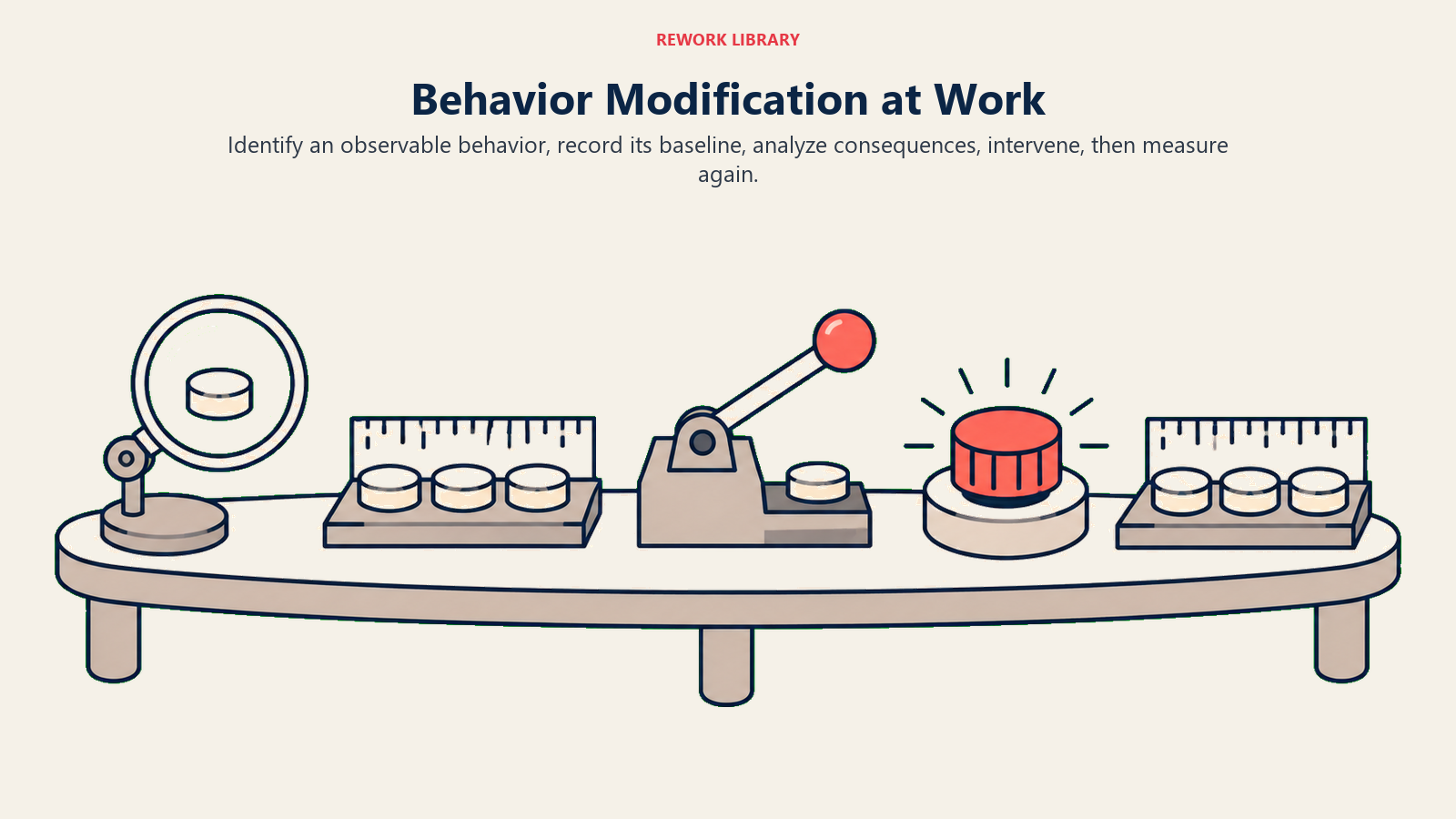
The formal workplace application of reinforcement theory is Organizational Behavior Modification, usually shortened to OB Mod, developed by Fred Luthans and Robert Kreitner in the mid-1970s. Its analytical unit is the A-B-C chain: the antecedent (the occasion on which the behavior occurs), the behavior itself, and the consequence that follows. The five-step model runs like this.
| Step | What you do | Where it usually goes wrong |
|---|---|---|
| 1. Identify | Pinpoint the behaviors that drive performance, using observability as the test: can you see it, count it, connect it to an outcome? | Organizations try to reinforce dispositions. "Be more accountable" fails the test, "log the defect within one shift" passes |
| 2. Measure | Record the current frequency before changing anything | No baseline, so an intervention effect can't be told from normal fluctuation or defended later |
| 3. Analyze | Map the existing contingencies: what precedes the behavior, and what follows it | Skipped, which hides the fact that the behavior you dislike is already reinforced by something in the system |
| 4. Intervene | Change the consequences, naming which of the four types you're using and on what schedule | A vague new reward instead of a specified consequence on a specified schedule |
| 5. Evaluate | Re-measure against the baseline | A null result is read as a reason to raise the reward, when it usually means step 3 was wrong |
Does it actually work?
Better than a lot of management interventions, within its range. Alexander Stajkovic and Fred Luthans meta-analyzed 72 behavioral management studies conducted in real organizations and reported an average effect size of d = .47, which they translate as a 16% improvement in task performance and a 63% probability of success. Money, performance feedback and social recognition each had a significant independent effect: money improved performance 23%, social recognition 17% and feedback 10%.
Two details there deserve attention. Social recognition beat performance feedback and came within striking distance of money, at a fraction of the cost. And the three combined produced a synergistic effect, 21% greater than the sum of their individual effects, though the authors note money and social recognition paired together didn't work as well as the other combinations. So the strongest configuration isn't "pay more." It's pay, tell people how they're doing, and acknowledge them. That's one reason a direct feedback practice like radical candor lifts performance even when compensation doesn't change.
The caveat is scope. That 16% comes from studies of measurable task performance, which skews toward observable work: production output, attendance, safety compliance, service transactions. It isn't evidence that reinforcement schemes improve strategy or judgment.
The serious criticisms
Reinforcement theory attracts more sustained criticism than any other motivation model in this collection, and the objections aren't trivial.
Extrinsic rewards can crowd out intrinsic motivation
This is the strongest empirical challenge and it has a name: the overjustification effect. If someone already enjoys an activity for its own sake and you start paying them for it, the reward can become the reason they do it, and interest drops once the payment stops.
Edward Deci, Richard Koestner and Richard Ryan's meta-analysis of 128 experiments is the canonical reference. Engagement-contingent, completion-contingent and performance-contingent rewards all significantly undermined free-choice intrinsic motivation, with effect sizes of d = -0.40, -0.36 and -0.28, and the same held for tangible and expected rewards as broad categories. Positive feedback ran the other way, enhancing free-choice behavior (d = 0.33) and self-reported interest (d = 0.31).
Read those together and the guidance is unusually clear. Informational recognition builds intrinsic interest. Tangible rewards tied to doing the task, finishing it, or hitting a number erode it. That's a difficult finding for anyone whose entire motivation strategy is a bonus plan. Self-determination theory explains why: rewards that feel controlling undermine autonomy, while feedback that feels informational supports competence.
Treating people as behavior to be conditioned is an ethical problem
The technique was developed on pigeons and rats and transfers to humans because the underlying learning mechanism transfers, which is exactly what makes people uneasy about it. A manager running a reinforcement schedule on an adult professional has taken a stance about that person: that the useful lever is their behavior rather than their reasoning.
The defensible version is transparency. If people know what's being reinforced and why, and can argue with the choice, the manipulation objection weakens considerably. The indefensible version is covert conditioning. It's no accident that reinforcement thinking sits close to McGregor's Theory X, which assumes people need to be directed and controlled. The technique doesn't require that assumption, but it's comfortable for managers who hold it, and that comfort is worth noticing in yourself.
Ignoring cognition makes it a poor fit for complex knowledge work
The black-box design that makes reinforcement theory practical on a production line makes it nearly useless on an architecture decision. Complex work involves judgment under ambiguity, where the right behavior isn't observable in advance and the outcome arrives months later, badly attributed. You can't reinforce what you can't see, and you can't reinforce promptly what doesn't resolve for two quarters. For that work the cognitive theories carry more weight, because the questions that matter are whether the person believes their effort will produce the result (expectancy theory), whether they think the deal is fair (equity theory), and whether the target is specific and difficult enough to focus effort (goal-setting theory).
You get exactly the behavior you measure
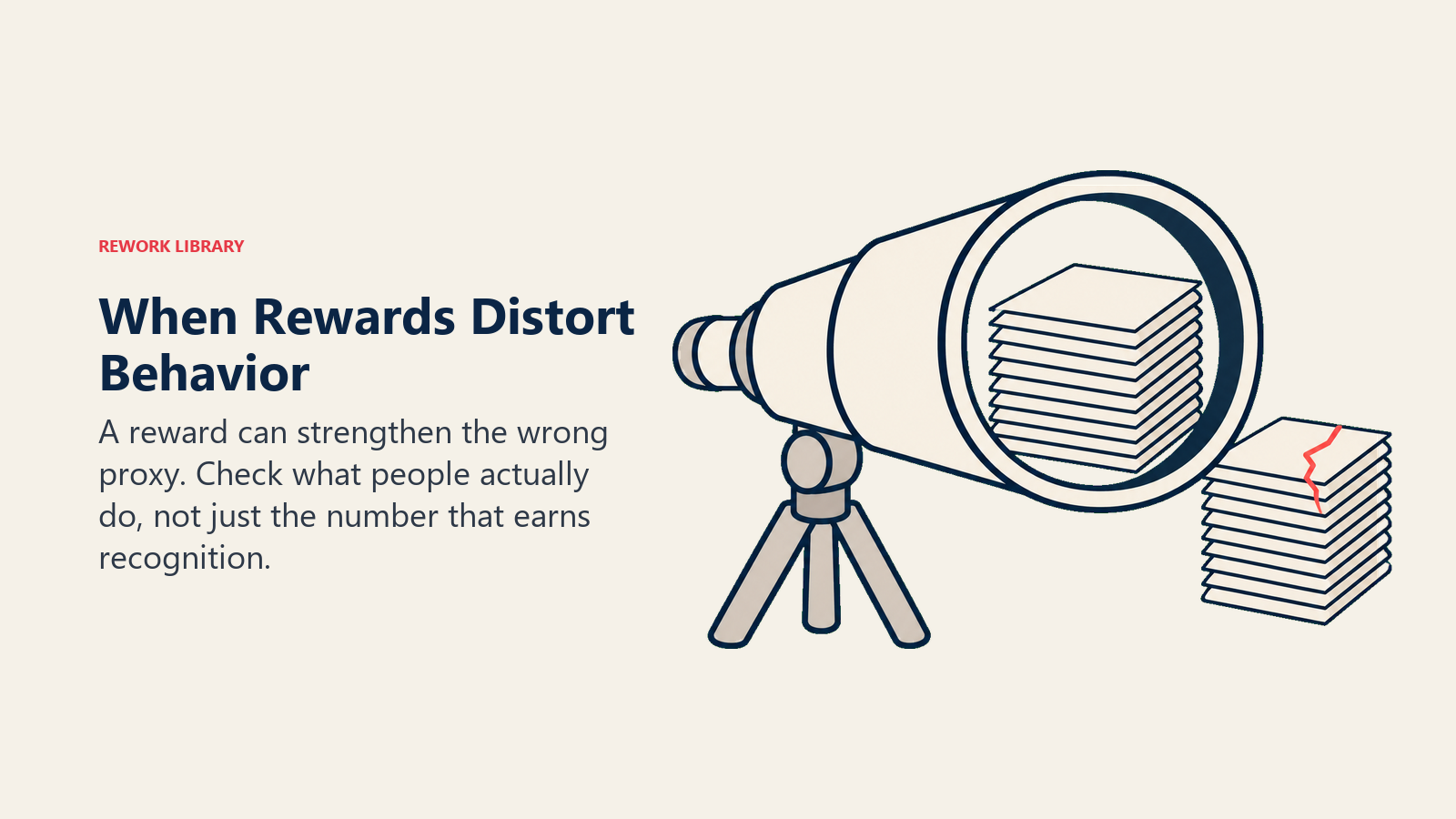
Reinforcement is indifferent to intent. It strengthens whatever behavior actually preceded the reward, which may not be the behavior you meant to strengthen.
The systematic version of this argument is Ordóñez, Schweitzer, Galinsky and Bazerman's "Goals Gone Wild," which argues the benefits of goal setting have been overstated while the harms have been ignored, and catalogues the side effects: a narrow focus that neglects everything outside the goal, a rise in unethical behavior, distorted risk preferences, corrosion of organizational culture and reduced intrinsic motivation. Every one is a reinforcement failure. The scheme reinforced a proxy, people optimized the proxy, and the thing the proxy stood in for got worse. Reward closed tickets and get tickets closed prematurely.
The pattern underneath is that reinforcement works, which is why a badly chosen target is dangerous rather than merely ineffective. This is the sharpest limit of transactional leadership, essentially reinforcement theory operationalized as a leadership style: contingent reward is effective at producing the specified behavior and structurally incapable of noticing when the specification was wrong.
Where it still genuinely works
None of that makes the theory obsolete. It makes it a specialist tool with a well-defined range, and inside that range it outperforms almost everything else.
| Domain | Why it fits | What to reinforce |
|---|---|---|
| Safety behavior | The target is observable, and the natural consequence (an injury) is too rare to teach anything | Wearing the equipment, running the check, reporting the near-miss, on a variable-interval observation schedule |
| Quality and defect reduction | Defects are countable, causes traceable, feedback loops fast | Catching a defect upstream, logging it accurately, stopping the line when the standard isn't met |
| Habit formation and onboarding | New routines need dense reinforcement early, and a learner can't judge their own work yet | Each correct step, continuously for the first weeks, then thinning to variable |
| Repetitive, observable tasks | Output is measurable per unit and the consequence can follow within minutes | Throughput, accuracy, adherence to sequence |
| Shaping one specific behavior | Narrow scope is the theory's home ground, and it prevents the proxy problem | A single named action, defined tightly enough that two observers would agree it happened |
The pattern is that reinforcement theory works when the behavior is observable, the consequence can be immediate and contingent, and the target is a specific action rather than an attitude. Which is why "reinforce engagement" is a category error. Engagement isn't a behavior, nobody can watch it happen, and there's no moment at which to deliver a consequence.
How to apply it honestly
Reinforce behavior, don't just reward outcomes
This is what separates competent practice from a bonus plan. Outcomes are contaminated by luck, market conditions and other people's work. Behaviors are the part the person controls. Reward a closed deal and you've partly rewarded a favorable quarter. Reinforce the discovery call that surfaced the real objection and you've reinforced something repeatable. Outcome rewards still have a place, they just teach less than people assume.
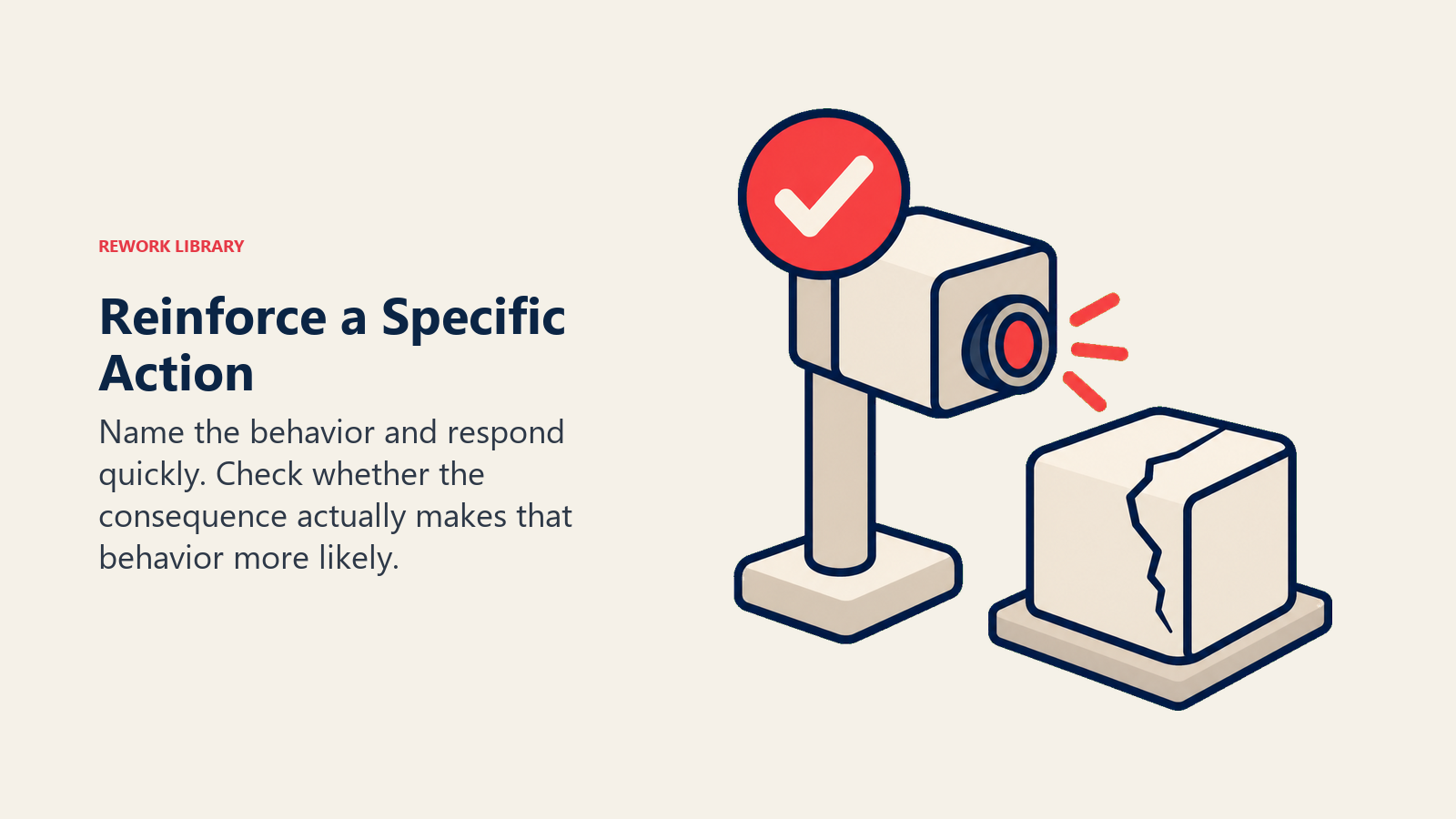
Make it immediate and make it contingent
These are the two variables that matter most, and both are usually broken. Immediate means the consequence follows closely enough that the connection is obvious, which is why recognition in tomorrow's standup beats recognition in next quarter's review by an enormous margin. Contingent means the consequence depends on that behavior and only that behavior. A bonus everyone receives isn't contingent on anything, so it reinforces nothing. It may still be fair to pay. It just isn't a motivational instrument.
Prefer unpredictable recognition to a scheduled bonus
Given the schedule research, this is the highest-leverage habit change available to most managers, and it costs nothing. A fixed-interval reward produces the scallop: a surge before the date, a slump after. Unpredictable recognition produces steady behavior and holds far longer once you stop. In practice that means noticing good work when you see it rather than saving it for a review cycle.
Name the behavior too. "Great work this week" reinforces nothing in particular, because the person can't tell which of the forty things they did earned it. "You flagged that dependency before it blocked the release, and that saved us two days" reinforces a specific action, and that specificity is what converts a reward into feedback.
Use extinction deliberately, and expect the burst
If a behavior is maintained by something you control, you can usually stop it by removing the reinforcement rather than punishing it. Escalations that bypass the process stop when bypassing stops working. Just plan for the extinction burst, and decide in advance that you won't restore the old reward in the week the behavior intensifies.
Check what your system already reinforces
Before designing anything, run step 3 of OB Mod on yourself. Every organization is already a reinforcement machine, whether or not anyone planned it. The person who volunteers for extra work and gets more work has been punished. The team that surfaces a risk early and gets an audit has been punished. The colleague who quietly absorbs the problem and gets left alone has been reinforced. Most reinforcement work at the manager level isn't adding new rewards. It's finding the contingencies you built by accident and turning them off.
One caution across all five: a reinforcer is defined by its effect, not your intent. Public praise reinforces some people and mildly punishes others. Test it by watching what the behavior does next.
How it sits alongside the other motivation theories
Reinforcement theory is one instrument in a set rather than a rival to the others. It answers a narrower question than any of them, and answers it more concretely.
| Theory | What it looks at | Where it beats reinforcement theory | Where reinforcement theory beats it |
|---|---|---|---|
| Reinforcement theory (Skinner) | Observable actions and their consequences | Nowhere on its own ground | Directly actionable this week, and measurable |
| Maslow's hierarchy | Internal needs in sequence | Explains why a reward lands flat when a lower need is unmet | Testable, without guessing at a hidden state |
| Herzberg's two-factor theory | Hygiene factors versus motivators | Explains why removing an irritant doesn't create motivation | Specifies the timing and contingency Herzberg leaves vague |
| McClelland's needs theory | Achievement, affiliation and power profiles | Tells you which reinforcer will function as one | Tells you when and how often to deliver it |
| Vroom's expectancy theory | Expectancy, instrumentality and valence | Diagnoses motivation failures no reward can fix | Works when the person can't articulate their own reasoning |
| Adams' equity theory | Input to output ratios versus a referent | Explains why a technically correct reward backfires | Deals in one person's behavior, not a social comparison |
| Locke's goal-setting theory | Goal specificity, difficulty and commitment | Directs effort before the behavior rather than after | Sustains the behavior after the goal is set |
| Self-determination theory | Autonomy, competence and relatedness | Explains when rewards will actively backfire | Faster movement on narrow, observable behaviors |
The synthesis most managers land on looks like this. Use goal-setting to decide what matters, expectancy and equity to check the deal is believable and fair, self-determination theory to decide whether a tangible reward is appropriate at all, and reinforcement theory to handle the timing and specificity of what you actually say once the behavior happens in front of you. That last part is the daily work, and it's the part most leadership development ignores completely.
Frequently Asked Questions about Reinforcement Theory
What is reinforcement theory in simple terms?
Reinforcement theory says behavior is shaped by what follows it. Actions followed by favorable consequences get repeated, and actions followed by unfavorable consequences or by nothing at all fade out. It deliberately ignores what a person is thinking and works only on observable behavior and observable consequences.
What are the four types of reinforcement?
Strictly, there are two types of reinforcement and two ways of decreasing behavior. Positive reinforcement adds something desirable and negative reinforcement removes something unpleasant, and both increase the behavior. Punishment adds something unpleasant or removes something valued, and extinction removes all consequences, and both decrease it.
Is negative reinforcement the same as punishment?
No, and this is the most common mistake in management writing on the subject. Negative reinforcement increases a behavior by removing something unpleasant, such as chase-up emails stopping once a report is filed on time. Punishment decreases a behavior. They're opposites, and "negative" here means removing rather than bad.
Which reinforcement schedule works best at work?
For learning something new, continuous reinforcement teaches fastest. For maintaining a behavior, variable ratio is strongest, because it produces high steady output and is the most resistant to extinction of the four schedules. Fixed-interval rewards such as quarterly bonuses produce the weakest pattern, with a surge before the date and a slump after it.
Does reinforcement theory actually improve performance?
Within its range, yes. Stajkovic and Luthans meta-analyzed 72 behavioral management studies in real organizations and reported a 16% average improvement in task performance, with money at 23%, social recognition at 17% and performance feedback at 10%. Those studies concentrate on observable task performance, so the finding doesn't extend to strategy or complex judgment work.
What is the main criticism of reinforcement theory?
The strongest evidence-based criticism is the overjustification effect. Deci, Koestner and Ryan's meta-analysis of 128 experiments found tangible rewards tied to doing, completing or performing a task significantly undermined intrinsic motivation, while positive feedback increased it. There are also ethical objections to conditioning adults, and a practical limit: reinforcement strengthens exactly the behavior you measured, including when that behavior was the wrong proxy.
When should a manager use reinforcement theory?
Use it when the behavior is observable, the consequence can follow quickly and depends only on that behavior, and the target is a specific action rather than an attitude. Safety, quality, habit formation, onboarding and repetitive measurable work are its strongest cases.
Reinforcement theory isn't a philosophy of motivation and doesn't pretend to be. It's a claim about consequences, and it's right about them. The discipline it imposes is that you have to name a behavior precisely enough to see it happen, then be honest about what your organization currently does the moment after it happens. Most teams find they've been reinforcing something other than what they say they value.

Senior Operations & Growth Strategist
On this page
- What is reinforcement theory?
- The four consequences
- Negative reinforcement is not punishment, and most management writing gets this wrong
- Schedules of reinforcement
- Organizational behavior modification: the applied version
- Does it actually work?
- The serious criticisms
- Extrinsic rewards can crowd out intrinsic motivation
- Treating people as behavior to be conditioned is an ethical problem
- Ignoring cognition makes it a poor fit for complex knowledge work
- You get exactly the behavior you measure
- Where it still genuinely works
- How to apply it honestly
- Reinforce behavior, don't just reward outcomes
- Make it immediate and make it contingent
- Prefer unpredictable recognition to a scheduled bonus
- Use extinction deliberately, and expect the burst
- Check what your system already reinforces
- How it sits alongside the other motivation theories