High-Output Management: The Framework for Leading Through Leverage
Turn this article into takeaways for your work.


Each assistant summarizes the article only for you and suggests best practices for your work.
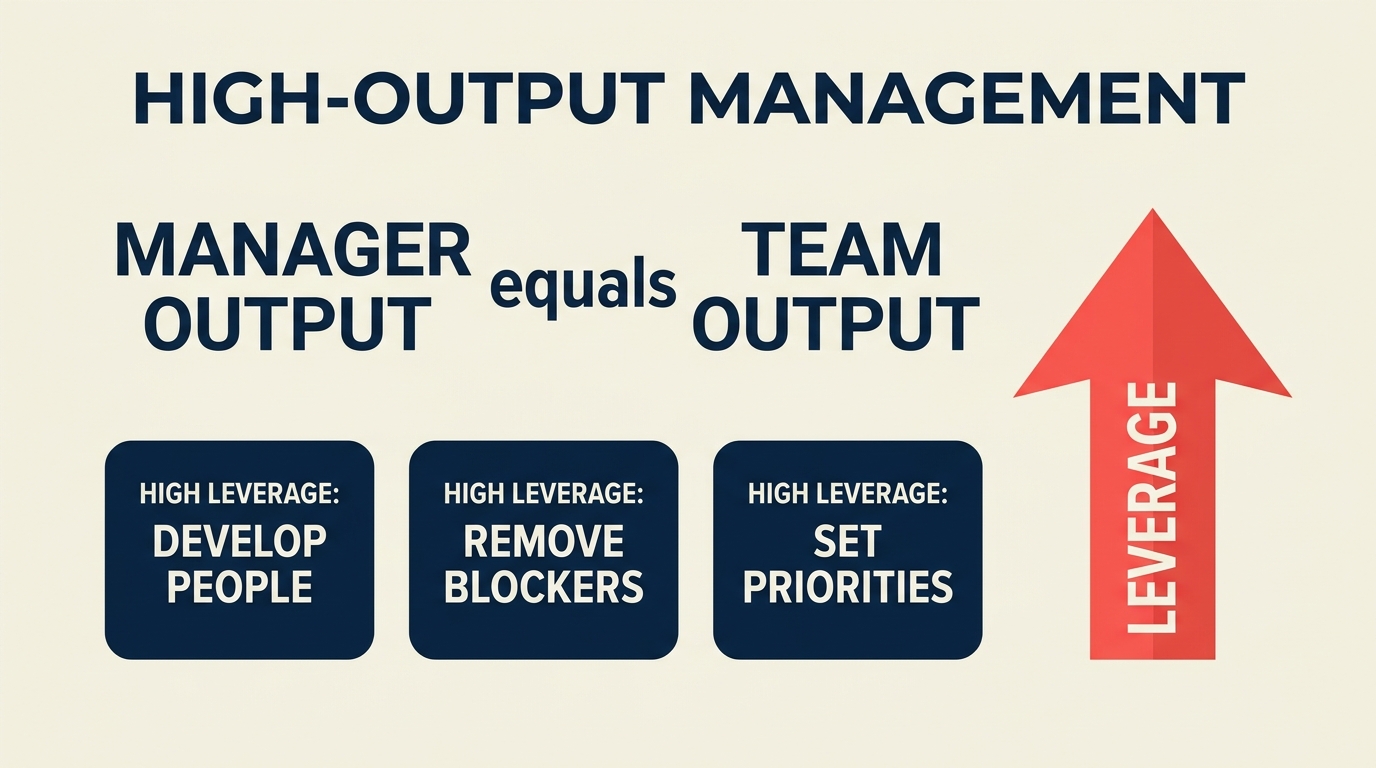
High-output management is a management framework built on one central idea: a manager's output is the output of their organization, not the output of the manager personally. This reframing, simple on its surface, has significant implications for how managers spend their time, how they measure their own effectiveness, and how they think about their leverage in the system.
The framework was developed at Intel during a period when the company was scaling rapidly and needed a disciplined approach to what managers should do and how their effectiveness should be evaluated. It has since become one of the most widely referenced management frameworks in the technology industry and beyond, applicable to any knowledge-work context where managers lead through influence on others rather than direct production of the work.
The core idea: output, not activity
Traditional management evaluation tends to focus on inputs: how many decisions did the manager make, how many meetings did they run, how many problems did they solve personally? High-output management shifts the frame entirely to outputs: what did the team produce? What decisions got made well? What work got done at what quality? What problems are being solved faster or better because of how the manager organized and developed the team?
This shift has a practical implication that many managers find uncomfortable: a manager who is personally busy and always in the thick of the work may be adding less value than a manager who is harder to spot in the operational flow but whose team is consistently better organized, better developed, and better coordinated. The first manager is producing personal output. The second is producing organizational output. High-output management prizes the second.
The concept of managerial leverage captures this idea precisely. Leverage is the ratio of output produced to the manager's time and effort invested. High-leverage activities are those where a relatively small investment of managerial time produces a large amplification of team output. Low-leverage activities are those where the manager works hard but the output of the organization does not change as a result.
Key Facts
Research on knowledge worker productivity finds that the quality of one-on-one conversations between managers and direct reports is one of the strongest predictors of employee engagement, retention of high performers, and team-level performance outcomes, consistent with the high-output management emphasis on one-on-ones as a primary managerial leverage tool.
Studies of managerial time allocation in large organizations find that managers who spend more time on people development and team organization consistently outperform on team output metrics over 12-month periods compared to managers who spend equivalent time on individual contribution and problem-solving.
Analysis of high-performing teams finds that the clarity and frequency of performance feedback from managers is one of the top three predictors of team member performance growth, alongside the quality of the work itself and the team's level of goal clarity.
Managerial leverage in practice
The practical question for every manager using this framework is: of all the activities I could do today, which ones have the highest leverage on my organization's output?
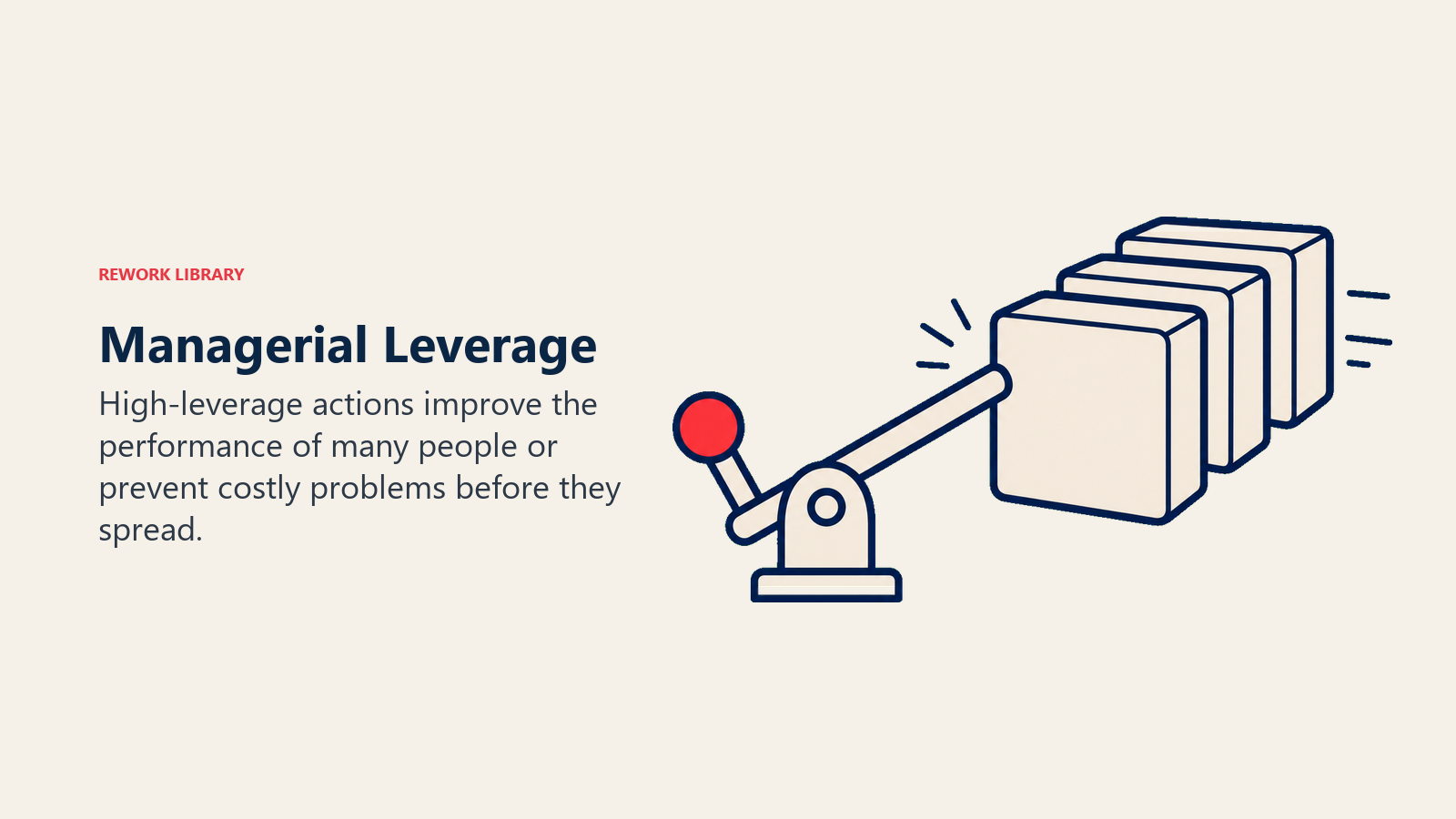
High-leverage activities include:
- One-on-one conversations that identify and remove obstacles to a direct report's performance before those obstacles become blockers
- Decisions that unblock multiple teams simultaneously
- Training and developing a direct report whose improved capability will compound over years
- Setting clear priorities that prevent the team from working on the wrong things
- Removing a person who is reducing team output through poor performance or destructive behavior
- Building a shared understanding of what excellent output looks like in the team's domain
Low-leverage activities include:
- Attending meetings where the manager's presence adds nothing to the decision
- Doing work that could be done by someone else so that person is available for higher-leverage work
- Making small decisions that direct reports could and should make themselves
- Writing status updates that could be produced by the team more accurately and with less summary loss
- Reviewing work in detail that direct reports are capable of reviewing themselves
The discipline of high-output management is recognizing the distinction and continuously shifting time allocation toward higher-leverage work. This is harder in practice than it sounds. Low-leverage activities are often more comfortable (the work is familiar and tangible), more urgent (they require response now), and more visible (other people see the manager doing them). High-leverage activities are often uncomfortable (developing a struggling employee is hard), diffuse in impact (better team clarity pays off over months, not days), and less visible to others.
One-on-ones as the primary leverage tool
The most important practical contribution of the high-output management framework is its detailed account of the one-on-one meeting. In this framework, the one-on-one is not an administrative check-in or a status update. It is the primary forum for managerial leverage on individual performance.
The one-on-one belongs to the direct report, not the manager. Its purpose is to surface what the manager cannot see from above: what is blocking the employee's work, where their thinking on a problem has gone, what they are uncertain about, what organizational dynamics they are navigating. The manager's role is to listen, ask questions, provide information the employee needs, remove obstacles, and offer coaching on problems the employee has chosen to bring.
A well-run one-on-one has a few consistent characteristics:
It is regular and protected. Ad hoc check-ins are not substitutes. The regularity of the one-on-one communicates that the manager's investment in the direct report's performance is consistent, not contingent on problems arising. Canceling one-on-ones when things get busy sends the opposite message: that the direct report's development is optional overhead.
It is prepared. Both parties should bring specific topics. A direct report who comes without topics has either no problems (rare) or has learned that the one-on-one is not a productive forum for real concerns (common in poorly run organizations). The manager's job is to create the conditions where real concerns surface, not to fill the time with manager-driven topics.
It surfaces the iceberg. Most of what affects an employee's performance is not visible to their manager in shared work. One-on-ones are the forum for the employee to surface the 80% that does not show up in shared meetings: interpersonal friction, skill gaps they are aware of, concerns about direction, personal circumstances affecting work, and things they observe that they are not sure the manager knows.
It produces action, not just conversation. A one-on-one that consistently produces no commitments, no information transfers, and no decisions is not functioning. The manager should regularly ask: "Is there anything you need from me to move this forward?" And the answers should reliably get acted on.
The task-relevant maturity model
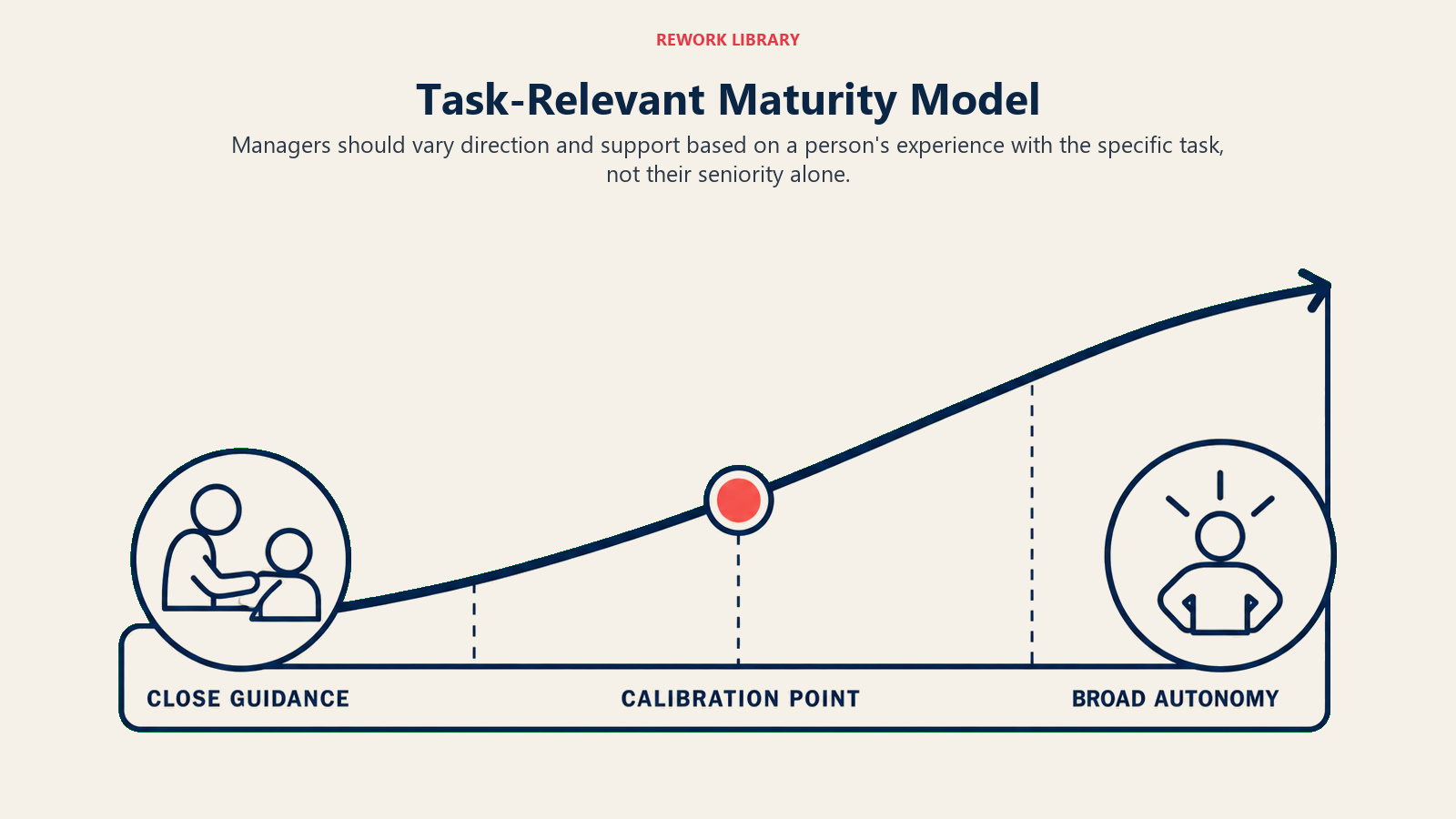
One of the most useful concepts in the high-output management framework is task-relevant maturity: the idea that an employee's readiness for autonomy on a specific task is different from their general seniority or overall capability.
An experienced engineer who is new to a particular codebase has low task-relevant maturity for that codebase, regardless of their general seniority. A junior analyst who has been running a specific type of customer analysis for two years has high task-relevant maturity for that analysis. A senior leader who is running their first product launch has low task-relevant maturity for that specific type of work.
The managerial implication is that the right leadership style varies by the employee's task-relevant maturity on the specific task, not by their overall seniority. This maps closely to the situational leadership framework developed separately, but the high-output management treatment is practically specific: at low task-relevant maturity, managers need to provide structured guidance and monitor closely. As maturity increases, the manager delegates more and checks less. At high maturity, the manager is primarily a resource and a sounding board, not a director of the work.
The failure mode in the other direction is also common: managers who continue to direct and monitor experienced direct reports whose task-relevant maturity is high create friction, reduce motivation, and implicitly communicate a lack of trust. High-output management is explicit that this is a managerial mistake that reduces team output even when the manager's intentions are good.
| Task-Relevant Maturity | What the manager should do | What the manager should avoid |
|---|---|---|
| Low (new to the specific task) | Provide structure, check progress, give detailed feedback | Delegating without context, leaving the employee to figure it out alone |
| Medium (developing capability) | Coach through the problem, check at key decision points | Both extremes: over-directing and under-directing |
| High (experienced and capable) | Set the objective, provide resources, be available as sounding board | Checking in too frequently, re-reviewing completed work in detail |
Meetings as managerial output
The high-output management framework has a demanding view of meetings. The core question for any meeting is: what decision, information transfer, or plan will be the output? A meeting without a clear output is a meeting that should not have happened.
This standard applies differently to different meeting types:
One-on-ones produce a shared understanding of the direct report's current state, obstacles, and development priorities, and specific commitments from the manager and employee.
Staff meetings produce shared situational awareness among the manager's direct reports, coordination on cross-team issues, and decisions that require the group.
Decision-making meetings produce a specific decision, clearly owned, with a clear plan for communication and execution.
Information transfer meetings produce shared understanding of something the group needs to know. They should be brief, used only when the information cannot be communicated effectively in writing, and result in no ambiguity about what the group is expected to do with the information.
The framework is hard on meetings that are primarily managerial theater: large gatherings where the real decisions have already been made, updates that could be emails, and check-ins that substitute for the one-on-ones where the real work of alignment should happen.
Applying high-output management at different organizational levels
The framework applies differently depending on organizational level.
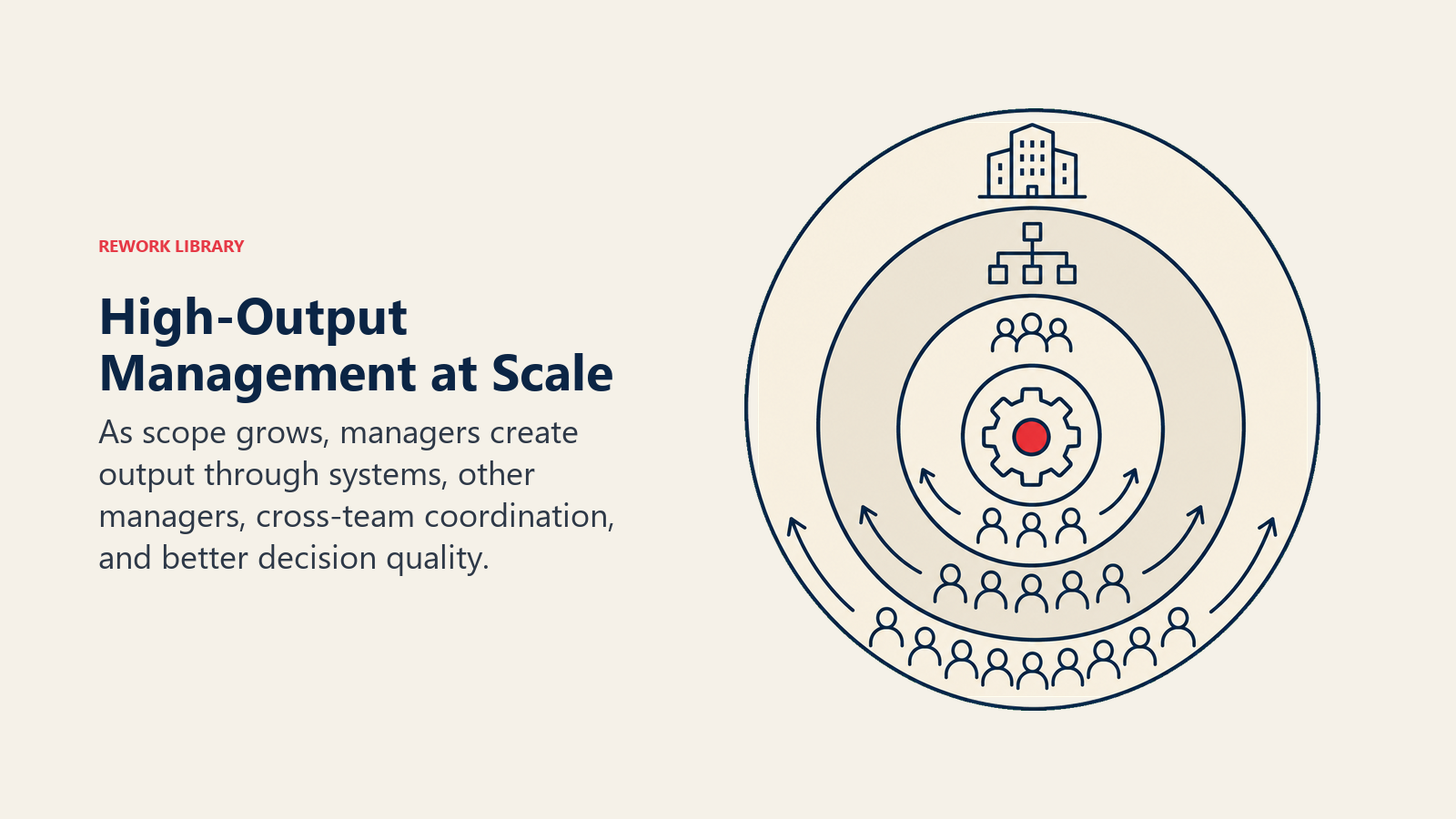
First-line managers operate closest to the individual output. Their leverage is in removing obstacles from individual contributors, developing team members' capabilities, and maintaining the clarity and quality standards that allow individual contributors to do their best work. The one-on-one is the primary tool at this level.
Middle managers operate at the level of organizing teams toward objectives. Their leverage comes from how they allocate resources across teams, how they set and communicate priorities, how they develop the first-line managers who report to them, and how they coordinate across organizational boundaries.
Senior leaders operate at the level of organizational design and strategy. Their leverage comes from the quality of the organizational structures they design, the people decisions they make (who leads what), the strategic priorities they set and communicate, and the culture they model and reinforce. At this level, direct output on any specific task is a small fraction of total organizational output. The question is entirely about leverage through others.
Frequently Asked Questions about High-Output Management
How do you measure a manager's output?
The framework is explicit that this is a hard measurement problem with no single metric. Useful proxies include team output quality and velocity, team member development and retention, the quality of decisions made within the team's domain, and the reduction of problems that escalate to the manager's manager. The absence of fires is a better signal than the manager's personal busyness.
How often should one-on-ones happen?
The framework suggests weekly for most direct report relationships. The frequency should be higher for newer employees, employees in transitions, or employees working on high-uncertainty tasks. For very experienced direct reports doing well-understood work, bi-weekly may be adequate, but weekly is the default. The consistent finding is that managers who run effective weekly one-on-ones have better-informed teams and fewer performance surprises.
Does high-output management work for creative or research-oriented work?
Yes, with adjustment. The output metrics are different (scientific results, design quality, and insight generation rather than operational throughput), but the leverage logic is the same: a manager's value lies in the quality and productivity of the organization's creative or research output, not in the manager's personal creative or research output. The one-on-one structure works well for creative and research contexts; the task-relevant maturity model is directly applicable.
How does high-output management handle underperformance?
The framework is direct: a manager who tolerates sustained underperformance is failing their high-performing team members, not just the underperformer. The steps are: assess whether the underperformance is a training problem, a motivation problem, or a mismatch between the person and the role; address it directly and specifically; and if performance does not improve after a real corrective effort, make the personnel change. The framework treats the decision to retain a chronic underperformer as a high-negative-leverage decision that reduces the output of everyone who works with them.
The lasting contribution of the high-output management framework is the insistence on measuring the right thing: organizational output, not managerial activity. That standard is demanding, because it strips away the comfort of personal productivity as a defense for organizational mediocrity. But it is also clarifying. It points directly at what managers need to do more of (develop people, remove obstacles, make high-quality decisions), less of (personal execution of work others could do, low-stakes meetings, approval steps that add no value), and how to think about the trade-offs in between. See coaching leadership style for the related framework on developing direct reports through questions rather than directives, and management skills for a broader overview of the capabilities that effective management requires.
