Design-Led Leadership: How Executives Use Design Thinking to Lead Better
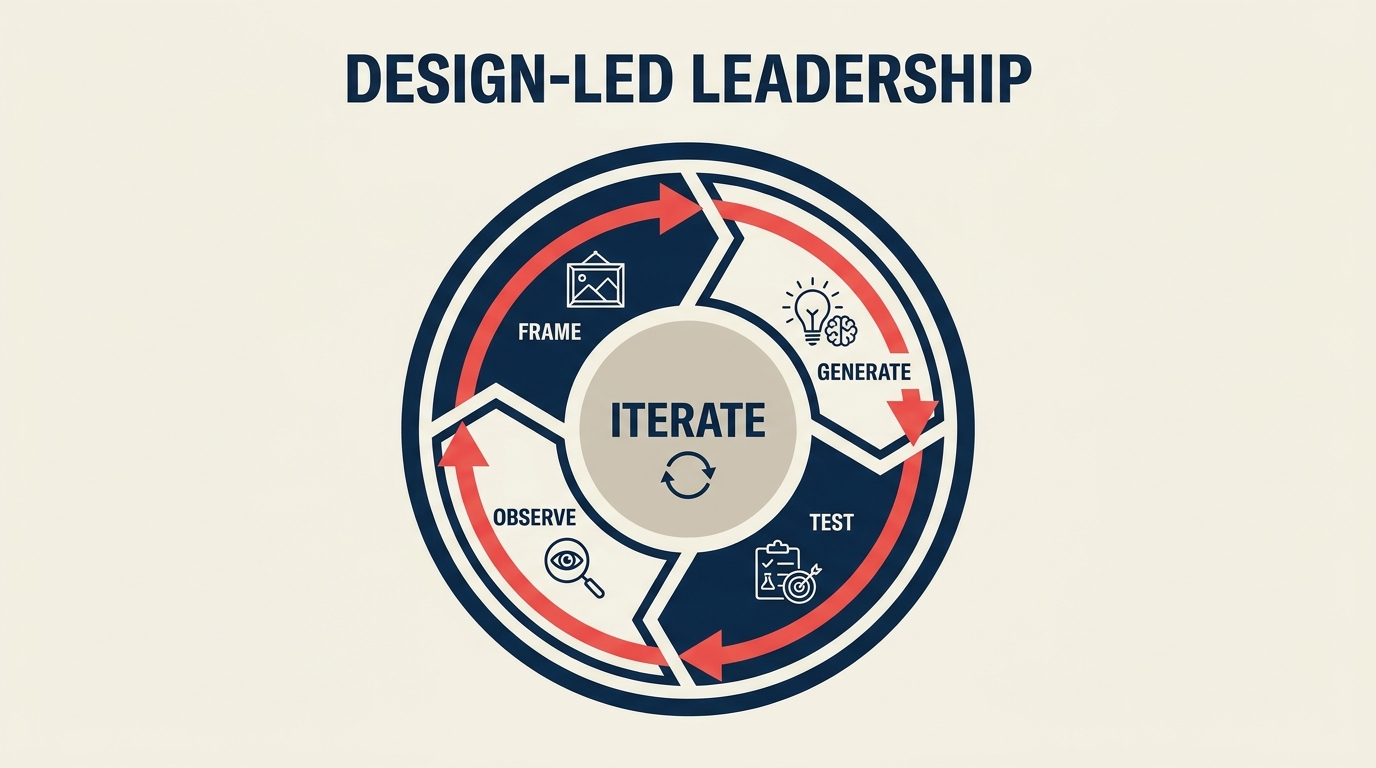 Design-led leadership is the practice of applying design thinking to how an organization sets strategy, makes decisions, and solves problems. It is distinct from managing a design function or having design expertise. A design-led leader does not need to sketch, prototype, or run user research. But they lead with the design principles of empathy for users, tolerance for iteration, comfort with ambiguity, and a bias for testing assumptions over debating them.
Turn this article into takeaways for your work.


Each assistant summarizes the article only for you and suggests best practices for your work.
What is design-led leadership?
Design thinking emerged from product development as a methodology for creating products that users actually want rather than products that engineers find technically interesting or that market research approves in theory. The core practices: deep observation of actual user behavior, rapid prototyping of candidate solutions, iterative refinement based on real feedback, and deliberate suspension of premature judgment.
Design-led leadership applies these practices outside product development, to the full scope of what leaders do: defining organizational problems, developing strategic options, designing how work gets done, and building the processes that serve both employees and customers.
The leaders who practice design-led leadership bring a specific set of habits to every kind of problem. They insist on observing before concluding. They generate multiple candidate approaches before converging on one. They test assumptions cheaply before committing resources. They treat failure as data rather than verdict. And they focus relentlessly on the experience of the people who will actually live with the decision, not just the people who are making it.
This approach contrasts with the analytical leadership model that dominates most business education, where the primary task is to structure the problem clearly, assemble the relevant data, analyze options, and choose the optimal one. Analytical leadership is powerful for well-defined problems with reliable data. It struggles with problems that are poorly defined, involve human behavior in ways that data does not capture well, or require solutions that have to work for people who think and feel differently than the decision-makers.
Key Facts
Studies of design maturity in large organizations consistently find that companies at the highest levels of design integration report better customer loyalty, lower cost of customer service, and faster time to market than industry peers at lower design maturity levels.
Research comparing decision outcomes in ambiguous strategic situations finds that teams using structured iteration (generate, test, refine) outperform teams using structured analysis (gather, analyze, decide) in situations where the problem definition itself is uncertain, while analytical approaches maintain advantage in well-defined problem spaces.
Data on new product success rates shows that organizations that invest in deep customer observation before development begins achieve substantially higher market success rates than those relying primarily on customer surveys or focus groups, consistent with the design-thinking emphasis on behavioral observation over stated preference.
The design-led leadership practices
Problem framing before problem solving. The most expensive mistake in organizational leadership is solving the wrong problem efficiently. Design-led leaders invest disproportionately in defining the problem before developing solutions. They ask: what is the user's actual experience? What are they trying to accomplish? What is making that difficult? What have they already tried? The "five whys" technique, asking why five successive times to reach the root cause, is one practical tool. Reframing exercises, deliberately restating the problem from different angles before choosing a frame, are another.
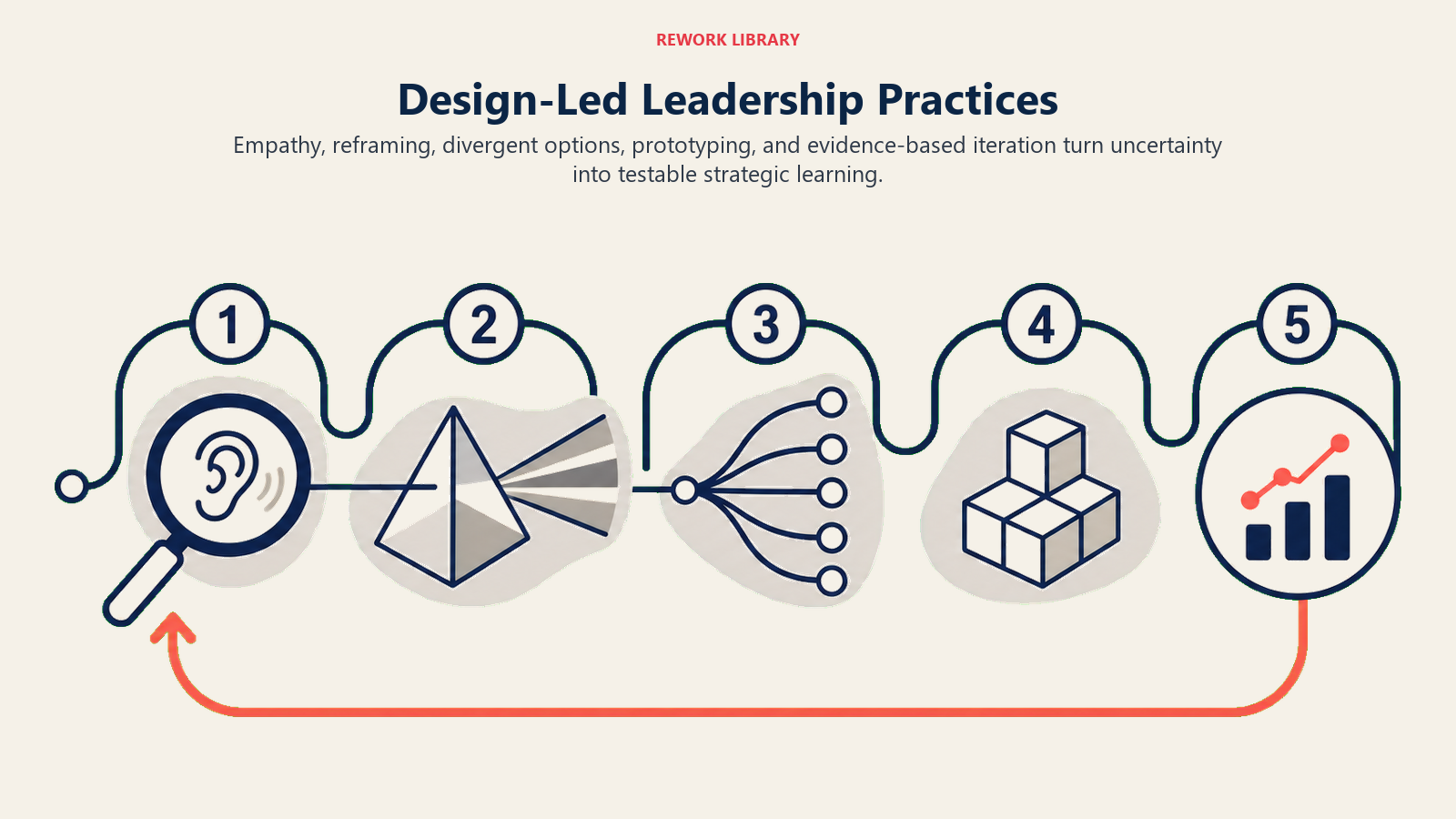
Observational research over stated preference. Design-led leaders have learned that what people say they want and what they actually do are often different. They create opportunities to observe behavior directly: walking the customer journey themselves, shadowing frontline employees, reviewing how customers actually use a product versus how it was designed to be used. This behavioral observation surfaces insights that surveys and focus groups consistently miss, because people are poor reporters of their own motivations and constraints.
Generating options before evaluating them. Standard business processes tend to converge quickly: a problem is raised, a solution is proposed, and the meeting becomes a debate about whether that solution is good. Design-led leaders interrupt this pattern. They require that multiple candidate approaches be generated before any are evaluated. This is not about creativity for its own sake. It is the practical recognition that the first solution proposed is rarely the best one, and that organizations that evaluate single options are systematically making worse decisions than they would with three to five options on the table.
Prototyping to test assumptions. Before committing resources to a solution, design-led leaders identify the assumptions the solution depends on and find cheap ways to test them. A new customer journey can be walked through with five customers before engineering builds anything. A new management process can be piloted with one team before it is rolled out to the organization. A new pricing structure can be tested with a small segment before it becomes policy. The prototype is not the solution. It is a cheap way to discover what the solution needs to be.
Iteration based on real feedback. Design-led leaders expect to be wrong on the first attempt and build cycles of refinement into their processes. They do not treat a first deployment as a commitment. They treat it as a hypothesis, create mechanisms to collect feedback from the people who experienced it, and build in decision points to revise based on what they learn. This requires organizations to accept that initial deployments will be imperfect, which in turn requires leaders to model tolerance for early-stage imperfection without abandoning accountability for eventual quality.
Design-led leadership in strategic decisions
Design thinking's most powerful application for senior leaders may not be in product work at all but in strategy, where the problems are maximally ambiguous, the user populations are complex, and the cost of testing assumptions in advance is low compared to the cost of committing to the wrong strategy.
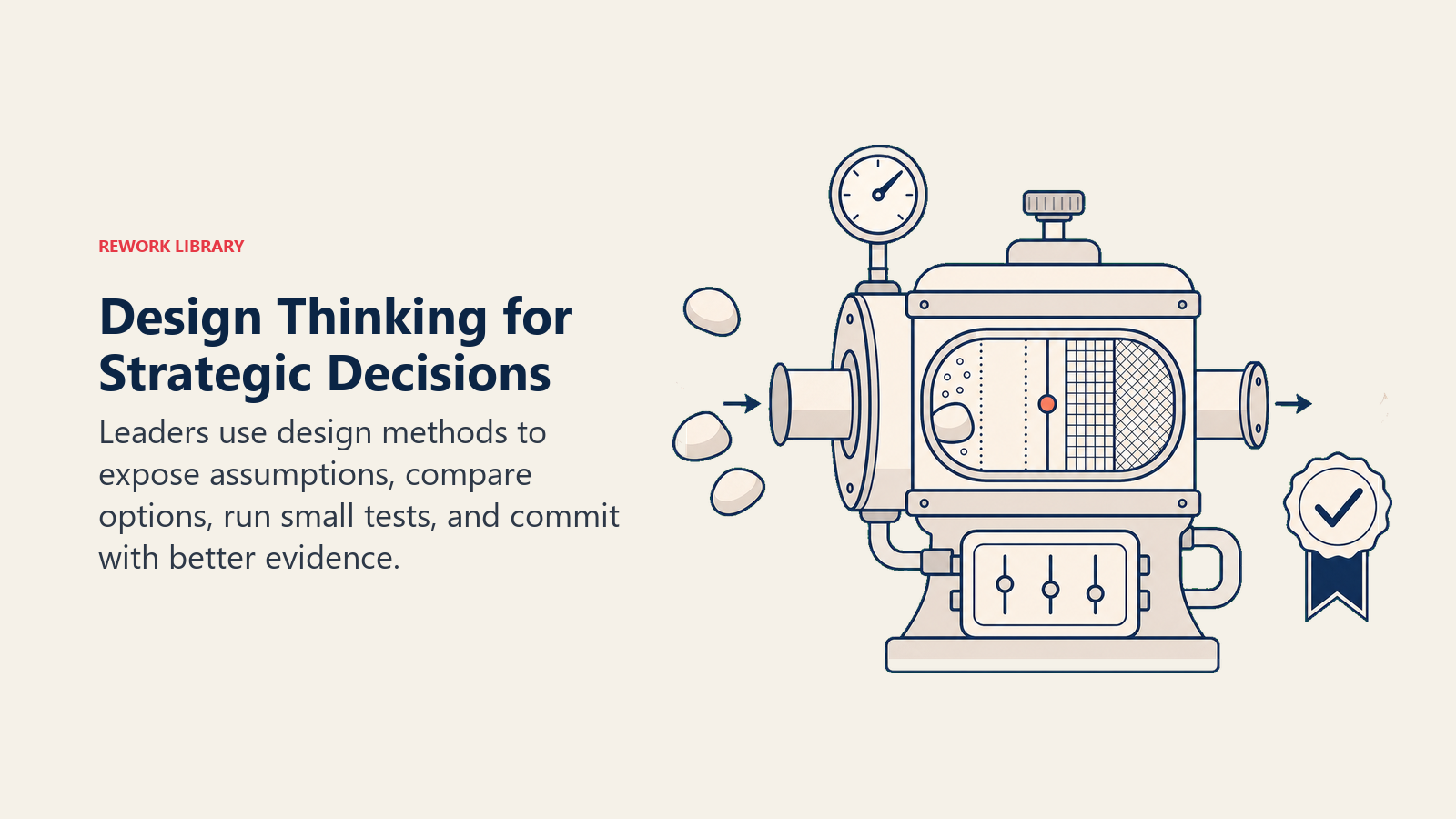
Strategic problem definition. Most strategy processes start by defining the competitive landscape and the available options. Design-led strategy starts earlier, with a rigorous attempt to understand the actual experience of the customers and users you are trying to serve, the actual experience of employees who will execute the strategy, and the actual constraints that will bind implementation. This observational foundation often reveals that the problem is different from what was assumed.
Scenario-based strategy development. Rather than converging on a single strategic direction, design-led leaders develop two to four distinct strategic scenarios in enough detail to test the assumptions each one depends on. The goal is not to pick the best scenario by analysis but to identify which scenario's assumptions are most testable and to run small real-world experiments against them before committing.
Organizational design as user experience. Design-led leaders apply empathy to their own organization as a system. They ask: what is the actual experience of being a manager in this organization? What makes it hard to do the right thing? What does a new employee discover in their first 90 days that was not in the job description? These questions surface organizational design problems that are invisible from the strategic level but determine whether strategy actually executes.
Design-led vs other leadership approaches
| Dimension | Design-led | Analytical | Transformational |
|---|---|---|---|
| How problems are defined | Through observation of users/users' experience | Through data gathering and structured analysis | Through vision of the desired future state |
| Source of solutions | Generated broadly, then evaluated | Derived logically from analysis | Driven by the leader's vision |
| Relationship to uncertainty | Comfortable with ambiguity; tests to reduce it | Requires clarity before deciding | Resolves uncertainty through commitment |
| How failure is handled | As data to iterate on | As deviation to analyze | As obstacle to the vision |
| When it works best | Complex human problems, early-stage uncertainty | Well-defined problems, reliable data | Strategic inflection points |
Design-led leadership works best in situations where the problem is complex, the people dimension is central, and the assumptions underlying proposed solutions have not been tested in reality. It is less well-suited to situations requiring rapid execution of a clear plan, where the analytical and transformational leadership approaches provide more direct tools.
Building design-led organizations
Individual design-led leadership is valuable. But the greatest advantage comes when design thinking is embedded in how the organization works, not just in how the senior leader works.
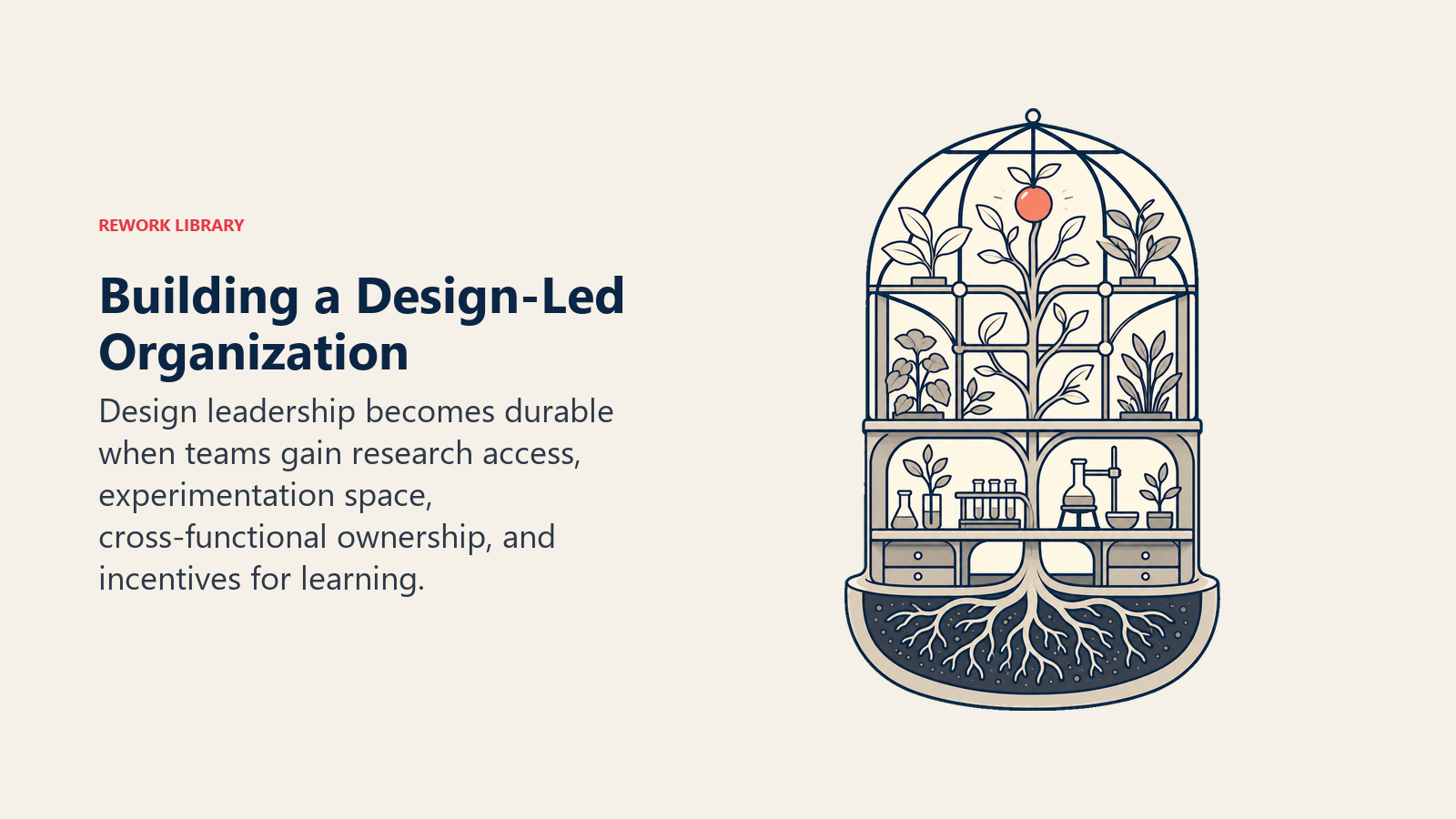
Hire for and develop curiosity about user experience. Organizations where design thinking is deeply embedded have a workforce that is genuinely curious about how users and customers experience the product, the service, and the interaction. This is partly a hiring criterion and partly a cultural development. Leaders who model this curiosity, who ask "have we observed that, or are we assuming it?" regularly in strategy and product discussions, make it safe for others to do the same.
Build structured creative processes. Design thinking does not happen spontaneously in organizations built for execution. Leaders who want design thinking to be organizational capability need to build explicit process structures: required problem-framing phases before solution development, mandatory generation of multiple options, prototyping requirements before full commitment, and feedback collection as a standard step in every major initiative.
Create pathways for customer voice in strategic decisions. The farther senior leaders are from direct customer contact, the more likely strategic decisions will optimize for internal metrics rather than external value. Design-led organizations create structured pathways: customer advisory boards that report to senior leadership, front-line employee forums where customer insights are surfaced upward, and regular senior leader immersion in direct customer experience.
Frequently Asked Questions about Design-Led Leadership
Do I need a design background to practice design-led leadership?
No. The practices of design-led leadership are habits of observation, option generation, assumption testing, and iteration. They can be learned by any leader willing to practice them. Formal design training is useful context but not a prerequisite for applying design principles to strategic and organizational problems.
Is design-led leadership the same as human-centered design?
Human-centered design is the product design methodology from which design-led leadership draws. They share principles: empathy for users, iterative development, prototype-and-test approaches. Design-led leadership extends these principles from product design into leadership practice more broadly, including how strategy is set, how organizations are structured, and how problems are defined and solved at the executive level.
How does design-led leadership interact with data-driven decision-making?
The two are complementary. Data-driven decision-making excels at answering "what is happening" at scale. Design thinking excels at understanding "why it is happening" at the level of individual human experience and "what would need to change" in ways that data cannot fully reveal. The strongest leaders use both: data to identify patterns and prioritize where to look, design observation to understand what the data actually means and what solutions will actually work.
When is design-led leadership the wrong approach?
In genuine emergencies requiring rapid execution of a known plan, the deliberate pace of design thinking is a liability. Similarly, in highly commoditized operational contexts where the problem is clear and the solution is known, extensive problem-reframing and option generation add overhead without proportionate value. Design-led leadership is most valuable when the problem is genuinely unclear, when human behavior is central to the outcome, or when previous solution attempts have not worked.
The organizations that most consistently build products and services that customers love are rarely the ones with the best analytics. They are the ones whose leaders genuinely understand what it is like to be a customer of their product, a user of their service, or an employee trying to do good work inside their organization. Design-led leadership is the discipline of sustaining that understanding and building it into how decisions get made. See creative leadership for the related framework on building organizational conditions for original thinking, and adaptive leadership for how design principles connect to navigating challenges that require people to change their behavior.
