Difficult Employee Communications: How Leaders Navigate Hard Conversations
Turn this article into takeaways for your work.


Each assistant summarizes the article only for you and suggests best practices for your work.
Difficult employee communications are the conversations leaders avoid until they cannot. The performance problem that has been visible for months. The role that no longer fits. The behavioral issue that everyone on the team knows about but no one has addressed. The termination that could have been handled with more dignity. In each case, the delay almost always makes the outcome worse and the conversation harder.
This article is a practical guide to preparing for and conducting the most common types of difficult employee communications: performance conversations, role and scope changes, terminations, and interpersonal conflict. The goal is not to make these conversations comfortable. That is not achievable. The goal is to make them clear, fair, and as constructive as the circumstances allow.
Why leaders avoid difficult conversations
Understanding why leaders delay difficult conversations helps diagnose what is actually getting in the way.
Discomfort with emotional reactions. Many leaders have not learned how to stay grounded when someone responds with anger, tears, or silence. The anticipation of an intense emotional reaction, not the conversation itself, is often what drives delay. Leaders who develop the ability to be present with difficult emotions without being overwhelmed by them are significantly more likely to have the conversations early.
Fear of damaging the relationship. Particularly with high performers or long-tenured employees, leaders worry that a difficult conversation will permanently harm a relationship they value. The evidence generally runs the other way: relationships damaged by a hard conversation honestly delivered usually recover. Relationships eroded by months of avoided feedback or unclear expectations do not.
Uncertainty about the outcome. Some leaders delay because they have not decided what they actually want from the conversation. Is this a warning, a development conversation, or a decision that has already been made? Ambiguity about purpose produces ambiguity in the conversation, which produces the worst outcomes.
Organizational norms against directness. In some organizations, direct negative feedback is culturally coded as harsh, and leaders who give it directly face reputational risk even when the feedback is accurate. This is a systemic problem, but individual leaders can navigate it by separating the manner of delivery (respectful, specific, prepared) from the substance of the message (clear and honest).
The foundation: preparation
Every difficult conversation requires preparation. The leaders who handle these conversations well are not naturally gifted at confrontation. They prepare more carefully than their peers.
Clarify your purpose before the conversation. The most important preparation question is: what do I want this conversation to accomplish? A developmental feedback conversation, a performance warning, and a termination conversation all require different preparation and different conduct. Confusing them, most commonly by treating a termination decision as if it is still a development conversation, produces outcomes that are unfair to the employee and confusing to everyone else.
Gather specific, factual evidence. Difficult conversations about performance or behavior need to be grounded in specific, observable events, not general impressions. "Your work has been below expectations" is not an evidence-based statement. "The last three quarterly reports contained calculation errors that required correction before distribution" is. Specificity does two things: it makes the feedback credible (the employee cannot reasonably dismiss it as subjective), and it makes it actionable (the employee knows what specifically needs to change).
Anticipate the likely response. Think through how the employee is likely to respond: denial, defensiveness, minimizing, emotional distress, or a constructive engagement with the feedback. For each likely response, think through how you will handle it. This is not about scripting the conversation, which produces robotic delivery and breaks down at the first unexpected response. It is about not being caught unprepared by predictable reactions.
Prepare the logistics. Difficult conversations need private settings, adequate time, and the right people present. A performance conversation should not happen in an open office, should not be compressed into ten minutes before a meeting, and should rarely involve additional people who are not directly relevant. These details matter both for the quality of the conversation and for the dignity of the person receiving difficult news.
Performance conversations
Performance conversations are the most common category of difficult communication, and the most commonly handled poorly. The two most frequent failure modes are vagueness (the leader delivers feedback that the employee cannot act on because it lacks specificity) and delay (the leader waits so long that the gap between the observed behavior and the feedback is too large to be credible).
Be specific about the standard and the gap. A useful performance conversation has three components: this is what the role requires, this is what I am observing, and this is the gap. All three need to be specific enough that the employee can act on them. "You need to improve your communication" is not specific. "The team has flagged that your project updates come without context about what changed and why, which is making it difficult for them to reprioritize their work" is.
Distinguish between a can't and a won't. Performance problems have two distinct root causes: the employee lacks the capability to perform at the required level, or the employee has the capability but is not applying it. These require fundamentally different responses. A capability problem requires development, coaching, or role adjustment. A motivation or effort problem requires a different kind of conversation. Conflating the two, giving a development plan to someone who is not trying, produces frustration on both sides without resolving the problem.
Be clear about stakes and timeline. A performance conversation without a clear statement of consequences and timeline is not a performance conversation. It is a wish. If continued performance below standard will result in a formal improvement process or job loss, the employee deserves to know that clearly. Avoiding that clarity feels kinder in the moment, but it is a disservice: the employee cannot make an informed decision about whether to change their behavior if they do not understand what happens if they do not.
Document the conversation. Notes of what was discussed, what was committed to, and what the timeline is provide protection for the employee (who knows what was actually said) and for the organization (which has a record of what coaching and notice was provided). This is standard practice in well-run people operations, and the absence of documentation is one of the most common legal vulnerabilities in performance management situations.
Role and scope changes
Role changes are one of the most emotionally difficult types of communication, particularly when they involve reduction in scope or responsibility.
Be direct about what is changing and why. The most common mistake is softening the message to the point where the employee does not understand that a real change is happening. "We are restructuring your role to focus on your core strengths" needs to be followed immediately by: "This means the strategic planning responsibilities you have had will move to the new VP." The employee needs the full picture, not a version of the conversation that makes the leader feel better.
Separate the performance message from the structural message. Sometimes role changes happen because of performance. Sometimes they happen because of organizational restructuring. These require different conversations. A role change driven by organizational structure is not a performance signal, and framing it ambiguously leaves the employee wondering whether they did something wrong. A role change driven by performance should be part of an ongoing performance conversation with clear documentation, not a surprise restructuring announcement.
Give people time to process before requiring a response. Significant role changes carry emotional weight. Leaders who present a role change and immediately ask "so are you willing to stay in this new role?" are compressing a process that needs time. Present the change clearly, acknowledge that it is significant, and give the employee time to think before requiring a commitment.
Terminations
Terminations are the highest-stakes category of difficult employee communication, and the one where the largest gap exists between how they are often handled and how they should be.

Have decided before the conversation. A termination conversation is the delivery of a decision that has been made, not a conversation that is still in progress. Conducting a termination as if the outcome is still uncertain is unfair to the employee and creates risk for the organization. If the conversation is a formal performance improvement process where the outcome depends on future performance, make that clear explicitly. But when a termination decision has been made, the conversation should communicate that clearly from the beginning.
Be direct in the first two minutes. Research on how terminated employees experience the conversation consistently finds that ambiguity in the opening makes the experience worse. The employee is anxious from the moment the conversation starts. Prolonged preamble about the employee's strengths before getting to the substance is not kind. It is an extended period of anxious anticipation followed by a worse emotional landing. Be direct: "I'm telling you today that your employment with us is ending. Let me explain the specifics."
Provide the factual basis clearly but without lecture. The terminated employee deserves to understand why, but this is not the moment for an extensive performance debrief. State the basis clearly and once. Do not repeat it multiple times, and do not use the conversation to litigate the employee's performance history in detail. That is not what this conversation is for.
Have the logistics ready and explain them. The employee needs to know: what today's last day is, how severance works, what happens to benefits, what the process is for collecting their belongings, and who to contact with questions. Having these answers ready is a basic act of respect. Not having them ready communicates that the conversation has not been properly prepared.
Allow the employee to have their reaction. Termination produces strong emotional responses. The manager's job is not to manage the emotion away but to be present without panicking. If the employee is upset, let them be upset. If they want to ask questions, answer them honestly. If they want to sit quietly, allow that. The one thing that is not useful is trying to convince them that this is actually for the best or that they will be fine. They may be, eventually. But they do not need to be convinced of that in this meeting.
Interpersonal conflict
Interpersonal conflict between employees presents a different kind of difficulty. The leader is not a party to the conflict (usually) but has responsibility for its impact on the team.
Intervene sooner than feels necessary. Most leaders wait too long to intervene in interpersonal conflict between team members, hoping it will resolve on its own. It rarely does. Early conversations, before the conflict has hardened into entrenched positions, are more productive than late interventions after real organizational damage has been done.
Have individual conversations before a joint one. Understanding each party's experience and perspective separately, before bringing them together, gives the leader more context and allows each party to be honest without performing for the other. Joint conversations before individual ones often produce theater rather than resolution.
Separate the behavior from the person. Interpersonal conflict often involves behavioral patterns that are genuinely problematic, and leadership conversations about those behaviors need the same specificity as performance conversations. Vague requests to "work better together" do not produce change. Specific behavioral requests, "in the next cross-functional meeting, I need you to let Alex finish her point before responding," do.
Be clear about what is and is not acceptable. Some conflicts arise from genuine misunderstanding or different work styles. Some arise from behavior that is genuinely unacceptable. Leaders need to be clear about which situation they are in. Where behavior crosses a clear line (harassment, intimidation, dishonesty in reporting), naming that clearly is the leader's responsibility. Framing it as a "conflict to resolve" rather than behavior that needs to stop creates false equivalence.
After difficult conversations
The conversation is not the end of the process. Difficult employee communications require follow-through.
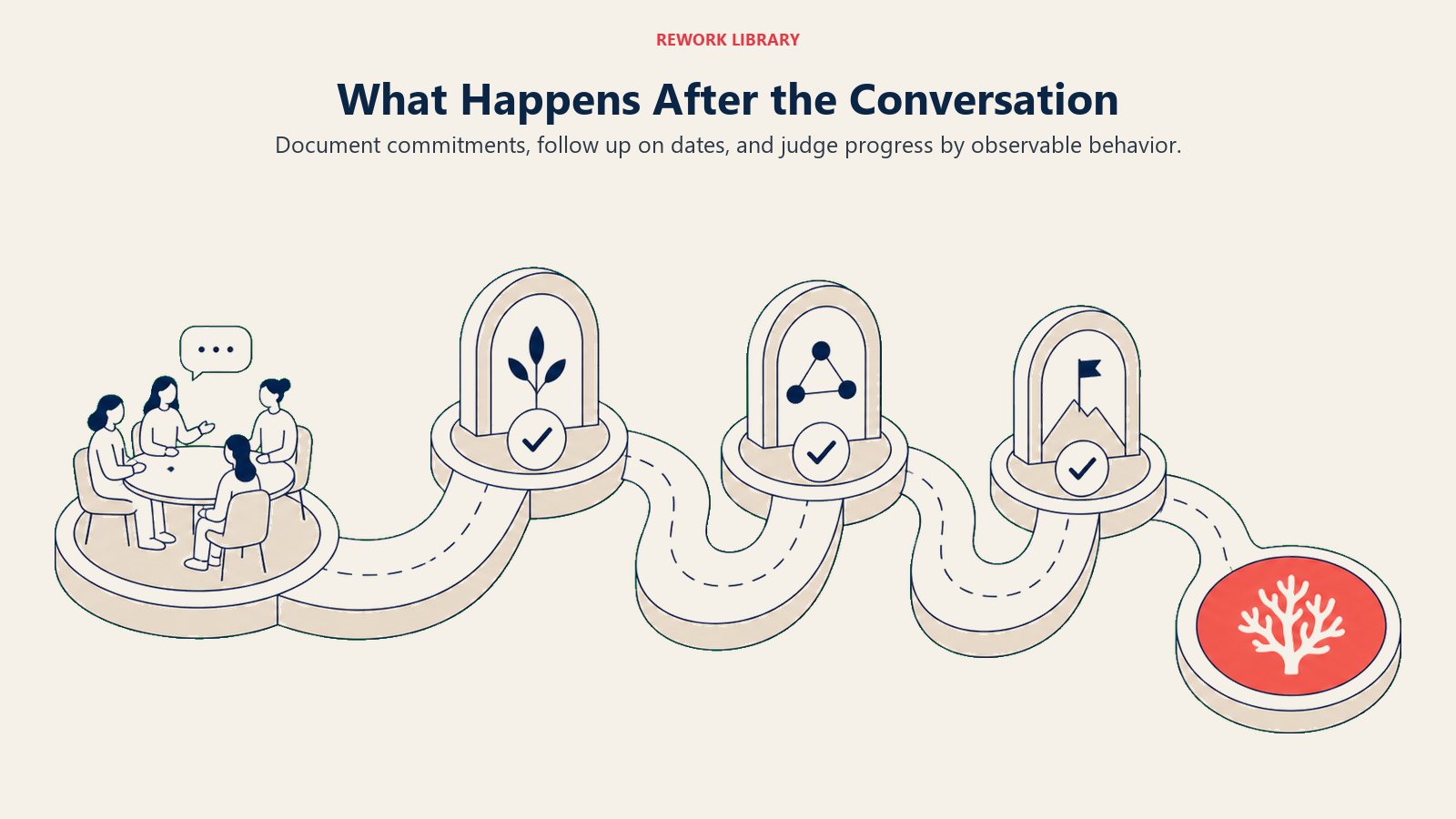
Check in after the conversation. For performance and development conversations, a follow-up within a week signals that the conversation was serious and that the leader is engaged in the outcome. This is also the opportunity to address any questions that came up after the initial discussion.
Hold commitments made in the conversation. If the leader committed to something in the conversation (coaching support, a clarified role description, a revised timeline), that commitment needs to be honored. Broken commitments after difficult conversations are a major driver of trust erosion.
Watch for retaliation by others. In situations involving interpersonal conflict or complaints about behavior, monitoring for retaliation against the person who raised a concern is a management responsibility. The absence of explicit retaliation monitoring sends a signal that complaints are risky to make.
Frequently Asked Questions about Difficult Employee Communications
How do I give feedback when I know the employee will react emotionally?
Prepare for the emotional reaction rather than avoiding it. Know specifically what you need to say and commit to saying it even if the reaction is difficult. If the employee becomes very distressed, it is appropriate to pause the conversation and offer to continue after a short break. What is not appropriate is backing away from the substance of the feedback because the emotional response is uncomfortable.
What is the right way to document a difficult conversation?
A written summary of what was discussed, what was agreed to, and what the timeline is, sent to the employee shortly after the conversation, serves everyone. It confirms the employee's understanding (they can flag anything they perceived differently), creates a record of what was covered, and communicates that the conversation was serious. For formal performance conversations, this documentation is essential.
Should HR be present for all difficult conversations?
For terminations and formal performance warnings, yes, typically. For developmental feedback conversations and most performance discussions, an HR representative is not usually present. The guideline is that HR involvement increases with the formal stakes of the conversation and with the organization's size and complexity.
Is it ever appropriate to have a difficult conversation in writing rather than in person?
For performance conversations, role changes, and terminations, no. Written communications do not allow for real-time clarification, and they strip the human element from conversations that require it. The exception is when geography makes an in-person or video conversation genuinely impossible, in which case a live video call is preferable to an email, and a phone call is preferable to a written message. Terminations via email or text message are generally considered a failure of basic professional respect.
The leaders who handle difficult employee communications well are not the ones who find them easy. They are the ones who treat the preparation seriously, communicate with clarity and specificity, stay present during difficult emotional moments, and follow through on what they committed to. For the people on the receiving end of these conversations, the difference between a well-handled difficult communication and a poorly handled one is often the difference between being treated as a person and being treated as a problem to be managed. See coaching leadership style for how developmental conversations build on this foundation, and psychological safety for why the culture in which difficult conversations happen shapes their outcomes.
