Sales Capacity Planning: How RevOps Connects Headcount to Revenue Targets
Sales capacity planning translates revenue targets into the seller capacity required to hit them.
It connects quota, ramp time, attainment, attrition, pipeline creation, and hiring timing. Without it, the company may have an achievable target on paper and insufficient productive capacity in reality.
McKinsey's B2B growth research is relevant because growth plans depend on productivity, not only ambition. McKinsey's sales productivity research also reinforces why sales capacity has to be connected to management discipline and operating metrics.
Key operating facts
- Sales capacity planning should convert revenue targets into productive seller capacity, not only headcount.
- Real capacity depends on ramp, attainment, attrition, territory coverage, manager load, pipeline creation, and sales cycle.
- RevOps should separate theoretical quota capacity from realistic capacity after ramp and attainment assumptions.
- Capacity planning should be reviewed before hiring deadlines, not after the quarter starts.
Inputs
| Input | Why it matters |
|---|---|
| Revenue target | Defines the output needed |
| Quota per rep | Sets theoretical capacity |
| Attainment rate | Converts quota to realistic capacity |
| Ramp time | Delays productivity from new hires |
| Attrition | Reduces available capacity |
| Pipeline coverage | Shows whether demand supports capacity |
Use Sales Quota, Quota Attainment, and Pipeline Coverage Ratio.
Capacity math model
A simple capacity model should include:
| Component | Why it matters |
|---|---|
| Number of quota carriers | Starting selling base |
| Quota per seller | Theoretical production ceiling |
| Ramp curve | New hires are not fully productive immediately |
| Expected attainment | Converts quota into realistic output |
| Attrition | Removes capacity before replacement productivity arrives |
| Open roles | Shows hiring gap |
| Pipeline support | Shows whether demand can support capacity |
The model should show both theoretical and realistic capacity. If the theoretical model says the team can hit plan but the realistic model says it cannot, leaders need to change hiring timing, productivity assumptions, target, or coverage.
Why capacity planning fails
Capacity planning fails when leaders calculate theoretical quota capacity and stop there.
Example: ten reps with $1M quota each appear to create $10M of capacity. But if two reps are ramping, one role is open, average attainment is 70 percent, and pipeline coverage is weak, real capacity is much lower. The plan may still show $10M, but the operating system cannot support it.
RevOps should separate:
- Theoretical capacity
- Productive capacity
- Ramp-adjusted capacity
- Attrition-adjusted capacity
- Pipeline-supported capacity
- Forecast-supported capacity
That distinction prevents false confidence.
Capacity model formula
A simple model:
Capacity = ramped reps x quota x expected attainment
Then adjust for:
- New-hire ramp
- Open roles
- Attrition
- Leave or role changes
- Territory coverage
- Segment mix
- Pipeline availability
- Seasonality
The model does not need to be mathematically perfect. It needs to expose assumptions clearly enough that sales, finance, and executives can debate the right things.
Ramp assumptions
Ramp is often the hidden risk in a revenue plan.
A rep hired in March may not create full productivity for the March quarter. Depending on sales cycle and onboarding, that rep may contribute meaningfully one or two quarters later. If the plan depends on new reps producing immediately, the company is not planning capacity. It is hoping.
Document:
| Ramp period | Planning treatment |
|---|---|
| Month 1 | Onboarding and activity setup |
| Month 2 | Early pipeline creation |
| Month 3 | Partial productivity |
| Month 4+ | Motion-dependent productivity |
The exact ramp curve should come from company history where possible. If history is limited, use conservative assumptions and update them as actual data appears.
Attainment assumptions
Quota capacity should be adjusted by attainment.
If the average rep reaches 70 percent of quota, a plan that assumes 100 percent attainment across the team is not a capacity plan. It is a quota math exercise.
RevOps should review:
- Average attainment
- Median attainment
- Top-quartile attainment
- Attainment by tenure
- Attainment by segment
- Attainment by manager
- Attainment by territory
Median attainment often tells a more realistic story than average attainment because a few very high performers can hide capacity risk.
Capacity and pipeline
Capacity only matters if sellers have enough qualified pipeline to work.
Turn this article into takeaways for your work.


Each assistant summarizes the article only for you and suggests best practices for your work.
A fully staffed team with weak pipeline coverage will miss plan. A team with strong pipeline but not enough sellers may also miss plan because opportunities receive weak follow-up, slow qualification, or poor manager inspection.
RevOps should connect sales capacity to:
- Pipeline coverage
- Pipeline creation per rep
- Qualified pipeline per rep
- Win rate
- Stage conversion
- Sales cycle
- Forecast accuracy
This prevents the common fight where sales says demand is weak and marketing says sales has enough leads. The capacity model should show whether the issue is demand supply, seller capacity, conversion quality, or timing.
Hiring timing
Hiring plans need to account for recruiting time and ramp time.
If the company needs productive capacity in Q3, hiring in late Q3 is too late. RevOps should help finance and sales model when roles must be opened, filled, onboarded, and productive.
Planning questions:
- When must the rep be productive?
- What is the average time to hire?
- What is the ramp curve?
- How much pipeline must exist before the rep is productive?
- Which manager can support the new hire?
- Which territory or segment will the rep own?
Capacity planning should turn headcount requests into timed operating assumptions.
Territory and segment capacity
Aggregate capacity can hide local shortages.
The company may have enough total quota capacity while one region is undercovered, one segment lacks experienced reps, or expansion capacity is overloaded. RevOps should model capacity by segment, region, manager, and motion.
Useful cuts:
- Enterprise vs commercial
- New business vs expansion
- Region
- Product line
- Named account vs territory
- Ramped vs ramping
- Manager span of control
If capacity is in the wrong place, the plan is still at risk.
RevOps role
RevOps should model scenarios with sales and finance:
- Current productive capacity
- Needed capacity
- Hiring gap
- Ramp timing
- Pipeline required
- Risk by segment or region
Scenario planning
Capacity planning should include scenarios.
Base case: current hiring plan, current attainment, expected pipeline.
Downside case: slower hiring, lower attainment, weaker pipeline, higher attrition.
Upside case: faster hiring, better productivity, stronger conversion, lower attrition.
Each scenario should show:
- Revenue capacity
- Hiring gap
- Pipeline required
- Timing risk
- Segment risk
- Forecast implication
Scenario planning helps leaders make decisions earlier. If the downside case shows a Q4 capacity gap, waiting until Q4 to react is not an operating plan.
Capacity and finance
Finance needs capacity planning because headcount is one of the largest growth investments.
RevOps should give finance:
- Rep roster
- Role status
- Quota assignment
- Ramp curve
- Attainment assumptions
- Hiring timing
- Pipeline requirements
- Risk notes
Finance should challenge assumptions. Sales should own productivity judgment. RevOps should make the model transparent enough that both teams work from the same facts.
Capacity dashboard
A useful dashboard includes:
- Ramped capacity
- Ramp-adjusted capacity
- Open roles
- New hires by ramp stage
- Attainment by tenure
- Pipeline per rep
- Coverage by segment
- Forecast vs capacity
- Attrition risk
- Hiring plan vs actual
Do not show capacity without assumptions. A capacity number without ramp and attainment context will be misread.
Capacity decision tree
When the model shows a capacity gap, do not default to hiring. Diagnose the constraint first.
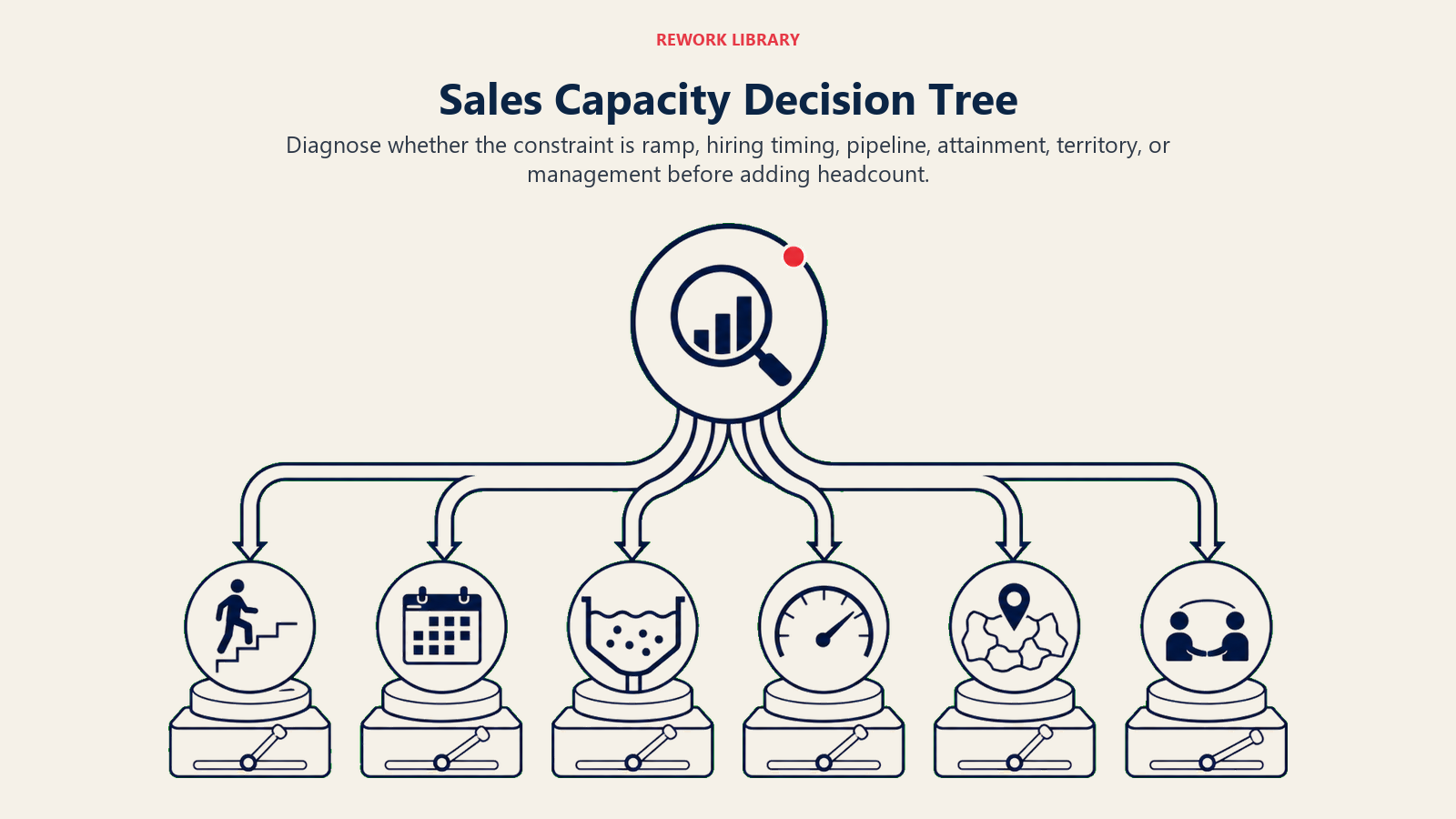
| Constraint | What the model shows | Better first decision |
|---|---|---|
| Not enough ramped sellers | Productive capacity is below target even with normal attainment | Open roles earlier or adjust target timing |
| Hiring is late | Required productivity date is earlier than hiring plus ramp date | Move hiring plan forward or reset forecast expectations |
| Pipeline is weak | Sellers have quota capacity but low qualified pipeline per rep | Fix demand, qualification, routing, or pipeline creation |
| Attainment is weak | Ramped reps have enough pipeline but miss productivity | Inspect onboarding, manager coaching, territory quality, or pricing |
| Manager load is high | Many ramping reps sit under one manager | Add manager capacity or slow hiring until support exists |
| Segment mix is wrong | Total capacity looks fine but one segment is undercovered | Reassign coverage or change territory design |
| Support role bottleneck exists | AEs have capacity but sales engineering, implementation, or CS capacity is constrained | Add support capacity or change deal qualification |
This keeps the model tied to action. A capacity gap is not automatically a hiring gap. It may be a demand gap, ramp gap, manager gap, segment gap, or support capacity gap.
What not to do with the model
Sales capacity models become dangerous when leaders use them as certainty instead of assumptions.
Avoid these patterns:
- Treating quota capacity as guaranteed revenue.
- Assuming new hires produce immediately.
- Showing a single company-level capacity number without segment or manager views.
- Updating the model only during annual planning.
- Hiding weak attainment behind average attainment.
- Separating capacity planning from pipeline planning.
- Using the model to justify hiring without explaining what those hires will work.
The model should make uncertainty visible. It should show which assumptions need monitoring and which decisions should happen before the quarter starts.
Common mistakes
Counting all quota as productive capacity. Quota is not revenue.
Ignoring ramp. New hires need time to become productive.
Ignoring pipeline. Sellers cannot close pipeline that does not exist.
Using average attainment only. High performers can mask median weakness.
Planning only at company level. Segment and region gaps remain hidden.
Updating capacity once per year. Hiring, attrition, and pipeline change too often.
Readiness checklist
Before leadership uses the model:
- Rep roster is current.
- Quotas are assigned.
- Ramp assumptions are documented.
- Attainment assumptions are documented.
- Attrition assumptions are visible.
- Pipeline coverage is connected.
- Segment views are available.
- Finance has reviewed assumptions.
- Sales leadership owns productivity actions.
What the checklist should prove
Sales capacity planning is not headcount math. It is the connection between the revenue plan, productive sellers, pipeline supply, ramp timing, and realistic attainment. If those assumptions are not visible, the plan is not ready.
Example capacity model
Suppose the company has 20 account executives, each with a $900K annual quota. On paper, that is $18M of quota capacity.
Now adjust the model:
- 15 reps are fully ramped.
- 3 reps are in first-half ramp.
- 2 roles are open.
- Expected attainment is 72 percent.
- Attrition risk is one role.
- Pipeline coverage is weak in commercial.
The real capacity is not $18M. RevOps should show ramped capacity, expected productive capacity, and pipeline-supported capacity separately. This helps leadership decide whether the answer is hiring, pipeline creation, enablement, territory change, manager coaching, or plan adjustment.
Capacity by role
Capacity planning should include more than account executives.
Roles to model:
- Account executives
- SDRs or BDRs
- Account managers
- Customer success managers
- Solutions consultants
- Channel managers
- Sales engineers
- Managers
If account executives have quota capacity but no SDR coverage, pipeline creation may lag. If enterprise reps have large opportunities but not enough solution consultant support, deals may slow. If customer success managers are overloaded, expansion and renewal risk may rise.
RevOps should model the parts of the revenue system that constrain growth, not only quota-carrying headcount.
Manager capacity
Manager span of control matters.
A team may hire enough sellers but fail to support them. Too many ramping reps under one manager can slow onboarding, weaken inspection, and reduce coaching quality. The capacity model should show manager load, ramping-rep count, and segment complexity.
Questions:
- How many reps does each manager support?
- How many are ramping?
- Which managers own the largest plan risk?
- Where is inspection quality weak?
- Where does hiring require manager hiring first?
Manager capacity often becomes visible only after performance misses. RevOps should surface it earlier.
Capacity governance cadence
Review capacity monthly with sales and finance.
Monthly review:
- Open roles
- Hiring progress
- Ramp status
- Attainment trend
- Pipeline per rep
- Forecast vs capacity
- Segment risk
- Attrition risk
Quarterly review:
- Quota design assumptions
- Territory coverage
- Segment productivity
- Hiring plan changes
- Ramp curve changes
- Demand generation requirements
Capacity is dynamic. A model built once during annual planning will decay quickly.
Actions from capacity gaps
A capacity gap should produce a decision.
Possible actions:
- Open roles earlier.
- Shift territories.
- Change segment coverage.
- Increase pipeline creation.
- Reduce quota in a weak segment.
- Add manager capacity.
- Improve onboarding.
- Reassign expansion ownership.
- Adjust forecast or plan assumptions.
The right action depends on the root cause. Hiring more people is not always the answer.
Capacity and board reporting
Capacity risk should appear in Board-Ready Revenue Reporting when it affects the plan.
The board does not need every roster detail, but it should see whether the company has enough productive capacity to support the forecast and future target. If the plan assumes new hires will produce faster than historical ramp, that assumption should be visible.
Capacity planning examples
Example: the company misses pipeline creation in Q1 but still hires five reps in Q2. Capacity rises on paper, but sellers do not have enough qualified opportunities. The action may be to fix demand and qualification before adding more sellers.
Example: enterprise pipeline is strong, but solution consultant capacity is constrained. The sales capacity model should show that enterprise revenue is limited by support capacity, not only account executive count.
Example: commercial reps have enough pipeline, but median attainment is low for reps under six months of tenure. The issue may be ramp quality, onboarding, enablement, or manager load.
Capacity model governance
Document the owner and update rhythm.
RevOps should maintain the model. Finance should approve planning assumptions. Sales leadership should own productivity actions. Changes to ramp curve, attainment assumptions, quota, or role count should be logged.
Without governance, each planning cycle rebuilds the model from scratch. With governance, the company learns which assumptions were right, which were wrong, and which need to change before the next plan.
Minimum viable model
A first model can include:
- Active reps
- Open roles
- Quota
- Ramp status
- Expected attainment
- Pipeline coverage
- Forecast vs capacity
This simple version is enough to expose obvious gaps. Add territory, manager capacity, role dependencies, and segment detail as the company scales.
Quality bar
A useful capacity model should let leaders answer one question quickly: do we have enough productive capacity, in the right place, at the right time, with enough pipeline to support the plan?
If the model cannot answer that question, it needs clearer assumptions.
Review the model monthly while hiring, ramp, attrition, or pipeline conditions are changing. Capacity risk moves too quickly for annual planning alone.
The strongest capacity reviews end with a decision, not only a model update. Leaders should know whether to hire, shift coverage, improve ramp, create more pipeline, change quotas, or adjust the plan.
Make those decisions explicit, then review whether they changed the forecast.
Capacity planning gets better when leaders compare the model to actual outcomes. If new hires ramp slower than planned, update the curve. If pipeline per rep falls after a territory change, adjust coverage assumptions. If one segment needs more support roles than expected, make that constraint visible before the next plan.
Frequently Asked Questions about Sales Capacity Planning
Who owns sales capacity planning?
Sales and finance own the plan. RevOps owns the operating model, data inputs, and scenario analysis.
What is the biggest mistake?
Ignoring ramp time. A rep hired in Q3 rarely contributes full quota immediately.
Learn more

Principal Solution Architect
On this page
- Inputs
- Capacity math model
- Why capacity planning fails
- Capacity model formula
- Ramp assumptions
- Attainment assumptions
- Capacity and pipeline
- Hiring timing
- Territory and segment capacity
- RevOps role
- Scenario planning
- Capacity and finance
- Capacity dashboard
- Capacity decision tree
- What not to do with the model
- Common mistakes
- Readiness checklist
- What the checklist should prove
- Example capacity model
- Capacity by role
- Manager capacity
- Capacity governance cadence
- Actions from capacity gaps
- Capacity and board reporting
- Capacity planning examples
- Capacity model governance
- Minimum viable model
- Quality bar
- Learn more