AI Agent Memory: Short-Term, Long-Term, and Vector Stores
Turn this article into takeaways for your work.


Each assistant summarizes the article only for you and suggests best practices for your work.
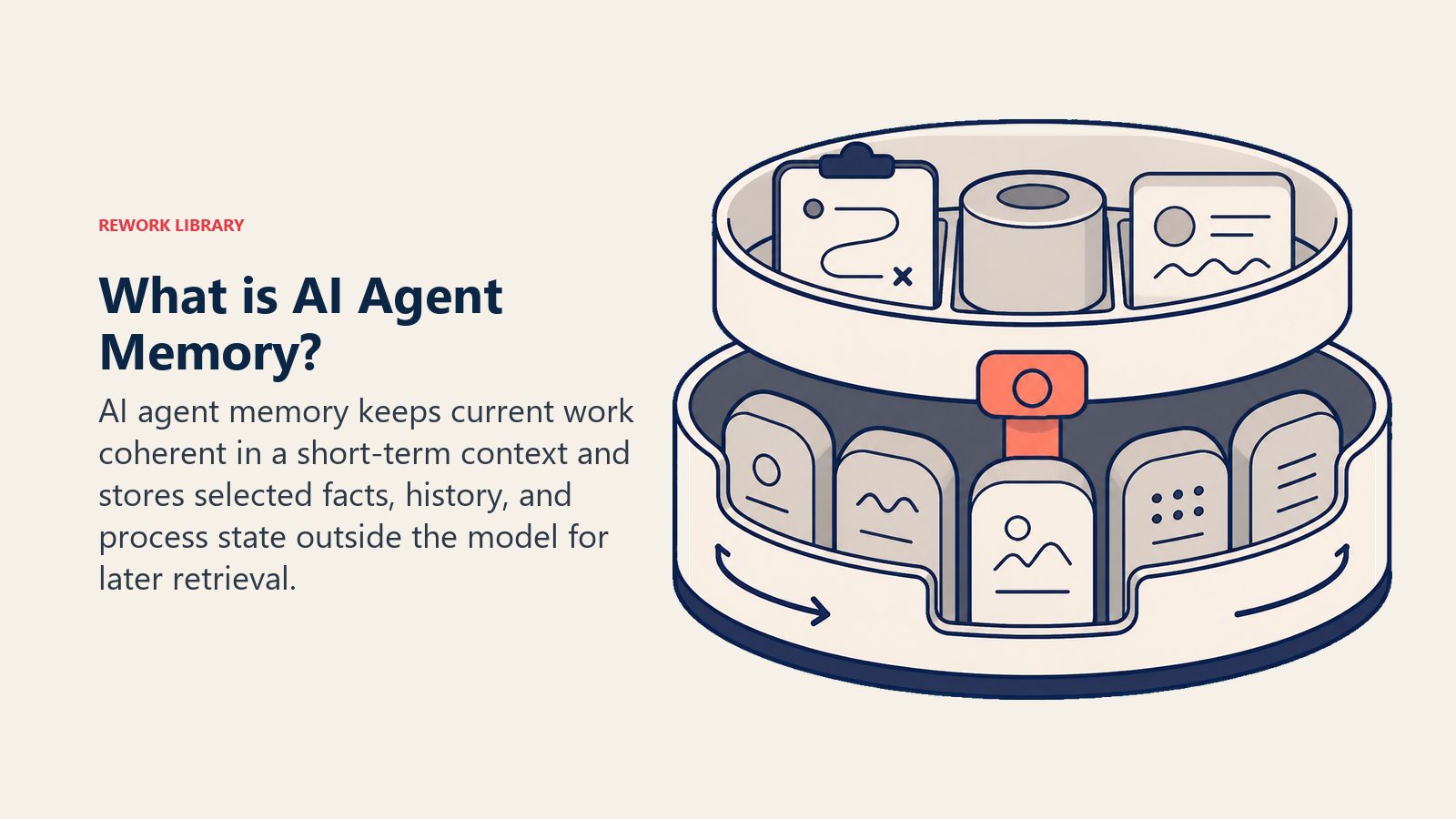
AI agent memory is how an agent keeps track of what's already happened, both within a single task and across every future interaction with the same account or user. Short-term (working) memory holds the current run so the agent doesn't repeat itself or lose the thread. Long-term (persistent) memory, usually stored in a database or a vector store the agent can search, holds facts and history across sessions so the agent doesn't start from zero every time. Without both, an agent either forgets what it just did or forgets everything it ever learned about you the moment the conversation ends.
Why an Agent Needs Memory at All
Memory is one of the five parts that make software an agent instead of a plain chatbot or script, alongside perception, reasoning, tools, and bounded autonomy. A plain language model has no memory by default. Ask it something, it answers, and the next question starts fresh unless you paste the entire prior conversation back in. That's fine for a single question. It falls apart the moment a task takes more than one step.
Picture an agent running a sales follow-up sequence, the AI Follow-Up Agent is a real example. Step one goes out. Three days pass with no reply. Step two needs to come from a different angle than step one, because repeating the same pitch reads as spam and a rep would never do it. The only way the agent knows to vary the message is if it remembers what it already sent, and to whom, and how they responded. That's memory doing real work, not a nice-to-have.
Short-Term Memory: What Keeps One Run Coherent
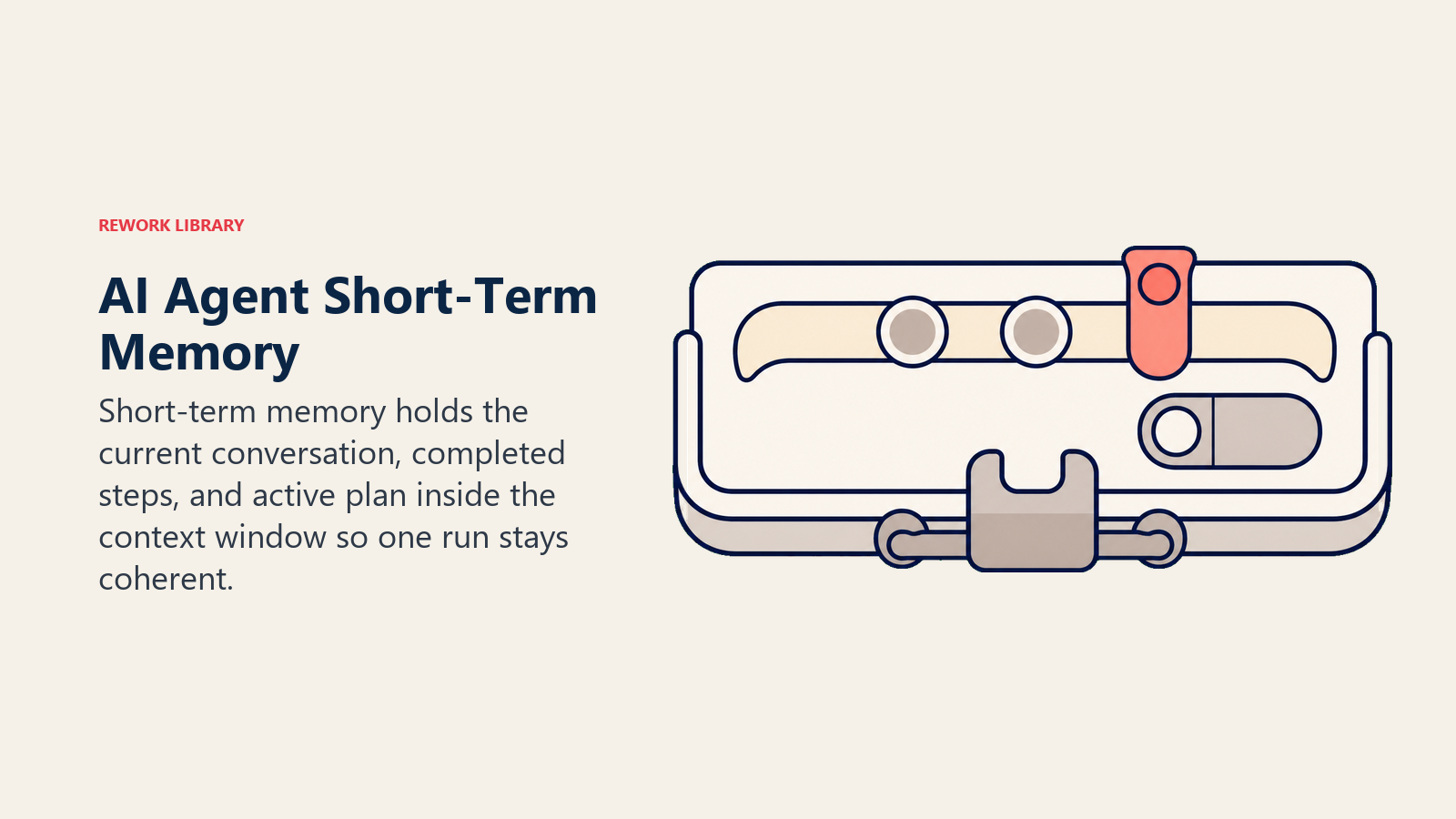
Short-term, or working, memory holds everything relevant to the task currently in progress: the conversation so far, the steps already taken, the plan the agent is partway through. It typically lives inside the model's context window, the amount of text the model can consider at once, and it disappears when the task ends unless something deliberately writes it somewhere more permanent first.
The practical limit here isn't just how much text you can fit. Context windows have grown enormous, modern frontier models now offer windows from the hundreds of thousands up past a million tokens, but a bigger window isn't the same as reliable use of everything inside it. Chroma's 2025 research on long-context performance, which tested 18 leading models, found that accuracy can start degrading well before a model runs out of room, sometimes as early as 50,000 tokens into a 200,000-token window, and that a model with a 1-million-token window doesn't reliably reason across the full million. The researchers found that even on 2-million-token models, the safe budget for high-accuracy work tends to land closer to 150,000 to 400,000 tokens, well below the number on the label. A related, widely cited academic study, Liu et al.'s "Lost in the Middle", found that models are noticeably better at using information placed at the very start or end of a long context than information buried in the middle, even when a model is explicitly built to handle long inputs.
The takeaway for anyone building an agent: don't treat the context window as unlimited scratch space. Stuffing in every past message, every retrieved document, and every tool result "just in case" degrades performance instead of improving it. Keep working memory to what the current step actually needs, and push everything else to long-term storage the agent can query on demand.
Long-Term Memory: What Survives Past the Current Run
Long-term memory is what makes an agent consistent from one interaction to the next instead of relearning your account, your preferences, and your history every single time. It lives outside the model, typically in a database, a CRM, or a vector database built for fast similarity search, and the agent queries it the way it would query any other tool.
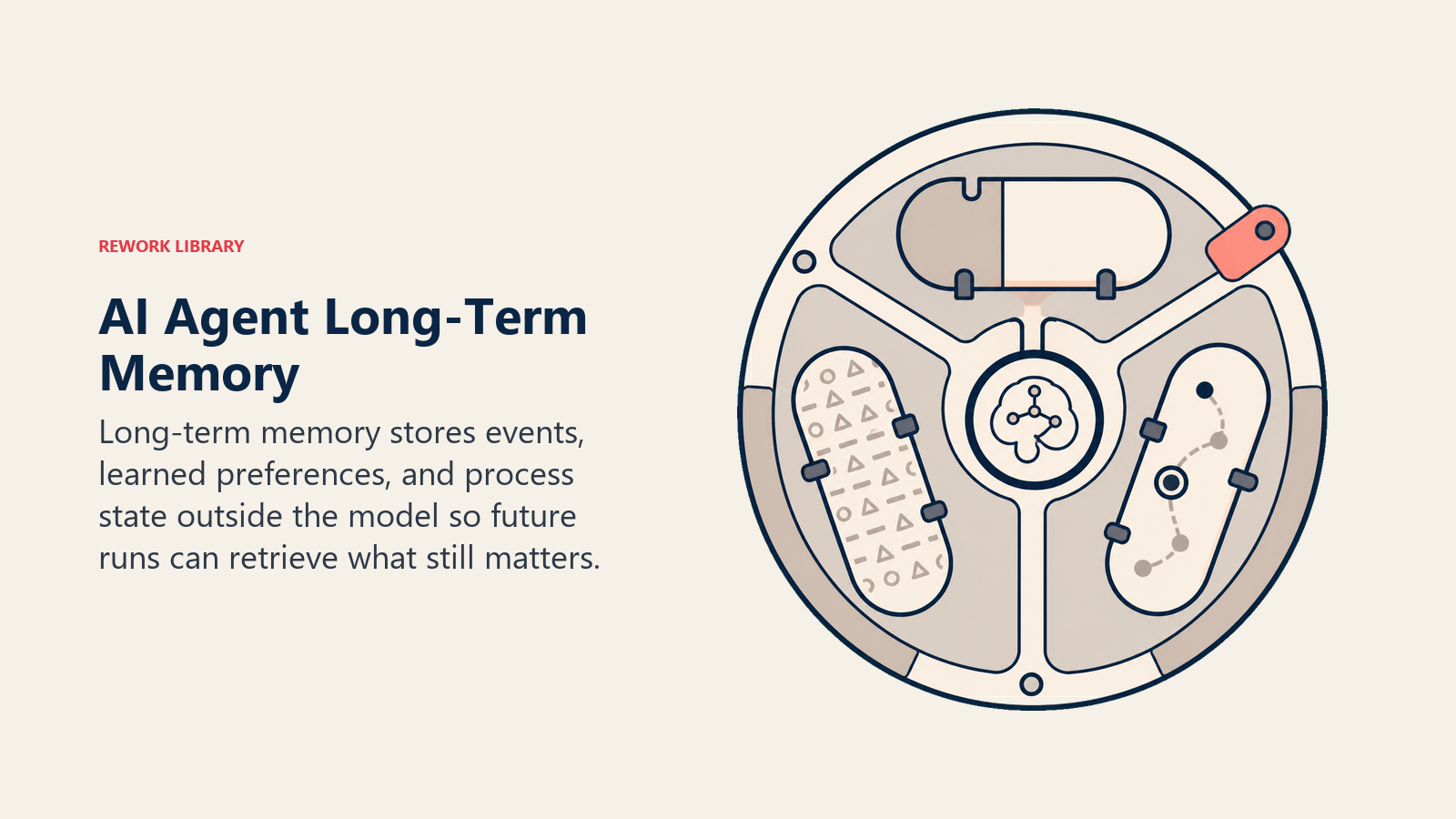
Three shapes of long-term memory show up most often in practice:
- Episodic memory, a record of specific past events, like what a customer asked last time or what was decided in a prior meeting. The Meeting Notes Agent is a direct example: it produces structured, timestamped records of decisions and action items specifically so a future question ("did we already commit to this?") has a real answer to retrieve instead of a shrug.
- Semantic memory, generalized facts and preferences learned from patterns over time, like knowing a specific account always wants executive summaries under 300 words, or that a given customer segment tends to churn after a support escalation.
- Procedural context, state about where a multi-step, multi-session process currently stands. The AI Customer Onboarding Agent has to remember which setup milestones an account has already completed across a process that can run for weeks, so it nudges the next unfinished step instead of repeating one that's already done or, worse, skipping one that isn't.
How Long-Term Memory Actually Gets Stored and Searched
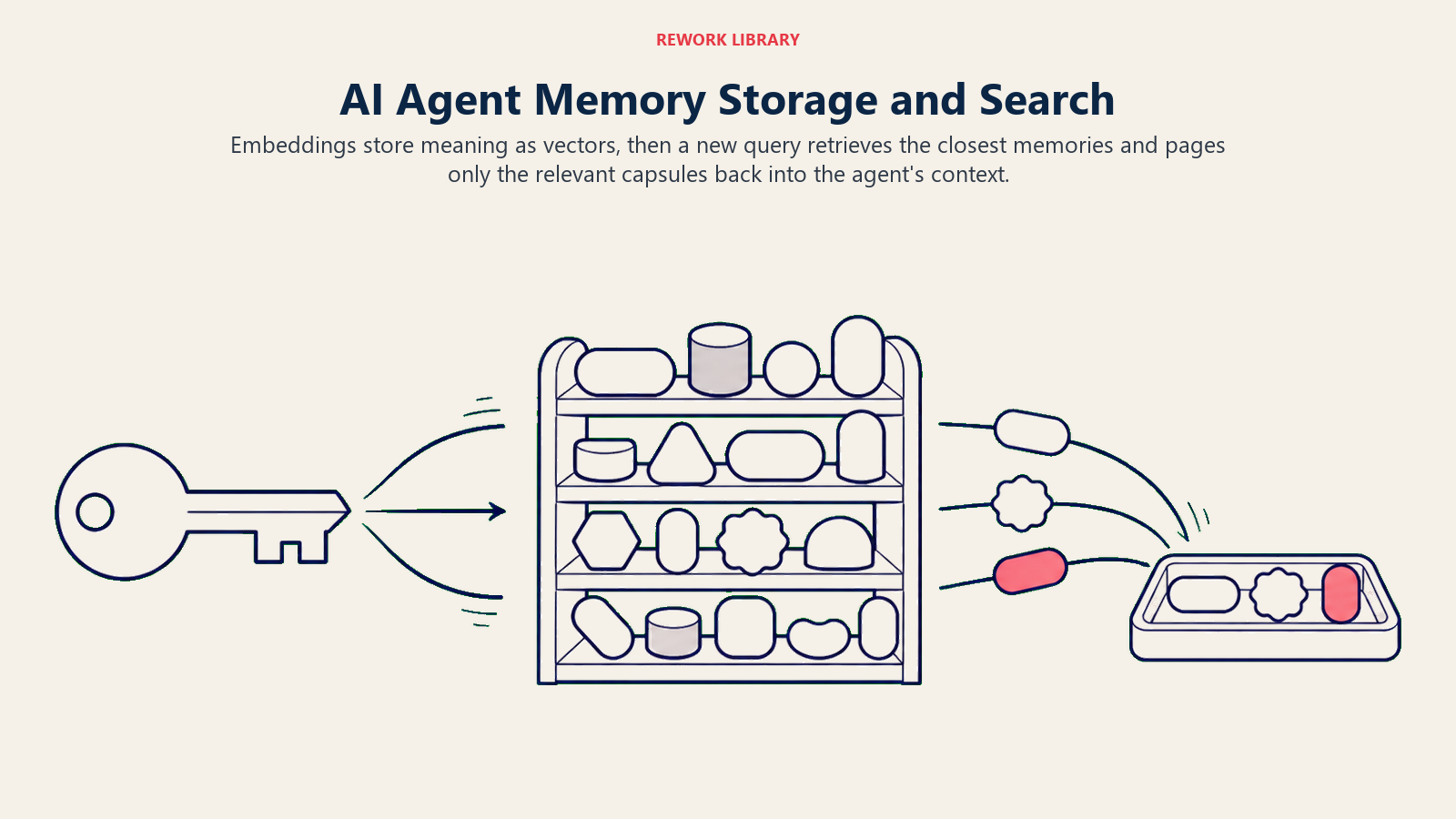
Most long-term memory that needs to be searched by meaning rather than looked up by exact ID ends up in a vector database. Facts, past conversations, and document chunks get converted into vectors, numerical representations of their meaning, through an embedding model, and a query gets converted the same way. The system then finds the stored vectors closest to the query, which is how an agent can retrieve "the client's data residency preference" even if it was originally phrased completely differently three months ago. This is the same underlying mechanism covered in RAG for AI Agents: long-term memory and retrieval-augmented generation frequently run on identical infrastructure. The difference is mostly what's being stored, the agent's own accumulated history versus your company's reference documents, rather than how it's retrieved.
An influential architecture proposal called MemGPT frames this well. It borrows the idea of tiered memory from operating systems, keeping a small amount of "hot" information in the model's immediate context and moving everything else to slower, larger external storage, paging information back in only when it's actually needed. That's a useful mental model even if you never touch the paper's implementation: treat the context window like fast, expensive, limited memory, and everything else like a larger, cheaper store the agent deliberately queries rather than permanently carries around.
If the long-term memory you actually need is a shared customer record rather than a custom-built vector store, the CRM tools roundup is a more direct starting point, and the knowledge base software buying guide covers the organization-wide version of the same problem.
Memory Pitfalls That Actually Bite
Treating a growing context window as memory. A long chat thread isn't the same as long-term memory. It disappears the moment the session ends, and per the context-degradation research above, a model doesn't use a stuffed-full context reliably even while the session is still open.
No memory verification or correction path. Agents can remember something incorrectly, especially if it was wrong the first time it got stored, or if it's simply gone stale. Build a way for a person to correct or delete a bad memory, the same way you'd fix a wrong field in a CRM record, or errors compound silently every time the agent reuses them.
Memory with no privacy boundary. Long-term memory that spans customers or accounts needs the same access controls as any other sensitive data store. An agent that can technically see another customer's history needs an explicit rule against surfacing it, not just an assumption that it won't come up. AI Governance covers the policy side of setting those boundaries.
Memory that never gets pruned. Not everything is worth keeping forever. A memory store that accumulates every detail indefinitely gets slower to search and noisier to retrieve from. Decide what expires, what gets summarized down over time, and what genuinely needs to persist.
For the deeper mechanics of how AI systems build and manage this kind of persistent understanding generally, not just inside a single agent, see AI Memory, which covers memory architectures (session-based, user-scoped, organization-scoped, and domain-specific) and the privacy frameworks that should sit around all of them. This page has focused narrowly on how that plays out inside an agent's own loop.
Key Facts
- Short-term memory keeps a single task coherent and typically lives in the model's context window. Long-term memory survives across sessions and typically lives in an external database or vector store.
- A bigger context window isn't the same as reliable memory. Research from Chroma and the academic "Lost in the Middle" study both found that model accuracy degrades well before advertised context limits are reached, especially for information buried in the middle of a long input.
- Long-term memory and RAG frequently run on the same vector-database infrastructure. The difference is what's stored: the agent's own history versus your organization's reference documents.
- Unverified, unpruned, or access-uncontrolled memory is a real risk. Build a correction path, an expiration policy, and explicit privacy boundaries before an agent's memory spans multiple customers or accounts.
Frequently Asked Questions about AI Agent Memory
What is AI agent memory?
AI agent memory is how an agent tracks what has already happened, both within a single task (short-term or working memory) and across every future interaction with the same account or user (long-term or persistent memory). Short-term memory typically lives in the model's context window. Long-term memory lives in an external database or vector store the agent queries.
What's the difference between short-term and long-term agent memory?
Short-term memory holds the current task: the conversation so far, the steps already taken, the plan in progress. It disappears when the run ends. Long-term memory holds facts, past interactions, and state that need to persist across sessions, stored outside the model in a database or vector store, and it's what makes an agent consistent from one interaction to the next.
Does a bigger context window solve the memory problem?
Not by itself. Research testing 18 leading models found that accuracy can degrade well before a context window is full, and that models handle information placed at the start or end of a long context better than information buried in the middle. Treat the context window as fast, limited scratch space, and push anything that needs to persist into long-term storage instead of just making prompts longer.
How is agent memory different from RAG?
They frequently share the same underlying infrastructure, a vector database that stores and retrieves information by meaning. The difference is what's stored and why: RAG typically retrieves from your organization's reference documents to ground an answer, while long-term memory retrieves the agent's own accumulated history with a specific task, user, or account.
Can an AI agent's memory be wrong?
Yes. An agent can store something incorrectly the first time, or a stored fact can simply go stale as circumstances change. Production memory systems need a way for a person to review, correct, or delete a bad memory, the same discipline you'd apply to any other system of record, or errors compound quietly every time the agent reuses them.
Where to Go Next
Memory is what lets an agent act consistently instead of relearning your business from scratch every run. Pair it with RAG for AI Agents to ground the agent in documents it doesn't need to memorize, and with how to evaluate and test AI agents to catch memory drift, like a stale fact or a growing context quietly hurting accuracy, before it reaches a customer. For the building blocks memory fits into more broadly, how AI agents work covers the full loop.
