AI Agent ROI: How to Build (and Prove) the Business Case
Turn this article into takeaways for your work.


Each assistant summarizes the article only for you and suggests best practices for your work.
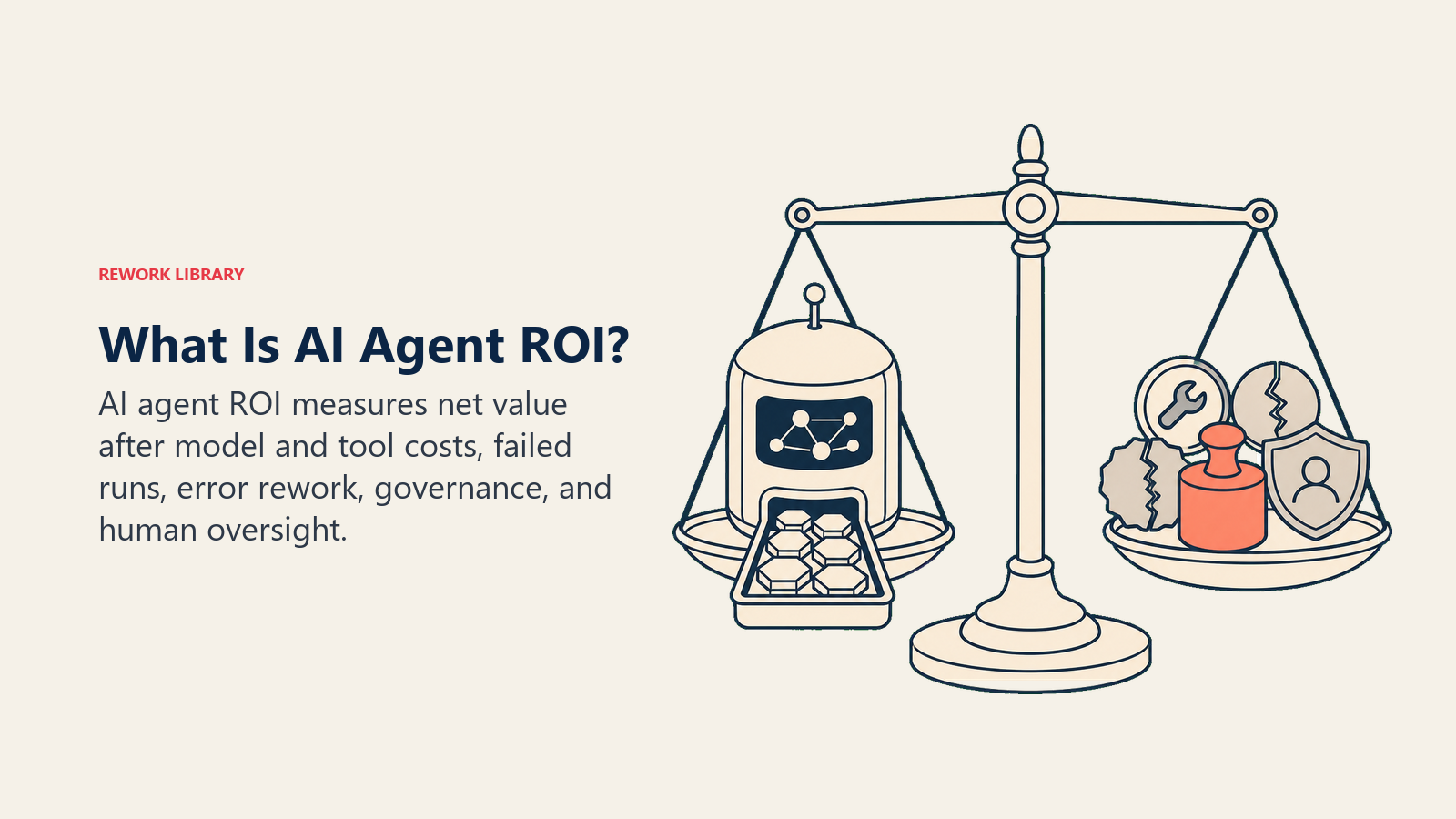
AI agent ROI is the net financial return an agent produces once you count everything it touches: the value of the work it completes, the cost of running it, and the cost of cleaning up after the mistakes it makes along the way. The formula sounds simple. The measurement discipline behind it is where most projects actually fall apart, because an agent's cost compounds with every extra step it takes, and its value is easy to overstate before you've run it at real volume. This guide covers how to build an agent ROI case that survives contact with your CFO: what to measure, the traps that inflate the number, and why the gap between what executives expect and what's actually been proven is wide open right now.
The Expectation Gap
PagerDuty's 2025 Agentic AI Survey, fielded by Wakefield Research among 1,000 IT and business executives at companies with at least $500 million in revenue, found that 62% expect more than 100% ROI from their agentic AI investments, with the average expected return at 171% (192% among U.S. respondents). Read that carefully: it's a projection executives are making, not a return anyone has banked yet.
Deloitte's 2026 State of AI in the Enterprise survey puts a number on the other side of that gap. Only 11% of organizations report they're actively running agentic AI in production today. Another 14% have a solution ready to deploy, 38% are still piloting, and 30% are just exploring the idea. Most of that 171% figure, in other words, describes what leaders think will happen, not what's been measured at real scale.
That's not a reason to distrust agents. It's a reason to build your own ROI case with real measurement instead of borrowing someone else's expectation. For the general AI ROI framework, four metrics and formulas that apply to any AI investment, see AI ROI measurement. This page goes narrower: the version of that framework built for an agent's loop-based cost structure specifically, where deploying AI agents to production covers the operational side of closing the expectation gap and this page covers the financial side.
Start From the Simple Formula, Then Add the Layer Most Teams Skip
When to use an AI agent gives you the back-of-envelope version: multiply volume by time saved per task by the fully loaded hourly cost to get the gross saving, then subtract the error cost (error rate times volume times cost per error) and the platform cost. That formula is the right starting point for sizing a single task. A full agent ROI case needs one more layer on top: the ongoing cost of running the agent responsibly, not just the model calls it makes.
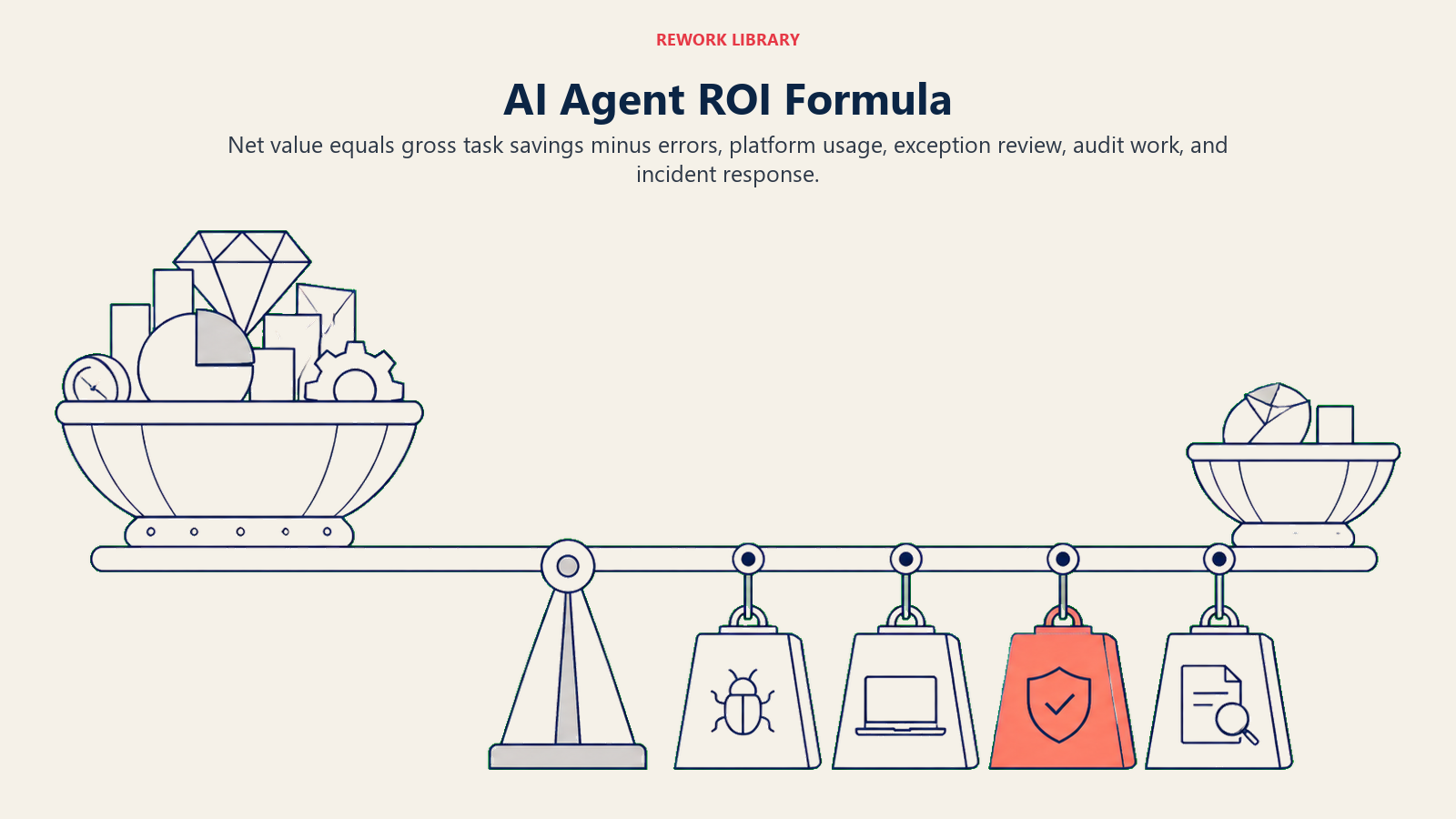
Measuring AI pattern ROI names the layer most teams leave out. For the Autonomous Agent pattern specifically, it warns that total cost of ownership is almost always underestimated, because the governance overhead, human review time, audit trail management, incident response, can add 30 to 50% to the apparent automation savings in a well-run deployment. Skip that line and you've built a business case for a cheaper, less-supervised agent than the one you're actually going to run.
| Component | What it means for an agent | Worked example |
|---|---|---|
| Baseline | The fully loaded cost of the human workflow the agent assists or replaces, measured and timestamped before launch | 1 AP clerk processing invoices manually, $32/hour fully loaded |
| Primary metric | Tasks completed per hour and error rate, read from week 4 onward, not week 1 | 95 invoices/hour, 2% needing rework |
| Business impact metric | What the primary metric is worth once you subtract error cost and governance overhead | Net monthly saving after rework and oversight time, not gross saving alone |
Measure Cost Per Completed Task, Not Cost Per Run
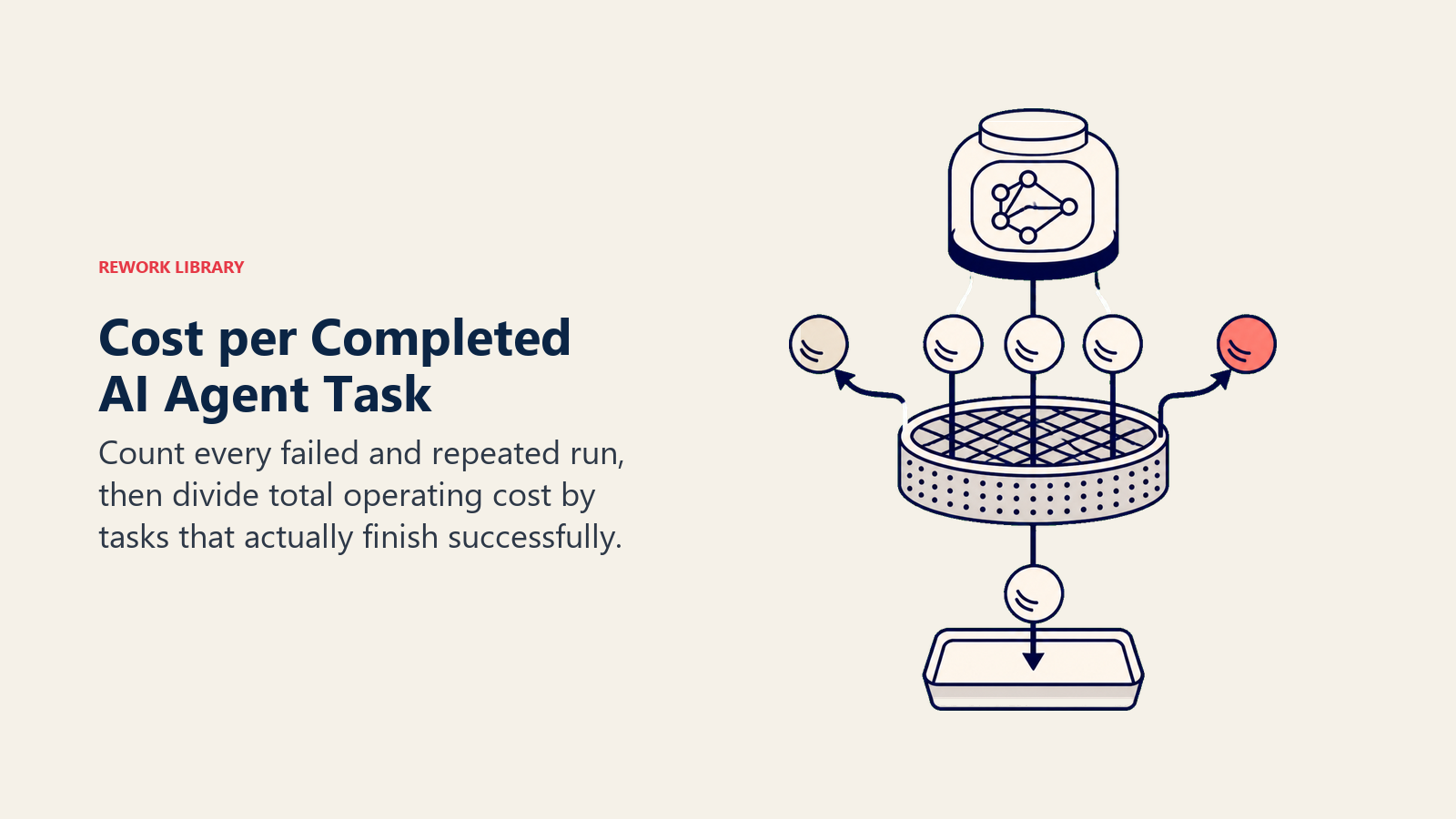
AI agent cost optimization makes a point that belongs in every ROI model, not just the cost conversation: a run that fails still spent tokens, and a cheap run that fails twice before succeeding isn't actually cheap. The number that matters is cost per completed task, tracked in AI agent observability alongside cache hit rate and error rate. An ROI case built on cost per run, or on the model's list price alone, overstates the return by roughly whatever the agent's failure rate costs you. That gap is easy to miss in a pilot, where volume is low and someone is watching closely, and easy to feel at real scale, where nobody is.
A Worked Example, With the Line Most Teams Skip
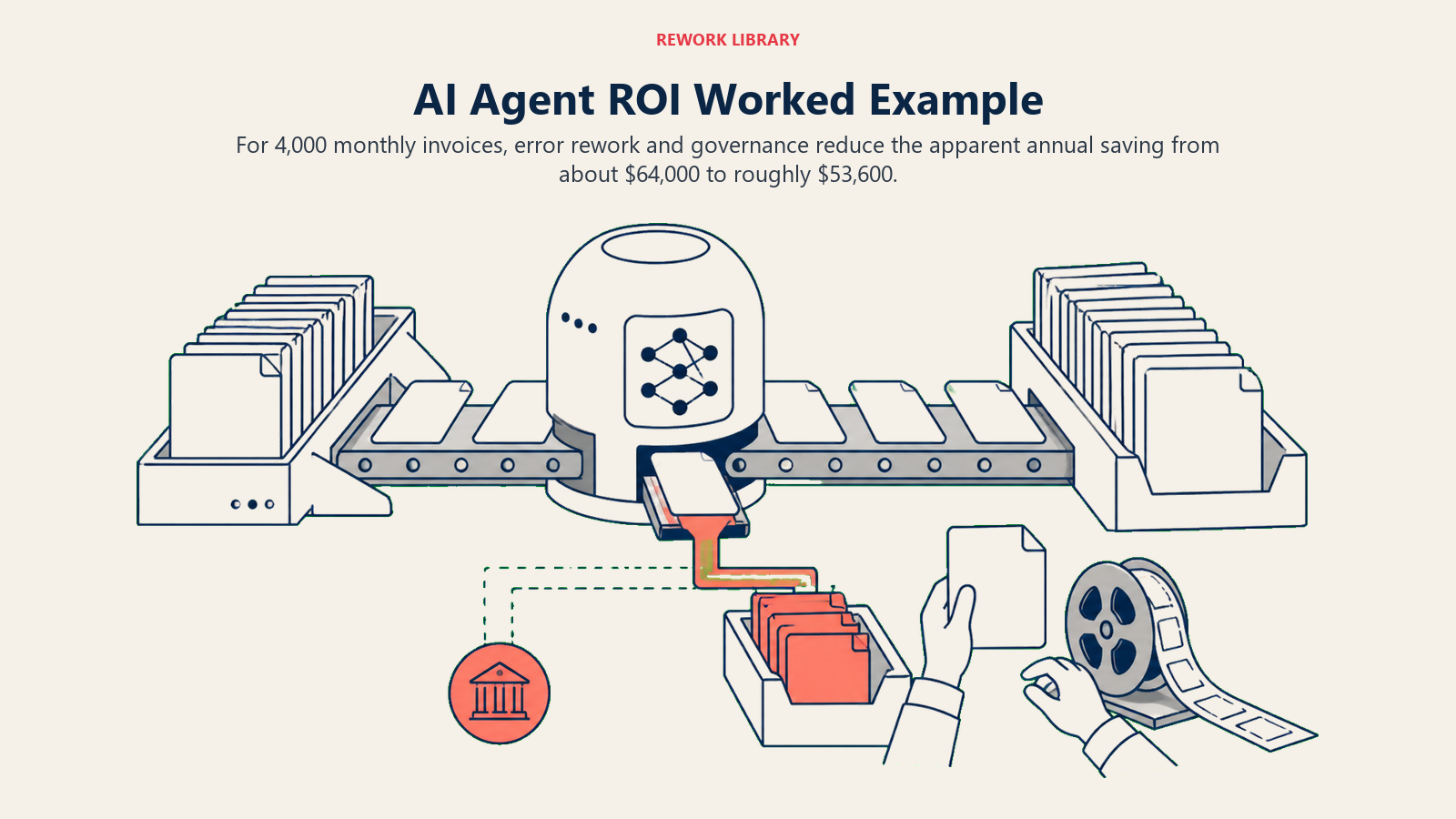
Take an agent shaped like the AI Invoice AP Agent blueprint: processing 4,000 invoices a month, saving 4 minutes each against a manual baseline, at a fully loaded clerk cost of $32 an hour.
| Input | Value |
|---|---|
| Invoices per month | 4,000 |
| Time saved per invoice | 4 minutes |
| Fully loaded hourly cost | $32 |
| Gross monthly saving | ~$8,530 |
| Error rate | 2% |
| Cost per error (rework) | $40 |
| Monthly error cost | ~$3,200 |
| Naive net (gross minus error cost) | ~$5,330/month |
| Governance overhead (exception review + audit log time) | ~$860/month |
| True net monthly value | ~$4,470/month |
The naive number, gross saving minus error cost, looks like about $64,000 a year. Add the governance line, roughly 13 hours a month of an ops analyst reviewing the exception queue plus a quarterly audit log review, and the real number lands closer to $53,600. That's a 16% gap between the version of this business case that gets approved in a slide and the version that survives a full year of actually running the agent. For a higher-stakes agent than invoice matching, measuring AI pattern ROI puts that gap as high as 30 to 50%. Run the governance line every time, even when it makes the number smaller. It's the number that's actually true.
Why the Number Moves After You Ship
AI ROI isn't a fixed line the way a software license is. A freshly trained scoring or routing model can lose accuracy as the input mix shifts, and human reviewers change how much they trust an agent's output as their exposure to it grows. The timeline for reading results matters too: weeks 1 to 3 after launch are noise while users learn the system, weeks 4 to 8 produce the first real signal on the primary metric, and months 4 to 6 are the minimum window for a number you'd actually present to finance. Read your agent's ROI too early and you'll either kill something that was about to pay off or keep funding something that never will.
Three Ways Teams Inflate Their Own Number
Comparing to a broken baseline. If the process the agent replaced wasn't really being done well before, or wasn't being done consistently at all, the agent looks miraculous by comparison. That's not ROI. That's replacing nothing with something, and finance will eventually notice the baseline doesn't hold up.
Crediting activity instead of outcome. "The agent processes 500 invoices a day" is a volume claim, not an ROI claim. "The agent processes 500 invoices a day at a 2% error rate, saving $53,600 a year after governance overhead" is one. The first sentence describes what the agent does. The second describes what it's worth.
Reading the number before month 3. Early weeks favor whichever narrative you already believe. A skeptic reads early noise as failure, and a champion reads it as proof. Neither read is reliable yet, so hold the presentation until the window above has actually passed.
What Decides How Fast You'll See a Real Number
Two things outside the formula itself set your timeline. First, where the agent sits on the AI agent maturity model: a first pilot at the crawl stage should expect a longer, noisier measurement window than a fifth agent built on governance patterns your team already trusts. Second, how the rollout itself is staged. Deploying AI agents to production walks through shadow mode and gated traffic increases, and every stage in that ramp delays full-volume data on purpose, because the alternative is reading ROI off a rollout that hasn't stabilized yet.
If you're evaluating vendors as part of building this case, don't take a vendor's ROI claim as your baseline. Score cost predictability the same way you'd score any other capability. The SaaS vendor evaluation scorecard gives you a weighted template for that, and our AI tools comparisons are a useful starting point for seeing how platforms differ on more than feature lists.
Key Facts
- PagerDuty's 2025 survey of 1,000 executives found 62% expect more than 100% ROI from agentic AI, averaging 171% expected return (192% in the U.S.), a projection, not a measured result.
- Deloitte's 2026 State of AI in the Enterprise survey found only 11% of organizations are actively running agentic AI in production, with 14% deployable, 38% piloting, and 30% still exploring.
- Autonomous Agent governance overhead, human review, audit trails, incident response, can add 30 to 50% to the apparent savings of a well-run deployment, and most naive ROI cases never include it.
- The ROI measurement window has real gates: weeks 1 to 3 are noise, weeks 4 to 8 give early signal, and months 4 to 6 are the minimum for a number worth presenting to finance.
- Gartner predicts over 40% of agentic AI projects will be canceled by the end of 2027, citing escalating costs and unclear business value as leading causes, exactly the gap a disciplined ROI case closes.
Frequently Asked Questions about AI Agent ROI
What is a good ROI for an AI agent?
There's no universal benchmark, since it depends heavily on task volume, error cost, and governance overhead. What matters more than hitting a specific percentage is whether the number includes the full cost of running the agent responsibly, not just its gross time savings. A modest, fully loaded 40% ROI you can defend to finance is worth more than an inflated 200% figure that skips governance and error costs.
How is AI agent ROI different from regular AI ROI?
An agent's cost and risk compound with every step in its loop, since each pass can trigger its own model call or tool call, unlike a single model prediction. That means agent ROI needs an extra line item most simpler AI tools don't: the ongoing cost of oversight, audit trails, and exception handling, which can add 30 to 50% to what a naive calculation assumes.
Why do executives expect such high ROI from AI agents?
Largely because agentic AI is following the pattern generative AI set before it. PagerDuty's research found that expectations for agentic AI, 171% average expected ROI, closely track what companies previously reported achieving with generative AI, 152% average return, which suggests leaders are extrapolating from one technology wave to the next rather than measuring the new one independently yet.
When can I trust my agent's ROI numbers?
Not before month 3 at the earliest. The first three weeks after launch are noise while users adjust, weeks 4 to 8 give you a read on the primary metric (speed, accuracy, throughput), and months 4 to 6 are the minimum window for a business impact number with enough data to present confidently to finance.
What's the biggest mistake in AI agent ROI calculations?
Leaving out governance overhead. Teams reliably count the time an agent saves and just as reliably forget to count the human review time, audit trail maintenance, and incident response that a responsibly run agent still requires. That omission is exactly what turns an approved business case into a number nobody can defend a year later.
Where to Go Next
Proving ROI is only half the picture. Where your agent sits on the AI agent maturity model shapes how much of this you can even measure reliably yet, and AI agent cost optimization covers the caching, routing, and budget levers that improve the number once you've measured it honestly. For the org-wide version of this question, once agents move from a single pilot to a real part of how work gets done, the agentic workforce covers what changes about how you plan capacity and headcount around them.

On this page
- The Expectation Gap
- Start From the Simple Formula, Then Add the Layer Most Teams Skip
- Measure Cost Per Completed Task, Not Cost Per Run
- A Worked Example, With the Line Most Teams Skip
- Why the Number Moves After You Ship
- Three Ways Teams Inflate Their Own Number
- What Decides How Fast You'll See a Real Number
- Key Facts
- Where to Go Next