How to Evaluate and Test AI Agents
Turn this article into takeaways for your work.


Each assistant summarizes the article only for you and suggests best practices for your work.
AI agent evaluation is the practice of systematically testing whether an agent completes real tasks correctly, safely, and consistently, before it ever reaches a customer and continuously after it does. It combines a test set of realistic tasks, a task-success metric instead of a single right-answer check, and a grading method (rules, human review, or a second model acting as judge) that catches failures before they compound in production. Skip this step and you're not running an agent, you're running an uncontrolled experiment on your business.
If you haven't yet pinned down what an AI agent actually is and the bounded-autonomy idea behind it, start there first. This page assumes you're past that step and already asking whether your agent is reliable enough to trust with real volume.
Why Testing an Agent Isn't Like Testing Software
Traditional software QA checks a fixed input against a fixed expected output. Click this button, expect that screen. An AI agent breaks that model in three ways: the same input can produce several valid outputs, a single task might take five or fifteen steps depending on what the agent finds along the way, and the model's own probabilistic nature means it won't always do the identical thing twice.
| Traditional software test | AI agent test | |
|---|---|---|
| Input to output | One correct output | Multiple valid outputs possible |
| Path | Fixed sequence of steps | Path varies by case, tools used, and order |
| Repeatability | Same input, same result every time | Same input can produce different, still valid, paths |
| Pass or fail | Binary | Often a graded score against a rubric |
| What breaks it | A code change | A prompt change, a model update, data drift, a tool's API changing |
That's not a reason to skip testing. It's a reason to test differently. And the cost of skipping it is real: Gartner predicts that over 40% of agentic AI projects will be canceled by the end of 2027, citing escalating costs, unclear business value, and inadequate risk controls as the leading causes, not failed technology. A rigorous evaluation practice is what turns "we think this agent works" into a number you can defend to a budget owner.
The Core Metric: Task Success, Not Accuracy
The single most important thing to define before you write a test case is what "success" means for this specific agent, in terms of the outcome it produces, not the words it generates along the way.
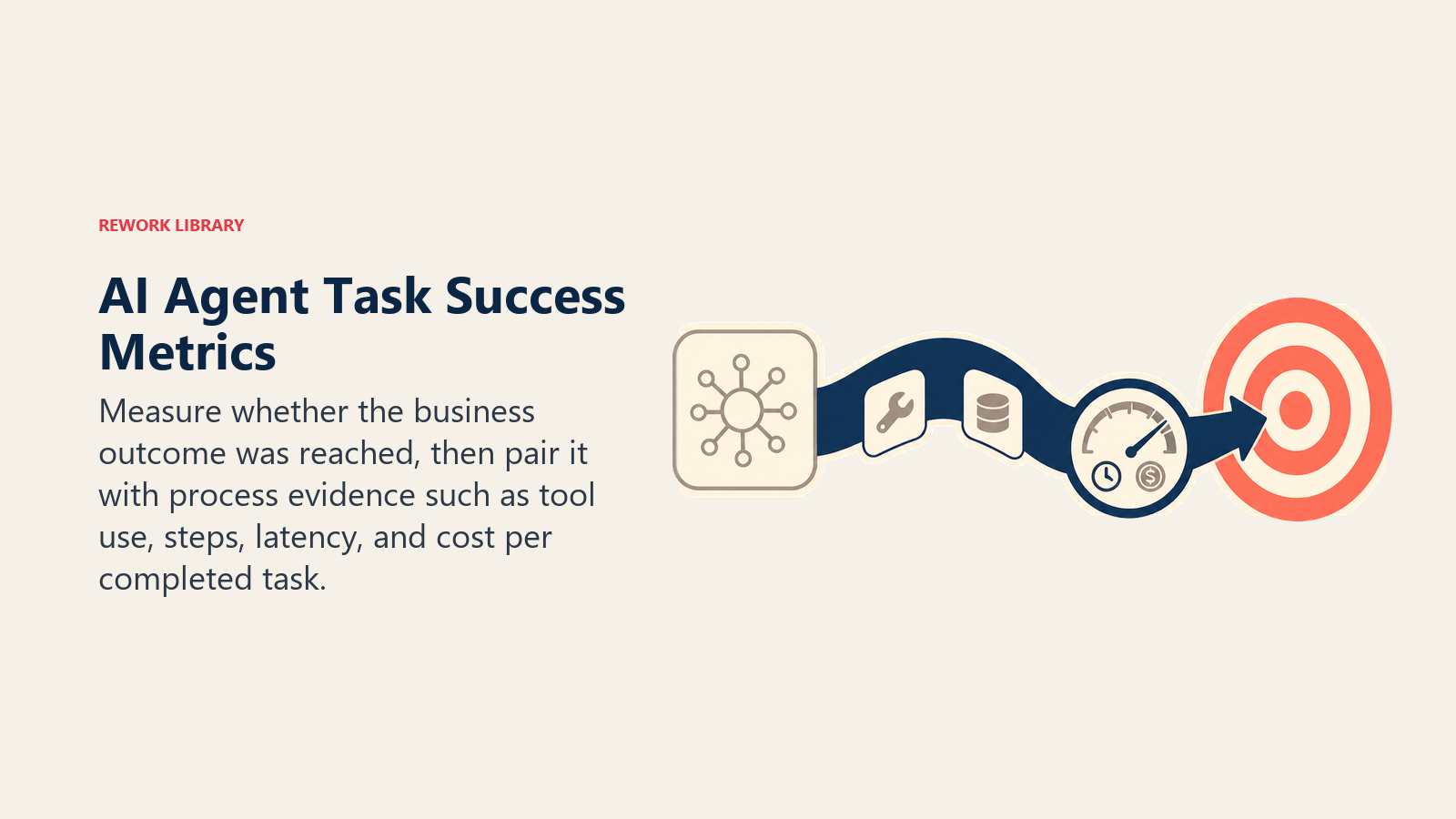
For an AI Lead Scoring Agent, success isn't whether each individual score matches what a human would have guessed. It's whether the leads it scores "hot" convert at a meaningfully higher rate than the leads it scores "cold" over the following weeks. For an AI Support Triage Agent, success is whether the ticket lands in the right queue with the right context attached, not whether the wording of its classification matches a human's phrasing exactly.
Split your metrics into two kinds:
- Outcome metrics measure whether the goal was actually reached: booked meeting, resolved ticket, correctly extracted invoice fields, accurately flagged transaction.
- Process metrics measure how the agent got there: which tools it called, how many steps it took, how much it cost in tokens and API calls, and how long it took.
You need both. An agent that hits its outcome metric by taking twenty unnecessary steps and burning ten times the expected cost per task isn't actually a success. It's a problem wearing a good scorecard.
Build a Test Set Before You Ship
You can't evaluate what you haven't defined. Before an agent goes live, assemble a set of realistic tasks it will actually face, pulled from three sources:
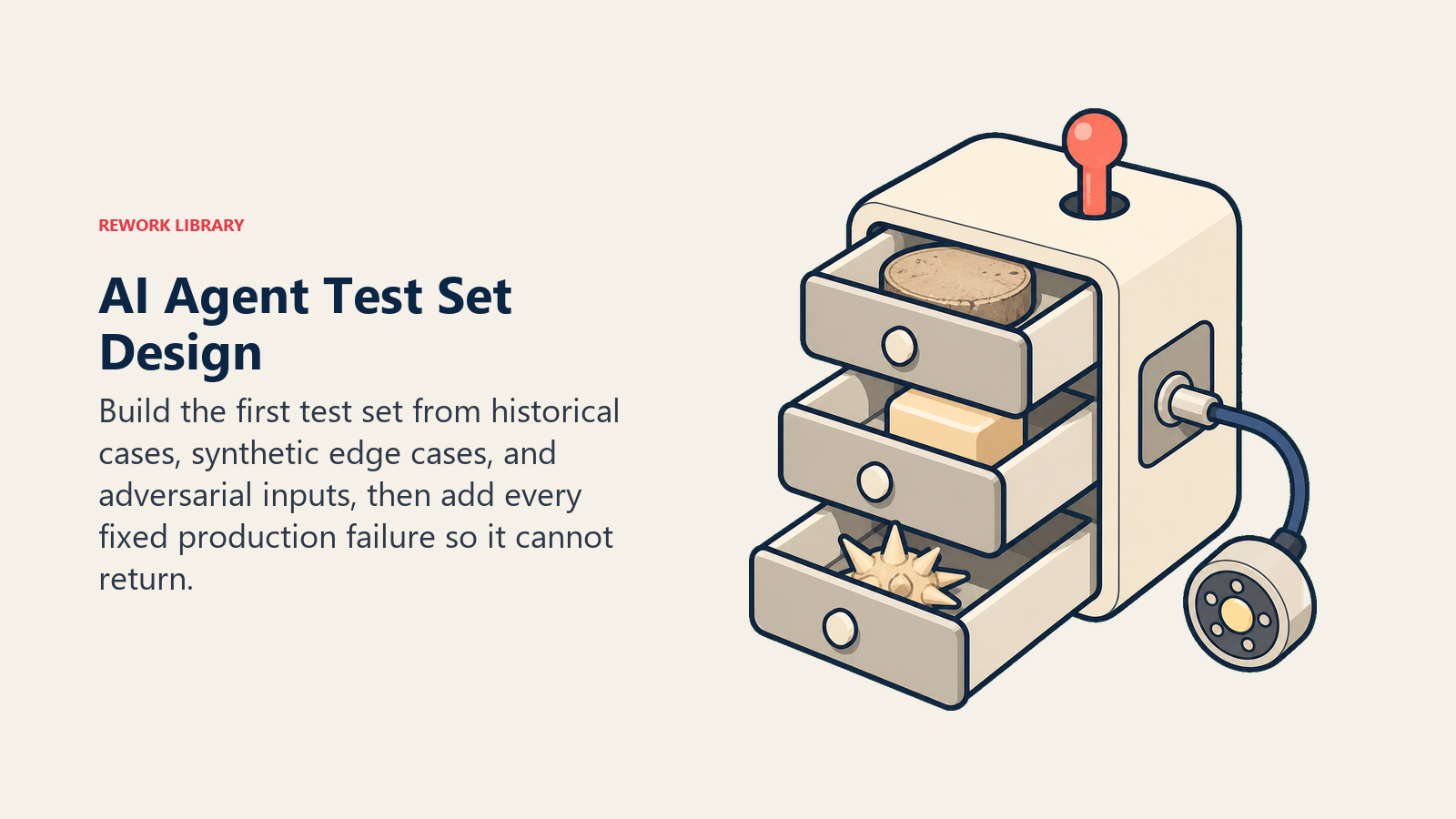
- Historical real cases. Past tickets, leads, or transactions, anonymized if needed. These are the closest thing to ground truth you have, because they already happened and you know, or can determine, what the right outcome was.
- Synthetic edge cases. Situations you know will happen eventually but might not have enough historical examples of yet: a customer asking about a product you just launched, a lead outside your usual ICP, a transaction just under your fraud threshold.
- Adversarial cases. Inputs designed to break the agent on purpose: a message trying to talk it into ignoring its rules, a question with no good answer in its knowledge base, a request clearly outside its scope.
A practical starting point is one test case for every row in the agent's scenario playbook, part of the six building blocks every Rework blueprint defines, plus a handful of adversarial cases layered on top. That's usually a few dozen cases to start, not hundreds. The habit that matters more than the size is adding every real production failure back into the set once you've fixed it, so the same bug never ships twice.
Offline Evaluation vs. Online Evaluation
Run both, and understand what each one is actually for.
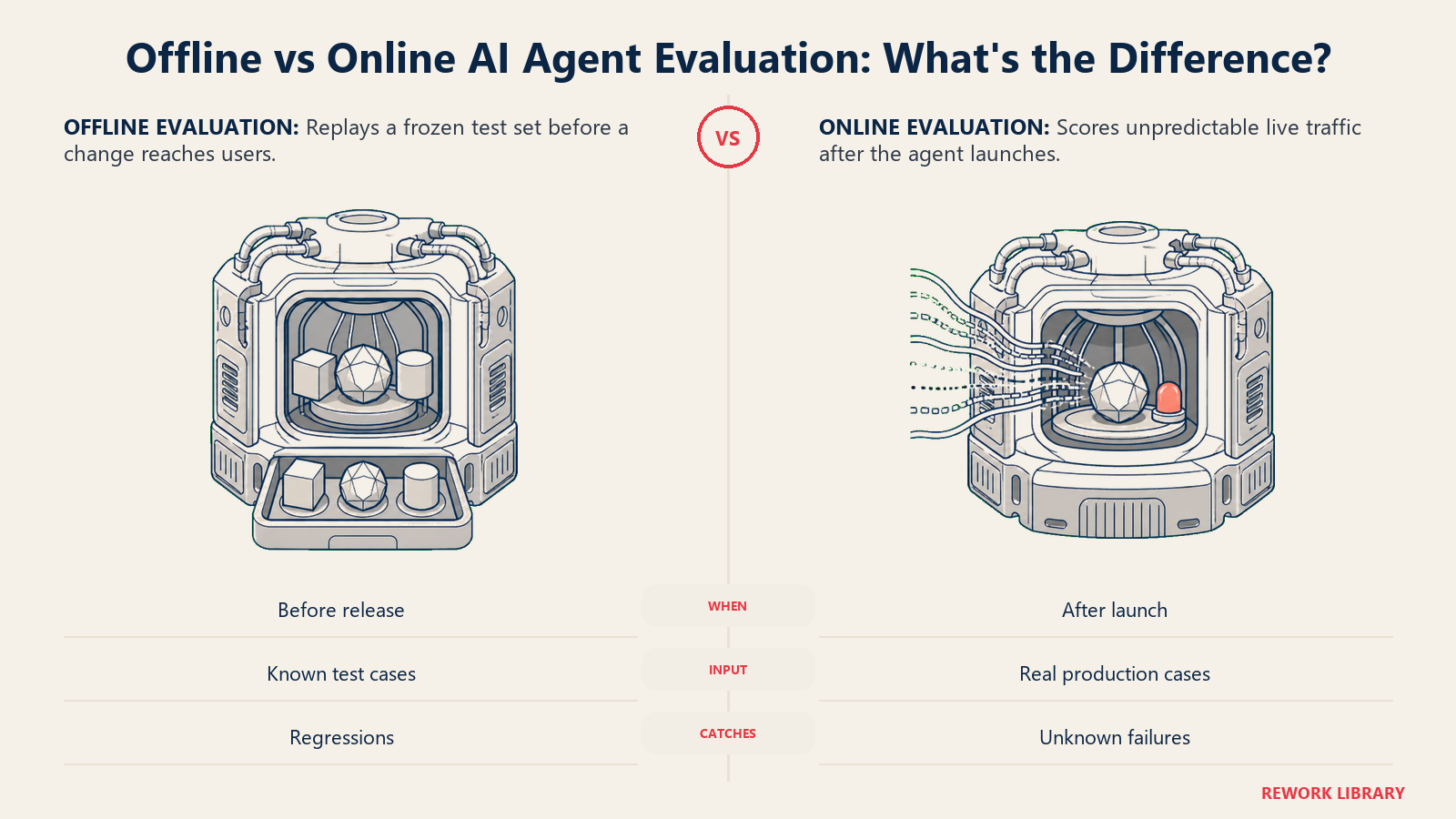
| Offline evaluation | Online evaluation | |
|---|---|---|
| When it runs | Before you ship a change | After the agent is live |
| Tested against | A frozen, known test set | Real, unpredictable production traffic |
| Cost to run | Cheap and repeatable, safe on every change | Needs monitoring infrastructure and real usage |
| What it catches | Regressions: did this change break something that used to work | Unknowns: cases you never thought to write a test for |
| Typical cadence | Every prompt, model, or tool change | Continuously |
Offline evaluation is your seatbelt. Every time you touch a prompt, swap a model, or add a tool, rerun the full test set before deploying. If task-success rate drops on cases that used to pass, you caught a regression before a customer did.
Online evaluation is where the real world talks back. A common pattern is shadow mode: run the new version of the agent alongside the version already in production, on the same live inputs, without letting the new version actually act. Compare the two sets of outputs before flipping traffic over. This is also where ongoing production monitoring, the logs, traces, metrics, and automated evaluations that watch an agent continuously after launch, takes over. That discipline has its own depth: see AI Agent Observability for how to instrument an agent so problems surface in minutes instead of weeks.
How to Grade What the Agent Produced
Once you have a test set, you need a way to score each result. Three approaches, used together more often than alone:
Rule-based checks. Fast and cheap: did the agent call the correct tool, did the output match an expected format, did it include a required citation. Rules only work for behavior you can check mechanically, so they cover less of the picture than people expect. OpenAI's guide to building agents frames this as layered defense, since no single check catches everything.
Human review. The most reliable judge of tone, judgment calls, and anything subjective, and the slowest and most expensive. Nobody reviews every conversation by hand. Sample it: 20 to 50 transcripts a week for a live agent is enough to catch drift without turning it into someone's entire job.
LLM-as-judge. Use a second model to grade the agent's output against a written rubric. It scales to thousands of cases in the time human review covers dozens, which is why it's become the standard pattern for evaluating agents at real volume. The catch: an LLM judge is only trustworthy once it's calibrated. Periodically score the same sample with both a human and the judge model, and if they disagree often, fix the rubric, not the model. For side-by-side comparisons, like a prompt upgrade, asking the judge to pick the better of two outputs tends to beat asking it for an absolute score.
Evaluate the Steps, Not Just the Final Answer
A final answer can look right for the wrong reason. An agent might land on the correct ticket category after checking the wrong knowledge base article, or book the correct meeting slot after ignoring a scheduling conflict it should have caught. That's a bug wearing a passing grade, and it will resurface the next time the lucky path isn't available.
Trace-level review means walking through the agent's actual sequence: which tool it called, with what parameters, in what order, and whether it handled a bad or empty result before moving on. This matters more as agents take on longer, more autonomous tasks. METR benchmarks frontier AI models on realistic work and found that the length of task an agent can reliably complete, its "time horizon," has been doubling roughly every seven months for six years straight. Current models are close to perfect on tasks that take a human expert a few minutes, but succeed less than 10% of the time on tasks that take around four hours. That gap is where trajectory-level evaluation earns its keep: a single final-answer check can't show you where in a long chain of steps things started to drift.
Two examples of why the trace matters more than the headline number:
- An AI Support Triage Agent needs its full routing decision checked, not just the ticket's final tag. Did it also preserve the customer's original request, or did the queue change wipe out context the human agent now has to re-ask for?
- An AI Fraud Detection Agent needs precision and recall tracked as two separate numbers, never blended into one. A false positive freezes a legitimate customer's account. A false negative lets real fraud through, and those two failures cost the business in completely different ways.
Some teams build this trace review directly into the product. An AI Chatbot QA Agent is evaluation packaged as its own agent: it reads live bot conversations, scores each for accuracy, tone, and resolution, and flags hallucinations or dead-end loops for a human to fix, the same discipline this article describes, running continuously instead of as a one-time pre-launch pass.
What to Track After Launch
Once an agent is live, a short list of numbers tells you whether it's still doing its job:
- Task success rate over time. Trending down means something drifted: a model update, a stale data source, or a shift in the kind of cases coming in.
- Escalation and handoff rate. Too low can mean the agent is overstepping its bounds. Too high can mean its rules are too conservative to be useful.
- Human override rate. How often does a person reverse or correct what the agent decided? A rising override rate is an early warning long before task success visibly drops.
- Cost per completed task. A model swap or prompt change that quietly doubles token usage without improving outcomes is a budget problem hiding where nobody's looking.
- Regression rate. What fraction of new failures are repeats of bugs already fixed once? This should trend toward zero as your test set matures.
If you're comparing agent-building platforms and want this kind of tracing and evaluation tooling built in rather than assembled by hand, the AI chatbot platform buying guide covers what to look for, and the automation tools roundup is a reasonable starting point for browsing what's available in 2026.
Key Facts
- AI agent evaluation combines a realistic test set, a task-success metric, and a grading method (rules, human review, or LLM-as-judge), run both offline before every change and online continuously after launch.
- Gartner predicts more than 40% of agentic AI projects will be canceled by the end of 2027, driven by unclear business value and inadequate risk controls, exactly what a real evaluation practice is built to catch early.
- METR's research shows AI agents' reliable task length has been doubling roughly every seven months, which is why trace-level, step-by-step evaluation matters more as agents take on longer, more autonomous work.
- Trust an LLM-as-judge only after calibrating it against human ratings on the same sample of cases.
Frequently Asked Questions about How to Evaluate and Test AI Agents
What is AI agent evaluation?
AI agent evaluation is the practice of testing whether an AI agent completes real tasks correctly, safely, and consistently. It uses a test set of realistic cases, a task-success metric that measures the outcome rather than a single right answer, and a grading method such as rules, human review, or a second model acting as judge, run both before launch and continuously afterward.
What's the difference between offline and online evaluation?
Offline evaluation runs a frozen test set against every change before you ship it, catching regressions cheaply and repeatably. Online evaluation watches real production traffic after launch, catching the unpredictable cases you didn't think to write a test for. A mature agent program runs both, not one or the other.
Can an LLM really grade another AI agent's work?
Yes, and it's the standard way to evaluate agents at real volume, since human review alone can't scale past a few dozen cases a week. The catch is calibration: periodically compare the LLM judge's scores against human ratings on the same sample, and fix the rubric if they disagree often, before trusting the judge's scores at scale.
How many test cases do I need before launching an agent?
Start with one test case for every row in the agent's scenario playbook, plus a handful of edge cases and adversarial inputs, usually a few dozen cases rather than hundreds. Grow the set over time by adding every real production failure back in once you've fixed it, so the same bug can't ship twice.
What's the single most important metric to track?
Task success rate, measured against the actual business outcome the agent exists to produce, not accuracy on any individual step. Pair it with a process metric like cost per completed task, because an agent that reaches the right outcome through an expensive or roundabout path still has a real problem.
Where to Go Next
A solid evaluation practice is what separates an agent you can trust with real volume from a demo that only works in the cases you happened to try. Once your test set and grading method are in place, the natural next step is how to build an AI agent if you haven't shipped a first version yet, or a look at how the agent grounds its answers in real data with RAG for AI Agents and how it keeps context straight across a long task with AI Agent Memory, since both directly affect what your evaluation will catch.
