AI Agent Cost Optimization: Caching, Model Routing, and Budgets
Turn this article into takeaways for your work.


Each assistant summarizes the article only for you and suggests best practices for your work.
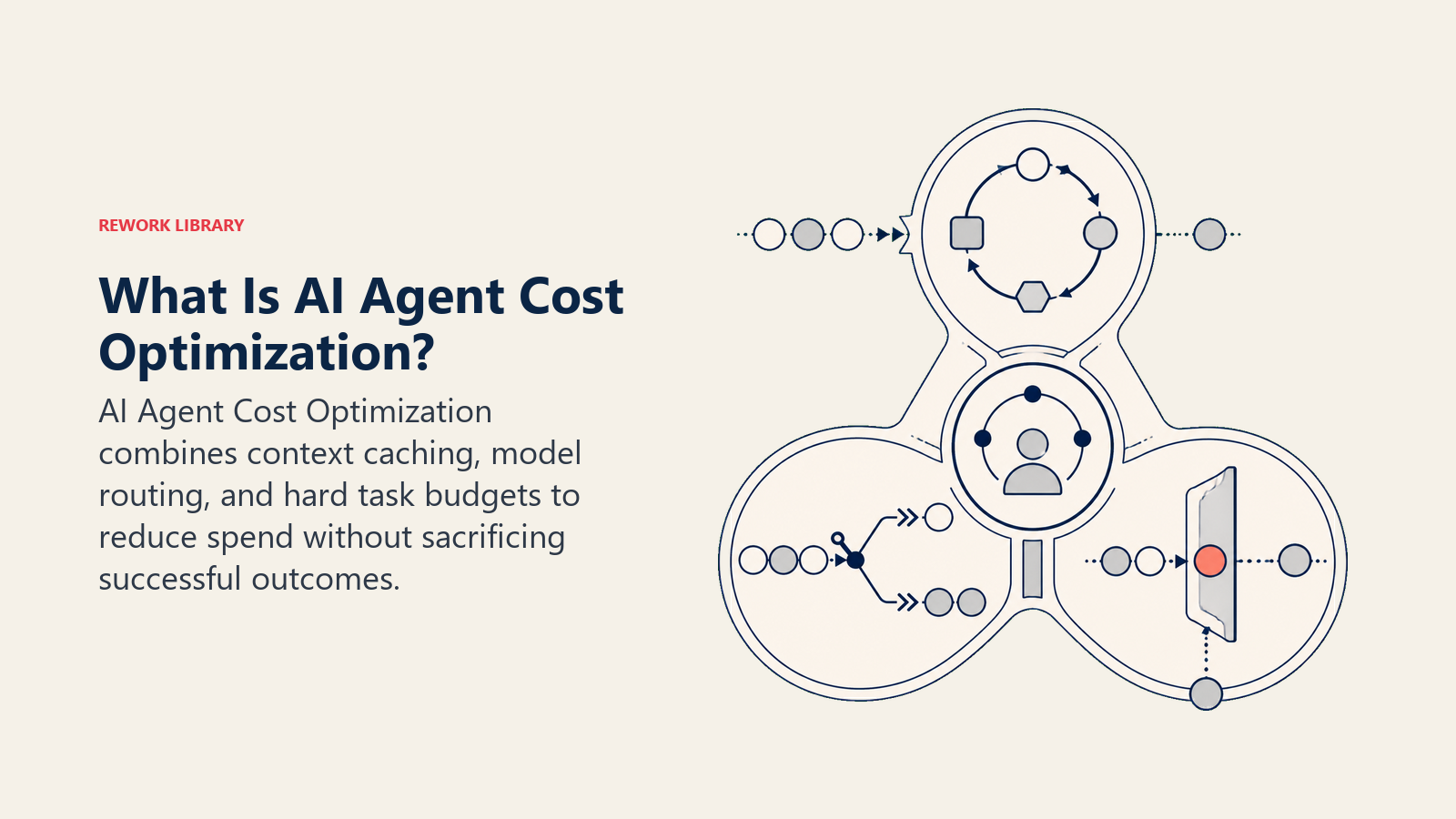
AI agent cost optimization is the set of techniques that keep an agent's token and compute spend proportional to the value it delivers: caching so the agent doesn't re-pay for context it already processed, model routing so easy steps run on cheap models and hard steps run on expensive ones, and hard budgets that cap what a single task can spend before it hands off to a person. None of this is optional once an agent leaves the pilot stage. An agent that loops, calls tools, and re-reads context on every pass can turn a demo that cost cents into a production task that costs dollars, and the gap is almost always one of these three levers, not the model itself.
Why an Agent's Cost Curve Isn't a Model's Cost Curve
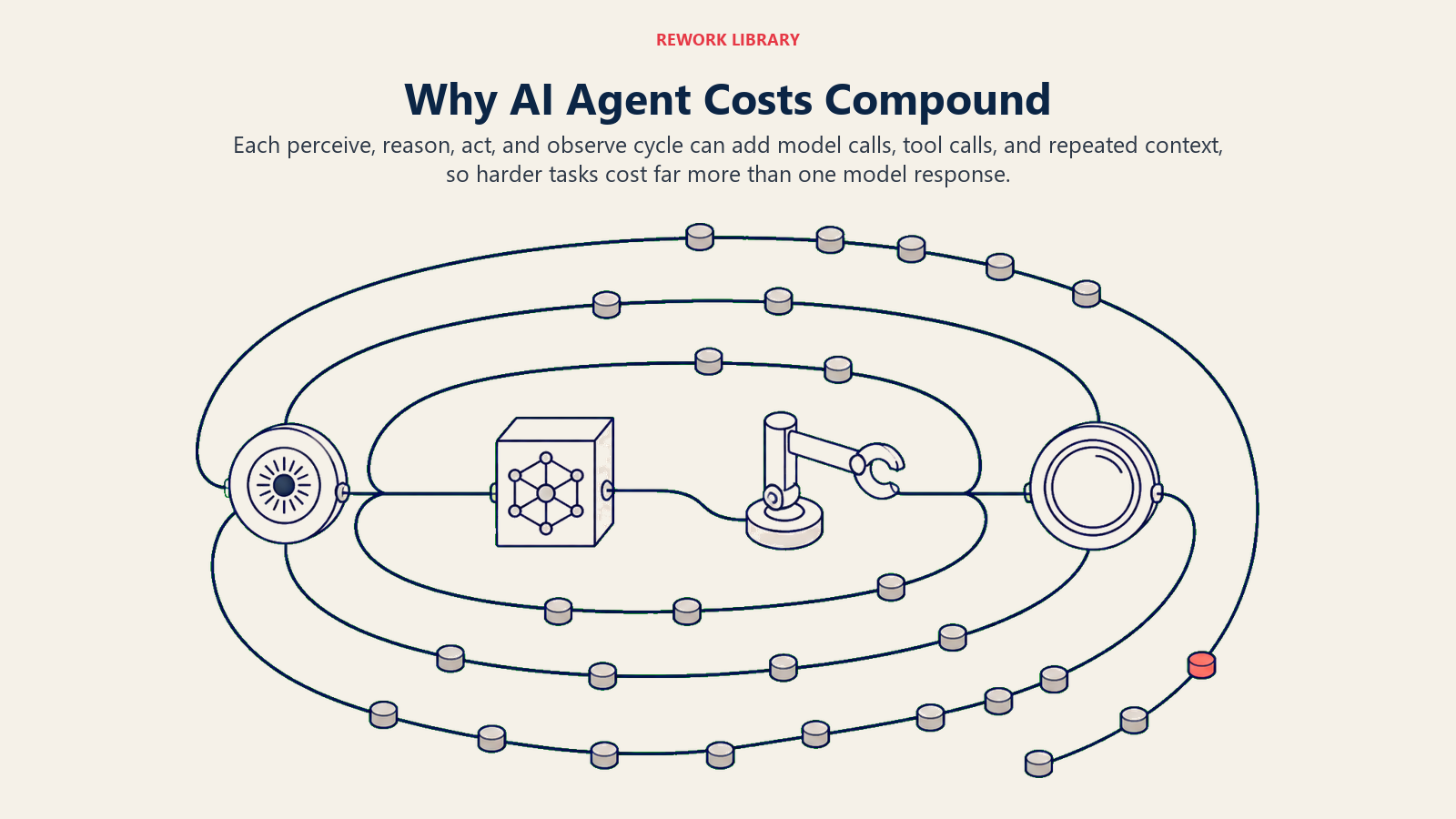
A single model call has one input, one output, one price. How AI agents work describes an agent as a loop instead: perceive, reason, act, observe, repeat, and every pass through that loop can trigger its own model call or tool call. A task that takes one call for a simple case can take five, ten, or more for a harder one, and each of those calls re-sends some amount of context, so cost compounds with iterations in a way a single call never does.
This is exactly why cost shows up so often as a reason agentic projects stall. Gartner predicts that over 40% of agentic AI projects will be canceled by the end of 2027, citing escalating costs, unclear business value, and inadequate risk controls as the leading causes. Escalating cost is rarely a surprise if you model it before you scale. When AI patterns get expensive at scale walks through how an Autonomous Agent without controls turned a single support ticket into 25 model calls instead of the two or three a pilot assumed. The three levers below are how you stop that from happening to you.
Lever 1: Caching, So You Don't Pay for the Same Context Twice
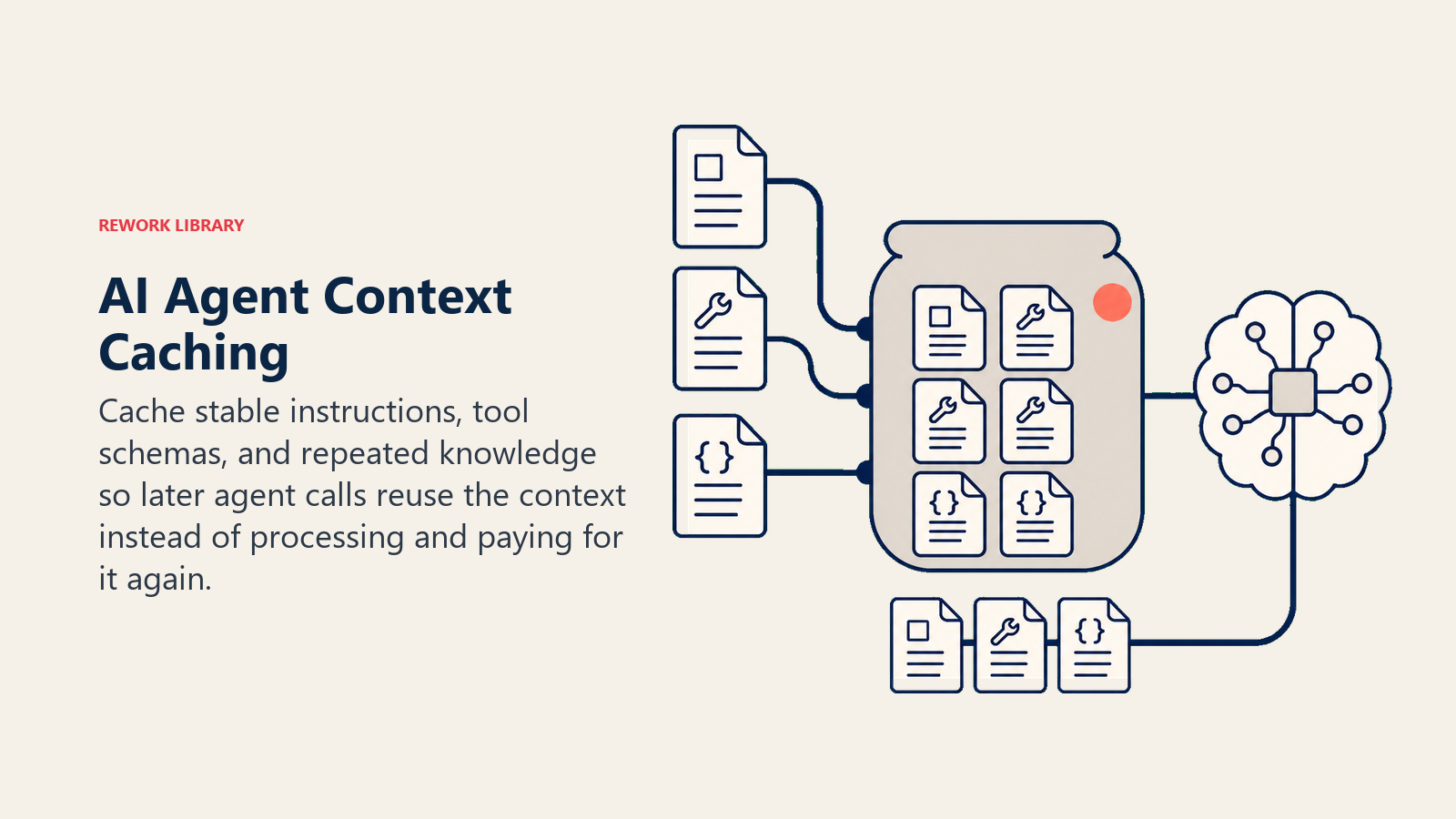
Every agent run re-sends a chunk of context that barely changes call to call: the system prompt, the tool schemas, a long knowledge base excerpt, the conversation so far. Caching means the model provider remembers that chunk and charges a fraction of the price to reuse it instead of reprocessing it from scratch.
The discount is real and it's large. Anthropic's own pricing shows cached input tokens cost 10% of the base input price, a 90% reduction, though writing new content to the cache costs 25% more than a normal call, so caching pays off once a prompt gets reused more than a couple of times. OpenAI and other major providers offer their own version of cached-token discounts; the exact mechanism varies by vendor, but the economics are the same across all of them. For work that doesn't need an instant reply (nightly CRM hygiene sweeps, batch document classification, overnight report generation), Anthropic's Batch API adds a separate discount on top: 50% off standard pricing in exchange for asynchronous processing instead of a live response.
Two caching patterns are worth building into an agent from day one:
- Context caching: cache the system prompt, tool definitions, and any large static reference document (a policy file, a product catalog) so only the parts that actually change between calls get charged at full price.
- Response caching: for genuinely repeated questions (the same FAQ, the same classification on near-identical inputs), skip the model call entirely and serve a stored answer, refreshed on a schedule rather than regenerated every time.
Lever 2: Model Routing, So Easy Steps Don't Pay Frontier Prices
Not every step in an agent's loop needs your most capable, most expensive model. Classifying a ticket, extracting a field from a form, or checking whether a case matches a known scenario is a different job than drafting a nuanced customer reply or reasoning through an ambiguous exception, and published API pricing across every major provider shows an order-of-magnitude gap, often 10x or more, between a small fast model and a frontier flagship model.
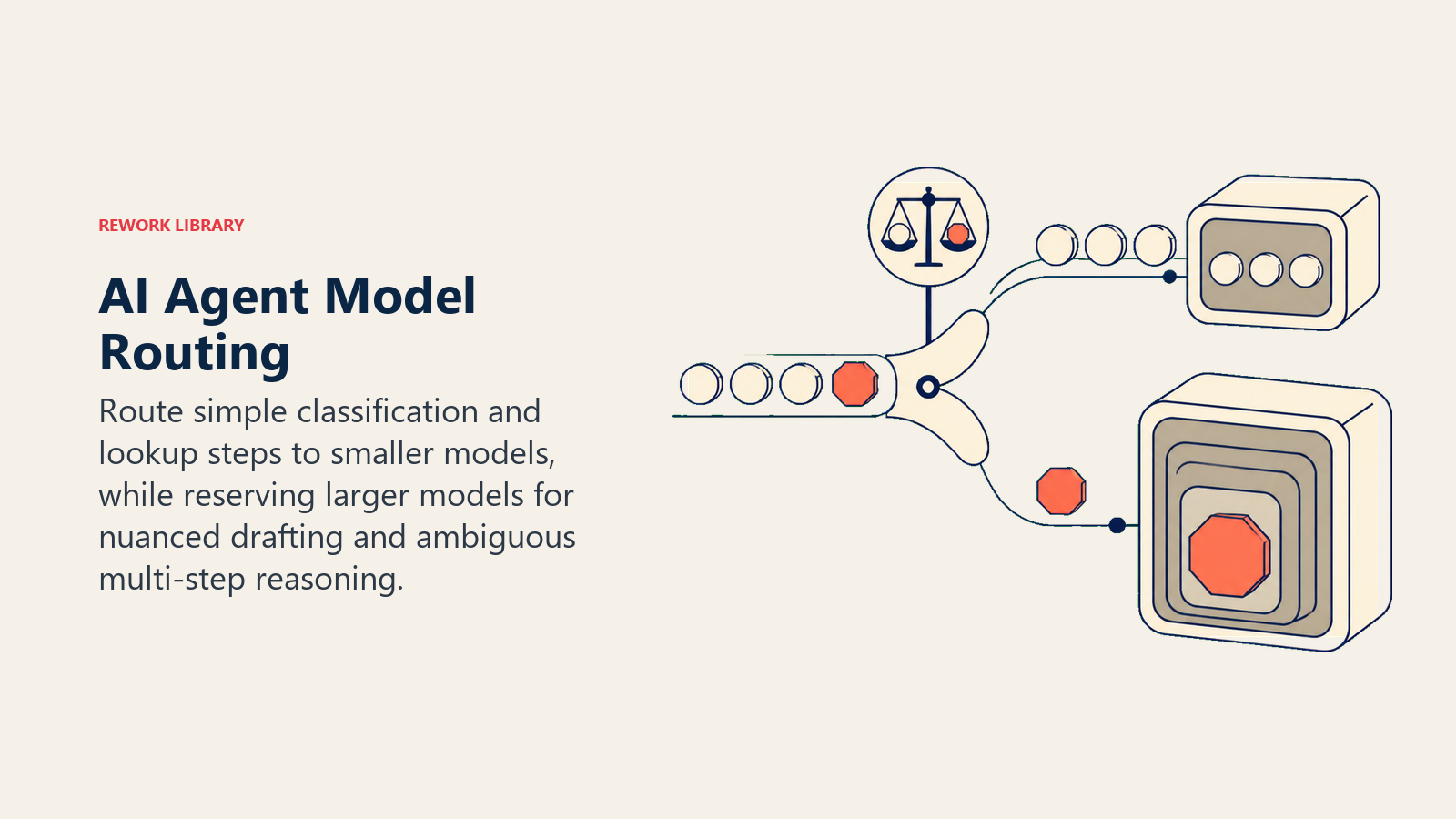
Model routing means matching the step to the model instead of running the whole agent on one tier by default. When AI patterns get expensive at scale documents this same idea in its Workflow Copilot cost section: routing simpler suggestion requests to cheaper models while reserving premium inference for the requests that actually need it. A simple routing table for a typical agent:
| Step type | Example | Model tier |
|---|---|---|
| Classification, extraction, routing decisions | Which queue does this ticket belong in? | Small, fast, cheap |
| Structured lookups and rule matching | Does this invoice match an approved PO? | Small to mid |
| Drafting customer-facing text | Write the reply for this specific case | Mid to large |
| Ambiguous exceptions and multi-step reasoning | This case doesn't match any playbook scenario | Largest available |
The decision logic building block that decides whether an agent acts, asks, or hands off is the same place model routing belongs. You're already branching logic by case type. Route the model choice through that same branch instead of treating it as a separate decision.
Lever 3: Hard Budgets, So a Runaway Task Can't Run Up the Bill
Caching and routing lower the price per call. Budgets limit how many calls a single task is allowed to make, and that matters because the real cost blowups rarely come from the price per call. They come from a task that keeps calling the model far more times than anyone planned for.
When AI patterns get expensive at scale makes the point bluntly: an Autonomous Agent without hard iteration limits and per-task token budgets is a financial liability, not a productivity tool. The fix is two settings, both simple to state and easy to skip: a maximum number of model calls per task, and an automatic handoff to a human when the task hits that limit instead of continuing to spend. Neither of these is a nice-to-have you add after the first expensive month. They belong with every other hard limit an agent needs. AI agent guardrails covers output and tool-call guardrails in depth, and a budget cap is exactly that kind of guardrail: a rule that holds regardless of how confident the agent is that one more call will finish the job.
Where This Shows Up in Real Agents
These levers aren't abstract. A few places in this library where getting them right, or wrong, has an outsized effect on the bill:
- AI Research Agent: cost scales directly with how many sources it pulls into context per brief. Scoping the source count and routing the synthesis step to a mid-tier model instead of the largest one available is often the difference between a $2 brief and a $20 one.
- AI Knowledge Base Agent: the same policy documents and FAQ excerpts get retrieved across hundreds of similar questions, which makes it one of the highest-payoff places to cache context instead of re-sending the same retrieved chunks on every query.
- AI Support Triage Agent: high call volume means even a small per-call saving multiplies fast. Routing the initial classification step to a small model while reserving a larger one for drafting the actual reply keeps volume from becoming the whole budget.
A Simple Cost Model Before You Scale Past the Pilot
Before taking an agent from a small pilot to real volume, put rough numbers on four things: average tokens per call (measure it, don't guess), expected call volume at production scale, your cache hit rate assumption, and your routing split across model tiers. Multiply it out at 2x and 5x pilot volume, not just at pilot volume, because pilots run on the easiest, most representative cases and production doesn't. When AI patterns get expensive at scale recommends adding a 50-100% buffer to whatever your samples suggest, for exactly this reason.
The other number worth modeling early is cost against outcome, not cost against activity. Measuring AI pattern ROI goes deeper on that framing: a cheaper agent that fails half its tasks isn't actually cheaper once you count the human time spent cleaning up after it. And zoom out one more level: agent inference is one line item inside the broader AI total cost of ownership picture that also includes talent, integration, and governance, so getting this one lever right doesn't mean the rest of the AI budget takes care of itself.
Watching Cost After You Ship
Optimization at launch drifts without monitoring after launch. AI agent observability already names the metric that matters most here: cost per completed task, not cost per run, because a run that fails still spent tokens and a cheap run that fails twice before succeeding isn't actually cheap. Track that number alongside cache hit rate and your model-tier distribution, and pay attention when any of the three drifts: rising cost per completed task, falling cache hit rate, or a shift toward the expensive tier on step types that used to route cheap. Any of those three is usually the earliest sign that something in the agent's inputs or behavior changed, well before the bill tells you.
If you're comparing platforms to build or run agents on, cost predictability is worth scoring explicitly rather than assuming it's similar across vendors. Our AI tools comparisons evaluate platforms on more than feature lists, and the SaaS vendor evaluation scorecard gives you a weighted template for putting cost predictability on equal footing with capability when scoring options.
Key Facts
- Cached input tokens cost 90% less than standard input pricing on Anthropic's models (10% of base price to read from cache), while writing new content to the cache costs 25% more, so caching pays off on anything reused more than once or twice.
- Batch processing for non-real-time agent work adds a separate 50% discount on top of standard API pricing.
- Gartner predicts over 40% of agentic AI projects will be canceled by the end of 2027, with escalating costs among the leading cited causes.
- Published model pricing across major providers typically shows an order-of-magnitude gap between small, fast models and frontier flagship models, which is what makes routing by task difficulty the highest-leverage lever most teams haven't used yet.
- The financial control that matters most for a looping agent is a hard cap on model calls per task with automatic handoff when it's reached, not a lower price per call.
Frequently Asked Questions about AI Agent Cost Optimization
What is AI agent cost optimization?
It's the set of techniques that keep an agent's token and compute spend proportional to what it delivers: caching repeated context so you don't pay to reprocess it, routing easy steps to cheaper models and hard steps to more capable ones, and capping how much a single task can spend before it hands off to a person.
Why do AI agents cost more to run than a single model call?
An agent runs a loop, perceive, reason, act, observe, repeat, and each pass can trigger its own model call or tool call. A task that takes one call for a simple case can take many more for a harder one, so cost compounds with the number of iterations in a way a single model call never does.
What's the difference between caching and model routing?
Caching lowers the cost of reusing context you've already sent to the model, often by 90% or more on the cached portion. Model routing lowers cost by matching each step to the cheapest model capable of doing it well, instead of running every step on your most expensive model by default. They're complementary, not alternatives.
How much can these techniques actually save?
It depends on your mix of repeated context, call volume, and task complexity, but the underlying discounts are substantial: 90% off cached input tokens, 50% off batch processing, and typically an order-of-magnitude price gap between small and frontier models for the steps that don't need frontier reasoning.
What's a reasonable budget cap for an agent task?
There's no universal number, since it depends on task complexity, but the principle is universal: set a maximum call count per task and route to a human automatically when it's hit, rather than letting the agent keep trying indefinitely. Treat it as a guardrail, not a suggestion.
Where to Go Next
Caching, routing, and budgets control what an agent costs. AI agent observability is how you confirm those controls are still working after launch, since cost per completed task is one of the clearest early signals of drift. If you haven't modeled why costs escalate at scale in the first place, when AI patterns get expensive at scale is the deeper read, and how to build an AI agent covers where budget caps fit among the rest of an agent's guardrails.

On this page
- Why an Agent's Cost Curve Isn't a Model's Cost Curve
- Lever 1: Caching, So You Don't Pay for the Same Context Twice
- Lever 2: Model Routing, So Easy Steps Don't Pay Frontier Prices
- Lever 3: Hard Budgets, So a Runaway Task Can't Run Up the Bill
- Where This Shows Up in Real Agents
- A Simple Cost Model Before You Scale Past the Pilot
- Watching Cost After You Ship
- Key Facts
- Where to Go Next