AI Agent Compliance: Audit Trails, Data Residency, and the EU AI Act
Turn this article into takeaways for your work.


Each assistant summarizes the article only for you and suggests best practices for your work.
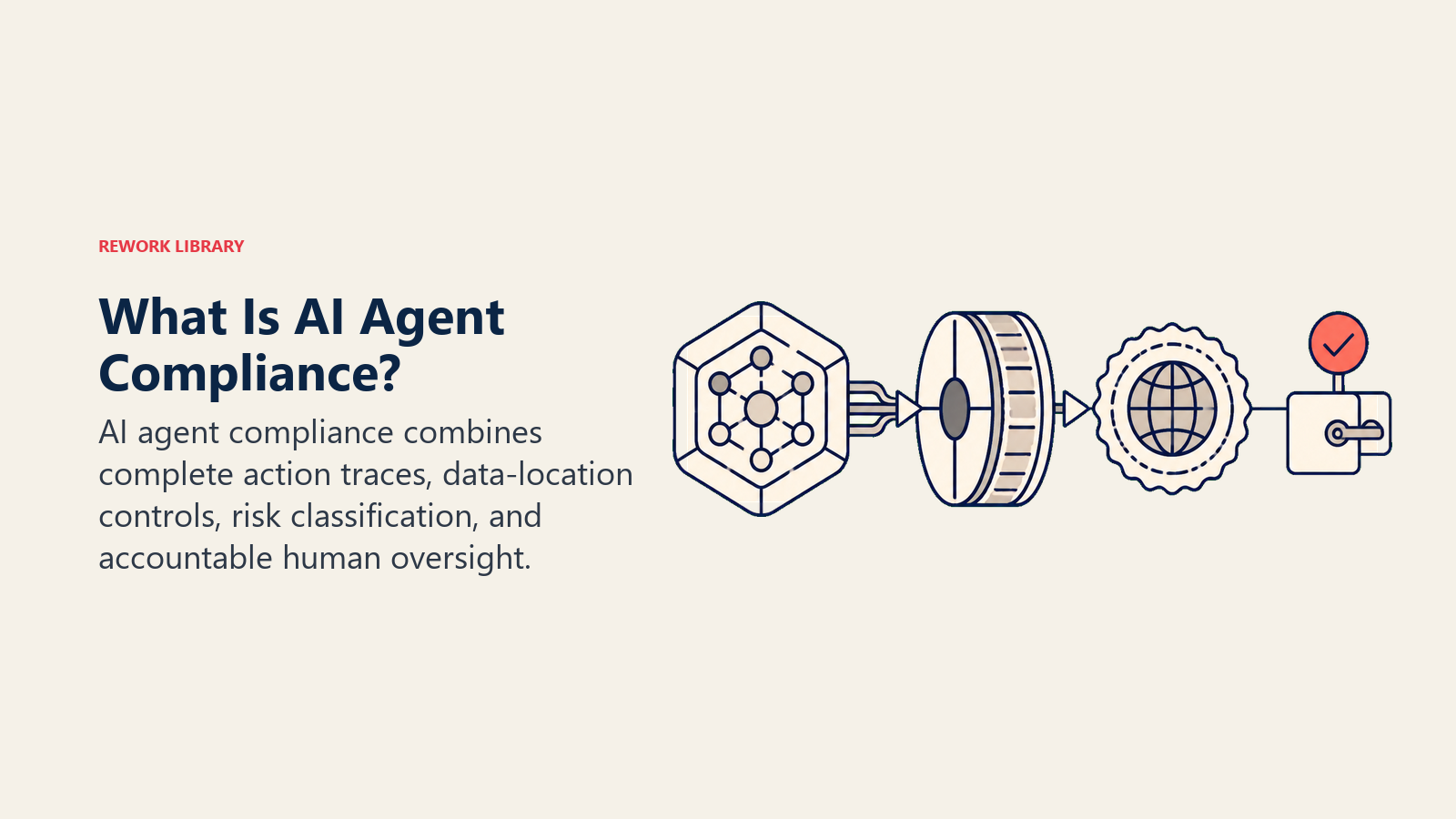
AI agent compliance is the set of controls that let you prove, to a regulator, an auditor, or your own legal team, exactly what an autonomous agent did, why it did it, where the data went, and who was accountable for the outcome. It's a harder problem for agents than for a single model, because the thing you have to defend isn't a generated sentence, it's a real action: a refund issued, a candidate screened out, a record changed. Three areas carry most of the weight, and this article covers all three: a complete audit trail of the agent's decision-and-action chain, data residency for what crosses borders during a run, and mapping the agent's actual function against frameworks like the EU AI Act before it ships.
Why Compliance Gets Harder Once Software Can Act
AI governance is the umbrella discipline: the policies, ownership, and oversight that keep any AI system aligned with regulatory and organizational expectations. Everything in that broader practice still applies to an agent. What changes is where the risk concentrates. Rework's ACE Framework draws a hard line between Generate and Execute: a draft is low stakes because a person can review it before anything happens, and the Execute step is where a decision becomes an action nobody gets to review first. An agent, by definition, is built to cross that line, so governance requirements concentrate at the Execute step in a way they don't for a chatbot that only ever drafts.
That's the reason compliance for agents needs its own playbook instead of borrowing the general AI governance one wholesale. A model that only generates text needs to be evaluated for what it says. An agent needs to be evaluated for what it's allowed to do, what it actually did, and whether you can reconstruct and defend that decision months later.
The Audit Trail: More Than a Logged Prediction
An AI audit trail is generally defined as the timestamped record of an AI system's inputs, decisions, and outputs, built to satisfy the same accountability role a flight data recorder plays for an aircraft. That definition holds for an agent, but the record itself has to capture more.
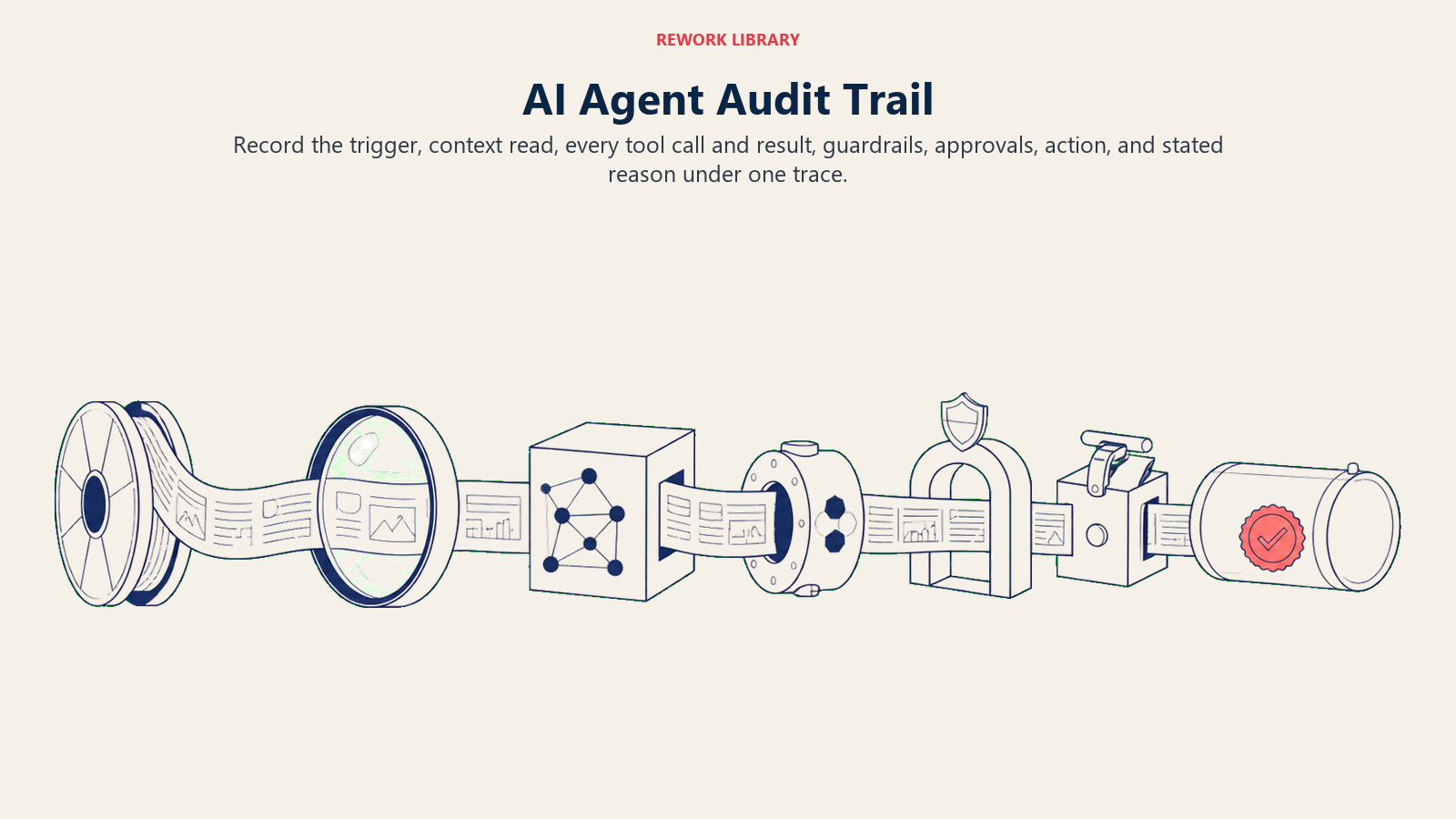
A single model call has one input and one output to log. An agent run is a chain: how AI agents work describes it as perceive, reason, act, observe, repeated across a task, and a defensible audit trail has to capture every link in that chain under one trace, not just the first and last step. At minimum: what triggered the run, what context and records it read, every tool it called with the parameters it sent and the result it got back, which guardrail fired if any did, whether a human approved the action, and the final outcome with a stated reason.
This is closely related to, but not the same job as, AI agent observability. Observability is built for an operations team debugging a live system: short retention, fast access, tuned for catching drift. An audit trail is built for a compliance team or a regulator defending a specific decision years later: long retention, immutable storage, tuned for reconstruction. Most teams can capture both from the same underlying trace data, but they serve different audiences and different retention rules, and treating them as one system with one purpose is a common gap.
The design principle that makes this tractable is the Autonomous Agent pattern's Audit-Or-Block Rule: if the agent can't produce a complete decision trace for an action, it shouldn't be allowed to take that action autonomously in the first place. Build the trail into the loop itself, not as a report generated after the fact.
Data Residency: Where Does the Data Actually Go?
Software vendor due diligence used to mostly ask where a system stores data. An agent adds a second question: where does it reason over that data, since a retrieval step or a tool call can pull a record into a model's context window running in a different region than the system storing it. Reading EU customer data into a US-hosted model's context during a run is a data flow that needs to be mapped and defensible on its own terms, not assumed to be fine because the underlying record store happens to be EU-hosted.
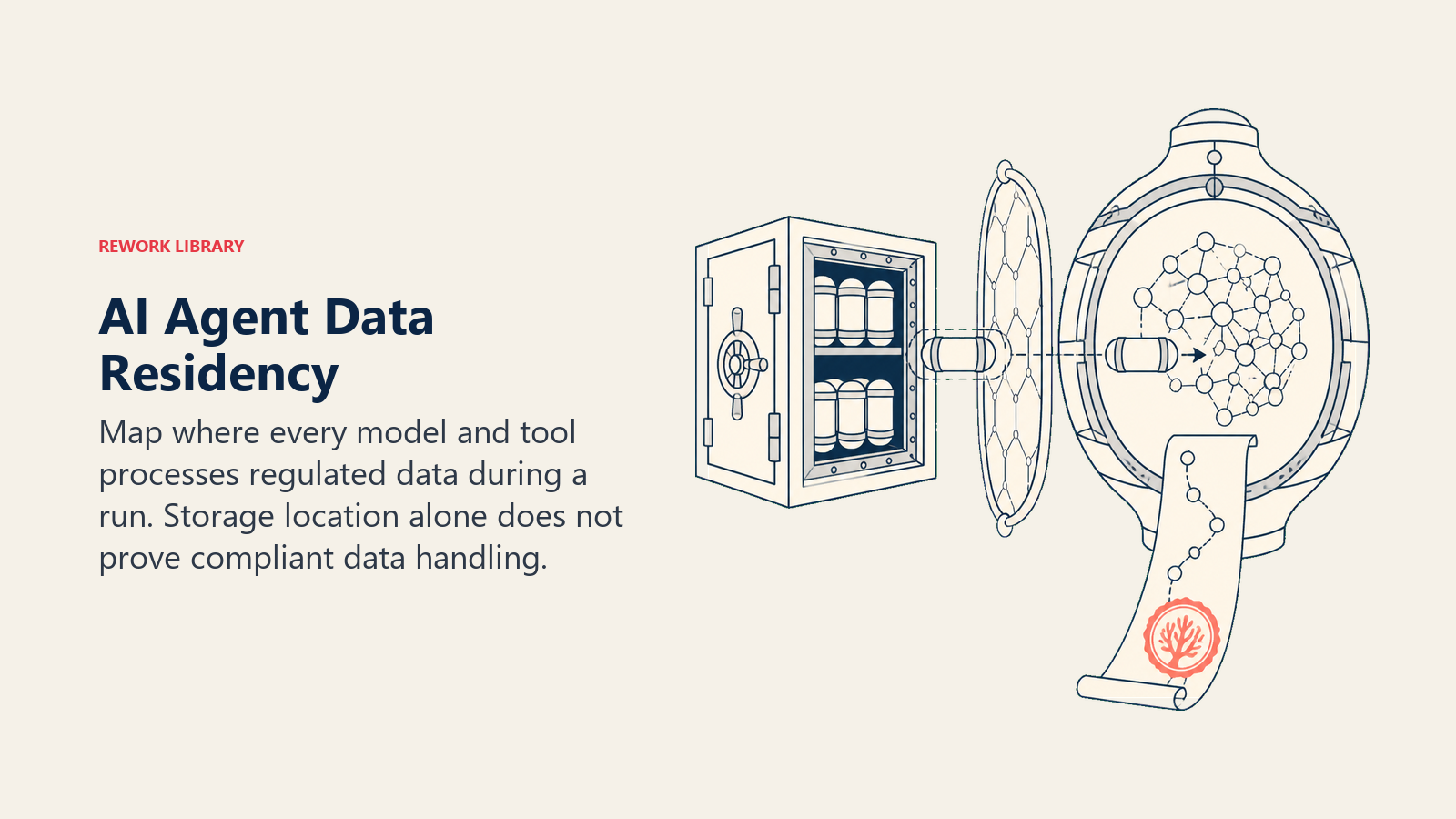
This isn't a hypothetical compliance nuance. Under GDPR-style regimes, processing personal data typically requires a legal basis, and when that processing happens outside the governed region, a valid transfer mechanism, regardless of whether a human or an agent triggered the processing. Practically, that means inventorying which tools and data sources an agent actually touches during a run, confirming where each one actually processes data (not just where it's stored), and treating any agent that reasons over regulated personal data as a subprocessor relationship deserving the same scrutiny you'd apply to a new vendor, not a background detail of your AI stack.
Mapping an Agent Against the EU AI Act
The EU AI Act classifies AI by risk tier based on what it's used for, not on whether the system happens to be "agentic." Its High Risk tier already covers employment, credit, essential services, law enforcement, and education, among other categories, and an agent doing any of that work falls into the same tier a simpler system doing the identical job would. An AI Recruiting Screener Agent making or materially influencing a hiring decision sits squarely in the employment category. An agent touching credit decisions or essential services inherits the same obligations.
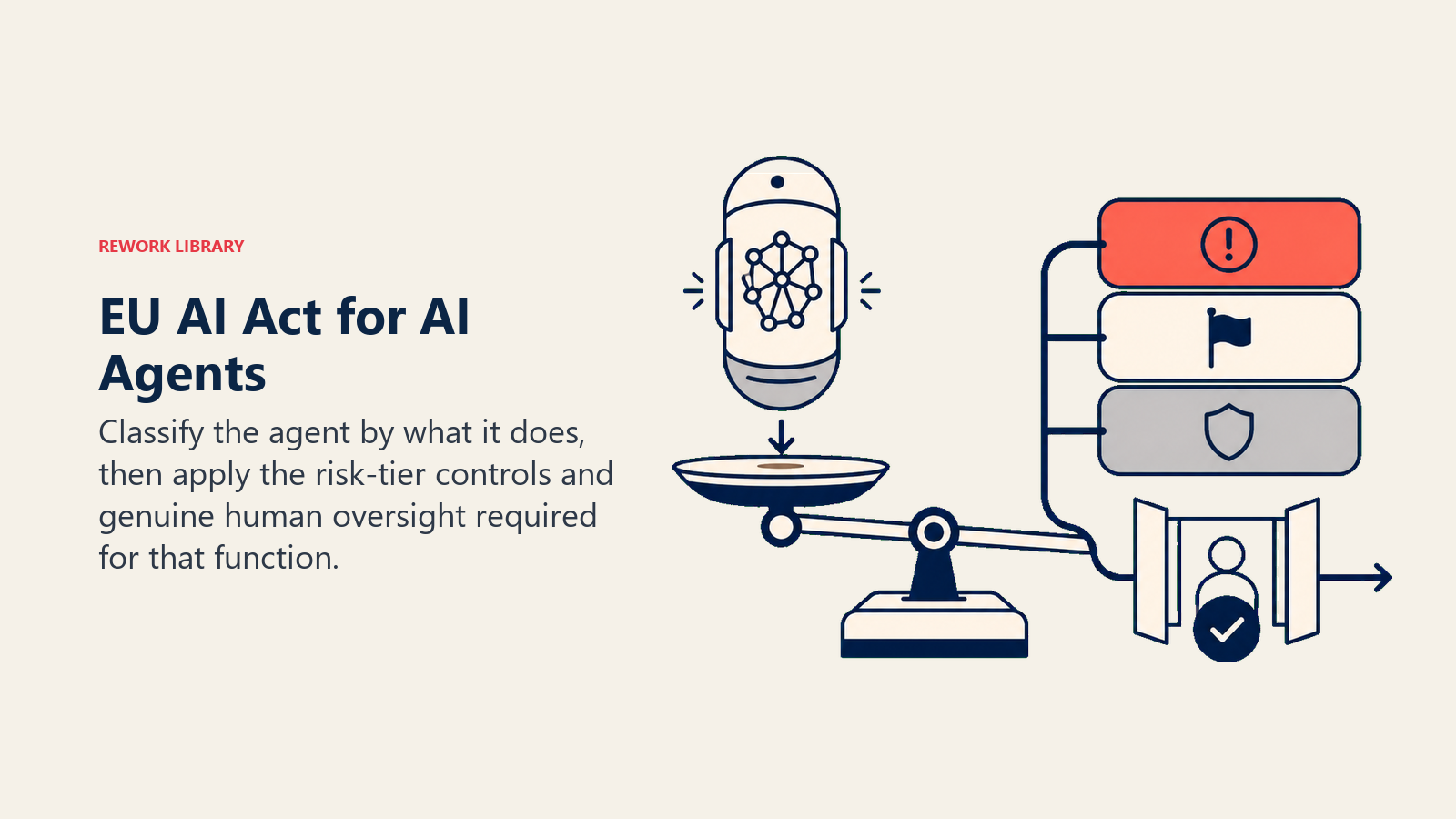
What's specific to agents is the human oversight requirement. High-risk systems under the Act need real human oversight built in, and for an agent that autonomously executes actions rather than just producing a recommendation, that oversight has to be a genuine checkpoint on the actions that matter, not a rubber stamp on an activity log after the fact. Human-in-the-loop design for AI agents is the practical guide for building that checkpoint correctly.
The timeline is also worth checking rather than assuming, because it has moved. Earlier guidance pointed to August 2027 for full high-risk compliance. In May 2026, the European Parliament and Council reached a provisional agreement delaying high-risk obligations to come into force in phases starting December 2, 2027, according to law firm analysis of the update, while obligations for general-purpose AI models stayed on their original August 2026 start. If you're scoping compliance timing for an agent that might fall into a high-risk category, verify the current phase-in schedule directly rather than working from a date you read once. The penalties for getting it wrong haven't softened: up to €35 million or 7% of global annual turnover for the most serious violations.
A Compliance Checklist Before an Agent Ships
Five questions worth answering before an agent with any meaningful autonomy goes live, not after:
| Question | Why it matters |
|---|---|
| What does the agent actually do, and what data does it touch? | You can't classify risk or map data flows for a function nobody has written down precisely |
| Does that function fall into a regulated high-risk category? | Employment, credit, and essential-services functions carry obligations regardless of whether a human or an agent performs them |
| Can you reconstruct any single decision months later? | This is the real test of an audit trail: not whether logging exists, but whether it's usable in a real dispute |
| Is there a genuine human checkpoint on the actions that matter? | Required for high-risk functions under the EU AI Act, and good practice regardless of jurisdiction |
| Where does the agent actually process regulated data, not just store it? | Model inference location is a data flow that needs its own due diligence, separate from where records live |
Compliance Is a Build-Time Decision, Not a Launch-Day Checklist
Retrofitting an audit trail onto an agent that's already live costs far more than building it into the six building blocks from the start, because the trail has to be native to the loop, not bolted onto it afterward. Most organizations aren't there yet. A 2026 survey of compliance, risk, and audit leaders found that 83% of organizations report using AI tools, but only about 25% have implemented a strong governance framework to go with it, which means most agents in production today are running with far less compliance infrastructure underneath them than the risk they carry would justify. The gap doesn't close itself. It closes when a team decides, before the first agent ships, that the trail and the oversight are part of the build, not a follow-up project for whenever a regulator asks.
Key Facts
- An agent's audit trail has to capture the full decision-and-action chain (trigger, context read, every tool call and result, guardrails fired, human approvals, final outcome) under one trace, not a single input-output pair.
- Audit trails and observability use the same underlying trace data but serve different jobs: observability is short-retention and built for operations, audit trails are long-retention and built for legal and regulatory defense.
- The EU AI Act classifies agents by function, not by autonomy. An agent doing employment, credit, or essential-services work inherits the same high-risk obligations a non-agentic system doing the same job would carry.
- High-risk compliance deadlines under the EU AI Act were delayed via a May 2026 provisional agreement to phases starting December 2, 2027, though general-purpose AI model obligations still started August 2026. Verify the current schedule directly before assuming a date.
- A 2026 compliance survey found 83% of organizations use AI tools but only about 25% have a strong governance framework in place, meaning most agents in production are under-covered relative to their actual risk.
Frequently Asked Questions about AI Agent Compliance
What is AI agent compliance?
It's the set of controls that let you prove what an autonomous agent did, why it did it, where the data went, and who was accountable, to a regulator, auditor, or your own legal team. It covers audit trails, data residency, and mapping the agent's function against relevant regulation like the EU AI Act.
How is an agent's audit trail different from a regular AI system's?
A single model call has one input and one output to log. An agent runs a chain of decisions and tool calls across a task, so its audit trail has to capture every step under one trace, including which tools it called, what guardrails fired, and whether a human approved the action, not just a final answer.
Does the EU AI Act apply to AI agents specifically?
The Act classifies systems by what they're used for, not by whether they're agentic. An agent performing a high-risk function, employment, credit, essential services, inherits the same obligations a simpler system doing that job would carry, plus a genuine human oversight requirement that matters more once the system can act on its own.
What is data residency risk for an AI agent?
It's the risk created when an agent's reasoning pulls regulated data into a model's context window that runs in a different region than where the data is stored. That's a data flow that needs its own compliance review, separate from where the underlying records live.
How long should you retain an AI agent's audit trail?
It depends on your industry and jurisdiction, but multi-year retention, commonly 3 to 7 years, is typical for regulated functions. Check the specific requirement for your function, since financial, employment, and healthcare-adjacent uses often carry different minimums, rather than defaulting to whatever your logging tool retains out of the box.
Where to Go Next
An audit trail and a human checkpoint only work if they're built into the agent from the start. How to build an AI agent covers where both fit among the six building blocks, human-in-the-loop design covers the oversight mechanism regulators actually want to see, and AI agent security covers the adjacent risk discipline that shares much of the same threat model.

On this page
- Why Compliance Gets Harder Once Software Can Act
- The Audit Trail: More Than a Logged Prediction
- Data Residency: Where Does the Data Actually Go?
- Mapping an Agent Against the EU AI Act
- A Compliance Checklist Before an Agent Ships
- Compliance Is a Build-Time Decision, Not a Launch-Day Checklist
- Key Facts
- Where to Go Next