AI Agents for Marketing: 11 Use Cases to Deploy First (2026)
Turn this article into takeaways for your work.


Each assistant summarizes the article only for you and suggests best practices for your work.
A marketing team of four owns eleven channels: blog, email, paid social, organic social, landing pages, webinars, PR, and more. Nobody has time to do all eleven well every single week. Something always gets the rushed version, or gets skipped entirely. Multiply that by every campaign launch, every product update, and every seasonal push, and the backlog never fully clears. AI agents don't replace the strategy or the voice behind a campaign. They cover the repeatable production and monitoring work underneath it, so the team's time goes to the calls only a person can make.
This page maps where AI agents fit across a marketing team: what each one actually does, and which real blueprint to build from. For the underlying definition first, see what an AI agent actually is. If you already know your use case, jump to the table below.
What AI Agents Actually Do for a Marketing Team
A generic AI writing tool drafts one email when you ask it to. An AI agent runs the ongoing job: it drafts on a schedule, checks its own output against your brand guidelines, publishes or queues for approval, and flags you the moment something needs a human call, a legal review, a brand judgment, a campaign pivot. The difference is the loop, not the single output.
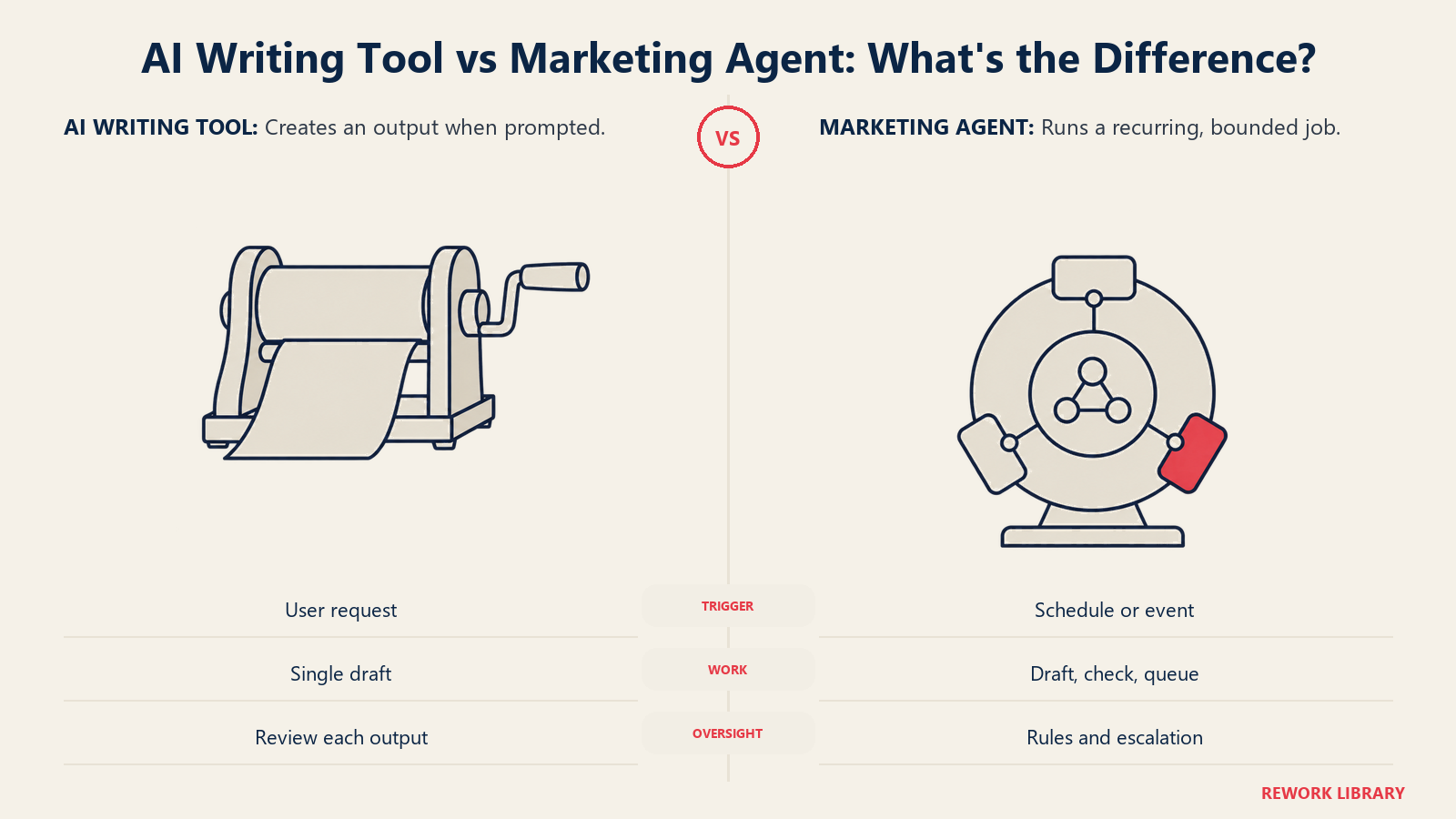
Marketing has more room for full automation than most functions, since a lot of the work (drafting, formatting, scheduling, monitoring) has a fairly clear right answer once the guidelines are written down. But brand voice, campaign strategy, and anything customer-facing at real scale still deserve a human check before it ships. The safest place to start is usually the work with the least ambiguity: a social caption follows a format, an ad variant follows a template, a first draft follows a brief. Strategy doesn't follow a template, which is exactly why it stays with a person. The when to use an AI agent guide has the fuller test for where that line sits for your team.
Key Facts: AI Agents for Marketing
- High-performing marketing teams are nearly twice as likely as underperformers to use AI agents, and are reclaiming up to eight hours a week doing it, according to Salesforce's State of Marketing 2026 research.
- Mature AI deployments in marketing and sales can lift lead volume by more than 50% and cut prospecting costs by up to 60%, per McKinsey.
- Content and campaign production (drafting, briefs, social scheduling) is usually the first place marketing teams put an agent to work, since the rules already exist in a brand guide or style guide somewhere.
Eight hours a week is basically a full extra day. Where would your team spend it if production stopped eating the calendar?
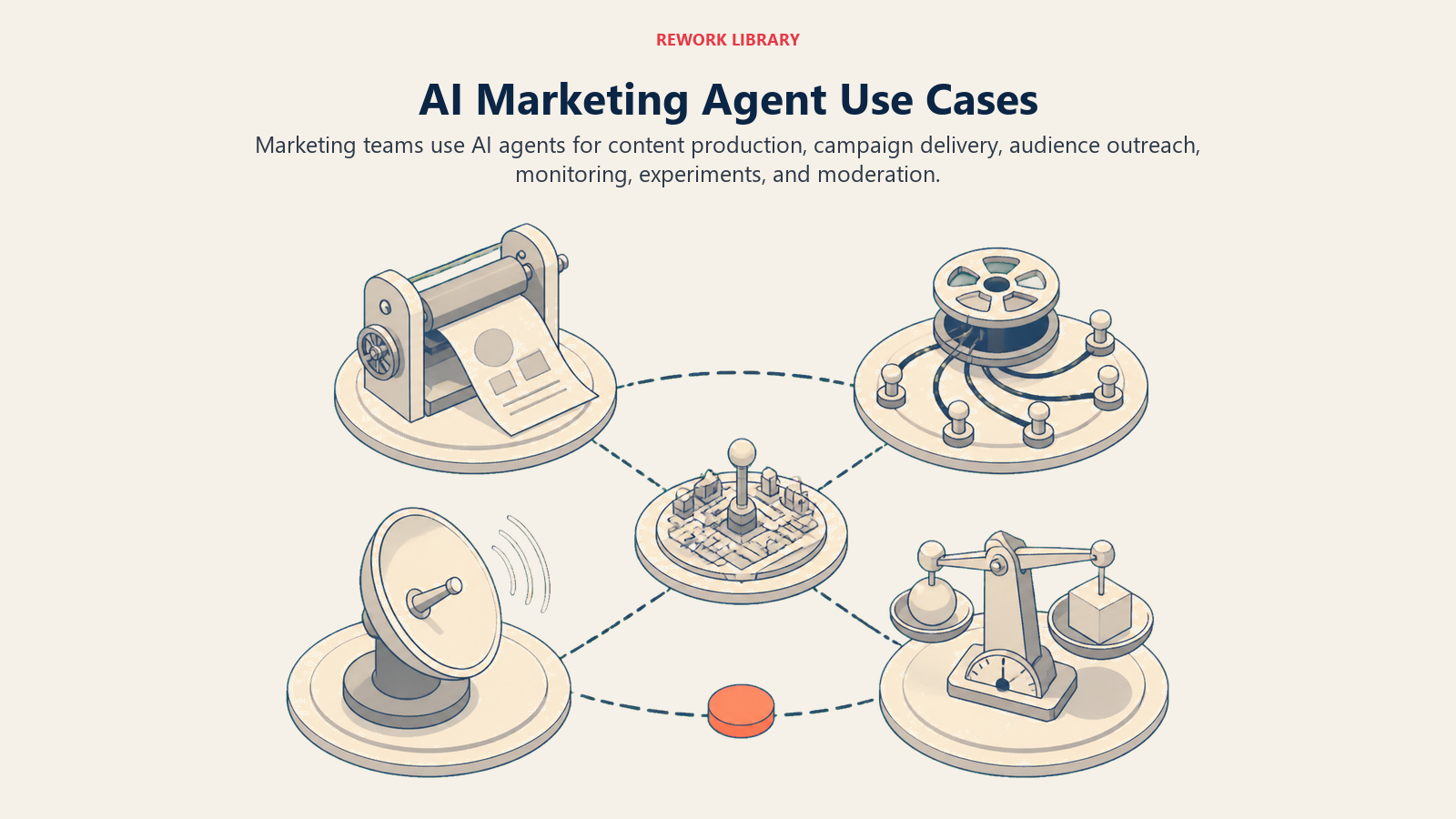
11 AI Agent Use Cases for Marketing Teams
Each row is a distinct job. Most marketing teams start with whichever one has the most standing, well-documented rules already, since that's the fastest agent to configure well.
| Marketing Function | What the Agent Does | Blueprint |
|---|---|---|
| Ad copy | Drafts and tests ad copy variants against your brand guidelines and past performance | AI Ad Copy Agent |
| Content drafting | Turns briefs into first drafts of blog posts, emails, and landing page copy for human review | AI Content Drafting Agent |
| SEO content briefs | Researches a keyword, competitors, and search intent, then builds a brief a writer can work from | AI SEO Content Brief Agent |
| Social media | Drafts and schedules social posts across channels within your brand voice and cadence | AI Social Media Agent |
| Email campaigns | Builds and sends segmented email campaigns, and adjusts send logic based on engagement | AI Email Marketing Agent |
| Landing pages | Assembles and updates campaign landing pages without a developer in the loop for every change | AI Landing Page Agent |
| Influencer outreach | Identifies and reaches out to relevant creators or partners for a campaign | AI Influencer Outreach Agent |
| Webinars and events | Handles the logistics loop around a webinar or event: invites, reminders, follow-up | AI Webinar / Event Agent |
| PR and media monitoring | Watches for brand and competitor mentions across media and flags what needs a response | AI PR Monitoring Agent |
| A/B testing | Sets up, monitors, and calls the winner on marketing experiments against rules you define | AI A/B Testing Agent |
| Community moderation | Monitors community channels for policy violations and flags or removes what breaks the rules | AI Community Moderation Agent |
What Each Marketing Use Case Needs Before You Build It
A marketing agent drafts on-brand only if the brand is written down, and it publishes only where it has access. Check the inputs below, and set the approval points before the first piece ships.
| Use Case | Data and Systems It Needs | Where a Human Approves |
|---|---|---|
| Ad copy | Brand guide, approved claims, past ad performance, ad platform access | A person approves every variant before spend; legal reviews claims about price or results |
| Content drafting | Content briefs, style guide, product facts, CMS access | An editor reviews every draft; the agent never publishes a factual claim without a source |
| SEO content briefs | Keyword and search-intent data, your existing content inventory, competitor pages | A strategist approves the angle before a writer starts |
| Social media | Brand voice guide, content calendar, scheduler access | Scheduled posts can run with spot checks once trusted; anything reactive or sensitive is approved |
| Email campaigns | Segment definitions, consent and suppression lists, email platform access | A person approves each new campaign and any change to send logic |
| Landing pages | Page templates, approved copy blocks, CMS or builder access, analytics | A person approves publishing; pricing or legal copy is locked to approved text |
| Influencer outreach | Target criteria, a creator or partner list, outreach templates | A person approves the first message to each new creator and any offer |
| Webinars and events | Registration data, event calendar, email and calendar access | A person approves the invite and follow-up copy and any speaker-facing message |
| PR and media monitoring | Media and social monitoring sources, a list of brand and competitor terms | A person decides on any public response; the agent only flags and summarizes |
| A/B testing | Traffic and conversion data, a test plan, defined success metrics | A person approves the test design and confirms the winner before a rollout |
| Community moderation | Community rules, platform moderation access, escalation contacts | Removals are logged; bans and borderline cases go to a person |
How to Get Started
The Written-Down Test: if a marketing task's rules only live in one person's head, brand voice, approval steps, escalation points, that's a task to document first and automate second.
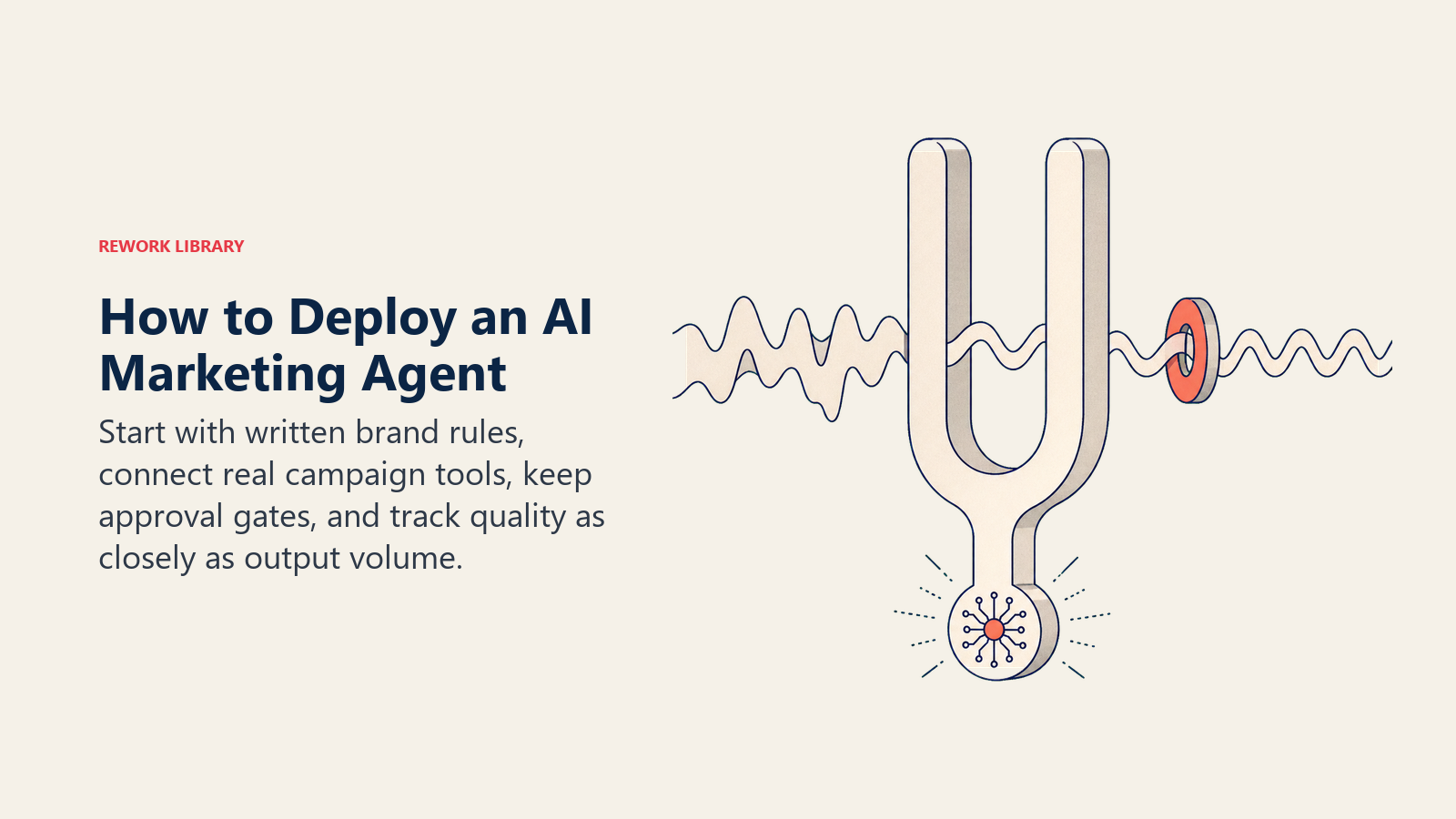
Start from your brand guide, not a blank prompt. The agent's output is only as on-brand as what you feed it. Voice, tone, approved claims, and anything legal or compliance won't sign off on: get that written down before the agent drafts a single post.
Connect it to your actual content and campaign tools. Whether that's your CMS, your social scheduler, or your email platform, the agent needs somewhere real to publish or queue work, not just a doc it hands back to someone. If you're still comparing marketing platforms, the marketing tools hub and the how to choose marketing automation software guide cover the current options side by side.
Watch for style and brand-safety drift. An agent producing content at higher volume can drift from your style, or worse, publish something off-brand faster than a human ever would. Build a lightweight review checkpoint for anything that ships publicly, at least until the agent has a track record.
Keep a human in the loop on anything customer-facing at scale. Draft and schedule can run mostly unattended once trust is built. Publish, especially anything with a claim, a price, or a legal implication, should keep an approval step for longer than feels necessary at first.
Track quality alongside output. More posts published or more emails sent isn't the win by itself. Watch engagement, conversion, and how often a human has to substantially rewrite what the agent drafted. That last number tells you when it's actually ready for more autonomy.
How to Measure a Marketing Agent
Output volume is the easiest number and the least useful one. Track quality and the effort it takes a person to make the agent's work shippable.
- Content, ad copy, and social: engagement and conversion on agent-drafted work, and how often a human had to substantially rewrite it. A falling rewrite rate tells you when it is ready for more autonomy.
- Email and landing pages: conversion against your pre-pilot baseline, plus errors caught at approval.
- SEO briefs and A/B testing: how many briefs a writer used as written, and how many tests reached a clean, usable result.
- PR monitoring and moderation: time from a mention or violation to a flag, and how many flags a person judged worth acting on.
Frequently Asked Questions about AI Agents for Marketing
What's the first AI agent a marketing team should build?
Whichever content or production task has the most standing rules already written down, commonly social scheduling or first-draft content, since those are the fastest to configure accurately and touch the calendar every week. Most teams see the clearest early win here, because the volume is high and the format is repeatable.
Will an AI marketing agent replace copywriters or content strategists?
No. It handles the repeatable production work (first drafts, scheduling, formatting, monitoring) so writers and strategists spend more time on positioning, campaign ideas, and anything genuinely creative that needs a person's judgment.
How do we keep an AI marketing agent on brand?
Give it a written brand guide: approved voice, tone, claims, and examples of what good looks like. The agent can only stay consistent with rules you've actually documented, not ones that live only in a senior marketer's head.
Can an AI agent publish content without a human reviewing it first?
It can, once you've built enough trust in its output through a pilot period. Most teams keep a human approval step for anything customer-facing at first and only loosen it for lower-risk content, like internal drafts or routine social posts.
What marketing tasks are a bad fit for an AI agent?
Anything that depends on a judgment call with real business risk, like a brand pivot, a sensitive PR response, or campaign strategy itself. Agents are built for the well-documented production work underneath those decisions, not the decisions.
How is this different from the AI features already inside my marketing platform?
Built-in AI features usually generate one output when you ask. An agent runs the ongoing job: drafting on schedule, checking its own output, publishing or flagging for review, and escalating on its own when something needs a human, across whatever tools you connect it to. That difference, a single output versus a managed, ongoing process, is what separates every blueprint in this library from the AI features already built into most marketing software.
Where to Go Next
Start with the row in the table above that matches your loudest production gap. If content is the bottleneck, read the AI Content Drafting Agent blueprint first. If it's the social calendar, start with the AI Social Media Agent. Both follow the same underlying design covered in how to build an AI agent. Whichever you pick, treat the first month as a pilot, not a launch: watch the rewrite rate, not just the output count. One job the agents in the table don't cover is finding out whether ChatGPT and Perplexity mention your brand at all; Best AEO Tools in 2026 prices twelve platforms built for it.
Buying a Ready-Made Agent?
If you'd rather buy than build, see our ranked list of AI agents for marketing teams. It compares ready-made products and pricing, so you can judge vendors against the same use cases listed above.
