How to Build an AI Agent with Zapier
Turn this article into takeaways for your work.


Each assistant summarizes the article only for you and suggests best practices for your work.
Zapier Central is Zapier's AI agent builder: you give an agent instructions, connect it to the apps it needs, and it reasons through a task the same way a person would, deciding which app action to take and when, instead of following one fixed if-this-then-that path. It sits on top of Zapier's existing catalog of thousands of app integrations, so the agent's toolset is whatever your team already connects Zapier to. This guide covers why teams pick Zapier for agent work, what an agent is made of, a full build walkthrough, a worked example, real costs, and when Zapier is the wrong choice.
Why Teams Build Agents in Zapier
Three things make Zapier a default starting point for a lot of business teams, not just automation specialists.
The app catalog is the widest in the category. Zapier says it's trusted by 3 million-plus businesses and connects to 9,000-plus apps out of the box, with managed authentication so you're not handling API keys and OAuth flows yourself. For a team whose stack already runs through Gmail, Salesforce, Slack, and a few dozen smaller tools, that catalog is the difference between an agent you can build this week and one that needs custom integration work first.
Governance is built in, not bolted on. Zapier ships AI Guardrails that scan for prompt injection, PII exposure, toxic language, and negative sentiment before an agent's output goes anywhere, plus an activity dashboard for audit logging and SOC 2 Type II compliance. That matters because an agent with access to your CRM and inbox is exactly the kind of surface prompt injection attacks target.
No-code agent builders are becoming their own category, not a lesser version of "real" agent tools. Gartner now tracks this as an emerging market landscape specifically for no-code agent builders, with analyst Jason Wong noting these tools accelerate agent creation by citizen developers while tech leaders still need clear definitions and scope for how far that goes. Zapier is one of the platforms driving that shift, alongside the broader trend Gartner captures in its prediction that 40% of enterprise applications will feature task-specific AI agents by the end of 2026, up from less than 5% in 2025.
What a Zapier Agent Is Made Of
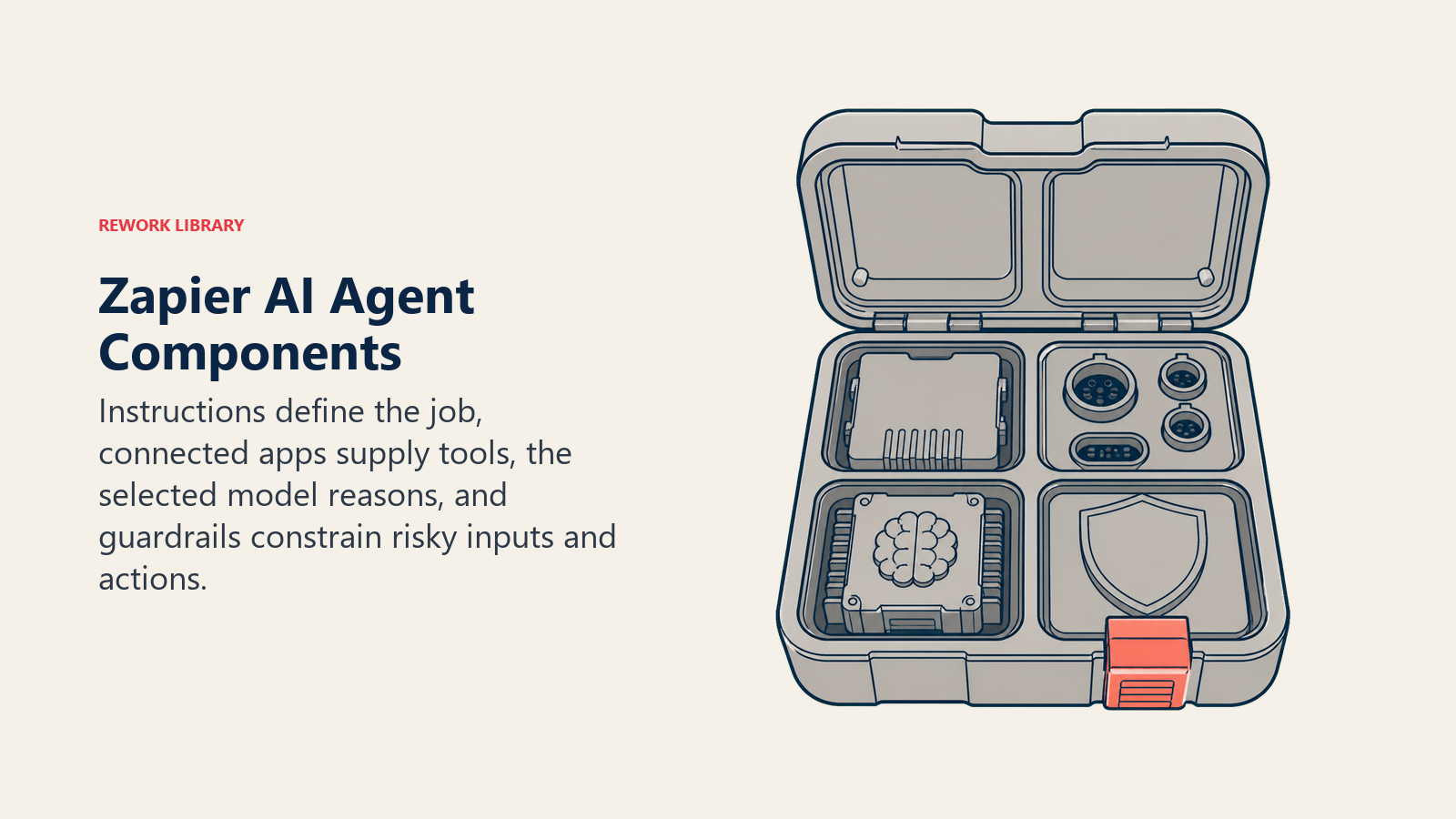
| Component | What it does | Your options |
|---|---|---|
| Instructions | The agent's role and rules, written in plain language | A free-text prompt describing the job and its limits |
| Tools | What the agent can actually do | Any of Zapier's 9,000+ app connections, plus web browsing and a Chrome extension for browser-based tools |
| Model | The reasoning engine behind the agent | Anthropic, OpenAI, Google Gemini, and other frontier models, selectable per agent |
| Guardrails | Built-in safety checks | AI Guardrails (prompt injection, PII, toxic language, sentiment), plus human approval checkpoints you configure |
This maps onto the same six building blocks covered in how to build an AI agent: instructions carry the Role and Rules, connected apps are the Tools, and the guardrail settings you turn on are exactly that, Guardrails, before the agent touches anything consequential.
The Build Walkthrough
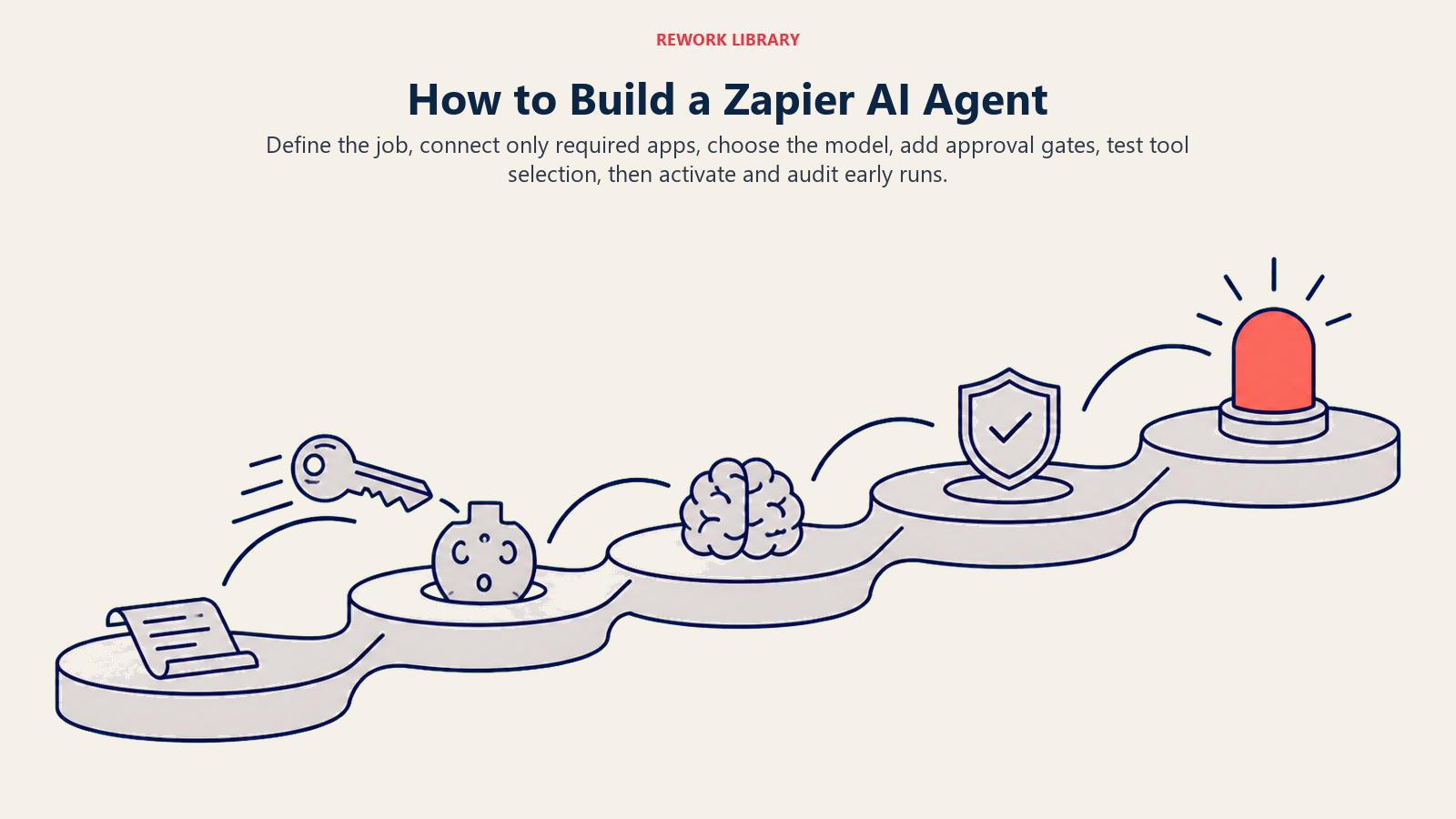
- Define the job in plain instructions. State what the agent owns and what it should never do without approval, the same clarity how to build an AI agent asks for regardless of platform. Vague instructions produce an agent that guesses; specific ones produce an agent you can trust with real accounts.
- Connect the apps it needs. Add each tool the agent should have access to, your CRM, inbox, calendar, Slack, whatever the job touches. Zapier's managed authentication means you're approving access, not wiring API credentials by hand.
- Choose a model. Pick the underlying LLM. This is a separate decision from which apps the agent can touch, the same layering build an AI agent with n8n makes explicit: the orchestration platform and the model underneath are two different choices.
- Turn on AI Guardrails and set human approval checkpoints. Decide which actions the agent can take on its own and which need a person to confirm first, especially anything that sends an external message, changes a record, or spends money.
- Test the agent in chat before connecting a live trigger. Run it conversationally and watch which tools it reaches for. This catches obvious tool-selection mistakes before they touch real data.
- Add a trigger and monitor the first runs closely. A form submission, a new CRM record, a scheduled check, whatever starts the job. Watch the activity dashboard for the first batch of real runs before trusting it unsupervised.
The build sequence narrows access first, then adds a model, approval gates, tool-selection tests, activation, and early-run auditing.
A Worked Example: An AI Lead Routing Agent in Zapier
Here's how this comes together for a job several Rework blueprints handle with fixed rules, built instead as an agent that can use judgment across apps.
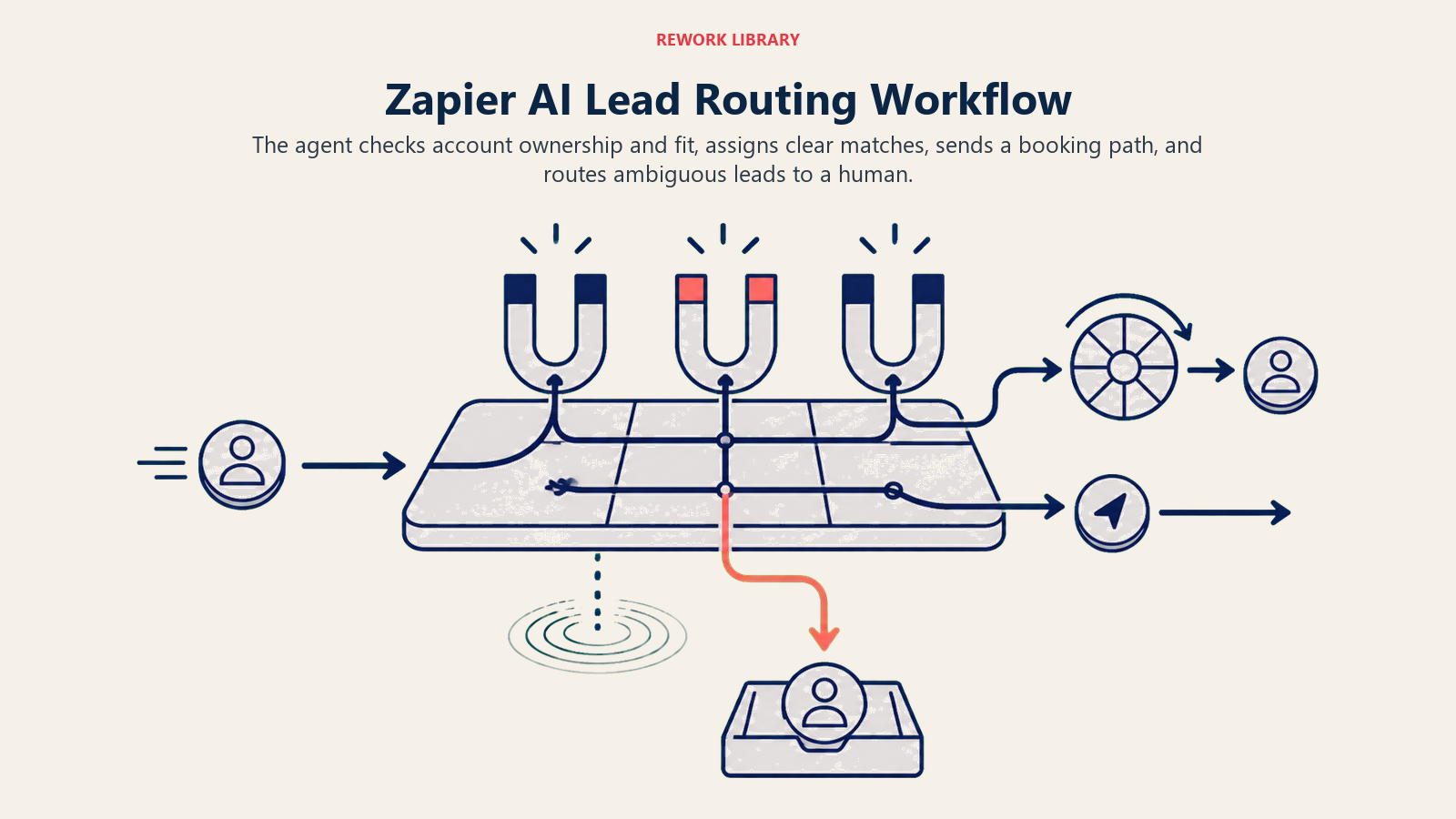
Trigger: a new form submission lands from your website's demo request form.
Tools: a CRM lookup checks whether the lead's company already exists as an account; a CRM create/update action logs the new lead with the right owner if it doesn't; a calendar tool sends the matched rep's booking link; a Slack tool posts a summary to the sales channel.
Instructions: classify the lead by company size and stated need first. If it matches an existing account, route to that account's owner and skip re-qualification. If it's a new account that clearly fits the ideal customer profile, assign it to the next rep in rotation and send the booking link directly. If anything is ambiguous, missing a company name, an unclear use case, post to Slack for a human to route manually instead of guessing.
That last branch is the same handoff discipline covered in multi-agent systems: an agent doesn't need to resolve every case itself, it needs to resolve what it can and hand off cleanly. The AI Lead Routing Agent blueprint has the full spec for this function, rules and edge cases included, if you'd rather start from a template than write the instructions from scratch.
Guardrails, Governance, and Human-in-the-Loop
An agent that can read your inbox and write to your CRM is a real attack surface, not just a productivity tool. Zapier's AI Guardrails scan for the specific risks covered in prompt injection and AI agent security: a malicious instruction hidden in an inbound email or form field that tries to redirect the agent's next action. The activity dashboard gives you an audit trail of what the agent actually did, which matters as much for debugging a bad run as for compliance.
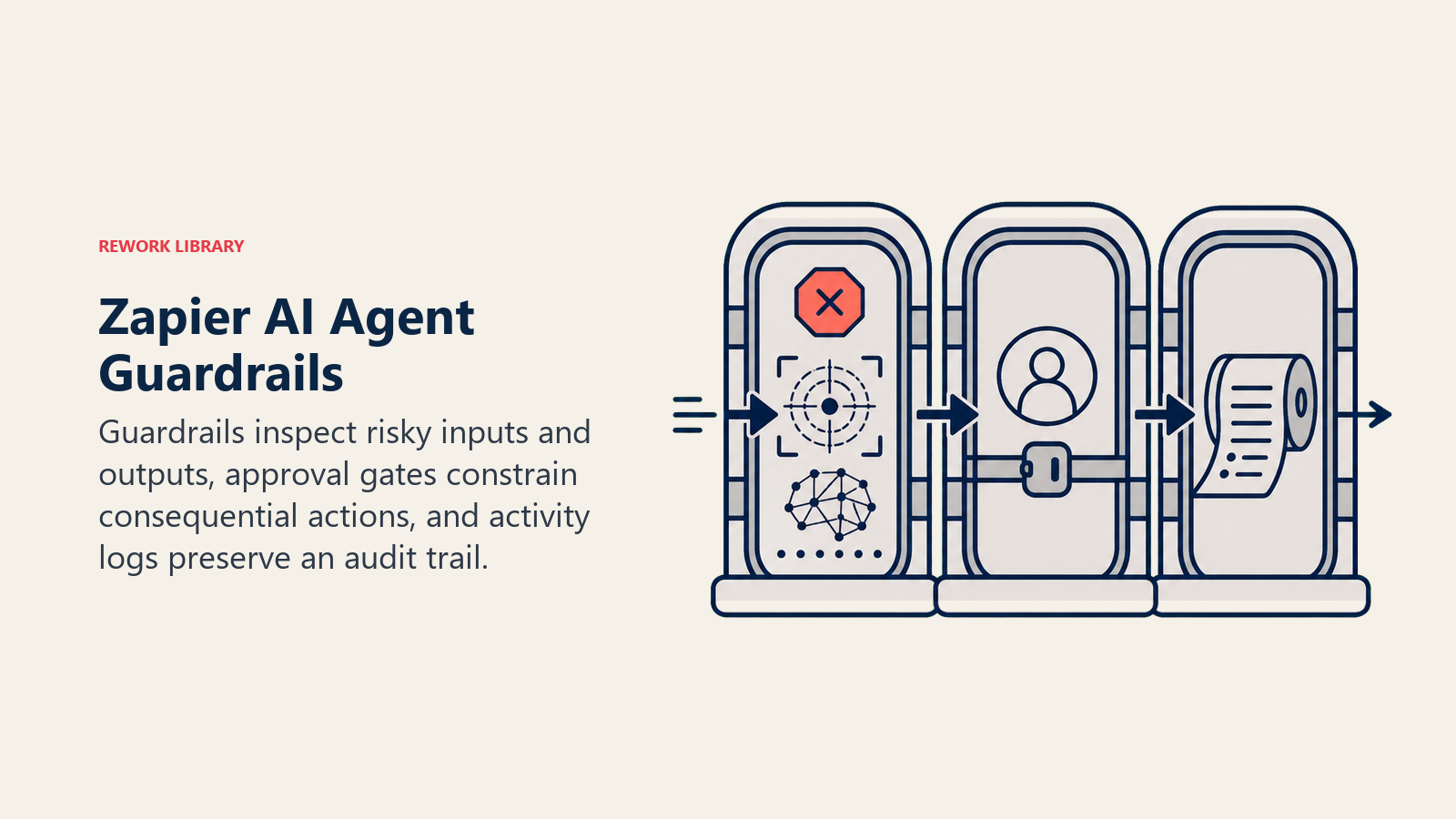
Human approval checkpoints are the practical version of human-in-the-loop for AI agents: you decide per action, not per agent, which steps need a person to confirm first. Sending an external email and updating an internal field are different risk levels, and Zapier lets you gate them differently rather than treating the whole agent as either fully autonomous or fully manual.
Cost and Limits
Zapier's AI agent features run on Zapier's standard plan structure: a free tier for testing, paid plans starting under $20 a month billed annually, scaling up through Team and Enterprise tiers billed on usage (activities and tasks the agent and its connected Zaps run), separate from whatever the underlying model provider charges for tokens. Budget for both meters, the platform tier and the model usage, rather than assuming one number covers everything, the same total-cost thinking covered in AI total cost of ownership.
The real limit isn't pricing, it's the same one every no-code platform shares: you're bounded by what the platform exposes. Zapier's catalog covers most common business apps well, but a proprietary internal system with no existing connector means custom API work either way, inside Zapier's webhook tools or outside the platform entirely. And because the agent's judgment lives inside Zapier's configuration rather than code you own, migrating that logic later takes more rebuilding than migrating a well-documented codebase would.
When to Pick Zapier vs Alternatives
| If you want... | Consider |
|---|---|
| The widest pre-built app catalog with built-in governance | Zapier |
| Self-hosting and full control over infrastructure | n8n |
| A deep visual flow builder with strong app coverage | Make |
| The fastest possible first agent with zero assembly | Lindy |
| Full code control and no ceiling on custom logic | LangGraph or CrewAI |
| Deep Microsoft 365 grounding and enterprise governance | Microsoft Copilot Studio |
These aren't always mutually exclusive choices. The real question, covered in full in choosing an AI agent platform, is who owns the agent day to day and how custom the logic genuinely needs to be. A business team that lives inside a few dozen common SaaS apps and wants to move fast without engineering in the loop is exactly Zapier's target user.
Key Facts
- Zapier Central builds AI agents from plain-language instructions, connected apps as tools, a chosen model, and built-in AI Guardrails.
- Zapier says it's trusted by 3 million-plus businesses and connects to 9,000-plus apps with managed authentication.
- Gartner tracks no-code agent builders as their own emerging market category, while cautioning that tech leaders need clear definitions and scope for citizen-developer use.
- AI Guardrails scan for prompt injection, PII exposure, toxic language, and negative sentiment before an agent's output ships; the platform is SOC 2 Type II compliant.
- Zapier's agent features bill separately from model usage: platform pricing covers activities and tasks, the LLM provider bills tokens directly.
Where to Go Next
Zapier is one no-code path to a working agent, not the only one. Build an AI agent with Make and build an AI agent with n8n cover the closest alternatives if you want to compare app coverage and self-hosting options before committing. If you're still deciding between a no-code platform, a code framework, or a managed enterprise tool, choosing an AI agent platform walks through that decision directly. The automation tools roundup and the best no-code automation tools guide are good places to compare Zapier against the rest of the category.
