The AI Agent Maturity Model: Crawl, Walk, Run Stages of Adoption
Turn this article into takeaways for your work.


Each assistant summarizes the article only for you and suggests best practices for your work.
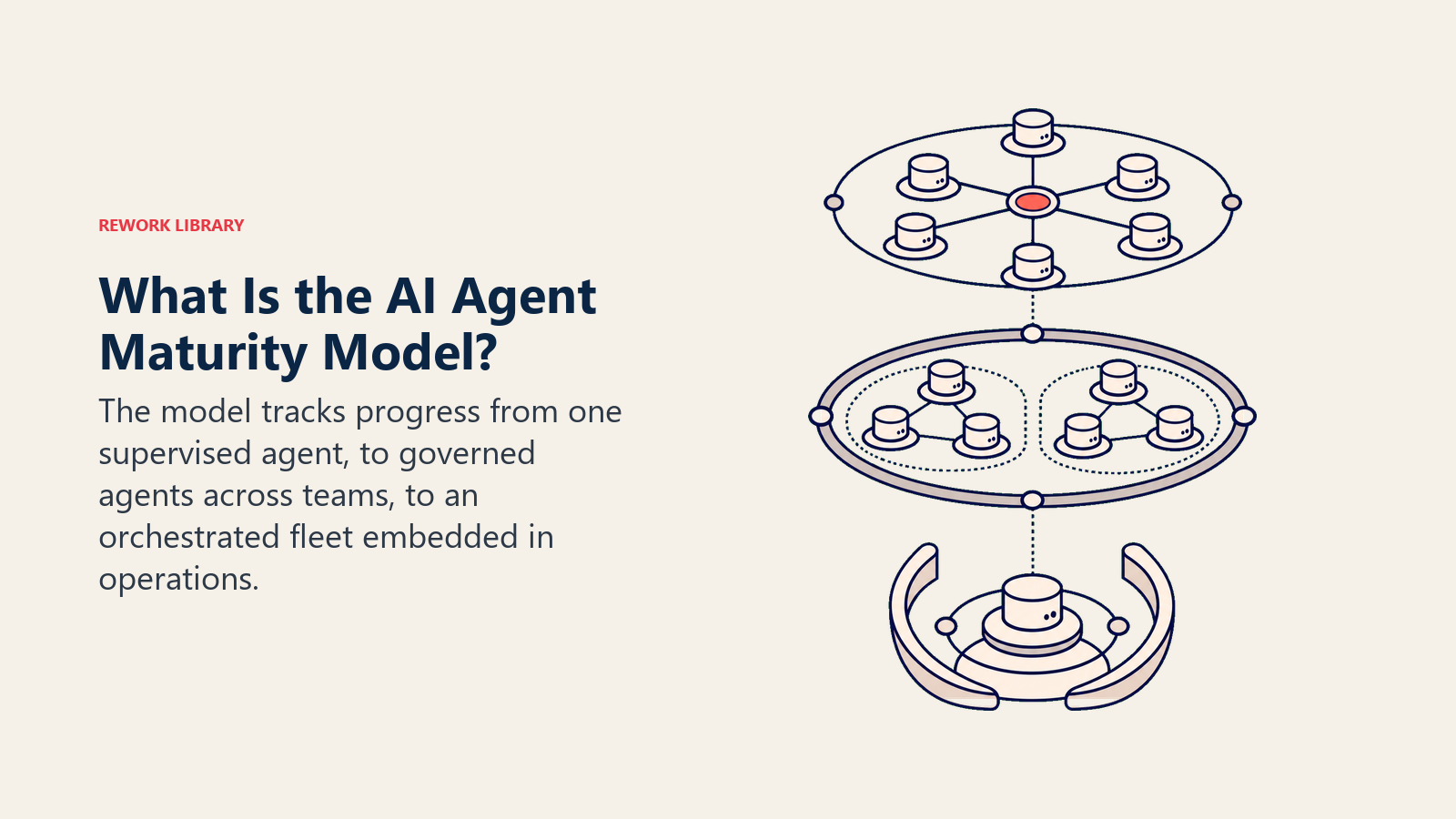
The AI agent maturity model sorts an organization's agent adoption into three stages: crawl, a single supervised agent proving the concept; walk, several governed agents running across more than one team; and run, agents operating as a coordinated fleet embedded in how the business actually works. Most companies describe themselves as "using AI agents" without saying which of the three they mean, and that vagueness is exactly what lets agent projects get funded, then quietly stall. This model gives you the real signals for each stage, so you can name where you actually are instead of where the slide deck says you are.
Why Maturity Beats Adoption as the Right Question
Adoption asks whether you use agents at all. Maturity asks how far that use actually goes, and the gap between those two questions is enormous. McKinsey's State of AI 2025 survey found that 88% of organizations deploy AI in at least one business function, and 62% sit somewhere on the agentic AI path specifically: 23% scaling an agent somewhere in the business, 39% experimenting. But inside any single business function, McKinsey found no more than roughly 10% of organizations have agents running at genuinely scaled status. Most of that headline adoption number is still crawl or early walk, not run, whatever the org chart's AI slide implies. Agentic AI in 2026 covers that full adoption picture across the market. This page is about what actually separates the stages once you're past "we use an agent somewhere."
Crawl, Stage 1: One Agent, Heavily Supervised
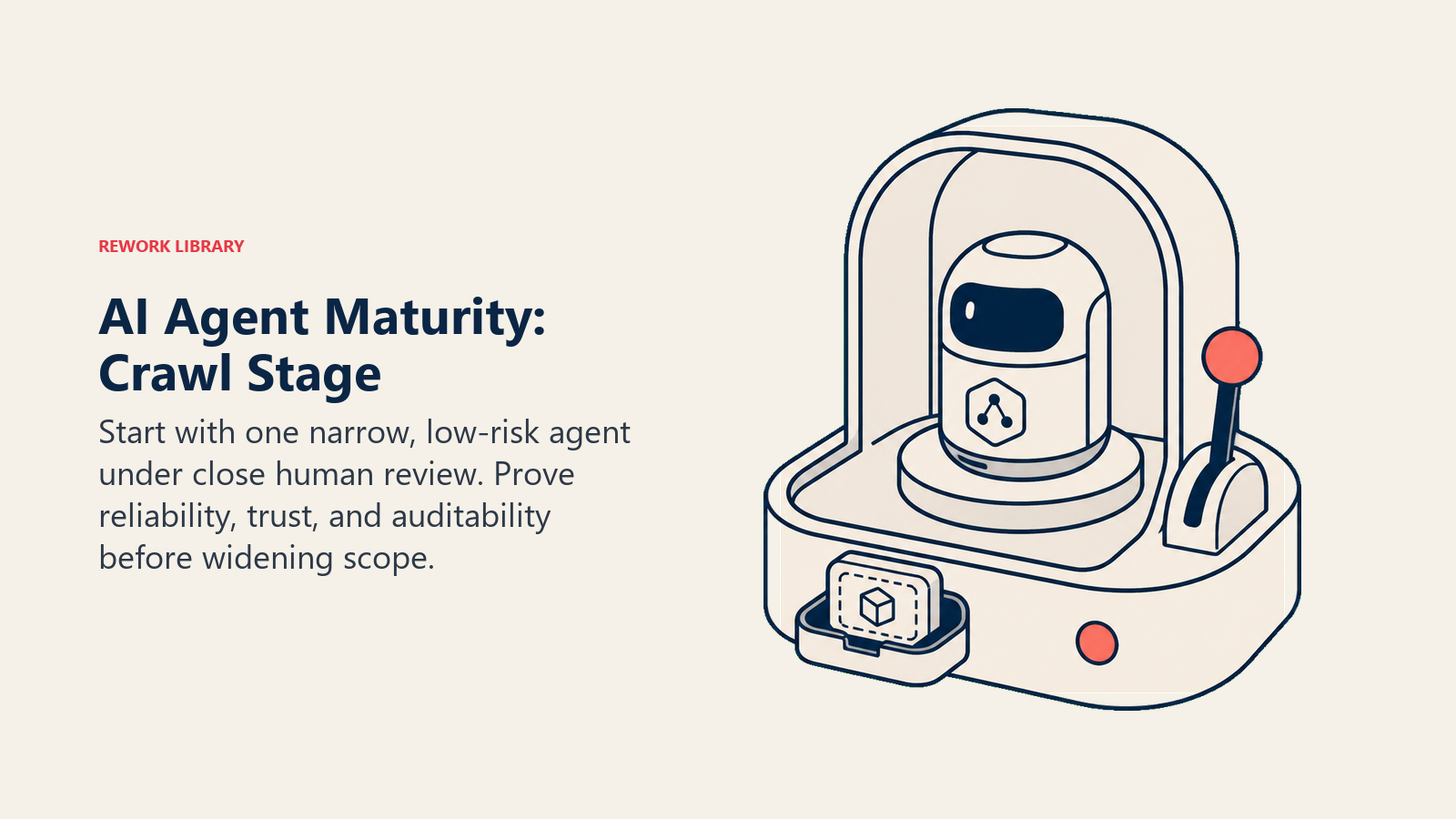
Crawl looks like a single narrow agent, owned by one team, usually built on a no-code platform because the job is templated rather than novel. Something shaped like the AI Reply Agent or AI Meeting Scheduler Agent is a typical first build: bounded scope, clear rules, low stakes if it gets something wrong. Human review sits close to every action, and success at this stage isn't "did it save money," it's "did it work, and did we build enough trust and audit trail to widen its scope later." When to use an AI agent's readiness checklist and deploying AI agents to production's shadow-mode ramp both live inside crawl, applied to exactly one agent. Maturity is the slower clock running underneath: how many times you've been through that ramp, and what you kept from each pass.
Deloitte's 2026 State of AI in the Enterprise survey shows most of the market sitting right here. 30% of organizations are still exploring agentic AI and 38% are piloting it, while 35% report having no formal agentic AI strategy at all. If that's you, you're not behind. You're where most of the market actually is, whatever the vendor pitch implies.
Walk, Stage 2: Governed, Repeatable, Cross-Functional
Walk looks different in kind, not just in count. It's not "five crawl-stage pilots running at once." It's a handful of agents, usually somewhere between three and eight, running across two or more departments, with a named governance owner and guardrail patterns that get reused instead of reinvented for each new build. Types of AI agents starts to matter here in practice, not just in theory, because a walk-stage team is deliberately choosing autonomy level and architecture per job instead of defaulting to whatever the first agent happened to use. Cost discipline shows up too: AI agent cost optimization's caching, routing, and budget levers stop being optional once you're running enough agents that an unoptimized one actually shows up in the bill.
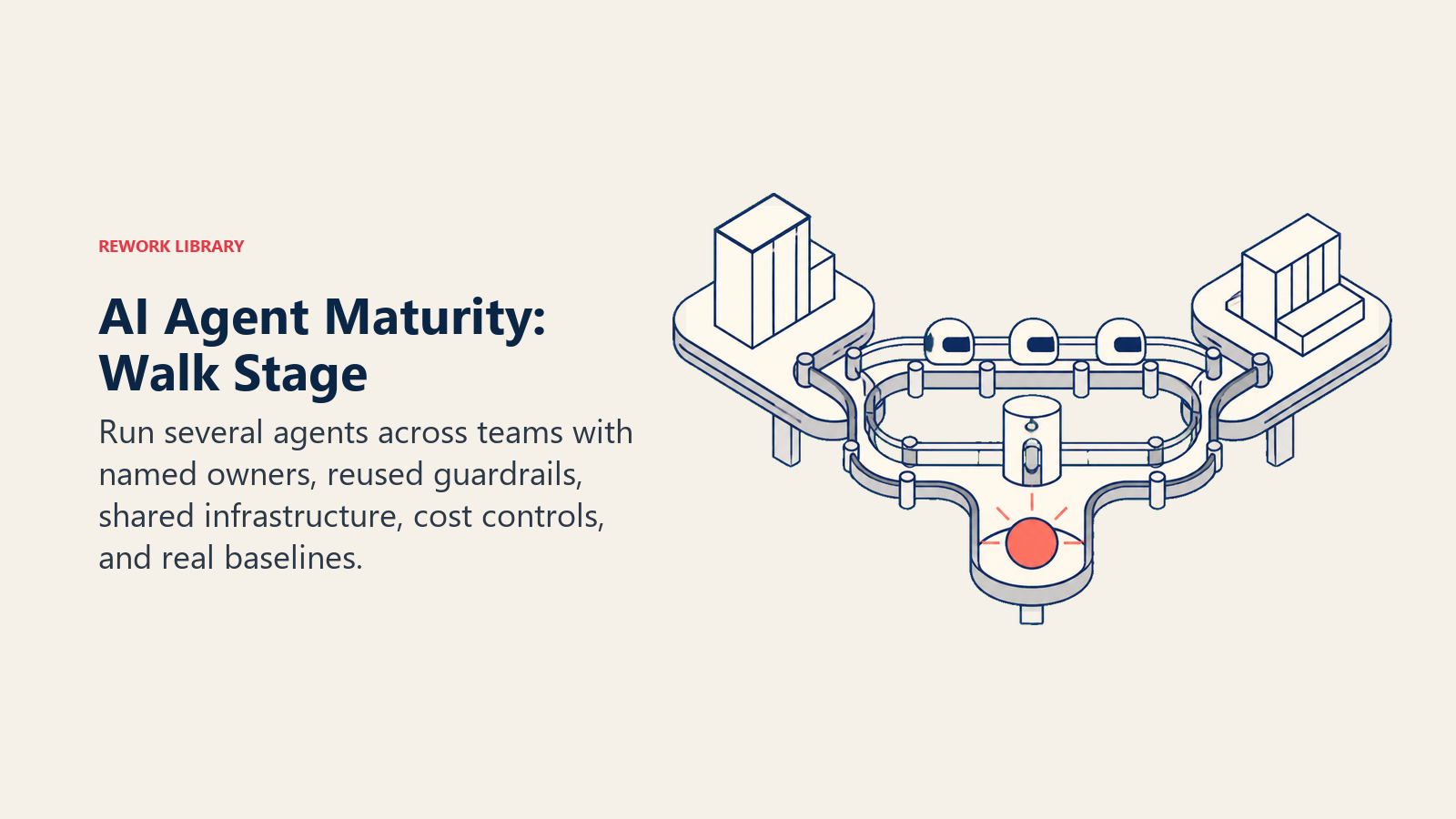
The clearest signal of walk, though, is measurement. A crawl-stage team can get away with "it seems to be helping." A walk-stage team has baselines, tracks primary metrics from week 4 onward, and can show real numbers, the discipline covered in AI agent ROI. Deloitte's data puts about 14% of organizations at the "solution ready to deploy" point that maps closest to early walk, meaningfully fewer than the 68% still exploring or piloting at crawl.
Run, Stage 3: Fleet, Orchestrated, Embedded
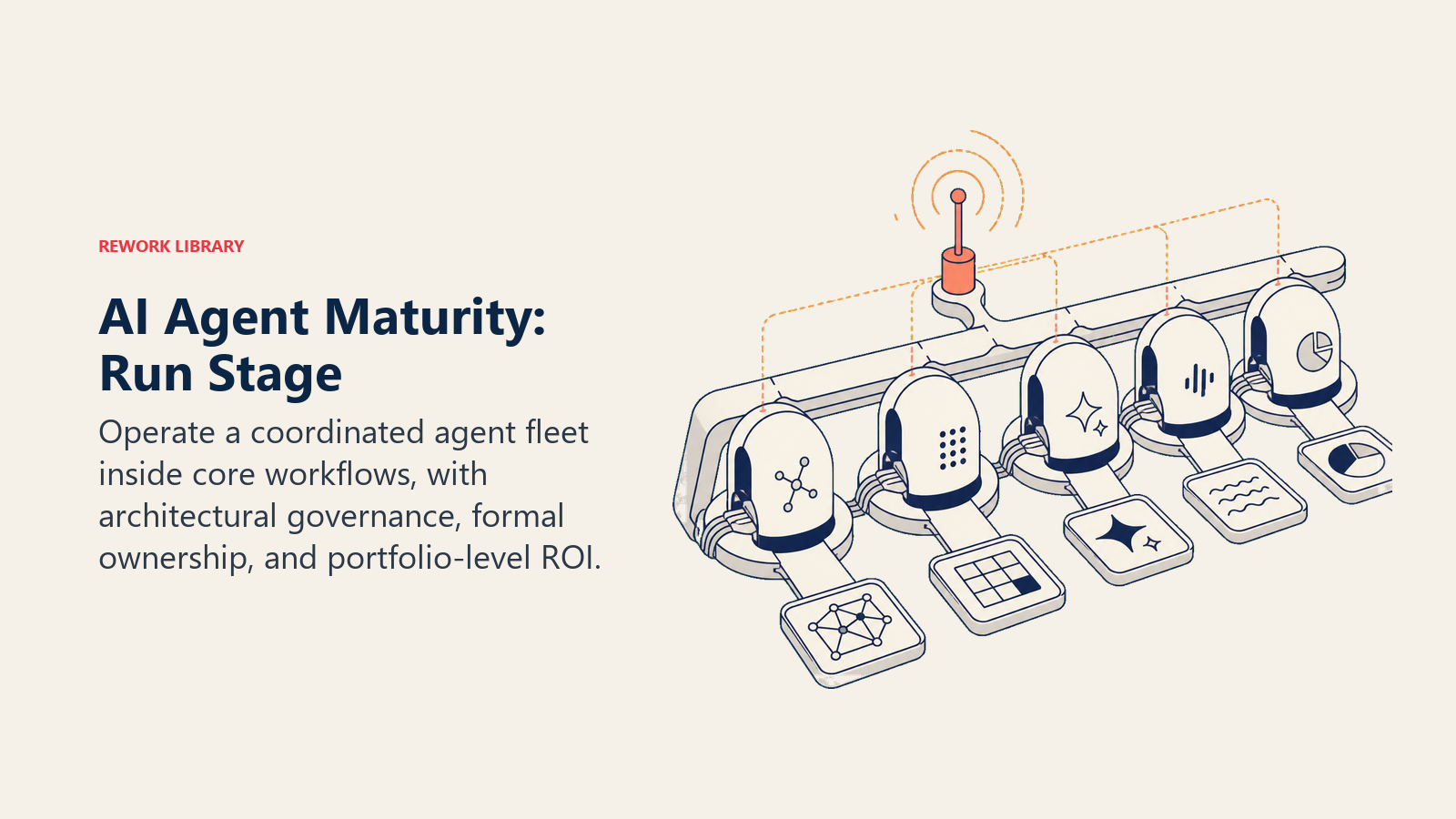
Run is where agents stop being a collection of individual projects and start being a capacity layer the organization plans around. Multi-agent systems become common here, not because orchestration sounds advanced, but because enough distinct, well-governed agents now exist that chaining them, the way a lead scoring agent hands off to a lead routing agent, which hands off to a follow-up agent, actually beats building one broader agent from scratch. Ownership usually formalizes into a structure like an AI Center of Excellence, and governance stops being a checklist bolted onto each new agent and becomes architectural: built into how any new agent gets specced from day one. Run is also where the agentic workforce becomes a real description of how the organization works, not an aspirational phrase in a strategy memo.
Gartner's June 2025 forecast gives a sense of where the ceiling sits: 15% of day-to-day work decisions will be made autonomously through agentic AI by 2028, up from 0% in 2024, and 33% of enterprise software applications will include agentic AI by 2028, up from less than 1% in 2024. Run-stage organizations are the ones actually pushing toward that ceiling today. They're still rare. Deloitte found just 11% of organizations are running agentic AI in production right now, though 74% expect to be using agents at least moderately by 2027, 23% extensively, and 5% expect agents to be a fully embedded, core part of operations. The trajectory is fast. The current population at run is small.
Self-Assessment: Which Stage Are You Actually In
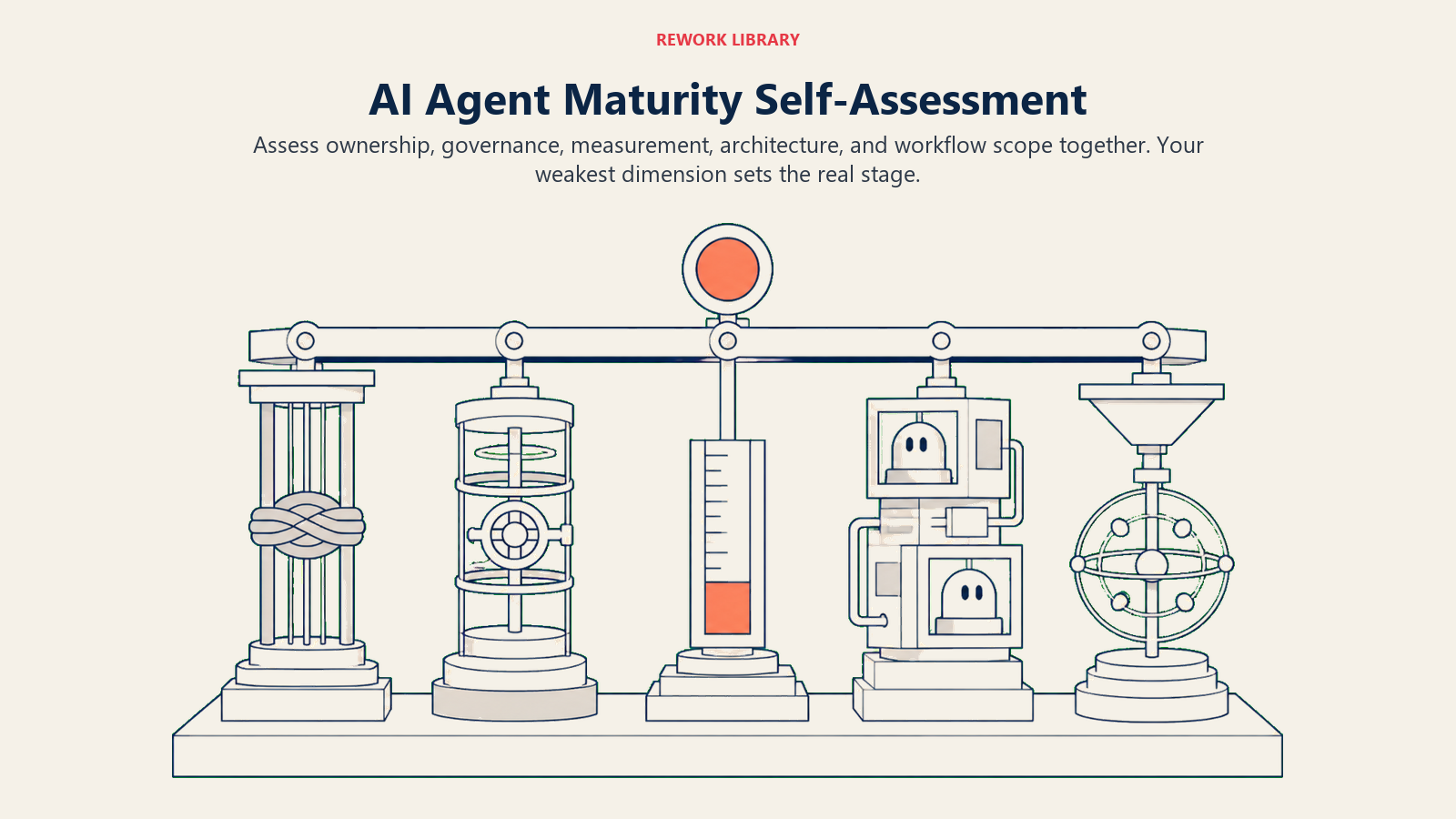
Use the five dimensions below as a practical check. The weakest dimension usually sets your real maturity stage, even if another dimension looks advanced.
| Dimension | Crawl | Walk | Run |
|---|---|---|---|
| Ownership | One team, often informal | Named owner per agent, a shared standard | Central structure (a CoE or equivalent) plus embedded owners |
| Governance | Ad hoc, a human approves almost everything | Reused guardrail and approval patterns across agents | Governance is architectural, built into how any new agent gets specced |
| Measurement | "Did it work" is the only question asked | Real baselines, primary metric tracked from week 4 | ROI tracked as a portfolio, not just per agent |
| Architecture | Single agent, single toolset | Several single agents, some shared infrastructure | Multi-agent orchestration where the job actually calls for it |
| Scope | One narrow, repeatable task | Several tasks across 2 or more departments | Agents embedded in core workflows, not bolted onto the side |
Score yourself honestly on all five, not just the one that flatters you. A team with a run-caliber architecture but crawl-caliber governance isn't at run. It's at crawl with more moving parts, and more exposure.
The Mistake That Skips a Stage
The most common failure isn't staying at crawl too long, though that happens too. It's jumping straight from crawl to run: standing up a multi-agent system or handing an agent broad autonomy before the walk-stage basics, a named governance owner, reused guardrails, a real cost model, exist anywhere in the organization. Multi-agent systems is explicit that added agents add coordination surface, and coordination surface is where governance gaps hide. Gartner's prediction that over 40% of agentic AI projects will be canceled by the end of 2027 names escalating costs, unclear business value, and inadequate risk controls as the leading causes, and all three show up disproportionately in projects that skipped a stage rather than earned their way through it.
The quieter failure runs the other direction: staying at crawl indefinitely. A single supervised pilot that never gets a second agent, never gets a named owner, and never gets measured past "did it work" isn't actually de-risking anything. It's deferring the real decision. If your agent has been in pilot for two quarters and nobody can tell you its cost per completed task, you haven't been careful. You've stalled, and AI agent ROI covers exactly this measurement gap and how to close it before a stalled pilot quietly gets defunded for lack of a business case nobody built.
Key Facts
- McKinsey's State of AI 2025 survey found 88% of organizations deploy AI somewhere and 62% are on the agentic AI path (23% scaling, 39% experimenting), but no single business function shows more than roughly 10% of organizations at genuinely scaled status.
- Deloitte's 2026 State of AI in the Enterprise survey found 30% of organizations exploring agentic AI, 38% piloting, 14% with a deployable solution, and only 11% actually in production, with 35% reporting no formal agentic strategy at all.
- By 2027, Deloitte found 74% of organizations expect to use agents at least moderately, 23% extensively, and 5% expect agents fully embedded as a core part of operations.
- Gartner projects 15% of day-to-day work decisions will be made autonomously through agentic AI by 2028 (up from 0% in 2024), and 33% of enterprise software applications will include agentic AI by 2028 (up from less than 1% in 2024).
- Gartner separately projects over 40% of agentic AI projects will be canceled by 2027 due to cost, unclear value, and weak risk controls, risks concentrated in projects that skip the walk stage entirely.
Where to Go Next
Crawl, walk, and run are useful labels only if you act on which one you're actually in. If you're still at crawl, when to use an AI agent and how to build an AI agent are the right next reads. If you're pushing into walk or run, AI agent ROI covers the measurement discipline that stage needs, and the agentic workforce covers what run looks like once agents are less a project and more a workforce layer you plan around. For tooling that fits a first, crawl-stage agent, the automation tools roundup and best no-code automation tools guide are good starting points.
