Types of AI Agents: A Practical Taxonomy for Business
Turn this article into takeaways for your work.


Each assistant summarizes the article only for you and suggests best practices for your work.
"AI agent" gets used for everything from a chatbot to a system that runs your accounts payable overnight. That vagueness makes it hard to decide what to build first. So this page sorts agents into a taxonomy you can actually use to scope a project.
There isn't one right way to classify agents. There are four useful ones, and each answers a different question a buyer asks. How much rope do I give it? How many moving parts does it have? How wide is its job? And which team owns it? Cut the space those four ways and a fuzzy category turns into a shortlist. For each type below we name a real blueprint you can open and copy.
If you want the ground floor first, what business AI actually is sets the vocabulary the rest of this taxonomy leans on.
By Autonomy: How Much It Decides on Its Own
The first and most important cut. Autonomy is how far an agent gets to go before a human has to touch it. Low autonomy is safe and predictable. High autonomy is powerful and riskier. Most real deployments live in the middle and earn more rope over time.
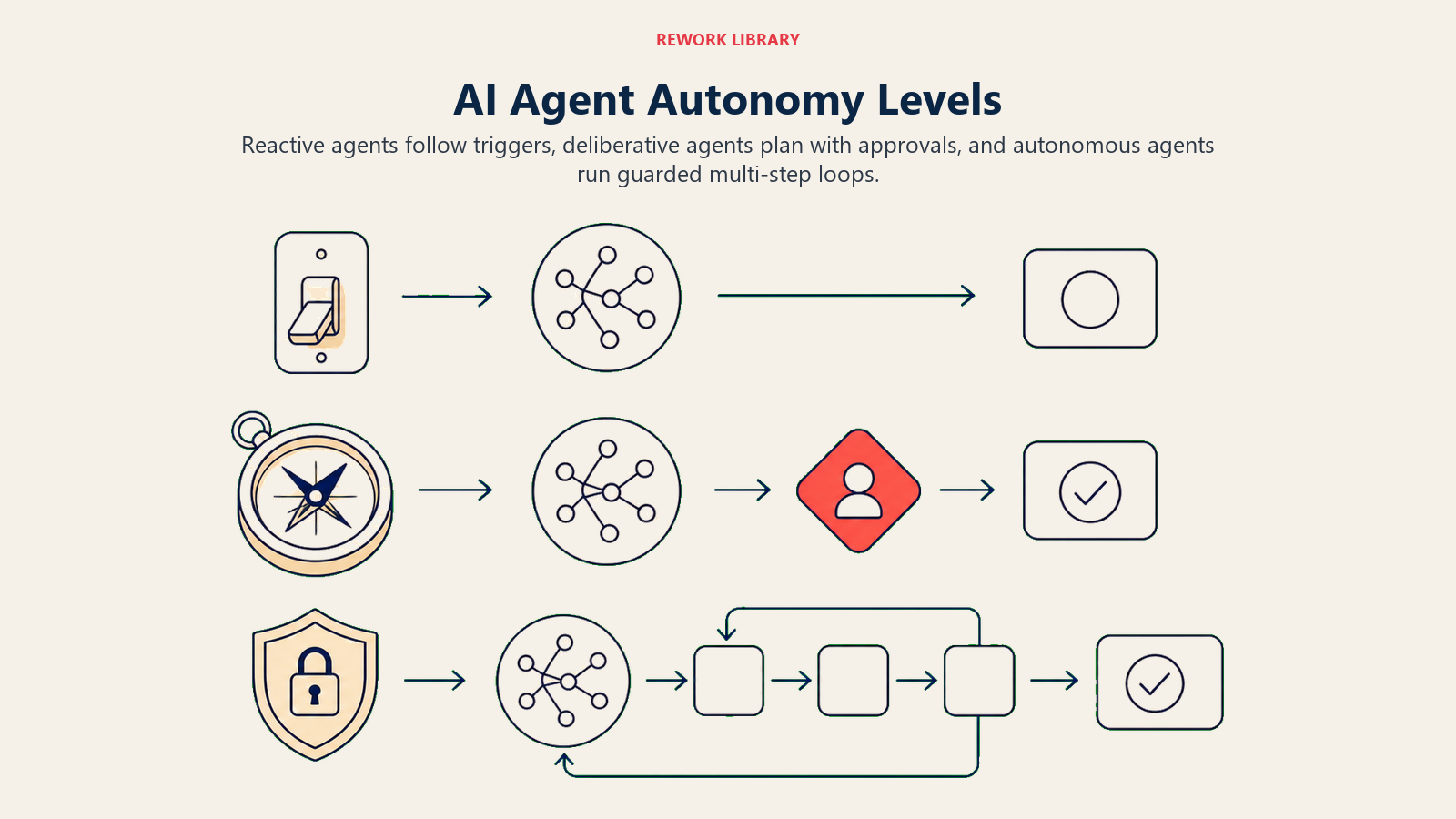
Three bands cover almost everything:
| Autonomy level | How it behaves | Human role | Good first fit |
|---|---|---|---|
| Reactive / rule-based | Responds to a trigger with a fixed response. No planning. | Sets the rules; reviews edge cases | FAQ deflection, ticket tagging, alerts |
| Deliberative / planning | Reasons over a goal, picks steps, uses tools in sequence | Approves plans or key actions | Research briefs, draft-and-send with approval |
| Autonomous | Runs a multi-step loop, adapts, retries, closes the task | Sets guardrails; audits outcomes | Overnight invoice processing, self-healing workflows |
A reactive agent is the tagging layer on a shared inbox: message comes in, it labels and routes, done. A deliberative agent researches an account, drafts a sequence, and waits for a rep to hit send. An autonomous agent takes an inbound invoice, matches it to a purchase order, posts it, and only surfaces the exceptions. The AI Invoice AP Agent blueprint is a clean example of that last band, with the guardrails that make it safe to leave running.
The practical rule: start one band lower than you think you need. An agent that asks for approval on its first hundred actions builds the trust and the audit trail you'll want before you let it run alone. For the deep end of this spectrum, the autonomous agent pattern covers where full autonomy pays off and where it burns you.
By Architecture: Single Agent vs Many Working Together
The second cut is about structure. Is this one agent doing one job, or a team of agents coordinated by a manager? The answer changes how you build, debug, and budget.
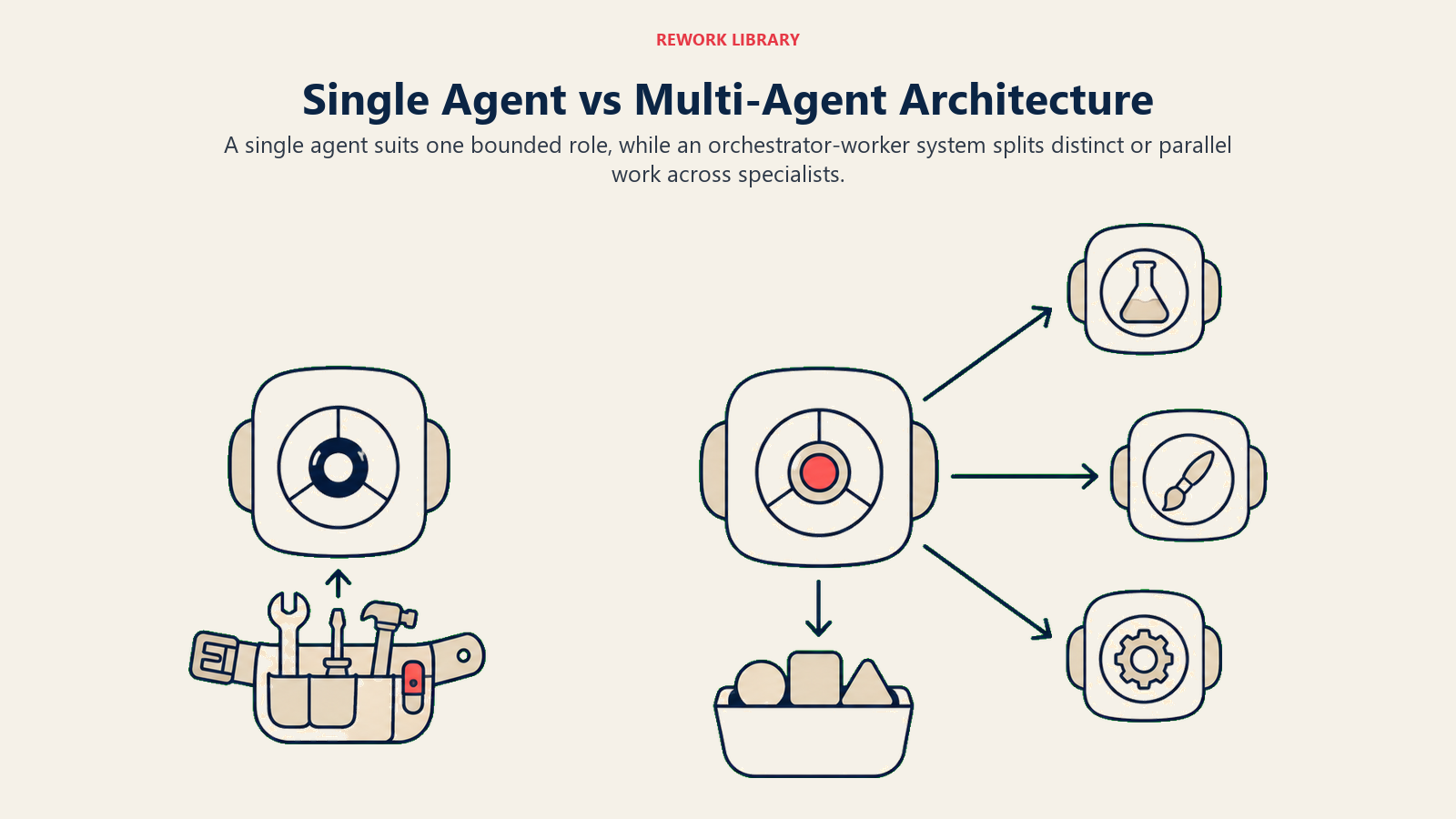
A single agent has one role, one set of tools, and one prompt. It's easier to reason about, cheaper to run, and the right default for a bounded job. Most of the blueprints in this library are single agents. If a person could describe the job in a sentence, a single agent can usually do it.
A multi-agent system splits a bigger job across specialists. The common shape is orchestrator-worker: a lead agent breaks the goal into parts, hands each to a worker agent, and stitches the results back together. Think of a research task where one agent gathers sources, another fact-checks, and a third writes the summary. It buys you specialization and parallelism. It also multiplies the failure points, the token cost, and the debugging surface.
| Architecture | When it fits | Watch out for |
|---|---|---|
| Single agent | Bounded job, clear tools, one owner | Trying to cram five jobs into one prompt |
| Multi-agent (orchestrator-worker) | Broad goal with distinct sub-skills, or work that parallelizes | Cost, latency, and cascading errors between agents |
Don't reach for multi-agent because it sounds advanced. Reach for it when a single agent's prompt is getting long and contradictory, or when parts of the work genuinely run in parallel. Until then, one good single agent beats a fragile committee of them.
By Scope: Narrow Task Agents vs Broad Autonomous Agents
The third cut is width of job, and it's easy to confuse with autonomy. They're different. A narrow agent can still be highly autonomous inside its lane; a broad agent can still ask for approval. Scope is about how many kinds of task the agent owns.
A narrow task or workflow agent owns one repeatable job with clear inputs and outputs. It knows its lane and stays in it. The AI CRM Hygiene Agent is a good picture of this: deduplicate records, fill gaps, flag stale deals. It doesn't try to run your sales process. It keeps the data clean, every day, and that focus is exactly what makes it reliable.
A broad agent spans many task types toward a larger outcome, deciding along the way which sub-task to do next. That's closer to the "digital coworker" pitch. It's also where scope creep hides: the wider the mandate, the harder it is to write rules for every case and the more often it should hand off.
For a business team, narrow wins first. Narrow agents are easier to measure, easier to trust, and faster to show ROI. String several narrow agents together and you get most of the value of a broad one, with far less risk. Choose the width to match the problem, not the ambition, and lean on choosing the right AI pattern to size it honestly.
By Business Function: Mapping Agents to the Org Chart
The last cut is the one buyers actually shop by. Nobody asks for a "deliberative single-agent." They ask, "what can AI do for my support team?" So here's the taxonomy mapped to who owns the agent, using the blueprint groups in this library.
| Function | What the agent does | Blueprint example |
|---|---|---|
| Sales & Lead | Researches accounts, sends sequences, books meetings, hands warm replies to reps | AI SDR Agent |
| Support & Success | Reads tickets, deflects FAQs, routes by intent, escalates on sentiment | AI Support Triage Agent |
| Marketing & Content | Drafts posts, emails, and outlines from a brief, then hands off for approval | Content Drafting Agent |
| Operations & Data | Keeps the CRM clean, processes documents, runs reports, flags anomalies | AI CRM Hygiene Agent |
| Finance, HR & IT | Processes invoices, chases overdue payments, screens candidates, resolves IT tickets | AI Invoice AP Agent |
Two things are worth noticing here. First, every function has both inbound and outbound work. On the sales side, the AI SDR Agent pushes outbound while the AI Reply Agent handles the inbound side of the same inbox. Pairing them beats stretching one agent across both.
Second, the function view is the one to start your buying conversation with, then translate down. Pick the team with the most repetitive, rule-heavy work, choose the narrow agent that owns one painful job, and set its autonomy one band lower than feels comfortable. That's a scoped project, not a science experiment.
How the Four Cuts Work Together
These aren't competing systems. They're four dimensions of the same agent, and a real spec names all four. The AI Invoice AP Agent is autonomous (by autonomy), single-agent (by architecture), narrow (by scope), and finance (by function). Write those four down and you've described the thing precisely enough to build it or buy it.
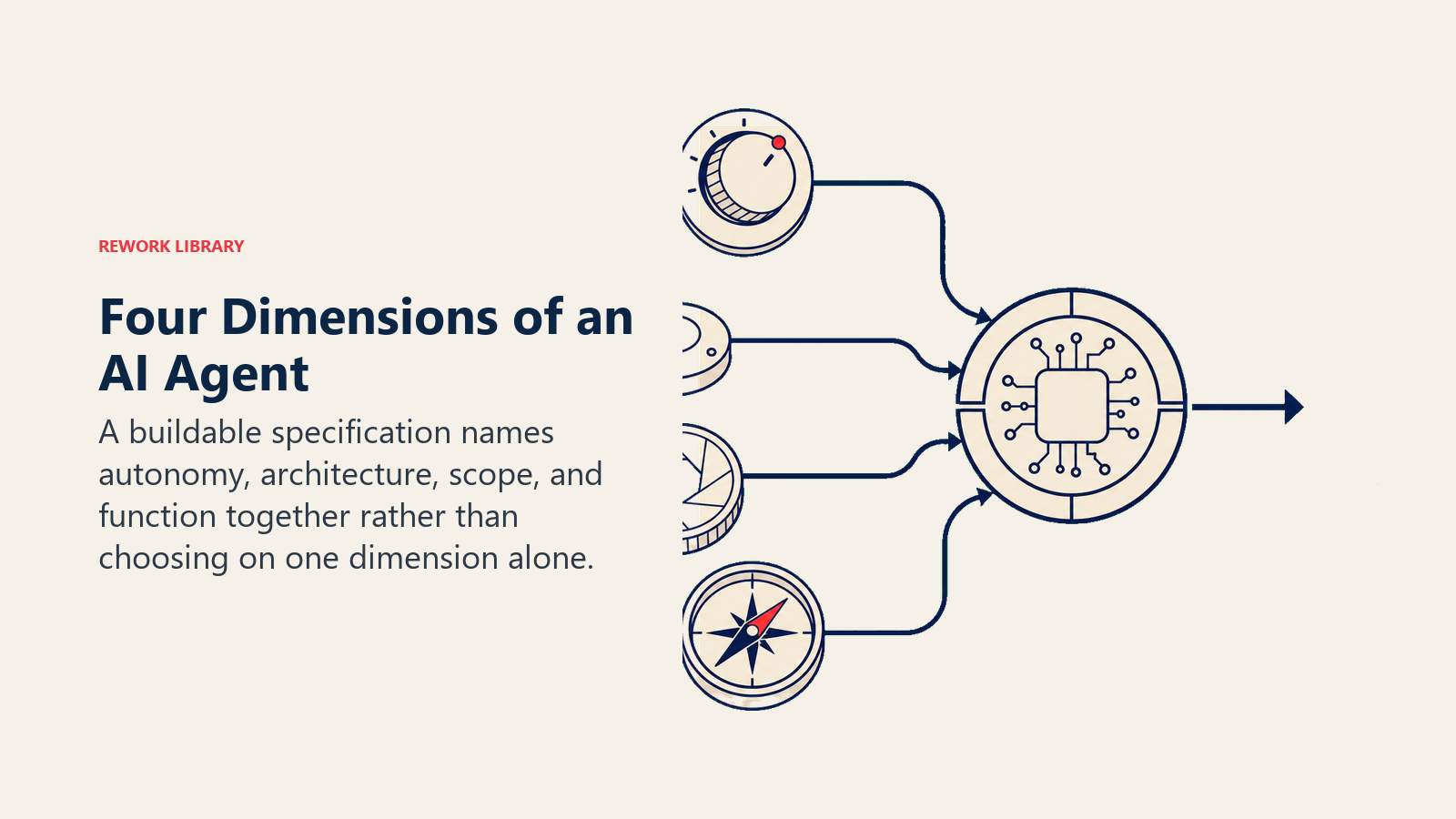
- Autonomy sets your risk and approval model.
- Architecture sets your build cost and debugging surface.
- Scope sets how easy it is to measure and trust.
- Function sets who owns it and where the ROI shows up.
The most common mistake is picking on function alone, then discovering too late that the job needed more autonomy than the team was ready to grant, or a multi-agent build the budget didn't cover. Name all four up front and the surprises shrink.
What the Numbers Say About Where This Is Going
The direction of travel matters for how much autonomy you plan for, and the honest read is that the value shows up first in the busy, rule-heavy functions in the table above.
Gartner puts real hours behind that. A Gartner survey of 210 chief sales officers in early 2026 found AI saves sellers nearly five hours a week, yet 72% of sales organizations fail to reinvest that time into high-value work. The lesson for agent buyers: the time savings are real, but a narrow agent only pays off if you redirect the freed hours toward the conversations an agent cannot have.
McKinsey puts numbers on the upside. Its research on AI-powered marketing and sales reports that mature implementations can increase leads by more than 50% and cut prospecting costs by up to 60%. Those gains land in the same sales and marketing functions the taxonomy maps to, which is why the function cut is where most teams see payback first. The taxonomy isn't academic. It tracks where the value is showing up.
Frequently Asked Questions about Types of AI Agents
What are the main types of AI agents?
The clearest way to sort them is by four dimensions at once: autonomy level (reactive, deliberative, or autonomous), architecture (single-agent or multi-agent), scope (narrow task agents or broad agents), and business function (sales, support, marketing, operations, finance, HR, IT). Any real agent has a value on all four.
What is the difference between a reactive and an autonomous agent?
A reactive agent responds to a trigger with a fixed response and does no planning, like a rule that tags and routes an incoming ticket. An autonomous agent runs a multi-step loop toward a goal, adapts, retries, and closes the task, surfacing only the exceptions. Autonomous agents are more powerful and need stronger guardrails and audit trails.
What is a multi-agent system?
It's a job split across several specialized agents coordinated by a lead agent, most often in an orchestrator-worker shape where the lead breaks the goal into parts and workers handle each. It buys specialization and parallelism at the cost of higher spend, more latency, and more failure points. Use it only when a single agent's job has genuinely distinct sub-skills.
Which type of AI agent should a business start with?
Start with a narrow, single-agent, function-specific agent set one autonomy band lower than feels necessary. Pick the team with the most repetitive rule-heavy work, give the agent one painful job, and require human approval on its early actions to build trust and an audit trail before you widen its scope.
How is agent scope different from autonomy?
Scope is how many kinds of task the agent owns; autonomy is how far it can go without a human. A narrow agent can be highly autonomous inside its one lane, and a broad agent can still pause for approval on everything. They're separate dials, and a good spec sets both.
